VIRGIN – HEBREW & ISAIAH 7:14
Hebrew: העלמה (characters: He, Mem, Lamed, Ayin, He), transliterated: almah, Strong Hebrew # 5959
Isaiah 7:14:
Therefore the Lord Himself will give you a sign: Behold, the virgin shall conceive and bear a Son, and shall call His name Immanuel (God with us).
http://home.talkcity.com/gaiawa/el_sharra/christ.html (4-6-02), A Pagan Interpritation of the Symbolism in the mythology of Jesus Christ:
Also the word ?Virgin’ must be properly defined. The word Almah (used to describe Mary) means virgin, a word that has undergone a great transformation in our present language. In the ancient world, ?virgin; described a woman who was not owned by any male- that is she was not the property of a male relative nor did she rely on any male for mental, physical or monetary well-being. This is how the temple virgin-priestesses could engage in the sexual fertility rights, bear children and still be considered a true virgin.
http://www.amazon.com/gp/richpub/syltguides/fullview/1V8V767TG1NT8, So you'd like to... Find how Translators Restored Virgin Mary. A guide by Didaskalex "Eusebius Alexandrinus" (Kellia on Calvary, Carolina, USA):
There are two Hebrew words usually translated 'virgin' in English. 'Bethulah' means virgin in the sense that we understand it. It was used, for example, in Isaiah 62:5. 'Almah' (the word used in Isaiah 7:14) simply means a young woman. Although it is sometimes used in the sense of a sexually pure woman, this is not it's exclusive usage. The context will usually point out the correct usage.
http://www.geocities.com/Athens/Olympus/5599/excomm/excomm-1.html, Letter from Patrick Mooney to Pastor Monsignor XXXXXXX or Current Pastor, Holy Redeemer Catholic Church, 2411 Montrose Ave., Montrose, CA 91020:
65. Roman Catholic doctrine claims that Mary, the mother of your "savior," Jesus Christ, was a virgin, as required by Hebrew prophecy (cf. Matthew 1:28). However, the prophecy that Matthew is referring to, Isaiah 7:14, uses the Hebrew word almah, which simply means a young woman. It has nothing to do with sexual experience; the Hebrew word for virgin is bethulah.
Expository Dictionary of Bible Words, Richards, Zondervan, 1991, p. 613:
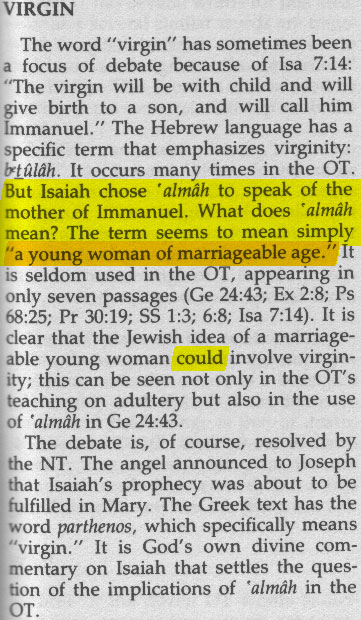
You mean girls younger than “marriageable age” are not virgins? Well, it sounds like the definition had to have changed somewhat to mean today’s overwhelming definition of never had sex (and for both females and males, young or old).
If I showed a picture to the writers of the Bible of a woman in her 70s, who had never had sex, and told them she was a virgin, they’d probably disagree.
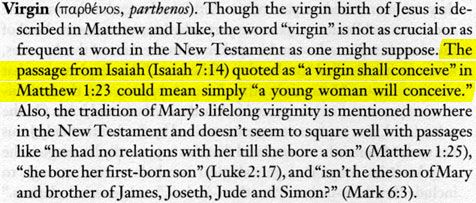
The Unvarnished New Testament: A New Translation from the Original Greek, Andy Gaus, 1991, “Glossary” p. 507, “Virgin”:
http://www.tmbible.com/BWCcitations.htm, Bible Word Comparisons:
Isaiah 7:14
AV - Behold, a virgin shall conceive and bear a Son…
D-R - Behold a virgin shall conceive, and bear a son…
KJ21 - Behold, a virgin shall conceive and bear a Son…
TMB - Behold, a virgin shall conceive and bear a Son…
CEV - A virgin is pregnant; she will have a son…
GW - A virgin will become pregnant and give birth to a son…
NAB - …the virgin shall be with child, and bear a son…
NASBU - Behold, a virgin will be with child and bear a son…
NIV - The virgin will be with child and will give birth to a son…
NJB - …the young woman is with child and will give birth to a son…
NKJ - Behold, the virgin shall conceive and bear a Son…
NLT - Look! The virgin will conceive a child!
NRSV - Look, the young woman is with child and shall bear a son…
REB - A young woman is with child, and she will give birth to a son…
TEV - …a young woman who is pregnant will have a son…
Comment
Here is a monumental difference between the traditional bibles and some contemporary bibles. A reading of this verse in context discloses the writer's intention to describe a notable and astonishing miracle, namely, the birth of a child to a virgin. But some modern versions substitute the words young woman for virgin, thereby tending to deprive the birth of our Lord of its miraculous and blessed nature.
http://www.jcsm.org/StudyCenter/kjvstrongs/STRHEB59.htm, The NKJ Bible: Strong’s Hebrew Dictionary:
|
5956 |
`alam |
a primitive root; to veil from sight, i.e. conceal (literally or figuratively):--X any ways, blind, dissembler, hide (self), secret (thing). |
|
5958 |
`elem |
from '`alam' (5956); properly, something kept out of sight (compare '`almah' (5959)), i.e. a lad:--young man, stripling. |
|
5959 |
`almah |
feminine of '`elem' (5958); a lass (as veiled or private):--damsel, maid, virgin. |
http://www.jasher.com/Virgin.htm, The Fiction of the Virgin Birth, “Two Important Words”:
Further, the Hebrew word often rendered virgin here is almah which simply means ayoung woman. It does not necessarily mean virgin in the sense of having not known
any man (See BDB lexicon p 761). It is used definitively in Proverbs 30:19, where
almah is rendered as maid. The entire thought is expressed in verses 19 and 20. There are four things which are too wonderful for me. Yes four which I do not understand. The way of the eagle in the air, the way of thw serpent on a rock, the way of the ship in the midst of the sea, and the way of a man with a maid(almah). This is the way of an adulterous woman. She eats and wipes her mouth
and says I have done no wickedness.The point of this proverb is clearly the lack of evidence that adulterous sex has takenplace. The adulterous woman conceals her sin and there is no sign of it. The same istrue of any man who has intercourse with a maid, any ship in the sea, any serpent whopasses over a rock, or any eagle who flies through the air. Thus those things leave notrace are are too serrupticious to understand that anything has happened. Clearlythough, the almah in this verse cannot be a literal virgin.
Continuing, the Hebrew word harah, rendered in this verse in the KJV is not a verb butis rather an adjective meaning pregnant, not shall conceive. Christian translators havealso messed with the meaning of this word to suit their purposes. They want to placethe fulfillment far into the future of king Ahaz, so it would not do to translate it properly: The Lord himself will give you a sign. It is this: The maiden is with child and will soon give birth to a son whom she will call Immanuel.
This “young maidens” is Strong Hebrew # 5959:
http://ecmarsh.com/lxx/Song%20of%20Songs/index.htm, Septuagint Bible (which is the Early Christian Old Testament) Online, Translation by Sir Lancelot C. L. Brenton 1851, Song of Songs, Chapter 1:
1:1 The Song of songs, which is Solomon’s. 2 Let him kiss me with the kisses of his mouth: for thy breasts are better than wine. 3 And the smell of thine ointments is better than all spices: thy name is ointment poured forth; therefore do the young maidens love thee. 4 They have drawn thee: we will run after thee, for the smell of thine ointments: the king has brought me into closet: let us rejoice and be glad in thee; we will love thy breasts more than wine: righteousness loves thee.
(“Breasts” are “mastoid” plural of mastos: a female breast.) Sounds like a lot of sexytime going on around the virginity definition of Jesus’ mother.