VIRGIN – GREEK: SEPTUAGINT
It’s the Greek Old Testament used by Jesus and early Christianity. Aka: LXX
Greek: παρθεν… (transliterated: parthen…)
http://septuagint-interlinear-greek-bible.com/downbook.htm (newer location: http://septuagint-interlinear-greek-bible.com/platformSIGB.htm), The Apostolic Bible (applies to all the unreferenced Septuagint Interlinear images below):
Genesis 34:1-4:
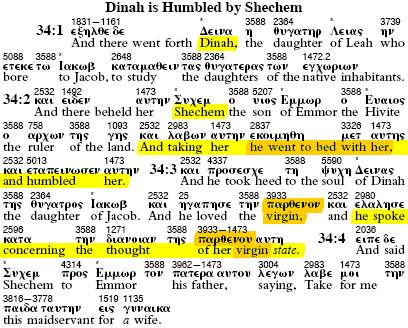
Here’s the NKJV:
1 Now Dinah the daughter of Leah, whom she had borne to Jacob, went out to see the daughters of the land. 2And when Shechem the son of Hamor the Hivite, prince of the country, saw her, he took her and lay with her, and violated her. 3His soul was strongly attracted to Dinah the daughter of Jacob, and he loved the young woman and spoke kindly to the young woman. 4So Shechem spoke to his father Hamor, saying, "Get me this young woman as a wife." Notice the difference?
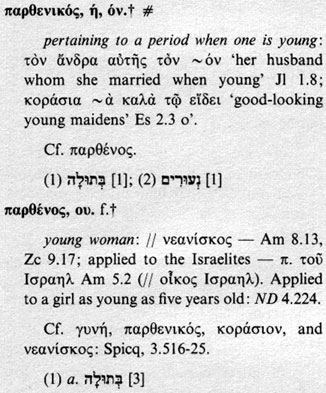
A Greek-English Lexicon of the Septuagint: Chiefly of the Pentateuch and the Twelve Prophets, Muraoka, 2002, p. 439:
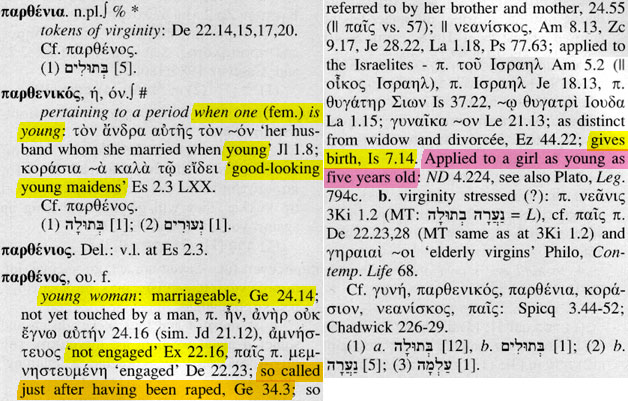
You know, when you’re referring to a five year old girl, it is often necessary to use a word that tells whether she has had sex yet or not; otherwise, how would we know?
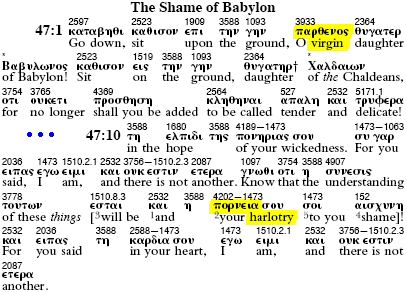
Isaiah 47:1-10:
Here’s an example where a virgin is a harlot (sexually active):
Isaiah 62:5:
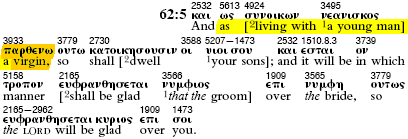
A young man living with a virgin. (An example without transposition may be easier to see:)
The Septuagint with Apocrypha, 1851, Brenton, seventh printing 1998, p. 897, Isaiah 62:5:

Jeremiah 3:1-4:
Here’s an example where sexually active harlotry is virginity:
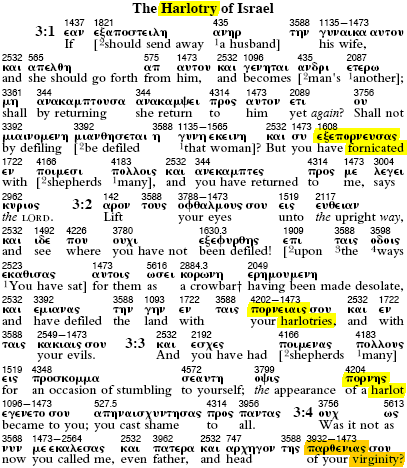
The Septuagint with Apocrypha, 1851, Brenton, seventh printing 1998, p. 925, Jeremiah 18:12-13:

Jeremiah (51:20-23 Hebrew) (28:20-23 Septuagint):
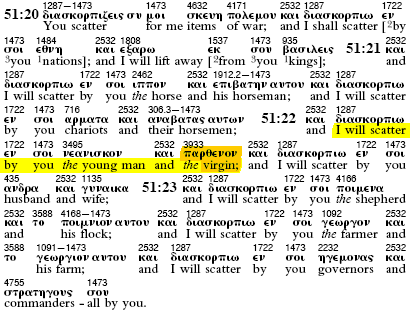
Strong # 1287 for scatter also defines it as “separate.” Therefore, what’s this connection that needs separating between a young man and a virgin if it’s not sex? Everything else listed needing separation (for discipline) has an obvious connection.
The Septuagint with Apocrypha, 1851, Brenton, seventh printing 1998, (The Apocrypha) p. 100, Wisdom of the Son of Sirach (Ecclesiasticus) 30:20:

(A “eunuch” can still perform sexually, and enjoy it; and, cannot reproduce, therefore stays unmarried.)
Here’s an example of other English translations for virgin:
The Holy Bible; 1611 (King James Version); The Wisdome of Iefus the fonne of Sirach, or Ecclesiasticus; Chap. XXX:
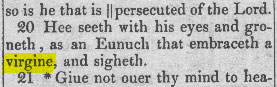
Ignatius: The Holy Bible: Revised Standard Version, Catholic Edition, Sirach 30:20:

The Access Bible: NRSV with the Apocrypha; Oxford, 1999; Ecclesiasticus, or the Wisdom of Jesus Son of Sirach, 30:20:

The New Jerusalem Bible, Ecclesiasticus 30:20:

Where’d the teaching go that embraced girls are virgins?
Here are just some other English Bible examples where the Septuagint uses the word παρθεν… (parthen…):
New King James Version, Genesis 24:14:
Now let it be that the young woman to whom I say, "Please let down your pitcher that I may drink,' and she says, "Drink, and I will also give your camels a drink'--let her be the one You have appointed for Your servant Isaac. And by this I will know that You have shown kindness to my master."
New King James Version, Genesis 24:16 (two places):
Now the young woman was very beautiful to behold, a virgin; no man had known her. And she went down to the well, filled her pitcher, and came up.
Here, the semicolon designates “and” no man had known her elaborating on the kind of virgin / young woman she was.
(KJV):
And the damsel was very fair to look upon, a virgin, neither had any man known her: and she went down to the well, and filled her pitcher, and came up.
They found it necessary to add to the “virgin” definition that “neither had any man known her.” In other words, if virgin meant then what it means today, they would not have needed the additional phrase.
New King James Version, Genesis 24:55:
But her brother and her mother said, "Let the young woman stay with us a few days, at least ten; after that she may go."
New King James Version, Genesis 34:3 (two places):
His soul was strongly attracted to Dinah the daughter of Jacob, and he loved the young woman and spoke kindly to the young woman.
New King James Version, Job 31:1:
"I have made a covenant with my eyes; why then should I look upon a young woman?"
New King James Version, Psalms 78:63 (77:63 Septuagint):
The fire consumed their young men, and their maidens were not given in marriage.
New King James Version, Psalms 148:12:
Both young men and maidens; old men and children.
New King James Version, Jeremiah 3:4:
Will you not from this time cry to Me, "My Father, You are the guide of my youth?"
New King James Version, Jeremiah 51:22:
With you also I will break in pieces man and woman; With you I will break in pieces old and young; With you I will break in pieces the young man and the maiden
New King James Version, Lamentations 5:11:
They ravished the women in Zion, the maidens in the cities of Judah.
New King James Version, Ezekiel 9:6:
Utterly slay old and young men, maidens and little children and women; but do not come near anyone on whom is the mark; and begin at My sanctuary." So they began with the elders who were before the temple.
New King James Version, Zechariah 9:17:
For how great is their goodness. And how great their beauty! Grain shall make the young men thrive. And new wine the young women.
The Septuagint with Apocrypha, 1851, Brenton, seventh printing 1998, (The Apocrypha) p. 3, 1 Esdras 1:53:

The Access Bible: NRSV with the Apocrypha; Oxford, 1999, The Letter of Jeremiah 9 (via Baruch 6:9):
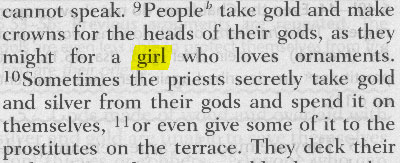
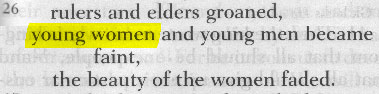
The Access Bible: NRSV with the Apocrypha; Oxford, 1999, 1 Maccabees 1:26:
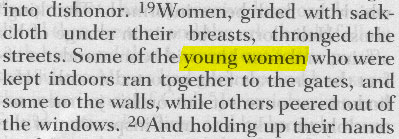
The Access Bible: NRSV with the Apocrypha; Oxford, 1999, 2 Maccabees 3:19:
The New American Bible (Catholic), 2 Maccabees 3:19:
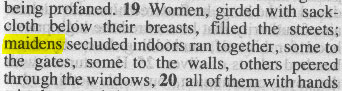
The New English Bible, with the Apocrypha, 2 Maccabees 3:19:

The New Jerusalem Bible, 2 Maccabees 3:19:
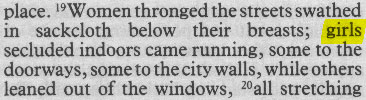
The New English Bible, with the Apocrypha, 2 Maccabees 5:13:

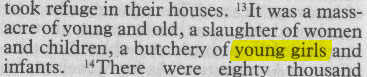
The New Jerusalem Bible, 2 Maccabees 5:13:
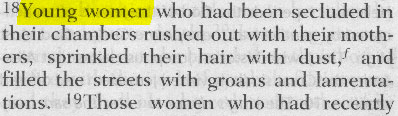
The Access Bible: NRSV with the Apocrypha; Oxford, 1999, 3 Maccabees 1:18:
Miscellaneous:
A Pocket Lexicon to the Greek New Testament, Souter, Oxford, 1916 (reprinted 1917), p. 193:
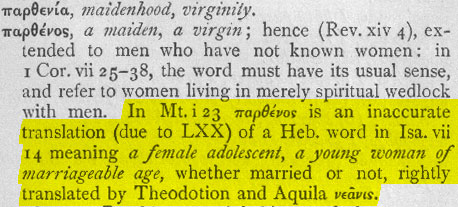
(Both Theodotion and Aquila translated the Scriptures from Hebrew to Greek, and both lived in the 2nd century.)
A Greek-English Lexicon of the Septuagint (Twelve Prophets), Muraoka, 1993 (earlier version of way above), p. 185: