VIRGIN – GREEK
(Used in the original New Testament)
Greek: παρθεν… (transliterated: parthen…)
English-Greek Dictionary: A Vocabulary of the Attic Language, Woodhouse (late scholar of Christ Church), 1932, p. 954:
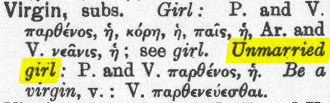
http://www.infoplease.com/ipd/A0327746.html, Dictionary, “Attic”:
the dialect of ancient Attica that became the standard language of Classical Greek literature in the 5th and 4th centuries b.c.
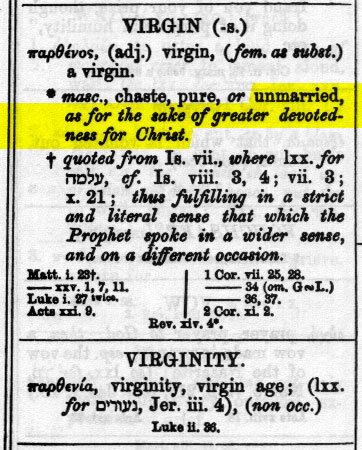
A Critical Lexicon and Concordance to the English and Greek New Testament, Bullinger, 1908 (republished 1999), p. 849, “VIRGIN (-S.) | παρθένος”:
http://muse.jhu.edu/login?uri=/journals/journal_of_the_history_of_sexuality/v013/13.3james.pdf, James, Sharon L., A Virgin Conceived: Mary and Classical Representations of Virginity (review): Journal of the History of Sexuality - Volume 13, Number 3, July 2004, pp. 379-382:
Foskett begins by focusing on the ambiguity inherent in the ancient Greek word partheneia, which is usually translated as "virginity." She rightly notes that a parthenos can mean both a virgin, that is, a female who has had no sexual penetration, and a young girl of marriageable or near-marriageable age. Most narratives that focus on a parthenos, as Foskett notes, relying on classical scholarship, are interested not in her age but in her sexual status, but the word retains an ambiguity that the later Marian narratives exploit.
The New International Dictionary of New Testament Theology, Brown, Zondervan Publishing, 1978, vol. 3, p. 1071, “παρθένος”:
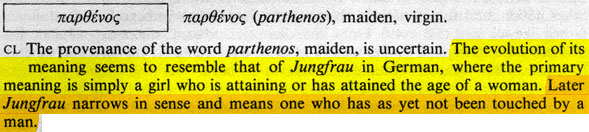
“Jungfrau” is today’s German word for “the Holy Virgin, the Virgin Mary.”
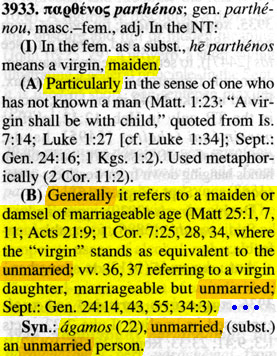
The Complete Word Study Dictionary of the New Testament, Zodhiates, 1993, p. 1119, “3933. παρθένος parthénos”:
Greek-English Lexicon of the New Testament Based on Semantic Domains, Louw & Nida, United Bible Societies, 1989, Vol. 1, p. 108, “Males | 9.33 παρθένος”:
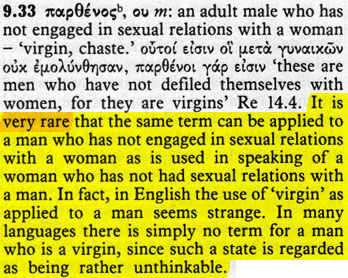
P. 109, “Females | 9.39 παρθένος”:
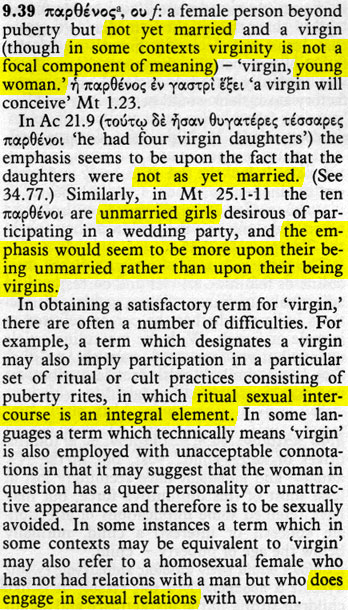
P. 457, “Marriage, Divorce | 34.77 παρθένος”:
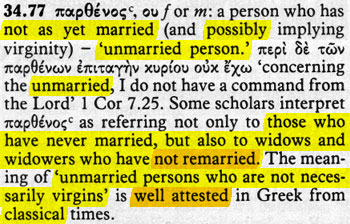
Therefore, being or “remaining” unmarried is the holy thing to do, and regardless if you’ve ever had sex.
http://www.perseus.tufts.edu/cgi-bin/ptext?doc=Perseus%3Atext%3A1999.04.0057%3Aentry%3D%2379596, Henry George Liddell, Robert Scott, A Greek-English Lexicon, “parthenos”:
Since part of the definition has to do with “unmarried women who are not virgins[modern day sense]” then when the Greek word was used, it could not have ever meant “never had sex” because “who are not virgins” is part of the definition. In other words, today, when you say someone in a virgin, it definitely does not apply to anyone who has ever had sex before, in their entire life. But, the Greek word definitely cannot say that.
Let’s check some of this stuff above out:
Il.2.514:
http://www.perseus.tufts.edu/cgi-bin/ptext?doc=Perseus:text:1999.01.0134:book=2:card=511, Homer, Iliad, 2.511-2.515:
And they that dwelt in Aspledon and Orchomenus of the Minyae were led by Ascalaphus and Ialmenus, sons of Ares, whom, in the palace of Actor, son of Azeus, Astyoche, the honoured maiden(“parthenos”), conceived of mighty Ares, when she had entered into her upper chamber; [515] for he lay with her in secret.
http://www.perseus.tufts.edu/cgi-bin/ptext?doc=Perseus%3Atext%3A1999.01.0217&layout=&loc=2.511, Homer, The Iliad (ed. Samuel Butler), Scroll 2, 2.510-2.515:
[510] there were a hundred and twenty young men of the Boeotians. Askalaphos and Ialmenos, sons of Ares, led the people that dwelt in Aspledon and Orkhomenos the realm of Minyas. Astyoche a noble maiden bore them in the house of Aktor son of Azeus; for she had gone with Ares secretly into an upper chamber,
[515] and he had lain with her.
Pi.P.3.34:
http://www.perseus.tufts.edu/cgi-bin/ptext?doc=Perseus:text:1999.01.0162:book=P.:poem=3:line=1, Pindar, Odes, Pythian 3.31-3.35 [?474 BC]:
[31] Knowing even then of her sleeping with Ischys, son of Elatus, and of her lawless deceit, he sent his sister, raging with irresistible force, to Lacereia, since the girl(“parthenos”) lived by the banks of Lake Boebias.
S.Tr.1219:
http://www.perseus.tufts.edu/cgi-bin/ptext?doc=Perseus%3Atext%3A1999.01.0196;layout=;query=card%3D%2362;loc=1221, Sophocles, Trachiniae [Women of Trachis] (ed. Sir Richard Jebb):
Heracles:
Well, that much will be enough--yet add one small favor to your large benefits.
Hyllus:
Even if it is tremendously large, it will be done.
Heracles:
Do you know, then, the maiden(“parthenon”), daughter of Eurytus?
Hyllus:
[1220] You mean Iole, I would guess.
(Next page), http://www.perseus.tufts.edu/cgi-bin/ptext?doc=Perseus:text:1999.01.0196:line=1221:
Heracles:
You know her. Just this is the command that I impose upon you, my son: when I am dead, if you wish to show your piety by remembrance of your oath to your father, make this woman your wife and do not disobey your father. [1225] Let no other but you take her who has lain (“lechos”: a couch, bed) close at my side. You, my son, make that marriage-bond your own. Obey; for although you were obedient in great affairs, your disobedience in small ones cancels the gratitude already won.
http://www.perseus.tufts.edu/cgi-bin/ptext?doc=Perseus:text:1999.01.0222:line=1203, Sophocles, Trachiniae (ed. Robert Torrance):
Heracles:
Then that is all I ask. Now only add
to these great benefits one little favor.
Hyllus:
However great it is, it shall be done.
Heracles:
You know the daughter of king Eurytus?
Hyllus:
(line1220):
Iole? Do I understand your meaning?
(Next page), http://www.perseus.tufts.edu/cgi-bin/ptext?doc=Perseus%3Atext%3A1999.01.0222;layout=;query=card%3D%2363;loc=1203:
Heracles
Yes, child. This is the charge I lay upon you:
(line 1221)
if you revere my memory when I
have died, remembering the oath you swore,
make her your wife, and do not scorn my wish.
No other man but you must ever marry
this woman who has lain with me in love;
no, you, my son, must take her for your own.
Consent! To disrespect me in small matters
destroys the greater favors you have done.
Ar.Nu.530:
http://www.perseus.tufts.edu/cgi-bin/ptext?doc=Perseus:text:1999.01.0241:line=518, Aristophanes, Clouds [Ar.Nu.] (ed. William James Hickie), Choros, (530ish):
For since what time my Modest Man and my Rake were very highly praised here by an audience, with whom it is a pleasure even to hold converse, and I (for I was still a virgin(“parthenos”), and it was not lawful for me as yet to have children) exposed my offspring, and another girl took it up, and owned it, and you generously reared and educated it, from this time I have had sure pledges of your good will toward me.
http://classics.mit.edu/Aristophanes/clouds.html, The Clouds, by Aristophanes, written 419 B.C.E, “Chorus”:
(Again, 530ish):
I have not forgotten the day, when men, whom one is happy to have for an audience, received my Virtuous Young Man and my Paederast with so much favour in this very place. Then as yet virgin, my Muse had not attained the age for maternity; she had to expose her first-born for another to adopt, and it has since grown up under your generous patronage.
http://www.mala.bc.ca/~johnstoi/aristophanes/clouds.htm, Aristophanes, The Clouds, 423 BC:
But still I won’t
ever willingly abandon
the discriminating ones among you all,
not since that time when my play about two men—
one was virtuous, the other one depraved—
was really well received by certain people
here,
710
whom it pleases me to mention now. As for me,
I was still unmarried, not yet fully
qualified
[530]
to produce that child. But I exposed my
offspring,
and another woman carried it away.
In your generosity you raised and trained it.*
Since then I’ve had sworn
testimony from you
that you have faith in me.
Yep, it looks like all virgins are sexually active in their near context.
http://www.perseus.tufts.edu/cgi-bin/ptext?doc=Perseus:text:1999.01.0092:line=677, Euripides, Bacchae (ed. T. A. Buckley):
[690] standing up in the midst of the Bacchae, to wake their bodies from sleep, when she heard the lowing of the horned cattle. And they, casting off refreshing sleep from their eyes, sprang upright, a marvel of orderliness to behold, old, young, and still unmarried virgins(parthenoi).
The Bacchae were known for having sex orgies, but they apparently included “virgins.”
http://www.mala.bc.ca/~johnstoi/euripides/euripides.htm, Euripides: The Bacchae, 404 BC:
MESSENGER: …
Once
she heard my horned cattle lowing,
your mother stood up amid
those Bacchae,
then called them to stir
their limbs from sleep.
They rubbed refreshing
sleep out of their eyes,
[690]
and
stood up straight there—a marvelous sight,
to see such an orderly arrangement,
women young and old and
still unmarried girls(parthenoi).
First,
they let their hair loose down their
shoulders,
860
tied
up the fawn skins (some had untied the knots
to loosen up the chords).
…
PENTHEUS:
You've made some arrangement,
you and your god, so you
can always dance
your Bacchanalian orgies. [807]
http://www.ccel.org/fathers2/NPNF2-01/Npnf2-01-15.htm#P5627_2530414 (Christian Classics Ethereal Library: Early Church Fathers), Eusebius Pamphilus: The Church History of Eusebius (Ecclesiastical History, by Eusebius of Caesarea [260-339 AD]), Book X, “The Subsequent Wickedness of Licinius, and His Death”: Chapter VIII.13, documented 325 AD:
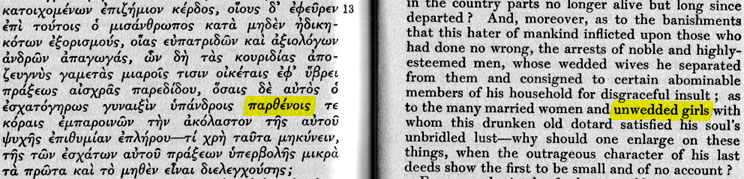
Why is it necessary to speak at length of the banishments which, in addition to these things, this enemy of mankind inflicted upon those who had done no wrong, the expatriations of men of noble birth and high reputation whose young wives he snatched from them and consigned to certain baser fellows of his own, to be shamefully abused by them, and the many married women and virgins upon whom he gratified his passions, although he was in advanced age - why, I say, is it necessary to speak at length of these things, when the excessive wickedness of his last deeds makes the first appear small and of no account?
What about women who were not married, but not a virgin (in today’s sense): sexually active? You mean he wouldn’t gratify his passions with non-married women unless they were virgins (in today’s sense)?
(The Loeb Classical Library): Eusebius: Ecclesiastical History, translated by Oulton, 1932, vol. 2: books VI-X, pp. 472-473, “X. VIII. 12-16 | 13”:
The Greek New Testament, United Bible Society, 1994, (supplement) A Concise Greek-English Dictionary of the New Testament, Newman, 1993, p. 136, “παρθένος”:
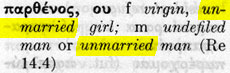
The New Testament in the Original Greek, Westcott / Hort, 1935, (supplement) Greek-English Lexicon to the New Testament, Hickie, 1935, p. 142, “παρθένος”:
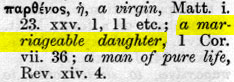
Children born of virgins:
Harper’s Dictionary of Classical Literature and Antiquities, Peck, 1965, p. 1179:

So, in those days they’d say: “My mother is a holy virgin.” Today, they’d have to say, “My mother has never been married; therefore, she’s a slut and I’m a bastard.”
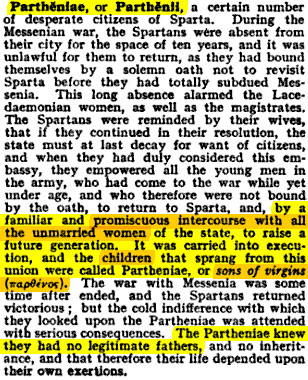
http://books.google.com/books?ct=result&id=88g9AAAAIAAJ&dq=%22Lempri%C3%A8re%27s+Classical+Dictionary+of+Proper+Names%22+%22messenian+war%22&ots=qmBmDG4iJw&pg=PA376&lpg=PA376&sig=ACfU3U16pYlNOPyvT-SFVpxWg4zYZTPVBA&q=448#PPA448,M1, Lemprière's Classical Dictionary of Proper Names Mentioned in Ancient Authors: With a Chronological Table –Google Books Result, Published by Routledge, 1949, p. 448, “Parthěniae, or Parthěnii”:
The Vocabulary of the Greek Testament, Moulton / Milligan, 1930 (reprinted 1949), p. 494, “παρθένος” (parthenos: virgin):
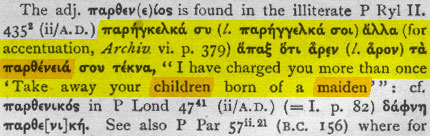
Well, there’s more “children” being “born of a [woman who has never had sex].” The correct translation – which “fits” more with the reality of the “problem” – is “unmarried woman.”
A Lexicon of the Homeric Dialect, Cunliffe, University of Oklahoma, 1963, p. 315, “παρθεν…”:
I like it when “virgins” are having children. It means something.
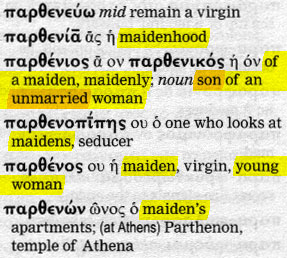
Pocket Oxford Classical Greek Dictionary, 2002, p. 248, “παρθεν…”:
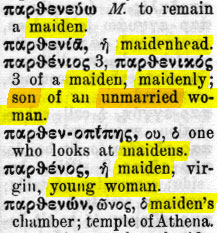
Langenscheidt’s Pocket Greek Dictionary: Classical Greek-English, Feyerabend, no date, p. 294, “παρθεν…”:
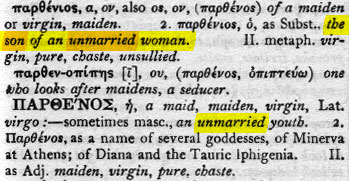
Greek-English Lexicon: Abridged Edition, Liddell & Scott, Oxford, 1871, impression of 1994, p. 533, “παρθένιος”:
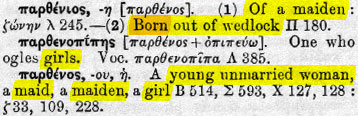
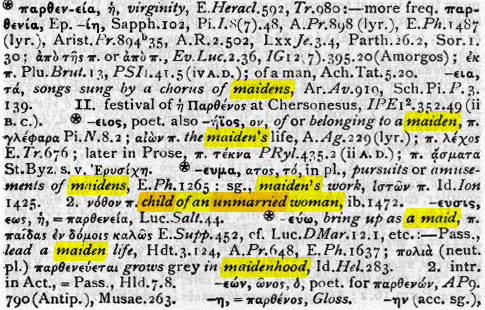
An Intermediate Greek-English Lexicon, Liddell & Scott, Oxford, 1997 (first edition 1889), pp. 608-609, “παρθεν…”:
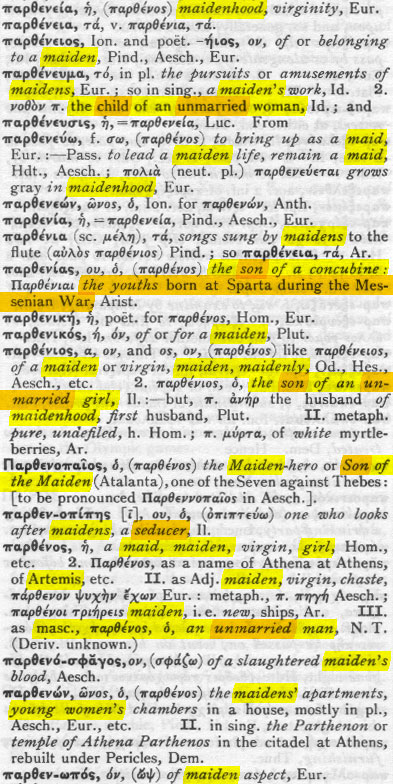
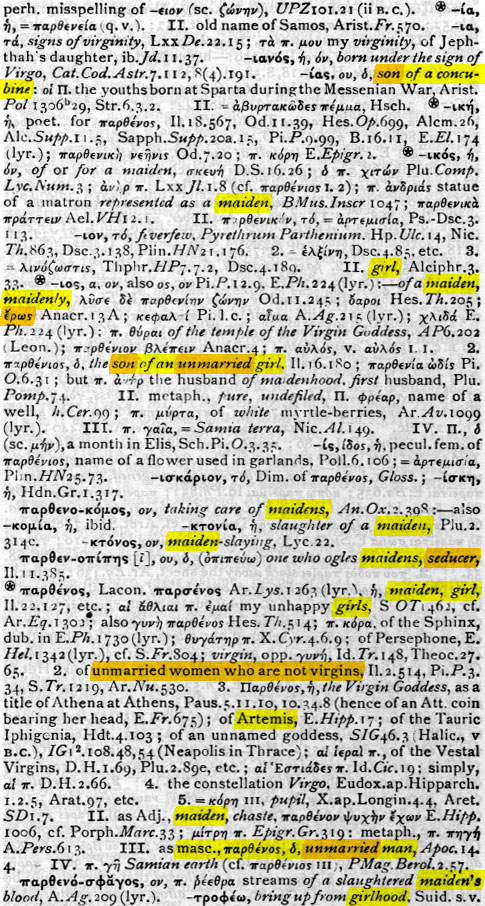
A Greek-English Lexicon with a Revised Supplement (unabridged), Liddell & Scott, Oxford, 1996 (first edition 1843), p. 1339, “παρθεν…”:
The Woman’s Encyclopedia of Myths and Secrets, Barbara G. Walker, 1983, pp. 1048-1049, “Virgin Birth”:
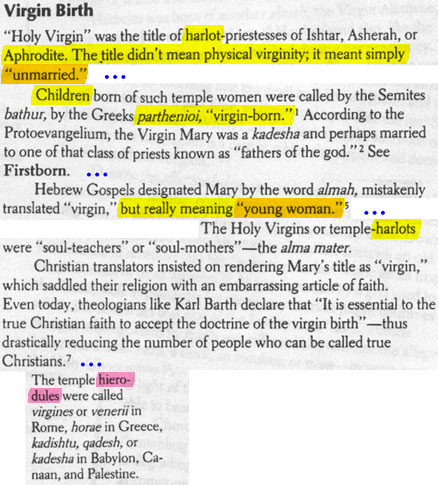
http://www.answers.com/hierodule&r=67 (via Google Search “hierodule”):
In ancient Greece and Anatolia a hierodule, from Greek hiero- "holy" and doule "female slave", was a temple slave in the service of a specific deity, often with the connotation of religious prostitution.
Bibliotheca Classica; or, A Classical Dictionary, containing A full Account of all the Proper Names, Lemprière, 1788, (no page numbers), “Partheniae & Parthenii”:
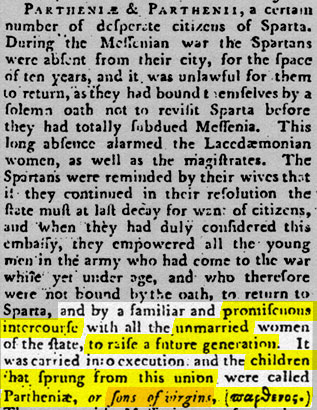
Translated: … and by a familiar and promiscuous intercourse with all the unmarried women of the state, to raise a future generation. It was carried into execution; and the children that sprung from this union were called Partheniae, or sons of virgins, (παρθενος.)
Born of “virgins”:
Plato, Alexander the Great, Romulus, Augustus, Remus, Pythagoras.
Folks:
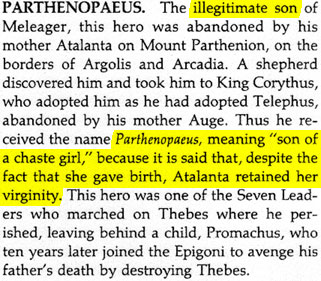
Larousse Greek and Roman Mythology, English translation 1980, p. 208:
The Oxford Classical Dictionary, 1949, p. 650, “Parthenius”:
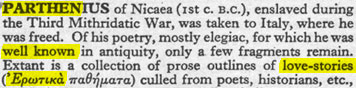
“Ερωτικα” is transliterated “Erotica.”
Character Sketches of Romance, Fiction and the Drama, Brewer, 1896, Vol. 5, p. 163:
