VIRGIN – ENGLISH / GENERAL
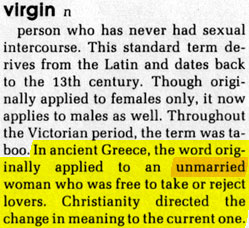
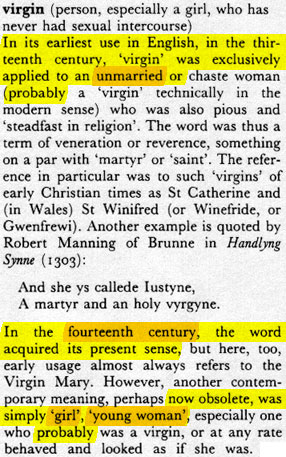
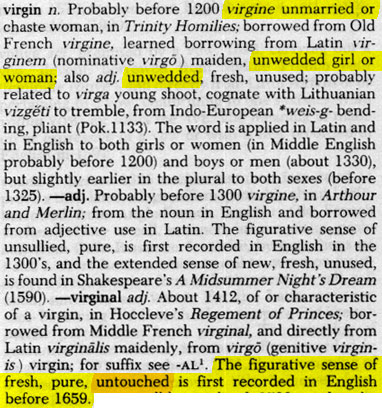
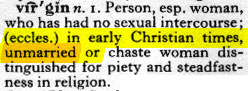
It used to mean “an unmarried girl”
(Which “fits” with Christ ordering us to not marry in Matt. 19:10-12, see here).
(Greek: παρθεν…)
Fact: If one can just be “unmarried” to be a “virgin,” then “virgin” doesn’t necessarily mean they’ve never had sex, which is today’s teaching.
Dictionary of Sexual Slang, Richter, 1993, p. 233, “virgin”:
Dictionary of Changes in Meaning, Adrian Room, 1986, p. 279, “virgin”:
The Barnhart Dictionary of Etymology, 1988, p. 1206, “virgin”:
http://en.wikipedia.org/wiki/Virgin, Virginity, “Etymology”:
With the standard usage of these terms (where the state of purity is thought to come from a lack of sexual intercourse), they have been more commonly applied to women than to men, both historically and in many present-day situations. In fact, the terms traditionally were used to simply describe a female unmarried person: It was introduced to English in the 13th century, and via French virgine derived from Latin virgo (Genitive virginis), which is composed of "vir" meaning "man" or "husband", and "genere", "created (for)", and already had the meaning of a female in (nuptial) subjection to a male.
http://www.fjkluth.com/sacri.html, Human Sacrifice of Virgins as it Relates to Art Subjects:
It should be noted that the choice of a virgin has nothing to do with her sexual innocence or knowledge. It has to do with the fact that she is unmarried and unnattached. Only later do the concepts of innocence and purity matter.
http://trumpeter.athabascau.ca/index.php/trumpet/rt/printerFriendly/240/345, Trumpeter, Vol 13, No 4 (1996), “Warriors: Then and Now”:
"Women", writes Breton historian Jean Markale, "could become head of the family, rule, marry or remain virgin (which merely mean remaining unmarried.)
http://www.mysticwicks.com/showthread.php?t=34661&page=2, Mystic Wicks Online:
The terms maiden and virgin began as very different. 'Virgin' at one time indicated a female who was unmarried and independent of a man.She was beholden to no-one. A good thing to be.
The Century Dictionary and Cyclopedia, 1897, p. 2340:
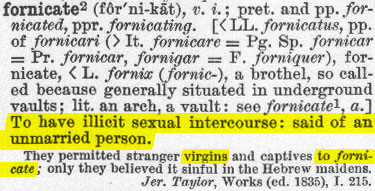
There’s “virgins” fornicating.
Oxford Universal English Dictionary on Historical Principles, 1937, vol. 10, p. 2360, “Virgin”:
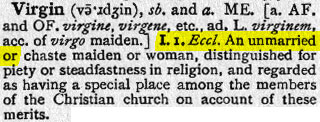
The American Heritage Dictionary of the English Language, 1992, p. 1995, “virgin”:

Many of us today didn’t know that we were also a “virgin” when we were just not married. Which, is a definite contradiction, if you are unmarried and sexually active, or have ever been. Or, could that “not married” definition still be listed because it’s simply the actual origin of the word?
Merriam Webster’s Collegiate Dictionary, 1997, p. 1319, “virgin”:
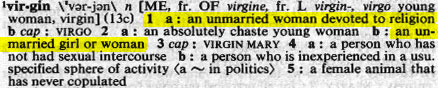
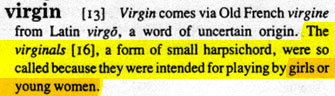
Arcade Dictionary of Word Origins, Ayto, 1990, p. 560, “virgin”:
Random House Crossword Puzzle Dictionary, 2001, p. 773, “virgin”:
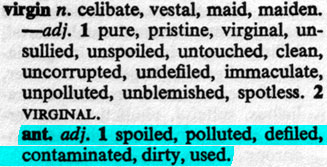
Now, the above is a modern day definition, but in logical truth, since historically being an “unmarried” girl constitutes “virgin” what should be added to the antonyms of “spoiled, polluted, defiled, contaminated, dirty, uses” correctly should be: “married.”
Pagan:
http://www.menstruation.com.au/periodpages/virgin.html, Virgin Archetype:
Virgin in this context has more to do with state of mind and attitude rather than physical attributes or sexual status .
Often the Virgin goddesses were unmarried, but this did not mean that they were necessarily asexual. In fact, some of the virgin goddesses expressed their sexuality openly, owning their sexuality proudly and without shame.
Late Antiquity: A Guide to the Postclassical World, Harvard University Press, 1999, pp. 743-744, “Virginity”:
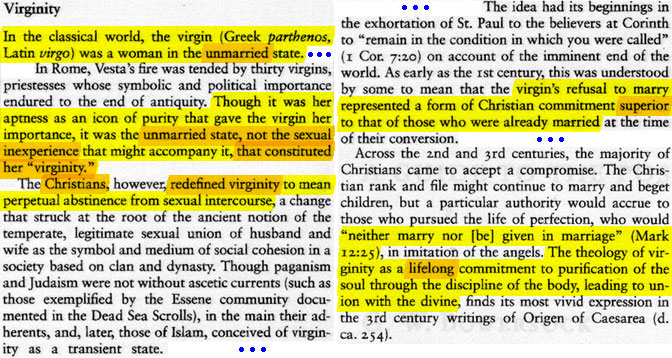
Funk & Wagnalls Standard Dictionary of Folklore, Mythology and Legend, 1972, p. 1159, “virginity”:
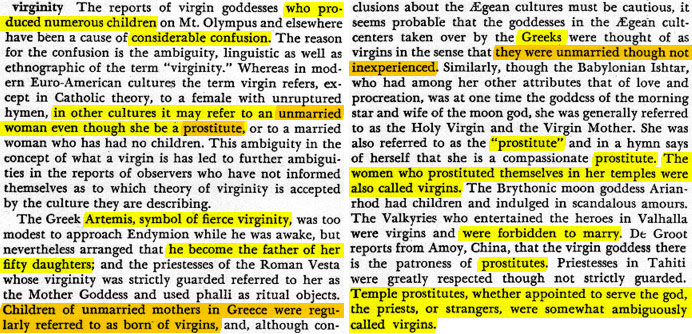
By the way, a “phalli” is a penis.
http://www.whoosh.org/issue31/mcbride2.html, My Gods, What Did They Do To You?, “Hestian Virgins”:
Hestian virgins are not much like their portrayal on either show. Our modern definition of virgin does not cut it in Greek mythology. In ancient times, a virgin was a woman who belonged to herself [not married]. She was not her father's daughter nor her husband's wife. A virgin goddess could create life by herself. A virgin priestess would not have been chaste, but she would have made love in tribute to her deity. Aphrodite had virgin priestesses! By this definition, Xena is a virgin. But saving Hestian virgins would not be nearly as interesting if their true characterization was used.
http://www.geocities.com/Paris/Arc/3860/goddess/aphrodite.html, Aphrodite, Greek Goddess, Goddess of Love, Life and Sex:
She is a virgin, in the original sense of the word (meaning "one-within-herself." [not married]) … She was called virginal, meaning that she remained independent. Her priestesses were not physical virgins, but celebrated sexual rites; … Greeks came to regard Aphrodite primarily as the essence of erotic love.
http://webdoc.sub.gwdg.de/edoc/ia/eese/artic20/spoor/supoor.html, Progress of Beauty: Swift's Passionate Take on Women:
The reference to Venus' providing women with "white lead and Lusitanian dish" is not only satiric but ludicrous because Venus/Aphrodite probably never used any cosmetics at all. She never grows old; she is always beautiful, virginal (which in this case means perpetually renewing herself like Diana) -- despite her many lovers.
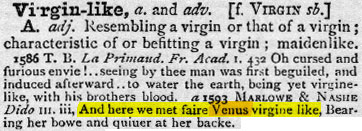
The Oxford English Dictionary, 1933, “Virgin-like”:
The Woman’s Encyclopedia of Myths and Secrets, Walker, 1983, p. 12:
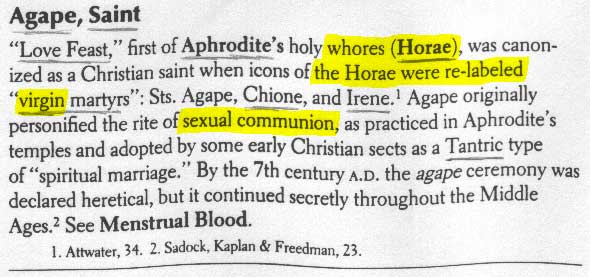
Exactly how can a “whore” be labeled by the Christians as a “virgin”?
http://www.dhushara.com/book/hieros/hieros.htm, Genesis of Eden Diversity Encyclopedia, “11.8 The Anathema of the Holy Whore”:
The Holy Harlot was also a Virgin because she remained unmarried. Ishtar-Asherah-Mari-Anath was both the Great Whore and the Great Virgin Mother (Walker 822).
The Oxford Companion to Classical Civilization, 1998, p. 577, “prostitution, sacred”:
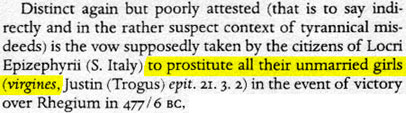
A New English Dictionary, John Kersey, 1702, (no page numbers):
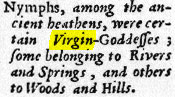
The English Dictionarie: or, An Interpreter of hard English Words (The Second Part of), H. C. Gent (Henry Cockeram), 1623:
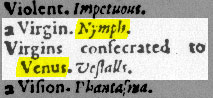
Translated: a Virgin. Nymph. | Virgins consecrated to Venus. Vestal[l]s.
Dictionary of Mythology Folklore and Symbols, Jobes, 1962, Vol. 2, p. 1653, “Virgin Birth”:
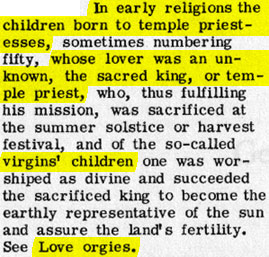
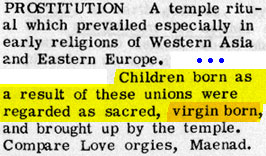
Dictionary of Mythology Folklore and Symbols, Jobes, 1962, Vol. 2, pp. 1296-1297, “PROSTITUTION”:
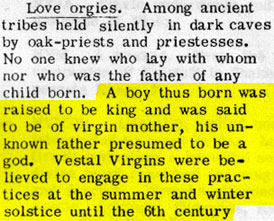
Dictionary of Mythology Folklore and Symbols, Jobes, 1962, Vol. 2, p. 1018, “Love orgies”:
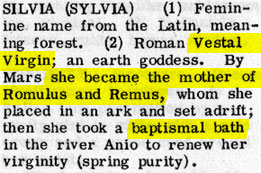
Dictionary of Mythology Folklore and Symbols, Jobes, 1962, Vol. 2, p. 1454 “SILVIA (SYLVIA)”:
http://www.religioustolerance.org/chr_jcpa3.htm, Parallels between the Christian Gospels and Pagan Mythology:
Mother's pregnancy: It was a common belief among early Christians that Mary was pregnant for only seven months. This legend is preserved in the Gospel of the Hebrews. Although this gospel was widely used by early Christians, it was never accepted into the official canon. Semele, mother of Dionysus, was also believed to have had a 7 month pregnancy.
Virgin birth: Author William Harwood has written that Jesus' "equation in Greek eyes with the resurrected savior-god Dionysos led an interpolator to insert a virgin-birth myth into the gospel now known as Matthew." 1 … 1. William Harwood, "Mythology's last gods: Yahweh and Jesus," Prometheus Books (1992), Page 257.
Bible:
The HarperCollins Bible Dictionary, Achtemeier, 1996, p. 1194, “virgin | virgin birth”:
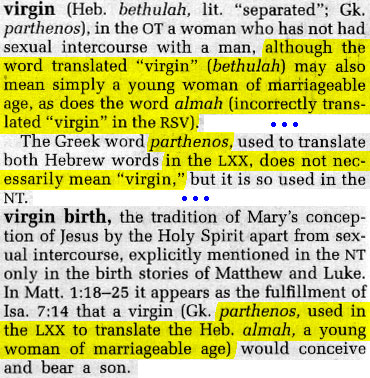
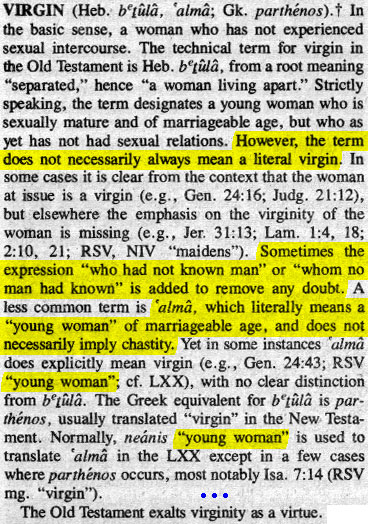
The Eerdmans Bible Dictionary, Myers, 1987, p. 1039, “VIRGIN”:
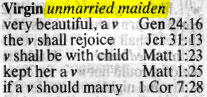
New American Standard Bible, Broadman & Holman Publishers, 1977, “Concordance” p. 59, “Virgin”:
Early Christianity:
http://www.angelfire.com/alt/scm/pedalion.html, The Pedalion or Rudder: THE 85 CANONS OF THE HOLY APOSTLES (2nd-4th century, but some canons originally supposed to be by St. Peter and the other Apostles):
CANON 67
If anyone is keeping a virgin whom he has
forcibly raped, though she be not engaged to another man, let him be
excommunicated. And let it not be permissible for him to take another, but let
him be obliged to keep her whom he has made his choice even though she happen
to be indigent.
“Keeping a virgin” is used in the future tense of “whom he has forcibly raped.” How could “virgin” mean “never had sex” if she was raped? Plus, here he’s being permitted to have sex out of marriage by being “obligated to keep her.”
http://www.catholicprimer.org/chrysostom/matthew/homily017.htm, St. John Chrysostom (347-407 AD): Homilies on the Gospel of St. Matthew (c. 390 AD): Homily XVII., “2.”:
What now can they say, who have those virgin inmates? [748] Why, by the tenor of this law they must be guilty of ten thousand adulteries, daily beholding them with desire. For this cause the blessed Job [749] also laid down this law from the beginning, blocking out from himself on all sides this kind of gazing.
…
[748] t sunokou parthnou, they were often called suneisakto. The practice of unmarried men, especially of the clergy, having single young women in their houses, is a frequent object of warning and censure both in the Homilies of the Fathers and in Church Canons. The earliest mention of such a thing, and of the sad abuse consequent on it, appears to be in St. Irenæus, i. 6, 3: who lays it to the charge of the Valentinian heretics. Tertullian (de Jejun. ad fin.) imputes it to the Catholics. St. Cyprian's fourth Epistle (ed. Fell.) was written to repress and punish an instance of it in the Church of Carthage. It was one of the charges against Paul of Samosata, and was forbidden by the third canon of Nicæa. See Dr. Routh's Reliquiæ Sacræ, 2,506, to which the editor is indebted for this note. The custom seems to have prevailed particularly at Antioch, ib. 482. See also an oration of Chrysostom on this subject, vi. 214.
Canons of St. Basil, c. 375 AD:
http://www.otitismedia.net/ccel/fathers2/npnf214/npnf2285.htm#P11346_2161892, The First Canonical Epistle of Our Holy Father Basil, Archbishop of Caesarea in Cappadocia to Amphilochius, Bishop of Iconium: The Second Canonical Epistle of the Same, “Canon XVIII.”:
That the ancients received a professed virgin that had married, as one guilty of digamy, viz., upon one year's penance; but they ought to be dealt with more severely than widows professing continency, and even as adulterers: But they ought not to be admitted to profess virginity till they are above sixteen or seventeen years of age, after trial, and at their own earnest request; whereas relations often offer them that are under age, for their own secular ends, but such ought not easily to be admitted.
So one can be a “virgin” after being married. And they don’t become “virgins” until sixteen or seventeen. You see, it’d all makes better sense when you realize “virgin” just meant the sanctity of being “unmarried.”
“Canon XX.”:
Women professing virginity, though they did marry while they were heretics, or catechumens, yet are pardoned by baptism. What is done by persons in the state of catechumens, is never laid to their charge.
So, girls, somehow the church has a way to restore your hymen by just being baptized.
“Canon XXII.”:
That they who have stolen virgins, and will not restore them, be treated as fornicators; that they be one year mourners, the second hearers, the third received to repentance and the fourth be co-standers, and then admitted to communion of the Good Thing. If the virgins be restored to those who had espoused them, it is at their discretion to marry them, or not; if to their guardians, it is at their discretion to give them in marriage to the raptors (“lifted up and carried away; to seize”), or not.
How could a “virgin” be fornicated then still be a “virgin”?
A History of the Councils of the Church, by Charles Joseph Hefele, 1896, vol. 2, p. 429, “BOOK VIII | Roman Synod under Innocent I. in 402” (Canon 2):

Sounds like they had at the time two kinds of “virgins”: those they punish for having sex out of marriage, and those who never have – which is what they obviously expect.
The Oxford Illustrated Dictionary, 1975, p. 942, “virgin”:
http://www.newadvent.org/fathers/062306.htm, Banquet of the Ten Virgins (Discourse 6), “Chapter 5. The Reward of Virginity”:
These, O fair virgins, are the orgies of our mysteries; these the mystic rites of those who are initiated in virginity; these the "undefiled rewards" Wisdom 4:2 of the conflict of virginity. I am betrothed to the Word, and receive as a reward the eternal crown of immortality and riches from the Father; and I triumph in eternity, crowned with the bright and unfading flowers of wisdom. I am one in the choir with Christ dispensing His rewards in heaven, around the unbeginning and never-ending King. I have become the torch-bearer of the unapproachable lights, and I join with their company in the new song of the archangels, showing forth the new grace of the Church; for the Word says that the company of virgins always follow the Lord, and have fellowship with Him wherever He is. And this is what John signifies in the commemoration of the hundred and forty-four thousand.
The Catacombs of St. Callixtus; Baruffa; Published by L.E.V., Vatican City; 1993; p. 136; “The Liberian Area | Life in Christ | Felix, a neophyte”:

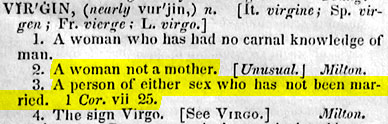
An American Dictionary of the English Language, Noah Webster, 1856, p. 1237, “VIRGIN”:
The History Channel, 12-29-08 (originally air date: 8-20-99), The History of Sex: The Middle Ages (documentary) (or, http://seattlepi.nwsource.com/archives/1999/9908160060.asp):
“During the Middle Ages, it was possible to be a ‘born again virgin.’ Women wanting to become nuns could be publicly declared consecrated virgins, even after being married and bearing children.”
New Testament virgin birth: Matt. 1:18-24; Luke 1:26-36.
Sounds like the church needed to settle the issue about the “virgin” birth of Jesus:
http://www.jasher.com/Virgin.htm, The Fiction of the Virgin Birth, “Where Did The Idea Come From”:
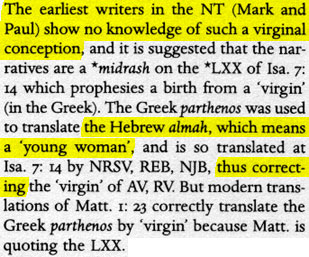
The notion of the virgin birth is mentioned only 2 places in the New Testament - Mat. 1:23 and Luke 1:27. It is curious that neither of these passages appear in any of the 60 earliest manuscripts of the New Testament dating from the 3rd century or before. (Refer to The complete text of the Earliest New Testament manuscripts, by Comfort and Barrett). This suggests that the first century followers of Jesus had never heard of this notion. It was added to the scriptures later by who knows who. … And consider this: If Jesus were born of a virgin, conceived by the Holy Spirit, then he could not possibly be a descendant of David and heir to the throne through the male line. Thus the geneology of Matthew through Josephs line is worthless.
Oxford Dictionary of the Bible, Browning, 1996, p. 389, “virgin birth”:
http://www.infidels.org/library/modern/jim_meritt/bible-contradictions.html#war_or_peace, A List of Biblical Contradictions:
Human vs. ghostly impregnation
ACT 2:30 Therefore being a prophet, and knowing that God had sworn with an oath to him, that of the fruit of his loins, according to the flesh, he would raise up Christ to sit on his throne;
MAT 1:18 Now the birth of Jesus Christ was on this wise: When as his mother Mary was espoused to Joseph, before they came together, she was found with child of the Holy Ghost.
I noticed during the verbatim 2003 film The Gospel of John, there was (appropriately) no mention in John 8:41 of Jesus’ Jewish opposers stating that Jesus was born of “fornication” (Greek “pornia”: specifically / correctly “prostitution”). I found later the reason is because the film was based on the Good News Bible (GNT, GNB & TEV), translated by the American Bible Society, 1966:
“You are doing what your father did.” “God himself is the only Father we have,” they answered, “and we are his true children.”
Now here’s the New King James Bible representing the traditional text:
“You do the deeds of your father.” Then they said to Him, “We were not born of fornication; we have one Father--God.”
And, I checked: porneia is the original Greek text. Jesus does not defend himself against the statement; especially something that would be such a crucial point today. Do you think the book and movie needed to leave out the true text because it would conflict, enough so, with what we’ve all been brainwashed today to believe? By the way, this instance is the only time fornication / porneia is used in the entire Book of John.
Most Christians believe that everyone in the entire world should do what God wants:
Revelation 14 (NKJV):
1 Then I looked, and behold, a Lamb standing on Mount Zion, and with Him one hundred and forty-four thousand, having His Father's name written on their foreheads. 2And I heard a voice from heaven, like the voice of many waters, and like the voice of loud thunder. And I heard the sound of harpists playing their harps. 3They sang as it were a new song before the throne, before the four living creatures, and the elders; and no one could learn that song except the hundred and forty-four thousand who were redeemed from the earth. 4These are the ones who were not defiled with women, for they are virgins. These are the ones who follow the Lamb wherever He goes. These were redeemed from among men, being firstfruits to God and to the Lamb. 5And in their mouth was found no deceit, for they are without fault before the throne of God.
http://septuagint-interlinear-greek-bible.com/pdf/revelati.pdf, The Apostolic Bible, “Revelation”:
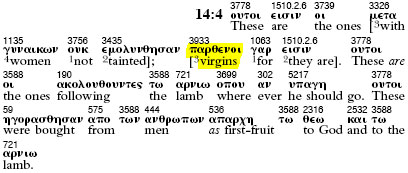
These who “follow the Lamb (Jesus)” are “virgins.” Now, if all men in the world were “virgins,” then the mankind would cease to continue to exist. But, if you translate parthenoi (virgin) to its original meaning “unmarried” then (1) you are allowing mankind to continue, via (2) you are allowing sex outside of marriage, and (3) you are saying that no one should get married, and “defiled with women” therefore means being married, and you can be one of the few “firstfruits to God and to the Lamb” if you never marry. Again, that’s only if you want to place God into “reality” with the prolongation of mankind.
I don’t know, some atheist won’t have children just to save them from an evil bias society. Now, Christians can go along with that theory since they adamantly desire to translate parthenoi as virgin; or, they can simply quit causing it to be an evil bias society by translating it as “unmarried.”
Gnostics (early Christian sect):
http://www.themystica.org/mystica/articles/g/gnosticism.html, Gnosticism:
Another point concerning Jesus which caused discord was that the Gnostics did not accept that Jesus was born of a virgin. Holding that Jesus specially came from God and the Spirit, they said he entered a body brought about by sexual intercourse between Mary and Joseph. Many Gnostics scoffed at the idea of a virgin birth which other Christians held.
Written between 374 and 377 AD:
http://books.google.com/books?id=K22xQJbzdUIC&pg=PR5&sig=dxaXa8lZKbxZmGpThn7DEzxPMcg#PPA92,M1, The Panarion of Epiphanius of Salamis – Google Book Result, by Epiphanius, “Section II | 26. Against Gnostics, or Borborites.1 Number six, but twenty-six of the series,” p. 92, 11.9 – 11.11:
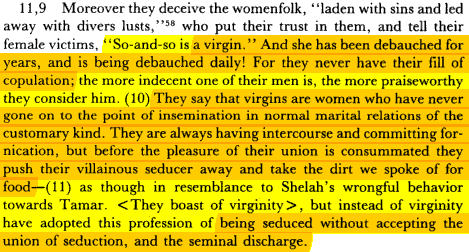
Nuns -- Luke 23:28-31 & Rev. 6:10-16:
http://www.newadvent.org/cathen/15458a.htm (Catholic Encyclopedia), Virginity:
In the article NUNS it is shown how Christian virgins have been one of the glories of the Church since the first ages, and how very ancient is the profession of virginity.