VIRGIN – ARTEMIS (Greek) / DIANA (Roman); LASCIVIOUS / NOT SELGE
Part 1: ARTEMIS / DIANA:
Virgin goddess:
http://www.pantheon.org/articles/a/artemis.html, Encyclopedia Mythica, “Artemis”:
Artemis was one of the Olympians and a virgin goddess.
http://www.answers.com/artemis, “Artemis”:
The virgin goddess of the hunt and the moon and twin sister of Apollo. … The Greek name for Diana, the virgin goddess of the hunt and the moon; the daughter of Zeus and the sister of Apollo.
http://blogs.salon.com/0004357/2004/12/09.html, Everything Relative:

Patroness of Childbirth:
The Oxford Classical Dictionary, 1949, p. 274, “Diana”:
http://www.geocities.com/Hollywood/Lot/5775/gods.html,
Gods in Greek Mythology, “Artemis”:
Artemis was one of the principal goddesses of Greek mythology. She was the
daughter of the gods Zeus and Leto and the twin sister of the god Apollo. She
was goddess of chastity, virginity, the hunt, the moon, and the natural
environment. Even though she was a virgin
goddess, she also presides over childbirth, which goes back to causing Leto
no pain when she was born.
http://www.mothergoddess.com/completelist.htm, “Latin / Rome | Diana”:
Diana - Queen of Heaven. Patroness of childbirth, nursing and healing. Mother of Animals, Lady of Wild Creatures and Goddess of wild woodlands, forests, hunting. Often depicted with a basket. Oak groves were sacred to Her.
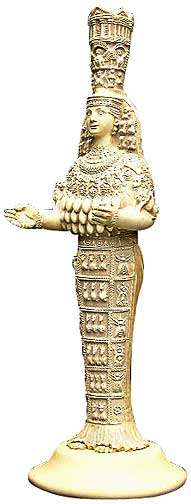
The multiple breasts represent the nurturing of many children:
http://www.ymago.net/cyberart/artemis/AtemisUrbainHierne.jpg (via http://www.tagzania.com/item/28457), Temple of Artemis at Ephesus map - Tagzania:
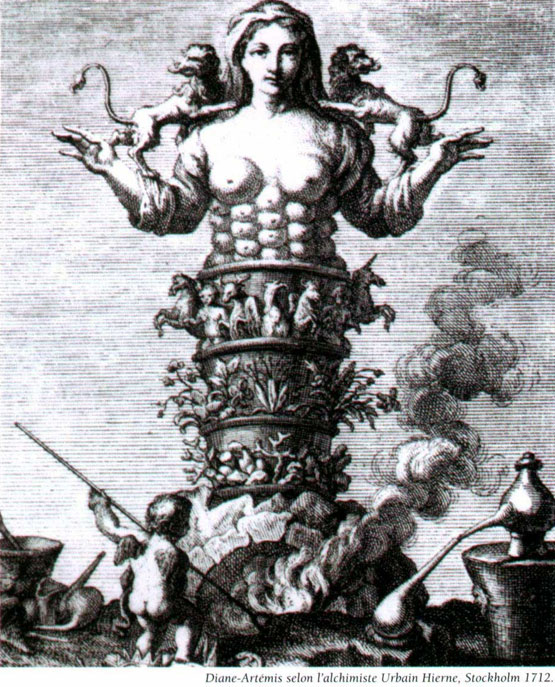
http://www.newagetravel.com/ephesus.shtml, Seeking Artemis in Ephesus:
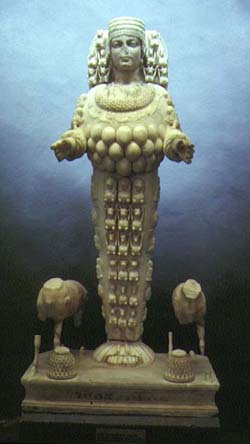
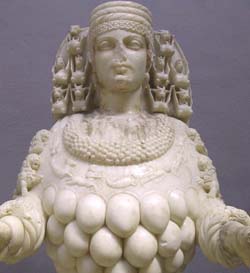
Both figures of Artemis have three rows of egg shaped breasts.
http://www.geocities.com/Athens/Troy/5385/z_wt_artemis2.jpg (via http://biology.kenyon.edu/slonc/books/Children_Star/cs-guide.htm), “Artemis of Ephesus”:
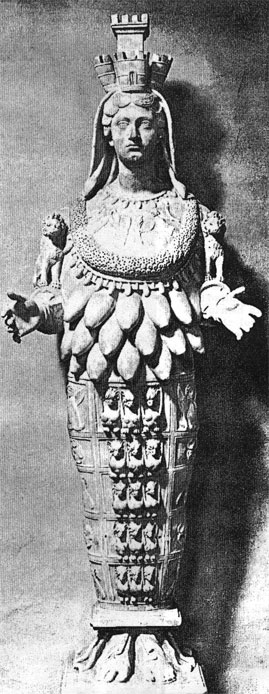
http://en.wikipedia.org/wiki/File:Artemis_Efes_Museum.JPG (via http://en.wikipedia.org/wiki/Temple_of_Artemis), Temple of Artemis:
The Lady of Ephesus, 1st century CE (Museum of Ephesus), Efes, Turkey
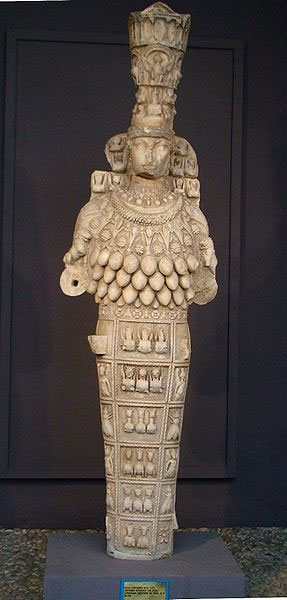
http://en.wikipedia.org/wiki/File:ArtemisEphesus.jpg (via http://en.wikipedia.org/wiki/Temple_of_Artemis), Temple of Artemis:
Synthesizing Artemis of Ephesus: an 18th-century engraving of a Roman marble copy of a Greek replica of a lost Geometric period (c. 900-700 B.C.) xoanon.
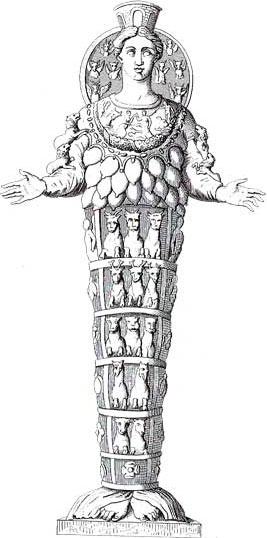
Committed to not marry:
http://www.1911encyclopedia.org/Artemis, Classical Encyclopedia (based on the 1911 Ency. Brittannica), “Artemis”:
The idea of Artemis '.s a virgin goddess, the "queen and huntress, chaste and fair," which obtained great prominence in early times, and seems inconsistent with her association with childbirth, is generally explained as due to her connexion with Apollo, but it is suggested by Farnell that irapOE'os originally meant "unmarried," and that "Apreµcs 7r-ap9Evos may have been originally the goddess of a people who had not yet the advanced Hellenic institutions of settled marriage.
http://www.victorianweb.org/authors/wilde/dawson3.html, Actaeon and Artemis:
Artemis was a virgin huntress. By virgin was meant "unattached" (= unmarried)
http://www.mamohanraj.com/Stories/dianacrit2.html, A Comparative Religions Perspective on "Diana" - A Reader's Response:
But Diana is not the goddess of marriage, or family life … I have even read the possibility that in her early worship, "virgin" did not mean "celibate" but "unmarried".
http://www.angelwing4.com/goddess.html, Goddess Names and the Cultures:
21-Virgin
(independent, unmarried, not necessarily celibate)
Goddess:
Anath (Canaanite), Artemis (Greek),
Athena (Greek), Britomartis
(Cretan),
Hestia (Greek), Mary (Christian), Vesta
(Roman)
http://sgfisher.blogspot.com/search/label/goddesses, The Moon Tree Blog, “Understanding Artemis”:
She also asked for all the mountains in the world, one city to be dedicated to Her (obviously showing the value She placed on mountains over towns), and to always remain unmarried and free to roam the wilderness with her nymphs and hunting-hounds.
http://www.eternalsailormoon.org/mythology.html, Mythology and Legends, “Zeus / Jupiter”:
One of Zeus's most notorious traits was having affairs with other women, much to the anger of Hera.
“Artemis / Diana”:
Artemis is one of the three virgin goddesses, and young females often want to be free and unmarried like her.
“Vesta, or Hestia”:
Like Athena and Artemis, Hestia is one of the three virgin goddesses. However, Hestia has no distinct personality.
http://www.goddess-gift.com/goddess_gift_book/06Mar.htm, The Goddess Path Issue #040: Housekeeping with Heart and Soul, “Hestia, Goddess of Home and Hearth”:
She didn't require the trappings of power or adventure (like Athena and Artemis, the other virgin, i.e. unmarried, goddesses). She was perfectly content and fulfilled, being "Aunt Hestia", and enjoyed being of service to her family and community.
Lempriere’s Classical Dictionary, 1898, p. 201, “Diana”:
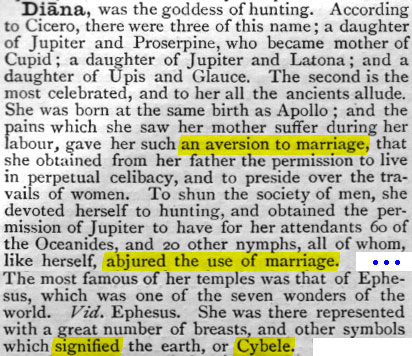
Lempriere’s Classical Dictionary, 1853, p. 146, “Diana”:
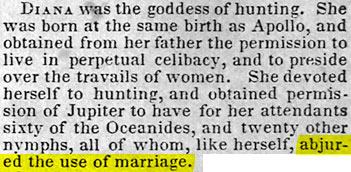
In 1853 “celibacy” just meant “not married.”
http://www.consultsos.com/pandora/artemis.htm, Artemis Artemisia Artemision:
THE PAIN OF CHILDBIRTH ENDURED BY LETONA
LED ARTEMIS TO VOW TO REMAIN A VIRGIN or in
gr PARTHENOS = UNMARRIED
NOT NECESSARILY VIRGIN
PARTHENIA CONCUBINE in Sparta
note HISTORY OF CHRISTIAN RECORDS MANY
VIEWS OPPOSING THE IDEA THAT
SAINT MARY WAS A VIRGIN
JESUS OF NAZARETH HAD A BROTHER
She was orgiastic / sexual:
The Oxford Guide to Classical Mythology in the Arts, 1300—1990s, 1993, Vol. 1, pp. 215-216, “Artemis”:
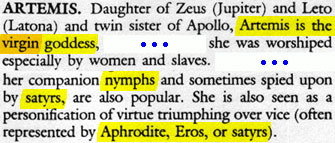
The New International Dictionary of New Testament Theology, Brown, Zondervan Publishing, 1978, vol. 3, p. 1071, “παρθένος (parthenos), maiden, virgin”:
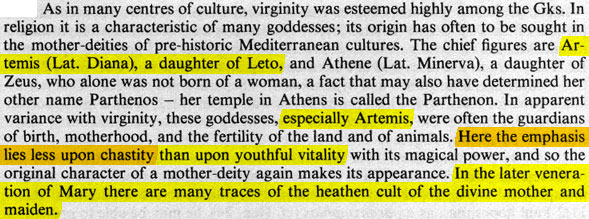
http://www.dhushara.com/book/diana/diana.htm, Genesis of Eden Diversity Encyclopedia, “The Nemesis of the White Goddess”:
The truth is, that the word parthenos applied to Artemis, which we commonly translate virgin, means no more than an unmarried woman … Further, it is highly significant that while her titles and the allusions to her functions mark her out clearly as the patroness of childbirth, we find none that recognise her distinctly as a deity of marriage.' Nothing, however, sets the true character of Artemis as a goddess of fecundity, though not of wedlock, in a clearer light than her constant identification with the unmarried, but not chaste, Asiatic goddesses of love and fertility, who were worshipped with rites of notorious profligacy at their popular sanctuaries.'
http://www.answers.com/topic/profligate, “profligate”:
An immoral or licentious person: libertine, rake1, wanton. See sex/asexual.
So she represents notorious unmarried sexual activity. Hey, that supports my theme.
Encyclopedia of World Mythology, Warner, 1975, p. 155, “Diana”:
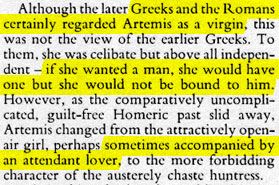
http://www.hranajanto.com/goddessgallery/artemis.html, Artemis. Other names: Diana:

The most beloved goddess of Greece, Artemis was honored in rituals that were wildly popular although as varied as the forms of the goddess herself. At Ephesus, in her well-endowed temple, Artemis was served by chaste priestesses called Mellisai, or "bees," and by eunuch priests. In Sparta she was Korythalia, worshiped in orgiastic dancing. The Amazons honored the war mother Astateia, the mother as protector of her children, in a circle dance amid the clashing of shields and swords and the stomping of battle-clad feet. But apparently the most popular festivals of Artemis were those celebrated on nights of the full moon, when worshipers would gather in the goddess's wood and give themselves over to her power in revels and anonymous matings. The beloved goddess of Greece was the personification of natural law, so different from the laws of society, so much more ancient, so everlasting.
Encyclopedia of Greco-Roman Mythology, Mike Dixon-Kennedy, 1998, pp. 48-49, “Artemis”:
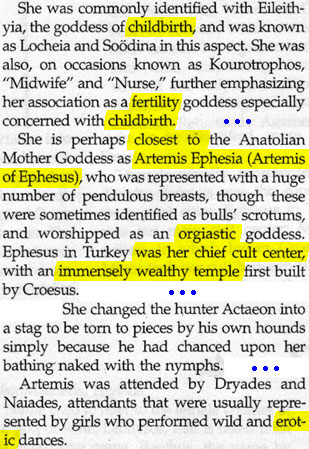
Dictionary of Mythology Folklore and Symbols, Jobes, 1962, Vol. 3 (topical) Index, p. 47:
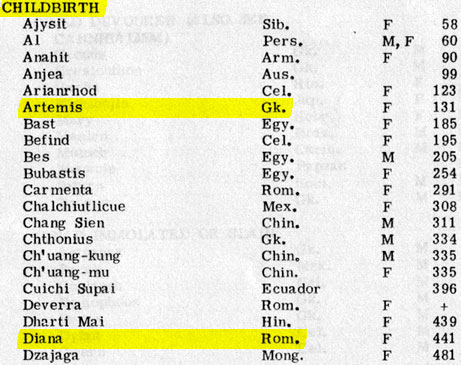
…, pp. 255-257:
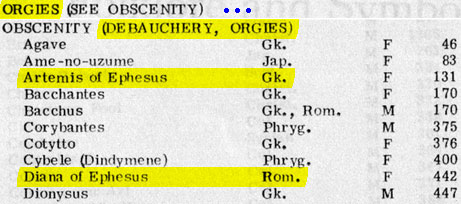
…, 1961, Vol. 1, pp. 131-132, “Artemis”:
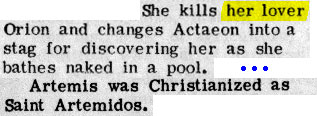
…, 1961, Vol 1, p. 442, “Diana”:
http://www.avalonia.co.uk/gods_pagan/artemis/virgin_goddess.htm, ARTEMIS - The Virgin Goddess:
Artemis declared as a child that she would remain forever virgin. … This clearly demonstrates that virginity referred to a complete absence of sexual activity
Sexualia: From Prehistory to Cyberspace, Clifford Bishop and Xenia Osthelder, Konemann, 2001, The Classical World, Festivals and Mysteries, p. 215:
http://www.amazonation.com/artemisI.html, Artemis, by Carla Osborne:
Her portrayal as a rather minor Goddess who was asexual, and not really a part of the community of deities she supposedly belonged to does not match her true nature. … Like Jesus (interestingly also strongly associated with fish) she could walk on water. Despite claims that she had no sexual relations, she was called the Mother of the Muses, and was concerned with midwifery. … Myths called her a chaste virgin, unnecessary now, but not then, when to be a virgin meant to belong to oneself, to have no outside restraints. As originally conceived of, a virgin could and did have sex. Her followers were remembered as her nymphs and Amazons, roaming free in the forests and mountains. … Artemis was also connected with sex, reproduction, and birth, three of the most instinctual experiences humans have. … She was called the mother of Eros, desire. Spartans called her Korythalia, and worshipped her in orgiastic dances, similar to the Amazons.
http://www.sermons.org/sermons/sermon3.html, Church on the Grow: A Sermon by Rev Ken Liles, Pastor; South Knollwood Baptist Church; Topeka, Kansas: From Acts 11:19-30; 13:1-3, “3. Antioch”:
Antioch ranked next to Rome and Alexandria in size, wealth, power, and vice. The city was proverbial for its lax sexual morals; this reputation was mainly due to the cult of Artemis and Apollo at Daphne, five miles distant, where the ancient Syrian worship of Astarte, with its ritual prostitution, was carried on under Greek nomenclature.
http://en.wikibooks.org/wiki/Relationships/Apollo-Artemis, Relationships/Apollo-Artemis, “Artemis | sex”:
Artemis women see sex as an adventure. For them, sex is a recreational sport, not an expression of commitment (Hera) or an occasion for sensuality (Aphrodite).
A lesbian Artemis woman will have many friends, a band of nymphs looking for adventure. If her lover is another Artemis woman (her "identical twin") she should consider whether her partner is her best friend or her romantic lover. She may better off with a more feminine lover-the goddess and her nymph.
The word for “nymph” is all over the New Testament translated as “bride,” “a betrothed girl,” etc. But, that doesn’t exactly correlate with the mythological characters.
http://www.amazonation.com/LegendsArtemis.html, Legends of Artemis, by Carla Osborne:
Clues that Artemis' worship included sexual rituals and sacred kings are also hinted at by tales like those of Leukippe and Priene.
http://www.theoi.com/Cult/ArtemisTitles.html, Artemis Titles:
TAU′RICA (DEA) (hê Taurikê), "the Taurian goddess," commonly called Artemis. Her image was believed to have been carried from Tauris by Orestes and Iphigenia, and to have been conveyed to Brauron, Sparta, or Aricia. The worship of this Taurian goddess, who was identified with Artemis and Iphigenia, was carried on with orgiastic rites
http://www.amazon.com/Invoke-Goddess-Visualizations-Egyptian-Deities/dp/1567184316, Invoke the Goddess; Visualizations of Hindu, Greek, and Egyptian Deities (Paperback), by Kala Trobe:
Price: $11.66 & eligible for FREE Super Saver Shipping on orders over $25 …
“Spotlight Reviews”:
For the most part, it gave the impression that the goddess are petty and the information did not necessarily follow the mythology presented earlier in the chapter - especially for Artemis (orgies?!).
Geschichte der Griechischen Religion (History of the Greek Religion), Nilsson, 1955, Chapter 4, Neue Götter (New Gods), 1. Eingewanderte Götter (Immigrated Gods), pp. 835-836:
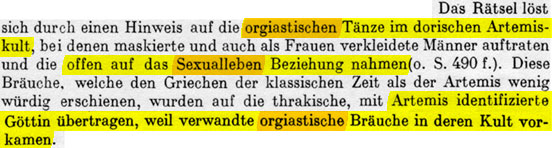
In text:
Das Rätsel löst sich durch einen Hinweis auf die orgiastischen Tänze im dorischen Artemiskult, bei denen maskierte und auch als Frauen verkleidete Männer auftraten und die offen auf das Sexualleben Beziehung nahmen(o. S. 490 f.). Diese Bräuche, welche den Griechen der klassischen Zeit als der Artemis wenig würdig erschienen, wurden auf die thrakische, mit Artemis identifizierte Göttin übertragen, weil verwandte orgiastische Bräuche in deren Kult vorkamen.
Translated from German:
The mystery separates by a reference to the orgiastic dances in the Dorian Artemis-cult, with those masked and also men disguised as women arose and openly on the Sexual life the relationship took(o. S. 490 f.). These customs, which appeared a little worthy to the Greek of the classical time as the Artemis, became on the thracian, with Artemis identified Goddess because related orgiastic customs occurred in its cult.
http://en.wikipedia.org/wiki/Artemis_(brothel), “Artemis (brothel)”:
Artemis is a large brothel in Germany, where prostitution is legal and widespread. … Artemis was created by the Turkish businessman Haki Simsek for some 5 million Euros.
http://www.mabenterprises.com/gaychristians/religious_text/thebible_b.htm, An Investigation into the Bible and Homosexuality, "Malokoi and Arsenokoitai":
The cultural environment of the Greek world of the 1st Century, as far as homosexual behavior was concerned dealt with two major areas. First, there was the refined temple prostitution activity. Only now, it had taken on a significant self-mutilation aspect that made it particular detestable. In the course of ritual worship, temple prostitutes, male and female, would have sexual intercourse with worshipers during drunken orgiastic excesses, often including self-emasculation. The Temple of Diana at Ephesus was notorious for such practices, and Paul, first as a Pharisee of the Pharisees and then as the Apostle of the Lord Jesus Christ to the gentile world, would have been utterly appalled at such spectacles.
Realize that Ephesus is fairly close to Selge.
http://www.uwm.edu/Course/mythology/0600/751f.jpg (via http://www.uwm.edu/Course/mythology/0500/athena.htm), Artemis of Ephesus:
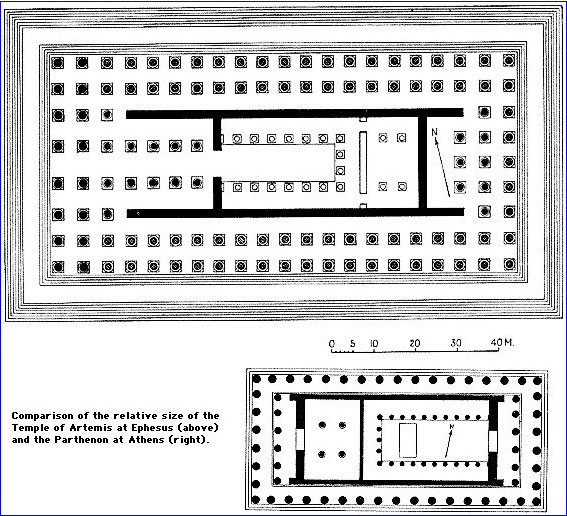
The temple which housed the colossal statue became one of the most famous in the Greek world in the Hellenistic period, glorified as another of the Seven Wonders of the World. Although this temple is no longer standing, there are enough remains to at least be able to recreate its appearance, as seen here in two modern restorations, (one, two). Despite a basic similarity to the Parthenon, the Temple of Ephesus was much, much larger, as seen in the comparative diagram. The temple was also much more elaborately decorated, with each column containing sculpted figures around the base.
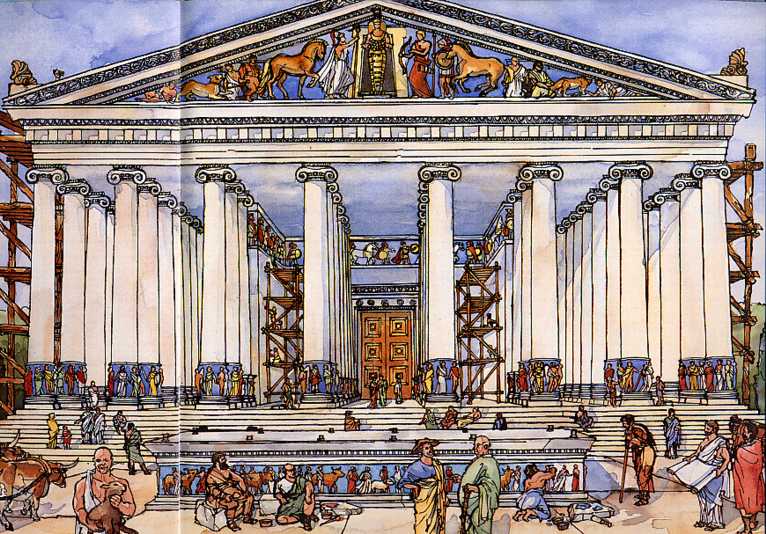
http://www.uwm.edu/Course/mythology/0600/751c.jpg, “Ephesus – Parth.”:
http://meta-religion.com/World_Religions/Christianity/Other_Books/New_Testament_Apocrypha/acts_of_john.htm, The Acts of John: The Apocryphal New Testament, “37”:
37 (continued.) Now the brethren from Miletus said unto John: We have continued a long time at Ephesus; if it seem good to thee, let us go also to Smyrna; for we hear already that the mighty works of God have reached it also. And Andronicus said to them: Whensoever the teacher willeth, then let us go. But John said: Let us first go unto the temple of Artemis, for perchance there also, if we show ourselves, the servants of the Lord will be found.
John’s not praising the pagan temple, but is saying the ones who worship Artemis likely will worship Jesus.
Identified with Kotytto, Cybele, Corybantes, Dionysus, etc.:
http://harfners.net/troia5.htm, Das griechische Pantheon (2): Göttinnen, Götter, Heroen, Heroinen! (The Greek Pantheon (2): Goddess, Gods, Heroen, Heroin!):
Kotytto - eine Göttin der Jagd, deren Wurzeln eventuell in Phönizien liegen. Oder im Thrakischen. Sie wird mit Artemis verglichen oder ist sogar eine Form der Artemis. Zumindest sind die Göttinnen in Art und Aufgaben de facto identisch.
Translated from German:
Kotytto - a goddess of the hunt, whose roots possibly lie in Phoenizien. Or in Thraki. It is compared with Artemis or is even a form of the Artemis. At least the Goddess is in fact identical in kind and tasks.
http://www.sagengestalten.de/lex/grie_roem_Kor.html, Griechische und Römische Götter und Sagengestalten, Buchstabe K (Greek and Roman Gods and legend shapes, letter K):
Kotytto
Griech. (thraz-phöniz.) Göttin.
Wurde mit Artemis gleichgestellt.
Translated from German:
Kotytto
Greek (thrace-phoeniz.) Goddess.
Became on an equal footing with Artemis.
http://www.chaman.ch/fr/projets/vialivenza/_doc/1_texte.pdf, L’Hypogee de Via Livenza a Rome Nouvelles Questions (The hypogeum [ancient subterranean chamber] of Via Livenza in Rome: New Questions):
Paribeni77, le "découvreur" de l'hypogée, propose, toutefois sans réelle conviction, que le bâtiment ait pu être un lieu de réunion pour la secte des Baptai, adorateurs de la déesse thrace Kotys. En effet, les Baptai pratiquaient le plongeon rituel en vue d'atteindre une sorte d'extase ou d'hypnose. De plus, la déesse Kotys était souvent identifiée avec Artémis. Pour amener cette explication, Paribeni s'est basé sur un article de Hubaux78 qui avait notamment interprété la basilique souterraine de la Porte Majeure comme un lieu de culte des Baptai79.
Translated from French:
Paribeni77, the "discoverer" of the hypogean[ancient subterranean chamber], proposes, nevertheless without real conviction, that the building could be a place of meeting for the sect of Baptai, worshippers of the Thrace goddess Kotys. Indeed, Baptai practised the ritual dive / plunge in order to reach a kind of ecstasy or hypnosis. Moreover, the goddess Kotys was often identified with Artémis. To bring this explanation, Paribeni based itself on an article of Hubaux78 that notably had interpreted the underground basilica of the Major Door like a place of worship of Baptai79.
Encyclopaedia of Religion and Ethics, Hastings, Vol. 12, Latest impression 1980, p. 329, “Thrace”:
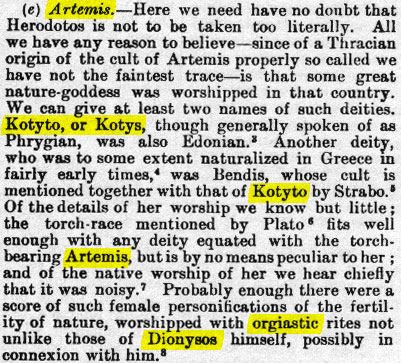
The Encyclopedia of Religion, Vol. 14, 1987, p. 495, “Thracian Religion”:
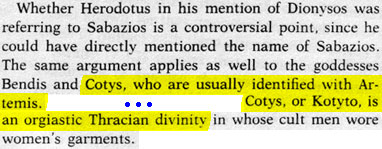
(Artemis / Diana is also spoken about quite often as being much like Cotytto / Cotys, in my Baptism-Cotytto Web pages.)
The New International Dictionary of New Testament Theology, Brown, Zondervan Publishing, 1975, vol. 1, p. 560, “Eunuch”:
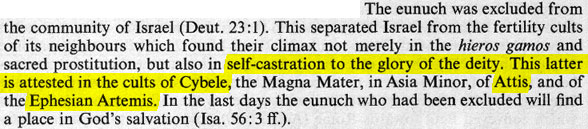
http://www.sacred-texts.com/wmn/rca/rca05.htm, Religious Cults Associated with the Amazons: Chapter IV: Artemis Astrateia and Apollo Amazonius:
Curetes, and Corybantes, all of whom were connected with Corybantes, all of whom were connected with orgiastic rites--the first, with those of Dionysus, the second and third, with those of Rhea-Cybele. It would follow that Artemis Hegemone belonged to the circle of deities honoured by mystic ceremonies like those of Crete and Asia Minor.
http://members.tripod.com/great-bulgaria/Bulgaria/, Bulgaria, “Bendis”:
Bendis, the Thracian goddess of the moon, as well as a The Great Mother Goddess. She had power of heaven and earth. The Greeks equated her with their goddess Artemis. Her cult involved orgiastic rites.
The Century Cyclopedia of Names, Benjamin E. Smith, 1897, p. 324:
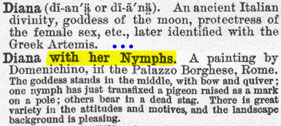
http://www.magickmind.net/pagangods.html, Pagan Gods:
ARTEMIS Also PARTHENOS Fertility goddess, patron of maidens, goddess of childbirth. Identified with the moon, as her brother Apollo is identified with the sun. The Virgin Huntress, Mistress of Beasts, Lady of All Wild Things, A Lion unto Women. Usually benevolent, but stern and demanding, dangerous to cross. Artemis lived in Arcadia with a band of nymphs subject to her strict discipline; those who dallied with men, as did Callisto, might be shot down with an arrow or otherwise punished. No man or god ever gained the love of Artemis.
http://www.darvillsrareprints.com/Cipriani.htm, Diana and her Nymphs bathing:
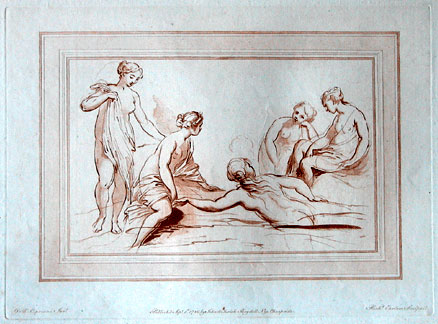
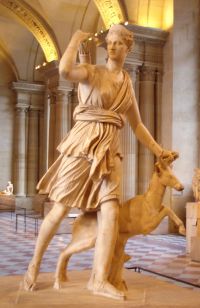
Diana and her Nymphs:
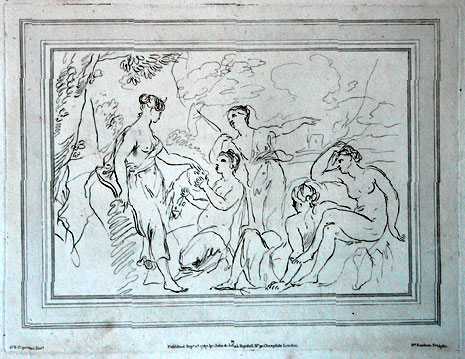
Homosexual message:
http://www.prntrkmt.org/divine/greek/artemis.html, Artemis:
Artemis was a virgin goddess (virgin meaning unmarried). Artemis was one of three primary Kore (virgin) goddesses in the Greek religion (Hellenism), representing the three kinds of unmarried women in Greek society. Kore Persephone represented the young maiden awaiting marriage. Kore Athena represented the professional woman. Kore Artemis represented the “wild” woman (often lesbians). …
“Myths”:
When Artemis was three years old, she sat on the knee of Zeus and asked him to grant her wishes (which he did). Artemis asked never to have to get married. Artemis asked for a silver bow and arrows. Artemis asked to have lop-eared hounds. Artemis asked to have stags to lead her chariot. Artemis asked for nymphs to be her hunting companions. All of Artemis’ nymphs remained virgins.
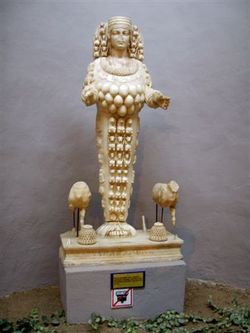
http://www.talariaenterprises.com/product_lists/greek_marble_fbust.html, Greco-Roman Women - Page 1:
Diana
of Ephesus
Diana was the daughter of Jupiter, the Chief God and the twin sister of Apollo.
Her mother, Latona, was one of Jupiter's paramours. When Diana was born her
mother bore her painlessly, and then Diana helped her mother deliver Apollo,
thus making Diana the Patroness of Childbirth. As
a child Jupiter asked Diana what she like to have as gifts. She replied that
she wanted eternal virginity (in the sense of always being true to her own
nature), as many names as Apollo, a bow and arrow like Apollo's, the
office of bringing light (providing guidance to others), a saffron tunic with a
red hem, and nine nymphs as her maidens. Here, Diana is shown adorned with meticulus
decoration. She is made from compound stone, weighs 1.4 lbs., and measures
11.5”H x 3.75”W. 4771, $43
http://www.antinopolis.org/carpocrates.html, Saint Carpocrates And The Libertine Companions of ANTINOUS, “Carpocrates and Antinous”:
Orphism was an initiatory philosophy devoted to Dionysus, but it was not purely Dionysian. It was deeply influenced by Apollo and Artemis, from whom extend the principles of moral aesthetics and purification. But within Apollo and Artemis is likewise the Homosexual message, which we find expressed by Socrates, through Plato, who proclaimed Apollo to be “The God,” from whom all Wisdom, all Purity, and all Light radiate. Apollo and Dionysus shared the shrine of Delphi, they were as closely connected as twin brothers, with female counterparts in the aspect of Artemis and Persephone. The mystery cults are intricately and deeply related, and Antinous and Carpocrates are found right in the center all their subterfuge, radiance, and sexual license.
http://www.jessworks.org/emilyasleep/ (4-10-05):
|
Artemis/Diana |
megabyzoi, antianeira |
Artemis in Greece, Diana in Rome. Also worshipped in Crete, England, France, Italy, Spain, etc. Goddess of maidenhood, the moon, the hunt. Diana may have been served by antianeira priestesses, born women who rejected marriage, loved to hunt, enjoyed warrior skills, and felt a sense of comradeship with transgendered women (born male). She was invoked by women participating in same-sex unions in Greco-Roman antiquity. She was honored with a dance in which women and men dressed in the garments of the opposite sex. Alexander the Great enjoyed dressing as Artemis in parades honoring Her. The megabyzos as and institution dates from the seventh century BCE. In the latter days of the worship of Artemis/Diana, it appears that the castration ritual was replaced by the sacrifice of certain loaves of bread. I’m not entirely sure what this was about. |
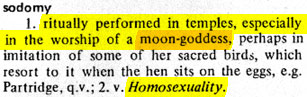
Dictionary of Symbols and Imagery, Ad de Vries, 1976, p. 431, “sodomy”:
Miscellaneous:
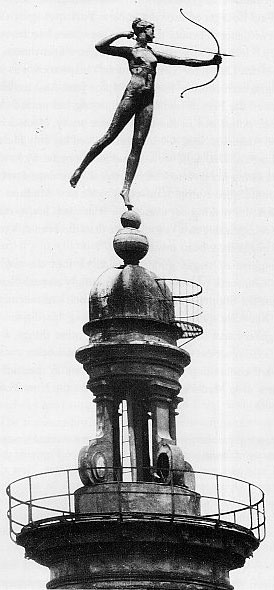
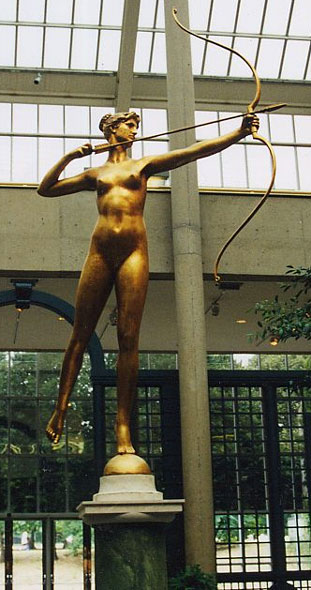
http://www.uwm.edu/Course/mythology/0600/msg2.jpg (via http://www.uwm.edu/Course/mythology/0500/athena.htm), Athena (Minerva) and Artemis (Diana), “The Diana of St.Gaudens”:
This sculpture by Augustus St. Gaudens, one of the most prominent American sculptors of the late 1800s, was originally commissioned to stand atop Madison Square Garden in the heart of New York City. The first photo shows the building when it was still relatively new in the 1880s. This 19-foot Diana was a source of some controversy, since some public officials found the nudity too blatant. The original figure was then transported to Chicago for the World's Fair of 1893-4, where it crowned the Agriculture building, as seen in the two views below. St. Gaudens was in fact pleased to make a second version for New York, since he thought the first figure was too large. The 13-foot replacement is seen in a 1905 photograph, and in its current location in the Metropolitan Museum of New York.
http://www.theoi.com/Gallery/Z6.1.html, Ancient Greek & Roman Mosaic: Artemis / Diana:
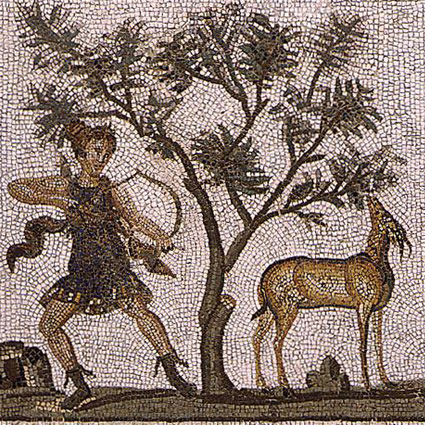
Artemis (Diana) aims her bow at a deer browsing on the leaves of an olive tree. The goddess wears a short maiden's skirt and boots.
http://www.araldodeluca.com/root/archivio/scheda.asp?id=60117 (via http://www.araldodeluca.com/root/archivio/archivio.asp?passaggio=ricerca&ricerca=semplice&parola=triclinio%20casti%20amanti), CASA DEI CASTI AMANTI. TRICLINIO. AFFRESCO CON MERCURIO E DIANA (translated from Italian: HOUSE OF THE CHASTE LOVERS. TRICLINIO. I FRESCO WITH MERCURY And DIANA) (Pompei, Campania, Italia):
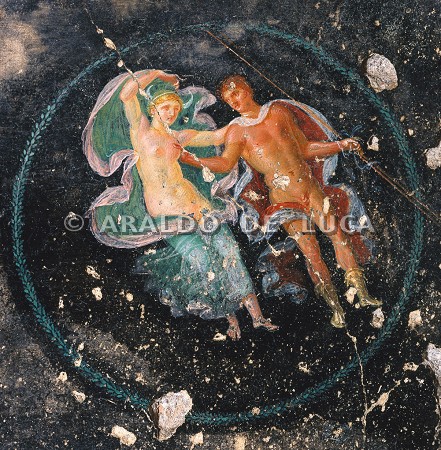
Looks like she’s letting him cop a feel in the “House of Chaste Lovers.”
Part 2: LASCIVIOUS / NOT SELGE:
lasciviousness / wantonness / lustfulness / filthy
Mark 7:22; Romans 13:13; 2 Corinthians 12;21; Galatians 5:19; Ephesians 4:19; 1 Peter 4:3; 2 Peter 2:7,18; Jude 1:4
Greek: ασέλγε… (transliterated: aselge…), a combination word of “a-” meaning “not,” and “selge.”
“Selge” (aka: Altinkaya, Zelk) was a city in Pisidia (part of modern day Turkey). It had a Temple of Artemis, telling of its virtue. The negation “α-“ gives its meaning of the opposite, which does not match today’s translation of “lascivious.”
ασέλγε… is a combination word:
http://www.jcsm.org/StudyCenter/kjvstrongs/STRGRK7.htm#S766, The KJV Bible: Strong’s Greek Dictionary:
|
766 |
aselgeia |
from a compound of a - a 1 (as a negative particle) and a presumed selges (of uncertain derivation, but apparently meaning continent); licentiousness (sometimes including other vices):--filthy, lasciviousness, wantonness. |
http://www.jcsm.org/StudyCenter/kjvstrongs/CONGRK76.htm#S766, The KJV Bible: The Greek Concordance:
|
766 |
aselgeia |
aselgeiaiV aselgeian aselgeia |
For example: http://www.jcsm.org/StudyCenter/kjvstrongs/B41C007.htm#V22, Mark Chapter 7:
|
22
|
klopai pleonexiai ponhriai doloV aselgeia ofqalmoV ponhroV blasfhmia uperhfania afrosunh 7:22 Thefts, covetousness, wickedness, deceit, lasciviousness, an evil eye, blasphemy, pride, foolishness: |
The Englishman’s Greek Concordance of the New Testament, Wigram, 1903, republished 1996, p. xviii, “Vocabulary” (shows compound words via “-“):
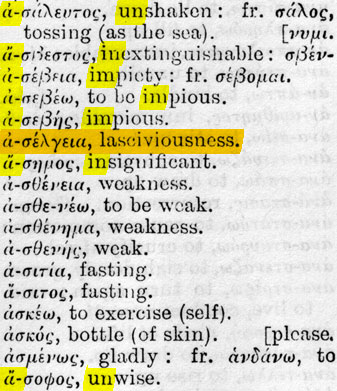
(σθεν- means “strength,” “vigor,” “strong,” “forceful.”)
(σιτ- means “food,” “to feed,” etc.)
http://www.newadvent.org/cathen/13692a.htm (Catholic Encyclopedia), Selge:
Greek grammarians connect its name with aselges, which means "licentious"; some think the first letter of the word a negative particle, but others find in it a meaning of reinforcement.
Well, “α-“ is of the negative, so there’s some wishful thinking it was the other way around. Apparently the Catholic Church is aware of the connection of Artemis and the city of Selge:
Connection to Selge:
http://www.bible-history.com/isbe/L/LASCIVIOUSNESS/ (Bible History Online), Lascivioiusness:
Etymologists assign three probable sources of aselgeia, namely: (1) from a compound of the alpha privitive (negation) and Selge, a Pisidian city whose inhabitants according to Thayer (New Testament Lexicon) "excelled in strictness of morals," but, according to Trench, a place whose people "were infamous for their vices"; (2) from a compound of "a" intense, and salagein, "to raise a disturbance or noise"; (3) from a compound of the alpha privitive a- and selgo, or thelgo, "exciting disgust or displeasure." It evidently means conduct and character that is unbecoming, indecent, unrestrainedly shameless.
(I don’t think that the Catholic Encyclopedia [two] above would use their “meaning of reinforcement” with the above definition “excelled in strictness of morals” when Jesus and Paul saying to not do it.)
http://home.att.net/~jackthompson/page167.htm, Lasciviousness, “I. Defining The Word From The Scriptures”:
3. Note the different definitions from various scholars and authorities: … Some have derived the word from a, negative,and Selge, a city in Pisidia. Others, with similar improbability, trace it to a, negative and selgo, or thelgo, to charm. See Wantonness. (Expository Dictionary of N.T. Words, W. E. Vine)
http://www.antioch.com.sg/cgi-bin/bible/vines/get_defn.pl?num=1600, Vine's Expository Dictionary of New Testament Words, “Lascivious, Lasciviousness”:
Some have derived the word from a, negative, and selge, "a city in Pisidia." Others, with similar improbability, trace it to a, negative, and selgo, or thelgo, "to charm." See WANTONNESS.
Vine’s Expository Dictionary of New Testament Words: Unabridged Edition, W. E. Vine (1873-1949), MacDonald Publishing Co., p. 650, “LASCIVIOUS, LASCIVIOUSNESS”:

http://www.missionprinting.us/pdf_pubs/Licentiousness%20A%20Variety%20of%20Sins.pdf, Licentiousness: A Variety of Sins:
Thayer, in his Greek-English Lexicon of the New Testament has a rather extensive definition of the term: "The conduct and character of one who is aselgeia (a word which some suppose to be compounded with 'a' which is a negative, and Selge—the name of a city in Pisidia whose citizens excelled in strictness of morals)." The negative would indicate that they excelled in immorality, making it an abhorrent, repulsive word. And, indeed, it is despicable when one considers the nature of the sins it describes and the attitude of the people who engage in them have toward their revolting conduct. Then, Thayer gives the definition of the expression: "Unbridled lust, excess, licentiousness, lasciviousness, wantonness, outrageous, shamelessness, insolence (Mark 7:22); of gluttony and venery (Jude 4); of carnality, lasciviousness (II Corinthians 12:21); manners, as filthy words, indecent bodily movements, unchaste handling of males and females (Romans 13:13); of the wantonness of women."
It has so many definitions because the actual meaning is lost. So, if you’re “saved,” it’s whatever you want it to mean.
http://www.augiedoggie.org/adproductions/1Peter/OurPastLifetime.htm, 1 Peter 4:3-6 (Our Past Lifetime):
Lewdness = ἀσέλγεια aselgeia as-elg'-i-a From a compound of as a negative particle) and a presumed σελγής selgēs (of uncertain derivation, but apparently meaning continent); licentiousness (sometimes including other vices):—filthy, lasciviousness, wantonness.
Selge-Artemis connection:
http://www.gototurkey.co.uk/index.php?link=1253, The Mediterranean and more: Turkey Welcomes You, “Selge”:
The remains of two temples can be found at the top of the highest hill to the west. It is more than likely that this is the Kasbedion mentioned by Polyios. In that case, the large 17x34 metre peripteral temple must have been that of the city's chief god, Zeus. As for the small temple with the templum in antis plan, this can be tentaviely assigned to Artemis on the basis of an inscription found nearby. … Between this hill and the other hills to the south-east, lie the other principal municipal buildings. Here on an incline lie the extremely fragmentary remains of a very long porticoed street, a nymphaeum, and a bath.
http://www.planetware.com/side/selge-tr-ant-sdsl.htm, Attractions, “Selge”:
The extensive ruins contain many interesting remains, but the principal sights are the Roman theater with a Greek auditorium (10,000 seats) and the adjacent stadium. Some distance to the southwest on a mound lie the remains of a Temple of Zeus and a Temple of Artemis and just beyond a cistern-like round vessel for the town's water supply.
http://www.farhorizon.com/turkey/southern_turkey.htm (Far Horixons Archaeological & Cultural Trips, Inc.), Remote Southern Turkey:
Day 5: Depart this morning for the Roman city of Selge, strikingly situated in the mountains at the top of Köprülü Valley. The site contains a spectacular theater, stadium, agora, necropolis, and temples to Zeus and Artemis.
http://www.manavgatside.com/Deutsch/Ausfluge/Selge/body_selge.html, Selge:
Translated from German:
According to inscriptions, which one had found in Selge, we experience that in the stadium many plays were organized. The two large temples of the city are on the hill in the south next to each other. One assumes that the one from those to the main God Zeus and the other one belonged to the goddess Artemis. West of it is a large round cistern. This cistern was filled up except the rain water also with the water, which was led by the hydrodynamic tanks by the north the west into the city. In the east of the same hill is a Stoa (gallery) at the southern end of this Stoa stands a column, on which two inscriptions are to be still read. At the third hill in the city is the Agora, which consisted of a square place, and three sides surrounded and the south side is still open. Beside the Agora is the remainder of a Basilica to be seen, which originates from Artemis.
http://www.estates-turkey.com/information_about/manavgat_beskonak/, Manavgat , Beskonak , Koprulu Canyon, “Antique Cities | Selge”:
It is theater with 5 gates and 45 stairs at north is an important monument. At the south of rock engraved theater, stadium and gymnasium, and at west a Ionian type temple, whose ceiling is adorned with eagle décor, draws the attention. At the south of the stadium, there are Fountain and Agora. At the north of the ramparts lying southwest of the city, Artemis and Zeus monuments as well as necropolis present.
http://www.asiaminorcoins.com/gallery/displayimage.php?album=277&pos=11, Asia Minor Coins, “Home > Pisidia > Selge”:
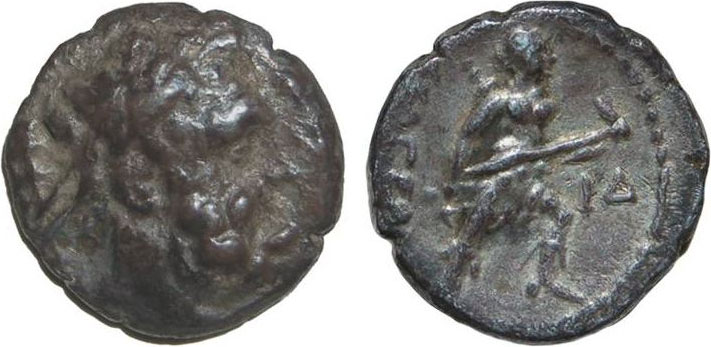
Selge (BC 210-170) Hemistater?
ca 200 BC. AR Hemistater? (18mm, 4.68g, 12h). Head of bearded Herakles right / Artemis advancing right, holding torch in hands; ΣΕΛΓΕΩΝ to left, IΔ to right. VF. Rare.
ΣΕΛΓΕΩΝ = SELGEON
http://www.wildwinds.com/coins/ric/aurelian/_cremna_AE30_vA_1554-r.jpg (via http://www.wildwinds.com/coins/greece/pisidia/kremna/), Ancient Coinage of Pisidia, Kremna:
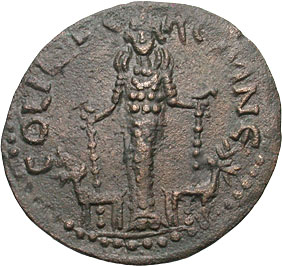
Aurelian AE30 of Pisidia, Cremna. IMP CS L DOM AVRELIANO, laureate, draped & cuirassed bust right / COL IL (sic, for IVL) F CREMNE, cult image of Artemis of Ephesus, multibreasted, standing front between two small stags, extending both forearms to hold birds, fillet also hanging from each hand.
http://www.wildwinds.com/coins/greece/asiaminor.jpg (via http://www.wildwinds.com/coins/greece/geo.html), Geographical Index of Greek Mints, Rulers, Etc.:
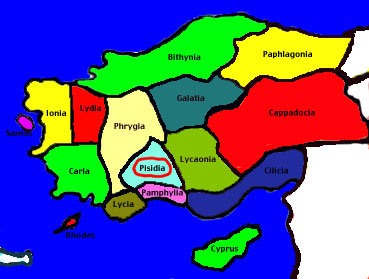
http://www.worldcoincatalog.com/AC/C2/Greece/AG/IonianCityStates.jpg (via http://www.worldcoincatalog.com/AC/C2/Greece/AG/CSofIonia.htm), Greek City States of Asia Minor, “Map of City States of Asia Minor”:
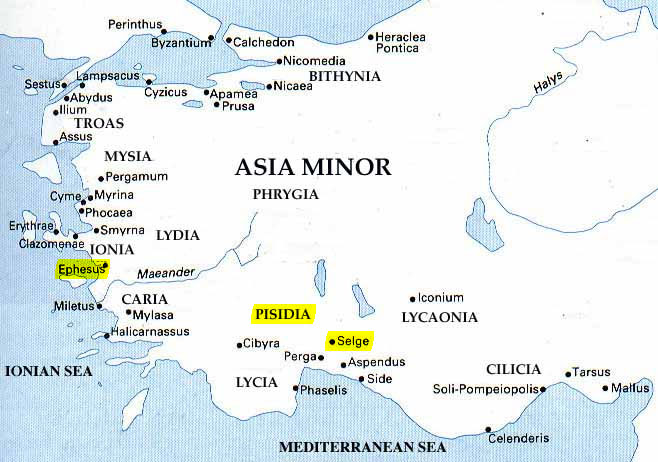
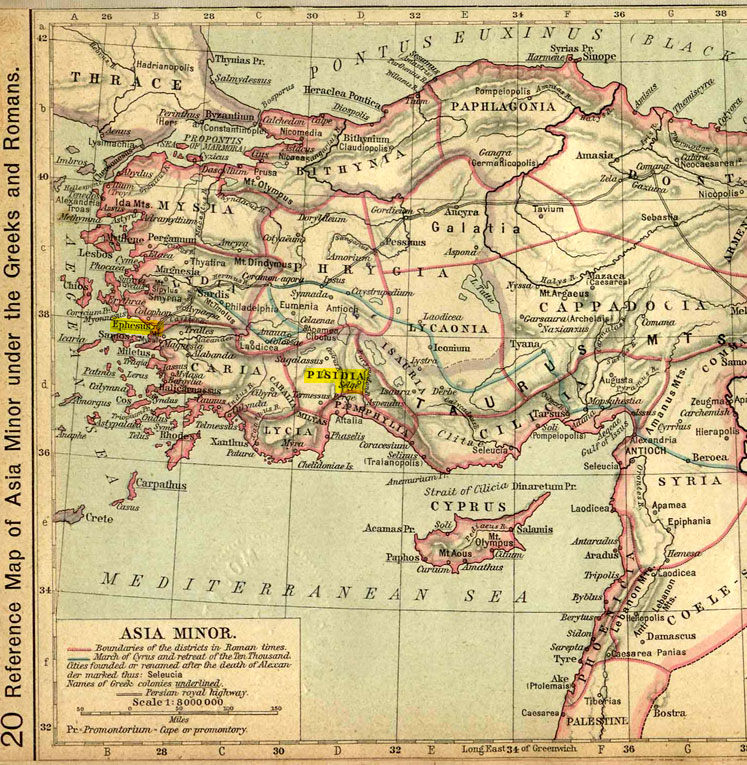
http://z.about.com/d/ancienthistory/1/0/9/9/2/Reference-Map-of-Asia-Minor-under-the-Greeks-and-Romans-.jpg (via http://ancienthistory.about.com/od/romeancientrome/ig/Maps-of-Rome-and-the-Empire/Asia-Minor.--Qr.htm), Asia Minor under the Greeks and Romans, From The Historical Atlas by William R. Shepherd, 1923:
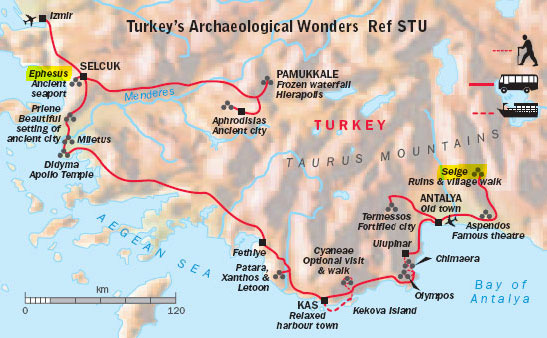
http://www.explore.co.uk/docsXL/2006Dossiers/STUXL.pdf, Turkey’s Archaeological Wonders:
http://www.aeqvitas.com/elag203.jpg (via http://www.aeqvitas.com/photo.php?freeform=elagabalus), Coin Images:
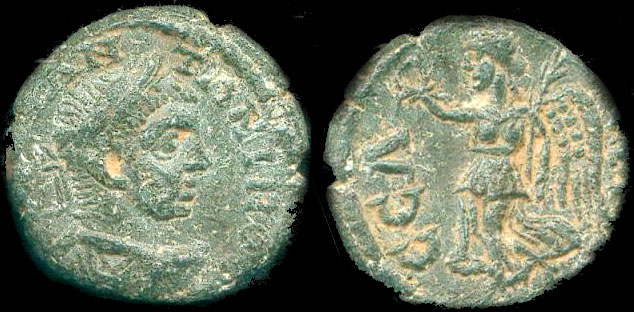
Elagabalus --AE17, Selge. R: Nike left with wreath and palm branch. cf SNG Cop 282.
http://www.asiaminorcoins.com/gallery/displayimage.php?album=277&pos=5 (via http://www.asiaminorcoins.com/gallery/thumbnails.php?album=277), Asia Minor Coins, “Home > Pisidia > Selge”:
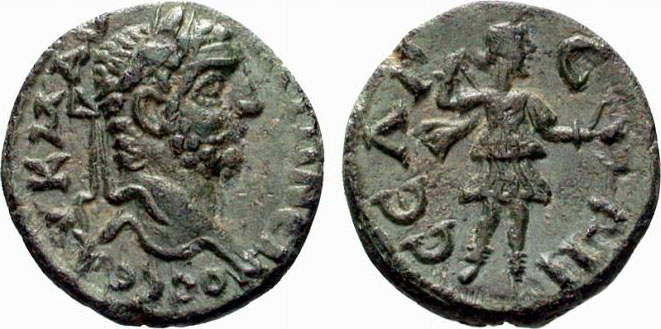
Selge (AD 197-217) AE 18 - Caracalla
Caracalla, 197-217 AD. AE18 (3.58g). Laureate head right /CΕΛΓΕΩΝ, Artemis in short chiton standing facing, head right, holding bow in outstretched left hand, with the right reaching into quiver. Good style, fine green patina, EF.
http://imansolas.freeservers.com/Andros.html, Andros & the Origin of the Manaola family name, “Andros History”:
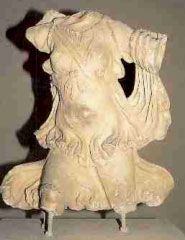
Statue of Artemis in the archeological museum of Andros
http://www.s110120695.websitehome.co.uk/SNG/sng_reply2a.php?verb=SNGuk_0300_3030, Sylloge Nummorum Graecorum:
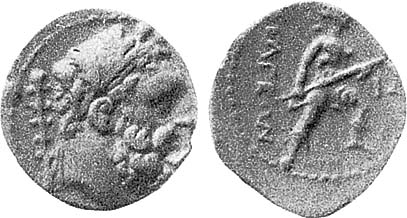
SNG Vol: III 3030 Lockett Collection, State: Selge, OBV Description: Heracles r., wreathed with styrax; to l., club. REV Description: Artemis striding r., holding torch.
http://mihalkam.ancients.info/images/gordian1/giiiselge1.jpg (via http://mihalkam.ancients.info/giiiprovincial.html), Gordian III PROVINCIAL, “Pisidia”:
Seleuceia
Selge
Ae 25 Asclepius and Hygeia stg. vis a vis
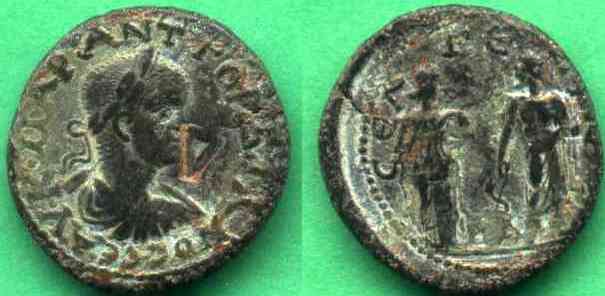
http://www.beastcoins.com/RomanProvincial/Pisidia-Selge/pisidia-selge.htm (Beast Coins), Pisidia-Selge:
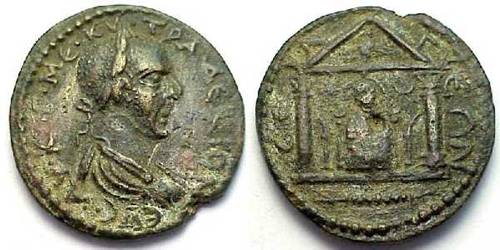
Trajan Decius, AE 25, 249-251, Pisidia, Selge. EUC . AU . K . G . ME . KU . TRA . DEKION Laureate, draped bust right. CE-LA-G-EWN Simulacrum of Artemis Pergaia within distyle temple, * to left and crescent to right within temple, eagle in pediment, spear below.
Today’s a-selge definition:
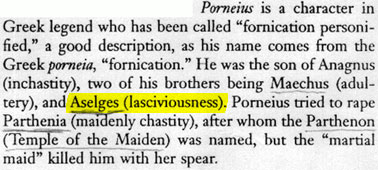
The Facts on File: Encyclopedia of Word and Phrase Origins, Hendrickson, 1997, p. 540, “pornography; Porneius”:
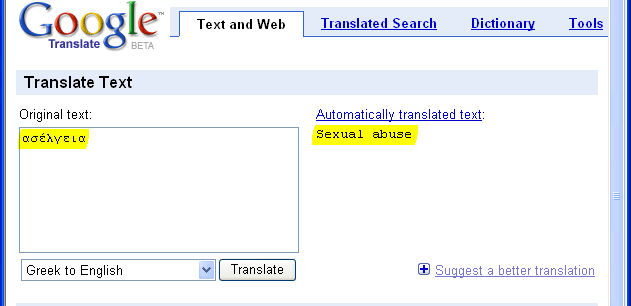
http://translate.google.com/translate_t?langpair=el|en, Google Translate, Greek to English, “ασέλγεια”:
Monolingual Greek Dictionary:
http://www.gnosinet.gr/ez/irsearch.asp?Query=áóÝëãåéá (ψηφιακή βιβλιοθήκη [Digital Library]), e-ncyclopedia, “ασέλγεια”:
|
ασέλγεια |
|
Κάθε πράξη ακόλαστη που σκοπό έχει τη, χωρίς μέτρο, παράδοση στις ορμές του γενετήσιου ενστίκτου. Κατά τον ποινικό νόμο, ασελγής πράξη είναι αυτή που προσβάλλει το κοινό αίσθημα της 'αιδούς' και των ηθών και αποβλέπει στην υποκειμενική ικανοποίηση ή διέγερση της γενετήσιας ορμής (εξαναγκασμός σε ασέλγεια, κατάχρηση σε ασέλγεια, αποπλάνηση παιδιών, κατάχρηση ανήλικου σε ασέλγεια, ασέλγεια με κατάχρηση εξουσίας). |
Translated from Greek:
Any act of sexual abuse that aim has, without measure, a tradition for the outburst of sexual instinct. In criminal law, aselgis act is the one that offends the common feeling 'decencies' and morals seeking subjective satisfaction or excitation of sexual impetus (forced into / coercion in sexual abuse, abuse to lewdness, seduction of children, abuse of minor in sexual abuse, sexual abuse by abuse of power).
…
“ακολασία” (from above):
|
ακολασία |
|
Η ακράτεια, η ασέλγεια, η παραλυσία, η ασωτία. Ο όρος υπάρχει στο άρθρο 348 §1 του Ποινικού Κώδικα, που ορίζει ότι όποιος διευκολύνει με οποιοδήποτε τρόπο την ασέλγεια, μεταξύ άλλων, τιμωρείται με φυλάκιση μέχρι ένα χρόνο. |
Translated from Greek:
The intemperance (lack of self-control), sexual abuse (Google translator), laxity, or prodigality. The clause exists in Article 348 §1 of the Criminal Code, which stipulates that anyone who in any way facilitates sexual abuse, among others, shall be punished with imprisonment of up to one year.
If it’s a legal matter, then it’s not just sex outside of marriage. The Greek word for marriage (gamos: γαμος) isn’t even in either translation. Sounds similar to our laws against sexual abuse, e.g., in the workplace.
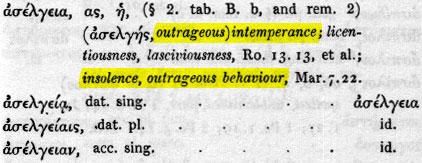
The Analytical Greek Lexicon, Zondervan Publishing House, 1973 printing, p. 55:
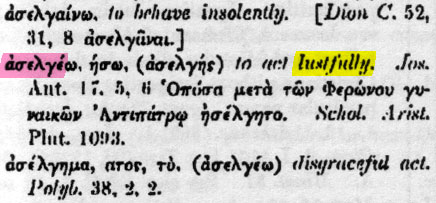
Greek Lexicon of the Roman and Byzantine Periods (From B.C. 146 to A.D. 1100), Sophocles (1807-1883), 1870, Vol. I, p. 261:
The Vocabulary of the Greek Testament, Moulton / Milligan, 1930, p. 84, “ασέλγεια”:
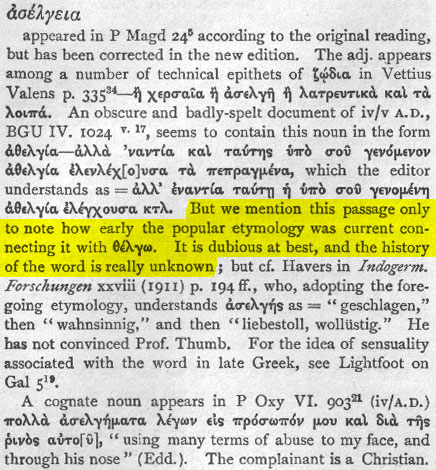
It appears that the true etymology of the word is strangely unclear, giving opening for corruption to satisfy the medieval Catholic Church.
Impud… (Latin Vulgate parallel):
The flip from not sexually promiscuous to sexually promiscuous may have occurred as shown in the parallel Latin Vulgate word “impudicitia,” which does mean today “shameless” (“feeling no shame”), unchaste, etc. Given that “shame” means “sexually promiscuous,” the negative “no” in “no shame” can also be easily asserted as, e.g., being no shame, or not being sexually promiscuous; and, moreover since “being” covers the entire person, where someone’s “feelings” only covers part of a person.
http://www.perseus.tufts.edu/cgi-bin/ptext?doc=Perseus%3Atext%3A1999.04.0059%3Aentry%3D%2322078, Charlton T. Lewis, Charles Short, A Latin Dictionary, “impŭdīcus”:
I. Shameless, impudent ( = impudens
http://www.perseus.tufts.edu/cgi-bin/ptext?doc=Perseus%3Atext%3A1999.04.0059%3Aentry%3D%2322072, Charlton T. Lewis, Charles Short, A Latin Dictionary, “impŭdens”:
I. without shame, shameless, impudent (freq. and class.; cf.: impudicus
Again Jesus and Paul were against this word, and a double negative makes it into a positive, so Jesus and Paul said be sexually promiscuous / of shame.
Like how imperfect means not perfect, or how immoral means not moral, the prefix im- means “not.” So let’s remove the im-:
http://www.perseus.tufts.edu/cgi-bin/ptext?doc=Perseus%3Atext%3A1999.04.0060%3Aentry%3D%2313269, Charlton T. Lewis, An Elementary Latin Dictionary, “pudendus”:
pudendus adj. [P. of pudeo] , causing shame, shameful
http://www.perseus.tufts.edu/cgi-bin/ptext?doc=Perseus%3Atext%3A1999.04.0059%3Aentry%3D%2339406, Charlton T. Lewis, Charles Short, A Latin Dictionary, “pŭdendus”:
pŭdendus , a, um.
I. Part., from pudeo.--
II. P. a., v. pudeo fin. B.
http://www.perseus.tufts.edu/cgi-bin/ptext?doc=Perseus%3Atext%3A1999.04.0059%3Aentry%3D%2339409, Charlton T. Lewis, Charles Short, A Latin Dictionary, “pŭdĕo”:
to make or be ashamed, to feel shame; to be influenced or restrained by shame … B. pŭdendus , a, um, P. a., of which one ought to be ashamed, shameful, scandalous, disgraceful, abominable … the parts of shame, the privy parts … 2. Subst.: pŭdenda , ōrum, n. (sc. membra). a. The private parts
(Also:) http://www.rostra.dk/latin/saxo.html, P:
pudendus, -a, -um 1 adi i.q. turpis 2 subst. n.pl. de genitalibus
http://lysy2.archives.nd.edu/cgi-bin/words.exe?de+genitalibus (Latin-English translator), “de genitalibus”:
with regard to … reproductive/genital organs (male or female); seminal fluid; … of creation/procreation, reproductive; fruitful; connected with birth
So Jesus and Paul were against something against “the private parts” / genitalia. So, in changing the double negative to one positive, Jesus and Paul were for something that had to do with “the private parts” / the genitalia.
Shame is exposing your “private” parts. Therefore, shameless would not be showing your private parts. Jesus and Paul said to not be shameless, thereby stating the acceptance of exposing your private parts. And we all know that covering private parts is to lessen sexual desire, like how the limited time allowed in today’s movies for showing private parts confines the natural rising of sexual craving, thereby giving it a milder rating for inclusion in the big theaters. This is why pornography is so popular as a sexual stimulant.
http://www.answers.com/pudenda, “pudendum”:
The human external genital organs, especially of a woman. Often used in the plural.
http://www.answers.com/vulva, “vulva”:
The external genital organs of the female are collectively known as the vulva (also sometimes called the pudenda).
http://www.answers.com/penis, “penis”:
Pudendal nerve entrapment is a condition characterized by pain on sitting and loss of penile (or clitoral) sensation and orgasm. Occasionally there is a total loss of sensation and orgasm.
Merriam-Webster’s Collegiate Dictionary, 1997, p. 944, “pudendum”:

I think the Catholic Church has taken that word through the ringer.
Dictionary of Ecclesiastical Latin (Latin-English), Stelten, 1995, p. 216, “pudénda”:

Thesaurus Linguae Romanae et Britannicae (Latin-English), Thomas Cooper, 1565, no page numbers, “Pudendus”:

Translated from Elizabethan English:
Pudenda. The privy parts of the body.
(H)ortus Vocabulorum (Latin & English definitions), 1500, no page numbers, “pudenda”:

Dictionary (Latin-English), Thomas Elyot, 1538, no page numbers, “Pudenda | Pudicitiā”:

Translated from Elizabethan English:
Pudefio,fis,fieri, to be ashamed.
Pudenda, the privy members.
Pudens,tis, shamefast. …
Pudicitiā habere(to have), to be violated in the act of lechery(excessive indulgence in sexual activity; lewdness).
Dictionarium Linguae Latinae et Anglicanae (Latin-English), Thomas Thomas, 1587, no page numbers:
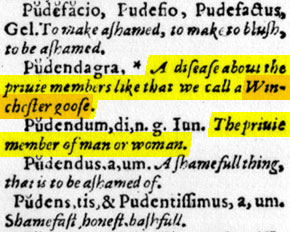
Translated from Elizabethan English:
Pŭdĕfăcio, Pudefio, Pudefactus, Gel.To make ashamed, to make to blush, to be ashamed.
Pŭdendagra, * A disease about the privy members like that we call a Winchester goose.
Pŭdendum, di,n. g. Iun. The privy member of man or woman.
Pŭdendus,a,um. A shameful thing, that is to be ashamed of.
Pŭdens,tis,& Pudentissimus, a, um. Shameful, honest, bashful.
http://www.sex-lexis.com/Sex-Dictionary/Winchester%20goose (Dictionary of sexual terms), “Winchester goose”:
Winchester goose:
Obsolete term for:
1. A prostitute in 14 th centrury London.
2. The pocks (or pox), the venereal bulbos of syphilis
A sexual thing.
http://www.answers.com/vulva, “vulva”:
Many cultures have commonly viewed the vulva as something shameful that should be hidden; the term pudendum literally means "shameful thing."
Oxford Latin Dictionary, Glare, 1982, p. 1513, “pudendus”:

A Smaller Latin-English Dictionary, William Smith, 1879, p. 468, “pŭdendus | pŭdĕo”:
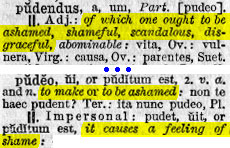
Cassell’s Latin Dictionary, Simpson, 1968, p. 292 (Latin-English), “impŭdens”:

P. 486, “pŭdendus | pŭdĕo”:

Just to show that “shame” here is sexually related:
Oxford Latin Dictionary, Glare, 1982, p. 853, “impudent…”:
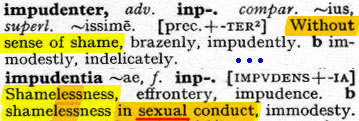
How about rather: Without the occurrence of shame? Otherwise, it sounds like the same meaning with or without the negation.
It can be a bit confusing dealing with the negatives “a-“ (Greek) and “im-“ (Latin). But again, what is “shame” or “shameful” matches what went on in Selge. And the opposite of what went on in Selge is what the Bible writers are putting down. Therefore, what went on in Selge is what the Bible writers support, including Jesus. And, there are indications that it was a tamer open-sex than the popular orgies of Bacchus / Dionysus:
Jesus and Paul here may have been talking against the rioting and drinking of Bacchus; taming it to a more gentler, loving kind of promiscuous love:
Romans 13:13-14:
13Let us walk honestly, as in the day; not in rioting and drunkenness, not in
chambering and wantonness, not in strife and envying.
14But put ye on the Lord Jesus Christ, and make not provision for the flesh, to fulfil the
lusts thereof.
A provision / providence is conditions, agreements, preparations in advance, like in getting married. Not open / free sex.
The literal and verbatim Greek says:
Romans 13:13-14:
As in day, becomingly we should walk, not in rioting and drinking, not in cohabitation and aselgia, not in fighting / strife and envy / emulation; but, put one the Lord Jesus Christ and the flesh forethought / provision / providence not make for lusts.
Cohabitation is living together which is near monogamy. And envy and lust is the “strong” / “intense” desire that makes two people only want to be with each other. Therefore, sexual love would be more loving and openly mutual between all, instead of so wild. One of the (far) above definitions defining “a-“ as “to raise a disturbance or noise” would fit.