LUST
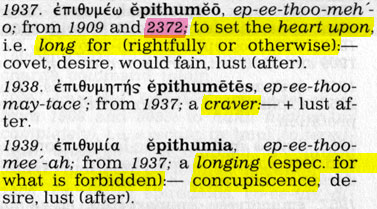
Greek: επιθυμ… [transliterated: epithum… ]: Strong # 1937-1939
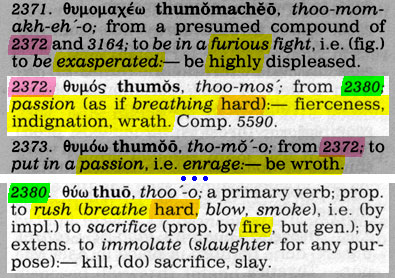
Also, θυμ… is the root [transliterated: thum… ]: Strong # 2372
You see, today’s church morals has everything to with marriage, redefining all sexual wrongs to be any sex outside of marriage; but, the true essence of “lust” is strong / intense love: a longing for someone.
This is pursuant to my 08-03-00 NEWS RELEASE – Easily Brainwashed Society “lust” circular.
Premise:
Matthew 5:28:
“But I say to you that whoever looks at a woman to lust for her has already committed adultery with her in her heart.”
It has something to do with the way men look at women. What are guys thinking when an “attractive” female is walking down the sidewalk? And, what are guys thinking when an “unattractive” female is walking down the sidewalk? See the difference? See the discrimination? Therefore, the message against lust is to avoid looks discrimination in partners. Otherwise, if we define lust as any kind of sexual desire, then mankind would end if everyone did what Jesus says to do.
It’s a combination word:
The Englishman’s Greek Concordance of the New Testament, Wigram, 1903, republished 1996, p. xxiii, “Vocabulary” (shows compound words via “-“):
P. xxv:

Overview:
The New Strong’s Complete Dictionary of Bible Words, James Strong 1822-1894, Thomas Nelson Publishers, 1996, “Greek Dictionary of the New Testament” p. 621, “1937 | 1938 | 1939”:
P. 634, “2372 | 2380”:
Greek επι- :
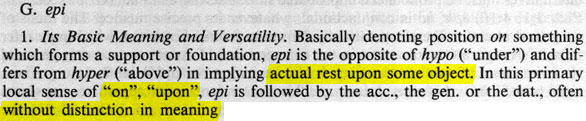
The New International Dictionary of New Testament Theology, Brown, Zondervan Publishing, 1978, vol. 3, p. 1193, “Appendix | II Some Theologically Important Instances of the Major Prepositions | G. epi-”:
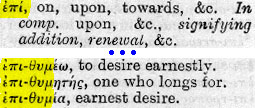
A Greek and English Lexicon, Wright, 1861, p. 187:
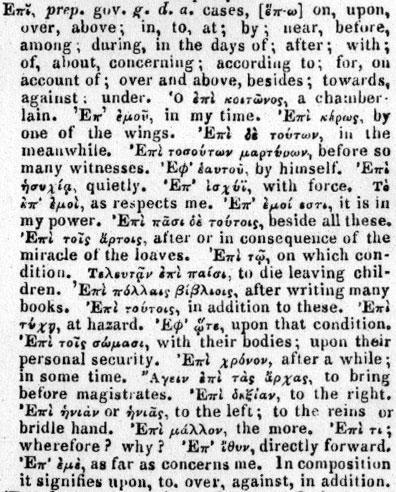
επί means: on, upon, over, at, etc.
Greek επι-θυμ… :
A Critical Lexicon and Concordance to the English and Greek New Testament, Bullinger, 1908 (republished 1999), p. 472, “LUST [noun.] | επιθυμία”:
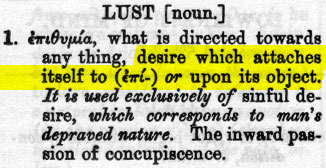
“Marriage” is much more of an attachment than is a one-night stand. “Marriage” definitely corresponds to man’s depraved nature. Ask those who suffer in or out of its conditions.
…
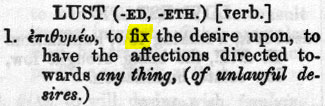
“Marriage” is much more of a fixed position than is a one-night stand. “Marriage” is unlawful according to Matthew 19:10-12.
Mounce’s Complete Expository Dictionary of Old & New Testament Words, 2006, p. 1152, “επιθυμέω”:
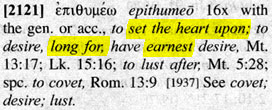
http://www.answers.com/long, “long”:
Of relatively great duration: a long time.
Doesn’t sound like a one-night stand to me.
http://www.answers.com/earnest, “earnest”:
Marked by or showing deep sincerity or seriousness
Sounds like marriage to me.
http://www.answers.com/heart-symbol, “heart (symbol)”:
The heart (♥) has long been used as a symbol to refer to the spiritual, emotional, moral, and in the past also intellectual core of a human being.
Sounds like what we’re supposed to feel for our spouse, not for a one-night stand.
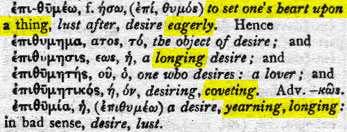
Greek-English Lexicon: Abridged Edition, Liddell & Scott, Oxford, 1871, impression of 1994, p. 252, “επιθυμ…”:
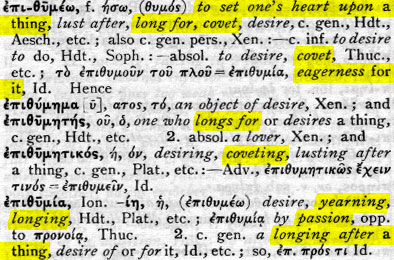
An Intermediate Greek-English Lexicon, Liddell & Scott, Oxford, 1997 (first edition 1889), p. 292, “επι-θυμ…”:
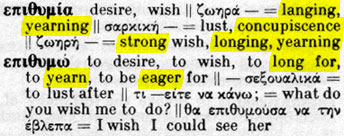
ΑΡΙΣΤΟΝ ΕΛΛΗΝΟΑΓΓΛΙΚΟΝ ΛΕΞΙΚΟΝ (Most Excellent Greek-English Dictionary), Michigan Press, 1969, Vol. A, p. 265, “επιθυμ…”:
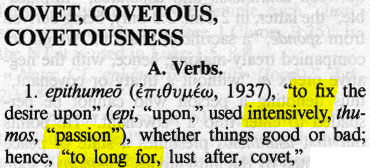
Vine’s Complete Expository Dictionary of Old and New Testament Words, W. E. Vine (1873-1949), Thomas Nelson Publishers, 1996, p. 136 (New Testament Words), “COVET, COVETOUS, COVETOUSNESS”:
P. 221, “FAIN”:

Sounds like marriage to me.
P. 384, “LUST”:
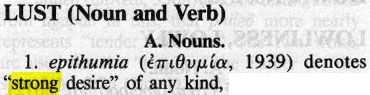
Greek-English Lexicon of the New Testament Based on Semantic Domains, Louw & Nida, United Bible Societies, 1989, Vol. 1, p. 290, “25.12 επιθυμέωa; επιθυμίαa, ας”:
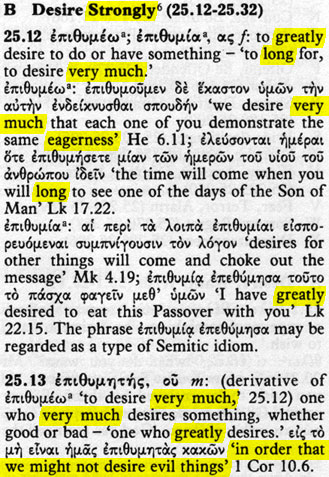
The Greek English Concordance to the New Testament with the New International Version, Kohlenberger III / Goodrich / Swanson, 1997, p. 1060 (“A Concise Greek-English Dictionary”), “(G/K #’s) 2121-2123 επιθυμ…”:
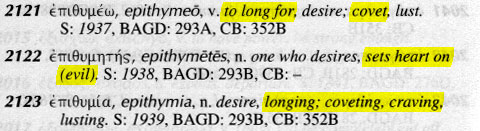
A Pocket Lexicon to the Greek New Testament, Souter, Oxford, 1916 (reprinted 1917), p. 92:
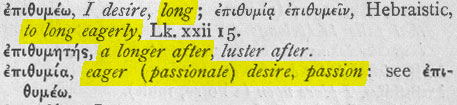
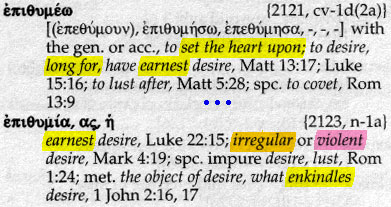
The Analytical Lexicon to the Greek New Testament, Mounce, 1993, p. 205, “επιθυμ…”:
Much domestic violence is caused by the co-dependent marriage standard.
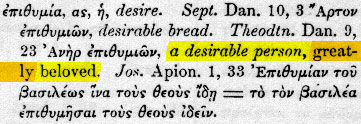
Greek Lexicon of the Roman and Byzantine Periods (From B.C. 146 to A.D. 1100), Sophocles (1807-1883), 1957, Vol. I, p. 501:
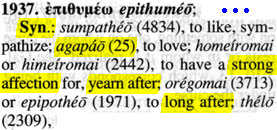
The Complete Word Study Dictionary of the New Testament, Zodhiates, 1993, p. 627, “1937. επιθυμέω epithuméō”:
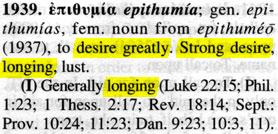
“1939. επιθυμία epithumίa”:
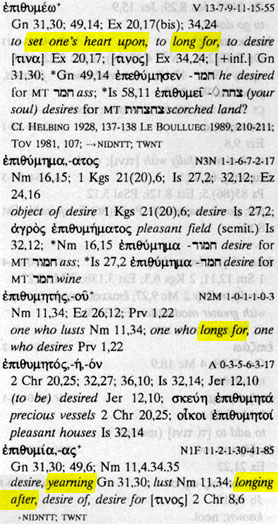
A Greek-English Lexicon of the Septuagint, Lust / Eynikel / Hauspie, 1992, part one, p. 170, “επιθυμ…”:
Expository Dictionary of Bible Words, Richards, Zondervan, 1991, p. 423, “LUST”:
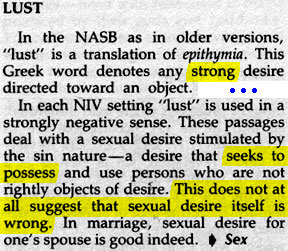
Let me get this straight: We’re not supposed to desire to “possess” a person. But then, that’s what makes people want to get married / monogamous. But then, it’s okay to have that desire “rightly” like in marriage. So “marriage” is the line, in their addendum.
The same word is used for “Thou shalt not covet” in Romans 7:7 & 13:9.
Greek -θυμ… :
The New International Dictionary of New Testament Theology, Brown, Zondervan Publishing, 1975, vol. 1, p. 106, “Anger, Wrath | -θυμός”:

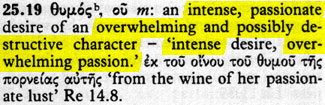
Greek-English Lexicon of the New Testament Based on Semantic Domains, Louw & Nida, United Bible Societies, 1989, Vol. 1, p. 291, “25.19 -θυμός”:
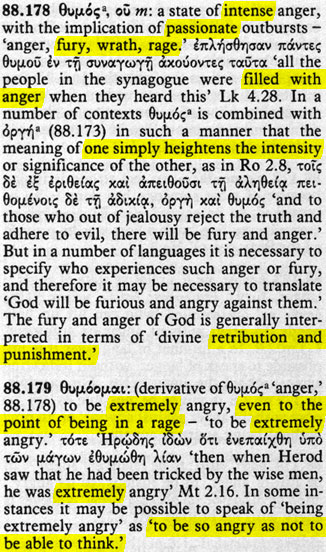
P. 762, “88.178 -θυμός”:
The Analytical Lexicon to the Greek New Testament, Mounce, 1993, p. 248, “-θυμ…”:
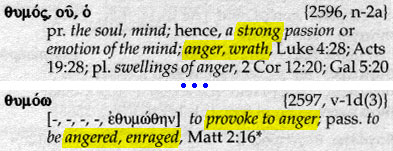
The Analytical Greek Lexicon, Zondervan Publishing House, 1973 printing, p. 197, “-θυμο…”:
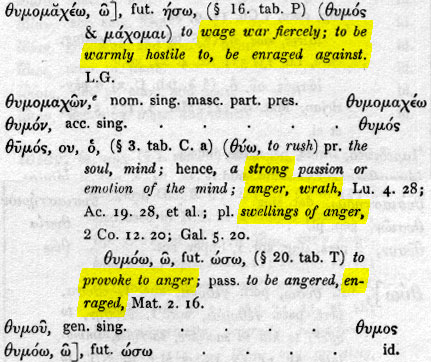
Greek to English Interlinear, Berry, 1981, Greek-English New Testament Lexicon (supplement), p. 47, “-θυμο…”:
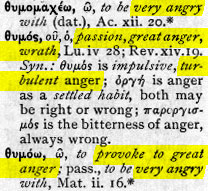
A Greek-English Lexicon with a Revised Supplement (unabridged), Liddell & Scott, Oxford, 1996 (first edition 1843), p. 810, “-θυμός”:

The Greek English Concordance to the New Testament with the New International Version, Kohlenberger III / Goodrich / Swanson, 1997, p. 1069 (“A Concise Greek-English Dictionary”), “(G/K #’s) 2595-2597 -θυμο…”:
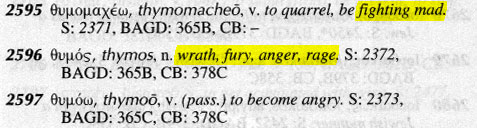
Greek-English Lexicon: Abridged Edition, Liddell & Scott, Oxford, 1871, impression of 1994, p. 323, “-θυμός”:
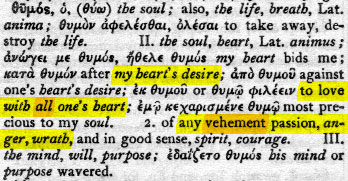
Langenscheidt’s Standard Greek Dictionary, Magazis, 1990, p. 605 (Greek-English), “-θυμός”:

ΑΡΙΣΤΟΝ ΕΛΛΗΝΟΑΓΓΛΙΚΟΝ ΛΕΞΙΚΟΝ (Most Excellent Greek-English Dictionary), Michigan Press, 1969, Vol. A, p. 311, “-θυμός”:

A Greek-English Lexicon of the Septuagint, Lust / Eynikel / Hauspie, 1992, part one, p. 209, “-θυμός”:
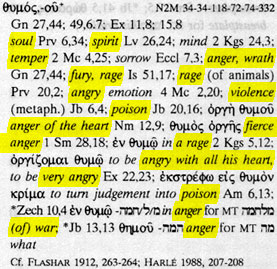
A Critical Lexicon and Concordance to the English and Greek New Testament, Bullinger, 1908 (republished 1999), p. 905, “-θυμός”:
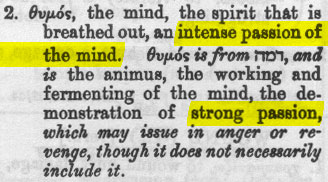
In monolingual Ancient Greek:
http://www.magenta.gr/en/en_demos.htm, Ancient-Modern & Modern-Ancient Greek dictionary, (free 15-minute demo download [anc_setup_en.exe 2-16-04]), “-θυμος” (key-in “uymow”):
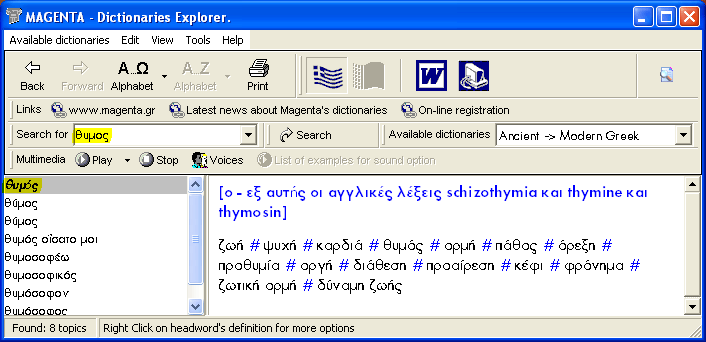
http://babelfish.altavista.com/ (phrase translations), Greek-English, (the above text via copy-paste):
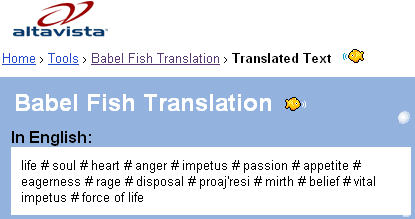
proaj'resi means preference, internal bent.
English:
http://www.newadvent.org/cathen/15458a.htm (Catholic Encyclopedia), Virginity:
There are two elements in virginity: the material element, that is to say, the absence, in the past and in the present, of all complete and voluntary delectation, whether from lust or from the lawful use of marriage; and the formal element, that is the firm resolution to abstain forever (darkness) from sexual pleasure.
Here, the Catholic Encyclopedia defines “lust” as sex outside of marriage.
The Century Dictionary and Cyclopedia, 1897, p. 3547, “lust” (n.):
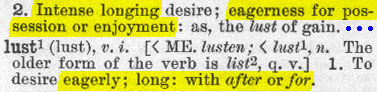
Sounds to me like the sentiment of someone who wants to get married. I mean, they shouldn’t get married if they don’t have these kinds of feelings.
Roget’s II: The New Thesaurus, Expanded Edition, 1988, p. 309, “lust”:
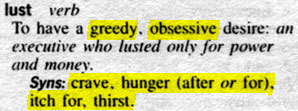
Would that be like falling head over heals for someone? With a greedy, obsessive crave, hunger, itch or thirst, where jealousy against all other’s is mandate? I’m sure she’ll be very impressed.
New Webster’s Dictionary of the English Language: Modern Desk Edition, 1976, p.303 , “lust”:

Microsoft Encarta Dictionary (paperback), 2002, p. 526, “lust”:

The Youth Bible, Word Publishing, 1991, “Dictionary” p. 1367, “lust”:

“Something” doesn’t specifically define what the “evil” is.
The Random House Dictionary: Concise Edition (paperback), 1980, p. 524, “lust”:
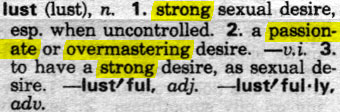
The Random House Dictionary of the English Language (Unabridged), 1987, p. 1146, “lust | lustful”:
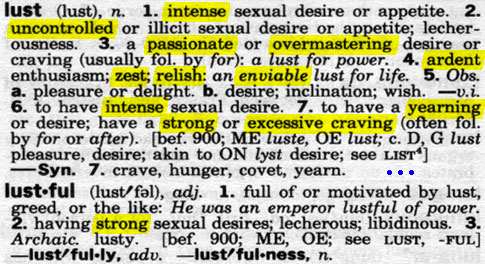
Young’s Analytical Concordance to the Bible, Robert Young (1822-1888), p. 625, “LUST (after), to”:

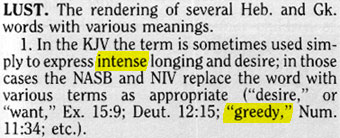
The New Unger’s Bible Dictionary, 1988, p. 789, “LUST”:
A Pronouncing Dictionary of the English Language, 1796, p. 159:

The Merriam-Webster Dictionary: Home & Office Edition, 1998, p. 309, “lust”:

The American Heritage Dictionary of the English Language, 1992, p. 1071, “lust”:
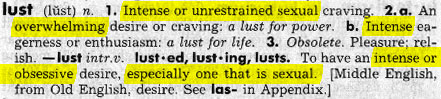
“Unbridled,” “unrestrained” is their spin for marriage.
Here’s the Catholics pinpointing “attractive”:
How Catholics Live: Section 4: Virtues and Vices (free booklet I picked up 8-16-09 at the Catholic booth at the Missouri State Fair), Catholic Information Services, Knights of Columbus Supreme Council, 2001, p. 19, “23. The Seven Deadly Sins | Lust”:

Wouldn’t “desiring the one God alone” be like sexually desiring all different kinds of looks?
Love versus lust (they’re kind of the same):
Random House Word Menu, 1992, p. 734, “Character and Behavior | Sex, Love, and Romance | love”:

Longmans English Larousse, 1968, p. 686:

Longman Dictionary of American English, 1997, p. 483:
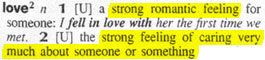
The New Home and Office Webster Dictionary, 1933, p. 545:
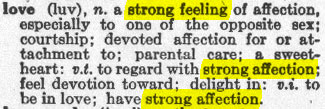
P. 548:

Of course, Jesus in John 13:34 commanded us to “love one another” thereby evening-out “love,” lessening the intense attachment for just one, and to gain concern for all others. Both objectives are needed in this world.
Jealousy:
Stories Behind Words, Limburg, 1986, p. 21:
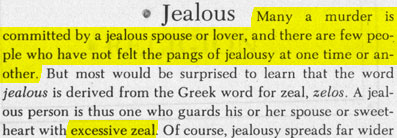
Also, in an open/free sex world, there will simply be less “lust”:
When everyone is satisfied with the diversity of sexual partners, no one will “crave intensely” like today’s people who are sexually depraved. No one will desire to rape someone, or become violent when she breaks up with you, etc.
Luster:
http://www.answers.com/luster, “Luster”:
3. Glory, radiance, distinction, or splendor, as of achievement, reputation, or beauty.
http://www.merriam-webster.net/cgi-bin/dictionary?book=Dictionary&va=lusterless, “luster”:
3 : a superficial attractiveness or appearance of excellence
The Oxford English Dictionary, 1933, “Lustre”:
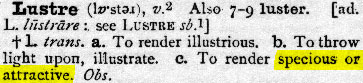
“Specious” means “deceptively attractive.”
Well, this definition fits with Jesus’ definition of sexually lusting with the eye: Matt. 5:28:
“But I say to you that whoever looks at a woman to [render superficially / deceptively attractive / appearance of excellence] for her has already committed adultery with her in his heart.”
Parallel passage in the Old Testament:
The following passage indicates that the “lust” that Jesus was talking about in adultery was because of her “beauty.” This indicates that it’s not “lust” if you have sex with an “unattractive” woman. Furthermore, the penalty from this particular scenario was secular punishment not Afterlife punishment:
Proverbs 6:24-26; 34 (NIV):
24 keeping you from your neighbor’s wife,
from the smooth talk of a wayward woman.
25 Do not lust in your
heart after her beauty
or let her captivate you with her eyes.
26 For a prostitute can be had for a loaf of
bread,
but another man’s wife preys on your very life.
…
34 For jealousy
arouses a husband’s fury,
and he will show no
mercy when he takes revenge.
It goes on telling that the jealous revengeful husband will kill you. Therefore, don’t sleep with a jealous man’s wife! You hear? It would actually be better to cut out your eyes then to be killed by this jealous man, right? But, in a future open-sex society, where there are no jealous husbands, it would not harm a man to sleep with any other women. Plus, if there are no jealous husbands claiming valid victimizations, then there are no Afterlife penalties either (concerning adultery). Like Jesus said in Matthew 19:9-12, if there are no marriages, then there can be no adulteries.
Case in point:
Proverbs 7:10-27 (NIV):
10 Then out came a woman to meet him,
dressed like a prostitute and with crafty intent.
11 (She is unruly and defiant,
her feet never stay at home;
12 now in the street, now in the squares,
at every corner she lurks.)
13 She took hold of him and kissed him
and with a brazen face she said:
14 “Today I fulfilled my vows,
and I have food from my fellowship offering at home.
15 So I came out to meet you;
I looked for you and have found you!
16 I have covered my bed
with colored linens from Egypt.
17 I have perfumed my bed
with myrrh, aloes and cinnamon.
18 Come, let’s drink deeply of love till morning;
let’s enjoy ourselves with love!
19 My husband is not at home;
he has gone on a long journey.
20 He took his purse filled with money
and will not be home till full moon.”
21 With persuasive words she led him astray;
she seduced him with her smooth talk.
22 All at once he followed her
like an ox going to the slaughter,
like a deer stepping into a noose
23 till an arrow pierces his liver,
like a bird darting into a snare,
little knowing it will cost
him his life.
24 Now then, my sons, listen to me;
pay attention to what I say.
25 Do not let your heart turn to her
ways
or stray into her paths.
26 Many are the victims she has brought down;
her slain are a mighty throng.
27 Her house is a highway to the
grave,
leading down to the chambers
of death.
The passage sounds like the most attractive women were all married. In that era, it really doesn’t make any sense that the most attractive women would not have been captured in marriage with the expectations of monogamy by the wealthiest men, as he would give her more for her monogamy.
The solution:
…is a new teaching for open sex with a desire for diversity in sexual partners. Then, when we desire another kind of look every time, it will result in the inclusion of everyone, “attractive” or “ugly,” and pretty much balanced out. In fact, this kind of balanced diversity is the only way an open-sex society can succeed. In the seventies, after the pill and before serious STDs/AIDS, there was a lot more promiscuity, but mainly for the attractive: “ugly” people were pretty much left out.
Because there are some really “ugly” people out there that most people wouldn’t want to touch with a ten foot poll, you think my goal is impossible. But, since men (with libidos) enjoy doing cunnilingus to women: since they like doing that, then the human mind can equally enjoy having sex with an “ugly” person. So, my ultimate solution is not as dumb as you all think. In fact, “sewer chewers” (anal cunnilingus) guys (and gals) just proves how “powerful” of a tool sexual desire really can be, when what is otherwise repulsive or ugly becomes attractive. That power can make everyone (adults) in the entire world “attractive,” and is the key to us all getting along a lot better. Thank you Jesus for giving me your very demanding (cut out your eye) support on this issue.