AGAPE – SEPTUAGINT QUOTES
(Either “αγαπ…” or “ηγαπ...”)
(Includes ahab, the Hebrew parallel word)
By understanding the context of a word, a person can see valid definitions of a word used by the Early Christian (the actual writers of the New Testament).
http://apostolicbible.com/downbook.htm (formerly: http://septuagint-interlinear-greek-bible.com/downbook.htm), The Apostolic Bible (Applies to all the unreferenced Septuagint Interlinear images below).
Non-marital sexual love:
Genesis 34:1-4:
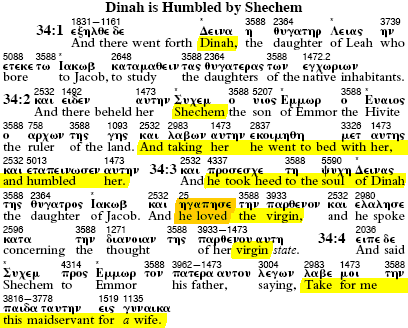
This shows that agape love is not only about just having sex, but is sexually based love with strong fondness. You can have non-sexual agape love for your son or your parents; but, again, today’s Churches are trying to say that agape love has nothing to do with sexual love, but it does. The word agape or love (in English) are like the Greek word parthenos (παρθενος), which is translated virgin or maiden: Sometimes it meant a young unmarried woman who has had sex, and sometimes it meant a young unmarried woman who has not had sex. Or like gunaikos (γυναικος), sometimes it meant wife and sometimes it just meant woman. If Jesus meant for us to love one another but not sexually / romantically, he would have had to discriminate that from the word agape; but, he didn’t signifying that He did not mean to change the full meaning of agape, which includes sexual / romantic love. He just “added” to the full definition of agape that agape needed to be done between all people; therefore, with less favoritism. Therefore, since an unrelated man and woman, who are in “love” with each other, is a sexually based love, then, logically, any and all unrelated men and women need to sexually love one another. You see, in Bible class, when a one-in-a-thousand “thinker” asks, “Since the English word love indicates sexual love between unrelated adults, then how do we know that Jesus’ word for love only meant non-sexual / non-romantic love?” They would only need to answer, “Because of the definition of fornication.” End of story for the thinkers. Therefore, the brainwash is immense.
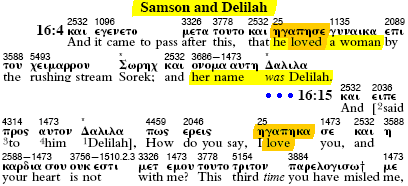
Judges 16:4,15:
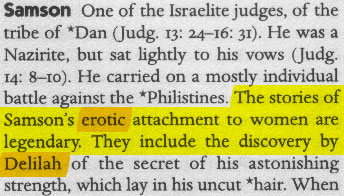
HarperCollins Bible Dictionary, 1996, p. 966, “Samson”:

So agape love includes “[fall] in love” kind of love. So, what kind of relationship is a “fall in love” relationship? It’s a sexual / romantic / “erotic” kind.
Oxford Dictionary of the Bible, Browning, 1996, p. 332:
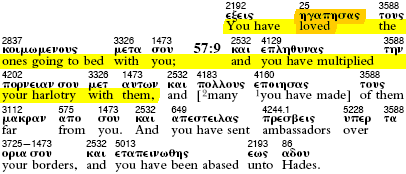
Isaiah 57:8-9:
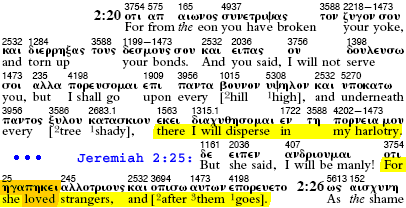
Jeremiah 2:20, 25:
The Oxford Bible Commentary, 2001, Jeremiah, p. 491, “A Broken Marriage | The Divorce”:
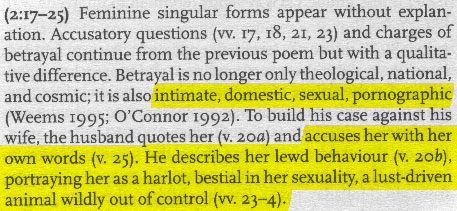
Having intimate, sexual, pornographic, lewd behaviour, harlotry, lust-driven agape love with stranger sounds sexual / erotic.
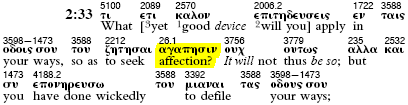
Jeremiah 2:33:
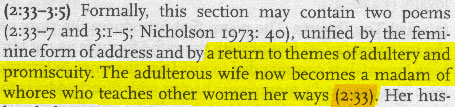
The Oxford Bible Commentary, 2001, Jeremiah, “A Broken Marriage | The Divorce,” p. 492:
Hosea 4:18:
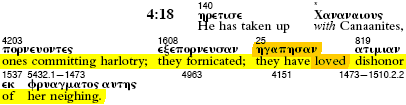
The New International Dictionary of New Testament Theology, Brown, Zondervan Publishing, 1976, vol. 2, p. 540, “Love | αγαπάω”:

Hosea 9:1:
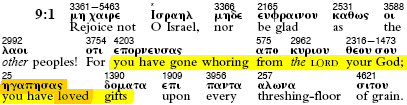
http://bible.gospelcom.net/passage/?book_id=35&chapter=9&version=50, Same verse (Hosea 9:1) in NKJV (from the original Hebrew):
Do not rejoice, O Israel, with joy like other peoples, for you have played the harlot against your God. You have made love for hire on every threshing floor.
Married love:
Genesis 24:67:

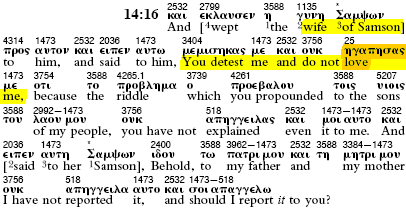
Judges 14:16:
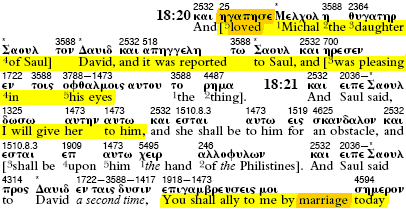
1 Samuel 18:20-21:
1 Kings 11:1-3:
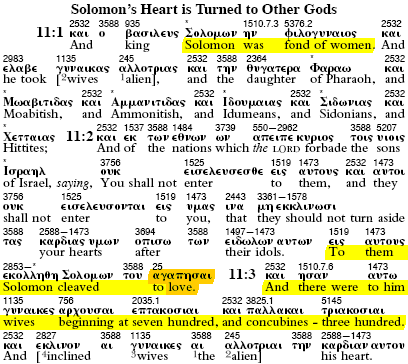
Solomon “cleaved” to so many pagan women just to please his agape love, that he turned away from the Lord because of their abundant pagan influence. Now if that doesn’t refer to sexual love, then my name is Mr. Non Reality. I’m seeing that agape love is basically the same definition as the English word “love,” which includes the sexual desire parts. But, I realize, it’s still very, very difficult for your human mind to believe that Jesus instructed sexual love between His disciples and other adults. So let’s just pretend that Joe Blow today tells us that “We need to love all the people we can.” So with Children: you’d be nice to them, keep them from harm, do things for them, buy them toys, etc. Nothing sexual. (Pretty much what we already do.) To other adults (from the male perspective) – women: (“love all you can”) It definitely sounds sexual with non-blood-related women. With men: (“love all you can”) It also sounds sexual. You see, no trucker tells another trucker on the CB, where everybody can hear it, that he loves him, unless they’re gay. With family: Stop there: You already have enough favoritism for them, so avoid incest. So, it looks like the only modern day change we really have is the open sexual love between non-related adults part. I think there’ll be a lot less incest and rape once all adults are free to have sex with all other non-related adults. I would also suggest for you to not have sex with close friends either. Pretty much anyone you have a good amount of favoritism for, avoid sex with them. Your enemies? -- A must (to have sex with them). I know what you’re still thinkin’: that there’s still just no way that Jesus could have wanted that. Right? (It’s just makes me feel good to know what people are really thinking.) I mean, I could show you some nude photographs of women, and the vast majority of you non-clergies would better understand what Solomon was talking about when he said he agape loved them, but this site is rated PG (for today’s status quo); so, you’re going to have to “think” harder. Technically, it’s impossible for you to “emotionally” feel that Jesus instructed sex, but overruling your emotions with true facts and logic makes the impossible possible. However, if you actually do understand this, then you’ll say “now I have to change my lifestyle”; but no, the beauty of this is that you don’t have to change your present love arrangement. We just need to teach the right thing to our open-minded youth, so they can have the chance to live in a less favoritism world – a world that no one today, anywhere in the entire world, has ever experienced. The context of agape in the Septuagint is “conclusive” evidence as to its full meaning.
The Septuagint with Apocrypha, 1851, Brenton, seventh printing 1998, (The Apocrypha) p. 7, I. Esdras IV.24-25:
Here’s a connection between a form of the word eros (ερωμενη) in verse 24 and agape in verse 25:

But regardless of the eros-agape connection, when a man agape loves his wife better than his father or mother, it’s sexual love.
(The Apocrypha is just as valid for context definitions, because it was part of the earliest Christian Bible.)
Okay, let’s see how it sounds:
John 13:34-35:
34A new commandment I give to you, that you have the kind of love in marriage for one another; as I have had the kind of love in marriage for you, that you also have the kind of love in marriage for one another. 35By this all will know that you are My disciples, if you have the kind of love in marriage for one another."
Again, Jesus commands that the kind of love in marriage (sexually based) is for all to do with “one another”:
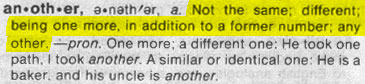
New Webster’s Dictionary of the English Language: Modern Desk Edition, 1976, p. 22:
Love for the sexually attractive:
Genesis 29:16-18:
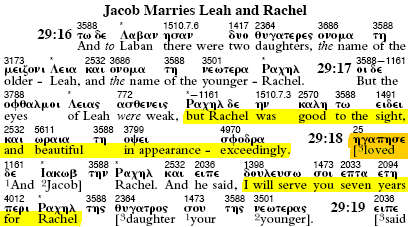
So agape love is “Hey good lookin’, whatcha got cookin’. How’s about cookin’ somethin’ up with me?” kind of love.
Genesis 29:20:
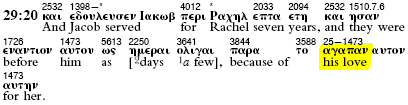
Genesis 29:28-30:
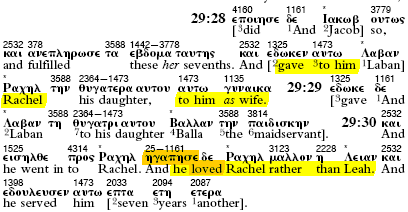
This is exceptionally good, because it shows Jacob had agape love for Rachel (the more attractive, the one he wanted to marry), and did not have agape love for Leah who he didn’t want to marry, but was tricked into marrying. You can have non-sexual agape love for your son or your parents; but, again, today’s Churches are trying to say that agape love has nothing to do with sexual love, but it does. Yes, as you can see, Septuagint agape is intense love like the word lust – especially as it is used for the love you’re supposed to have for God – but that’s okay, because Jesus then commanded “that you lust for one another.” The problems come in when you just lust for one or a few people, not all people. I believe verse 31 indicates that God was displeased because Jacob didn’t also lust for Leah as well.
Genesis 29:32:
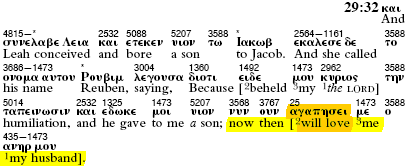
Leah was hoping that Jacob would have agape love for her.
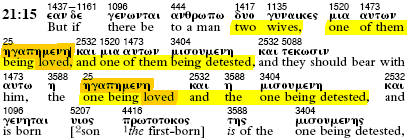
Deuteronomy 21:15:
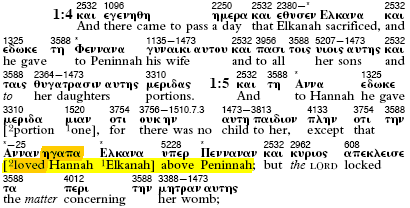
1 Samuel 1:4-5:
Elkanah had two wives: Hannah and Peninnah:
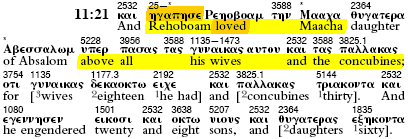
2 Chronicles 11:21:
A Concordance to the Septuagint, Hatch and Redpath, 1897, reprinted 1983, vol. 1, p. 6 “αγαπαν”:

The above concordance of 1 Esdras (Apocrypha) 4:18 shows “A” agape analogous with “B”; with the English translation as “love.” Which means that “A” agape was the word used in Codex Alexandrinus, and the word in “B” was the one used in Codex Vaticanus (which Brenton used):
The Septuagint with Apocrypha, 1851, Brenton, seventh printing 1998, (The Apocrypha) p. 7, I. Esdras IV.18:

Let’s try ‘er:
John 13:34-35:
34A new commandment I give to you, that you have sexual desire in looks for one another; as I have had sexual desire in looks for you, that you also have sexual desire in looks for one another. 35By this all will know that you are My disciples, if you have sexual desire in looks for one another." Well, it’d have to be a desire for diversity in looks, now wouldn’t it? The evidence is clear, yet you still think I’m just drawing my own conclusions. I’m just putting all forms of the word agape-love into context. They all “fit” with what I say is needed. Jesus did not say: “… except any kind of sexual love.” But the people who we pay dearly to run our Churches do. How could one “nobody” (me) know all this, and all the Churches not? Good question.
Flat out sexual love:
Ah yes, the most romantic stories in the Bible are the agape love stories:
Song of Solomon 1:1-4:
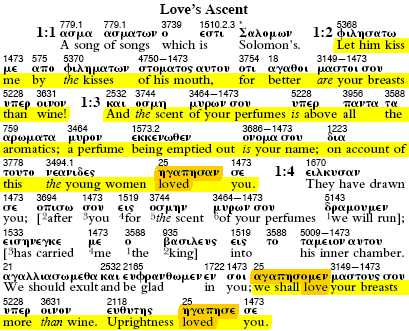
Now, for all you long-term, conventional nuns and priests, “kisses of the mouth,” “breasts” and “perfume” all have to do with… sexual love. So, agape love definitely has to do with sexual love. John 13:34 (NKJV): “A new commandment I give to you, that you love the breasts, mouths, and scents of one another.” It is also stating that this kind of agape love is ευθυτης, which means righteousness / uprightness.
But was Jesus aware of Solomon: Matthew 6:29 & Luke 12:27 (NKJV): “and yet I say to you that even Solomon in all his glory was not arrayed like one of these.” Matt. 12:42 & Luke 11:31: “indeed a greater than Solomon is here.” – And, it sounds like Jesus was very impressed with Solomon. Also, John 10:23: “And Jesus walked in the temple, in Solomon’s porch.” Of course, Jesus is the voice of God, so God definitely knew Solomon, because God knows everything – end of story.
Song of Solomon 1:7:
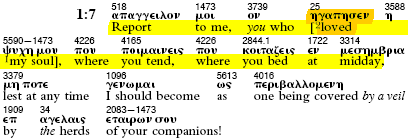
Most people go to bed at… “night.” Going to bed during the “midday” would be for another purpose.
Song of Solomon 2:4-7 (“Chapter 2: Love’s Embrace”):
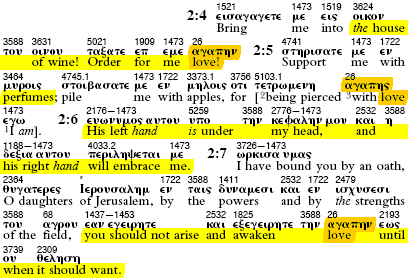
Wine seems to get the women in the mood for agape love; and, agape love does not “arise and awaken” until it “should want,” both sound like the reality of intermittent sexual desires because, as we all know, sexual desire is not a continuous desire: sometimes we desire sex and sometimes we don’t. No other kind of love is that way.
Song of Solomon 3:1-5:
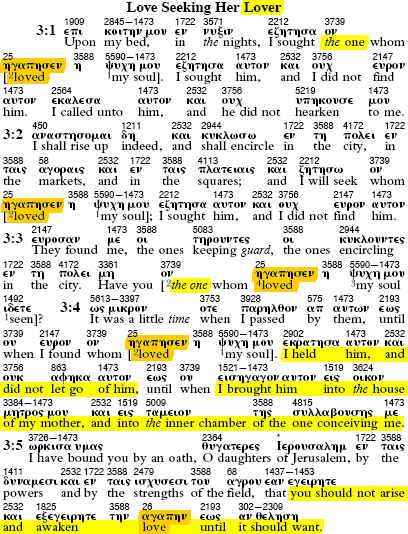
This “one” that her soul agape loved, implies that she is able to only agape love “one” individual, her lover; but, this just shows that the highest or strongest kind of agape love is sexual love, which makes her willing to search all of Jerusalem for him. According to the commentaries, the “inner chamber of the one conceiving me” is her mother’s bedroom. This also indicates that they are not married. “Conceiving” (συλλαβουσης) is the Greek word for getting pregnant (Strong # 4815: Luke 1:24,31,36; 2:21). Ditto above on the “arise and awaken” until it “should want.”
Song of Solomon 5:8:
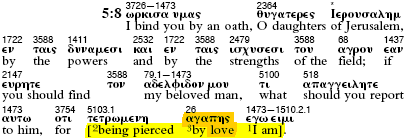
Verses 5:2-6 indicates that her beloved purposely disappears, probably by her stalling while he’s waiting for her at her door. Then she’s upset because she can’t locate him. “Being pierced by agape love” indicates that agape love is heartbreak (lovesick) love.
http://www.soniclight.com/constable/notes/pdf/song.pdf, Notes on Song of Solomon, “5:8”:
"'Lovesick' here seems to describe frustration from sexual abstinence rather than exhaustion from sexual activity (cf. on 2:5).
By the way, “My beloved man” (αδελφιδον) is a Classical Greek word meaning a beloved kinsman.
Song of Solomon 7:1-13:
This sounds like something that would be good to say in a strip joint:
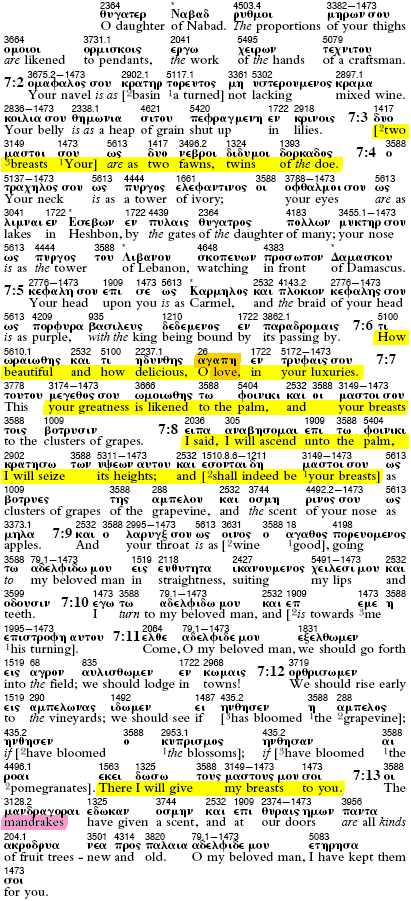
Lots of sexual / erotic talk there. Eros would be proud.
http://dictionary.reference.com/search?q=mandrake (Dictionary.com), “mandrake”:
… were formerly supposed to have aphrodisiac properties … was formerly used especially to promote conception
Song of Solomon 8:1-8:
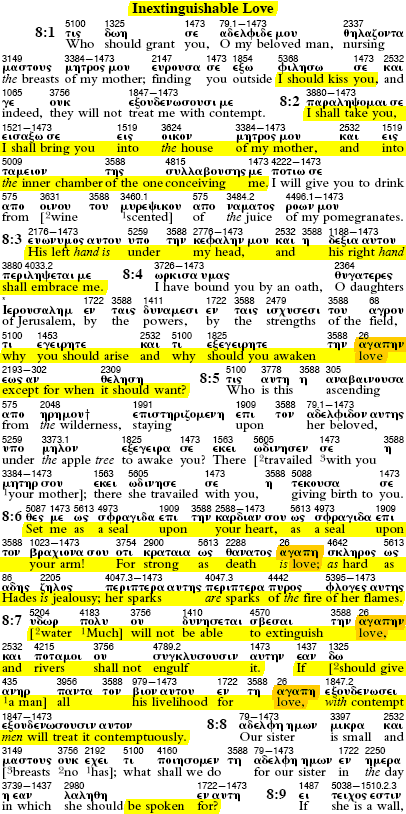
Kissing, taking him to bed, wining and dining, his hands embracing her, a kind of love that arises / awakens when it wants, and a seal on her heart, strong agape love, painful jealousy, agape sparks, agape fire (that water / rivers can’t extinguish / engulf), to be spoken for. It all sounds sexually based to me. Again, this IS what the writers of the entire New Testament were aware of (because the Septuagint was their Bible; therefore, their dictionary) when they used the word agape for what Jesus “commanded” everyone to do to one another. This IS proof CONCLUSIVE! And, agape between one another was Jesus Christ’s only “new” commandment that He instructed (John 13:34); therefore, making agape between one another the only unique thing about being a Christian over being a Jew (John 13:35). Jesus Christ is the most popular person (and religious figure) that has ever lived; which, might make a person think He had something to do with God. Jesus made it very clear that there would be a very noteworthy imposter of His teachings (today’s mainstream Churches, “logically”). If God did not inspire Jesus Christ, the most popular religious figure ever, then God royally messed up. You see, I believe God knew that Jesus would become the most popular person that ever lived.
Holman Book of Biblical Charts, Maps, and Reconstructions, Broadman & Holman Publishers, 1993, p. 28:
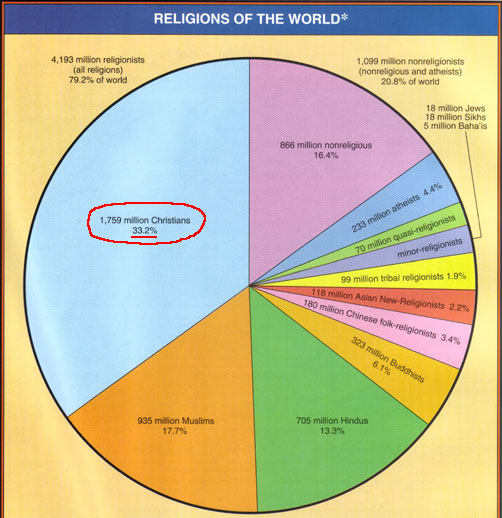
As you can see, Christianity is the largest religion in the world; therefore, Christ is the most popular religious figure that has ever lived. No one high in the Church is going to change until someone influential presents my stuff to the public.
Note, “jealousy” is (for example), of course, not what Jesus wanted everyone to have between one another, it’s just an attribute of sexually based love used in Solomon. Today’s Churches’ marriage standards, is where jealousy between one another comes into view.
Song of Solomon is sometimes titled “Song of Songs” or “Canticles.”
Song of Solomon is just another great example of the “agape” love between a man and a woman. So, if you are a man and a woman, “Jesus” says you should love like this. And especially with “one another.”
Eros / erotic love:
Proverbs 30:15-16:
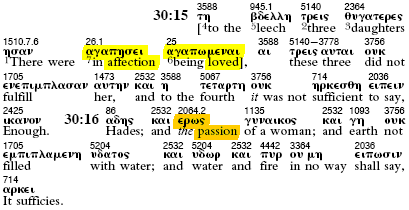
The Septuagint with Apocrypha: Greek and English, Brenton, 1998, p. 812 (Originally published by Samuel Bagster & Sons, Ltd., London, 1851), “Proverbs 30:15-16”:

This allegoric / metaphoric / symbolic verse has two instances side by side of agape (αγαπ…) in context with one instance of eros (ερως). The text indicates that one of the agape agape daughters has unsatisfying eros. A solution to the metaphor could be that eros is one of the three parts of agape: (1) agape for and from God, (2) non-sexual agape for and from parents, siblings, children, etc., and (3) sexually based agape for and from non-blood-related adults. The grave (Greek Hades) may represent Purgatory, the eros desire of a woman represents sexual love (the Purgatory and sex issues are, by far, where the most religious need is), and earth not filled with water may represent the world not fulfilled with correct religious teachings. And water again, representing religious need, and fire representing the corrupt mainstream Church, which is not enough to fulfill the world.
Incest love:
2 Samuel 13:1-15:
Amnon tricks his sister Tamar, then actually rapes her (therefore, sexual):
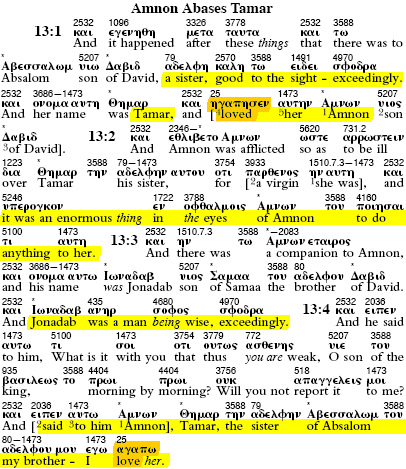
Then it goes on how Jonadab helped Amnon get sex from his sister, to aid him with his agape desire for his sister Tamar. (But, non-rape sex according to Jonadab later).

Now, I’m against rape no different than anybody else, and I don’t recommend incest (because love needs to be spread out more between the families), but this is a good example of how agape love can definitely mean sexual love / desire. Therefore, if a Greek man well versed in the Greek Old Testament during the days of Christ, says he has agape love for his sister (especially if he’s sick over it), it doesn’t mean he loves her as a sister, it means he loves / desires her sexual. If today’s churches were correct about agape love only meaning non-sexual love, then why would Amnon rape someone who he just had a high regard for? Most male siblings who love, but don’t sexually love their sister, would ruthlessly defend a sister that was being raped. So, agape love definitely only means sexual love here.
This is a good point in that if someone today says they love their sister, it means something non-sexual. But when Amnon said he (agape) loved his sister, it meant he desired her sexually. Therefore, today’s English word for “love” has many sexual references, but agape “love” had more: Today’s English word for “love” is sort of a euphemism for sexual love. But Biblically, agape love was apparently more sexually direct, connoting secondarily a non-sexual appeal as powerful as sexual love. Like a love for money didn’t mean someone was having sex with their money: it meant they strongly desired money like how one strongly desires sex. As a matter of fact, I can’t see a better comparison for a very, very strong kind of desire or feeling if it doesn’t measure up with sexual desire. Any other object of comparison would have to be less.
Bisexual love:
David and Jonathan:
(By the way, 1Sam. 17:42 tells that David was quite good-looking):

(They were not blood-related brothers.) Verses 18:1-4 doesn’t seem to indicate necessarily bisexual love, until you realize that they had just met: it was literally “love at first sight.” In 1:26 David relishes the fact that Jonathan possessed the Greek word for “beauty” with an “exceedingly” sort of agape affection, and then specifies a parallel to that unique kind of agape affection men receive from “women,” which is sexual love, so to accordingly compare that their agape love was even “above” that. With David not referencing agape love to or from God, or a father, or a son, etc. but pinpointing a sexual type of agape love between women and men (from David’s perspective), definitely conveys a bisexual relationship. I just like the fact that King David identified that there is a special kind of love between a man and a women which is called agape. Also, there’s that Greek word for wife / woman again (γυναικ…), this time just used (in its plural sense) as “women” instead of wives. The next instance of the full form of the same word is 2 Samuel 12:11:

By the way, “God” is the one giving the wives to the “neighbor” to have sex with them. Maybe the national wife swingers organizations should know about this one. Again, it’s not a sin (adultery) if both are consensual, but I don’t advise it (swinging) if you really want to stay married to each another.
Love between animals:
The Septuagint with Apocrypha, 1851, Brenton, seventh printing 1998, (The Apocrypha) p. 85, Wisdom of the Son of Sirach (Ecclesiasticus) 13:15:

There’s a lot of sex going on between animals of its own kind. There’s some interesting reading there:
http://ecmarsh.com/lxx/Sirach/Sirach.htm (The Septuagint Bible Online), The English Translation of the Septuagint Bible (Brenton 1851), Sirach 13:15-24:
15 Every beast loveth his like, and every man loveth his neighbour. 16 All flesh consorteth according to kind, and a man will cleave to his like. 17 What fellowship hath the wolf with the lamb? so the sinner with the godly. 18 What agreement is there between the hyena and a dog? and what peace between the rich and the poor? 19 As the wild ass is the lion’s prey in the wilderness: so the rich eat up the poor. 20 As the proud hate humility: so doth the rich abhor the poor. 21 A rich man beginning to fall is held up of his friends: but a poor man being down is thrust away by his friends. 22 When a rich man is fallen, he hath many helpers: he speaketh things not to be spoken, and yet men justify him: the poor man slipped, and yet they rebuked him too; he spake wisely, and could have no place. 23 When a rich man speaketh, every man holdeth his tongue, and, look, what he saith, they extol it to the clouds: but if the poor man speak, they say, What fellow is this? and if he stumble, they will help to overthrow him. 24 Riches are good unto him that hath no sin, and poverty is evil in the mouth of the ungodly.
Now, you see, if sex is restricted between a kind (humans), as it is today (the marriage standard), then they (humans) will not treat its kind devotedly. Now, not at animals cares for its own kind; accordingly, we’re in the same category as the Praying Mantis (who eats their mates).
Unclear:
Ecclesiastes 5:9:
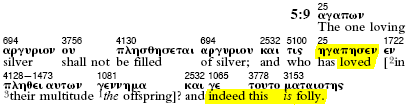
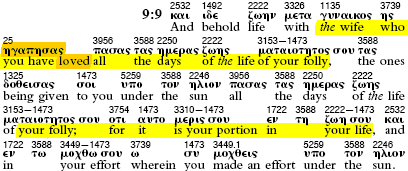
γεννημα “the offspring” which they have a question mark next to, is used four times in the New Testament as “generation.” And, “folly” has a sense in Dictionary.com as “lewdness; lasciviousness”; which, would say that agape love is sexual “lewdness; lasciviousness.” The following from the same book (Ecclesiastes) gives more support to my speculation:
Ecclesiastes 9:9:
http://www.agapetae.org/agape.html, St. Ephrems Pearl, “Original Agape – Song of Solomon love”:
Christians are generally taught that 'agape' was a new word coined by the early Christians, as they did not want to use any of the existing Greek words for love because of their associations. This is not true.
The Compact Dictionary of Doctrinal Words, Miethe, Bethany House Publishers, 1988, p. 17:
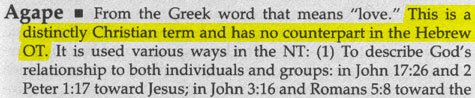
I am amazed how many college graduates will “just believe” that statement. The absurdity of “a distinctly Christian term” is that, if the Christians just made up the word (with apparently no definition added), then no one would know what they were talking about. Their statement meets the criteria for their definition of (p. 184):

They do have, however, a good entry for “Septuagint” (p. 188):
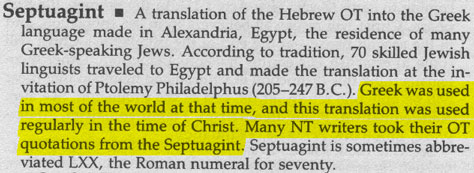
Concerning their “no counterpart in the Hebrew OT”:
Hebrew Parallel: ahab… (…אהב):
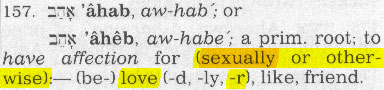
The original Hebrew Old Testament word that corresponds (counterparts) with the Septuagint’s agape is ahab… (…אהב), which is Strong’s Hebrew # 157:
http://www.sacrednamebible.com/kjvstrongs/STRHEB1.htm, King James Bible, Strong’s Hebrew Dictionary:
(I left the “157” link open below in case you want to compare verse numbers to the above. [158, 159 & 160 are also forms of the same word])
|
'ahab |
or raheb {aw-habe'}; a primitive root; to have affection for (sexually or otherwise):--(be-)love(-d, -ly, -r), like, friend. |
Another source:
The New Strong’s Complete Dictionary of Bible Words, James Strong 1822-1894, Thomas Nelson Publishers, 1996, “Hebrew and Aramaic Dictionary,” p. 299:
Encyclopedia of Early Christianity, Ferguson, 1997, Vol. 1, “Agape (Love Feast)”:
http://christiantherapist.com/Morris/journl4.htm (Christian Counselors Directory), The Journal of Redemptive Therapy: A Doubletake on Love:
The predominant Hebrew word for love is Aheb. It is interesting to note that the word is used in just about every way one can use the word love: Love for God; love for fellow man; love for inanimate things; erotic love; permanent steadfast love, etc. Another curiosity is that the LXX uses the greek word agape when translating Aheb in the Canticles where clearly erotic and romantic love is intended. Some agree this text (LXX) is more representative of the actual Autographs than the Masoretic texts. The one place where eros does occur (Prov. 7:18) concerns prostitution. (It’s not the only place for eros [see Proverbs 30:15-16 above]; but, in Proverbs 7:18 eros is in full context with phil… love) … Let me remind us once again that agape is the logical corollary to aheb in the Old Testament. It is used over 300 times in the New Testament. … It is doubtless, more precise to note that aheb and agape are the two most common words for love and are really not unlike our present day use of the word "love." … If we ignore aheb in our attempts to understand agape and phile, we have theologically impoverished our understanding of God, hence our understanding of Love.
http://christiantherapist.com/Morris/journl4.htm (Christian Counselors Directory), The Journal of Redemptive Therapy: A Doubletake on Love, “How agape is Used in the New Testament”:
The prostitute who had "loved much:" Therefore, I tell you, her many sins have been forgiven--for she (agape)loved much. But he who has been forgiven little (agape)loves little."(11) (--Luke 7:47) Many scholars agree (because of the tense of the verb) that Jesus was referring to her many lovers. If so, this means that even our Lord referred to eros with the use of the word, agape as it is so used in the Septuagint translation of the Song of Solomon. Agape as eros? Despite the incredulity, we haven't taken leave of our senses. The fact that Jesus quoted the LXX exclusively lends credibility to this use of agape.
More New Testament agape context:
1 Corinthians 13:4:
4(Agape)love suffers long and is kind; (agape)love does not envy (envy / jealousy / covet); (agape)love does not parade itself, is not puffed up; 5does not behave rudely, does not seek its own, is not provoked, thinks no evil; 6does not rejoice in iniquity, but rejoices in the truth; 7bears all things, believes all things, hopes all things, endures all things.
“Envy” is Strong # 2206 which includes “jealousy” and “covet” in the definition. As we all know, traditionally speaking, a wife is someone who her husband envies, is jealous over, and covets (lusts for). Therefore, agape love cannot be that “special” love in marriage. Also, from the husband’s point of view, a wife is definitely someone who is “puffed up.”
Okay, let’s give it a fair shot:
John 13:34-35:
34A new commandment I give to you, that you not have envious, jealous, coveteous love for one another; as I have not had envious, jealous, coveteous love for you, that you also not have envious, jealous, coveteous love for one another. 35By this all will know that you are My disciples, if you do not have envious, jealous, coveteous love for one another."
Sure, the Septuagint’s agape love is envious, jealous, and covetous, but Jesus changed that in John 13:34-35 by commanding a non-bias, non-partial (non-married) kind of agape love.
http://theologytoday.ptsem.edu/jan1973/v29-4-article2.htm, The Sensuousness of Agape:
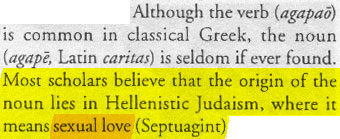
In this essay I shall attempt to demonstrate that the Greek Bible does not support the common assumption that agape should be defined in a way that stands in contrast to ordinary human love. That Bible, following the Hebrew Scripture, has no word for sexual love as differentiated from other kinds of love. Consequently, the sensuousness of agape percolates through the most exalted aspects of biblical maids covenantal bonds. Agape, or its cognates, is used hundreds of times in the Septuagint to express the whole spectrum of human relationships. That translation is the principal quarry from which the vocabulary of the New Testament was mined. In the case of the noun agape, this is especially true, for there are only a few instances of its use in extra-biblical literature. The wide latitude of meaning of agape in the Septuagint can best be displayed by reviewing some representative usages. It was frequently used to refer to intimate relationships between individuals. The yearning of an unmarried man for a maiden was called agape. Jacob was willing to work seven years for a woman because,of that urge. Cupid's arrow struck him so deeply that those years seemed like only a few days because of the love (agape) be had for Rachel.14(14 Gen. 29:20.) It also drove Amnon to devise a scheme for seducing Tamar."15(15 II Sam. 13: 1.) But agape was most frequently used for referring to affection displayed by the married. In the patriarchal saga it is written that Isaac "took Rebekah, and she became his wife; and he loved (agapan) her." Lest one think that his love was non-sensual, it is stated that he was observed later in life fondling Rebekah.16(16 Gen. 24:67, 26:8.) In Ecclesiastes a man is advised to "enjoy life with the wife whom you love (agapan)."17(17 Eccl. 9:9.) It was assumed that the passionate relationship was mutual. In the Song of Songs a bride testifies: "I found him whom I love (agapan). I held him, and would not let him go." That sensuous love song advances the notion that warmth in physical relations can help make marriage permanent. The Song concludes with this affirmation: Love (agape) is strong as death…. Many waters cannot quench love (agape) Neither can floods drown it.18(18 Song of Songs 3:4; 8:6, 7.) The noun agape, which always has a sensuous connotation in the Song, occurs more frequently in that book than in the entire remainder of the Old Testament. Agape could also refer to friendships between those of the same sex David composed this elegy for his slain comrade Jonathan: Your love (agape) to me was wonderful, Passing the love (agape) of women.19(19 Sam 1.26; cf. Sam. 18:3.) In addition to relationships between individuals, agape connoted goodwill expressed generally. The basic moral law in the Torah is: "You shall love (agapan) your neighbor as yourself Also in the passage where that nugget is embedded there is recorded an even more remarkable injunction: "The resident alien shall be to you as the native among you, and you shall love (agapan) him as yourself."20(20 Lev. 19:18, 34.) … Love was so highly valued among the Hebrews that it is not surprising that they extrapolated love to be the prime attribute of the God they worshipped. … In the New Testament, as in the Septuagint, agape was such a comprehensive term that it was employed to refer to physical and/or spiritual relationships.38(38 Another verb, philein, is employed, but it is used interchangeably with agapan as a synonym. Cf. James Moffatt, Love in the New Testament (New York, n.d.), pp. 45-46.) … There can be little doubt that, had the New Testament writers had occasion to speak at large of sexual love-to write, e.g., a series of narratives like those of Gen. 24 and Judg. 16 and I Sam. 13-they would have employed agapan and agape in them just as the writers of the Septuagint had done.39(39 B. B. Warfield, "The Terminology of Love in the New Testament," The Princeton Theological Review, Vol. XVI (1918), pp. 182-183.) … Standard classical lexicons show that eros was also, in the GrecoRoman culture, used to connote everything from what is now called the erotic to a transcendental relationship with the divine. … Biblical prophets from Hosea's era onward believed that natural love was not to be renounced but extended. … The Hebrew term ahabah and the Greek term agape are like the English term love in that they were used to apply to everything from a sensualist's carnal appetite to a martyr's courageous self-sacrifice.
Theological Dictionary of the New Testament: Abridged in One Volume, Bromiley, 1985, p. 5:
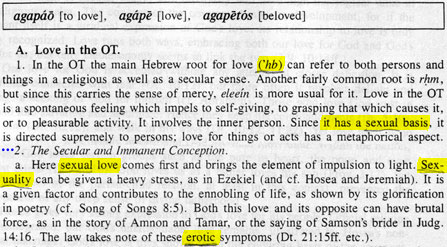
New International Dictionary of Old Testament Theology & Exegesis, VanGemeren, 1997, vol. 1, pp. 277-278, “אהב”:
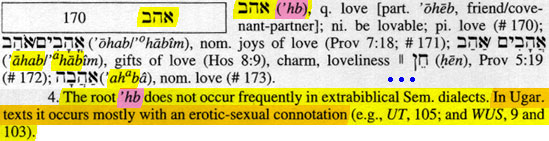
(170-173 are G/K numbers.)
http://www.thefamily.org/dossier/books/book5/main.htm, Christianity and Sex, “Holy Sex!”:
Fox) envisions a renaissance of sexual mysticism, and in his book The Coming of the Cosmic Christ, he offers one of the finest commentaries on Solomon's Song of Songs, with a wholehearted endorsement of an erotic spirituality.
A Greek-English Lexicon of the Septuagint: Chiefly of the Pentateuch and the Twelve Prophets, Muraoka, 2002, pp. 2-3:
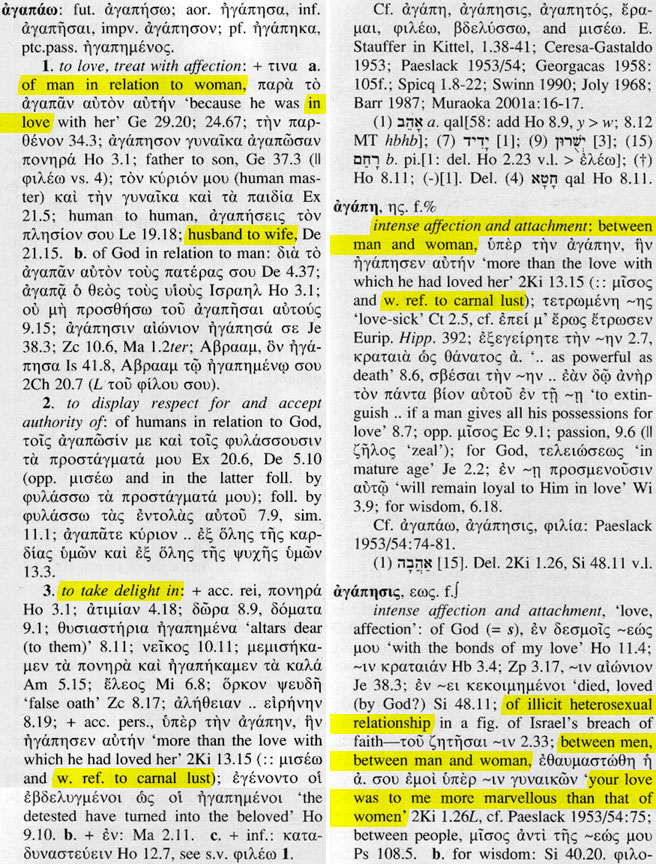
Well, let’s see:
John 13:34-35:
34A new (overruling “old”) Commandment I give to you, that you (between adults) take delight in, via carnal lust between man and woman one another; as I have taken delight in, via carnal lust between man and woman you, that you also take delight in, via carnal lust between man and woman one another. 35By this all will know that you are My disciples, if you take delight in, via carnal lust between man and woman one another."
You mean you have to do this to be a real Christian? Well, what would my pastor say?
The Oxford Dictionary of the Christian Church, 1997, p. 26, “agape”:

Which includes sexual love.
http://www.iconbook.org/Spirituality.html, Spirituality, the Spiritual Life and the Jesus Prayer:
THE GIFT OF LOVE, by Vladimir Berzonsky Fr. Berzonsky presents fifty-six reflections on the theme of love expressed in the Bible. He takes as starting points texts in Solomon's Song of Songs, Paul's Hymn of Love in 1 Corinthians and other parts of the Bible. In his preface he observes that erotic love conditions us for the selfless, outpouring love that is agape. 181pp $10.00 Paper (SVS Press)
http://peterjblackburn.com/papers/irsresp.htm (Rev. Peter J Blackburn is a minister of the Uniting Church in Australia), Response to the Interim Report on Sexuality, “Chapter 3: God and the person | Love”:
3.15 The attempt to link erotic love (eros) with agape through the use of the latter in the Septuagint is unconvincing. The question is: what does the word mean in the New Testament? No New Testament example is given where it might mean erotic love.
That’s because the New Testament wouldn’t have made it through the Middle Age corruption.
In Greek, the deity “Eros” is defined as “the god of agape.” And his characteristics are sexual / erotic.
Churches today have absolutely no evidence to substantiate that Jesus’ agape-love had nothing to do with sex. And, conversely, they certainly do have substantial evidence to say it did. Since Jesus told His disciples the do this with one another, churches could easily use this to support promiscuous sex including bi sex, over today’s less stable non-sexual conclusion.

The Septuagint is “con-clu-sive” evidence. These are hard coded, rock solid, ironclad facts, which Churches will eventually have to acknowledge, concede and accept. So why not now?