EARLY CHRISTIAN SEX ORGIES (OVERVIEW)
(Notice how many apologists say it exactly to the satisfaction of the persecuting pagans.)
Most accounts are the government opposers of the Christian orgies telling their version. Others are Christian apologists, etc. who are obviously stating their opposition in conjunction to avoid persecution; or, groups who had already altered to the Roman anti-free-sex morals. Where are all the stories of the Christians who supported the orgies? “Destroyed” – that’s where they are. Christians who squealed on open-sex Christian sects are pretty darn evil in my book, as it was an era of harsh government persecutions; but, glad today as it gives me more sources. Yes, there are many instances telling that the Roman government morals reflected those of today (or, more like the 1950s), and those of today’s church (anti-free-sex, pro-family).
http://www.genxplosion.ca/bookcase/notes/our_history/part4.pdf, The History of Our Church: Part 4: Defending the Faith, “Base Rumours & Lofty Criticism” (12-12-01):
rumour: Christian worship is an orgiastic ritual of excessive drinking, darkness and indiscriminate and incestuous unions
http://kt70.com/~jamesjpn/articles/ChristianityAndSei.htm, The Christian Digest, Presents: CHRISTIANITY AND SEX--PART 1:
"They recognize each other by secret signs and marks; they fall in love almost before they are acquainted; everywhere they introduce a kind of religious lust, a promiscuous `brotherhood' and `sisterhood.'"[1] This is not some modern-day tabloid description of the Family, but a second century description of early Christians, who the Roman establishment considered to be a promiscuous sex cult which indulged in orgies at secret meetings.
…
It was Saint Augustine (354-430 AD) who, according to Nigel Davies in The Rampant God, "set the final seal on the anti-sexual bias of the Church" (Davies, 1984: 180).
…
By the eighth century an enormously strict system of sexual rules and penalties was firmly in place, covering every imaginable thought and action related to sex.
http://www.enjoyinggodministries.com/article/history-of-the-roman-catholic-church-part-I, History of the Roman Catholic Church - Part I, “The Age of Apologetics (a.d. 95-325)”:
B. Factors contributing to the Persecution of the Church
Eventually it became evident to Rome that the church was distinct from Judaism and posed what they perceived to be a threat to the social fabric of the empire. The causes for Rome's reversal of policy toward the church are many.
…
- Religious Factors
…
b. Because the meetings of the Christian community were secretive and at night, rumors of political conspiracy and treason were rampant. The increasing organizational structure of the church served to fan the flames of civil suspicion.
c. The designation of the church gatherings as agape or love feasts led to charges of orgiastic practices and extreme immorality.
d. The Christian custom of calling one another brother and sister, along with the custom of greeting one another with a holy kiss, led to charges of incest!
http://www.us.oup.com/us/companion.websites/0195154622/studentresources/ch26/?view=usa, Christians and Pagans: 1 Peter, the Letters of Ignatius, the Martyrdom of Polycarp, and Later Apologetic Literature, “Christians on the Defense: The Later Apologetic Literature”:
The apologists argued that Christianity was superior to other religions. They maintained that since Christianity spread so quickly, it was clear that the hand of Providence was behind it. In addition, the apologists argued that it was the truth of their faith that allowed Christians to withstand persecution. These authors also confronted the accusations of Christian immorality. They insisted that Christians were good citizens and were not a threat to the state.
http://www.tekline.co.uk/natjes2.htm, 3. The Naked Christ – Peter – the Naked Fisherman:
The triumphant Catholics destroyed all early Christian writings that did not support their doctrines, killed or banished anyone who opposed them
But some got through.
http://books.google.com/books?id=7bXtGrn1xT4C&pg=PA45&lpg=PA45&dq=%22silencing+the+pagans%22&source=web&ots=u5gAvm3Gnw&sig=sgFMAUsHcyX1K8F1cRhOrIoK87M, History as Mystery –Google book result, by Parenti, 1999, “Priests and Pagans, Saints and Slaves”:
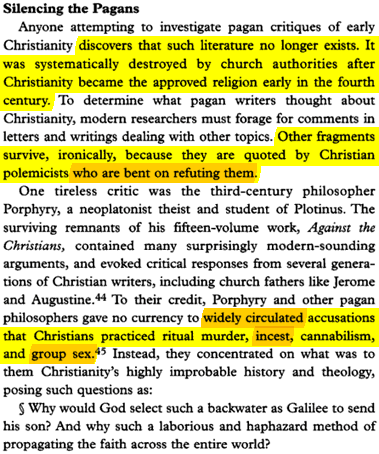
Because of the honors given to the many martyrs of the era, a lot of people misunderstand that when a Roman emperor declared that all Christian should be sought out to be tortured and killed, the early Christians didn’t just line up at their doors wishing to become martyrs. Their assignment was mostly to hide and evade that punishment, thereby helping to continue the faith. Christ Himself did not offer Himself to the Pharisee’s doors: they had to find Him. Certainly when a Christian was caught or found, they had no choice but to die for the honor of martyrdom. Therefore, it makes sense that an early Christian would lie to evade another charge of free love; which, are writings the later Church would not so easily destroy. You see, free love (in numerous quantities) greatly disrupts the marriage standard, the family standard, and the prostitution trade (all of which is the same basis thing). The prostitution trade paid a lot of taxes for Rome. Since marriage is prostitution in reality, a pagan man who can get it free from Christian women, will tend to give less and less support to his own wife; thereby causing his wife and her children financial problems… allocating taxes to welfare instead of building more stuff and fluff for the government. This is the most “fitting” explanation, over today’s church explanation that these accusations were “just” not so.
You all can see and understand why today’s Christians wish to deny and make excuses about Early Christians sex orgy evidence (to save face), but you might not understand why they’d do it back then (to avoid torture and death).
http://ccat.sas.upenn.edu/rs/rak/courses/535/syllabus.html, Religious Studies 535: Varieties of Early Christianity, “13. Patterns of Social Involvement and/or Withdrawal”:
In what ways, and for what reasons, did early Christians attempt to distance themselves from the world in which they found themselves and in what ways did they acknowledge and affirm it? Pay attention to attitudes regarding social contacts and meetings, citizenship, military service, attendance at theater and/or the games and banquets (note accusations of misanthropy, atheism, secret orgies, and the like).
http://etd.lib.ttu.edu/theses/available/etd-04032006-130643/unrestricted/St_Basils_Address_to_Young_Men_Metaphors_to_Live_By.pdf, ST. BASIL’S ADDRESS TO YOUNG MEN—METAPHORS TO LIVE BY, by KYLE DAVID HIGHFUL, B.A., A THESIS IN CLASSICS, p. 1 (document), p. 4 (pdf), “CHAPTER I: INTRODUCTION”:
As Christianity began to flourish in the Roman world, believers found themselves forced to deal not only with their own internal conflicts and theological disagreements, but also with religious, philosophical, and ethical pressures from the Hellenistic culture in which they were embedded. This collision of old and new paradigms spawned a wide variety of Christian and non-Christian apologies, containing arguments ranging from the perceptive and profound to the outrageous and ad hominem. As various Romans accused Christians of obscenities2, Christian believers confronted what they considered to be the immoral polytheism of traditional Greek religion.
…
2 Christians were accused of such taboos as infanticide, cannibalism, and incest, because of misunderstandings of baptism, the Lord’s Supper, and Christian fellowship, respectively. cf. Tatian, Oratio ad Graecos and Fragments, p.27.12.
Tatian, Oratio ad Graecos (Address to the Greeks), written152–155 AD.
http://www.philipharland.com/Blog/, Religions of the Ancient Mediterranean, “Sex and salvation in the Gospel of Philip”:
Not to steal Hollywood’s excitement, but the kisses in question in the Gospel of Philip are best understood not as sexual ones but as further examples of the “holy kiss” greeting among members of Jesus groups as early as the mid-first century (see Rom 16:16, for instance). The followers of Jesus who used the Gospel of Philip also apparently attached an even more important significance to this kiss (59.1-5 and 58.30-59.6) and to breath (63.6-10; 70.23-24) in connection with their understanding of how the spiritual spark in some human souls is connected with the spiritual realm as a whole . It is true, however, that some outsiders–both Greeks and Romans– accused early followers of Jesus of incest (as well as cannibalism), but that had less to do with any knowledge of Christian “holy kisses” or their tendency to call one another “brothers” or “sisters” than it had to do with common mud-slinging in characterizing foreign peoples or minority groups as dangerous barbarians (see my posts here and my article here).
Nonetheless, there is some sex, quite a bit in fact, in the Gospel of Philip. I’m talking about the consistent way in which the author of the materials gathered in this writing uses sexual union as a METAPHOR for salvation itself. And the way in which the community of Christians that used this gospel enacted this salvation in a ritual known as the “bridal chamber”. So this is not sex of the usual type and is a little more tame than Hollywood likes–sorry to disappoint.
Yeah, I’m disappointed. So, let’s go on to the next “metaphor”:
http://www.infidels.org/library/modern/james_still/john_context.html, Contextual Problems with the Gospel of John:
These, and other Johannine elements attached to a paganized Jesus were so close to the cult of Dionysus that Justin found himself apologizing for their similiaries. Additionally, the cult of Dionysus and pre-200 CE Christianity were often confused with each other so that people accused the Christians of infanticide, sexual orgies, and omophagia, (eating of human flesh as a transubtantiation of the god), practices which were widely known as Dionysaic. Justin found himself defending Christianity against these charges declaring "Do you also...believe that we eat human flesh and that after our banquets we extinguish the lights and indulge in unbridled sensuality?" (Trypho 10) Tertullian likewise wrote, "We are accused of observing a holy rite in which we kill a little child and then eat it...[and] after the feast, we practice incest...." (Apology 39)
“Unbridled” equates with “freedom.” So you know real Americans should like it.
The Dictionary of Psychology, Corsini, 1999, p. 677, “orgy”:
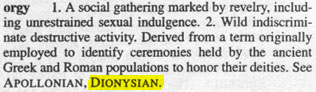
Of course, “destructive” activities aren’t good, but a society can conform where there are no victims in free sex (once there are STD cures). Today, if there were cures for all STDs, open sex would become more the norm, but would stabilize against God, as long as today’s church opposes the sexual truth about Jesus (just to save face). And, a predominantly atheist society diminishes the Goldenrule, which will just create more real problems (victims).
I don’t know if having sex orgies is the best way to handle love for the future of Mankind. Sex orgies are sort of like over eating. It’s too much within a short period. I think love should be more timely spread out. Initiated by Jesus Christ in John 13:34, I think the orgies of the Early Christian were done only to produce an overly-weighted statement, one that would attain enough attention so I would have it available for my support today. Multi-person orgies (versus just support of sex) also stresses that the ones who got married could not have been sexually monogamous. However, I don’t know for sure: Maybe sex orgies is best the way to have it: I’m not trying to make a “no sex orgies” rule, I’m only stressing to eliminate “the rules.” The “rules” (sexually) should be that there aren’t anymore “rules,” it’ll be just whatever works; and that may still vary per individual; initially for sure. I also think people will ultimately better enjoy a variety or partners, once the (religious) “rules” have been dropped, and once financial gain is eliminated as a female’s motive for sex.
When Jesus made his “new commandment” in John 13:34 to “love one another” the word for love was “αγαπατε” which is in the “plural” form, indicating sex with multiple partners.
If mankind historically always had effective birth control, then we would not have today’s conditional sex standards.
http://www.studylight.org/enc/isb/view.cgi?number=T270 (The International Standard Bible Encyclopedia), AGAPE, “Reasons for the Separation (from the eucharist)”:
but a stronger influence probably came from the rise of a popular suspicion that the evening meals of the church were scenes of licentious revelry and even of crime. The actual abuses which already meet us in the apostolic age (1 Corinthians 11:20; Jude 1:12), and which would tend to multiply as the church grew in numbers and came into closer contact with the heathen world
Understand, that the “heathen” was persecuting the Christians for the free-sex. Yet those “heathen” morals are basically the same as today’s Catholic Church.
http://members.virtualtourist.com/m/90939/1c18fd/, For those who into art history, “MONASTICISM –RELATED TO ROMAN PERSECUTIONS”:
160 AD Response of the church to Roman persecutions : Apologies: The bishops and leaders who wrote these defenses are known as the Apologists. Writing especially in the 2nd century AD, the Apologists' primary goal was to defend Christianity against pagan accusations and misconceptions in an effort to stop the persecution. The Apologists explained, for example, that the Christian "love feast" did not involve cannibalism or orgies as many thought, but was a sacred meal of bread and wine in honor of Christ's death.
Much of the Bible is allegoric, and Jesus often spoke both symbolically and in parables. Much of this can be attributed to avoiding persecution. If they had today’s First Amendment, then they could have said it the way I’m saying it.
http://www.scrollpublishing.com/store/Early-Christian-Martyrs.html, Early Christian Martyrs: Persecution of Christianity and Christian Martyrdom, “§ 15. Causes of Roman Persecution | Obstacles to the Toleration of Christianity”:
27 The common people also, with their polytheistic ideas, abhorred the believers in the one God as atheists and enemies of the gods. They readily gave credit to the slanderous rumors of all sorts of abominations, even incest and cannibalism, practised by the Christians at their religious assemblies and love-feasts, and regarded the frequent public calamities of that age as punishments justly inflicted by the angry gods for the disregard of their worship. In North Africa arose the proverb: "If God does not send rain, lay it to the Christians." At every inundation, or drought, or famine, or pestilence, the fanatical populace cried: "Away with the atheists! To the lions with the Christians!"
Of course, their love-feasts were agape-feasts: Song-of-Solomon-romantic/Cupid-kind-of-love-feasts. The Jews weren’t persecuted in this way and they believed in the same one God.
http://www.monroe.edu/~mcq/rel/roman_empire.html (Monroe BOCES 1 [Board of Cooperative Educational Services]), Roman Empire, “Christianity in the Roman World: Notes”:
II. Christian relations with Rome: Persecution …
C. Initial accusations - incest and cannibalism
http://www.ccel.org/ccel/renan/marcus.txt, The History of the Origins of Christianity. Book VII. Marcus-Aurelius, “CHAPTER XXII. NEW APOLOGIES—ATHENAGORAS, THEOPHILUS OF ANTIOCH, MINUCIUS FELIX”:
They know each other by marks or secret signs; they almost love each other before being known. Then debauch becomes their religion, the bond which binds them together. They are called without distinction brothers and sisters, so that by the use of this sacred name that which would only be adultery or fornication becomes incest.
http://www.adultcatholiced.org/downloads/CH_f03_1.pdf, Church History, “3. Society, State and Christianity”:
b. Polemic and persecution. Popular rumors accused Christians of all sorts of nasty activities (e.g. incest or cannibalism).
http://www.the-orb.net/encyclop/religion/early/jcdoctrine.html, Early Christian Doctrine, “The Controversy over Martyrdom and Persecution”:
There is evidence of Christians being criticized as bad citizens for their refusal to partake in imperial cult and of charges that Christians were practitioners of incest and of cannibalism.
http://www.pbs.org/wgbh/pages/frontline/shows/religion/why/martyrs.html, Why Did Christianity Succeed?, ”Why were Christians persecuted?”:
Where did the suspicion arise that they did all kinds of dangerous anti-social things like cannibalism and incestuous sexual relations, orgies, this sort of thing?
http://www.probe.org/content/view/813/77/, Persecution in the Early Church, “Reasons for Persecution”:
With respect to what they did do in their own religious practices, talk of eating the body and blood of Jesus, and the customary greeting with a kiss, brought charges of cannibalism and incest.
http://www.freegrace.net/Gill/Revelation/Revelation_12.htm, John Gill's Exposition of the Entire Bible: INTRODUCTION TO REVALATION 12, “Revelation 12:10”:
it refers to the accusations brought against the Christians in the primitive times, during the ten persecutions, which were very horrid ones indeed; as that they had their private suppers, at which they ate their own infants, and their nightly meetings, for the gratifying of their lusts, in which they committed adultery, incest, and all manner of uncleanness
I don’t like this cannibalism and infanticide stuff at all, but those appear to be the results of a continuing eucharist, which Jesus literally (according to John 6:55) did once (Matt. 26:28) to overrule the Old Testament’s animal sacrifices, therefore not to be continued. Baptism was ordered by Jesus/God, but the continuation of the eucharist appears to be a mistaken sacrament added by the early church. The missing body of Jesus and the easy access at the catacombs support my theory, as they continued eating the literal body of Christ, then later anyone who had eaten of that body, and/or their direct descendants. Even if Christ wanted His disciples to continue to eat more and more of His body, He didn’t advise to start eating descendants, etc. once His body was completely gone. I don’t like the incest part either, but the starkness of it apparently made it more of an issue, thereby making it more available for my use today, as incest is indicative of a totally free-love orgy; and, therefore made it a lot easier for me to search for other instances on Google. I dread to think that the extraordinary eucharist was instituted by God to cause even more documented evidence, so the sexual parts could be more readily available for me today.
The Crucible of Christianity, Toynbee, 1969, p. 337, illustration 13, “The Persecutions | Christianity’s Encounter with the Roman Imperial Government”:
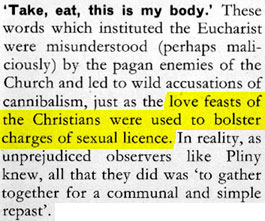
http://www2.open.ac.uk/ClassicalStudies/GreekPlays/conf96/huskinson.htm (The Open University, UK), The case of Orpheus in early Christian art:
(and remember that before the Peace of the Church (313 AD) Christians might be afraid of exposing themselves to persecution).
http://www.loyno.edu/~nicoll/WorldCivFall/06christianity.htm, “Pagan Antagonism For Christians”:
Christians were subversive, unsociable misanthropes, secretive, pacifists, intolerant, incestuous,
cannibalistic, superstitious, and held different
moral values
http://www.infidels.org/library/historical/joseph_mccabe/religious_controversy/chapter_22.html, The Story Of Religious Controversy, “The Real Witch“:
The Romans themselves put the darkest interpretations on the secret gatherings of the Christians; they were said to indulge in sensual orgies, to worship a god with an ass's head and to kill babies for sacramental purposes.
http://www.hcc.cc.nc.us/online/Rel110/christianity.html, Christian Lectures, “Early Worship” (12-27-01):
Persecution and the Triumph of Christianity:
The first few centuries were critical times for Christianity. To begin with, a series of persecutions threatened its survival. Accused of holding secret orgies and charged with infanticide, incest, and cannibalism, Christians were tortured. Emperor Nero (57-68 CE) used Christians victims for the bloody Roman arenas.
http://www.infanticide.org/history.htm, A Brief History of Infanticide, “Evidence in Judaism and Christianity”:
That some early Christian parents did indeed expose unwanted female infants to the elements was evident in the writings of the Church Fathers who were concerned over future acts of incest.
http://books.google.com/books?id=7mDdlmEnUNwC&pg=PA920&lpg=PA920&dq=%22a+dictionary+of+christian+biography%22+%22william+smith%22+promiscuous&source=web&ots=7Q9GcF11TE&sig=uZhc5UaNOWXdavFi_cbfH779Hpk#PPA767,M1, A Dictionary of Christian Biography, Literature, Sects and Doctrines – Google Book Result, by William Smith, Henry Wace, 1882, p. 767, “MACARIUS MAGNES”
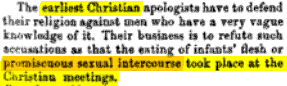
In Text:
The earliest Christian
apologists have to defend
their religion against men who have a very vague
knowledge of it. Their business is to refute such
accusations as that the eating of infants' flesh or
promiscuous sexual intercourse took place at the
Christian meetings.
http://www.cabinetmagazine.org/issues/5/orthodoxorigins.php (Cabinet Magazine Online), The Orthodox Origins of Heterodoxy, or, How What is Good Becomes Evil, “Medieval Manicheans”:
In his essay on "The Uncanny," Sigmund Freud traces the sensation of the Unheimliche to an encounter with what was once all too Heimliche. "This uncanny is in reality nothing new or foreign, but something familiar and old—established in the mind that has been estranged only by the process of repression," he writes.21 It may be that, if the idea of a secret sect given over to incest and cannibalism which seduces initiates by preventing them from realizing what they are entering until it is too late has had such a hold on mainstream Christianity for so many centuries, it is because of some vague recollection that the mainstream Church once occupied the place of this cult.
…
21 — Sigmund Freud, "The 'Uncanny,'" in On Creativity and the Unconscious: Papers on the Psychology of Art, Literature, Love, Religion, ed. Benjamin Nelson (New York: Harper & Row, 1958; rpt. 1965), pp. 122-61, at p. 148.
http://www.suppressedhistories.net/secrethistory/devil_mongers.html, Devil-Mongering:
After centuries of disuse, the Church prelacy had revived the old Roman smear of outlawed groups as ritual murderers who held orgies in secret conventicles. It had been applied to devotees of the women's mysteries, then to the Jews and early christians, then to christian heretics, especially Manichaeans.
The study of early christian writers such as Justin Martyr, Clement of Alexandria, Eusebius of Caesaria and Jerome of Milan led to the resurrection of ritual murder and orgy charges in France. Around 1050, the Byzantine Michael Psellos claimed that the Euchites burned children and ate food made from their ashes, and that heretics held orgies. [Russell, 93, gives credence to this smear.]
Again, a lot of things are true evil (where an innocent person gets hurt), and everyone seems to equate orgies as just as evil. Possibly only I know that orgies aren’t evil because they basically don’t hurt anyone. Maybe that’s the first step in understanding Christ: figuring out what can and can’t hurt us.
http://www.dinneratyourplace.com/historysite/2a.html (Christian History Time Machine), Christians, “The Arguments of the Apologists”:
Pagan Arguments vs. Christianity:
The doctrine of the Resurrection is absurd. (It
won’t be absurd in 1000 years)
There are contradictions in the Scriptures. (I
know)
Atheism is widely held. (Here, atheism just means
not worshiping pagan gods)
Christianity is the worship of a criminal.
(Jesus was convicted and crucified)
Christianity is a novelty. (Something very new /
different: not like the Jews)
Christianity evidences a lack of patriotism. (Lacks
a bias for one’s country, right or wrong; do not kill, do not judge)
Christians practice incest and
cannibalism.
Christianity leads to the destruction of society. (“Free” sex definitely interferes with the popular Roman prostitution
industry, marriage and family standard; Christians disrupted the cattle
business by being vegetarians)
The Body and Society: Men, Women, and Sexual Renunciation in Early Christianity, Peter Brown, 1988, “’A Promiscuous Brotherhood and Sisterhood’: Men and Women in The Early Churches,” pp. 140-141:
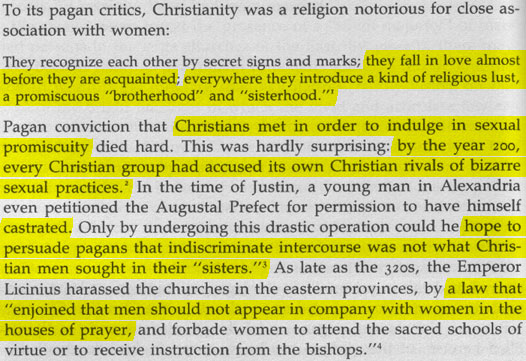
(Castration was just removing the testicles: a kind of birth control. It does not remove the ability to have and enjoy sex.)
Today’s excuses:
http://www.dtl.org/dtl/article/persecution.htm, PERSECUTION: A DOUBLE-EDGED SWORD, “What Brought About the Roman Persecutions?”:
Many false views on the part of the Romans about Christianity added to the prejudice leveled at Christians. Accusations of sexual orgies were brought about due to misunderstandings of the "Love Feast" (which the general public was barred from) and the custom of the "holy kiss" (see Rom 16:16; 1Cor 16:20; 1Thes 5:26 [don’t forget about also 2Cor 13:12 & 1Pet 5:14]). The extreme love seen among the Christians and the habit of calling each other "brothers and sisters" caused some to accuse the Christians of practicing incest.
…
“Was There Validity to the Accusations?”:
The Christians were certainly not guilty of cannibalism and sexual immorality. These were, at best, merely misunderstandings on the part of the misinformed. Or, perhaps, the charges provided justification to hate those who were challenging the sins of the culture and the populace.
However, some of the accusations were true. It was certainly true Christians had a tentative view of the state. This showed through in their refusal to serve in the military and hold government offices.
http://www.westarkchurchofchrist.org/chadwell/nurturing2.htm, God's Plan In the Church: CHRISTIANS NURTURING CHRISTIANS: Study Guide:
The "secret crimes" of Christians were declared to be atheism (rejection of established religions and their gods), cannibalism, and incest. These charges came from common misunderstandings of "eating the body and drinking the blood," an emphasis on "love" and "love feasts," and calling each other "brother and sister" (Egyptian terminology for husband and wife).
Egypt was one of the most incestuous cultures on the planet.
http://sitemason.vanderbilt.edu/files/fGwjug/Chapter%20Sixteen.%20The%20Christian%20Attack%20on%20GrecoRoman%20Culture%20ca.%20135%20to%20235%20CE.pdf, The Christian Attack on Greco-Roman Culture: ca. 135-235 CE, p. 10, “Tertullian, early Latin Christianity, and the offensive against Roman culture”:
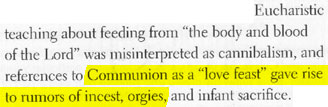
The Hellenes and Romans had their stories about the Christians, most of them false and all of them negative. The Christians’ celebration of the Eucharist at their weekly gatherings gave rise to the rumor that the Christians practiced cannibalism. The Christians’ agape or “love feast” suggested to many outsiders that after the meal was over an orgy commenced (probably because agape used to mean sexual love), as the participants in the agape made indiscriminate love to each other. The Christians’ practice of referring to each other as “brothers” or “sisters” persuaded some that for the Christians incest was a normal form of marriage. Thus Greco-Roman society looked with suspicion at the Christian counter-culture, while the Christians openly condemned most of Greco-Roman society.
http://www.gfcto.com/2006/05/no_other_foundation_part_1.php (Grace Fellowship Church, Toronto, Canada), No Other Foundation: A History of the Church, part 1, “Persecution”:
The charge of cannibalism and incest -- resulting from a misunderstanding about the Lord's Table and Christian speech about agape.
Since words were used that suggested indiscriminate sex, then, that’s what they meant. Otherwise they should have simply used words that didn’t suggest indiscriminate sex. Duh! If they couldn’t change the word(s) because Jesus ordered it that way, then that should “indicate” something. Even today, some churches have what they call an “agape feast” which entails eating a vegetarian meal, washing each others’ feet, etc. – no sex. They don’t call it a “love feast” simply because it sounds too sexual. Since “agape” became such an obscure word (I wonder why), churches today have taken the liberty to redefine it to actually mean “non-sexual love.” Early Christians could have easily picked an obscure word, or one that simply meant non-sexual love, or one just denoting a meal, service, party, ritual, etc.
http://www.bible.org/page.asp?page_id=2104,
The Apostle
Peter on Civil Obedience:
An Exegesis of 1 Peter 2:13-17:
Beare argues that Christians were also accused at this time of such things as cannibalism and incest, but, as Biggs points out, this is particularly a second century phenomena, not to be drawn out of the words of Peter.
http://www.xenohistorian.faithweb.com/church/xr01.html, A History of Christianity: Chapter 1: THE DEVELOPMENT OF THE EARLY CHURCH: 1 to 300 A.D., “Defending the Faith”:
Non-Christians often accused Christians of the following:
1.
Antisocial behavior, because they held their
worship services in secret places like underground cemeteries (catacombs),
did not observe the Roman holidays, and denounced the gladiatorial shows.
The easy body access at the catacombs simply
makes it easier to consume deceased Christians to erroneously continue the
eucharist of Christ’s lineage:
2.
Cannibalism, because the Christians referred to their holy communion as
"the body and blood of Christ."
3. Atheism, because the Christians, like the Jews, worshiped no images.
The Jews were allowed by Rome to be “atheists.”
4. Incest, because they openly spoke of their "love" for one another.
Since “love” was Song of Solomon agape love, then yes, because it meant “romantic”/Cupid love.
A series of Christian writers, known as Apologists, refuted these false charges, and by showing that Christianity was superior to Judaism and paganism, they hoped to win the legalization of their faith.
I don’t recommend incest because there’s already enough love between blood relatives. If fact, the only benefit of having sexual love with many people outside your family is to diminish some of that strong family love / bias and distribute it more about non-related people, simply because that’s where the “need” is greatest. I (only) have this entire thing figured out. Allowing incest would actually cause a leaning toward more monogamy between family members. Since they can be trusted, and they are of actual physical value, then they would stay within their family more. None incestuous sex, even today, allows one to seek outside their family. Spreading the love outside the family in open-sex causes all outsiders to become of actual tangible value, building more ethical fairness for them, and lessen discrimination and bias against them. A must for a true utopian society.
http://members.viafamily.com/oakley/chbook1.html (via http://members.viafamily.com/oakley/misc.html) (Greenwich Baptist Church), Church History Book1, “Why Were Christians Persecuted?” (1-7-02):
False: They have sex orgies during their secret meetings and even participate in cannibalism. These accusations were directed against the agape meal/love feast and the Lord's Table/Communion. The Christians emphasized love so much (something the tough, war-minded Romans never did), and their opponents used this as an attempt to make them appear sick and illicit. The Christians also "ate the flesh and drank the blood of Jesus" and so were accused of being cannibals. Both these accusations were deliberately taking normal Christian practices and warping them to make the Christians appear depraved and evil.
It seems that people of yesterday and today both equate the evil of killing an infant and incest. I may be the only living person who knows that killing an infant (for the mistaken continuation of the eucharist) does hurt people, but incest doesn’t really hurt anyone. Again, I’ve never found the perfect religious group. I’m just trying to establish here that “early” Christians followed what they believed Christ wanted. They were right about the free sex, but wrong about continuation of the “Last” Supper.
http://www.sqa.org.uk/files/nq/c01312_sqp.pdf, Higher Classical Studies - Paper II, Section2, 4, (b), p. 9:
- the Christian profession of "love" for one's neighbour was misinterpreted as sexual love and there were accusations of orgies
The Story of Christianity: 2,000 Years of Faith, Price and Collins, Tyndale, 1999, “Persecution,” pp. 44-45:
…
http://www.personal.kent.edu/~jlarson/christianity/persecution.htm (Jennifer Larson, Professor of Classics, Kent State University), Ancient Christianities: Persecution and Polemic, “The Christians as the Romans saw them” (12-14-01):
The fact that Christians met in private for worship, rather than publicly as normal, decent people did, gave credence to these rumors. Christians referred to each other as "brother" and "sister" even if they were married; therefore they committed incest. They were cannibals because they ate the flesh and drank the blood of Jesus. They held "love feasts," so they were sexually promiscuous. They were accused of conducting orgies
http://www.religioustolerance.org/urbanft.htm, HISTORY OF SATANIC RITUAL ABUSE AND OTHER "URBAN FOLK TALES":
History of the legend
This belief is directly traceable back to the first few centuries CE when the early Christians were in conflict with the Roman authorities. The government created false rumors in order to facilitate persecution of the Church:
- They twisted elements of the Eucharist and said that the wine and wafer were really the blood and flesh of ritually killed babies.
…
- They implied that the Agape (Love) Feasts were not group meals, but were really excuses to engage in sexual orgies, incest, sexual abuse of children etc. [There appears to be archaeological evidence that Gnostic Christians did engage in ritual sex; they regarded semen as a sacred fluid and consecrated their status with it. However, their rituals only involved adults, not children.]
“Archaeological evidence” eh? Might that “contradict” the “false rumors”? I should probably do more research on this “archaeological evidence.”
http://digitalcommons.libraries.columbia.edu/dissertations/AAI9999255/, Abandoned to lust: The politics of sexual slander in early Christian discourse:
This project considers the significance of accusations of sexual licentiousness lodged by various early Christian authors against non-Christians and against fellow Christian rivals within the context of ancient Greek, Roman, and Jewish polemics. Following a discussion of methods and approaches, the dissertation begins with a survey of Greek and Roman invective traditions. A “good” man, Greek and Latin orators argued, will control himself and his family, but a “bad” or “slavish” man indulges in sexual excess and other extravagances. Such behavior makes him “soft” or “womanly,” and unfit to rule.
Early Christian authors picked up on these rhetorics, turning them to their advantage and combining them with Jewish claims about the fornications of the Gentiles. Authors such as Paul, Ignatius, Polycarp, and the second-century “apologists” suggested that Christians alone possess self-control. Indeed, non-Christians were said to be incapable of virtue, an argument that not only drew boundaries between “us” and “them” but also sought to undermine non-Christian claims about their own prestige and position. Assertions that empire and city are upheld by the virtue of ruler and subject were attacked with a counter-claim that Christians, and Christians alone overcome desire.
“Self control” can simply mean that the orgies were more loving rather than wild and crazy, as were the secret, but rather popular orgies of the pagan god Dionysus (it’s well documented that Dionysus’ followers had to keep it a secret to also avoid government persecution). Paul, Ignatius, Polycarp, etc. were likely being compared with Dionysus. It’s like any sexual relationship could be either wild and crazy where selfishness rules, or it can be intimate and loving with concern for the other person’s satisfaction as well. Which kind do you think would be “more Christian”? And, it’s like when someone’s eyes are closed, it technically doesn’t matter who’s touching them for pleasure. Therefore, desiring diversity in partners (opposite of what we’re taught today) (with eyes open) has to be the best way to spread love between people (outside one’s family). It would cause everyone to be looked at as a tangible “value.” That alone could stop all wars. But, it definitely makes sense that free love would interrupt the “one-step thinking” Roman prostitution business (since Christians were “easy”), and the financial-agreement marriage possessiveness standards; therefore, had to come to an end. And, since sex with people outside of marriage is such a majority desire in humans, strict Middle Age & Renaissance standards had to be implemented, to the “going to hell” threat we base sex and religion with today. And, during the Middle Ages, many people may have still known about Christ’s free-sex teachings, which would have fueled even more of a reason to strongly condemn any sex outside of marriage to the extent of corrupting the Bible. And, it makes sense that the clerical mind can’t “just” start to think outside the box after hundreds of years of imbedded instruction of “the worse sin of all” being sex outside of marriage, just because someone invents effective birth control (the pill), and instantly antiquates the entire logical reason for the suppression and corruption. Of course, our forefathers didn’t say the suppression and corruption was suppression and corruption, so how could a modern day cleric know?
Exploring Church History, Vos, 1994, p. 14, “The Church in Its Early Development | Defense of the Faith: The Apologists”:
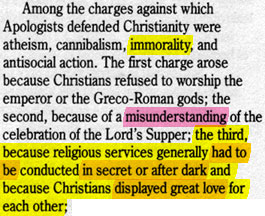
If these were “misunderstandings,” then why did they do them “in secret or after dark”? Why couldn’t they do them unconcealed or in the light, to make them clear from “misunderstandings”? Then they wouldn’t have been persecuted, tortured and killed (more to the advantage of spreading the faith then martyrdom). Again, the Jews were allowed by the Romans to not worship the emperor or the pagan gods.
Chronological and Background Charts of Church History, Walton, Zondervan Publishing House, 1986, chart 5, “The Arguments of the Apologists”:

... except at night or when it’s done in secret.
http://www.isesco.org.ma/pub/Eng/islamwis/Chap10.htm, Islam - what it is not:
Agape or love feast, was one of the early church festivals. Originally it was a sort of charity festival for the poor, accompanied by a rite called kiss of love, which developed later into something immodest. The whole festival began to be perverted into acts of sensuality and licence. Father Tertullian in the year 217 condemned very severely those acts which he deemed as occasions “for men to sleep with their sisters”. The festival eventually turned into a licentious orgy. A much later offshot of this love festival was the Agapemone sect of man and woman in the 19th century in England. The protagonists of this sect established in 1849 an abode which they called the Abode of Love or Agapemone. But their licentious conduct led to trouble with the authorities, and the sect was suppressed. There was later an attempt to revive it, but it failed in 1908.
“Which developed later into something immodest” just doesn’t “fit” or make sense: that Christ would order sex only in marriage, then it got abruptly changed to sex orgies for hundreds of years, then changed back to sex only in marriage (as we have it today).
You see, the only reason people today haven’t heard the information about all the early Christian sex orgies is because today’s church’s excuses don’t hold water, or they’d have no problem letting it be known.
To continue:
http://www.chss.iup.edu/history/pages/studentjournal/Vol1/Christianity%20in%20the%20Roman%20Empire.pdf, Christianity in the Roman Empire: Reformed Judaism to Official Religion, p. 42 in document, p. 6 in pdf:
http://books.google.com/books?hl=en&id=FaHNkJGgl9sC&dq=%22the+blackwell+companion+to+religious+ethics%22+schweiker&printsec=frontcover&source=web&ots=D7z4m6X7LK&sig=Pd2ZXjNPvRsXS4oCjfO2KWiYkQ0#PRA1-PA207,M1, The Blackwell Companion to Religious Ethics – Google Book Result, edited by William Schweiker, 2005, p. 207, “Apostolic Fathers”:
http://www.searchgodsword.org/his/ad/ecf/pos/eusebiuspamphilus/view.cgi?file=npnf2-01-09.htm, Eusebius Pamphilus Book IV, “Footnotes | 30.”:
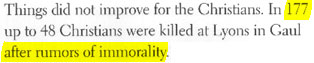
The chief accusations urged against the early Christians by their antagonists were atheism, cannibalism, and incest. These charges were made very early. Justin Martyr (Apol. 1. 26) mentions them, and Pliny in his epistle to Trajan speaks of the innocent meals of the Christians, implying that they had been accused of immorality in connection with them. (Compare, also, Tertullian's Apol. 7, 8, and Ad Nationes, 7.) In fact, suspicions arose among the heathen as soon as their love feasts became secret. The persecution in Lyons is to be explained only by the belief of the officer, that these and similar accusations were true. The Christians commonly denied all such charges in toto, and supported their denial by urging the absurdity of such conduct; but sometimes, as in the present case, they endeavored to exonerate themselves by attributing the crimes with which they were charged to heretics. This course, however, helped them little with the heathen, as the latter did not distinguish between the various parties of Christians, but treated them all as one class. The statement of Eusebius in the present case is noteworthy. He thinks that the crimes were really committed by heretics, and occasioned the accusations of the heathen, and he thus admits that the charges were founded upon fact. In this case he acts toward the heretics in the same way that the heathen acted toward the Christians as a whole. This method of exonerating themselves appears as early as Justin Martyr (compare his Apol. I. 26). Irenaeus also (I. 25, 3), whom Eusebius substantially follows in this passage, and Philaster (c. 57), pursue the same course.
http://en.wikipedia.org/wiki/Early_Christianity, Early Christianity, “Interaction with Greco-Roman and Jewish cultures”:
Christians were also accused of "cannibalism" (perhaps a reference to the Eucharist) and "incest" (perhaps a reference to the biblical prohibition of marriage outside the faith).
The Popular and Critical Bible Encyclopædia and Scriptural Dictionary, 1902, p. 66, “Agape or Agapæ | Festival”:
The Popular and Critical Bible Encyclopædia and Scriptural Dictionary, 1902, p. 66, “Agape or Agapæ | History”:
http://www.polachek.net/books/Kuhn/Kuhn,%20Alvin%20Boyd%20-%20Who%20is%20This%20King%20of%20Glory.pdf, Who is this King of Glory?: A Critical Study of the Christos-Messiah Tradition, By Alvin Boyd Kuhn:
These Agapetae are sometimes confounded with the Subintroductae or women who lived with clerics without marriage, says the Encyclopedia (I, p. 202). …
Lundy (Monumental Christianity, p. 353) speaks of the licentiousness in connection with the Agapae or "love-feasts" held in the Christian congregations--
"When in the fourth century . . . the Church, from the necessity of the case, substituted these Agapae for some of the pagan festivities the abuse became so great that the Council of Laodicea forbade their celebration altogether in the churches." Its Canon XXVIII enacts that "it is not permitted to hold love-feats, as they are called, in the Lord’s houses, or in church assemblies, nor to eat and to spread couches in the house of the Lord." Lundy states, however, that they were such a scandal to the Christian name by reason of the drunkenness and licentiousness practiced that entire suppression was the final resort. …
Mead assembles evidence to indicate that the lasciviousness of the Agapae can not be charged against people of such refinement and philosophical acumen as the Gnostics, though Clement does bring the charge against them; but thinks it probable that some cults calling themselves Christians did confuse the Agapae and love-feasts of the times with the orgies and feasts of the ignorant populace. "The Pagans brought these accusations against the Christians, and the Christian sects against one another."
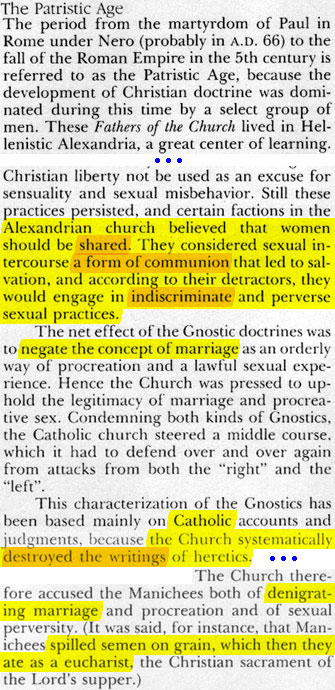
Fundamentals of Human Sexuality, Katchadourian, 1989, pp. 581-582, “The Patristic Age”:
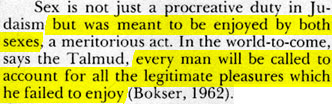
P. 569, “Judaic Attitudes to Sexuality”:
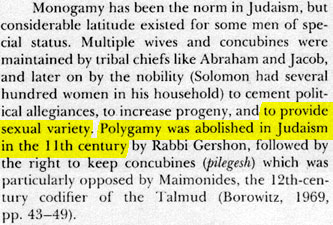
P. 570, “Jewish Marriage”:
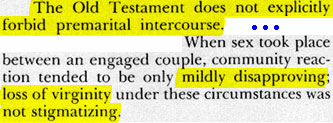
P. 571, “Proscribed Sexual Behavior”:
http://books.google.com/books?id=LsjagvvkveEC&printsec=frontcover&dq=%22Witchcraft+in+the+Middle+Ages%22&sig=_7aPn9aR9O1Hc7bYOFQIImKvUuw#PPA89,M1, Witchcraft in the Middle Ages –Google Books Result, by Jeffrey Burton Russell, 1984, p. 89:
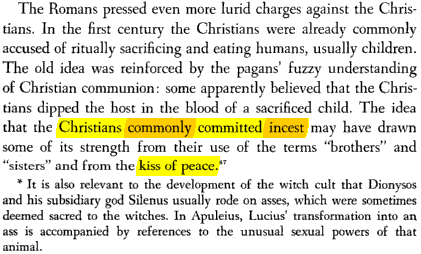
Christ’s first depiction was drawn by pagans with Christ’s head being an ass (see later information).
P. 90:
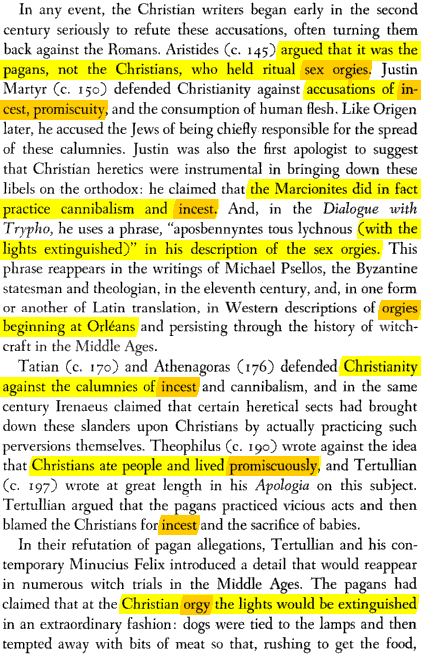
P. 91:
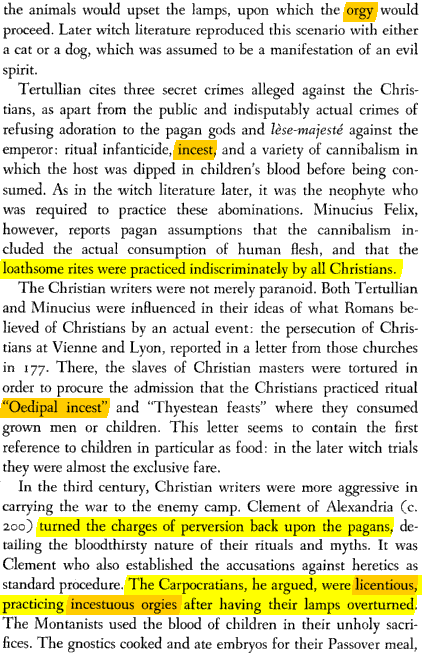
P. 92:
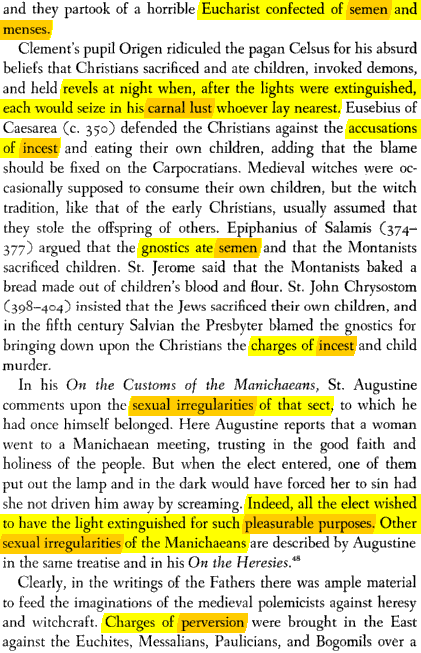
(The pages stopped here.)
See my Cathars page for information about that Orléans citing above.
http://www.sbl-site.org/assets/pdfs/JBL1253.pdf (Journal of Biblical Literature), The Disputed Words in the Lukan: Institution Narrative (Luke 22:19b–20): A Sociological Answer to a Textual Problem, “Allegations and Accusations against the Early Christian Community,” pp. 515-517:
Often, and importantly for the textual transmission of the Lukan institution narrative, the latter of these concerns is experienced most acutely at the point of the Christian community meal, which was, from the beginning, the central and defining act of corporate worship among the Christian community.23 The Christian meal practices seem to have attracted particular suspicion among their social peers because the ritual was observed in either predawn or nocturnal darkness and because the content was treated with reserve if not secrecy.24 Tacitus (Ann. 15.44) had accused the Christians of unspecified(not correct) flagitia (shameful, disgraceful, infamous, dissolute).25 The term, a common one in forensic language of the era, is used by Pliny in the course of his investigation into Christian practices.26 His response, in the celebrated letter to Trajan (Ep. 10.96) is illuminating. Pliny reports finding no flagitia and says that, in contrast, the Christians eschew adultery and that their food is that of an ordinary and harmless type (cibum promiscuum et innoxium). The particular mention by Pliny of the Christian meal practices is certainly significant and indicates that one of the central allegations made against the Christian community (which Pliny reports were perpetuated by the circulation of anonymous pamphlets) concerned the content and conduct of the communal meals in which they partook.27 The flagitia of which Christians stand accused and to which the letter of Pliny points are made explicit for the first time in the extant literature by Justin Martyr (ca. 152 c.e.), who refutes accusations that the Christian ritual meal involves infanticide, cannibalism, and orgiastic sex (1 Apol. 26).28 Following Justin, the apologetic literature of the next few decades bears witness to an increasing body of detailed and vigorous refutations of such allegations and, in particular, of the seemingly popular charge that the Christian communal gathering involved “Oedipodean intercourse” and “Thyestean banquets.”29 Accusative language invoking a charge of Thyestean banquets and Oedipodean intercourse would have been immediately recognized and understood in the cultural milieu of the Greco-Roman world. The Oedipus story is well known still today, most prominently through Sophocles’ trilogy, and the term “Oedipodean” has of course passed into the modern vernacular through the agency of Sigmund Freud. As an accusative term, “Oedipodean intercourse” clearly refers to incestuous, or at least “abnormal” sexual relations, which disrupt the good order of the social world.30
Footnotes:
24 Pliny, Ep. 10.96; Hippolytus, Trad. ap. 23; Tertullian, An. 9; Cor. 3; Ux. 2.4–5. The early morning or evening meetings were a necessity for Sunday, the “Lord’s day” and from the beginning the normative time for Christians to gather. This was a working day in the Roman Empire and was not declared a public holiday until 321 by Constantine. See John O. Cobham, “Sunday and Eucharist,” Studia Liturgica 2 (1963): 10. This practice, nevertheless, affirmed the suspicions of those such as Tacitus—“debauchees are emboldened to practice by night the lusts they have imagined by day” (Ann. 14.17).
25 Glanville Downey assumes that the unspecified flagitia referred to here are cannibalism and incest (“Un-Roman Activities,” 432n).
26 For the investigation conducted by Pliny as a response to popular allegations and not evidence of official Roman policy, see F. Gerald Downing, “Pliny’s Prosecutions of Christians: Revelation and 1 Peter,” JSNT 34 (1988): 119. The contrary view is maintained by Gerhard Krodel (“Persecution and Toleration of Christianity until Hadrian,” in Early Church History: The Roman Empire as the Setting of Primitive Christianity [ed. Stephen Benko and John J. O’Rourke; London: Oliphants, 1971], 262–63), but this depends somewhat shakily on Pliny’s unexpressed intentions and speculation that he glossed over or covered up his real reasons for investigating the Christian sect in his appeal to Trajan. In the similar letter of Hadrian to the Roman proconsul in Asia (ca. 117–138) preserved by Eusebius (Hist. eccl. 4.9), the accusations against Christians are brought by the populace and must be proved in a court of law.
27 This indicates that the charges of “Thyestean banquets” (cannibalism) and “Oedipodean intercourse” (incestuous orgies) were almost certainly current in the early second century; so Joseph M. Bryant, “The Sect-Church Dynamic and Christian Expansion in the Roman Empire: Persecution, Penitential Discipline, and Schism in Sociological Perspective,” British Journal of Sociology 44 (1993): 313; Allen Cabaniss, Pattern in Early Christian Worship (Macon, GA: Mercer University Press, 1989), 14; Albert Henrichs, “Pagan Ritual and Alleged Crimes of the Early Christians: Some New Evidence,” in Kyriakon: Festschrift Johannes Quasten (ed. Patrick Granfield and Josef A. Jungmann; 2 vols.; Münster: Aschendorff, 1970), 1:20; Casper J. Kraemer, “Pliny and the Early Church Service: Fresh Light from an old Source,” Classical Philology 29 (1934): 299; Andrew McGowan, “Eating People: Accusations of Cannibalism against Christians in the Second Century,” JECS 2 (1994): 418; Frans Jozef van Beeck, “The Worship of Christians in Pliny’s Letter,” Studia Liturgica 18 (1988): 125; Robert L. Wilken, The Christians as the Romans Saw Them (New Haven: Yale University Press, 1984), 17–18.
28 The nature of the charges, “feasting on human flesh” and “the drinking of human blood,” are more specific in the second apologetic work of Justin (2 Apol. 12).
29 Theophilus, Autol. 3.4–15; Tertullian, Nat. 1.7; Apol. 7; Minucius Felix, Oct. 7–9; Melito, Petition, apud Eusebius, Hist. eccl. 4.26; Tatian, Or. 25; Lactantius, Inst. 7.26; Athenagoras, Leg. 31–35; Origen, Cels. 6.27.
30 Plutarch reports that adultery was not known in Sparta because the state was in “good order” (Mor. 227C). The Mosaic Law expressly forbids a range of incestuous relationships (see Lev 18:6–18). Paul almost certainly draws on this in condemning an incidence of incest at Corinth (1 Cor 5:1–13). In the light of the Oedipodean allegations, Christian teaching against adultery and sexual promiscuity, and the chastity of Christian women in general, is a constant theme of the apologists. For example, Justin says that “promiscuous intercourse is not one of our mysteries” (1 Apol. 29), and Tatian insists that “all our women are chaste” (Or. 23). Similarly, Tertullian, Virg. 4–5.
I like the way some refer to early Christians as “primitive,” like they lacked correctness to Christ, even though they were a lot closer in time to Christ then we are today. That’s like saying that Christ must have been even more primitive.
http://www.ourcivilisation.com/smartboard/shop/taylorgr/sxnhst/chap13.htm, Sex In History (1954), by Gordon Rattray Taylor: 13. From Shame To Guilt:
Early Christianity seems to have been a movement based, in a quite literal sense, on love. Paul, indeed, devotes a whole chapter to saying that, without love, all other gifts are vain. Hence it was part of this filling of the heart with love, of this revelation of the soul's potentialities for love, that men and women took to living together - and called themselves Agapetae, that is, people who put Agape into practice. There is much other evidence of this desire to establish a new, loving relationship, regardless of sex, on a group basis. The deacon Nicolas offered to share his loved wife with the other members of the group, for instance - an offer which later writers interpreted as merely immoral, but which was probably chaste as far as sex was concerned. (124) No doubt, in some congregations the desire for a loving relationship was not modified by the ideal of chastity, and may have led to licence, as was alleged to have been the case with the Carpocratians. In others, as-already noted, the ideal of chastity was carried to the extreme of castration, as with the Valesians. (“Castration” [testicles removed] was a guaranteed form of birth control; the man can still have sex.)
In short, the characteristic of early Christianity seems to have been the existence of loving groups in which sex distinctions were forgotten, in which members greeted each other with the kiss of peace, and whose "raison d'être" was a genuine religious experience, a religion which has been termed Charitism. If so, then the -Cathars, the Beghards, the Brethren of the Free Spirit, and those other mediaeval sects which treated women as the equals of men and tried to maintain a chaste relationship between them, must be seen as continuing the earliest Christian tradition.
The transformation of this charitic religion into the very different sort of religion which we have seen at work in the mediaeval period seems to have been carried out chiefly in the third and fourth centuries after Christ. The most important move was obviously to abolish the Agape. So radical a move had to be carried out in stages. (143) The first step was to introduce the Eucharist into the Agape, as part of the proceedings. The next was to ordain that no Agape should be held without the presence of a bishop, who was to bless the food. Then it was ordered that the bishop should remain standing through out - thus leaving him somewhat apart from those taking part, and above them. Then the kiss of peace was modified by ordering that instead of kissing each other, the brethren should only kiss the priest; later this was modified to saying that the brethren should kiss a piece of wood which was passed round and was handed to the priest. Finally, the kiss of peace was abolished altogether. (Boy that sequence sure does “fit.”) The Eucharist became definitely established as the major Christian ritual in 363 when the Council of Laodicaea ruled that Agape should not be held in churches, which had the effect of separating it from the Eucharist. For a while it was customary to hold it outside the church door immediately after the service, but, towards the close of the century, the bishops, urged on by Augustine, prohibited it altogether. In the Eastern Church, and in Roman Africa, the Agape persisted much longer: in 692 the Trullan Council found it necessary to reissue the canon of Laodicaea against it, and to make excommunication the penalty. Excluded from the church, these love-feasts became a feature of funerals and marriages, and Theodoret (Bishop of Cyrus and theologian, 393-457) says they often replaced the festivals of Dionysos. So when we drink the nuptial champagne or the obituary port, we may enjoy the melancholy satisfaction of knowing that we are commemorating the last vestige of the Christian religion!
http://www.edwardcarpenter.net/ecpcc12.htm, Pagan and Christian Creeds: Chapter 12 – The Sex-Taboo:
The followers of Jesus were at times even accused - whether rightly or wrongly I know not - of celebrating sexual mysteries at their love-feasts. But as the Church through the centuries grew in power and scope - with its monks and their mutilations and asceticisms, and its celibate clergy, and its absolute refusal to recognize the sexual meaning of its own acclaimed symbols (like the Cross, the three fingers of Benediction, the Fleur de Lys and so forth) - it more and more consistently defined itself as anti-sexual in its outlook, and stood out in that way in marked contrast to the earlier Nature-religions. … The well-known T-shaped cross was in use in pagan lands long before Christianity, as a representation of the male member, …
Why (again we ask) did Christianity make this apparently great mistake?… It (sex) has led to an immensely long period of suppression - suppression of two great instincts - the physical instinct of sex and the emotional instinct of love. Two things which should naturally be conjoined have been separated; and both have suffered. And we know from the Freudian teachings what suppressions in the root-instincts necessarily mean. We know that they inevitably terminate in diseases and distortions of proper action, either in the body or in the mind, or in both; and that these evils can only be cured by the liberation of the said instincts again to their proper expression and harmonious functioning in the whole organism. …
(But in Christendom - after the communal enthusiasms of apostolic days and of the medieval and monastic brotherhoods and sisterhoods had died down - religion occupied itself more and more with each man or woman's individual salvation, regardless of what might happen to the community; till, with the rise of Protestantism and Puritanism, this tendency reached such an extreme that, as some one has said, each man was absorbed in polishing up his own little soul in a corner to himself, in entire disregard to the damnation which might come to his neighbor.) …
to create a hard and fast taboo - just as we tell our children on no account to walk under a ladder (thereby creating a superstition in their minds), partly because it would take too long to explain all about the real dangers of paint-pots and other things, and partly because for the children themselves it seems simpler to have a fixed and inviolable law than to argue over every case that occurs. … Modern inquiry has shown conclusively not only the foundational importance of sex in the evolution of each human being, but also the very great variety of spontaneous manifestations in different individuals and the vital necessity that these should be recognized,
(Parts of the following were said earlier from a different source):
http://www.thefamily.org/dossier/books/book5/main.htm, Christianity and Sex, “Preface”:
"They recognize each other by secret signs and marks; they fall in love almost before they are acquainted; everywhere they introduce a kind of religious lust, a promiscuous `brotherhood' and `sisterhood.'"(1) This is not some modern-day tabloid description of the Family, but a second century description of early Christians, who the Roman establishment considered to be a promiscuous sex cult which indulged in orgies at secret meetings. …
So eager were some zealous young Christians to prove the "purity" of their religious intent that at least one young man in Alexandria during the time of Justin Martyr (c. A.D. 100-165) petitioned the Augustal Prefect to allow himself to be castrated in order to prove to the pagans that indiscriminate sex with his "sisters" was not what Christianity was all about.(5)--However, the sex-cult impression must have been hard to eradicate for as late as A.D. 320, Emperor Licinius was promulgating laws that forbade Christian men and women (in the Eastern empire) from appearing in company together in their houses of prayer.(6) …
“The Great Cover-up Begins”:
Dealing with the dissonance that erupts when human sexuality and spirituality are set at odds has plagued all religions, but Christianity in particular. Church history reveals that a very long and stormy battle has been fought over the question of body and spirit, sexuality and spirituality, pleasure and piety. When human sexuality became the enemy of spirituality, humankind was caught in a dualistic dilemma. They were forced to choose between pleasure now and pain forever, between passion and paradise. Wherever this dualistic dilemma has seized control of religious belief, people have been thrown out of sync with their own God-created sexuality and have as a result suffered great mental agonies tormented by guilt and have become hateful of their own bodies and sexuality.
“Monastic Mindset: Sex Equals Sin!”:
The entrenchment of anti-sexual teachings in Christianity is actually not as traceable to the misinterpretations of the Bible as it is to the intentional anti-sexual teachings and writings of certain individuals. In the centuries following Jesus, a group of ascetics rose to positions of power and influence in the Church.
In the post-apostolic period Christian writers began expressing much more restrictive views of the role of sex in human life. . . . Church leaders needed to deal with the problems that sexual relations raised within the Christian community. There was a broad agreement that marital sex was acceptable, although a number of important writers sought to discourage sex among the devout. A few (so-called?) aberrant Christian groups taught that Christians were not subject to sexual restrictions and might have relations with anyone whom they pleased. Other doctrinal deviants wished to ban all sexual relations, even in marriage (Brundage, 1987: 74, 75).
Sad to say, the anti-sex lobby of "doctrinal deviants" gained the upper hand in the sex struggle, quickly labeling their sexually liberated brethren as heretics and "aberrants," much as they do to this very day. Some "deviants," as we will see, became so sexually uncomfortable with parts of the Bible that they virtually banned reading of them, fearing that the people would fall into sin from all those sinful sexual thoughts that might arise while reading suggestive selections of Scripture.
Reay Tannahill in her more recent revision of Sex in History, points out: What the modern world still understands by "sin" stems not from the teaching of Jesus of Nazareth, or from the tablets handed down from Sinai, but from the early sexual vicissitudes of a handful of men who lived in the twilight days of imperial Rome (Tannahill, 1992: 138). …
“Hermits and Hersies”:
Robert T.
Francoeur, a Catholic priest and a fellow of the Society for the Scientific
Study of Sex, is Professor of Human Embryology and Sexuality at Fairleigh Dickenson University and has written no less than twenty
books on human sexuality. This very respected author and academic, in his essay
The Religious Suppression of Eros, gives
us the following summary of the sexual derailment of Christianity:
"To understand the evolution from the early sex-affirming Hebraic culture
to Christianity's persistent discomfort with sex and pleasure, we have to look
at three interwoven threads: the dualistic cosmology of Plato (i.e. the soul
and mind are at war with the body), the Stoic philosophy of early Greco-Roman
culture (i.e., nothing should be done for the sake of pleasure), and the
Persian Gnostic tradition (i.e., that demons created the world, sex and your
body--in which your soul is trapped, and the key to salvation is to free the
spirit from the bondage of the body by denying the flesh). Within three centuries after Jesus, these influences
combined to seduce Christian thinkers into a rampant rejection of human
sexuality and sexual pleasure." …
Some early monastics became so anti-sex that they all but declared God an unfit Creator, who obviously should have invented a better way of dealing with the problem of procreation.
“Desexualizing and Censoring the Bible”:
A few early religious scholars became so ill-at-ease with the real Scriptural record that they decided to write their own scriptures. Some of these remain to this day and contain numerous anti-sex passages that degrade marriage as "a foul polluted way of life" or call it "an experiment of the serpent" or say that Jesus came "to destroy the (sexual) works of the female." Fortunately such writings as The Acts of Andrew, The Acts of John (16), etc., have ended up on the scrap heap and not in the New Testament.
“The Repression of Eros”:
By the eighth century an enormously strict system of sexual rules and penalties was firmly in place, covering every imaginable thought and action related to sex. …
Sexual accounts in the Bible were twisted to fit the new non-sexual image of holiness. The mechanics of how Mary was impregnated by God and yet remained a virgin was most challenging for anti-sexualists to resolve. …
Of course, once she was pregnant they faced the task of figuring out how Jesus could be born without having to touch or pass through Mary's "parts of shame," explaining why some taught that Jesus emerged through Mary's breast or navel. …
New Testament references to the other children born to Mary after Jesus, were brushed off as being "relatives" and not literal brothers and sisters. (See Matthew 12:46; 13:55; Mark 3:31; Luke 8:19; John 2:12; Acts 1:14.) Mother Mary could not be allowed to be seen as having been too "motherly," since she would have had to indulge in sex after Jesus was born in order to have other children,
“Tightening the Chastity Belt”:
Many took steps to make sure that even marital sex was limited to procreation purposes and was made as unenjoyable as possible; some even rigged up animal skin barriers with a hole cut in the rough hide that caused the maximum discomfort and allowed the minimum of body contact between a copulating couple.
“Smoldering Sexual Suppression”:
The "Agapae," or "love feasts" of Early Christians, had for the first three centuries been a time when liberal contributions were made by the rich to the poor at a special gathering held for fun, feasting and fellowship. The Council of Carthage, in the year 397, repressed and solemnly condemned these "love feasts." Rev. Charles Buck described the demise of this quaint Christian custom: The kind of charity, with which the ceremony used to end, was no longer given between different sexes; and it was expressly forbidden to have any beds or couches for the conveniency of those who should be disposed to eat more at ease. Notwithstanding these precautions, the abuses committed in them became so notorious, that the holding of them (at least in churches) was solemnly condemned at the Council of Carthage, in the year 397 (Buck, 1838: 16).
“Getting Christian Sexuality Back on Track”:
Peter Abelard (1079-1142), one of the leading medieval theologians and the famous lover of Heloise, openly opposed this anti-sexual value system. Abelard wrote: No natural pleasure of the flesh may be declared as sin, nor may one impute guilt when someone is delighted by pleasure where he must necessarily feel it. . . . From the first day of our creation when man lived without sin in paradise, sexual intercourse and good tasting foods were naturally bound up with pleasure. God himself had established nature in this way (cited by Robert T. Francoeur in his essay, The Religious Suppression of Eros).
“Are We Now Entering the Dawning of a Christian Sexual Reformation?”:
Given and received in mutual surrender and trust, sexual intercourse can heal hurt, mediate forgiveness, restore hope, and provoke laughter and a resilient attitude to life (ibid., p. 157).
Sex was created and instituted by God in the very beginning! God is the Author of genuine pleasure, genuine happiness, genuine fleshly satisfaction, even sex! "All things were made by Him, and without Him was not anything made that was made" (John 1:3).--Including your sexual organs, your body, and every part of you. If sex is a sin, then God is a sinner, because He made it and He created us to have it and enjoy it!
Sex was not the Devil's idea!--It was God's.--And the Devil is its arch-enemy because it encourages the growth of the Kingdom of God! The Devil tries to take the credit for it, and then turns around and condemns you for enjoying it. God created sex, not Satan! God is the One Who made those sexual organs and every single nerve that feels so good! He's the One Who dreamed up sexual pleasures and bodily contact and God Himself created that marvelous final explosion called the orgasm!
“Sexual Reformation or a Decadent New Dark Age?”
Serious cracks are forming in the moral retaining walls that have for so long stood for what was assumed right and wrong in sexual matters. Social and sexual storms of the nineties have left much of Christendom in a quandary. Faced with a growing disparity between official policy and actual practices, Church policymakers are increasingly forced to rule on issues unthinkable only a few decades back(20), having to accept or reject sexual teachings and practices that at best will divide and at worst will alter or destroy their church as they know it.
“The Voices of Dissent”:
Sex-negative teachings have been blamed for driving many sincere and searching individuals away from Christian churches, wearying the faithful as well as the clergy with needless sexual concerns, shame, guilt, confusion, loneliness and frustration. Many church-originated sex-negative teachings are now being ignored, challenged, re-evaluated and even blamed for the growing apostasy and antipathy to Christianity in society. --Hear, Hear! And leading them to crime, drugs and suicide.
“Holy Sex!”:
An increasing number of respected religious writers are turning out in force to challenge the notion that Christianity and erotic sexuality are incompatible. They also challenge the assumption that all Christians regard sex as something evil and alien to the Christian way of life. --That’s because the current instilment of the past brainwash is something that most people’s minds are unable to overcome. People are not nearly as smart as they think they are. Oh yeah, they may be able to read, write and speak with exceeding speed, but as far as “reckoning further” they are very limited. Oh I know they’ll disagree with that statement. In those cases, the simple majority of who they’re influenced by definitely overrules any degree of logic.
“‘Touch Me! Feel Me! I'm a Christian.’”:
in 397, when the "Agapae" love feasts seemed to be getting a little too "tactile" for the celibate rulers, the Council of Carthage made a decree severely limiting all show of physical intimacies in church--other than to kiss the priest (Taylor, 1970: 262).
“Self - Stimulation: Sin or Sacrament?”
research shows that the practice of masturbation does not prevent men and women from seeking sexual partners. In fact, it has become clear that women who have masturbated are more likely to experience general sexual pleasure and, in particular, orgasm in partnered sex than are women who have not masturbated(27) (Gudorf, 1994: 91-92). --However, many women cannot find sexual pleasure with a man if (1) they have been taught and believe that it is evil, (2) they’ve been taught that it’s only or primarily for the man’s pleasure, and/or (3) they are very attractive (too good for men). Then their subconscious will disallow them to enjoy it, or enjoy it optimally. Now, that’s definitely the majority, even today. But, some women you can just briefly touch, and ….
“Can Sexual Passion be Used to Revive Christian Churches?”
We need to proclaim from the housetops that sex is Holy. …
Sexual love is central to the lives of most people, but what they usually fear from the church are prohibitions and inhibitions on sexual love. And so their enthusiasm for the rest of the message is chilled. But if we, who know the power of sex to tenderize hearts, would celebrate that gift, the gospel would be relevant indeed. People would be drawn to the church like flies to honey (op. cit., 133-134). (Emphasis added.)
“Adultery”:
I believe that God created sex and made it pleasurable to us for a reason; not just to procreate, but as a means of physically expressing spiritual unity. To insist that it is dirty is an abuse of God's gift, and from that abuse springs more abuse: guilt, shame, humiliation, fear (op. cit., 75).
“Traditional "Morality" -- A Myth?”:
The Bible's view on relationships and sex is further demonstrated in the passages which mention how the patriarch Abraham on two occasions in order to save his own life offered his wife Sarah, first to the Pharaoh (Genesis chapter 12) and later to King Abemelech (Genesis chapter 20). His son Isaac, following in his footsteps, later offered his wife Rebecca to the same or similarly named Philistine king (Genesis chapter 26)! --This shows that “adultery” is not a sin if the would be victim (the spouse) approves it.
“Tough Questions for Christians -- Just Where do we Draw the Line?”:
More than forty percent of the households in America are now single-parent or single-person households. --Sounds like a good time for the truth to be said by today’s religious leaders, then some reformation. …
(1) Minucius Felix, Octavius 9, G. H. Rendall, trans., p. 337.
…
(5) Justin, Apologia I, 29.2.
(6) Eusebuis, Life of Constantine, I.53, E.C. Richardson, trans., Library of the Nicene Fathers, I:497.
…
(16) Refer to Acts of Andrew, Vatican ms frag. v. (J 352); Acts of John, fragment (J 266); Eusebius Ecclesiastical History iv 29, etc. There have been several acts of the Apostles, such as the acts of Abdias, of Peter, of Paul, Saint John the Evangelist, Saint Andrew, Saint Thomas, Saint Philip, and Saint Matthias; but they have been all proved to be spurious. The reference to Jesus coming to destroy the works of the female, i.e., sexual desire and procreation, are to be found in The Gospel of the Egyptians (9:63) and is cited by Rosemary Radford Ruther, p. 128, in Sexism and God-talk: Toward a Feminist Theology.
…
(20) On Tuesday, June 6, 1995, a Church of England report, the first major study of the family by Britain's state religion for 20 years, was made public by the Church's Board of Social Responsibility, chaired by Bishop Alan Moorage. The report said that, "Living in sin" should no longer be regarded as sinful and the phrase should be dropped given the number of people who now live together before getting married. It also warned against judgmental attitudes about cohabitation and fornication, the report estimated that four in five couples will live together before they marry by the year 2000. The report also said the Church should resist the temptation to look back to a "golden age of the family" and help people build strong, committed and faithful relationships. The Archbishop of Canterbury, George Carey, leader of the Church of England, welcomed the report as a "rich resource in a continuing process of debate and soul searching," but he said it was not the Church's authoritative teaching. The report's recommendations are likely to go before a decision-making general synod of the Church of England. (Reuters, London.)
The New Home and Office Webster Dictionary, 1933, p. 545:

http://www.philipharland.com/meals/Harland%20BanditBanquetsSBL.pdf, Culturally Transgressive Banquets in Greco-Roman Associations: Imagination and Reality, Philip A. Harland, Concordia University, Montreal, Greco-Roman Meals Seminar, Society of Biblical Literature, Philadelphia, 2005:
Nonetheless, both imagined anti-associations and real-life guilds provide glimpses into widely held banqueting values in the Greco-Roman world. Furthermore, the picture of the outlaw or foreign anti-association that emerges in the material discussed here provides an interpretive framework for allegations against early Christian groups, including charges of Oedipean unions (incest) and Thyestean feasts (cannibalism).
…
Yet added to this is the accusation of sexual “perversions” that accompanied the drinking. Ethnographic descriptions in which foreign peoples are accused of unusual sexual practices are common, as in Tacitus’ account of the Judeans’ supposed “unlawful” sexual behaviour (Histories 5.5.2; cf. Martial, Epigrams 7.30). This combination of inverted banqueting and perverted sexual practices would recur in the list of wild transgressions attributed to the early Christians as well. Livy provides another clear case where fiction informed by ethnographic stereotypes of the criminal tendencies of foreign peoples informs the description of real-life associations, in this case an association with mysteries. Inversion of proper banqueting and drinking practices, as well as distorted sacrificial rites, again stand out as the heart of the allegations.
“Come! plunge the knife into the baby”: Judean and Christian (anti-)associations
Since the classic work on accusations of infanticide against Christians by F. J. Dölger, a number of studies have focused on explaining the Thyestean feasts (cannibalism) and Oedipean unions (incest) mentioned in connection with the martyrs of Lyons, among them the important contributions by Albert Henrichs (1970; cf. 1981) and Robert M. Grant (1981). More recently, M. J. Edwards and Andrew McCowan have independently focused their attention on the Christian evidence and have come to similar conclusions regarding the origins of these accusations, challenging the suggestion of Grant and others that they emerged out of a misunderstanding of the actual practices of Christians (namely, a misunderstanding of the eucharist and the custom of addressing one another as “brother” or “sister”).21
And some evidence details the sharing of wives, semen, etc.
…21The argument against viewing the accusations of incest as a mistaken understanding of brother language within Christian groups is further supported, now, by epigraphic evidence. See Harland 2005b, which suggests that the use of fictive sibling language within associations and groups was not as scarce or foreign (to the Greeks) as often assumed.
…
Around 150 CE, Justin Martyr mentions the accusations of sexual licence and eating of human flesh (Apology 1.26.7). The charges of “Thyestean feasts” (cannibalism) and “Oedipean unions” (incest) are explicit in the letter from the Greek-speaking Christians of Vienne and Lyons to the Christians in Asia and Phrygia concerning the martyrdoms in 177 CE (Eusebius, H.E. 5.1.3-5.2.8).
…
In Minucius Felix’s dialogue, Caecilius27 critiques the atheistic, Christian “gang. . . of discredited and proscribed desperadoes (deploratae, inlicitae ac desperatae factionis; Octavius 8.3 [LCL]).” They consist of the dregs of society and women, who are also considered “profane conspirators (profanae coniurationis) leagued together by meetings at night and ritual fasts” (8.3-4). This “superstition” (superstitio) is a “promiscuous ‘brotherhood’ and ‘sisterhood’ (fratres et sorores)” that worship an ass and adore the genitals of their high-priest (9.2-4).
…
Finally, reminiscent of Livy’s tales of the Bacchanalia, Caecilius speaks of the Christians’ banquets in more detail, in which people of all ages and both sexes mingle and, after feasting, “when the blood is heated and drink has inflamed the passions of incestuous lust” the lamps are overturned and indiscriminate, incestuous sexual escapades take place in the dark (9.6-7).
In many respects, then, what we are witnessing with these allegations against Christians is the convergence of several factors: ethnographic stereotypes of the alien or immigrant cultic association (e.g. Bacchanalia),
…
Similarly, Stephen Benko (1980:1087-1089) gives credence to accounts of wild sexual and commensal transgression, even the most extreme ones described by Epiphanius in his critique of the gnostic Phibionites (Panarion 26).
http://ctlibrary.com/4269 (Christianity Today Library), Christian History Biography, “Defending the Cannibals: How Christians responded to the sometimes strange accusations of their critics”:
Christians are cannibalistic, incestuous, ass-worshiping magicians who practice dangerous superstitions. Or at least that is what early critics thought.
…“Deadly superstition”:
In his Lives of the Caesars, Suetonius (c. 69/75-130 AD) (a Roman writer and secretary to Emperor Hadrian) was one of the first pagan writers to mention Christianity. But the context was hardly positive: believers are mentioned only as "a class of men given to a new and mischievous superstition." This charge of superstition was perhaps the most serious, and most common, pagan accusation.
The comment was repeated by Tacitus (c. 55-120 AD), a Roman historian, in his account of the burning of Rome. He acknowledged that Nero fabricated the accusations that Christians started the fire, but he held little sympathy for the "notoriously depraved" believers.
"Their originator, Christ, had been executed in Tiberius's reign by the governor of Judea, Pontius Pilatus," he wrote. "But in spite of this temporary setback, this deadly superstition had broken out not only in Judea (where the mischief had started) but even in Rome. All degraded and shameful practices collect and flourish in the capital."
…
Christians, however, refused to acknowledge any god but their own. For the Romans, that was bad enough, but Christians also refused to participate in any non-Christian religious rites, to serve in the army, or to accept public office. Their refusal to eat meat during Roman religious rites, for example, prompted the trial before Pliny in Bithynia.
Sounds like Christians then, followed the Bible more than Christians do today.
“Incestuous cannibals”:
A strange complaint of critics was this: Christians were cannibals and practiced incest. They were thought to be involved in bizarre and abhorrent religious rituals such as Thyestian (cannibalistic) feasts and Oedipean (incestuous) sex—the most heinous acts in Greco-Roman myth and literature. In these two myths, Thyestes eats his own children, and Oedipus kills his father and married his mother.
These “myth” words were simply what the base acts were called in that language.
How could pagans associate these myths with Christianity? Most likely the critics misread the Christian Scriptures. New Testament writers referred to their fellow Christians as brothers and sisters (James 2:15) and encouraged them to greet on another with a "holy kiss" (Rom. 16:16). This could have been misunderstood as incestuous, especially if a married couple were referred to as a brother and sister in Christ. This perspective may have been intensified by the secrecy of early Eucharistic services, which were open only to baptized Christians.
The charge of cannibalism could also have arisen from a false understanding of the Christian Scripture and liturgy. The very words of the Eucharist, "Take and eat, this is my body broken for you," could be misread in a literal, cannibalistic sense by a reader ignorant of the metaphor.
You mean “a literal” interpretation by Christ:
{John 6:52-55:
52The Jews therefore quarreled among themselves, saying, “How can this Man give us His flesh to eat?” 53Then Jesus said to them, “Most assuredly, I say to you, unless you eat the flesh of the Son of Man and drink His blood, you have no life in you. 54Whoever eats My flesh and drinks My blood has eternal life, and I will raise him up at the last day. 55For My flesh is food indeed, and My blood is drink indeed.
“Indeed” in Greek (Strong # 230) also means “in truth,” “in fact,” “in reality,” “verily,” “surely.” But, He did this to overrule the animal sacrifices, and other lame rituals. (Baptism should be the only ritual.) I don’t think He intended for this eucharistic practice to continue on His descendants and/or on the descendants of those who once (literally) ate of His body. We all know His body became missing from His tomb. Today, if you’re Caucasian, Mexican, etc., you probably are a descendant of someone who ate of someone, who ate of someone, who ate of someone, etc. that ate part of Jesus. So if there is any significance to this, then I’d say it is well spread. And, John 6:51 does sound like Jesus is saying His literal body / flesh is metaphoric bread “which came down from Heaven.”}
Epiphanius of Salamis (315-403), a self-proclaimed expert on Christian heresies, offered another explanation. He suggested there were certain heretical Gnostic sects that proclaimed themselves Christians while performing rituals with no Christian origin or meaning. Christians were lumped together with Gnostics, who were said to gorge themselves with food and then engage in sexual orgies as wild dogs were turned loose on the leftovers.
Now that’s an admitted fact. But the early Christian denials didn’t state that just certain sects did it. So, in early times, likely all (or most) sects did it, but keep it secret – as the literature specifies.)
Christians were also accused of worshiping the head of an ass. The source of this accusation is unclear, though according to Tertullian, it arose from an account found in Tacitus’s Histories. Tacitus wrote that when the Jews were released from slavery in Egypt and wandered in the desert, they often followed wild asses because these beasts would lead them to water at hidden oases. In gratitude, Tacitus suggested, Jews deified the head of this animal. Since Christianity and Judaism were closely identified, critics likely tarred both groups with the libel.
Surely it relates to this:
Encyclopedia of Early Christianity, 1990, p. 19, “Alexamenos”:
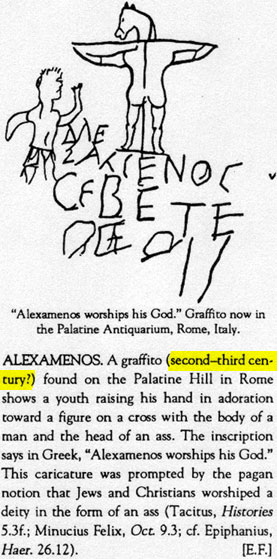
http://www.unf.edu/classes/byzantium/image/alexamenos.jpg (via http://www.unf.edu/classes/byzantium/ (University of North Florida), Origins of Christian Art, Rome:
Here it is for all you who like detail:
Rome: Graffiti: Alexamenos Worships his God:

There was also a famous story called The Golden Ass, by Apuleius (c.124-170AD), starring Eros, the god of sexual love. So apparently the early Christians were worshiping Eros as Jesus.
http://ccat.sas.upenn.edu/jod/Picts/fultrier.jpg (via http://ccat.sas.upenn.edu/jod/Picts/apuleius.images.html “The full Trier Ceiling”) OR http://www.scils.rutgers.edu/~mjoseph/CP/fultrier.jpg:
Here’s an early 4th century ceiling fresco of Apuleius, Cupid and Psyche, with other Christian motifs, now located in the Bischofliches Museum, Trier, Germany:
http://www.scils.rutgers.edu/~mjoseph/apuleius-questions1.html, Apuleius: Questions 1:
In The Golden Ass,, the tale of Cupid and Psyche is told by an old woman who recounts the story of "Cupid and Psyche" in order to quell the fears of a terrified kidnap victim; we are going to read "Cupid and Psyche" as though it were told directly by Apuleius. Let's remember, by effacing the context of the story, we are inevitably distorting it; however, "Cupid and Psyche" does seem to stand on its own, and our authority for reading it as such derives from precedent: it has been interpreted as a unitary work since the fifth century when Fulgentius analyzed it as an allegory about Christ--an ingenious Christian appropriation of a pagan tale that underscores for us its mythic power
The story is kind of odd: It tells that Eros / Cupid visited his girl friend Psyche in bed every night, which modern text defines Eros / Cupid as her “husband.” But then later in the story they go out and get “married.” Why get married if he’s already your “husband”? But regardless, Eros / Cupid is the god of sexual love.
http://www.italysoft.com/curios/psyche.htm, Psyche: The Beautiful Princess loved by Cupid, “The Legend”:
Psyche loved her nightly visits with Cupid, though during the day she was sad and lonely. One night, she asked her husband to allow her to send for her two older sisters. … (near end:) Before Aphrodite could catch them, Cupid lifted Psyche from the ground and carried her high into the heavens to Mount Olympus to the home of Zeus, god of the skies; and he bid Zeus to officially marry them.
I’m guessing that since they had lots of pre-marital sex, the story needed some later touch up.
Art Through the Ages, Gardner, 1986, p. 174, figure 5-85:
Get a room!
http://www.earlychristianwritings.com/text/justinmartyr-firstapology.html (Early Christian Writings), JUSTIN MARTYR -- THE FIRST APOLOGY OF JUSTIN (c. 150 AD), “CHAPTER LIV -- ORIGIN OF HEATHEN MYTHOLOGY”:
Bacchus was the son of Jupiter, and gave out that he was the discoverer of the vine, and they number wine [or, the ass] among his mysteries
To continue from above:
http://ctlibrary.com/4269 (Christianity Today Library), Christian History Biography, “Defending the Cannibals: How Christians responded to the sometimes strange accusations of their critics | The empire’s ‘best allies’”:
The apologist Athenagoras (c. 133-190 AD), whose primary concern was to deny the charges of atheism, Thyestian banquets, and Oedipean incest, challenged his pagan opponents to examine the lives of Christians in detail before judging them.
…“Sunshine policy”:
To counter the charge that Christian worship was a vile and secret assembly full of cannibalism, magic, and incest, apologists carefully and openly laid out the order and content of worship.
In his First Apology, Justin Martyr (c. 100-165 AD) explained the innocent nature of the "holy kiss" and then described the Eucharist and baptism
…“Taking the offense”:
Marcus Minucius Felix (flourished 200–240 AD ; died c. 250), for example, wrote, "For we were once the same as you; blind and ignorant, our opinions were once the same as yours. We believed that the Christians worshiped monsters, ate the flesh of infants, and practiced incest at their feasts. We did not understand that these tales were always being spread abroad by the demons, without examination or proof."
…
Tertullian (c. 160-220 AD) wrote, "How absurd it is for you to believe that [Christians] are panting for the blood of man when to your own knowledge they abhor the blood of man—unless indeed you have found by experience that human blood is the more palatable of the two? Again, who are more incestuous than those whom Jupiter himself has taught?" –There, Tertullian is trying to justify it. Romans were probably hypocrites: Christian free sex was the real disruption.
Eros and Ethos: A Comparative Study of Catholic, Jewish and Protestant Sex Behavior, Lopez, 1979, p. 104, “Sex With Prostitutes”:

This tells how a man can get tired of sex with the same woman all the time, and he actually feels healthier when he gets that variety. It’s like having caviar every night for dinner. Eventually, you’re going to want something else. Women are unable to detect the benefits of the healthier variety of sexual partners, simply because society’s double-standard brainwash “game” is directed toward them for the opposite (one man, or none). Few women can have an orgasm with a man simply because their mind won’t let them open up. A woman can’t open up their mind in this society because their conditional sex restrictions are usually never fulfilled – there’s always more they subconsciously hold back for. Plus, even today, they’re not “ladylike” if they enjoy sex. That slightest positive stimulation is sex: it’s your mind that determines to what degree you like it. And women have a great number more mental restrictions than men. If brainwash can cause thousands of soldiers to die in the battlefield, then brainwash can definitely curb sexual desires. It is important for humans to “realize” how extremely dumb and gullible we actually are -- we don’t believe this is the case simply because we are dumb and gullible, and because there is nothing superior: we will believe a great smile and a good personality over logic.
http://www.cannabisculture.com/articles/1949.html, Cannabis lit., “Sex, Drugs, Violence and The Bible” (book review):
His book includes a pro-snake analysis of the Garden of Eden myth, description of Jehovah as a "phallic god," and contends that Moses used marijuana for divine insight, that Jesus used cannabis for baptism and healing, and that some early Christians celebrated their faith with ritual orgies, gay sex, plant-drugs and/or consumption of semen and menstrual blood.
(“Phallic” means a penis.)
http://forerunner.com/realjesus/part3.html, THE REAL JESUS - Part Three, “Exposing the Christological Heresies of Pop Culture”:
THE ROMAN REPORT
WITH MAXIMUS MINIMUS
Saturday, August 10th, 167 A.D.
MAXIMUS MINIMUS: Last Sunday, we reported that the Roman Senate voted to officially sanction the persecution of a troublesome sect of religious fanatics. This cult advocates, among other abominations, the teaching of atheism in denying all gods but their one God should be worshipped. They also practice ritualistic cannibalism in the eating of the flesh of their God -- and a form of so-called brotherly love, thought by some to be a code word for incest. The cult is known as the Christians and they follow a leader named Jesus who was crucified for encouraging political insurrection in Palestine over 130 years ago. Leaders of the cult claim that their Jesus rose from the dead after three days revealing Himself to be a God-man.
“Enter the Critic Celsus: A second century pagan weighs in on the Supreme Court's Ten Commandments rulings”:
However, Celsus' work is different from other pagan attacks on Christians in the second century. He did not falsely accuse Christians of atheism, cannibalism and incest, as did his contemporaries Marcus Fronto and Lucian of Samasota.
http://victorian.fortunecity.com/palette/187/media.html, Temple of the Sacred Spiral, “2.2.1 Imperial Rome and the Christians”:
In Imperial Rome, the early Christians found themselves accused of dark deeds. There is a similarity between the "modern" religious inspired accusations and those made against the fledging Christian community in the early days of the faith.
Josephus (Josephus Flavius, 37AD-after100AD) listed these accusations as: the adoring of a donkey's head; ritual murder; & incest (Contra Apion [96AD-100AD]) vi
…
vi Church, History of I - Persecution New Catholic Encyclopaedia re-print 1981
A Greek-English Lexicon of the New Testament and Other Early Christian Literature, Walter Bauer, 1958, revised by Arndt / Gingrich 1979, p. 4, “αγαπάω”:

Sex is best and most seeing way to “practice” love.
http://www.orthodoxcentral.com/documents/Canons%20of%20the%20Apostles.doc, The 85 canons of apostles (2nd-4th century, but some canons originally supposed to be by St. Peter and the other Apostles), Canon 9:
9. All those faithful who enter and listen to the Scriptures, but do not stay for prayer and Holy Communion must be excommunicated, on the ground that they are causing the Church a breach of order.
(Canon LXVI of the 6th; c. II of Antioch; cc. Ill, XIII of Tim.).
“Concord.”:
Some contend that for this reason it was that the same Timothy, in c. Ill, ordains that on Saturday and Sunday that a man and his wife should not have mutual intercourse, in order, that is, that they might partake, since in that period it was only on those days, as we have said, that the divine liturgy was celebrated. This opinion of theirs is confirmed by divine Justin, who says in his second apology that “on the day of the sun” — meaning, Sunday — all Christians used to assemble in the churches (which on this account were also called “Kyriaka,” i.e., places of the Lord) and partook of the divine mysteries. That, on the other hand, all Christians ought to frequent divine communion is confirmed from the West by divine Ambrose, who says thus: “We see many brethren coming to church negligently, and indeed on Sundays not even being present at the mysteries.”
One “functional” reason couples shouldn’t have sex one or two days prior to an orgy is so they’ll be better ready to perform with others.
Gospel of Thomas, 37:
Jesus said, “When you strip without being ashamed, and you take your clothes and put them under your feet like little children and trample then, then [you] will see the son of the living one and you will not be afraid.”
Translation: Let’s all get naked and party!
1 Corinthians 7:39-40:
39A wife is bound by law as long as her husband lives; but if her husband dies, she is at liberty to be married to whom she wishes, only in the Lord. 40But she is happier if she remains as she is, according to my judgment—and I think I also have the Spirit of God.
Paul admits that he just thinks he has the judgment of God, like he’s really not for sure. But, for some reason he thinks she’ll be “happier” not being married (the translation is not “celibate”). It’s either because she’s not burdened any more with the demands of a husband, or she’s getting more sex by not being monogamous.
Art Through the Ages, Gardner, 1986, p. 247, chapter 7 (title page), “Early Christian, Byzantine, and Islamic Art”:
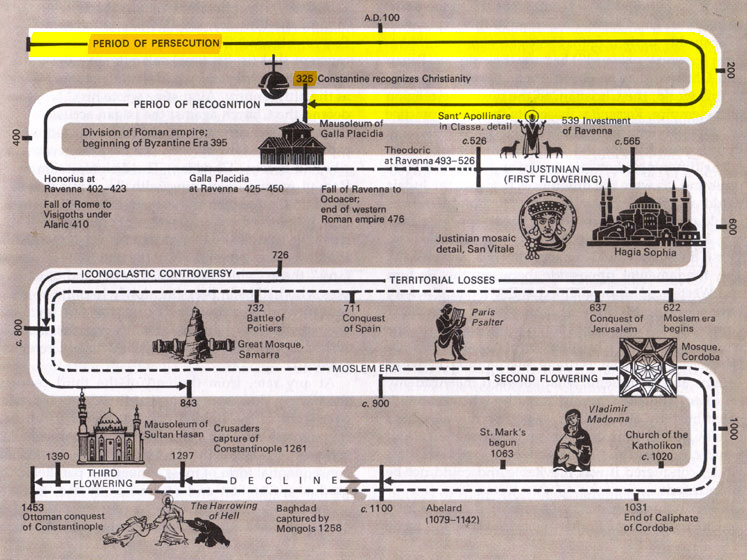
Here are some examples of words that may be used for free love:
Bartlett’s Roget’s Thesaurus, 1996, pp. 413-414, “432 Immorality | 2. sexual immorality”:
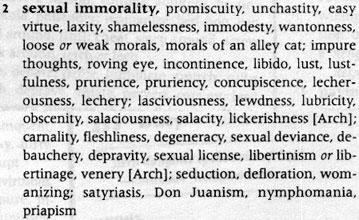
Synonyms of another popularly used word:
The Synonym Finder, Rodale, 1978, p. 661, “licentious | licentiousness”:
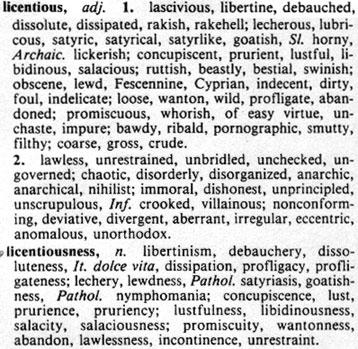
Christians were against the family standard:
http://rollingacrescrc.com/Sermons/Revelation%20series,%207%20Sermons%20started/2-%20Be%20Faithful%20unto%20death%20and%20I%20will%20give%20you%20the%20crown%20of%20life.doc, Revelation 2: Jesus Talks to the Church: Be faithful unto death, and I will give you the crown of life!:
Why were they persecuted:
There were 6 Slanders that kept coming against Christians in the early days:
1. They were cannibals- Because of the words of the sacracment of Holy Commnion, This is my Body, This is my blood.
2. They were said to be sexually immoral: Because they had Agape feasts. Love feasts—like a potluck supper.
3. They broke up families: Because often families were split when someone became a Christian, and God came first for them.
…
http://books.google.com/books?id=oWsf49cJSbcC&printsec=frontcover&dq=Plutarch%27s+Advice+to+the+Bride+and+Groom&sig=8PGr-bTQ5HwPh3Alw1OmyI9ofwQ#PPA155,M1, Plutarch's Advice to the Bride and Groom, and a Consolation to His Wife – Google Books Result, by Plutarch, edited by Sarah B. Pomeroy, 1999, p. 155, “Gendering Virtue” (Juvenal):
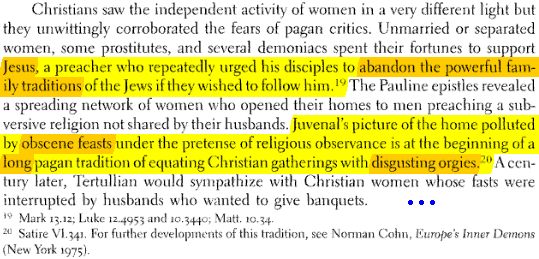
Juvenal wrote c. 93 AD.
Church Councils overview:
A Dictionary of Christian Antiquities. Being a continuation of the ‘Dictionary of the Bible’, 1877, Vol. 1, p. 41, “Agapae”:
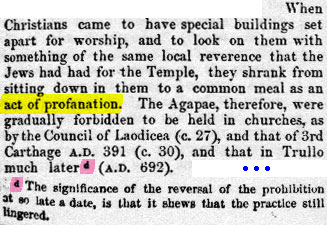
The Encyclopædia Britannica, Vol. 1, 1910, p. 364, “AGAPĒ”:
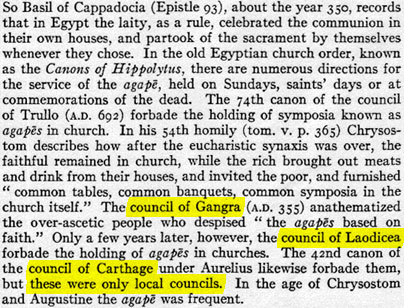
http://www.newadvent.org/cathen/01200b.htm (Catholic Encyclopedia), Agape:
The Christian assembly was held in the evening, and was continued far into the night. The supper, preaching, common prayer, the breaking of the bread, took up several hours; the meeting began on Saturday and ended on Sunday …
We know, from two texts of the first century, that these meetings did not long remain within becoming bounds. The agape, as we shall see, was destined, during the few centuries that it lasted, to fall, from time to time, into abuses. The faithful, united in bodies, guilds, corporations or "collegia" (equals), admitted coarse, intemperate men among them, who degraded the character of the assemblies. These Christian "collegia" seem to have differed but little from those of the pagans, in respect, at all events, of the obligations imposed by the rules of incorporation. …
The meal, as understood by the Christians, was a real supper, which followed the Communion; and an important monument, a fresco of the second century preserved in the cemetery of St. Priscilla, at Rome, shows us a company of the faithful supping and communicating. The guests recline on a couch which serves as a seat, but, if they are in the attitude of those who are at supper, the meal appears as finished. They have reached the moment of the Eucharistic communion, symbolized in the fresco by the mystical fish and the chalice. (See FISH; EUCHARIST; SYMBOLISM.)
Tertullian has described at length (Apolog., vii-ix) these Christian suppers, the mystery of which puzzled the Pagans, and has given a detailed account of the agape, which had been the subject of so much calumny; an account which affords us an insight into the ritual of the agape in Africa in the second century.
1. The introductory prayer.
2. The guests take their places on the couches.
3. A meal, during which they talk on pious subjects.
4. The washing of hands.
5. The hall is lit up.
6. Singing of psalms and improvised hymns.
7. Final prayer and departure.
The hour of meeting is not specified, but the use made of torches shows clearly enough that it must have been in the evening or at night. The document known as the "Canons of Hippolytus" appears to have been written in the time of Tertullian, but its Roman or Egyptian origin remains in doubt. It contains very precise regulations in regard to the agape, similar to those which may be inferred from other texts. We gather that the guests are at liberty to eat and drink according to the need of each. The agape, as prescribed to the Smyrnæans by St. Ignatius of Antioch, was presided over by the bishop; according to the "Cannons of Hippolytus", catechumens were excluded, a regulation which seems to indicate that the meeting bore a liturgical aspect.
An example of the halls in which the faithful met to celebrate the agape may be seen in the vestibule of the Catacomb of Domitilla. A bench runs round this great hall, on which the guests took their places. With this may be compared an inscription found at Cherchel, in Algeria, recording the gift made to the local church of a plot of land and a building intended as a meeting-place for the corporation or guild of the Christians. From the fourth century (when Christianity became the Roman religion) onward, the agape rapidly lost its original character. The political liberty granted to the Church made it possible for the meetings to grow larger, and involved a departure from primitive simplicity. The funeral banquet continued to be practised, but gave rise to flagrant and intolerable abuses. St. Paulinus of Nola, usually mild and kindly, is forced to admit that the crowd, gathered to honour the feast of a certain martyr, took possession of the basilica and atrium, and there ate the food which had been given out in large quantities. The Council of Laodicea (363) forbade the clergy and laity who should be present at an agape to make it a means of supply, or to take food away from it, at the same time that it forbade the setting up of tables in the churches. In the fifth century the agape becomes of infrequent occurrence, and between the sixth and the eighth it disappears altogether from the churches.
What were these “abuses”? People not praying right? People not eating right? People not washing their hands right? People not singing in tune? What “flagrant” behavior caused in to have to be ended, while in dispute for over 500 years (353-872 AD)? And probably longer:
http://www.geocities.com/Heartland/Pines/7224/Rick/chronindex.htm, Church History Timeline: The Fourth Century: Part 1:
303 The council of Elvira (Illiberis, near Granada). Nineteen bishops and 24 priests met at this first council of the Church in Spain. The council adopted 81 canons, 34 of them dealing with marriage and sexual misconduct. No reconciliation with the Church was permitted for those who committed the sins of idolatry, divorce, incest, or repeated adultery. Punishment for lesser sins was exclusion from the eucharist, for periods as long as 10 years. “[B]ishops, priests, deacons and all members of the clergy connected with the liturgy must abstain from their wives and must not beget sons” (see Siricius, 385-6). Canon 43 emphasizes the importance of celebrating the day of Pentecost, and it seems to be directed against those who would close Pentecost on the fortieth day after Pascha. At any rate, this canon is the first Christain use of ‘Pentecost’ as referring to a specific day and not to the full fifty-day period. The exact date of the council is not known. The range 300-303 and the year 309 have scholarly support.
http://community-2.webtv.net/Tales_of_the_Western_World/RLELVIRA/, “THE 81 CANONS OF ELVIRA”:
50. If any cleric or layperson eats with Jews, he or she shall be kept from communion as a way of correction.
You see, by then the Catholic Church wasn’t really Christian anymore as Jesus forsook no one.
CONTINUE TO NEXT PHASE (Specific Instances)