LIBERTINES
Date of event: c. 30 AD (at the beginning of Christianity)
Please note that the older something is, the harder it can be to get lots of information about it.
http://www.thoughtsandplaces.org/Journey2003/Item33Smith.pdf, 33. Smith, Morton, Clement of Alexandria and a Secret Gospel of Mark (Harvard University Press 1973):
Morton Smith apparently found, hand-written into the back of an old manuscript, a partial copy of a letter written by Clement of Alexandria to a presently unknown believer called Theodore. This believer had written about claims made by proselyting Carpocrations about them having a more complete version of mark showing that Jesus took part in some rites they suggested to be indications of the practice and thus approval of homosexual sexual acts. Clement wrote back that there indeed was a secret book written by Mark, one kept for those who are being perfected. The Carpocrations got a copy through bribery, and added to it what fueled their licentious ideas.
…
Mark came over to Alexandria, bringing both his own notes and those of peter, from which he transferred to his former book the things suitable to whatever makes for progress in knowledge. Thus he composed a more spiritual Gospel for the use of those who were being perfected. Nevertheless, he yet did not divulge the things not to be uttered, not did he write down the hierophantic (interpreting sacred mysteries, especially Eleusinian mysteries) teaching of the Lord, but to the stories already written he added yet others and, moreover, brought in certain sayings of which he knew the interpretation would, as a mystagogue, lead the hearers into the innermost sanctuary of that truth hidden behind seven veils. Thus, in sum, he prepared matters, neither grudgingly not incautiously, in my opinion, and, dying, he left his composition to the church in Alexandria, where it even yet is most carefully guarded, being read only to those who are being initiated into the great mysteries.
…
However, what if they were not teaching about a future destruction of the temple and abolishment of the law, but were declaring that even now the law was already superceded by the actions of Christ? That could be perceived as libertinism and considered treasonous to many jews. That could explain the stoning of Stephen and the killing of James the brother of John, and the attempt on Paul’s life. Maybe this drove Peter underground and allowed James, who isn’t mentioned at all until now, to come into the picture and try to take his brother’s movement over to steer it out of the hands of these fanatics. The libertines, who felt they were liberated from the law by Christ, were expelled, and the normative Jews who believed in the messianic nature of Jesus’ life took over. Smith takes a couple of pages to establish that libertinism was rampant in the early church, meaning that in several cases persons were taken to task who taught the law of Moses no longer mattered, and in several other cases people were taking additional liberties and declaring that sexual/moral excess was also OK in the new vision provided by Christianity.
…
Smith next shows the many places where Paul has to fight off the real libertines who celebrated incest and other excesses. Here is where the Carpocrations come in, the ones who later abused the Secret Gospel of Mark, and who lay the root of their libertinism directly at the feet of Jesus and his teachings. This discussion takes several pages in Morton Smith’s book, and there is a little warp-up of all he has shown us on page 262 to 263: The fact that the libertine tradition was so early so widespread is evidence that it derives from Jesus’ baptismal practice.
…
He not only taught his disciples that the law had come to an end with the Baptist, but he also administered a baptism–"the mystery of the kingdom of God"–by which he enabled some of his disciples, by union with himself, to enter the kingdom and to enjoy his own freedom from the law. Therefore, in our picture of pre-Pauline Christianity, alongside the legalistic interpretations of the religion, we must set the libertine. The legalistic interpretation went back to the (principally Pharisaic?) Converts of the Jerusalem church, and appealed to the tradition of Jesus’ exoteric teaching. The libertine interpretation went back to Jesus himself and preserved elements of his esoteric teaching. It was dominant in the Jerusalem church in the earliest days, but lost its hold as the small group of jesus’ original, initiated disciples was outnumbered by the new converts under the leadership of Jesus’ brother James.
…
At least in Jerusalem the libertine tradition would be a secret doctrine.
America is awful close to sexual Freedom with the Statue of “Liberty.”
http://www.answers.com/libertine, “libertine”:
One who acts without moral restraint; a dissolute person. … One who defies established religious precepts; a freethinker … An immoral or licentious person … Marked by an absence of conventional restraint in sexual behavior; sexually unrestrained … licentious
http://www.answers.com/Carpocrates, “Carpocrates”:
fl. c.130–c.150, Alexandrian philosopher, founder with his son Epiphanes of a Hellenistic sect, notoriously licentious, related to Gnosticism. Epiphanes wrote a treatise, On Justice, that advocated communal ownership of property, including women … Jesus, they held, was but one of several wise men who had achieved deliverance.
…
However, whilst the various references to the Carpocratians differ in some details, there is unanimity as to the libertinism of the sect.
…
Of the practices of the sect, Irenaeus says that they practised various magical arts as well as leading a licentious life. He also says that they possessed a purported portrait of Christ, a painting they claimed had been made by Pilate during his lifetime
…
Clement also affirms the licentiousness of the Carpocratians, claiming that at their Agape (in the sense of an early Christian gathering) they "have intercourse where they will and with whom they will".
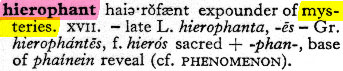
The Oxford Dictionary of English Etymology, Onions, 1966, p. 440, “hierophant”:
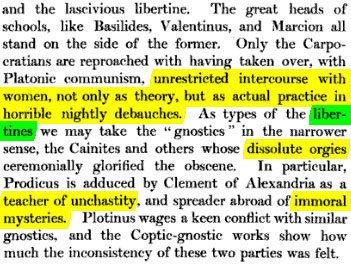
http://books.google.com/books?hl=en&id=1GcAAAAAMAAJ&dq=%22Christian+Life+in+the+Primitive+Church&printsec=frontcover&source=web&ots=kVVmLJRApD&sig=c5RbLy9tO0vunugxsHnfIb5f068#PPA271,M1, Christian Life in the Primitive Church – Google Books Result, by Ernst von Dobschütz, translated by George Bremner, 1904, p. 271, “The Beginnings of Gnosticism”:
http://www.pinktriangle.org.uk/lib/hic/dynes.html, Homosexuality, Intolerance, and Christianity: A Critical Examination of John Boswell’s Work: Christianity and the Politics of Sex:
To judge from the sources that have come down to us, the range of sexual behavior practiced among the Early Christians was astonishingly broad. We can grasp this breadth if we look first at the extremes: on the one hand, the Libertines who encouraged a great variety of sexual expression, and on the other, the party that demanded total virginity or eunuchry — no sex at all (that’s an erroneous assumption). The Early Christian libertine sects are known to us mainly from the colorful accounts of their opponents.
…
Let us now glance at one of the typical gatherings of these libertines, according to a description of a horrified opponent, the Early Christian father Epiphanius. The votaries have gathered for a banquet, but this is no chaste agape feast. In fact it soon turns into an orgy. Since women are held in common, there is no need to restrict oneself to one partner. However you must take care not to deposit the semen in the womb, but instead offer it up in your hands to God, and then eat it. Some sects, again according to Epiphanius, were much given to masturbation; others, such as the Levites, restricted themselves to homosexual relations. In any event variety seems to have been prized: according to Irenaeus, these libertines practiced acts “which we cannot believe or even conceive in our minds.” Some sects seem to have adopted the convenient rationalization that members were already in a state of grace, and could not, by definition, ever sin. Therefore all things are lawful (as even St. Paul allows). Each believer was accompanied by a guardian angel to make sure that he or she did nothing that was not permitted. Anything you can do then, it is appropriate to do.
These libertine sects have been dubbed the extreme left wing of Early Christian sexual mores. [4] Standing at the opposite extreme, the far right if you will, are the super-Puritans, or Encratites. The Encratites insisted on total continence; it is never lawful to have sex, even within marriage. For this belief various supports were sought. There is indeed a vein of continence-advocacy that runs through the New Testament (e.g., “But those that shall be accounted worthy of the resurrection from the dead neither marry nor take wives”; Luke 20: 35). A more moderate recommendation occurs in Paul’s well known “It is better to marry than to burn” (I Cor. 7: 9) (said as “a concession”). Marriage is a second option. For those who can manage it, virginity is preferable.
“Virgin” in that day just meant an “unmarried girl”; and, a eunuch can still perform the full sex act.
The only logical reason to ritually eat semen is to make it more noteworthy to make it better available for me to use today. You see, what would normally be thought of as hocus-pocus, is really functional and purposeful inspiration from God.
http://tse.sagepub.com/cgi/content/abstract/12/2/121, Celibacy and Free Love in Early Christianity:
Marriage was also attacked by those who wished to replace marriage with sexual communism. Epiphanes, On Righteousness, attacks marriage as part of a system of exclusive property rights that contradicts the original will of the Creator. Epiphanes was much indebted to the Cynic movement, as Encratism was also. Both Encratism and so-called ‘libertinism’ shared the same rejection of the narrow interests and the traditional family, and dreamt of a recovery of Paradise.
http://www.dacb.org/stories/egypt/carpocrates_.html (Dictionary of African Christian Biography), Carpocrates, 2nd century. Ancient Christian Church, Alexandria/Egypt:
Philo (c.20 B.C.-A.D. 50) had opposed those "who claimed that as they understood the mysteries of the Law they could disregard its ordinances," so it is evident that "by A.D. 40 libertinism was beginning to claim an intellectual respectability for itself in Alexandrian Judaism and a century later it had established itself as one of the principal aspects of Gnosticism in Alexandria through Carpocrates' movement" (Frend 1984: 204).
http://www.christian-apologetics.org/html/Manuscripts%20and%20linencloths.htm, MANUSCRIPTS AND LINENCLOTHS: MORTON SMITH, MAR SABA AND MARK:
If, on the other hand, we take the view that the first Christians were libertines but Paul was not, we still cannot claim to know what this libertinism was like from what Paul opposed. There is, in fact, no evidence from Paul's letters that he was in constant conscious opposition to a strong libertine teaching which preceded him.
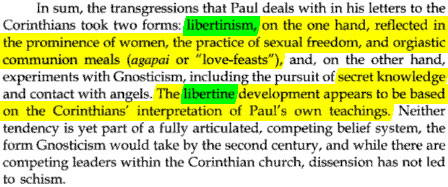
http://books.google.com/books?id=UFtts0GHZpQC&printsec=frontcover&dq=%22Jesus+And+The+Shamanic+Tradition+Of+Same-Sex+Love&sig=rtyP4fKMfedE4skKovR4FQbJ2Kw#PPA180,M1, Jesus And The Shamanic Tradition Of Same-Sex Love – Google Books Result, by Will Roscoe, 2004, p. 180, “Jesus and the Shamanic Tradition of Same-Sex Love”:
http://www.gnosis.org/thomasbook/ch4.html, Beyond the Law: The Gnostic Apostle Thomas: Chapter 4, “The Bridal Chamber”:
Nothing that is otherwise known of the Valentinians suggests that the bridal chamber involved a licentious rite. Either deliberately or naively, Irenaeus misrepresented the nature of the sacrament. Charges of sexual misconduct were standard weapons in the armory of sectarian strife. Roman authorities sometimes charged Christians with indulging in orgiastic "love feasts." In the room where they met, it was said, dogs tied to candleholders threw over the tapers when food was tossed among them; promiscuous intercourse, often incestuous, was supposed to follow in the dark. Other charges were cannibalism (because Christians were known to eat the flesh and drink the blood of Christ) and blasphemy (because they refused to honor the Roman gods). Anti-Christian writers may have had in mind certain libertine Christian Gnostic sects.
http://www.freerepublic.com/forum/a3b3a47345f84.htm, Do Parts of the Gospels Come From Pagan Mythology?, “Reasons for the Pagan-Christian similarities”:
Freke & Gandy have concluded that the original, main Christian movement was Gnostic Christianity. They kept their inner mysteries secret, revealing them only to those who have been initiated into the faith. … Decades later, literalist Christianity became the dominant movement. They oppressed and exterminated the Gnostics.
http://www.signaturebookslibrary.org/new/chapter16.htm, Toward Understanding the New Testament: Paul, Paulism and the Early Church: The Jewish Christian Tradition – chapter 16, “James”:
Some of these (the libertines) advocated freedom from the Law and used Paul as their primary source.
”Jude and 2 Peter”:
It appears that some were libertines who may have engaged in sensual practices in their rituals.
http://www.antinopolis.org/carpocrates.html, Saint Carpocrates And The Libertine Companions of ANTINOUS, “Carpocrates and Antinous”:
And the priests there are said (by Origen) to have indulged in Libertine feasts on the Sacred Nights, much like the Carpocratians. Both were in keeping with the wild orgies of the late Dionysian cult. As the power of the Orthodox fathers of the Church grew in Alexandria, and the protection of the Antonine Emperors waned, Antinoopolis became an island of safety for free thinkers and feelers in a world that was growing ever more dangerous and intolerant.
…
Hadrian favored Dionysian artists, whose religion had been previously outlawed for licentious practices during the Republican period.
THE FIRST THREE CHRISTIAN GROUPS
http://jmm.aaa.net.au/articles/12426.htm (John Mark Ministries), Why Do Christians Fight? A Sermon by Brent J. Eelman, September 28, 2003, Abington Presbyterian Church:
Shortly after the church began it divided into three groups. The first were the Libertines who had a radical view of Christian freedom, believing that the believer could do anything because of the grace of God. There were the Ascetics who developed a very rigid view of Christian discipline, almost the direct opposite of the libertines. There was a third group who were the Ecstatics. They believed that Christian faith should be manifest in joy and celebration, but their celebrations were a bit over the edge. Those are the three groups that we know about, but there was probably a fourth group. These were the people who were not part of any of the three groups in the conflict. They were there at the church to grow spiritually, to practice their faith and to worship God. They were not fighters, and my guess is that they represented the majority. (This is the group that is often hurt the most in conflict and fighting.) … When we look at that letter, Paul affirmed that all three were right, to an extent. Like the Libertines, Paul was a proponent of Christian freedom.
Ascetics (the church at Corinth):
http://home.messiah.edu/~mcosby/Paul-Glossary.pdf, Glossary of Terms for Apostle on the Edge:
|
Ascetics |
Christian group at Corinth who believed that spirituality is increased by denying physical pleasure to the body. They held a philosophy opposite from the Libertines, although both groups had a low view of the human body. |
However (concerning the above statement about the Corinth church):
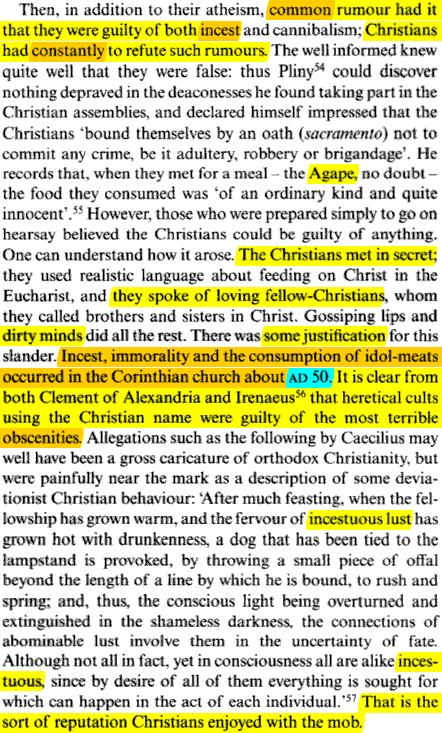
http://books.google.com/books?id=9F-nnE2dfqUC&printsec=frontcover&dq=%22Evangelism+In+The+Early+Church&sig=Q3wH6iM1DrPXZlQEP0VcGZRUDus#PPA63,M1, Evangelism In The Early Church – Google Books Result, by Michael Green, 2004, pp. 63-64, “Chapter 2: Obstacles to Evangelism | Three Factors which told against Christians”:
Pp. 396-397, “Notes | Chapter 2”:
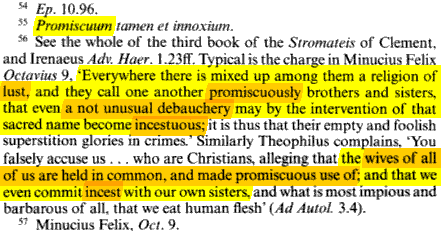
In Latin “promiscuum” means: “promiscuous,” “indiscriminate,” “shared general,” “mixed,” “common,” “to make no distinction between,” etc.
Ecstatics:
http://www.csp.org/chrestomathy/sacred_games.html, Sacred Games: A History of Christian Worship, Lang, Bernhard (1997), New Haven, CT: Yale University Press, “Excerpt(s): ON ECSTATIC WORSHIP”:
In ancient Greece, female participants dominated in the cult of Dionysos, the god of wine and vitality, in whose honor "orgies" were held. Specialists tell us that in the case of the Dionysian associations, the members called "maenads" actually came from the upper classes, for only these could afford to go to the mountains for a couple of days, leaving their children at home with their slaves. The ecstatic celebration offered them a respite from daily routine, domestic confinement, and isolation. When the dances and trances were over, they returned home to resume their dull and isolated existence, which the maenadic ritual helped them to endure.
…
In Christianity, ecstatic worship is more firmly rooted than mainstream Protestantism with its calm, intellectual worship might lead us to expect. If mainstream worship represents the Apollonian side of Christianity, ecstatic cults reveal its Dionysian aspects. Christian ecstatic worship has a long history as well as a noble, biblical pedigree. While the following sections will recall only parts of that history, its New Testament beginning must be analyzed in detail. (page 371)
http://www.sacredsource.com/prodinfo.asp?number=DDP, Sacred Source: Ancient Images, Ancient Wisdom, “Dionysus Satyr maenad Plaque 10””:
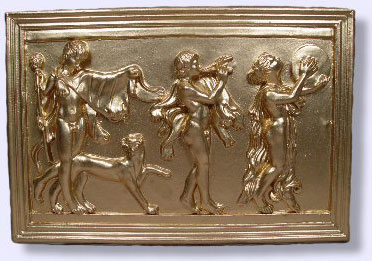
DIONYSUS -- God
of Ecstatic Devotion
Bacchus, or Greek Dionysus, came to Europe
from Crete and is thought to be the indigenous
vegetation God and consort of the Mother Goddess later displaced by patriarchal
Jupiter. His mystery school was closely
linked with that of Goddess Cybele, brought to Rome from Asia Minor. Both enjoyed flamboyant oriental
priestesses and priests, clashing cymbals and blowing twisted reeds as they
danced barefoot with ecstatic abandon.
This plaque shows Dionysus in procession with an aulos-playing Satyr and
drumming Maenad, and is the inspiration for our frame drum design. The Maenad women drummers, filled with erotic
longing for union with Dionysus, developed a
reputation for unbridled licentiousness
and the ability to invoke trance with rhythm. Our word orgy comes from the annual Roman celebration of Bacchanalia corresponding with the fermenting of wine.
Stands and hangs. [Roman Relief 100 C.E.]
So, it sounds like all three groups were promiscuous.