THE SEPTUAGINT (OVERVIEW)
(Includes: Attractive [looks discrimination])
The Septuagint was the Old Testament translated into Greek. It was the Bible used directly by Jesus, Paul, and the writers of the New Testament. “LXX” is also a name for the Septuagint.
What is it? (The Old Testament used by the Early Christians):
Dictionary of the Bible, Browning, Oxford, 1996, p. 339, “Septuagint”:

Unger’s Bible Handbook, Moody Press, 1967, “How the Bible Came To Us,” p. 883:
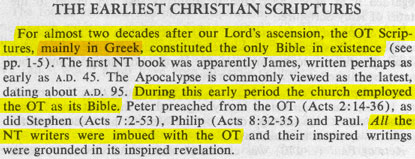
http://dictionary.reference.com/search?q=imbue, Dictionary.com, “imbue”:
To inspire or influence thoroughly; pervade: work imbued with the revolutionary spirit.
http://www.lxx.org/qa_d1.htm, Orthodox Study Bible: Old Testament Project:
In the last few centuries before Christ, Greek was the language most commonly used in Palestine and the Middle East In the writing of the apostles, the Septuagint version is quoted almost exclusively … The Old Testament of the Orthodox Church is that which it has been from the beginning the Septuagint, that Greek version already in use when Christ came. It was the Bible used by him and the Apostles.
http://www.ocbooks.co.nz/biblehowto/bible.htm, How To Choose A Bible:
Furthermore, what we call the Old Testament comes in two versions: the Hebrew and the Greek, (also called the Septuagint). For the most part, the people in Jesus' day used, and knew, the Greek text, which is why some of the verses quoted in the New Testament may seem to say something different from the Old Testament version.
http://users.binary.net/polycarp/apocry.html (A Catholic Response), The Apocrypha?:
Before the 2nd century, most Palestian Jews preferred a canon loosely similar to the Protestant OT; however, the Greek-speaking Jews preferred the larger canon found in the Greek Septuagint Bible - a 2nd-century B.C. Greek translation of the Hebrew Scripture. It was the "Bible" for the Greek-speaking Jews. When the Apostles began to evangelize the Greek-speaking Jews and Gentiles, they used the already established Septuagint as their Bible. Using the Hebrew Scripture would have been as effective as using a Russian Bible to evangelize Americans. The Septuagint served to bridge the culture gap. Quickly the Greek-speaking converts outnumbered the Hebrew Christians. Scholars also recognize that the NT writers quoted extensively from the Septuagint, e.g. Matt. 1:23. The Septuagint became the OT of the early Church. [S&W, p. OT 433]
http://search.barnesandnoble.com/booksearch/isbnInquiry.asp?z=y&EAN=9781850755715&itm=1, First Bible of the Church: A Plea for the Septuagint, “From the Publisher” (book review):
This fact is especially important since the Septuagint was extensively used in the New Testament writings, whereby it - and not the Hebrew Bible (the Masoretic text) - was the most obvious candidate to be the first Bible of the Church.
http://www.newadvent.org/cathen/13722a.htm (Catholic Encyclopedia), Septuagint Version, “Historical Importance of the Septuagint”:
The Jews made use of it long before the Christian Era, and in the time of Christ it was recognised as a legitimate text, and was employed in Palestine even by the rabbis. The Apostles and Evangelists utilised it also and borrowed Old Testament citations from it, especially in regard to the prophecies. The Fathers and the other ecclesiastical writers of the early Church drew upon it … We know also that the writers of the New Testament made use of it, borrowing from it most of their citations; it became the Old Testament of the Church and was so highly esteemed by the early Christians that several writers and Fathers declared it to be inspired. The Christians had recourse to it constantly in their controversies with the Jews
The Septuagint with Apocrypha, 1851, Brenton, seventh printing 1998, Preface:
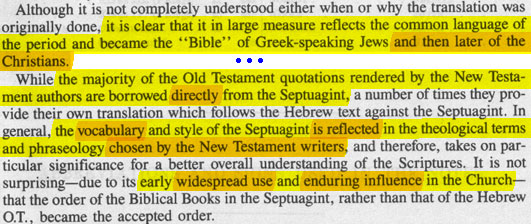
http://www.encyclopedia.com/doc/1E1-Septuagi.html, Septuagint, (from The Columbia Encyclopedia, Sixth Edition 2006):
It was the version used by Hellenistic Jews and the Greek-speaking Christians, including St. Paul; it is still used in the Greek Church.
http://www.encyclopedia.com/doc/1O999-septuagint.html, Septuagint, (from The Oxford Pocket Dictionary of Current English 2006):
Sep·tu·a·gint / ˈsepchoōəˌjint/ n. a Greek version of the Hebrew Bible (or Old Testament), including the Apocrypha, made for Greek-speaking Jews in Egypt in the 3rd and 2nd centuries bc and adopted by the early Christian Churches.
http://www.septuagint.net/, Septuagint and Reliability:
Septuagint
- Influence on Christianity
The Septuagint was also a source of the Old Testament for early Christians
during the first few centuries AD. Many early
Christians spoke and read Greek, thus they relied on the Septuagint translation
for most of their understanding of the Old Testament. The New Testament writers also relied heavily on the
Septuagint, as a majority of Old Testament quotes cited in the New Testament
are quoted directly from the Septuagint (others are quoted from the
Hebrew texts). Greek church fathers are also known to have quoted from the
Septuagint. Even today, the Eastern Orthodox Church relies on the Septuagint
for its Old Testament teachings.
http://encarta.msn.com/encyclopedia_761566700_6/Bible.html, Bible, page 6 of 14, “The Septuagint and Other Greek Versions”:
The most valuable versions of the Hebrew Bible are the translations into Greek. In some instances the Greek versions actually offer readings superior to the Hebrew, being based on older Hebrew texts than are now available. Many of the Greek manuscripts are much older than the manuscripts of the full Hebrew Bible; they were included in copies of the entire Christian Bible that date from the 4th and 5th centuries. The major manuscripts are Codex Vaticanus (in the Vatican Library), Codex Sinaiticus, and Codex Alexandrinus (both in the British Museum).
http://www.russpickett.com/study/roman02.htm (Faith Mountain), The Book of Romans!:
Jewish scholars filled this void by translating the Hebrew scriptures into a work called the Septuagint, so called because seventy scholars were supposed to have been involved in the translation (Septuagint means seventy).] Paul felt the compulsion of his calling to minister to both the civilized (Greek speaking) and uncivilized (non-Greek Speaking) people in Rome.
http://www.gpp-5grace.com/graceproclamator/bqbb0298.htm, Bouquets and Brickbats:
Sir, you lie when you say Jesus never quoted the Sep (Septuagint). [Editor’s Note: In the article to which Mr. Marlowe refers, I said that Jesus and the Apostles quoted the Septuagint]. Your arrogance has blinded you. Jesus quoted the Septuagint a number of times, more times that he quoted the Hebrew. Several New Testament passages are exact quotes from the Septuagint. Even the KJV translators declared that the Septuagint is quoted in the New Testament.
http://davidmacd.com/catholic/bible_catholics_apocrypha.htm (CatholicBridge.com), What's with these "extra" books in the Bible, “Deuterocanonical Books – (The Apocrypha)”:
Jesus quotes the Septuagint in 80% of his Old Testament References. The Septuagint was the Scripture of Jesus' time.
http://www.communitybapt.com/sermons/MT211217.TXT, (Community Baptist Church), CHRIST: CLEANSER AND HEALER:
Jesus responded to the leaders' complaints (vv.16-17 [Matt. 21]). He explained why the children praised Him (v.16) by quoting from Psalm 8:2. Jesus quoted the Septuagint version instead of the Hebrew version because most people in His day understood the Septuagint.:
http://www.cforc.com/kjv/Matthew/index.html, King James Version of the Bible, Book of Matthew, Chapter 21, “21:16”:
And said unto him, Hearest thou what these say? And Jesus saith unto them, Yea; have ye never read, Out of the mouth of babes and sucklings thou hast perfected praise?
http://www.cforc.com/kjv/Psalms/index.html, King James Version of the Bible (translated from Hebrew), Book of Psalms, Chapter 8, “8:2”:
Out of the mouth of babes and sucklings hast thou ordained strength because of thine enemies, that thou mightest still the enemy and the avenger.
http://ecmarsh.com/lxx/Psalms/Psalms%20LXX.htm (The Septuagint Bible Online), Psalms, “Psalm 8”:
2 Out of the mouth of babes and sucklings hast thou perfected praise, because of thine enemies; that thou mightest put down the enemy and avenger.
http://www.dawnbible.com/2001/0104cl-1.htm (Christian Life and Doctrine), Studies in the book of Hebrews—Chapter 10:1-22:
VERSE 5 “When he cometh into the world, he saith, Sacrifice and offering thou wouldest not, but a body hast thou prepared me.” The Apostle Paul in this verse, speaking of Jesus, quotes the Septuagint Version of Psalm 40:6 in the Old Testament.
http://www.cforc.com/kjv/Psalms/index.html, King James Version of the Bible (translated from Hebrew), Book of Psalms, Chapter 40, “40:6”:
Sacrifice and offering thou didst not desire; mine ears hast thou opened: burnt offering and sin offering hast thou not required.
http://ecmarsh.com/lxx/Psalms/Psalms%20LXX.htm (The Septuagint Bible Online), Psalms, “Psalm 40”:
6 Sacrifice and offering thou wouldest not; but a body hast thou prepared me: whole-burnt-offering and sacrifice for sin thou didst not require.
Funk & Wagnalls New World Encyclopedia (via EBSCOhost @ http://www.jocolibrary.org [library card number required]), “Christ”:
CHRIST, Greek term found in the Greek version of the Old Testament, the Septuagint, translating varied forms of the Hebrew verb m[amacr ]shakh, “to anoint” (most frequently the nominal form m[amacr ]shiakh, “an anointed one,” from which the English “Messiah” is derived).
Funk & Wagnalls New World Encyclopedia (via EBSCOhost @ http://www.jocolibrary.org [library card number required]), “Messiah”:
MESSIAH, in theology, the Anointed One, the Christ. It was the Hebrew name for the promised deliverer of humankind, assumed by Jesus and given to him by Christians. The English word is derived from the Hebrew m[amacr ]shiah, meaning “anointed.” In the Greek version of the Hebrew Bible, the Septuagint, this word is translated by the word Christos, from which “Christ” is derived.
Funk & Wagnalls New World Encyclopedia (via EBSCOhost @ http://www.jocolibrary.org [library card number required]), “Vulgate”:
VULGATE (Lat. vulgata editio, “popular edition”), edition of the Latin Bible that was pronounced “authentic” by the Council of Trent. The name originally was given to the “common edition” of the Greek Septuagint used by the early Fathers of the Church. It was then transferred to the Old Latin version (the Itala) of both the Old Testament and the New Testament that was used extensively during the first centuries in the Western church. The present composite Vulgate is basically the work of St. Jerome, a Doctor of the Church. At first St. Jerome used the Greek Septuagint for his Old Testament translation, including parts of the Apocrypha; later he consulted the original Hebrew texts.
http://www.coyotela.org/history.html, The Authentic Herstory [sic] of Prostitution: A Brief Chronicle of Sacred Whoredom:
The name "Christ," meaning "the anointed," was derived from the Horae's sacred sexual oil, chrism, which means "to anoint."
When was it written (translated from Hebrew)?
http://www.ancient-hebrew.org/17_translations.html (Ancient Hebrew Research Center), Biblical Facts: Ancient Translations of the Hebrew Bible:
|
http://www.bible-researcher.com/isbelxx04.html, Septuagint, part 4, “1. Grouping of Septuagint Books on Internal Evidence”:
The Greek Hexateuch (The first six books of the Old Testament) may be placed in the 3rd century BC, the Prophets mainly in the 2nd century BC, the "Writings" mainly in the 2nd and 1st centuries BC.
http://tt2.lonelyplanet.com/thorn/repliesflat.pl?Topic=850495&sb=5&view=expanded (Lonely Planet Online) (3-15-04), The Thorn Tree:
The Septuagint (the main Greek translation, dating from the 3rd to the 1st century BCE), which has been the basis for the Latin Vulgata and most other Christian translations
http://www.geocities.com/Athens/Thebes/4610/lifelines/love3.html (Victory Christian Center), The Love of God:
the translators of the Septuagint (the Greek version of the Hebrew Scriptures made between 250 and 150 B.C. by Jewish scholars) used agape to stand for romantic and sexual love in the Old Testament. … the writers of the NT followed the practice of the Septuagint which also predominantly used agapao for various Hebrew words for love. That the writers of the NT were heavily influenced by the Septuagint is evident from the facts that they quote from it rather than the Hebrew text much of the time, as well as employing many of its words and phrases.
A Time Line of Key Events in the History of the Bible: How We Got The Bible, Rose Publishing, 1998, (laminated foldout):
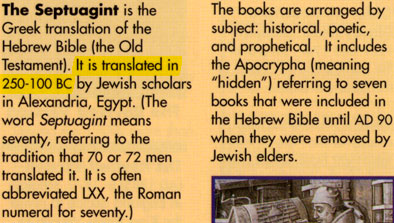
The Story of Christianity: 2,000 Years of Faith, Price and Collins, Tyndale, 1999, p. 232, “Glossary | Septuagint”:
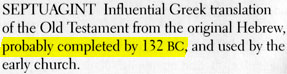
http://www.handsonweb.com/robert/course01.txt, An introduction to the Bible by Robert Boardman:
The ancient translation into Greek of the Old Testament known as the Septuagint was the book which conveyed the apocryphal materials into the Church. The Septuagint was the Bible of the Greek-speaking, or Hellenist, Jews, whose intellectual and literary centre was Alexandria in Egypt. The oldest existing copies of this translation date from the fourth and fifth centuries of our era, and were made by Christian hands. Nevertheless scholars generally agree these copies faithfully represent the Old Testament as it was current among the Hellenist or Alexandrian Jews in the two centuries before Jesus. … Almost without exception, the quotations of the Old Testament in the New Testament can be shown to come from the Septuagint.
www.kluweronline.com/article. asp?PIPS=brill_00472212_v34n2_s1&PDF=1 (12-8-04):
14 Moore places the date of translation for LXX Daniel at ca. 100 bce because this text is quoted in 1 Maccabees.
http://www.kensmen.com/catholic/septuagint.html, The Canon of the Bible and the Septuagint:
It was a
standard Jewish version of the Old Testament, used
by the writers of the New Testament, as is evidenced by the fact that Old
Testament references found in the New Testament refer to the Septuagint over
other versions of the Old Testament. Let
me reiterate: the then 300+ year old Septuagint version of Scripture was
good enough for Matthew, Mark, Luke, John, and Paul, etc., which is evident in
their referencing it over 300 times (out of 350 Old Testament
references!) in their New Testament writings -- and the
Septuagint includes 7 books and parts of Esther and Daniel that were removed
from Protestant Bibles some 1,500 years after the birth of Christ.
The Septuagint is the Old Testament referred to
in the Didache or "Doctrine of the Apostles" (first century Christian
writings) and by Origen, Irenaeus of Lyons, Hippolytus, Tertullian, Cyprian of
Carthage, Justin Martyr, St. Augustine and the vast majority of early
Christians who referenced Scripture in their writings. The Epistle of
Pope Clement, written in the first century, refers to the Books Ecclesiasticus
and Wisdom, analyzed the book of Judith, and quotes sections of the book of
Esther that were removed from Protestant Bibles. Bottom line: the Septuagint was the version of the Old Testament
accepted by the very earliest Christians (and, yes, those 7
"extra" books were found among the Dead Sea Scrolls which date
between 168 B.C. and A.D. 68, and which by the way, support both the Septuagint
and the 6th - 10th c. A.D. Masoretic texts in various ways, but supporting the
Septuagint on average. 3 ).
General agape sexual definitions:
http://members.ozemail.com.au/~moorea/agape_definition.html, God’s Love - agape:
The LXX or Septuagint, was the Hellenistic Jews Greek translation of the Hebrew Old Testament. This was the Greek Old Testament around in the time of Jesus and the early Church. … So then, if we go back to the Septuagint, and have a look at the passages, we should be able to get some context for this word. And when we do, we find that more often than not, the noun 'agape' refers to sexual love
http://www.agapetae.org/agape.html, Original Agape - Song of Solomon love:
Christians are generally taught that 'agape' was a new word coined by the early Christians, as they did not want to use any of the existing Greek words for love because of their associations. This is not true. Duh, if Christian writers used a word that the Greek world wasn’t familiar with, then they wouldn’t understand it – that means the message wouldn’t get taught – but, what amazes me, is that today’s Churches can say the early Christians coined the word, and everybody will “just” believe it. Whilst Christian 'agape' is certainly a kind of love distinct from any other love in human experience, the noun 'agape' existed prior to its use in the NT texts, and the word and its meaning would have been well known to the New Testament authors. … the noun 'agape' refers to intimate male female love as given context in the Song of Solomon … In Hastings. J Dictionary of the Bible under the reference for Love in the LXX we read: All these varieties of love, human and divine, may in the LXX be expressed by the verb agapao and noun 'agape'. In the story of Samson and Delilah agapao describes sexual relationship (Judges 16 v 4, 15) not to mention Solomon's legalised lust (3 K 11 v 2), besides expressing love in its higher reaches…. In the Greek Bible in the form that it must have been known to the NT writers, agapao does duty for every shade and variety of love, for divine pity and preference for Israel right down to erotic passion. … The noun 'agape' is usually connected with sex, or at least with the love of women; or it is a passion comparable in intensity with hatred; it is not at all a higher love than philia.
http://members.ozemail.com.au/~moorea/lxxagape.html, Agape in the Septuagint:
Agape is 'Song of Solomon' Love …(lists examples) So Christianity was not creating a new word for the God kind of love, it was redeeming a word already in existance. And it is this love that the early Church Celebrated in Love Feasts and the Kiss of Peace.
http://members.ozemail.com.au/~moorea/pcagape.html, Agape:
Why did God or at least the New Testament writers, not do as the modern Christian Church reconstruction has inferred, and truly invent a word that had no sexual connotations, or in the very least use 'phileo' which had a far more 'brotherly love' connotation to it?
http://members.ozemail.com.au/~moorea/agape.html, Goodness, Love and Virtue, “Celebrating God’s Love”:
Aspects that were central to the early church, but now rather obscured are predominantly those associated with openness, love and intimacy. They included the kiss of peace, the love feasts, as well as certain more controversial aspects. Openness and intimacy in the early church deserves a study of its own, however a cursory look at the expression of Love in Primitive Christianity is worthwhile here. It is clear that Christianity was originally an 'agape' religion (See appendix 4 for a short synopsis of early Church Fathers on the Kiss of Peace.) Since those early days, things have subsequently shifted into the realms of the lukewarm and the intellect. Whenever we fail to move in God's love, we fail to see the power of Christianity exhibited. Failing to rightly divide the Word, failing to truly embrace God for who he truly is as eternally good and loving, we fail to love and show goodness to each other. We fail to exhibit the true God to humanity, Christianity continues to allow the portrayal of an 'Old Testament' God, and all the while humanity continues to vainly yearn for the revelation of a pure and eternal goodness and love. Now is the time for Christians show the world who God truly is, and to destroy the intellectual strongholds that have blocked humanity's vision of the true God.
The fact of the matter is, you can’t have all that true Jesus kind of love for one another if it doesn’t include sex, and within the last 2000 years Christianity definitely removed the sex. And, that is why the agape love feast, the kiss of peace, and the other kinds of real considerations for others found in the New Testament and the Early Church had to all be eliminated. Sure, everyone would like to have it back, but refuse to do what would be necessary to have it back – free / unconditional sex.
1 John 4:12:
No one has seen God at any time. If we (agape)love one another, God abides in us, and His (agape)love has been perfected in us.
Philippians 2:2:
fulfill my joy by being like-minded, having the same (agape)love, being of one accord, of one mind.
2 Thessalonians 1:3:
We are bound to thank God always for you, brethren, as it is fitting, because your faith grows exceedingly, and the (agape)love of every one of you all abounds toward each other,
http://www.azlyrics.com/lyrics/alanjackson/wherewereyouwhentheworldstoppedturning.html, Alan Jackson Lyrics, “Where Were You (When The World Stopped Turning)”:
Did you just stay home and cling tight to your family. Thank God you had somebody to love
That indicates that in this Christian based society, after 2000 years, since the corruption of agape love, the only love you can count on is the limited love within your own family, in this case your spouse (for those minorities “lucky” enough to have a truly mutually loving spouse). But a true Jesus sexual based love would allow for all to be in love with “one another.”
… But I know Jesus and I talk to God, And I remember this from when I was young: Faith hope and love are some good things he gave us, And the greatest is (agape / sexual)love, The greatest is (agape / sexual)love, The greatest is (agape / sexual)love –1 Corinthians 13:13.
Now that “fits” a lot more with something called “reality.” But, then who really cares about the future of mankind – I must be the only one.
http://pathways-online.com/yabbse2/index.php?board=6;action=printpage;threadid=1051 (3-27-04):
The first written translation from the Hebrew into the Greek language is the Greek Septuagint. Its translation commenced about 280 B.C.E., according to tradition, by some seventy Jews of Alexandria, Egypt, and it was completed sometime in the second century B.C.E. Since the word "eros," usually translated as sexual love, lust (where we get our english word "erotic" from) is not found in the Septuagint, nor any other Greek bible, what Greek word do you think was used in 2 Samuel, the Song of Solomon, and other cases where it speaks of romantic love, or even lust such as in Amnon's case? So if the word "agape" was used at 2 Samuel 13:1, 4, 15 in the second century B.C.E. it goes to reason that it meant the same back then as it does today.
http://members.ozemail.com.au/~moorea/pc.html, Primitive Christianity:
A Christianity firmly rooted in intimate love - 'agape'
http://www.marianland.com/agape.html (Largest Roman Catholic Marian Resource and Pro-Life Web Site), Agape:
The term is not common in Hellenistic literature, which usually refers to "love" as eros (sexual) or Philia (friendship). The term occurs as a verb in the Greek Old Testament, the probable source from which the New Testament authors drew.
Song of Solomon (or, Song of Songs; or, Canticles):
http://www.steliasofatlanta.org/lvsxort1.htm (1-16-02) (Saint Elias Antiochian Orthodox Christian Church, Atlanta, GA); Love, Sex & Orthodoxy: Four Sessions and 1 Teen Discussion, “The Theology of Love”:
And Rabbi Aqiba used to teach that, while all the Bible is holy, the Song of Songs is the holy of holies of the whole Bible. All of this point to the belief that in the Song of Songs we have the experience of God’s love for man, and man’s love in response to God’s, expressed in the strongest terms possible to divinely inspired human language and artistic craft. The divine Wisdom Himself has deemed erotic love to be the most adequate human symbol for eternal divine love-Agape.
http://www.georgetown.edu/faculty/ap85/papers/notlust.html (Georgetown University), Not out of lust but in accordance with truth: Theological and philosophical reflections on sexuality and reality:
Moreover, it is worth noting that the Greek word agapê is used in the Septuagint translation of the Song of Songs to characterize precisely a love that is obviously deeply erotic; this shows that the erotic is not a separate relation from the agapic, but is a part of one whole.
http://www.othersheep.org/lesbigays.htm; The Bible, Sex, and Ideological Fundamentalism:
In relating sexuality to love, Ellul indicates his awareness of some recent theological and exegetical refutations of Nygren's simplistic distinctions between agape and eros (1984:292,296), but insists on working theologically on that level. Had he not buried himself so long in the study of Ecclesiastes (perhaps the clearest Biblical case of a Gay author, although Ellul finds this "incredible;" personal letter, 1989), he might have discovered how the Song of Solomon rather consistently uses the agape/agapao vocabulary (in the Septuagint translation) to refer to sexual love.
Dictionary of the Bible, Browning, Oxford, 1996, p. 341, “sexuality”:

http://kt70.com/~jamesjpn/articles/ChristianityAndSei.htm, The Christian Digest, Presents: CHRISTIANITY AND SEX--PART 1, “THE BIBLE IS NOT BASHFUL”:
Many passages of the Bible are unabashedly erotic, including the Song of Solomon … some sections of the Bible, such as the Song of Solomon, were virtually banned by fourth century celibates who feared they were just too hot.
Bible Stories, Dempsey Parr, 1999, The Old Testament, The Books of Poetry and Wisdom, p. 13:
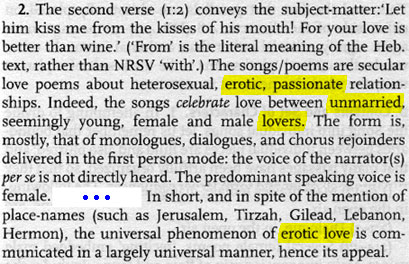
The Oxford Bible Commentary, 2001, p. 429, “The Song of Solomon”:
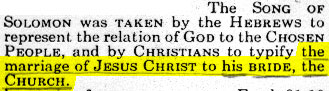
The Holy Bible: Clarified Edition (KJV), Consolidated Book Publishers, 1957, no page number, “Encyclopedic Index: Concordance and Dictionary, Gilbert James Brett, Editor | MARRIAGE”:
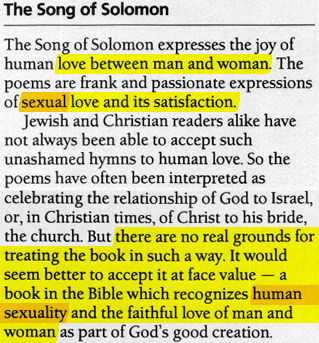
The Eerdmans Bible Dictionary, Myers, 1987, p. 929, “SEX”:

Agape and Eros, Nygren, translated by Watson, 1957, p. 388, “VI. The Eros Type in Alexandrian Theology | 7. God is Eros—God is Agape”:

Nelson’s Illustrated Bible Companion, Batchelor, Thomas Nelson Publishers, 1995, pp. 85-86, “Poems and Hymns | The Song of Solomon”:
So, “Jesus” has a “new commandment” for us to use this kind of love (not monogamously, but) with “one another,” as it is told to many adults (disciples), mostly of the same sex. And it’s the kind of love that outsiders will be able to easily see. I’ve visited many Churches, but can’t easily see, or can easily know, who loves who, by just seeing them together or sitting next to each other. But if they’re adults and they’re holding hands, arm around the other, kissing, etc. I’ll know there’s some sexual love there. Many people see Bill and Hillary together and even know they’re married, but can’t tell if they love each other. But, if we caught them having sex, we’d know for sure they at least love each other sexually. It would be the kind of love that “all” would be able to easily “know.” All this is unbelievable to you simply because you have all been “taught” different; simply because there was an era, as stated above, where all positive sexuality was to be taken out of the Bible, or reinterpreted. It still controls thought today, simply because society has been strongly set up to accommodate it (the marriage standard, where “evil” or “sin” is any sex outside marriage). But “Jesus” says there’s a better way… only if you want to look at it at “face value.”

Okay, let’s give it a try:
John 13:34-35:
34A new commandment I give to you, that you sexually love one another; as I have sexually loved you, that you also sexually love one another. 35By this all will know that you are My disciples, if you have sexual love for one another."
Does this mean that Jesus supported something evil (free sex)? No, it means that free sex is NOT “evil,” and now can be associated with the Goldenrule, and understood as more of a “love building” tool, because open / free sex can be arranged where no one gets hurt – it’s the conditions, restrictions and constraints in sex that causes the evil.
Advanced commentary: Because of its great power, sex is by far, the best (and only) real tool we have to cause a “true” Goldenrule reciprocal between adults. It’s even better than shaking hands in Church. Sex causes the subconscious to sense the value of each other’s individual unique body / value, and in a mutually pleasing way. When we limit sex to marriage / monogamy, we sense much less / little value for others (other than spouse), which causes / escalates more disputes, bias, wars, etc. This is why the true Son of God would have to support open / free sex. Marriage is simply an organized form of prostitution, which the Bible does denounce. We would simply allow future teens to seek their natural “diversity” desires (via creating a fad), rather than “the game” of winning that “one” special person. As we know, many lose that “game.” In true open / free sex, everybody wins. I guarantee no one will want to go back to the marriage / monogamy standard. But first, we need to expose existing cures and preventives for STDs, caused by the weakness of our antibodies, because of too many years of marriage / monogamy. I know how “crazy” I sound: I live in the same society that the rest of you live in, I’m just “able” and willing to analyze another step further. Weddings seem so special because it looks like two people have won the “game.” “Deep feelings” for another is felt simply because monogamy teaches us to strongly want to exclusively possess a higher quality person, just so to “win the game” which subconsciously impresses the overwhelming expectations of society. However, those “deep feelings” actually fit with the definition of “lust,” which can cause havoc when someone loses that “overwhelming” goal. But, I realize that monogamy is what is required to make the possessiveness / ownership of a marriage fair. Today’s abundances of divorces (thanks to “the pill” and women’s desires for independence) show that, deep down, we naturally don’t want marriage / monogamy. Coupled with the fact that we are on the edge of nuclear and/or biological annihilation, the time seems right for sexual truth about Jesus. Yes, such a revelation would be an Apocalypse. Plus, a Nationally Paid Child Support Program would “guarantee” wellness for “all” children. Traditionally, the “game” directs women (more than men) as “a winner” of the game, when they get monogamy; mainly because “the game” places women’s sex as a restricted condition (basically prostitution) not to be pleased unless certain conditions are met. Conversely, men feel it as a self-centered “victory” (kind of like war) if they get “free” sex without having to “earn it”; and, again, are brainwashed into thinking of the woman as very / totally unbecoming. It’s all part of the “game”; therefore, what your mind is (and your overwhelming emotions are) thinking about, when I talk about free sex, is not what it really is. But, down deep, women want diversity as much as (or, even more than) men:
http://www.sexuality.org/mgswing.html, A Modern Guide to Swinging, “Dealing with Jealousy”:
An interesting dynamic can sometimes arise in couples new to swinging, a dynamic which has inspired the community adage that "the more enthusiastic member (the man) of a couple will get the couple into swinging, but the less enthusiastic partner (the woman) will keep them there."
http://www.swinging.com/swinging101.html, Swinging & Sexuality 101: “A New Experience”, “Dealing with Jealousy”:
It's interesting that the male member of a couple will get the couple into swinging, but the woman will probably keep them there. He has had lifelong fantasies about open, free-wheeling sex and then he finally convinces his initially reluctant partner to give swinging a try. She has a great time and makes terrific friendships amongst the openness she experiences from both the men lining up to taste the "new female" and the bonds she makes within her sisterhood.
http://www.softswing.com/jealousy.shtml, Soft Swing, “Dealing with Jealousy”:
While many females are rather reluctant to get involved in swinging, once they do, they accept initial experiences more successfully than males.
http://www.libchrist.com/poly/polyvsswing.html, Polyamory vs. Swinging, “Dangerous To Weak Relationships”:
Women, typically but not always, are the most reluctant to explore open relationships. However, once exposed to loving intimacy and perhaps sexual variety in safe, caring groups, they often become the strongest supporters of the lifestyle. The joke in swinging is that its the man who drags the woman into the lifestyle and also the man who has to drag her away from the swing club. Often it is the man who becomes more possessive and jealous. Well don’t that beat all?
http://mdn.mainichi-msn.co.jp/national/news/20070127p2a00m0na025000c.html, MSN News: Mainichi Daily News, February 1, 2007, “Female orgasms are potentially a deadly shocker for men”:
If theta waves are taken as a criterion, the entire brain emits theta waves when women reach an orgasm that are close on 10 times stronger than when men climax. So, if theta waves are an indication of an orgasm's strength, then women experience an orgasm that is physically impossible for men to go through.
http://www.coyotela.org/history.html, The Authentic Herstory [sic] of Prostitution: A Brief Chronicle of Sacred Whoredom:
WOMEN ARE NATURALLY POLYGAMOUS
It should be pointed out here that long-term monogamy is not natural to women either: this type of bond has never occurred at any time in human evolution, therefore neither modern women or men are adapted for it.
The Corsini Encyclopedia of Psychology and Behavioral Science, Vol. 2, 2001, p. 899, “Love | Do Men and Women Desire the Same Thing in Mates?”:
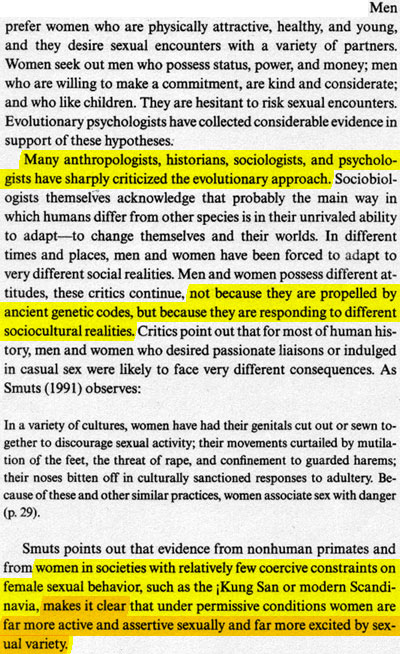
(That’s Barbara B. Smuts, Professor of Psychology and Anthropology, University of Michigan, Ann Arbor.)
Attractive (looks discrimination):
“Winners” of the game, who truly only want to be with that one special person, are exercising the true definition of “lust”: “strong / intense desire”; which the Bible tells to avoid. That is, “lust” is not the “strong / intense” feeling of the sexual act (or the prerequisite), but the “strong / intense” feeling of the partiality, especially the desire to possess someone, like exclusively. Lust is equivalent to the word “covet.” The problem is that partiality in a sex partner very much limits God’s strong sexual power of love for others, causing overshadowing apathy (lack of interest / concern) for others. And, beyond money, apathy for others is the root of all evil. A formula to find out Jesus’ true instructions is to ask: if everyone in the world did what He instructs, then what would be the result? And, if no one truly desired to have sexual intercourse, then mankind would cease to exist. No, “not being married” has nothing to do with the (original Greek) definition of “lust.” Matt. 5:28-29 has everything to do with “the eye”; therefore, it only has to do with sexual looks discrimination: desires for the sexually “attractive” only, which is very, very, very big (stylish) preference in this entire world. The normal human mind has absolutely no power over it. It is so powerful a standard (and long embedded) craze, and so much in need for change, that God, again, overly stresses the imperative importance of my point, via His “pluck it [your eye] out” or “be cast into hell.” – Now that is some super emphasized support from the Almighty:
Matthew 5:28-29:
28But I say to you that whoever looks at a woman to lust for her has already committed adultery with her in his heart. (Not too many men lust for the appearance of an “ugly” woman) 29If your right eye causes you to sin, pluck it out and cast it from you; for it is more profitable for you that one of your members perish, than for your whole body to be cast into hell. –That’s some God placed hellacious support for the importance of eliminating “looks discrimination,” which I say is a must in a workable free-love society. Otherwise, saying “lust” has to do with sexual desire period, if everyone followed it, which is what we are all taught we are supposed to do, it would be the end of mankind.
Interlinear Greek-English New Testament: With Strong’s Concordance Numbers above Each Word, Green, Baker, 1996, p. 13, Matthew 5:28:
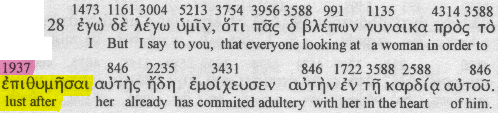
http://www.sacrednamebible.com/kjvstrongs/STRGRK19.htm#S1937, King James Bible: Strong’s Greek Dictionary:
|
1937 |
epiqumew |
from epi - epi 1909 and qumoV - thumos 2372; to set the heart upon, i.e. long for (rightfully or otherwise):--covet, desire, would fain, lust (after). |
Therefore, Matthew 5:28:
But I say to you that whoever looks at a woman to set his heart upon, to long for has already committed adultery with her in his heart.
Plus, this was instructed at Jesus’ famous Sermon on the Mount, not just to His disciples, but to “the multitudes.”
Matthew 5:1: And seeing the multitudes, He went up on a mountain
Tell me if I’m wrong, but a “mountain” is the highest place one can go on the earth (in that day), thus further stressing its importance.
Many people tell me that eliminating marriage and having free sex would be regressing from our civilized / educated state, back to becoming like animals; but, slavery was a civilized base thought to be the well organized, necessary hierarchy productive order, which animals did not do. But, the world seems to still be productive (actually much more productive) since the abolishment of slavery.
Just the lifting of all of today’s sexual / marriage restrictions alone can cause an overwhelmingly happier, more content, less greed stricken, and productive society.
Human Sexuality, Masters / Johnson / Kolodny, 1992, pp. 643-644, “Examples of the Social Organization of Sexuality”:
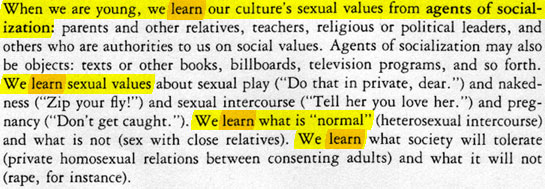
Human Sexuality, Luria / Friedman / Rose, 1987, p. 14, “Learning Sexual Values”:
It is a fact that most people are not self thinkers, but they all think they are.
Human Sexuality, Luria / Friedman / Rose, 1987, p. 15, “Sexual Values in Various Cultures”:

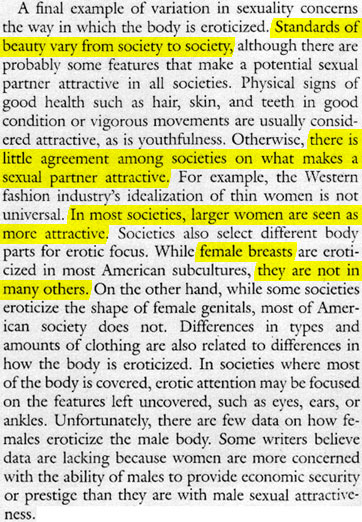
Human Sexuality, Luria / Friedman / Rose, 1987, pp. 414-415, “Physical Attractiveness”:

http://www.adlighthouse.com/testimony.html, Dennis Marcellino (musician) Bio, “The Journey Of My Search For Truth”:

“Free love” does end in pain in a world that still lusts for the more attractive. You have to rid the looks discrimination for “free love” to work, it’s just that simple. I don’t recommend anyone to try to implement “free love” for a group, until there’s a fad to desire diversity in appearance. Plus, I don’t recommend anyone trying to implement “free love” in any group in our current society: it will just cause more problems than good, hence “dysfunctional.” That’d be like setting up a free food restaurant in the middle of a city. All the other restaurants are going to hate you. I’m just trying to pass the very important religious based knowledge that will be necessary for all of us to know for when the time becomes right.
Sexualia: From Prehistory to Cyberspace, Bishop / Osthelder, 2001, p. 374, “Sexual Utopias | Oneida (NY; free love community; est. 1848)”:
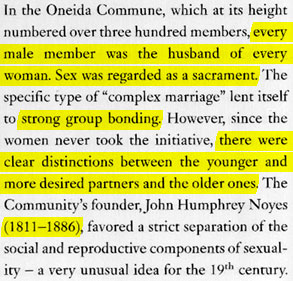
I can see the problem if you don’t teach a desire for diversity in looks.
The Oxford History of Classical Art, Boardman, 1993, p. 349, illustration 355, “Etruscan black-figure vase” (Greek, c. 600 BC):
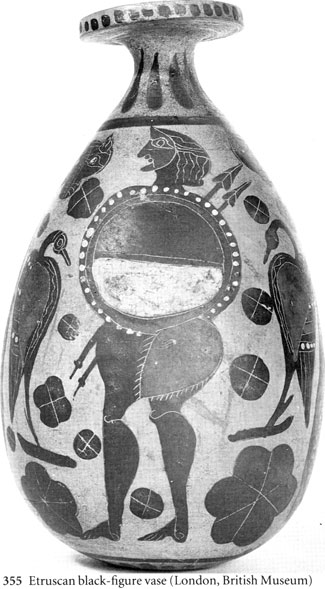
Who says ugly isn’t artistic?
Natural Health, Sept 2006 v36 i8 p26(1) (via Johnson County Library, Health & Wellness Resource Center [pin number required]), “How can I rev up my sex drive: get your mojo working with our expert advice on reclaiming your libido. (vital: advice)”:
If you've been in a relationship for a long time, you and your partner may be relating sexually in stale ways. Sex needs to be fun and novel (“strikingly new, unusual, or different”). Go away together and rediscover each other, learn about sensual massage, make it a priority to rejuvenate your sex life. Midlife is the perfect time to reinvent yourself sexually and surrender to your feelings. Menopausal women have been made to believe they're not sexual, but many can have the best sex of their lives after menopause. And also try doing it in the kitchen.
It’s a medical fact that people become bored having sex with the same person. Sex with different people who have different appearances is the natural way to keep sex “fun”; which will also create / discover a value in each living adult; which will cause a much better overall desire for the Goldenrule. Just a slight sense of value can cause a tremendous amount of Goldenrule. Basically today, if someone crosses / angers you, you will blackball them for life, because to you, they don’t have any physical value at all. If instead, you looked at every person with the slightest bit of physical value, you would not hate them near as quickly. Example: Notice how all men, court judges, etc. have much more leniency toward women than they do men. Even though the judge has not bedded the female, it all has to do with the slightest subconscious value of their physical sexual value. It’s that simple. It’s like how it kind of sickens people when they directly see destruction of property which has value, even though it’s not their property. – “Anger” against a person of no value, causes some to wish the destruction of their property. Today, women ignorantly criticize how they appear to men as just a sexual object; but intelligently, they reap many benefits thereof. That has 100% to do with how we are taught. E.g., “ignorance” / brain wash / what we are taught, is what causes soldiers to run toward machine guns. And “what we are taught” can and does greatly affect the human libido – and that’s according the medical science too.