ORIGEN – AGAINST CELSUS
Origen (Origen Adamantius) (ca. 185-254 AD), early Christian scholar, theologian, and one of the most distinguished of the early fathers
Against Celsus (Contra Celsus) Book 6, Chapters 27 & 40 (written 248 AD: 70 or 80 years after Celsus wrote)
http://www.newadvent.org/fathers/04166.htm (Catholic Encyclopedia), Contra Celsus (Origen), Book VI, “Chapter 27”:
He appears to me, indeed, to have acted like those Jews who, when Christianity began to be first preached, scattered abroad false reports of the Gospel, such as that "Christians offered up an infant in sacrifice, and partook of its flesh;" and again, "that the professors of Christianity, wishing to do the 'works of darkness,' used to extinguish the lights (in their meetings), and each one to have sexual intercourse with any woman whom he chanced to meet." These calumnies have long exercised, although unreasonably, an influence over the minds of very many, leading those who are aliens to the Gospel to believe that Christians are men of such a character; and even at the present day they mislead some, and prevent them from entering even into the simple intercourse of conversation with those who are Christians.
…“Chapter 40”:
After these things, Celsus appears to me to act like those who, in their intense hatred of the Christians, maintain, in the presence of those who are utterly ignorant of the Christian faith, that they have actually ascertained that Christians devour the flesh of infants, and give themselves without restraint to sexual intercourse with their women. Now, as these statements have been condemned as falsehoods invented against the Christians, and this admission made by the multitude and those altogether aliens to our faith; so would the following statements of Celsus be found to be calumnies invented against the Christians, where he says that "he has seen in the hands of certain presbyters belonging to our faith barbarous books, containing the names and marvellous doings of demons;" asserting further, that "these presbyters of our faith professed to do no good, but all that was calculated to injure human beings." Would, indeed, that all that is said by Celsus against the Christians was of such a nature as to be refuted by the multitude, who have ascertained by experience that such things are untrue, seeing that most of them have lived as neighbours with the Christians, and have not even heard of the existence of any such alleged practices!
http://www.newadvent.org/cathen/03490a.htm (Catholic Encyclopedia), Celsus the Platonist (wrote c. 178 AD):
The aim of Celsus's work is different from that of the other opponents of Christianity in the early centuries. He exhibits comparatively little of the bitterness which characterized their attacks. He does not descend to the lower level of pagan polemics. For instance, he omits the customary accusation of atheism, immorality, "Thyestian feasts and Œdipodean (incestuous) gatherings", accusations which were very commonly urged against the Christians for the purpose of rousing popular indignation.
http://www.faithalone.org/GESOT/Courses/hist501/501.pdf (formally at http://www.chafer.edu/distance/online/church_history.pdf), Church History 501: Survey of Church History: Apostolic To Pre-Reformation and Reformation to Modern, Dr. Stephen Lewis, Grace Evangelical School of Theology, “The Ancient Church: Apostolic (Pentecost) to A.D. 600,” p. 62 in document, p. 71 in pdf, “THE APOLOGISTS”:
These men faced a hostile Roman government and severe persecutions. They tried in turn to
convince the leaders of the State that the Christian had done nothing to deserve such punishment.
The Apologists were often intellectuals; they bring arguments from philosophy to bear upon
their readers in order to made Christianity respectable to the upper classes. Negatively, they
sought to refute the false charges of atheism, incest, indolence, cannibalism and antisocial action
which their great enemy, Celsus, the court philosopher, had leveled against them.
“THE LITERARY OPPONENTS OF CHRISTIANITY”:
3. Against the Christians: atheism; worship of a crucified malefactor; want of culture
and standing; divisions; want of patriotism; gloomy seriousness; credulity;
fanaticism; superstition; cannibalism; licentiousness.
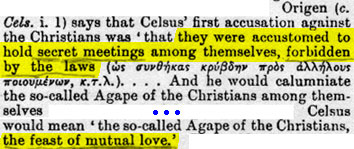
Encyclopædia of Religion and Ethics, Hastings, 1908-1927, vol. ?, p. 169, “AGAPE”: