CYPRIAN
Saint Thascius Cyprian, c. 200-258 AD, Bishop of Carthage, first great Church organizer. He became a Christian in 246 AD.
The Proconsular Acts of Saint Cyprian (Acta Proconsularia Sancti Cypriani) 4 (258 AD)
The Latin text:
http://www.ultramontes.pl/cypriani_martyrium.htm, ACTA MARTYRUM (OFFICIAL RECORDS OF THE MARTYRS): ACTA PROCONSULARIA SANCTI CYPRIANI (OFFICIAL RECORDS OF THE PROCONSULARS [GOVERNOR’S COUNCILMEN] ABOUT THE CONFIRMED CYPRIAN): EPISCOPI ET MARTYRIS (a). (BISHOP AND MARTYR):
(With translations from Latin):
Argumentum. Proof. Prima S. Cypriani confessio. First confession of Saint Cyprian. In exsilium mittitur. He is sent into exile. Reversus apprehenditur. Seizure reversed. Coram Proconsule sistitur. He is checked in person by the Proconsule (Roman officials). Sententia in eum lata. The sentence of him brought. Percutitur. He is beaten.
…
IV. Galerius Galerius Maximus Maximus collocutus spoke cum with concilio the public gathering/meeting sententiam the opinion vix hardly aegre painfully dixit he has said verbis by the words hujusmodi this: Diu A long time sacrilega sacrilegious/impious mente by the mind vixisti have been alive, et and plurimos much nefariae criminal/abominable tibi you conspirationis illegal homines men aggregasti added to your flock, et and inimicum unfriendly te by you diis god Romanis Romans et and sacris sacred legibus principles constituisti you have set up, nec nor te by you pii conscientious et and sacratissimi of the sacrament principes the leaders Valerianus Valerianus et and Gallienus Gallienus Augusti Augustus, et and Valerianus Valerianus nobilissimus noble/respected Caesar Caesar, ad to sectam cut caeremoniarum ceremony/sacred rite suarum their revocare call back potuerunt they have been able. Et And ideo accordingly cum with sis be nequissimorum licentious/dessolute/profligate/wicked/depraved criminum criminal charge/adultery (“In partic., the crime of lewdness, adultery”) / “Esp. illicit sexual intercourse” auctor promoted/enlarged et and signifer the standard bearer deprehensus caught/discovered: eris to be ipse himself documento example his these, quos those scelere by the crime tuo your tecum when you aggregasti add to your flock: sanguine by blood tuo your sancietur will be confirmed disciplina by the teaching. Et And his to these dictis said, decretum decreed ex from tabella writing tablet recitavit he read aloud: Thascium Thascius (13) Cyprianum Cyprian gladio by the sword animadverti judged placet satisfying. Cyprianus Cyprian Episcopus Bishop dixit said: Deo God gratias graces/lovelinesses.
http://www.perseus.tufts.edu/cgi-bin/ptext?doc=Perseus%3Atext%3A1999.04.0059%3Aentry%3D%2330787, Charlton T. Lewis, Charles Short, A Latin Dictionary, “nēquissĭmus”:
nēquissĭmus , a, um, v. nequam.
http://www.perseus.tufts.edu/cgi-bin/ptext?doc=Perseus%3Atext%3A1999.04.0059%3Aentry%3D%2330775, Charlton T. Lewis, Charles Short, A Latin Dictionary, “nēquam”:
: homo nequissimus, Cic. Verr. 2, 2, 78, § 192 ; id. Att. 1, 16, 3.--So of licentious, dissolute persons: juvenes nequam facilesque puellae(young licentious easy girls/maidens), Mart. 3, 69, 5 .--Comp.:
http://www.quicklatin.com, QuickLatin: A Latin-to-English Translation Assistant (a $29 download program [free 30 day evaluation available]):
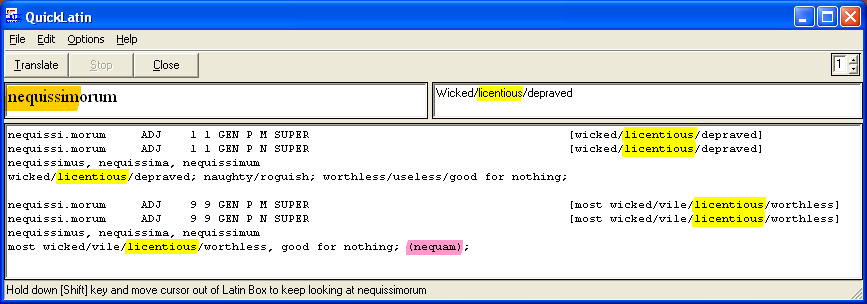
http://lysy2.archives.nd.edu/cgi-bin/words.exe?nequam, Latin to English translator, “nequam”:
wicked/licentious/depraved; bad/vile; naughty/roguish; worthless/useless
You see, “wicked,” “bad,” “naughty,” etc. alone doesn’t specify exactly how or why they are as such, but licentious / sexually liberal does. And our Latin church through the years definitely has equated licentious / sexually liberal with “wicked,” “bad,” “naughty,” etc.
http://lysy2.archives.nd.edu/cgi-bin/words.exe?criminum, Latin to English translator, “criminum”:
crimin.um N 3 2 GEN P N
crimen, criminis N (3rd) N [XLXAO]
indictment/charge/accusation; blame/reproach/slander; verdict/judgment (L+S);
sin/guilt; crime/offense/fault; cause of a crime, criminal (L+S); adultery;
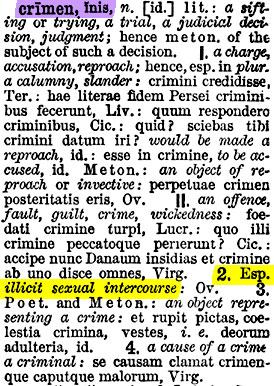
http://www.perseus.tufts.edu/cgi-bin/ptext?layout.reflang=la;layout.reflookup=criminum;doc=Perseus%3Atext%3A1999.04.0059%3Aentry%3D%2311601, Charlton T. Lewis, Charles Short, A Latin Dictionary, “crīmen” (of criminum):
2. In partic., the crime of lewdness, adultery, Ov. M. 9, 24; Sil. 6, 634.--
B. Meton.
1. An object representing a crime: et rupit pictas, caelestia crimina, vestes, i. e. deorum adulteria (devine adultery), Ov. M. 6, 131 ; cf.: tum paries nullo crimine pictus erat, Prop. 2, 6, 34 (2, 5, 26 Bip.): impressā signat sua crimina gemmā, a letter containing her crime, Ov. M. 9, 566 .--
A Smaller Latin-English Dictionary, Smith, 1879, p. 137, “crīmen, ĭnis”:
(The contiguous text):
IV. Galerius Maximus collocutus cum concilio sententiam vix aegre dixit verbis hujusmodi: Diu sacrilega mente vixisti, et plurimos nefariae tibi conspirationis homines aggregasti, et inimicum te diis Romanis et sacris legibus constituisti, nec te pii et sacratissimi principes Valerianus et Gallienus Augusti, et Valerianus nobilissimus Caesar, ad sectam caeremoniarum suarum revocare potuerunt. Et ideo cum sis nequissimorum criminum auctor et signifer deprehensus: eris ipse documento his, quos scelere tuo tecum aggregasti: sanguine tuo sancietur disciplina. Et his dictis, decretum ex tabella recitavit: Thascium (13) Cyprianum gladio animadverti placet. Cyprianus Episcopus dixit: Deo gratias.
An English Translation:
http://www.catholicradiodramas.com/Saints_Works_C/Cyprian%20A%20faith%20that%20is%20ready.htm, From a Letter to Pope Cornelius, exiled in persecution by Saint Cyprian, bishop and martyr (c. 210-258):
From the proconsular Acts of the
martyrdom of Saint Cyprian, bishop
(Acta, 3-6: CSEL 3, 112-114)
In such a just cause there is no need for deliberation
On
the morning of the fourteenth of September a great crowd gathered at the Villa Sexti,
in accordance with the order of the governor Galerius Maximus. That same day
the governor commanded Bishop Cyprian to be brought before him for trial in the
court of Sauciolum. After Cyprian was brought in, the governor asked him:
"Are you Thascius Cyprian?" And the bishop replied: "Yes, I
am." The governor Galerius Maximus said: "Have you posed as the
pontiff of a sacrilegious group?" The bishop answered: "I have,"
Then the governor said: "Our most venerable emperors have commanded you to
perform the religious rites." Bishop Cyprian replied: "I will not do
so." Galerius Maximus said: "Consider your position." Cyprian
replied: "Follow your orders. In such a just cause there is no need for
deliberation."
(4): Then Galerius Maximus, after consulting with his
council, reluctantly issued the following judgment: "You have long lived
with your sacrilegious convictions, and you have gathered about yourself many
others in a vicious conspiracy. You have set yourself up as an enemy of the
gods of Rome and our religious practices. The pious
and venerable emperors, the Augusti, Valerian and Gallienus, and Valerian the
most noble of Caesars, have been unable to draw you back to the observance of
their holy ceremonies. You have been discovered as the author and leader of
these heinous crimes, and will
consequently be held forth as an example for all those who have follow you in
your crime. By your blood the law shall be confirmed." Next he read the
sentence from a tablet: "It is decided that Thascius
Cyprian should die by the sword." Cyprian responded:
"Thanks be to God!"
After the sentence was passed, a crowd of his fellow
Christians said: "We should also be killed with him!" There arose an uproar
among the Christians, and a great mob followed after him. Cyprian was then
brought out to the grounds of the Villa Sexti, where, taking off his outer
cloak and kneeling on the ground, he fell before the Lord in prayer. He removed
his dalmatic and gave it to the deacons, and then stood erect while waiting for
the executioner. When the executioner arrived,
Cyprian told his friends to give the man twenty-five gold pieces. Cloths
and napkins were being spread out in front of him by the brethren. Then the
blessed Cyprian covered his eyes with his own hands, but when he was unable to
tie the ends of the linen himself, the priest Julian and the sub-deacon Julian
fastened them for him.
In this way the blessed Cyprian suffered, and his body
was laid out at a nearby place to satisfy the curiosity of the pagans. During
the night Cyprian's body was triumphantly borne away in a procession of
Christians who, praying and bearing tapers and torches, carried the body to the
cemetery of the governor Macrobius Candidianus which lies on the Mappalian Way near the fish ponds. Not many
days later the governor Galerius Maximus died.
The most blessed martyr Cyprian suffered on the
fourteenth of September under the emperors Valerian and Gallienus, in the reign
of our true Lord Jesus Christ, to whom belong honor and glory for ever. Amen.
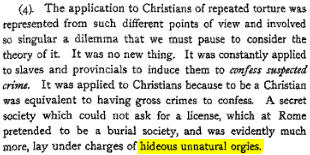
Cyprian: His Life, His Times, His Work, Benson, 1897, p. 63 “The Theory of Persecution”:
http://books.google.com/books?id=cY1SymrAGeEC&pg=PA493&lpg=PA493&dq=%22the+church+triumphant+a+history+of+christianity+up+to+1300%22&source=web&ots=8AMIhJ4xwX&sig=u07-KMf199dHAP0WMOMoLjS7om4#PPA92,M1, The Church Triumphant: A History of Christianity Up to 1300 –Google Books Result, by E. Glenn Hinson, 1995, p. 92, “The Seed of the Church | Valerian’s Vindictiveness”:
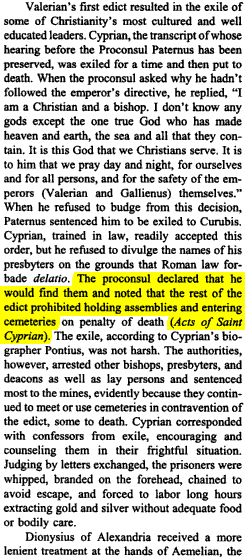
Sounds like basically the prohibitation of all the attributes of the Agape Love-Feast.
http://frterry.org/History/Chapter_2/Chap.2%20Handout_33.htm, Martyrdom of Cyprian, Bishop of Carthage, in 258 A.D.:
Galerius, after briefly conferring with his judicial council, with much reluctance pronounced the following sentence. 'You have long lived an irreligious life, and have drawn together a number of men bound by an unlawful association, and professed yourself open enemy to the gods and the religion of Rome; and the most pious, most sacred and august Emperors, Valerian and Gallienus, and the most noble Caesar Valerian, have endeavored in vain to bring you back to conformity with their religious observances; whereas, therefore, you have been apprehended as principal and ringleader in these infamous crimes, you shall be made an example to those whom you have wickedly associated with you; the authority of law shall be ratified in your blood. '
…
From the Acta proconsularia of St.Cyprian, in A New Eusebius, 261f.
http://www.jesusneverexisted.com/orthodoxy.html, What DID the Early Christians Believe?, “Invention of Orthodoxy”:
A fierce advocate of the Church hierarchy, Cyprian achieved a rare distinction in the early church: he actually was executed in 258, as "ringleader of an unlawful association."
Just a note:
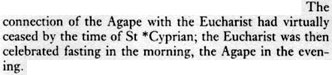
The Oxford Dictionary of the Christian Church, Cross / Livingstone, 1997, p. 26, “agape”: