COUNCIL OF LAODICEA
(In the Lycus valley, Phrygia)
Canons 27 & 28, c. 364 AD
“Beds” in churches:
http://reluctant-messenger.com/council-of-laodicea.htm, THE COUNCIL OF LAODICEA IN PHRYGIA PACATIANA 364 A.D.:
CANON XXVII.
NEITHER they of the priesthood, nor clergymen, nor laymen, who are invited to a love feast, may take away their portions, for this is to cast reproach on the ecclesiastical order.
CANON XXVIII.
IT is not permitted to hold love feasts, as they are called, in the Lord's Houses, or Churches, nor to eat and to spread couches in the house of God.
…
(By the way:)
Books banned by the Council of Laodicea
|
Barnabas |
The First Book of Adam and Eve |
http://www.ccel.org/ccel/schaff/npnf214.viii.vii.iii.xxxii.html, The Canons of the Synod Held in the City of Laodicea, in Phrygia Pacatiana, in which Many Blessed Fathers from Divers Provinces of Asia Were Gathered Together, Synod of Laodicea: A.D. 343–381, “Canon XXVII.”:
Canon XXVII.
NEITHER they of the priesthood, nor clergymen, nor laymen, who are invited to a love feast, may take away their portions, for this is to cast reproach on the ecclesiastical order.
Notes.
ANCIENT EPITOME OF CANON XXVII.
A clergyman invited to a love feast shall carry nothing away with him; for this would bring his order into shame.
HEFELE.
Van Espen translates: “no one holding any office in the Church, be he cleric or layman,” and appeals to the fact that already in early times among the Greeks many held offices in the Church without being ordained, as do now our sacristans and acolytes. I do not think, however, with Van Espen, that by “they of the priesthood” is meant in general any one holding office in the Church, but only the higher ranks of the clergy, priests and deacons, as in the preceding twenty-fourth canon the presbyters and deacons alone are expressly numbered among the ἱερατικοῖς and distinguished from the other (minor) clerics. And afterwards, in canon XXX., there is a similar mention of three different grades, ἱερατικοί, κληρικοί, and ἀσκηταί.
The taking away of the remains of the agape is here forbidden, because, on the one hand, it showed covetousness, and, on the other, was perhaps considered a profanation.
This canon is found in the Corpus Juris Canonici, Gratian’s Decretum, Pars I., Dist. XLII., c. iij.
http://www.ccel.org/ccel/schaff/npnf214.viii.vii.iii.xxxiii.html, The Canons of the Synod Held in the City of Laodicea, in Phrygia Pacatiana, in which Many Blessed Fathers from Divers Provinces of Asia Were Gathered Together, Synod of Laodicea: A.D. 343–381, “Canon XXVIII.”:
Canon XXVIII.
IT is not permitted to hold love feasts, as they are called, in the Lord’s Houses, or Churches, nor to eat and to spread couches in the house of God.
Notes.
ANCIENT EPITOME OF CANON XXVII.
Beds shall not be set up in churches, nor shall love feasts be held there.
HEFELE.
Eusebius (H. E., Lib. IX., Cap. X.) employs the expression κυριακά in the same sense as does this canon as identical with churches. The prohibition itself, however, here given, as well as the preceding canon, proves that as early as the time of the Synod of Laodicea, many irregularities had crept into the agape. For the rest, this Synod was not in a position permanently to banish the usage from the Church; for which reason the Trullan Synod in its seventy-fourth canon repeated this rule word for word.
This canon is found in the Corpus Juris Canonici, Gratian’s Decretum, Pars I., Disk XLII., c. iv.
http://www.godrules.net/library/hefele/84hefele_b6.htm, BOOK 6: The Synods Of Laodicea And Gangra. ECTION. 93. SYNOD OF LAODICEA, (from the book A History of the Councils of the Church, by Charles Joseph Hefele, vol. 2, 1896, pp. 298-299):
The sixty canons of the Synod of Laodicea were composed in Greek, and have come down to us in the original language. There were also early Latin translations, for instance one by Dionysius Exiguus, which we likewise still possess, and commentaries on them were published in the Middle Ages, chiefly by Balsamon, Zonaras, Aristenus, and more recently by Van Espen, and Professor Herbst in the Tubingen Review .
Here’s the text in Greek:
http://books.google.com/books?hl=en&id=qr0MAAAAIAAJ&dq=%22The+Agape+and+the+Eucharist+in+the+Early+Church%22&printsec=frontcover&source=web&ots=fRx8Ufg3EZ&sig=U6s9rWQx1PODfCkPvZNgEhh2acg#PPA151,M1, The Agape and the Eucharist in the Early Church: Studies in the History of the Christian Love-Feasts –Google Books Result, by John Fitzstephen Keating, 1901, p. 151, “IN THE FOURTH CENTURY”:
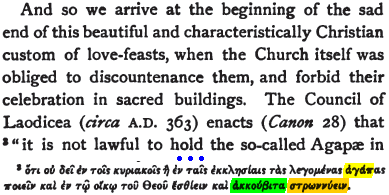
P. 152:

Here’s another source:
http://books.google.com/books?id=u_8UAAAAIAAJ&pg=PA91&lpg=PA91&dq=%22%CE%BA%CE%B1%CE%B9+*+%CF%83%CF%84%CF%81%CF%89%CE%BD%CE%BD%CF%8D%CE%B5%CE%B9%CE%BD%22&source=web&ots=CEH1usM3fI&sig=j9QfNXpP4EtW5mXBQc0mUdPEf64, Acta et symbola conciliorum quae saeculo quarto habita sunt –Google Books Result, by Engbert Jan Jonkers, 1974 , p. 91, “CONCILIUM LAODICENUM INTER 341 ET 381 HABITUM”:
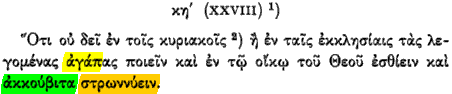
Here’s an example with just one “κ” in “ακκούβιτα” as “ακούβιτα”:
http://el.wikisource.org/wiki/%CE%9A%CE%B1%CE%BD%CF%8C%CE%BD%CE%B5%CF%82_%CF%84%CE%B7%CF%82_%CE%B5%CE%BD_%CE%9B%CE%B1%CE%BF%CE%B4%CE%B9%CE%BA%CE%B5%CE%AF%CE%B1_%CE%A3%CF%85%CE%BD%CF%8C%CE%B4%CE%BF%CF%85, Κανόνες της εν Λαοδικεία Συνόδου (Rules of the Laodicea Synod), “Κανων ΚΗ (Rule 28)”:

Either form (“ακκούβιτα” or “ακούβιτα”) means to lie back / to recline / to lay down for a feast / banquet.
An Intermediate Greek-English Lexicon, Liddell and Scott, 1997, p. 751, “στρωννύ…” (form of στρωννύειν):
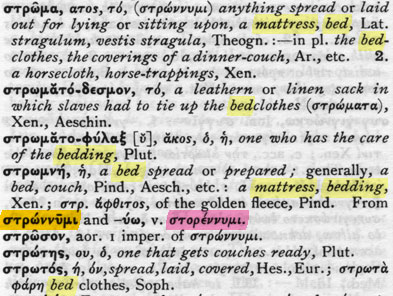
P. 748:
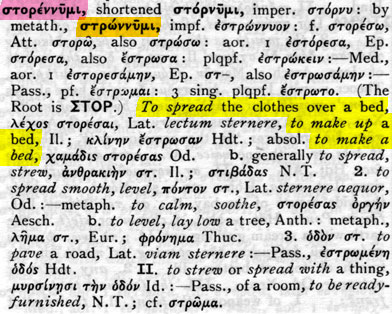
Here’s the text in Latin:
http://www.benedictus.mgh.de/quellen/chga/chga_015t.htm, Synodus Laudiciae (Synod of Laodicea), “INCIPIT SYNODUS LAUDICIAE (THE BEGINNING OF SYNOD OF LAODICEA).”:
XXVII.
Non Not debere should clericos clergymen sive or laicos
laity ad to agapem
agape love vocatos summons partes parts
tollere remove / to take up and away.
XXVIII.
Non Not licere permitted in in
ecclesiis churches accubitos
lie near or
by; recline at table sternere spread, strew, scatter; lay out vel in deed agapem agape love facere be done.
…
“EXPLICIUNT CAPITULA.: INCIPIT SYNODUS LAUDICIAE. (EXPLICIT CHAPTERS: THE BEGINNING OF SYNOD OF LAODICEA)”:
XXVII.
fehlt
Non Not oportet proper ministros ministers altaris altar vel or quoslibet who-pleases(?) clericos clergymen ad to agapem agape love vocatos summons, partes parts tollere remove / to take up and away, propter on account of iniuriam unjust quae anyone ex out of hac this occasione occasion ecclesiastico ecclesiastic ordini order poterit can deputari cut away.
XXVIII.
fehlt
Non Not oportet proper in in basilicis basilicas seu or if in in ecclesiis churches agapem agape love facere be done, et and intus within manducare eating vel or accubitus reclining couches / reclining at tables sternere spread.
I’d say the Latin Church toned it down a little.
Here’s another thing (in Latin):
http://web.infinito.it/utenti/i/interface/Archive/DecretumGr.pdf, DECRETUM GRATIANI GRATIAN’S DOCTRINE: Excerptum Excerpt: Æ. Friedberg, 1879: Corpus Iuris Canonici Collection of Canon Law: Pars Prior Region Prior: Romae Rome MMVII 2007, p. 122, “DISTINCTIO DISTINCTION XLII. 42 GRATIANUS GRATIAN.”
III. Pars.
Gratian. Gratian: Sed But licet it is permitted ipsa themselves conuiuia banquet / feast despicienda despicable / look down on non not sint to be, nec nor tamen yet in in ecclesiis churches celebram celebrate, nec nor clericos clergymen ad to ea they conuocatos summons partes parts sibi to or for himself ex out of eis them tollere remove / to take up and away oportet proper.
Unde From where in in Laudicensi Laodicea Concilio Council: [c. 27].
C. III. Clerici Clergymen ad to agapen agape love uocati summons partem part sibi to or for himself non not tollant remove / to take up and away.
…
C. IV. In In locis places Deo God sacratis makes sacred nec not comedere to eat up, nec nor accubitus reclining couches / lying at tables sternere spread liceat permitted.
Item. [c. 28].
accub… | accumbo:
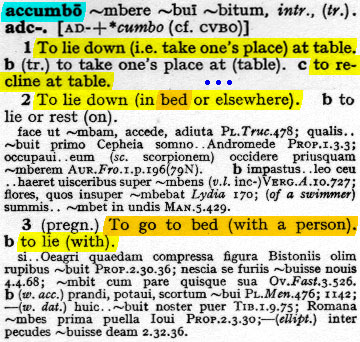
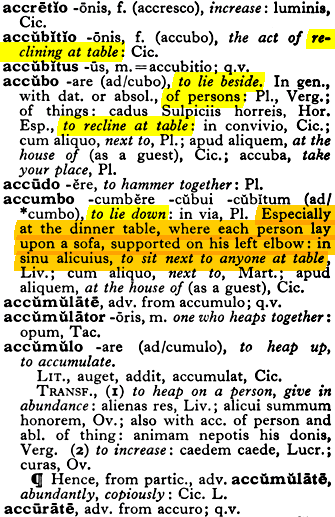
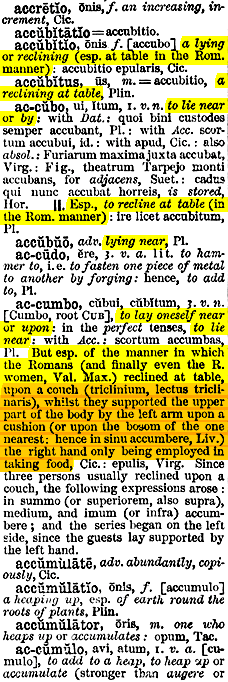
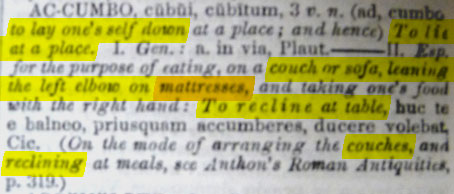
This may clarify the kind of couch used and how it was used:
Oxford Latin Dictionary, Glare, 1982, p. 23, “accumbō” (base form of “accubitus”):
Cassell’s Latin Dictionary, 1968, p. 7, “accub… | accumbo”:
A Smaller Latin-English Dictionary, William Smith, 1879, p. 7, “accub… | accumbo”:
A Latin-English and English-Latin Dictionary, For The Use Of Schools, Charles Anthon, Part I: Latin-English, 1880, p. 12, “accumbo”:
http://lysy2.archives.nd.edu/cgi-bin/words.exe?accumbo (Latin-English translator), “accumbo”:
accumb.o V 3 1 PRES ACTIVE IND 1 S
accumbo, accumbere, accumbui, accumbitus V (3rd) [XXXBO]
take a place/recline at the table; lie on (bed), lie at/prone, lie beside;
http://www.perseus.tufts.edu/cgi-bin/ptext?doc=Perseus%3Atext%3A1999.04.0060%3Aentry%3D%23181, Charlton T. Lewis, An Elementary Latin Dictionary, “accumbō”:
accumbō (ad-c-) cubuī, cubitum, ere [CVB-] , to lay oneself down, lie beside: mecum, T.: cum suis, N.--Esp., to recline at table: in convivio: in epulo: epulis divūm, V.; absol: ut vir adcumberet nemo.
accumbo (forms thereof) are words used in the Latin Vulgate:
Mark 2:15:
Now it happened, as He was dining in Levi’s house, that many tax collectors and sinners also sat together with Jesus and His disciples; for there were many, and they followed Him.
Mark 6:39:
Then He commanded them to make them all sit down in groups on the green grass.
Luke 7:49:
And those who sat at the table with Him began to say to themselves, “Who is this who even forgives sins?”
Luke 13:29:
They will come from the east and the west, from the north and the south, and sit down in the kingdom of God.
So, the Council of Laodicea stopped a practice that Jesus did and “commanded,” and even for the “kingdom of God.” And the English translation should not be “sit” or “sat” down / together, but to “lie” or “lay” down / together.
concub… | concumbo (another form of accub… / accumbo):
A Smaller Latin-English Dictionary, William Smith, 1879, p. 113, “concŭb… | concumbo:
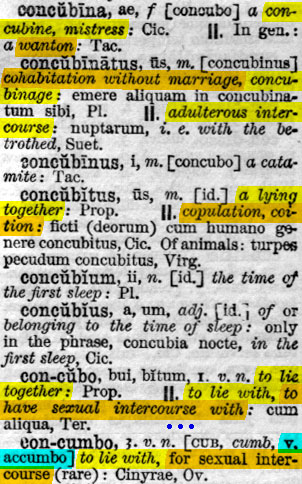
Apparently “...cumbo…” is a form of the word, including: accumbo, concumbo, decumbo, discumbo, incumbo, occumbo, procumbo, recumbo, succumbo, etc. Also stratum / sterno describe the same thing.
discumbo (another example):
A Smaller Latin-English Dictionary, William Smith, 1879, p. 172, “dis-cumbo”:
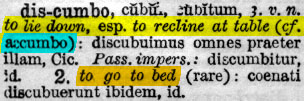
(“rare” because the got the beds out of the Latin churches.)
The New College Latin & English Dictionary, Traupman, 1966, p. 87 (Latin-English), “dis·cumbō”:

Langenscheidt’s Pocket Latin Dictionary, Handford / Herberg, 1966, p. 111 (Latin-English), “dis-cumbō”:

http://catholic.archives.nd.edu/cgi-bin/lookup.pl?stem=discumbo&ending= (University of Notre Dame), Latin Word Lookup, “discumbo”:
discumbo -cumbere -cubui -cubitum (1) [to recline at table]. (2) [to go to bed].
Examples of discumbo (or forms thereof):
Matthew 15:35 (NKJV):
So He commanded the multitude to sit down on the ground.
Matthew 26:20 (the Last Supper):
When evening had come, He sat down with the twelve.
Notice how they changed lay / laid to sit / sat? It’s because lying down sounds more sexually suggestive.
Genesis 39:7 (KJV):
And it came to pass after these things, that his master’s wife cast her eyes upon Joseph; and she said, Lie with me.
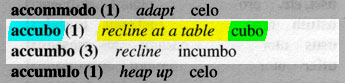
cubo (base form):
501 Latin Verbs, Prior / Wohlberg, Barron’s Educational Series, 1995, p. 534, “Latin Verb Index | accubo (original form)”:
http://www.perseus.tufts.edu/cgi-bin/ptext?doc=Perseus%3Atext%3A1999.04.0059%3Aentry%3D%2311784, Charlton T. Lewis, Charles Short, A Latin Dictionary, “cŭbo”:
cŭbo , ŭi, ìtúm, … to lie down. … I. Of persons. A. In gen., to be in a recumbent posture, to recline: … b. Of sexual intercourse, to lie:
Collins Latin Gem Dictionary, Kidd, 1957, p. 85 (Latin-English), “cub…”:
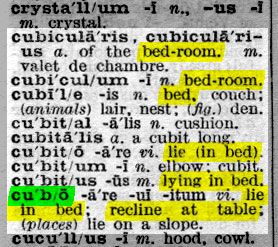
501 Latin Verbs, Prior / Wohlberg, Barron’s Educational Series, 1995, p. 545, “Latin Verb Index | recubo (another form example)”:
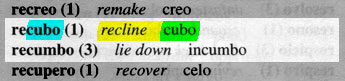
Examples of recub… (or forms thereof):
Matthew 8:11 (NKJV):
“And I say to you that many will come from east and west, and sit down with Abraham, Isaac, and Jacob in the kingdom of heaven.”
Luke 24:30:
Now it came to pass, as He sat at the table with them, that He took bread, blessed and broke it, and gave it to them.
John 13:12:
So when He had washed their feet, taken His garments, and sat down again, He said to them, “Do you know what I have done to you?”
John 21:20: Then Peter, turning around, saw the disciple whom Jesus loved following, who also had leaned on His breast at the supper, and said, “Lord, who is the one who betrays You?”
“sternere” (form of “sterno”):
Oxford Latin Dictionary, Glare, 1982, p. 1818, “sternō”:
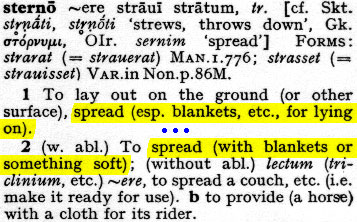
P. 1826, “strātum” (form of sterno):

http://www.perseus.tufts.edu/cgi-bin/ptext?doc=Perseus%3Atext%3A1999.04.0059%3Aentry%3D%2345366, Charlton T. Lewis, Charles Short, A Latin Dictionary, “sterno”:
stretch out their bodies, lie down … Of a couch, bed, etc., to spread, prepare, arrange, make … A bed-covering, a coverlet, quilt, blanket; a pillow, bolster … a bed, couch
http://catholic.archives.nd.edu/cgi-bin/lookup.pl?stem=sterno&ending= (University of Notre Dame), Latin Word Lookup, “sterno”:
sterno sternere stravi stratum [to stretch out , to spread]; 'se sternere', [to lie down]; [to strike down, lay down, overthrow; to make smooth; to calm, allay; to strew, spread a thing (with something else)]; 'lectum', [to make, make up]; 'equos', [to saddle]; 'viam', [to pave]. N. of partic. as subst. stratum -i, [a coverlet, blanket; a bed; a saddle-cloth, saddle; a pavement].
Langenscheidt’s Pocket Latin Dictionary, Handford / Herberg, 1966, p. 304 (Latin-English), “sternō”:
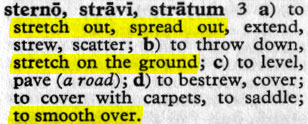
P. 305, “strātum” (form of sterno):

Collins Latin Gem Dictionary, Kidd, 1957, p. 316 (Latin-English), “ste´rn/ō”:
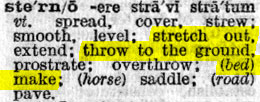
P. 317, “strā´t/us” (form of sterno):

Bible example of “sterno” / “stratum” (or forms thereof):
Matthew 21:6-11 (Douay-Rheims Version, 1899):
6And the disciples going, did as Jesus commanded them.
7And they brought the ass and the colt, and laid their garments upon them, and made him sit thereon.
8And a very great multitude spread their garments in the way: and others cut boughs from the trees, and strewed them in the way:
9And the multitudes that went before and that followed, cried, saying: Hosanna to the son of David: Blessed is he that cometh in the name of the Lord: Hosanna in the highest.
10And when he was come into Jerusalem, the whole city was moved, saying: Who is this?
11And the people said: This is Jesus the prophet, from Nazareth of Galilee.
By the way, this having the disciples take off their cloths so Jesus could ride into Jerusalem sitting on top of them, and the rest of His followers disrobe so He could trample over their clothes on the road path, has a very sexual connotation. Five days later he was crucified. Was it worth it? Well, I can sure utilize it.
Compare Gospel of Thomas, 37:
Jesus said, “When you strip without being ashamed, and you take your clothes and put them under your feet like little children and trample them, then [you] will see the son of the living one and you will not be afraid.”
Translation: Let’s all get naked and party!
Mark 14:15 (the Last Supper):
15And he will shew you a large dining room furnished; and there prepare ye for us.
Mark 14:15 (Biblia Sacra Vulgata: Jerome’s Latin Vulgate, c. 405 AD):
15et ipse vobis demonstrabit cenaculum (upstairs dining room) grande (large) stratum (spreaded the coverlet; bed, couch; horse-blanket) et illic parate nobis
I’d say the English translation purposely left a bit of detail out.
Acts 9:34:
34And Peter said to him: Eneas, the Lord Jesus Christ healeth thee: arise, and make thy bed. And immediately he arose.
Here’s an earlier “Christain” example of the kind of bed / couch one would lay on: Christian catacomb of Saints Peter and Marcellinus, arcosolium 75, end of third to early fourth century AD:
http://www.mcah.columbia.edu/dbcourses/klein/large/BISCO~32.jpg (via http://www.mcah.columbia.edu/cgi-bin/dbcourses/item?skip=1180), Arcosolium with banquet scene; Catacomb of SS. Pietro e Marcellino, Rome:
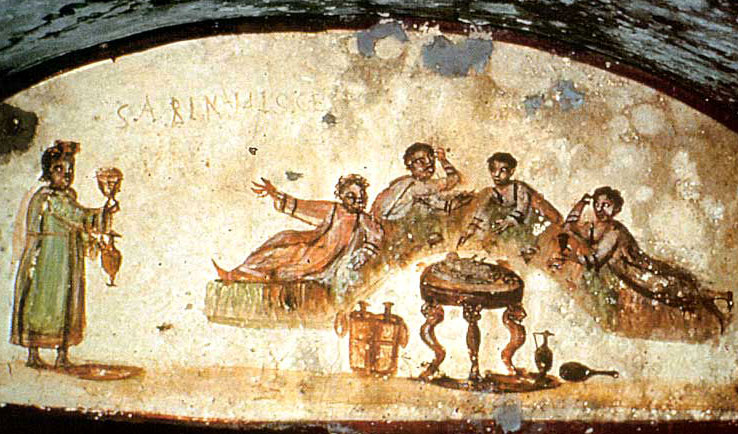
See details about the triclinium couch later at my Dionysus / Bacchus / Wine > Agape SIGMA-COUCH page.
The Council of Laodicea was just a local council. The main church still had the agape-feast.
The agape love-feast was an organized ritual, not just the way things happened to occur.
Interesting:
http://www.cogwriter.com/smyrnachurch.htm, The Smyrna Church Era, “Polycarp and His Followers Did Not Accept the Authority of Roman Bishops”:
Sabbath-keeping in Asia Minor was publicly still going on to at least 364 A.D. or else the Eastern Church would not have convened a Council in Laodicea to excommunicate any who rested on the seventh day that year:
CANON XXIX. CHRISTIANS must not judaize by resting on the Sabbath, but must work on that day, rather honouring the Lord's Day; and, if they can, resting then as Christians. But if any shall be found to be judaizers, let them be anathema from Christ (THE COMPLETE CANONS OF THE SYNOD OF LAODICEA IN PHRYGIA PACATIANA).
That sounds nice: make ‘em work seven days a week. Then there’s more getting done for the rich.
Miscellaneous:
Encyclopaedia Americana, Vol. I, 1829, pp. 93-94, “Agape”:
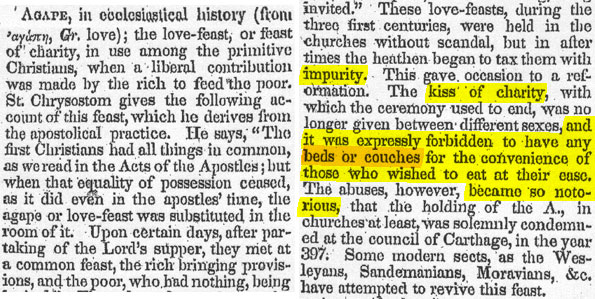
Well, you know that because of the fine lustful gent
that I am, I wouldn’t kick a nice lookin’ woman out of bed for eating
crackers, especially if she has bigguns. So, on my next “first” date, when she
asks what were going to do, I’ll say “we’re gonna pick up some McNuggets then
go to bed… to eat them. Then I’ll see if she interprets “going to bed”
as referring to having sex; because, interestingly no honorable religious
leader does. So who’s going to be the first preacher on his block to make a
large purchase at Mattress City for next Sunday’s service? If “beds in churches” are so
logically explained as a place to eat, then why did the church stop it?
If “beds in churches” are so logically explained as a place to eat, then why
have publishers removed this information in later editions? You answer,
“Because it’s too sexually suggestive.” Oh, I see. They’re saying the heathen
(pagan) was the cause of the “impurity” (connoting sexual relations), but the
heathen (pagan / Romans) strongly persecuted the Christians for these “impurit[ies]”;
therefore, it doesn’t make any sense why the heathen would cause the excuse,
then persecute them for it.
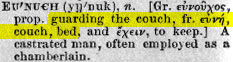
A Dictionary of the English Language: Academic Edition, Noah Webster, 1867, p. 150, “Eunuch”:
Encyclopædia Britannica, 1771, vol. 1, p. 36, “AGAPÆ”:
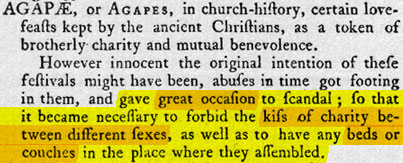
Translated from Elizabethan English:
AGAPÆ, or Agapes, in church-history, certain love-feasts kept by the ancient Christians, as a token of brotherly charity and mutual benevolence.
However innocent the original intention of these festivals might have been, abuses in time got footing in them, and gave great occasion to scandal; so that it became necessary to forbid the kiss of charity between different sexes, as well as to have any beds or couches in the place where they assembled.
“We don’t make a party out of lovin’ … in Muskogee, Oklahoma, USA.” –Merle Haggard, 1969. You might have 1700 years ago… in Church anyway.