ATHENAGORAS (re: Lyons and Vienne)
Athenagoras of Athens (c. 133-190 AD), early Christian apologist / philosopher, A Plea for the Christians (or The Plea, Plea on Behalf of Christians, alternatively called the Embassy, Supplication, or Legatio [Latin name]), Chapters 3, 31 & 32 (c. 177 AD)
Apology addressed to Roman Emperors Marcus Aurelius Antoninus (ruled 161-180) and Lucius Aurelius Commodus (ruled 180-192), written by Athenagoras shortly after the persecution of Christians in Lyons and Vienne in 177 AD, to evade further persecution.
http://www.newadvent.org/fathers/0205.htm (Catholic Encyclopedia), A Plea for the Christians: By Athenagoras the Athenian: Philosopher and Christian, “Chapter 3. Charges Brought Against the Christians”:
Three things are alleged against us: atheism, Thyestean feasts, Œdipodean (incestuous) intercourse. But if these charges are true, spare no class: proceed at once against our crimes; destroy us root and branch, with our wives and children, if any Christian is found to live like the brutes. And yet even the brutes do not touch the flesh of their own kind; and they pair by a law of nature, and only at the regular season, not from simple wantonness
…
“Chapter 31. Confutation of the Other Charges Brought Against the Christians”:
But they have further also made up stories against us of impious feasts and forbidden intercourse between the sexes, both that they may appear to themselves to have rational grounds of hatred, and because they think either by fear to lead us away from our way of life, or to render the rulers harsh and inexorable by the magnitude of the charges they bring. But they lose their labour with those who know that from of old it has been the custom, and not in our time only, for vice to make war on virtue.
–“Not in our time only” apparently means they’ve been accused of it many times in the past, so much that it is a “custom.” Is there any government anywhere on the planet today that is accusing or just saying any group is having open sex, where they don’t have any “proof” at all? I think any government would look pretty stupid if they did. It really wouldn’t be very difficult for a government spy to “become a Christian” to verify the rumor.
…
“Chapter 32. Elevated Morality of the Christians”:
It is, however, nothing wonderful that they should get up tales about us such as they tell of their own gods, of the incidents of whose lives they make mysteries. But it behoved them, if they meant to condemn shameless and promiscuous intercourse, to hate either Zeus, who begat children of his mother Rhea and his daughter Koré, and took his own sister to wife, or Orpheus, the inventor of these tales, which made Zeus more unholy and detestable than Thyestes himself; for the latter defiled his daughter in pursuance of an oracle, and when he wanted to obtain the kingdom and avenge himself. But we are so far from practising promiscuous intercourse, that it is not lawful among us to indulge even a lustful look. … On behalf of those, then, to whom we apply the names of brothers and sisters, and other designations of relationship, we exercise the greatest care that their bodies should remain undefiled and uncorrupted; for the Logos again says to us, "If any one kiss a second time because it has given him pleasure, [he sins];" adding, "Therefore the kiss, or rather the salutation, should be given with the greatest care, since, if there be mixed with it the least defilement of thought, it excludes us from eternal life."
He’s trying to fight the Kiss of Peace that Paul ordered in Rom. 16:16; 1 Cor. 16:20; 2 Cor. 13:12; 1 Thes. 5:26; 1 Peter 5:14. It just doesn’t make sense that Paul would order something that really, really pushes sexual desire, just so one can be condemned forever. Paul more told to do this Kiss whenever a Christian encountered another Christian, so there would be a sexual touch every time Christians passed. Specifically the word “greet”: “To salute or welcome in a friendly and respectful way with speech or writing, as upon meeting or in opening a letter. To receive with a specified reaction.” It’s Strong Greek # 782: “To enfold in the arms,” “to salute,” “to welcome,” “to embrace, greet, salute.” It’s how you identified that you were a Christian. The “love one another” at the Last Supper was something Jesus ordered.
http://ecole.evansville.edu/articles/athenagoras.html, ATHENAGORAS, “The Plea”:
The Plea (c. 177 AD) can be outlined as follows: The introduction and presentation of the charges (1-3); the defence against the charge of atheism (4-30); the defence against the charges of incest and cannibalism (31-36) and the conclusion (37).
…
Athenagoras next tackles the charges of cannibalism and incest. These accusations ran throughout contemporary literature (Justin[c. 100-165 AD], First Apology 7; the "Letter of Lyons and Vienne" in Eusebius [c. 177 AD], Ecclesiastical History 5.1; Tertullian [c. 160-220 AD], Apology 9.8; Minucius Felix [flourished 200–240 AD ; died c. 250], Octavius 9.5-6; Origen [ca. 185-254 AD], Against Celsus 6.27). Most individuals today assume that these indictments arose because of a misunderstanding of Christian doctrines, namely the Eucharist and brotherly-sisterly love (such as the "kiss of peace"). Benko(in 1984) has also argued that certain Gnostic sects actually practiced incest and perhaps even cannibalism; these atrocities were then transferred to all Christian groups (Benko 68ff).
…
To justify it: Second, Athenagoras attacks pagan morality. The pagan myths contained such stories as Zeus' incest with his mother Rhea, his daughter Core, and his own sister. Pagan society organized immorality through the business of prostitution. It also found entertainment at the murderous gladiator fights. Third, he stresses the rigor of Christian morality. The dominical teachings called Christians to refrain not only from promiscuity, but also from lust. Sexual union was only lawful within marriage, and even then only for the sake of procreation; remarriage was considered adultery. He further questions how Christians could be accused of murder "when we say that those women who use drugs to bring on abortion commit murder, and will have to give an account to God for the abortion" (Plea 35). Fourth, he stresses the peculiar nature of Christian motivation. Christians were incited to virtue not simply by present circumstances, but also by a firm belief in a future judgment.
Regardless of what the gods did, pagan sex lives must have not been too rampant, because “apparently” the pagan government and the vast majority of its people didn’t like promiscuous sex (just the free kind), as they persecuted both Christians and the orgiastic followers of Dionysus / Bacchus. Apparently gods could get away with things that mortals couldn’t. Do I need to explain how that could be? “Prostitution” was allowed (but, looked down on) because it was a business that made money. And, free sex would definitely interrupt that kind of income. Let me go to Florida and start selling oranges for free, then see how the ones who rely on that income treat me. Roman prostitution was even taxed, so everyone lost out something.
http://books.google.com/books?hl=en&id=IneVgVvlizwC&dq=%22early+christian+fathers%22+%22cyril+charles+richardson%22&printsec=frontcover&source=web&ots=g9iA7cQQcH&sig=QeUscgEq_0rRU7lKu7Svtr7eNOY#PPA292,M1, Early Christian Fathers – Google Book Result, by Cyril Charles Richardson, 1953, p. 292, “In Defense of the Faith”:
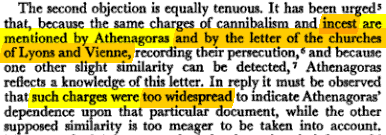
http://www.bibletexts.com/glossary/early-christians.htm, Early Christians, “Athenagorus (2nd century, AD), Eastern Church”:
Athenagorus was a Christian apologist who had been a Greek philosopher from Athens before his conversion. His apology, A Plea Regarding Christians, was presented to Emperors Marcus Aurelius and Commodus about 177 AD and sought to rebut the current accusations that Christians practiced atheism, incest, and cannibalism.