IRENAEUS
Irenaeus, bishop and theologian (c. 115-202 AD), Against Heresies (Adversus Haereses), Book 1, Chapter 6.1,3,4 (written in Greek, only available in Latin today) (c. 180 AD)
http://www.newadvent.org/fathers/0103106.htm, Adversus Haereses (Book I, Chapter 6):
(Title:) The threefold kind of man feigned by these heretics: good works needless for them, though necessary to others: their abandoned morals.
“1.”:
They further hold that the consummation of all things will take place when all that is spiritual has been formed and perfected by Gnosis (knowledge); and by this they mean spiritual men who have attained to the perfect knowledge of God, and been initiated into these mysteries by Achamoth (of Valentinian Gnostic Christian myth). And they represent themselves to be these persons.
“3.”:
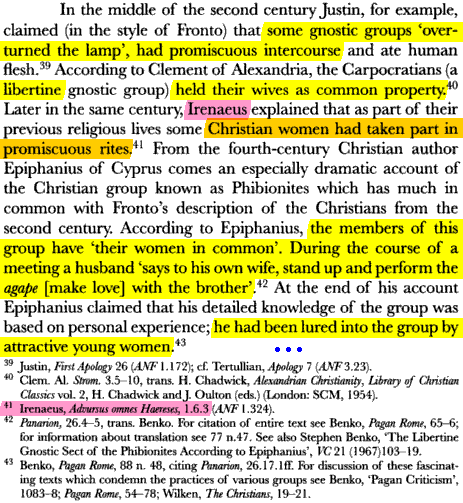
Others of them yield themselves up to the lusts of the flesh with the utmost greediness, maintaining that carnal things should be allowed to the carnal nature, while spiritual things are provided for the spiritual. Some of them, moreover, are in the habit of defiling those women to whom they have taught the above doctrine, as has frequently been confessed by those women who have been led astray by certain of them, on their returning to the Church of God, and acknowledging this along with the rest of their errors. Others of them, too, openly and without a blush, having become passionately attached to certain women, seduce them away from their husbands, and contract marriages of their own with them. Others of them, again, who pretend at first to live in all modesty with them as with sisters, have in course of time been revealed in their true colours, when the sister has been found with child by her [pretended] brother.
“4.”:
They maintain, therefore, that in every way it is always necessary for them to practise the mystery of conjunction. And that they may persuade the thoughtless to believe this, they are in the habit of using these very words, "Whosoever being in this world does not so love a woman as to obtain possession of her, is not of the truth, nor shall attain to the truth. But whosoever being of this world has intercourse with woman, shall not attain to the truth, because he has so acted under the power of concupiscence (strong desire, lust)."
http://books.google.com/books?id=bpj0g2OJRYcC&pg=PP1&dq=%22Early+Christian+Women+and+Pagan+Opinion&sig=TfQ-vU16pdVr3ZYu1UjFOJ1ZVI4#PPA64,M1, Early Christian Women and Pagan Opinion: The Power of the Hysterical – Google Books Result, by Margaret Y. MacDonald, 1996, pp. 64-65, “Pagan reaction to early Christian women in the second century CE | Marcus Cornelius Fronto”: