The Agape LOVE FEAST
Well… what’s a “love feast” sound like to you?
Agape (Greek: αγαπ… or ηγαπ…)
Jarrolds’ Dictionary of Difficult Words, Hill, 1944, p. 18, “agape”:

A Dictionary of Foreign Words & Phrases in Current English, Bliss, 1967, p. 68, “agape”:

The New Century Dictionary of the English Language, Emery / Brewster, 1952, vol. 1, p. 23, “agape”:

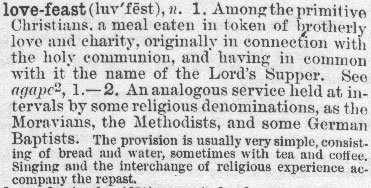
The Century Dictionary and Cyclopedia, 1897, p. 3528, “love-feast”:
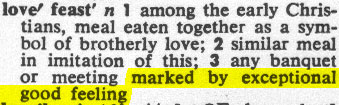
The Scribner-Bantam English Dictionary, 1977, p. 536, “love feast”:
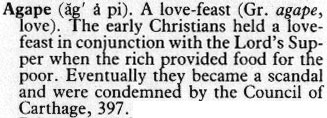
Brewer’s Dictionary of Phrase and Fable, 1981, p. 15, “Agape”:
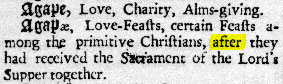
Dictionarium Anglo-Britannicum, John Kersey, 1708, (no page numbers), “Agape | Agapæ”:
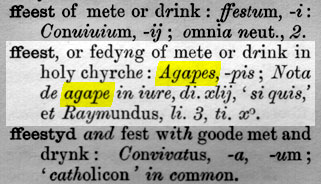
The Promptorium Parvulorum: The First English-Latin Dictionary, Mayhew, c. 1440 A.D.; re-typeset for the Early English Text Society, 1908; page column 159, “ffeest”:
Appendix C, p. 800, “Glossary of the Mediaeval Latinity of the Promptorium with Explanatory Notes | agape”:
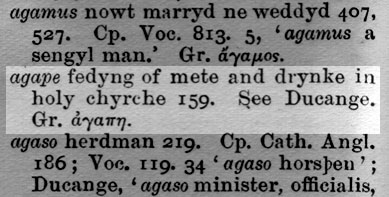
Translated from Middle English:
agape feeding of meat and drink in holy church 159.
Merriam Webster’s Collegiate Dictionary, 1997, p. 690, “love feast”:

The American Heritage Dictionary of the English Language, 2000, p. 1036, “love feast”:

Webster’s New World Dictionary of the American Language, Second College Edition, 1982, Guralnik, p. 25, “agape”:

“Spontaneous” means “Arising from a natural inclination or impulse and not from external incitement or constraint.” and “Unconstrained and unstudied in manner or behavior.” Sex is also “altruistic” as it is of mutual kindness and concern.
P. 838, “love feast”:

To update: Hey buddy, you’re going to get busted in the chops if you don’t stop showing affection for my wife’s good feelings. You especially better not do anything spontaneous.
Morris Dictionary of Word and Phrase Origins, 1977, p. 8, “agape”:
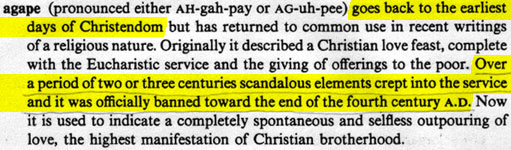
Or, it could be that the “scandalous elements” had always been there, until they became “scandalous.”
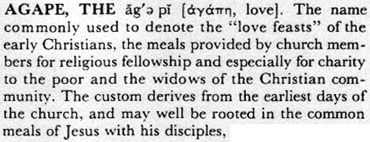
The Interpreter’s Dictionary of the Bible: An Illustrated Encyclopedia, 1962, “THE AGAPE”:
http://bibletools.org/index.cfm/fuseaction/Def.show/RTD/ISBE/ID/270 (BibleTools), Definitions, “Agape (From International Standard Bible Encyclopedia)”:
5. Reasons for the Separation:
Various influences appear to have cooperated in this direction. Trajan's enforcement of the old law against clubs may have had something to do with it (compare Pliny as above), but a stronger influence probably came from the rise of a popular suspicion that the evening meals of the church were scenes of licentious revelry
Trajan (c. 53-117 AD)
Mounce’s Complete Expository Dictionary of Old & New Testament Words, 2006, p. 429, “Love”:
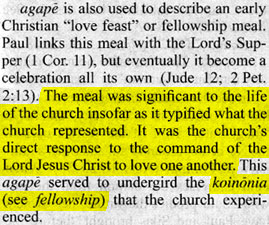
If such is the case, why would the later church stop it? I mean couldn’t they have just stopped the so called “abuses” and carried on with the “direct response to the command of the Lord Jesus Christ to love one another”? Of course, what they’re today calling “abuses” is the sex orgy part; but, why couldn’t they have just ended the sex orgy part and carried on with the “love one another” part. Apparently, back then, the “love one another” part was too evident for the sex orgy part, so they just had to end the whole thing, meal and all. Especially if “love” back then, meant the same thing that “love” means today in English. Apparently, they didn’t have anyone back then to substantiate “love” to mean nothing to do with sex. Later, when the aid of the real meaning of fornication became corrupted, that might explain why early Methodists were able to restart the “love feast.” Today, Seventh-day Adventists call it an “agape feast,” utilizing the redefined obscure word (agape) making it even easier to get the sex out of it. Don’t want anything weird happening at the church.
New Americanized Encyclopædia Britannica, 1902, vol. 1, p. 95, “AGAPE”:
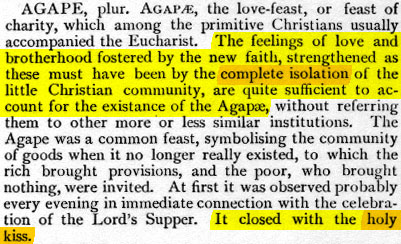
The Century Dictionary and Cyclopedia, 1897, p. 107, “agape”:
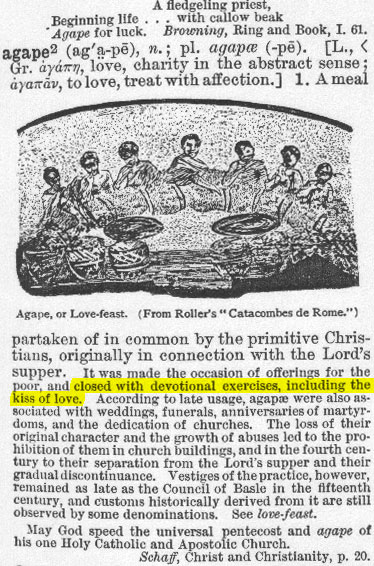
The Catacombs of St. Callixtus, St. Sebastian, and Domitilla, Englefield, 1913, pp. 55-56, “Glossary of Words, etc. in connection with the Catacombs | Agape”:
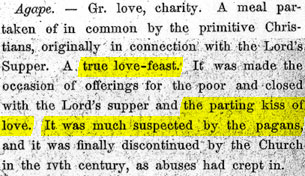
Webster’s New International Dictionary of the English Language, 1923, p. 41, “agape”:
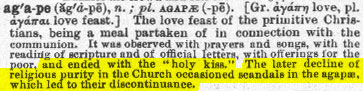
http://www.osv.com/OSV4MeNav/CatholicAlmanac/GlossaryAC/tabid/343/Default.aspx, Our Sunday Visitor's Catholic Almanac: Glossary, A-C, “Agape”:
Agape: A Greek word, meaning love, love feast, designating the meal of fellowship eaten at some gatherings of early Christians. Although held in some places in connection with the Mass, the agape was not part of the Mass, nor was it of universal institution and observance. It was infrequently observed by the fifth century and disappeared altogether between the sixth and eighth centuries.
http://www.piney.com/AgapeSummary.html, The Agape or Agapae Pagan and Biblical Background:
In the age of Chrysostom (347–407) and Augustine (354–430) the agape was frequent.
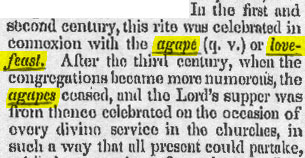
Encyclopaedia Americana, Vol. VIII, 1831, p. 79, “Lord’s Supper”:
The Donning International Encyclopedic Psychic Dictionary, Bletzer, 1986, p. 9, “AGAPE”:
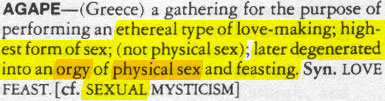
The fact of the matter is “ethereal” (intangible / spiritual) “love making” in phony therefore flat out doesn’t achieve much for the Goldenrule (ask the news media in today’s so called Christian based society). Putting a “tangible” air conditioner in your home achieves much better cooling results than just imagining one there. But, I appreciate them bring these excuses to my attention.
Words On Words: A Dictionary for Writers and Others Who Care About Words, Bremner, Columbia University Press, 1980, p. 14, “AGAPE”:

P. 272, “ORGY”:

Diccionario Enciclopédico: Hispano-Americano de Literatura, Ciencias, Artes, Etc. (Encyclopedic Dictionary: Hispano-American of Literature, Sciences, Arts, etc.), no date but pretty old, Vol. 1, p. 570, “ÁGAPE”:
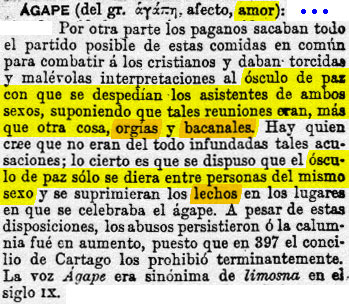
(ÁGAPE (del gr. άγάπη, afecto, amor): … Por otra parte los paganos sacaban todo el partido posible de estas comidas en común para combatir á los cristianos y daban torcidas y malévolas interpretaciones al ósculo de paz con que se despedían los asistentes de ambos sexos, suponiendo que tales reuniones eran, más que otra cosa, orgias y bacanales. Hay quien cree que no eran del todo infundadas tales acusaciones; lo cierto es que se dispuso que el ósculo de paz sólo se diera entre personas del mismo sexo y se suprimieran los lechos (beds) en los lugares en que se celebraba el ágape. A pesar de estas disposiciones, los abusos persistieron ó la calumnia fué en aumento, puesto que en 397 el concilio de Cartago los prohibió terminantemente.
La voz Ágape era sinónima de limosna en el siglo ix.)
Translated from Spanish:
AGAPE (of the Greek άγάπη, affection, amor): … On the other hand the pagans removed all the possible party from these meals in common to fight at the Christians and gave twisted and malicious interpretations to kiss of peace whereupon took leave the assistants of both sexes, supposing that such meetings were, more than another thing, orgies and bacchanalia. There is one who thinks that such accusations were not absolutely groundless; the certain thing is that it arranged that kiss of peace only occurred between people of the same sex (that was adopted years later) and the beds in the places were suppressed / eliminated in which the agape was celebrated. In spite of these dispositions, the abuses persisted or the calumny (slander) was in increase, since in 397 the Council of Carthage prohibited them finally. The voice Agape was synonymous of alms / charity in the 9th century.
The New International Encyclopaedia, 1922, Vol. 1, p. 225, “Agapae”:
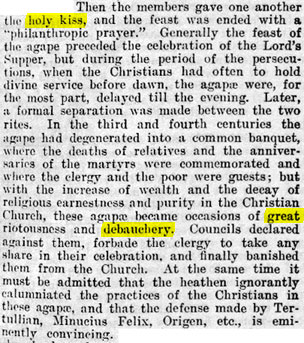
A Dictionary of Christian Antiquities. Being a continuation of the ‘Dictionary of the Bible’, 1877, Vol. 1, p. 40, “Agapae”:
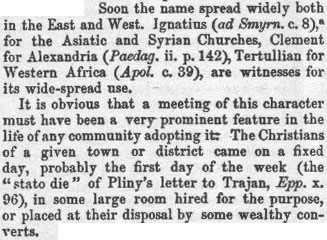
…
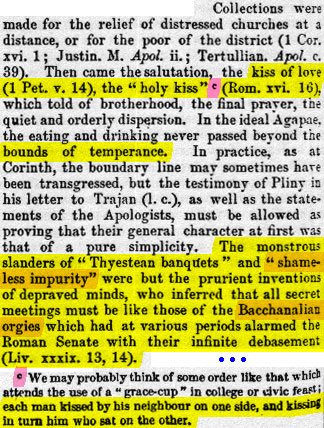
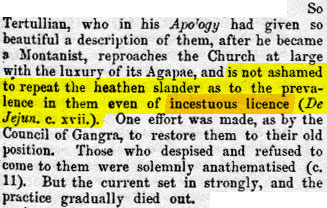
P. 41:
Dictionary of Spiritualism; Wedeck; Philosophical Library, New York; p. 8, “AGAPE”:

It is difficult to understand with today’s imbedded minds, but sex orgies can be “devout and benevolent” (especially “benevolent”), not evil and against God. I’m curious where they got this “but later on”? It sounds like speculation to me.
The New International Encyclopædia, 1912, Vol. 1, p. 193, “Agapæ”:
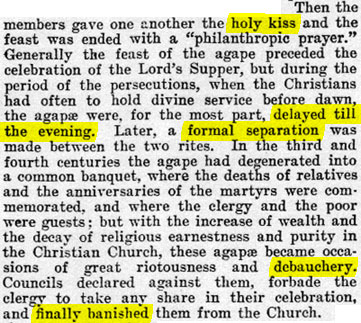
5,000 Facts and Fancies: A Cyclopaedia of Important, Curious, Quaint, and Unique Information in History, Literature, Science, Art, and Nature, Phyfe, 1901, p. 13, “Agapæ”:
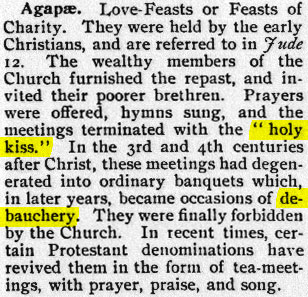
The Woman’s Dictionary of Symbols and Sacred Objects, Barbara G. Walker, 1988, p. 168, “Agape”:
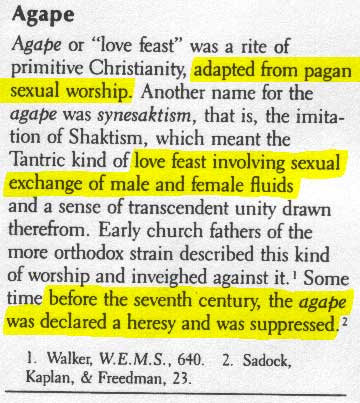
http://www.new-aeon.de/index.php?act=viewChapter&chapterID=98555, Menstrual Blood (From Barbara Walker's Encyclopedia of Myths and Secrets) - in english as u can c:
Epiphanius described the agape practiced by Ophite Christians, while making it clear that these heretical sexual activities filled him with horror: "Their women they share in common; and when anyone arrives who might be alien to their doctrine, the men and women have a sign by which they make themselves known to each other. When they extend their hands, apparently in greeting, they tickle the other's palm in a certain way and so discover whether the new arrival belongs to their cult. …Husbands separate from their wives, and a man will say to his own spouse, "Arise and celebrate the love feast (agape) with thy brother." And the wretches mingle with each other…after they have consorted together in a passionate debauch…The woman and the man take the man's ejaculation into their hands, stand up…offering to the Father, the Primal Being of All Nature, what is on their hands, with the words, "We bring to Thee this oblation, which is the very Body of Christ." …They consume it, take housel of their shame and say: "This is the Body of Christ, the Paschal Sacrifice through which our bodies suffer and are forced to confess to the sufferings of Christ." And when the woman is in her period, they do likewise with her menstruation. The unclean flow of blood, which they garner, they take up in the same way and eat together. And that, they say, is Christ's Blood. For when they read in Revelation, "I saw the tree of life with its twelve kinds of fruit, yielding its fruit each month" (Rev. 22:2), they interpret this as an allusion to the monthly incidence of the female period."
G-r-o-s-s … but what’s really gross is the fact that the vast majority today regularly chew on, then actually swallow the flesh, blood, tissue and remains of a dead animal carcass; which, science has even proved to be the most unhealthy of all foodstuffs; and, will even enjoy it better with its skin fried. You may not recognize it as gross, simply because you have been taught otherwise -- no other reason! Moreover, they will even kill the animal in its youth to get it. – Gross and cruel. “For this is My blood of the new covenant, which is shed for many for the remission of sins” –Matt. 26:28. However, the erroneous eucharist was not ordered by Christ to continue. “Then Jesus said to them, “All of you will be made to stumble because of Me this night” –Matt. 26:31, suggesting that Jesus prophesied the eucharistic error (among many other things). “For I say to you, I will no longer eat of it until it is fulfilled in the kingdom of God” –Luke 22:16, sort of indicates that they were not instructed to implement the eucharist. Then they said to Him, “Lord, give us this bread always.” And Jesus said to them, “I am the bread of life. He who comes to Me shall never hunger, and he who believes in Me shall never thirst. But I said to you that you have seen Me and yet do not believe.” –John 6:34-36, telling that once someone “comes to [and ‘believes in’] [Christ]”, they don’t need to continue to eat that bread (the eucharist), but since they “do not believe” they continue to do the eucharist even to this day. Realize that when it is God the Father speaking through Christ, it can only be told figuratively. “The Jews therefore quarreled among themselves, saying, “How can this Man give us His flesh to eat?” –John 6:52; and, “For My flesh is food indeed, and My blood is drink indeed.” –John 6:55. I know Jesus / God meant it as symbolic, but the early Christians apparently practiced it literally, even today to some extent, changing its name to “holy communion” for some reason. “Go therefore and make disciples of all the nations, baptizing them in the name of the Father and of the Son and of the Holy Spirit” –Matt. 28:19 (verse 20 is the end of the book), indicating that Baptism was the only sacramental order of Christ, not the eucharist (“holy communion”). Also, “He who believes and is baptized will be saved: but he who does not believe will be condemned” –Mark 16:16. Ejaculation and menstrual blood is a lot better than the cannibalism they once did.
http://www.brendastumpf.com/gallery_pages/assemblages/hidden/synesaktism.html, “Synesaktism” (agape):
From the earliest cultures, the magic of creation was thought to reside in the blood that women gave forth in harmony with the moon, as in the older female-oriented creation myth recounting the creation of man from clay and moon-blood. The Gnostic Christians like the Ophites, practiced the “spiritual marriage”. During this, the woman and the man take the man’s seed into their hands, stand up, offering it to the Father, as the body of Christ, and they do likewise with the woman’s moon-blood as Christ’s Blood. This was considered more “spiritual” than eating the transmuted form of bread and wine. When the semen made molten by the fire of great passion falls into the lotus of the “mother” and mixes with the red element, the man achieves “the conventional mandala of the thought of enlightenment.”
http://www.themystica.org/mystica/articles/t/tantrism.html, Tantrism:
Tantrism was never completely destroyed. It has been practiced in different forms or versions throughout the centuries. It was practiced by some early Christians who called it synesaktism … One big obstacle was when the Christian Church declared that the sole purpose of sex was for the propagation of children. This lead to the obstacle of others being suspicious of those practicing it, thinking promiscuity was occurring among them. Some early Christian sects such as the Gnostic Ophites practiced a form of Tantrism by adoring their Goddess symbol of Sophia. She was thought of as the Holy Spirit, the feminine soul or the Shakti of God. They called their rite a spiritual marriage which was completely misconceived by the orthodox Church which condemned it. Certain members of these sects laid naked together while copulating. Their rite was suspicious in that they say they only avoided male orgasm. As previously mentioned promiscuity was suspect.
http://www.themystica.org/mystica/articles/g/gnosticism.html, Gnosticism:
Where marriage was permitted within the monastic sects, sexual intercourse was absolutely forbidden. Many types of sexual acts and perversions were permitted in the libertine sects. One, the Ophites -- a name which honored the snake or serpent -- was known for its love feasts.
http://www.piney.com/AgapeSummary.html, The Agape or Agapae Pagan and Biblical Background:
"Another name for the agape was synesaktism, "the Way of Shaktism," meaning Tantric yoni-worship. Synesaktism was declared a heresy before the 7th centuryA.D.53 Subsequently the "love-feast" disappeared,
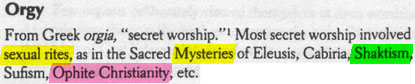
The Woman’s Encyclopedia of Myths and Secrets, Barbara G. Walker, 1983, p. 742, “Orgy”:
http://www.atlan.org/articles/sacraments/, The Atlantean Origin of the Seven Sacraments, “3) Matrimony”:
In Exodus 24, two Covenants ("marriages") are mentioned. One is bloody, with the participants being sprinkled with blood, and the other is bloodless. The first one is orgiastic (an agape) and is celebrated by a nocturnal supper akin to the Last Supper. … The other symbols of the Alliance (or Matrimony) are likewise Cosmogonic: the Tablets of the Law; the aspersion with blood; the agape; the orgies (chaotic mingling of fire and water); the Baptism of the New Covenant; the restoration of the Temple; the insistence on love, etc.
Love Feast, Buechner, 1974, (fiction), p. 194:

Encyclopedia of Ancient Deities, Coulter/Turner, 2000, p. 24, “Agape”:
(H)ortus Vocabulorum (Latin & English definitions), 1500, no page numbers, “Agap-”:
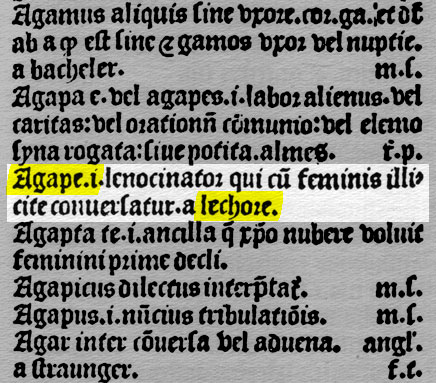
In text:
Agape. -i. lenocinator qui cu feminis illicite conuersatur (Latin). a lechore (English).
Latin translated:
|
lenocinator |
flatter / procure / entice / allure / promote / style: meretricious(prostitution) ornament [Cassell’s / Smith’s] |
|
qui |
any |
|
cu |
with (?) |
|
feminis |
female |
|
illicite |
illicit (per era) |
|
conuersatur |
behavior / keep company with / have intercourse with / companion |
Translated from Elizabethan English:
a lecher
http://www.answers.com/lecher, lecher:
A man given to lechery. … man with strong sexual desires. Synonym: satyr
http://www.answers.com/lechery, lechery:
Excessive indulgence in sexual activity; lewdness.
The surrounding agap- definition words are standard Church extant:
caritas: love / affection
comunio: communion / fellowship / mutual participation
almes (Eng.): love / charity
dilectus: love / value
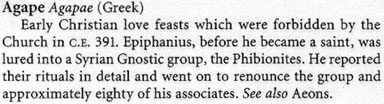
Merriam-Webster’s Encyclopedia of World Religions, 1999, p. 22, “AGAPE”:
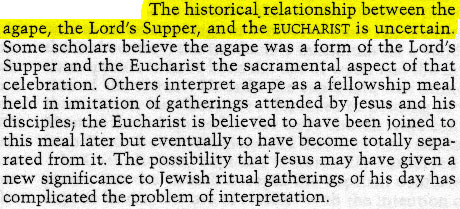
Why wasn’t good record kept of the agape? It’s because it was a sex orgy.
The International Encyclopaedic Dictionary, 1901, p. 2570, “love-feasts”:
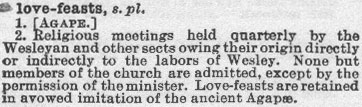
Webster’s New International Dictionary of the English Language, 1923, p. 1279, “love feast”:
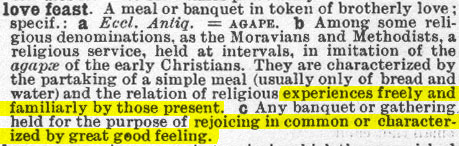
http://www.webster.com/cgi-bin/dictionary?book=Dictionary&va=love+feast (Merriam-Webster Online Dictionary), “love feast”:
1 : a meal eaten in common by a Christian
congregation in token of brotherly love
2 : a gathering held to promote
reconciliation and good feeling or show someone affectionate honor
http://www.webster.com/cgi-bin/dictionary?book=Dictionary&va=feast (Merriam-Webster Online Dictionary), “feast” (noun):
Etymology: Middle English feste festival, feast, from Middle French, festival, from Latin festa, plural of festum festival, from neuter of festus solemn, festal; akin to Latin feriae holidays, fanum temple
1 a : an elaborate meal often accompanied by a ceremony or entertainment : BANQUET b : something that gives unusual or abundant pleasure
“Feast” doesn’t just mean food.
http://www.webster.com/cgi-bin/dictionary… (Merriam-Webster Online Dictionary), “feast” (verb):
intransitive senses
1 : to take part in a feast
2 : to enjoy some unusual
pleasure or delight
transitive senses
1 : to give a feast for
2 : DELIGHT, GRATIFY
A “feast” is more than just a meal.
http://www.answers.com/feast, “feast”:
3. Something giving great pleasure or satisfaction
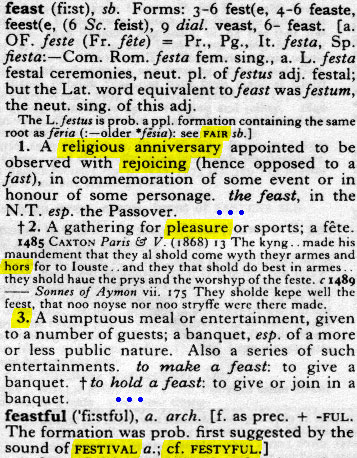
The Oxford English Dictionary, 1989, “feast”:
A Glossary of Liturgical and Ecclesiastical Terms, 1877, p. 127, “FEAST”:
