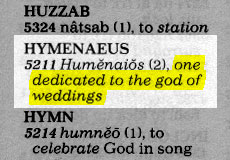
HYMEN (THE GOD OF MARRIAGE)
Some will say that Eros was in Church art because he represented the sexual desire only in marriage; but, that would be a deity error, simply because not Eros, but Eros’s brother Hymen was:
http://dictionary.reference.com/search?q=hymen (Dictionary.com), “Hymen”:
(Greek Mythology) the god of marriage.
http://www.pagan-heart.co.uk/godsandgoddesses.html, Pagan God’s and Goddesses, ”Greek”:
Hymen: God of Marriage and Commitment.
http://www.pantheon.org/articles/h/hymen.html, Hymen:
Hymen or Hymenaeus was the god of marriage and the marriage feast or song. He is often depicted with a marriage feast torch in his hand.
http://www.theoi.com/image/img_hebe.jpg (via http://www.theoi.com/Ouranios/ErosHymenaios.html), HYMENAIOS:
|
Greek Name |
Transliteration |
Latin Spelling |
Translation |
|
`UmenaioV |
Hymenaios |
Hymenaeus |
Wedding
or Bridal- |
HYMENAIOS (Hymen or Hymenaeus) was the god of weddings, or more specifically of the wedding hymn which was sung by the train of the bride as she was led to the house of the groom.
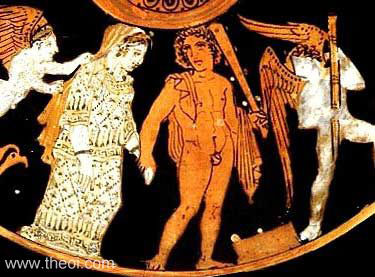
Hymenaeus,
Heracles & Hebe, Athenian red-figure pyxis
C5th B.C., University of Pennsylvania
Museum
http://www.entrenet.com/~groedmed/greekm/mythhyme.html, Hymen:

Hymen was the torch-bearing god of marriage.
http://humanitiesweb.org/cgi-bin/human.cgi?s=g&p=c&a=p&ID=266, “Ladies Adorning a Term of Hymen” by Sir Joshua Reynolds (1774):

… a bust of Hymen, the Greek god of marriage, that stands on a tapered column (known architecturally as a "term").
http://www.hist.uib.no/antikk/eftertid/frankrike/page_01.htm, Hymenaios:
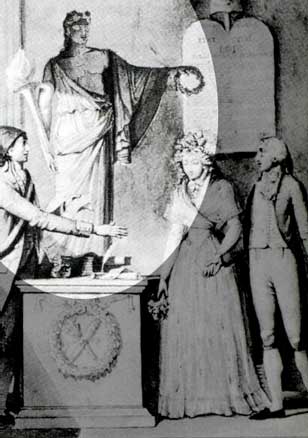
http://homepage.mac.com/cparada/GML/000Free/000Eros/source/21.html, Eros Album:
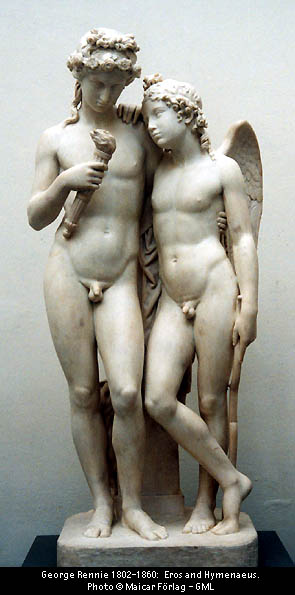
7808: George Rennie 1802-1860: Cupid kindling the torch of Hymen. Marble. Victoria and Albert Museum, London.
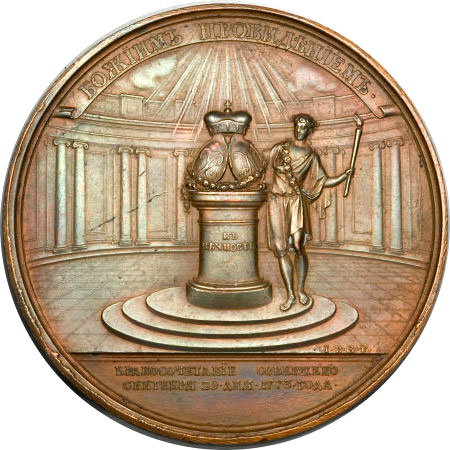
http://www.coinarchives.com/w/lotviewer.php?LotID=739678&AucID=539&Lot=21830, Heritage World Coin Auctions:
Catherine II bronze medal 1773 for the marriage of Paul Petrovich to Princess Natalia Alexeevna, by J.C.G. Jaeger and J.B. Gass, Facing busts of Paul Petrovich and Princess Natalia Alexeevna/Hymen with a torch, standing near a pedestal, Diakov-164.1 (R1), Reichel-2498, 65 mm, XF with faint trace of ink collection number 272 on obverse.
http://www.antiqueprints.com/images/ag/E735.JPG (via http://www.antiqueprints.com/Prints/humorous-hogarth-prints.html), Antique prints - Hogarth:
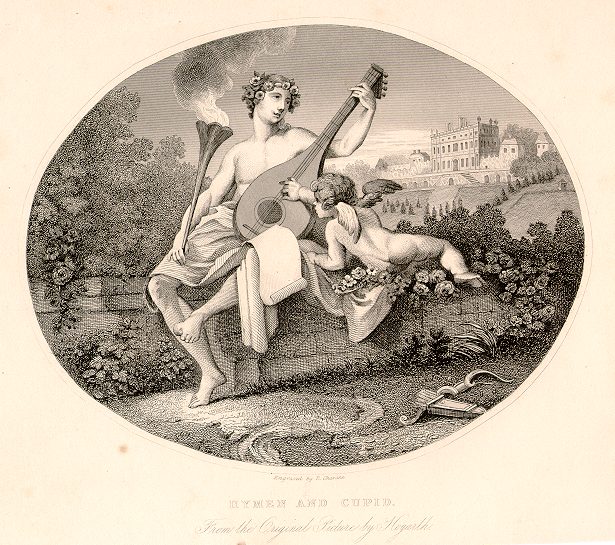
" Hymen and Cupid " engraved by E.Chavane. (1820-22)
The word “erotic” comes from the Greek mythological character Eros. Eros (“the god of sexual love”) is very popular in early Christian art, and later became the symbol of an angel. I haven’t seen Hymen in any Christian art. Most likely because Hymen is a character in the New Testament who is labeled as “an opponent of Christianity”:
Divry’s Modern English-Greek and Greek-English Desk Dictionary, 1996:
English-Greek, p. 145:
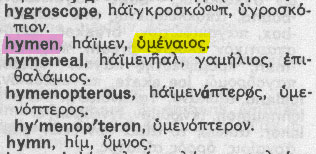
Greek-English, p. 716:
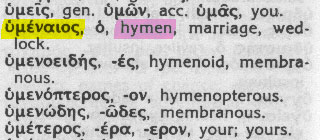
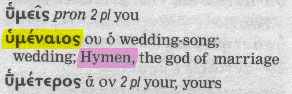
Pocket Oxford Classical Greek Dictionary, 2002, p. 327:
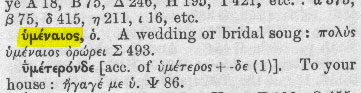
A Lexicon of the Homeric Dialect, Cunliffe, University of Oklahoma Press, 1963, p. 394, (Homer lived around 850 BC):
The New Strong’s Complete Dictionary of Bible Words, Thomas Nelson Publishers, 1996, Greek Dictionary, p. 716:
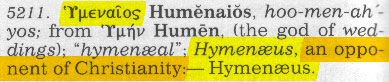
(Its first character “υ” is “Υ” in Greek uppercase.)
http://www.sacrednamebible.com/kjvstrongs/STRGRK52.htm, King James Bible: Strong’s Greek Dictionary:
|
5211 |
umenaioV |
from Humen (the god of weddings); "hymeneal"; Hymeneus, an opponent of Christianity:--Hymenaeus. |
Hymenaeus, but spelled identical to Hymen in Greek.
http://www.kl.oakland.edu/kraemer/edcm/h.html, An Etymological Dictionary of Classical Mythology:
hymeneal n
[L hymenaeus wedding song, wedding, fr. Gk hymenaios, fr. Hymen, Greek god of marriage] 1 : nuptial 2 : a wedding song
The Apostle Paul actually describes a Hymen supporter (“Hymenaeus”) as “Satan”:
The Eerdmans Bible Dictionary, Myers, 1987 / 1996 (paperback), p. 509:
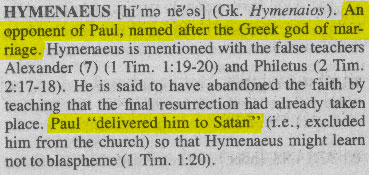
1 Timothy 1:18-20 (NKJV):
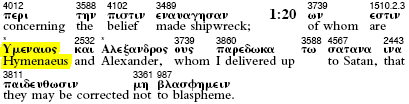
18This charge I commit to you, son Timothy, according to the prophecies previously made concerning you, that by them you may wage the good warfare, 19having faith and a good conscience, which some having rejected, concerning the faith have suffered shipwreck, 20of of whom are Hymenaeus and Alexander, whom I delivered to Satan that they may learn not to blaspheme.
2 Timothy 2:16-18 (NKJV):
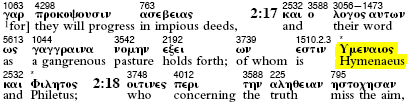
16But shun profane and idle babblings, for they will increase to more ungodliness. 17And their message will spread like cancer. Hymenaeus and Philetus are of this sort, 18who have strayed concerning the truth, saying that the resurrection is already past; and they overthrow the faith of some.
So, Apostle Paul’s message to the followers of faith (and for us today) is that “Hymen” attributes to “Satan.” You see, all we know about this Hymen / Hymenaeus individual is that his actual name is “god of marriage,” and that he said that the resurrection is already past, which Paul opposed. Every commentary I’ve read trying to (mainstream) justify both of these points has only been guesswork. The two literal (“upholding the exact or primary meaning of a word or words” –Dictionary.com) points are on my side. If, instead, that was “Eros” who Paul called Satan, then today’s mainstream church would definitely use it as firm support to condemn innocent sexually active single people. The earliest church support where the name Eros comes up is when Saint Ignatius (second Antioch bishop after Saint Peter) defined Christ as Eros, and the fifth bishop of the huge Church in Antioch was actually named Eros. Today’s Christians mainly “just ignore” these Eros definition names.
http://en.wikipedia.org/wiki/Ignatius_of_Antioch, Ignatius of Antioch:
Peter himself appointed Ignatius to the see of Antioch.
http://septuagint-interlinear-greek-bible.com/pdf/1timothy.pdf, 1 Timothy 1:20:
2 Timothy 2:17:
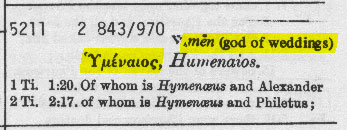
The Word Study Concordance, Wigram & Winter, Tyndale House Publishers, 1978, Proper Names Concordance, p. 865:
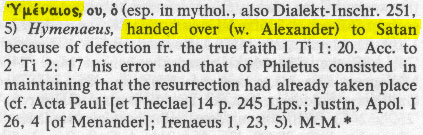
Thayer’s Greek-English Lexicon of the New Testament, 1889, Baker Books 1977, pp. 636-637:

A Greek-English Lexicon of the New Testament and Other Early Christian Literature, Bauer, University of Chicago Press, 1979, p. 836:
New American Standard Exhaustive Concordance of the Bible; Thomas, Wilkins; Foundation Publications; 1998, (inside:) Greek Dictionary; p. 1573:
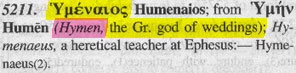
The Three-In-One Bible Reference Companion, Thomas Nelson Publishers, 1982, p. 341:
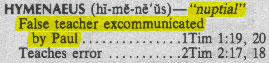
A Pocket Lexicon to the Greek New Testament, Souter, Oxford, 1916 (reprinted 1917), p. 267:

The Vocabulary of the Greek Testament, Moulton / Milligan, 1930 (reprinted 1949), p. 649:
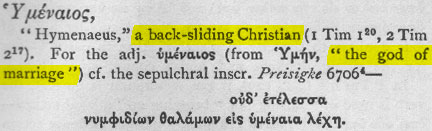
The Complete WordStudy Dictionary: New Testament, Zodhiates, AMG Publishers,1993, p. 1406:
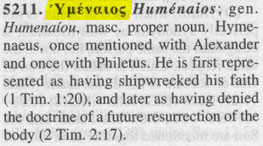
The Catholic Encyclopedia has nothing on Hymen or Hymenaeus in the index:
New Catholic Encyclopedia, 1967, Vol. 15, Index:
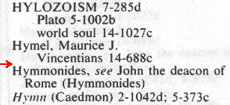
Young’s Compact Bible Dictionary, Tyndale House Publishers, 1989, p. 280:
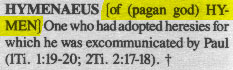
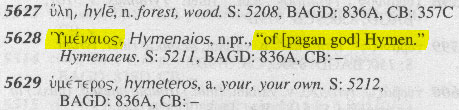
The Greek English Concordance to the New Testament with the New International Version; Kohlenberger, Goodrich & Swanson; Zondervan Publishing; 1997; (inside:) A Concise Greek-English Dictionary to the New Testament, p. 1124 (G/K numbering system):
Many of you may not know this, but in Christ’s day, pagan gods were as popular as… gods.
Hymen’s Appearance Attributes (mainly a torch):
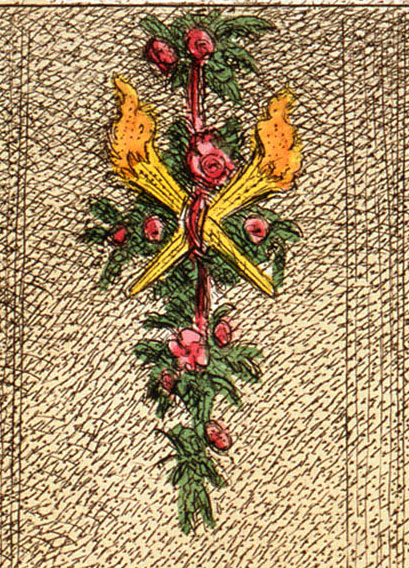
http://commons.wikimedia.org/wiki/File:1805-Gillray-Harmony-before-Matrimony.jpg,
Harmony before Matrimony
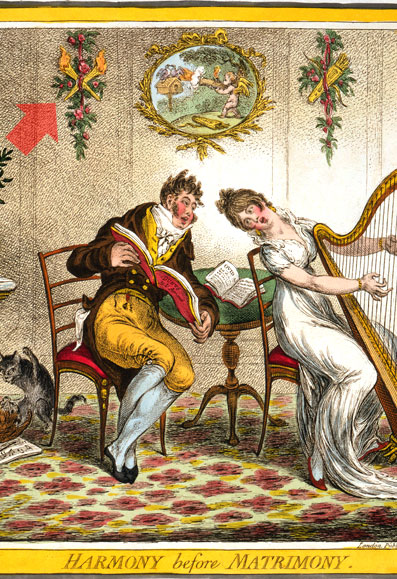
"Harmony before Matrimony", an October 25th 1805 caricature by James Gillray depicting a musical courtship. … The hanging floral wall decorations include torches of Hymen (the ancient Roman god of weddings) on the left, and the bow and quiver of arrows of Cupid on the right.
Enlargement (http://upload.wikimedia.org/wikipedia/commons/8/8b/1805-Gillray-Harmony-before-Matrimony.jpg):
Oxford Universal English Dictionary on Historical Principles, 1937, Vol. 4, p. 941:
The Random House Dictionary of the English Language: College Edition, 1968, p. 651:
http://www.infoplease.com/ce6/ent/A0824747.html (The Columbia Electronic Encyclopedia, 2004), “Hymen”:
Hymen or Hymenaeus [hīmunē'us] , in Greek mythology, personification of marriage, represented as a beautiful youth carrying a bridal torch and wearing a veil.
Oxford English Dictionary, 1989:
http://digital.library.upenn.edu/women/doolittle/hymen/1921-hymen.html, A Celebration of Women Writers, “Hymen” (song):
Beyond the cry of Hymen and the torch,
http://www.toutfait.com/issues/issue_2/Notes/metcalf.html, The Gift of Cassandra:
Euripides opens his play with Cassandra, possessed with prophecy, coming on stage with a flaming torch in each hand. One she places in a sconce on the statue of Hymen, God of Marriage, and the other she holds high in her right hand singing the marriage song, prophesying her betrothal to Agamemnon; this despite the fact that even Apollo had respected her virginity.
http://www.tiscali.co.uk/reference/encyclopaedia/hutchinson/m0014384.html, Hymen:
In Greek mythology, the god of the marriage ceremony; personification of the refrain of a wedding song. In art, he is represented as a boy crowned with flowers, carrying a burning bridal torch.
http://www.newmanjunior.wa.edu.au/gods/NA11.htm, Of Gods and Men: The A – Z of Mythology and Legend, “Hymen”:
Both the Greeks and Romans worshipped him as the god of marriage,and in this regard he was connected with Hera,who among other things was the goddess of the marriage troth. He was born so delicate and beautiful that he might be mistaken for a girl,and used this appearance to get close to a young Athenian maiden whom he loved,but whom he could not marry,on account of his poverty. … He is always depicted as a youth of staggering beauty,with a mantle of golden colour---though sometimes he is nude---and carrying a torch,or a veil.
http://math.boisestate.edu/gas/pinafore/html/notes.html#15 (Boise State University), H.M.S. Pinafore Notes:
Hymen. Originally a marriage song among the Greeks. The name was gradually personified, and Hymen was invoked as the God of Marriage. He is represented as a taller and more serious youth than Eros--the God of Love--carrying a bridal torch.
http://www.odyssy.net/users/erica/wicca/gods.htm:
Hymen - God or marriage. Shown as a handsom youth crowned with flowers. Holding a torch in one hand and a yellow veil in the other for his bride.
http://www.4literature.net/Euripides/Trojan_Women/3.html, Trojan Women by Euripides:
CASSANDRA
Bring the light, uplift and show its flame! I am doing the god's service, see! I making his shrine to glow with tapers bright. O Hymen, king of marriage! blest is the bridegroom; blest am I also, the maiden soon to wed a princely lord in Argos. Hail Hymen, king of marriage! Since thou, my mother, art ever busied with tears and lamentations in thy mourning for my father's death and for our country dear, I at my own nuptials am making this torch to blaze and show its light, in thy honour, O Hymen, king of marriage! Grant thy light too, Hecate, at the maiden's wedding, as the custom is. Nimbly lift the foot aloft, lead on the dance, with cries of joy, as if to greet my father's happy fate. To dance I hold a sacred duty; come, Phoebus, lead the way, for 'tis in thy temple mid thy bay-trees that I minister. Hail Hymen, god of marriage! Hymen, hail! Come, mother mine, and join the dance, link thy steps with me, and circle in the gladsome measure, now here, now there. Salute the bride on her wedding-day with hymns and cries of joy. Come, ye maids of Phrygia in raiment fair, sing my marriage with the husband fate ordains that I should wed.
CHORUS
http://www.gradesaver.com/ClassicNotes/Titles/tempest/summ4.html, Shakespeare: The Tempest, Analysis of Act IV:
Prospero's great concern foreshadows the importance of this theme in the betrothal masque; in the masque, Iris makes mention that the couple cannot be together "till Hymen's torch be lighted," her language parallel to that in Prospero's earlier entreaty to the lovers. … Though the marriage rites to be performed are Christian, allusions to ancient pagan mythology abound. Prospero invokes Hymen, god of marriage‹and a figure uniquely opposed to his wish for "holy rites" for his daughter. … A betrothal masque also appears in As You Like It that is presided over by Hymen; but otherwise, the spectacle was mostly reserved for weddings of state and almost exclusively for court functions.
Academic American Encyclopedia, 1995, p. 345:
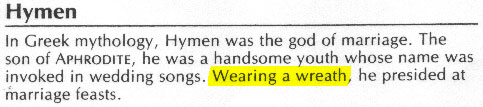
Hymen symbolized (today’s version of) virginity:
www.spiritonline.com/gods/searchquote_ v2.pl?ID=1&string=marriage, Book of Deities: Entries under marriage:
Hymen
Greek god of marriage.
Symbolizes love, virginity, and
obviously the oath of marriage.
http://www.amystical1.com/greekgodsgoddesses.htm, Greek Gods and Goddesses:
Hymen
Greek god of marriage. Symbolizes love, virginity, and the oath of marriage.
http://www.angelfire.com/ny4/sylverspage/gods/greekgods.html, Greek Gods and Goddesses:
Hymen: Greek god of marriage. He symbolizes love and virginity.
http://health.discovery.com/centers/sex/sexpedia/hymen.html (Discovery Health Channel), Sexual Health, “Hymen”:
A hymen is the thin piece of tissue that partially blocks the entrance to the vagina. It is sometimes called the maidenhead or cherry. It is named after the Greek god of marriage and has no known biological function.
http://en.wikipedia.org/wiki/Virgin (The Free Encyclopedia), “Virgin”:
Among human females, the hymen is a membrane, part of the vulva, which partially occludes the entrance to the vagina and which is often physically torn when the woman first engages in vaginal intercourse. The presence of an intact membrane is therefore often seen as physical evidence of virginity in the broader technical sense.
http://www.youngwomenshealth.org/hymen.html, Types of Hymens: A Guide for Teen Girls:
Hymen: a thin membrane that surrounds the opening to a young woman's vagina. Hymens can come in different shapes. The most common hymen is shaped like a half moon. This shape allows menstrual blood to flow out of a girl's vagina. (see diagrams)
http://www.dmu.edu/anatomy/anatomicalword2002.htm (Des Moines University – Osteopathic Medical Center), Anatomy Department: Word of the Month, “Hymen”:
Hymen means "membrane" in Greek. This membrane partially occludes the opening to the vagina. Although traditionally an intact hymen is considered a sign of virginity, it is an unreliable sign. Many nonsexual activities, horseback riding, ballet, gymnastics among others, can alter the integrity of this structure. However, it is interesting to note that in the ancient Greek mythology Hymen was the god of marriage. An archaic word for nuptials, a wedding ceremony, is “hymeneal”. Long held beliefs endure!
Hymen’s Popularity:
http://onlinedictionary.datasegment.com/word/Hymen (from Webster’s 1913 Dictionary):
Hymen \Hy"men\, n. [L., fr. Gr. ?.]
1. (Class Myth.) A fabulous deity; according to some, the sonof Apollo and Urania, according to others, of Bacchus and
Venus. He was the god of marriage, and presided over
nuptial solemnities.
[1913 Webster]
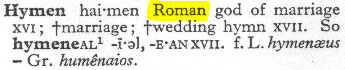
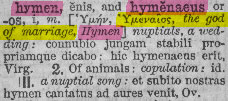
In addition to the Greek, Hymen was also the Roman god of marriage (same name) which made his name doubly popular:
Oxford Dictionary of English Etymology, 1966, p. 455:
A Smaller Latin-English Dictionary, Smith, 1879, p. 263:
http://www.geocities.com/Axiom43/mythgods.html:
|
Greek and Roman Gods. |
||
|
Greek |
Roman |
|
|
Aphrodite |
Venus |
Goddess of Love and Beauty |
|
Apollo, |
Apollo, |
Greek God of sun. God of music, poetry and prophecy. |
|
Ares |
Mars |
God of war |
|
Artemis |
Diana |
Virgin huntress, Goddess of the moon. |
|
Asciepius |
Aesculapius |
God of medicine. |
|
Pallas Athena |
Minerva |
Goddess of wisdom and art. |
|
Cronus |
Saturn |
Father of the supreme god: Zeus or Jupiter. |
|
Demeter |
Ceres |
Goddess of the harvest. |
|
Dionysus |
Bacchus |
God of wine and fertility. |
|
Eros |
Cupid |
God of love. |
|
Gaea |
Terra |
Mother Earth |
|
Hades, Pluto |
Dis |
God of the Underworld. |
|
Hephaestus |
Vulcan |
God of fire. |
|
Hera |
Juno |
Queen of heaven, wife of Zeus/Jupiter, goddess of women and marriage. |
|
Hermes |
Mercury |
Messenger of the gods, god of roads, cunning, commerce, wealth and luck. |
|
Hestia |
Vesta |
Goddess of the hearth. |
|
Hymen |
Hymen |
God of marriage. |
|
Hypnos |
Somnus |
God of sleep |
|
Irene |
Pax |
Goddess of peace. |
|
Pan |
Faunus |
God of flocks and shepherds. |
|
Persephone |
Proserpina |
Goddess of corn and the spring, goddess of the dead. |
|
Poseidon |
Neptune |
God of the sea. |
|
Rhea |
Ops |
Wife of Cronus/Saturn,
Mother Goddess. Goddess of |
|
Uranus |
Uranus |
God of the sky, Father of the Titans |
|
Zeus |
Jupiter, Jove |
Supreme ruler of gods and men, king of heaven and overseer of justice and destiny. |
Just to show a sample of the large variety of attributes, this chart shows several (but not all) pagan gods/goddesses with their basic representations, to let you see that not all gods and goddesses have to do with sex and/or marriage. Other’s are personifications of such things as: the sun; war; the moon; medicine; wisdom and art; the harvest; the underworld; fire; roads, cunning, commerce, wealth and luck; the hearth; sleep; peace; flocks and shepherds; the sea; fertility; the sky; heaven, justice and destiny; etc. For probably every attribute of life, there is a pagan god/goddess.
Another list details some of the specific attributes:
http://www.scarletsbookofshadows.freewebspace.com/whats_new.html, Gods and Goddesses:
E.g.: “Goddesses”:
Aphrodite:She is a Greek Goddess of passionate sexual love. She is a good goddess to call upon when you want to pull loving energies towards yourself. She is also a sky goddess. …
Hera:Greek Goddess of marriage. Call on her if you are having a handfasting.
E.g.: “Gods”:
Eros:Greek God of romance and passionate love. …
Hymen:Greek God of marriage and commitment.
http://www.geocities.com/crossword_links_au/Mythology.htm, Mythology by the (non-cryptic) Crossword solver – grouped into various Mythologies, “Greek Mythology”:
|
Of |
Name |
Status |
Comments |
…
|
Law & Justice |
Themis |
Goddess |
|
|
Light, Medicine, Healing & Truth |
Apollo |
God (Solar deity) |
Also, patron of music on Earth |
|
Love & Fertility |
Eros (Erotic Love) |
God |
|
|
Love, Beauty & Fertility |
Aphrodite |
Goddess |
|
|
Lyric, Poetry & Dance |
Terpischore |
Muse |
One of Zeus nine daughters |
|
Mother Earth |
Gaia (Gaea or Ge) |
Goddess |
|
|
Marriage Ceremony |
Hymen |
God |
|
|
Measured the Thread of Destiny |
Lachesis |
Muse |
|
|
Medicine & Healing |
Asclepius |
God |
Son of Apollo & Coronis |
|
Merchants, Thieves, Roads & Flocks |
Hermes |
God |
Also, the "winged messenger" of the Gods |
|
Moon |
Selene |
Goddess |
|
|
Murder |
Tisiphone |
Furies |
One of the three Furies |
|
Night, Moon |
Phoebe |
Queen |
One of the Twelve Titans |
Notice the only listings under “love” are Eros and Aphrodite; and, the only listing under “marriage” is Hymen, the documented “opponent of Christianity” message from the New Testament.
So, Early Christians should have been familiar with Hymen, but instead chose to model the pagan god Eros / Cupid.
Comment concerning Deuteronomy 22:13-21:
http://bible.gospelcom.net/passage/?book_id=5&chapter=22&version=50, Deuteronomy 22:13-21:
Laws of Sexual Morality
13"If any man takes a wife, and goes in to her, and detests her, 14and charges her with shameful conduct, and brings a bad name on her, and says, "I took this woman, and when I came to her I found she was not a virgin,' 15then the father and mother of the young woman shall take and bring out the evidence of the young woman's virginity to the elders of the city at the gate. 16And the young woman's father shall say to the elders, "I gave my daughter to this man as wife, and he detests her. 17Now he has charged her with shameful conduct, saying, "I found your daughter was not a virgin," and yet these are the evidences of my daughter's virginity.' And they shall spread the cloth before the elders of the city. 18Then the elders of that city shall take that man and punish him; 19and they shall fine him one hundred shekels of silver and give them to the father of the young woman, because he has brought a bad name on a virgin of Israel. And she shall be his wife; he cannot divorce her all his days.
20"But if the thing is true, and evidences of virginity are not found for the young woman, 21then they shall bring out the young woman to the door of her father's house, and the men of her city shall stone her to death with stones, because she has done a disgraceful thing in Israel, to play the harlot in her father's house. So you shall put away the evil from among you.
This is supposed to be written with the knowledge of God.
http://www.starmatrimonials.com/hymen.asp:
Hymen & virginity
Q. What is Hymen?
A. The hymen is a thin, fleshy membrane that in some girls and young women is
found at the opening to the vagina. It has a central perforation, which can be
round or elongated, through which menstrual blood will flow. It is also called
"maidenhead".
Q.
Is hymen an evidence of virginity?
A. For a long time, it was believed that an intact hymen was evidence of a
girl's virginity, as the hymen posed a barrier to sexual intercourse.
Some
girls who are still virgins have no hymen at all.
Also there have been
some cases in which girls who have had several sexual intercources had an
intact Hymen. This condition is also called as elastic hymen. A minor surgical
procedure should remove the hymen is such cases as elastic hymens sometimes do
cause pain during sexual intercourse.
Girls who do have a hymen can break their hymen
in a number of differerent ways, many times without even knowing it.
Some of the non-sexual ways in which a hymen will tear are:
1. Through an accident or injury.
2. Horseback riding, bicycling, high jumping, gymnastics or similar sports.
3. Insertion of finger or instrument by doctor during pelvic exam.
4. Tampon insertion.
etc..
While
the presence of a hymen indicates virginity, the absence of one is definately
not a proof a girl is not a virgin.
So “God” may have caused women to be stoned to death in error. This is why I prefer the New Testament. Jesus also overruled the Old Testament.
More On This Subject:
http://www.aol.bartleby.com/61/33/H0353300.html (American Heritage Dictionary), Hymen:
Greek Mythology The god of marriage.
http://www.arthistory.sbc.edu/imageswomen/papers/lombardiaphrodite/aphrodite.html (Sweet Briar College), Aphrodite: Her Power and Her Art:
Hymen was worshipped as the god of marriage
Encyclopedia Americana, 2000, p. 670:

http://www.paganpretties.com/ED.goddess.htm, Gods & Goddesses, “| Name | Tradition | Aspects |”:
|
Hymen |
Greek |
God of marriage & commitment |
http://www.scarletsbookofshadows.freewebspace.com/whats_new.html, Gods and Goddesses, “God”:
Hymen:Greek God of marriage and commitment.
http://www.witcheswell.com/text/goddesses/greek-gods-goddesses.txt, Greek Gods and Goddesses:
Hymen
Greek god of marriage. Symbolizes love, virginity, and obviously the oath of marriage.
http://www.bartleby.com/61/32/H0353200.html (American Heritage Dictionary), hymen:
A membranous fold of tissue that partly or completely occludes the external vaginal orifice.
Origins: A Short Etymological Dictionary of Modern English, Partridge, 1983, p. 301:
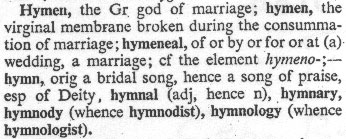
http://www.godchecker.com/pantheon/greek-mythology.php?deity=HYMENAEUS, The Gods of Greek Mythology, “Greek Mythology : HYMENAEUS”:
HYMENAEUS: God of Weddings and Getting Married. He's in charge of the wedding procession, the marriage feast, and the little bits of confetti. You'd better pray to him it all goes well.
Hear, hear.
The Oxford Classical Dictionary, 1949, p. 541, “Marriage Ceremonies”:

New Encyclopedia Britannica, 2002, Vol. 6, p. 198:
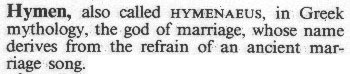
Encyclopædia Britannica, 1771, Vol. 2, p. 821:

http://www.thefreedictionary.com/Greek%20deity, Greek deity:
Hymen - (Greek mythology) the god of marriage
http://yahooligans.yahoo.com/reference/dictionary/entries/33/h0353300.html, Hymen:
Greek Mythology The god of marriage.
http://yahooligans.yahoo.com/reference/dictionary/entries/34/h0353400.html, hymeneal:
|
ADJECTIVE: |
Of or relating to a wedding or marriage. |
|
NOUN: |
1. A wedding
song or poem. |
|
ETYMOLOGY: |
From Latin hymenaeus, wedding
song, wedding, from Greek humenaios,
from Hum |
|
OTHER FORMS: |
hy |
 n,
Hymen, from hum
n,
Hymen, from hum me·ne
me·ne al·ly —
Webster’s Universal Dictionary of the English Language (unabridged), 1909, (supplement:) A Dictionary of Noted Names in Standard Fiction, Mythology, Legend, Etc., p. 65, “Hymen”:

The New Strong’s Complete Dictionary of Bible Words, James Strong (1822-1894), Thomas Nelson Publishers, 1996, “English Index to the Biblical Languages”, p. 133, “HYMENAEUS”: