SAINT IGNATIUS
Equated Christ with Eros: “Christ, my Eros, has been crucified”
Second Antioch bishop after Saint Peter; martyred c. 107 AD
http://st-elizabet.narod.ru/raznoe/moss_english.htm, Marriage, Grace And The Law:
Then he will be able to say, as did St. Ignatius the Godbearer on his way to martyrdom in Rome: "My Eros is crucified" [27] - put to death so as to rise again in a new, incorruptible form. … [27] St. Ignatius, To the Romans, 7.
http://www.angelic-visions.com/PDF%20Free/wmsbklet.pdf, The Descent of the Dove: A short history of the Holy Spirit in the church, Charles Williams, 1939:
Yet perhaps the greatest epigram of all is in a more ambiguous phrase. Ignatius of Antioch in the early second century, had tossed it out on his way to martyrdom: “My Eros is crucified.” Learned men have disputed on the exact meaning of the word: can it refer, with its intensity of allusion to physical passion, to Christ? or does it rather refer to his own physical nature? We, who have too much separated our own physical nature from Christ’s, cannot easily read an identity into the two meanings. But they unite, and others spring from them. “My love is crucified”, “My Love is crucified”: “My love for my Love is crucified “; “My Love in my love is crucified.”
http://private.peterlink.ru/alektor/mossbook.htm, Review of the article by Vladimir Moss in the collection "Marriage, Grace, and the Law":
For instance, his interpretation of the statement of St. Ignatius the Godbearer "My Eros is crucified". The Russian conventional translation goes "My Love is crucified", - and by Love the saint meant The Lord Jesus Christ. So, his statement can also be read as follows: "My Lord, Saviour, God, whom I love with all my mind, and my heart, and my soul, is crucified".
http://www.scriptoriumdaily.com/middlebrow/archives/my-love-is-crucified/, My Love is Crucified:
This was a shocking thing for him to say. Ignatius knew the writings of the New Testament (he quotes several of them), and he knew that the normal greek word for “love” in Christian conversation was already the word agape (uh, goppy). But Ignatius instead used the word eros: “My eros is crucified.” … eros with its orgiastic pagan connotations … The along comes Ignatius of Antioch: “My eros is crucified!” Here was a statement that made even Origen blush. Eros, the fire of desire, passionate affection? Origen ended up using the term, and even found it helpful in making pious sense out of the Song of Solomon.
http://www.jesusneverexisted.com/ignatius.html, Ignatius of Antioch, “Origen on Ignatius”:
2nd/3rd century Origen (ca. 185-254 AD) has little enough to say about Ignatius.
"Indeed, I remember that one of the saints, by name Ignatius, said of Christ: 'My Love is crucified.' and I do not consider him worthy of censure on this account." – Origen of Alexandria, Prologue, Commentary on Song of Songs.
http://books.google.com/books?id=wSIeAC3PNdgC&pg=PA228&lpg=PA228&dq=Origen+%22love+has+been+crucified%22&source=bl&ots=2D6AFSYlWC&sig=5rH28z-DdpWJnR6DGFiaECWTFhw&hl=en&ei=F0_ESpLWF4GV8AaBjvk_&sa=X&oi=book_result&ct=result&resnum=2&ved=0CA8Q6AEwAQ#v=onepage&q=&f=false, Origen: An Exhortation to Martyrdom, Prayer and Selected Works (Google Book Results), by Rowan A. Greer, 1979, p. 228, “Commentary on the Song of Songs”:

(All that is quoting Origen.)
http://www.sussex-academic.co.uk/PDFs/HarrisTheop1-10.pdf, Christian Theology and Spirituality, “The norms of Christian theology”:
Dionysius strikingly picks up Ignatius’ phrase, “my eros is crucified”, and maintains that this divine eros, this longing, is fundamental to all we say of God.
http://www.ccca.ca/history/ozz/english/books/hd_book/HD_Book_by_Robert_Duncan.pdf, The H.D. Book: Robert Duncan: Frontier Press 1984:
Some five hundred years after Plato, a Christian contemporary of Apuleius, Ignatius of Antioch, said, “crucified”: “My Eros is crucified.” It is the beginning of our era.
“Eros” is not used in the New Testament possibly because Jews and Christians are not supposed to worship pagan gods. But Ignatius apparently used it for pagan definition.
http://www.newadvent.org/cathen/07644a.htm (Catholic Encyclopedia), St. Ignatius of Antioch:
More than one of the earliest ecclesiastical writers have given credence, though apparently without good reason, to the legend that Ignatius was the child whom the Savior took up in His arms, as described in Mark 9:35 [9:36]. It is also believed, and with great probability, that, with his friend Polycarp, he was among the auditors of the Apostle St. John. If we include St. Peter, Ignatius was the third Bishop of Antioch and the immediate successor of Evodius (Eusebius, "Hist. Eccl.", II, iii, 22). … All the sterling qualities of ideal pastor and a true soldier of Christ were possessed by the Bishop of Antioch in a preeminent degree.
http://www.ewtn.com/library/MARY/IGNATIUS.htm (Global Catholic Network [TV, radio, etc.), Saint Ignatius of Antioch Bishop, Martyr C. 117:
The fourth-century Church historian, Eusebius, says that the Apostles Peter and Paul, who planted the faith in Antioch, left directions that Ignatius should succeed Evodius as bishop of that city; he states further that Ignatius retained the office for forty years, proving himself in every way an exemplary pastor.
http://www.spokanebiblechurch.com/study/Bible%20Books/acts/acts18.htm, II. Summary Outline, 4. Acts 18.18-22:
Paul went on to Caesarea and from there to Antioch, where he concluded this second missionary trip. Antioch was the third largest city of the empire after Rome and Alexandria.
http://www.lightoflife.com/light_of_life_Location.htm (The Christian Light of Life), Biblical Locations – Alphabetical: Antioch:
The large flourished Jewish colonies and cosmopolitanism of the city gave a fertile ground to seed Christianity. It was in Antioch where Paul made his first Christian mission sermon in a synagogue. Followers of Jesus Christ were first called as Christians in Antioch. It was the first city of east where Christianity was early introduced. With the ministry of Barnabas and Paul - and perhaps Peter - eventually converted half the population of Antioch to Christianity. … It was the great central point where evangelists went for ministry to the Gentiles and hence it was the cradle of Gentile Christianity. It was at the instance of the issues in Antiochian Church, the Council of Jerusalem decided to relieve Gentile Christians from the Jewish laws.
http://communio-icr.com/articles/PDF/DCS33-3.pdf, THE REDEMPTION OF EROS: PHILOSOPHICAL REFLECTIONS ON BENEDICT XVI’S FIRST ENCYCLICAL1, p. 2 (pdf):
2On the significance of eros in Christian thought, see Ysabel de Andia, “Eros and
Agape: The Divine Passion of Love,” Communio: International Catholic Review 24,
no. 1 (Spring, 1997): 29–50. The first linking of eros and agape in Christian thought
can be found in Origen’s prologue to his commentary on the Song of Songs, in
which he insists that amor (eros) can be substituted for caritas (agape) in John’s
affirmation that “God is Love.” To be sure, he cites as an authority Ignatius of
Antioch’s remark that “my eros has been crucified” (Letter to the Romans, 7, 2),
which is likely a willful misreading of Ignatius’s meaning. Nevertheless, Origen also
offers reasons for the linking of these two terms, which are echoed by other major
Fathers: Gregory of Nyssa, in Homily xiii, P. 1048C, proposes that eros is an
intensified agape (¦B4J,J"μX<0 (VD •(VB0 §DTH 8X(,J"4); Dionysius the
Areopagite claims in fact that, in a certain respect, eros is even more divine than
agape: Divine Names, ch. 4; Maximus the Confessor follows this same tradition in
Scholia in lib. de divinis nominibus, ch. 4 §§ 12, 15; Augustine, like Dionysius,
observes that some people object to thinking of God’s love in “erotic” terms, but
that this objection is not warranted: see City of God, bk. xiv, ch. 7.
http://books.google.com/books?id=wRIUBKoyOzEC&pg=PA298&lpg=PA298&dq=%22my+eros+has+been+crucified%22&source=bl&ots=Lva8QexcY_&sig=VbUqe4jsBZX7IlBJiuqFARlRzWs&hl=en&ei=ICnEStr6LNKm8Aac0aQ3&sa=X&oi=book_result&ct=result&resnum=6&ved=0CBsQ6AEwBQ#v=onepage&q=%22my%20eros%20has%20been%20crucified%22&f=false; Arché: A Collection of Patristic Studies (Google Books Result); J. C. M. van Winden, et al.; 1997; pp. 298-299; “Eros and Agape in Early Christian Thought”:
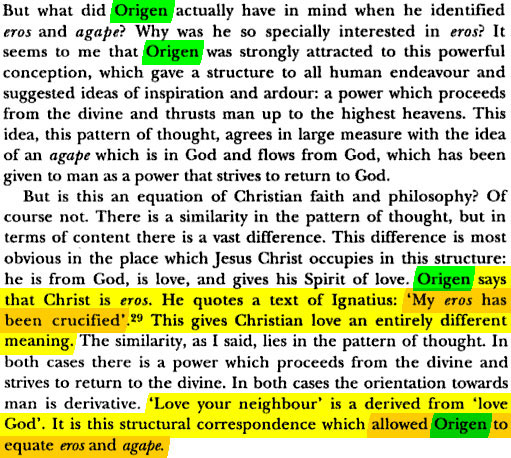
The context:
http://www.newadvent.org/fathers/0107.htm (Catholic Encyclopedia), The Epistle of Ignatius to the Romans, “Chapter 7. Reason of desiring to die”:
“For though I am alive while I write to you, yet I am eager to die. My love has been crucified, and there is no fire in me desiring to be fed; but there is within me a water that lives and speaks, saying to me inwardly, Come to the Father.”
http://www.pseudepigrapha.com/LostBooks/ignatius2romans.htm, Epistle of Ignatius to the Romans: Longer And Shorter Version: From the 38 volume work: Early Church Fathers: Ante-Nicene Fathers to A.D. 325, Vol. 1: Alexander Roberts and James Donaldson, editors; “Chapter 7: Reason Of Desiring To Die”:
“For though I am alive while I write to you, yet I am eager to die. My love has been crucified”
…
“For though I am alive while I write to you, yet I am eager to die for the sake of Christ. My love s has been crucified”
Yeah, I like the “longer” version better. And, because it probably is more what he really fully said.
http://books.google.com/books?id=ybrdsMioxv0C&pg=PA178&dq=%22die+for+the+sake+of+Christ+my+love+has+been%22#v=onepage&q=%22die%20for%20the%20sake%20of%20Christ%20my%20love%20has%20been%22&f=false, Sermons on Hymns for the Church Seasons (Google Books Result), by John Bird Stopford, 2008, p. 178, “O come and mourn with me awhile: F. W. Faber”:
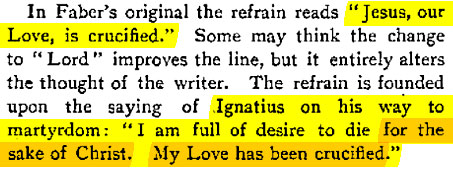
http://www.archive.org/stream/sermonsonhymnsfo00stopiala/sermonsonhymnsfo00stopiala_djvu.txt, SERMONS ON HYMNS FOR THE CHURCH SEASONS, BY THE REV. J. B. STOPFORD, M.A., RECTOR OF S. MARK'S, WEST GORTON, LONDON; “178 SERMONS ON HYMNS”:
In Faber's original the refrain reads "Jesus, our Love, is crucified." Some may think the change
to " Lord " improves the line, but it entirely alters the thought of the writer. The refrain is founded upon the saying of Ignatius on his way to martyrdom : " I am full of desire to die for the
sake of Christ. My Love has been crucified."
And, if you remove the period (because they didn’t use punctuation in that day):
http://www.sermonindex.net/modules/newbb/viewtopic_pdf.php?topic_id=21800&forum=45 (Sermon Index), Devotional Thoughts :: Make us 'clods of earth' into 'stars of glory' –watson:
Let us be deeply affected with the great love of Christ for us.
Who can tread upon these hot coals—and his heart not burn?
Cry out with Ignatius, "Christ, my love, is crucified!"
http://books.google.com/books?id=Bm8rAAAAYAAJ&pg=PA85&lpg=PA85&dq=%22christ+my+love+is+crucified%22&source=bl&ots=IdRrOlXer6&sig=lyPU9U1A94FmCthlsCMX5zNIYCg&hl=en&ei=z0PESu3ZCcfL8Qbt7OhE&sa=X&oi=book_result&ct=result&resnum=2&ved=0CA4Q6AEwATgK#v=onepage&q=%22christ%20my%20love%20is%20crucified%22&f=false; Origin and Development of the Nicene Theology: With Some Reference to the Ritschlian View of Theology and History of Doctrine (Google Books Result); by Hugh M. Scott, D.D., Professor of Ecclesiastical History in Chicago Theological Seminary; 1896; pp. 84-85; “Laid in Conflict with Hellenism”:
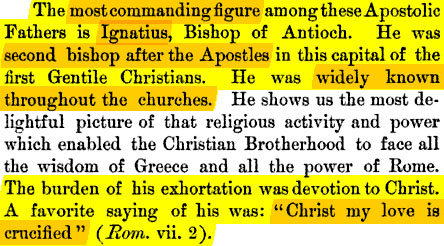
And, of course, that’s “Christ my Eros is crucified.”
Generic:
http://www.magnificat.ca/cal/engl/02-01.htm (Lives of the Saints), February 1: SAINT IGNATIUS of ANTIOCH, Bishop and Martyr (†107):
And when the emperor asked him what he meant by that, Ignatius explained that he bore in his heart Christ, crucified for his sake.
By the way:
http://home.inreach.com/bstanley/ign.htm, St Ignatius of Antioch, Bishop, and an Apostolic Father of the Church, wrote a letter to the Smyrneans... (Rev 1:11):
St. Ignatius of Antioch (35-107 A.D.), an Apostolic Father of the Church, and the Bishop of Antioch, wrote the following letter as he was being taken in chains to Rome to be martyred. It is believed that in this letter, the words Catholic Church, were used for the first time. … 8. … Where the bishop appears, there let the people be, just as where Jesus Christ is, there is the Catholic Church. It is not permitted without authorization from the bishop either to baptize or to hold an agape; but whatever he approves is also pleasing to God. Thus everything you do will be proof against danger and valid.
http://www.newadvent.org/fathers/0109.htm (Catholic Encyclodedia), The Epistle of Ignatius to the Smyrnaeans, “Chapter VIII”:
Wherever the bishop shall appear, there let the multitude [of the people] also be; even as, wherever Jesus Christ is, there is the Catholic Church. It is not lawful without the bishop either to baptize or to celebrate a love-feast; but whatsoever he shall approve of, that is also pleasing to God, so that everything that is done may be secure and valid.
http://www.agapetae.org/lovefeasts.html, The Christian Love Feasts:
St Ignatius of Antioch to the Smyrnaens (No baptisms or love feasts with out a bishop's supervision)
Dictionary of Religion and Philosophy, MacGregor, 1989, p. 12, “Agape”:
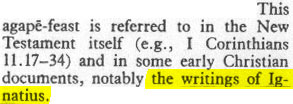
The Making of the New Testament: Origin, Collection, Text & Canon, Patzia, 1995, p. 153, “Appendix II: Significant Leaders of the Early Church (arranged alphabetically)”:
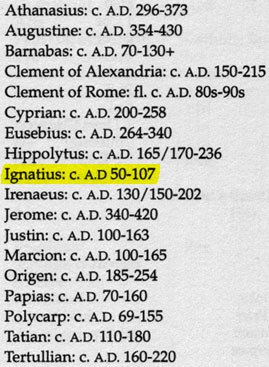
Ignatius seems to be the earliest. Origen is in there too.