SAINT EROS, BISHOP OF ANTIOCH
Supported Ignatius’s statement with his name
37 years after Ignatius, a bishop of Antioch named himself “Eros,” to apparently further support “the god of sexual love”:
http://www.hostkingdom.net/orthodox.html, Eastern Patriarchates, Antioch:
- St. Peter the Apostle...............................45-53 d. 64
- Evodius.............................................53-96
- St. Ignatius I......................................96-114
- Heron..............................................114-126
- Cornelius..........................................127-151
- Eros...............................................151-169
- Theophilus.........................................169-177
http://www.newadvent.org/fathers/250104.htm (Catholic Encyclopedia), Church History (Book IV), “Chapter 20, The Rulers of the Church of Antioch”:
At that time also in the church of Antioch, Theophilus was well known as the sixth from the apostles. For Cornelius, who succeeded Hero, was the fourth, and after him Eros, the fifth in order, had held the office of bishop.
http://ccat.sas.upenn.edu/~humm/Resources/Bauer/bauer08.htm, Orthodoxy and Heresy in Earliest Christianity:
The conclusion of the fourth book of the Ecclesiastical History … (20) And in the church of the Antiochians, Theophilus was the sixth bishop, numbered from the apostles. Cornelius, who succeeded Heron, had been the fourth there. After him, Eros followed as bishop in the fifth place.
Eusebius Ecclesiastical History, Books I – V, Loeb Classical Library, Translated by Kirsopp Lake, Harvard University Press, 1926, reprinted 2001, pp. 372-373, Book IV, Chapter XX.1 (criticizing Tatian):

http://www.earlychristianwritings.com/info/theophilus-wace.html, Theophilus of Antioch:
Theophilus (4), bp. of Antioch (Eus. H. E. iv. 20; Hieron. Ep. ad Algas. quaest. 6), succeeded Eros c. 171
In Christ’s day, pagan gods, like Eros, were as popular as… gods.
http://eword.gospelcom.net/comments/acts/gill/acts11.htm, John Gill’s Exposition of the Bible, Acts 11:
Verse
26. And when he
had found him, he brought him to Antioch,....
That he might be useful in directing, and
assisting in settling this new and numerous church; in the establishing
the members of it, and in putting them into Gospel order, and in a method to
secure and maintain peace, especially as they might consist both of Jews and
Gentiles; and none so proper to be concerned in such a work as the apostle of
the Gentiles.
And it came to pass, that a whole year they assembled themselves with the
church; preaching the Gospel, and administering the ordinances to them, during
that time, at proper seasons. For here being a number of converts, they were
embodied together in a church state, very probably by the direction and
assistance of Barnabas, who was sent to them from the church at Jerusalem, and
in which he might be assisted by Saul: the
first bishop, or pastor of this church, was Evodius, as Ignatius
observes unto them {k}; Remember Evodius, your worthy and blessed pastor, who
was first ordained over you by the apostles; and Ignatius himself was the next,
of whom Origen speaking, says {l}, that he was the second bishop of Antioch
after Peter, who in persecution fought
with beasts at Rome; next to him was Heron, after him Cornelius, then, Eros; to whom
succeeded Theophilus
http://www.ccel.org/ccel/schaff/hcc2.v.xv.xviii.html#fnf_v.xv.xviii-p10.3, History of the Christian Church, Volume II, § 176. Theophilus of Antioch:
Theophilus was converted from heathenism by the study of the Scriptures, and occupied the episcopal see at Antioch, the sixth from the Apostles, during the later part of the reign of Marcus Aurelius. He died about a.d. 181.1365 … 1365 Eusebius H. E. IV. 20, and in his Chron. ad arm. IX. M. Aurelii. His supposed predecessors were Peter, Evodius, Ignatius, Heron, Cornelius, and Eros.
http://n2messiah.1colony.com/2000.html, Time line in Early Church History 1900 – 2000 AD:
Bishops of Antioch to 325 AD
|
1 |
Evodius |
|
2 |
Ignatius |
|
3 |
Heron |
|
4 |
Cornelius |
|
5 |
Eros |
http://www.experiencefestival.com/a/List_of_Patriarchs_of_Antioch_-_List_of_Patriarchs_of_Antioch/id/4855158, Encyclopedia II - List of Patriarchs of Antioch:
· Saint Peter the Apostle (37—53)
· Saint Evodius (53—68)
· St. Ignatius the Illuminator (68—107)
· Saint Heron (107—127)
· Saint Cornelius (127—154)
· Saint Eros (154—169)
· Saint Theophilus (169—182)
Strangely, some list “Eros” in place of Heron, then call the above “Eros II”:
http://phoenicia.org/melkites.html, The Orthodox & Catholic Byzantine Church of the East, “Patriarchs of Antioch and All the East”:
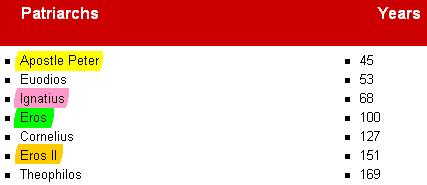
http://www.ecclesia.gr/english/news/antiocheia/historical_overview.htm, Greek Orthodox Patriarchate of Antioch and All the East Historical Overview:
Apostles Paul and Barnabas set up the Antioch see in 42 A.D It was then acceded for eight years (43 - 53 A.D) by Saint Peter as its first prelate who proceeded to establish other churches. … The names of the Patriarchs of Antioch and All the East since the foundation of Antioch see are as follows:
|
|
Patriarch |
As from |
|
1. |
Apostle Peter |
45 |
|
2. |
Euodios |
53 |
|
3. |
Ignatius |
68 |
|
4. |
Eros |
100 |
|
5. |
Cornelius |
127 |
|
6. |
Eros II |
151 |
|
7. |
Theophilos |
169 |
“Heron” may very well be a valid Eros:
There is no vocal “h” character in Greek. What makes the verbal “h” for transliteration is the "῾" “rough” breathing mark (Unicode hex 1FFE: “Dasia” in Arial Unicode MS or Tahoma), which accents many Greek beginning vowels; and Heron has one. Breathing marks are ignored when alphabetized. Therefore, the only relevant characters are the “eron,” which both ερων and ερον are forms of Eros (see my chart at the bottom of my “Eros / Cupid / erotic definition” page). However, Heron uses the Greek eta character (see Greek text citing above) instead of the epsilon, but both basically have the same “e” sound, and interchange frequently in Greek text. To confuse things more, the upper case eta is an “H” but is still pronounced as an “e,” and still requires the dasia for the “h” sound. Liddell & Scott define the closest Greek characters as “name of a god” and “service, office”:
A Greek-English Lexicon, Liddell and Scott, 1996, p. 778, “ Ἥρων | Ἥρως | ἠρώνα”:

A pronunciation of “heros” is above in the purple, again with the “h” sound only being the accent mark. Other variants are defined as a “hero.” But, since I can’t find any definition to firmly connect it to Eros, I concede that it’s probably not related to Eros, but it sure is close. Of course, I might not know as much about it as the Greek Orthodox Church.
This site tells about the Dasia:
http://library.princeton.edu/departments/tsd/katmandu/greek/roughbreathing_11-30.htm
More:
http://byzantineramblings.blogspot.com/2006_11_01_archive.html, “Chronological List of The Melkite Greek Catholic Patriarchs”:
St. Peter the Apostle (c.45-c.53); Euodios (c.53-c.68); St. Ignatius I (c.68-100); Eros I (100-c.127); Cornelius (c.127-c.151); Eros II (c.151-c.169); Theophilos (c.169-182)
It’s not an error:
http://bjornolav.blogspot.com/2006/08/kontinuiteten-i-kirkens-historie.html, Kontinuiteten i kirkens historie (Continuity of the church's history) (Norwegian):
Apostelen Peter (fra år 45)
Euodios (fra år 53)
Ignatius (fra år 68)
Eros (fra år 100)
Cornelius (fra år 127)
Eros II (fra år 151)
Theophilos (fra år 169)