HOMOSEXUAL – PEDERASTY
(1 Timothy 1:10, 1 Corinthians 6:9, Leviticus 18:22; 20:13)
(Greek: άρσενο-κοίτ… [arseno-koit… ]; Hebrew: זָכָר [zakar])
Both meant: sex with male children.
-- 1 Timothy 1:10, 1 Corinthians 6:9 --
It appears likely that Paul was denouncing the popular Greek and Roman sex with male children, not homosexuality between adults. At least these findings remove the stability of today’s traditional adult homosexuality conviction:
The GREEK word (with traditional meanings):
Interlinear Greek-English New Testament, Green, 1996, p. 638, 1 Timothy 1:10:

It’s a Greek combination word:
http://www.jcsm.org/StudyCenter/kjvstrongs/STRGRK7.htm, The KJV Bible: Strong’s Greek Dictionary:
|
733 |
arsenokoithV |
from arrhn - arrhen 730 and koith - koite 2845; a sodomite:--abuser of (that defile) self with mankind. |
… equals:
|
730 |
arrhn |
or arsen ar'-sane probably from airw - airo 142; male (as stronger for lifting):--male, man. |
plus:
http://www.jcsm.org/StudyCenter/kjvstrongs/STRGRK28.htm#S2845, The KJV Bible: Strong’s Greek Dictionary:
|
2845 |
koith |
from keimai - keimai 2749; a couch; by extension, cohabitation; by implication, the male sperm:--bed, chambering, X conceive. |
(The actual Greek words for “sodomite” (“σοδομίτης”) or “sodomy” (“σοδομία”) are not even used anywhere in the New Testament. The city of “Sodom” is, but not in these verses.)
Concise definition:
A Pocket Lexicon to the Greek New Testament, Souter, Oxford, 1916 (reprinted 1917), p. 38:

Langenscheidt’s Pocket Greek Dictionary: Classical Greek-English, p. 63:

Pederast… definition:
http://www.answers.com/pederast, “Pederast”:
A man who has sexual relations, especially anal intercourse, with a boy.
http://www.answers.com/pederasty, “Pederasty”:
The ancient Greeks seem to have been the first to describe, study, systematize, and establish pederasty as an institution. The ethical views held in those societies (such as Athens, Thebes, Crete, Sparta, Elis, and others) on the practice of pederasty have been explored by scholars ever since the nineteenth century.
In monolingual Ancient Greek (online):
http://www.magenta.gr/en/en_demos.htm, “Ancient-Modern & Modern-Ancient Greek dictionary”, (free 15-minute demo download [anc_setup_en.exe 2-16-04]), “άρσενοκοίται” (key-in “arsenokoitai”):

Results in text:
παιδεραστία # ομοφυλοφιλική σχέση ανάμεσα σε άντρα και αγόρι # ομοφυλοφιλία
The above definition text via copy-paste:
http://babelfish.altavista.com/ (phrase translations), Greek-English:
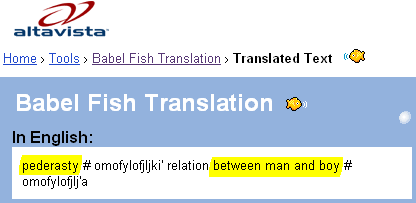
ομοφυλοφι- (omofylofjlj-) is defined as the combination word of homophile (homosexual) + love via the same magenta.gr dictionary above.
Better source:
http://translate.google.com/translate_t?langpair=el|en#el|en|%CF%80%CE%B1%CE%B9%CE%B4%CE%B5%CF%81%CE%B1%CF%83%CF%84%CE%AF%CE%B1%20%23%20%CE%BF%CE%BC%CE%BF%CF%86%CF%85%CE%BB%CE%BF%CF%86%CE%B9%CE%BB%CE%B9%CE%BA%CE%AE%20%CF%83%CF%87%CE%AD%CF%83%CE%B7%20%CE%B1%CE%BD%CE%AC%CE%BC%CE%B5%CF%83%CE%B1%20%CF%83%CE%B5%20%CE%AC%CE%BD%CF%84%CF%81%CE%B1%20%CE%BA%CE%B1%CE%B9%20%CE%B1%CE%B3%CF%8C%CF%81%CE%B9%20%23%20%CE%BF%CE%BC%CE%BF%CF%86%CF%85%CE%BB%CE%BF%CF%86%CE%B9%CE%BB%CE%AF%CE%B1, Google Translate, Greek to English:
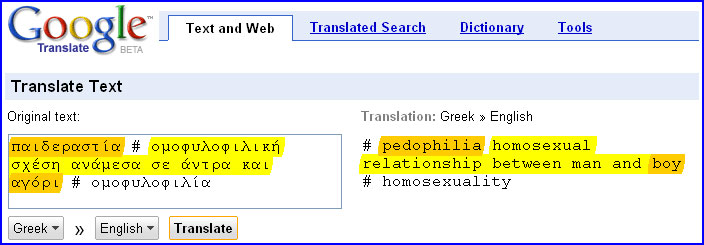
(I don’t know why the first “#” got placed at the beginning.)
Another monolingual Ancient Greek dictionary:
ΝΕΟΝ ΟΡΘΟΓΡΑΦΙΚΟΝ ΕΡΜΗΝΕΥΤΙΚΟΝ ΛΕΞΙΚΟΝ (NEW ORTHOGRAPHIC EXPLANATORY DICTIONARY) (this is a monolingual Greek dictionary, a 3” thick abridgment of a large 9 volume dictionary), by Δ. ΔΗΜΗΤΡΑΚΟΥ, 1969, p. 231:
(AN means the definition is from ancient Greek[A] to modern Greek[N]):
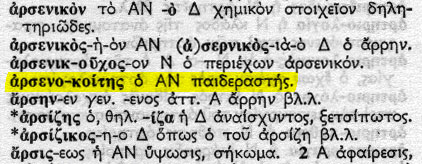
Which means:
http://babelfish.altavista.com/ (translator), Greek to English, “παιδεραστής”:
pedophile
http://www.answers.com/pedophile, “pedophile”:
An adult who is sexually attracted to a child or children.
http://translate.google.com/translate_t?langpair=el|en#, Google translate, “παιδεραστής”:
pederast
Divry’s Modern English-Greek and Greek-English Desk Dictionary, 1996, English-Greek (the first Greek word is just the pronunciation of the English), p. 229:
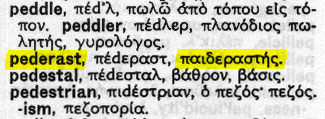
The Pocket Oxford Greek Dictionary, Pring, 1995, p. 138 (Greek-English), “παιδεραστής”:

An Intermediate Greek-English Lexicon, Liddell and Scott, 1997, p. 584:

παιδεραστής is transliterated as paiderastes:
The American Heritage Dictionary of the English Language, 1992, p. 1334, “pederast”:

Miscellaneous:
http://www.bibleteacher.org/homosexuality_corinthians6.pdf, The Condemnation of Homosexuality in 1 Corinthians 6:9:
The cultural sweep of theological thought toward leniency with respect to moral absolutes requires that Paul’s prohibitions against homosexual activity be examined in more depth. The primary argument posed by those who desire to see a more accepting Christian community is that the Apostle Paul did not write general prohibitions against homosexual activity, but against abuses in homosexual activity-specifically pederasty.
http://www.answers.com/The%20Bible%20and%20homosexuality, The Bible and homosexuality, “1 Corinthians 6; 1 Timothy 1: Wrongdoers”:
The term arsenokoitai was rarely used in Church writings (Elliott 1994), with Townsley (2003) counting a total of 73 references. Most are ambiguous in nature, while St. John Chrysostom, in the 4th century, seems to use the term "arsenokoitai" to refer to pederasty common in the Greco-Roman culture of the time[citation needed] , while Patriarch John IV of Constantinople in the 6th century used it to refer to anal sex: "some men even commit the sin of arsenokoitai with their wives" (Townsley 2003)
So, from sex with male children, to anal sex, to homosexuality in general.
http://www.tms.edu/tmsj/tmsj3h.pdf, THE SOURCE AND NT MEANING OF ARSENOKOITAI, WITH IMPLICATIONS FOR CHRISTIAN ETHICS AND MINISTRY, “SURVEY OF NEW INTERPRETATIONS OF ARSENOKOITAI”:
In the absence of the term from pagan writers such as Herodotus, Plato, Aristotle, and Plutarch, and from the Jewish writers Philo and Josephus, Boswell finds even more convincing evidence for his affirmation that arsenokoitai "did not connote `homosexual' or even `sodomite' in the time of Paul" (346).
http://clubs.csbsju.edu/prism/archive/A%20People%20Set%20Apart%20Homosexuals%20in%20the%20Catholic%20Church_files/prismconfdoc2.htm (PRISM: A People Set Apart: Homosexuals and the Catholic Church), Living with Leviticus, Satisfying Saint Paul: Laws about Homosexuality and Taking Them to Heart, “Romans and Corinthians”:
Arsenokoites is the term for a pederast or pedophile, that is an adult man who would pay the master so that he could receive sexual pleasures from the malakos or boy. We can see that the NRSV translators miss the mark by using the English term “sodomite” to translate the Greek word, arsenokoites; “pederast” would have been more accurate.
http://www.elcic.ca/docs/buck/01buck17.html, Study on Homosexuality and the Church, “arsenokoitai”:
Scroggs has sought to read the two Greek terms malakoi and arsenokoitai as references to pederasty, a practice in which an older male enjoys the sexual favours of a younger male. In that relationship malakoi is taken to refer to the passive younger person and arsenokoitai to the active older and controlling male.
http://www.worldpolicy.org/globalrights/sexorient/hom_bibc.htm, Verses From The Christian Scriptures (New Testament) On Homosexuality:
Some interpret the "men…with other men" clause to be a translation of the original Greek word for "pederasty" which was commonly practiced at the time by adult males with male children (often slaves). Thus Paul might have been criticizing child sexual abuse.
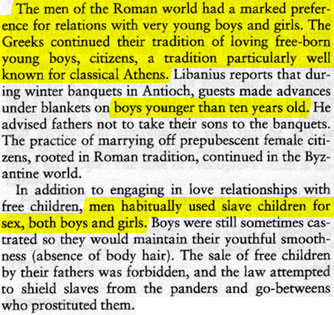
Pederasty was popular in ancient Greece and Rome (thereby requiring specific Christian disapproval):
http://www.answers.com/topic/pederasty-in-ancient-greece, “Pederasty in ancient Greece”:
The ancient Greeks were the first to describe, study, systematize, and establish pederasty as an institution.
http://www.mabenterprises.com/gaychristians/religious_text/thebible_b.htm, An Investigation into the Bible and Homosexuality, "Malokoi and Arsenokoitai":
Hellenistic society practiced the institution of male mentorship of older established man to younger protégé. This often included anal intercourse by the older upon the younger, usually until the young boy reached puberty. It was not unheard of for the relationship to continue beyond puberty, but this did not receive universal social approval. In fact, many of the leaders of Athens wrote extensively against the practice, out of a sense of the betrayal of the younger man's right to progress into a proper manhood. This practice was called "paiderastes," from which we get the word identifying anal intercourse, "pederasty," losing to some degree the identification with children, except in the term, "pederast" or "pedophile."
http://www.glbtq.com/social-sciences/greece_ancient.html, Greece: Ancient:
The institution of pederasty (paiderastia) was a conspicuous feature of ancient Greek public and private life.
The gods had boyfriends. Poseidon desired Pelops, seduced him, and took him to Olympus in a golden chariot. Radiant Apollo loved Hyacinthus, the youngest and handsomest son of a king of Sparta, and taught him archery, music, divination, and all the exercises of the wrestling ring. According to the Homeric Hymn to Aphrodite:
Wise
Zeus abducted fair-haired Ganymede
For his beauty, to be among the immortals
And pour wine for the gods in the house of Zeus,
A marvel to look upon, honoured by all the gods.
The earliest documented instances of man-boy relationships date from the second half of the seventh century B.C.E. For nearly a millennium, texts and artifacts of varying quantity, interest, and weight confirm the ubiquity of pederasty in the Greek-speaking world. Herodotus, the first great historian in the Western tradition, included "copulating with boys" in a list of the "good things of life."
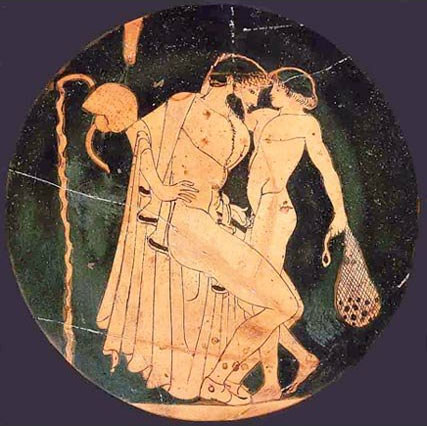
http://www.glbtq.com/social-sciences/greece_ancient,zoom.html:
A ceramic object depicting a scene of pederastic seduction (ca 480 B.C.E.).
Late Antiquity: A Guide to the Postclassical World, Harvard University Press, 1999, p. 430, “Eroticism”:
Confirmed by the Catholic Bible:
http://www.usccb.org/nab/bible/1corinthians/1corinthians6.htm, USCCB – NAB: New American Bible (Catholic), “1 Corinthians Chapter 6”:
9 2 3 Do you not know that the unjust will not inherit the kingdom of God? Do not be deceived; neither fornicators nor idolaters nor adulterers nor boy prostitutes nor sodomites
…with the following footnote (which is also printed in the book version):
3 [9] The Greek word translated as boy prostitutes may refer to catamites, i.e., boys or young men who were kept for purposes of prostitution, a practice not uncommon in the Greco-Roman world. In Greek mythology this was the function of Ganymede, the "cupbearer of the gods," whose Latin name was Catamitus. The term translated Sodomites refers to adult males who indulged in homosexual practices with such boys. See similar condemnations of such practices in Romans 1:26-27; 1 Tim 1:10.
Just for footnote:
http://www.usccb.org/nab/bible/1timothy/1timothy1.htm, USCCB – NAB: New American Bible (Catholic), “1 Timothy Chapter 1”:
10 the unchaste, sodomites, 5 kidnapers, liars, perjurers, and whatever else is opposed to sound teaching,
…with the following footnote (which is also printed in the book version):
5 [10] Sodomites: see 1 Cor 6:9 and the note there [which is the note above].
Another version:
http://sentpress.com/PDFs/1Corinthians.pdf (via http://sentpress.com/read_online/read_online.html), The Spoken English New Testament: A New Translation from the Greek by J. Webb Mealy, 2008, “1 Corinthians [9-10]”:
Neither sexually immoral people, nor idolaters,b nor people who cheat on their spouses, nor men who play the woman, nor men who have sex with boys, 10nor thieves, nor people obsessed with getting more possessions,c nor drinkers, nor people who verbally abuse others,d nor people who rob otherse—none of these are going to inherit the Reign of God.
OLD TESTAMENT, Greek Septuagint:
(Greek: άρσεν… [arsen… ]. Then κοίτ… [koit… ] as another word):
The Septuagint was the Old Testament in Greek used by the New Testament Greek writers, like Paul. Now, I’m not saying everything in the Old Testament is good to follow (N.T. overruled the O.T., e.g., Matt. 5:38-39), but it is an excellent source for context definition of Greek words.
These are all the instances of the forms of male child / son / male offspring alone: with no compound use with “bed”:
The Analytical Lexicon to the Septuagint: A Complete Parsing Guide, Taylor, 1994, p. 56:
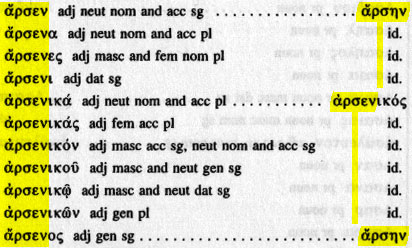
Example: Pharaoh orders the death of every Hebrew male child (KJV):
Exodus 1:16-18:
16And he said, When ye do the office of a midwife to the Hebrew women, and see them upon the stools; if it be a son (άρσεν), then ye shall kill him: but if it be a daughter, then she shall live. 17But the midwives feared God, and did not as the king of Egypt commanded them, but saved the men children (άρσενα) alive. 18And the king of Egypt called for the midwives, and said unto them, Why have ye done this thing, and have saved the men children (άρσενα) alive?
Exodus 1:22:
And Pharaoh charged all his people, saying, Every son (άρσεν) that is born ye shall cast into the river, and every daughter ye shall save alive.
Exodus 2:2:
And the woman conceived, and bare a son (άρσεν): and when she saw him that he was a goodly child, she hid him three months.
-- Leviticus 18:22; 20:13 --
The same word is used here, with the word “bed” (“lie”) as another word:
Greek Septuagint:
Leviticus 18:22:
Thou shalt not lie with mankind (άρσενος), as with womankind: it is abomination.
Leviticus 20:13:
If a man also lie with mankind (άρσενος), as he lieth with a woman, both of them have committed an abomination: they shall surely be put to death; their blood shall be upon them. (“man” is not the correct translation from the Septuagint; it is the Greek words “ος αν”: “who ever”; thereby indicating that also a woman is not to have sex with male children either. You see, if “mankind” meant male adults, then a woman would not be able to have sex with an adult male, which is allowed in the latter description. “he” is not there either. Again, this is the Bible Paul used [see my “Septuagint (overview)” page].)
The Septuagint with Apocrypha, 1851, Brenton, seventh printing 1998, p. 153. Leviticus XVIII.22 (18:22):

P. 156. Leviticus XX.13 (20:13):

The above is a place where κοίτην (bed) is used right next to, but not one-word connected to άρσενος (male child).
http://www.apostolicbible.com/downbook.htm (formerly: http://septuagint-interlinear-greek-bible.com/downbook.htm), The Apostolic Bible (Septuagint Interlinear):
(Again, traditionally translated):
Leviticus 18:22:
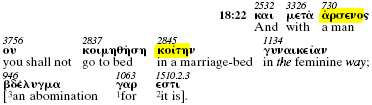
Leviticus 20:13:
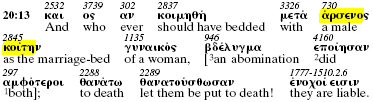
Since the subsequent verses condemn bestiality, it makes sense (is fitting) that the above would just be referring to sex with kids.
Old Testament, original Hebrew:
(זָכָר [zakar]):
Now in the Hebrew, it’s about the same as the Greek, except for the “man” part, which is missing in the Septuagint in 20:13, is listed. It is, however, not the same word as our subject “male child”; therefore, they are expressing two different kinds of males. They are two different Hebrew words: “male child” and “man” (in correct English). No one would call gay sex “a man with a male,” they would call it “a man with a man”:
The Interlinear Bible: Hebrew-Greek-English,1986, Part 1: Old Testament: Hebrew/Engish, p. 105, Leviticus 20:13:
(You read Hebrew from right to left, then down):

http://www.jcsm.org/StudyCenter/kjvstrongs/STRHEB3.htm, The KJV Bible: Strong’s Hebrew Dictionary, Strong number 376:
|
376 |
'iysh |
contracted for ''enowsh' (582) (or perhaps rather from an unused root meaning to be extant); a man as an individual or a male person; often used as an adjunct to a more definite term (and in such cases frequently not expressed in translation):--also, another, any (man), a certain, + champion, consent, each, every (one), fellow, (foot-, husband-)man, (good-, great, mighty) man, he, high (degree), him (that is), husband, man(-kind), + none, one, people, person, + steward, what (man) soever, whoso(-ever), worthy. Compare ''ishshah' (802 [which is a grown woman, also used in this verse; other verses she’s a mother, a concubine, a whore, an adulteress: not a kid]). |
The use of “husband” indicates an adult male. In other verses he’s an enemy, an adversary, an old man, David, a sinner, a Benjamite, a destroyer, etc., in other words: he’s grown up.
Also, in the Hebrew, the word “child” is a specified part of definition # 2145:
http://www.jcsm.org/StudyCenter/kjvstrongs/CONHEB214.htm, The KJV Bible: Strong’s Hebrew Dictionary, Strong numbers 2142 – 2148 (other forms listed):
|
2142 |
zakar |
a primitive root; properly, to mark (so as to be recognized), i.e. to remember; by implication, to mention; also (as denominative from 'zakar' (2145)) to be male:--X burn (incense), X earnestly, be male, (make) mention (of), be mindful, recount, record(-er), remember, make to be remembered, bring (call, come, keep, put) to (in) remembrance, X still, think on, X well. |
|
2143 |
zeker |
or zeker {zeh'-ker}; from 'zakar' (2142); a memento, abstr. recollection (rarely if ever); by implication, commemoration:--memorial, memory, remembrance, scent. |
|
2144 |
Zeker |
the same as 'zeker' (2143); Zeker, an Israelite:--Zeker. |
|
2145 |
zakar |
from 'zakar' (2142); properly, remembered, i.e. a male (of man or animals, as being the most noteworthy sex):--X him, male, man(child, -kind). |
|
2146 |
zikrown |
from 'zakar' (2142); a memento (or memorable thing, day or writing):--memorial, record. |
|
2147 |
Zikriy |
from 'zakar' (2142); memorable; Zicri, the name of twelve Israelites:--Zichri. |
|
2148 |
Zkaryah |
or Zkaryahuw {zek-ar-yaw'-hoo}; from 'zakar' (2142) and 'Yahh' (3050); Jah has remembered; Zecarjah, the name of twenty-nine Israelites:--Zachariah, Zechariah. |
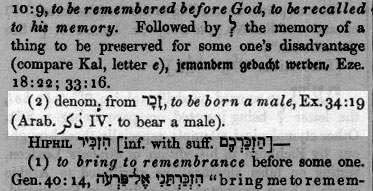
Technically and etymologically our use of the word refers to a male offspring specifying a “remembrance” or “memorial” of the parents (thereby also indicating one should not have sex with his/her son, regardless of his age). In fact, Strong Hebrew numbers 2142 through 2148 all refer to a “memory,” “rememberance,” “memorial,” “to bring to mind,” “to be recalled,” etc.:
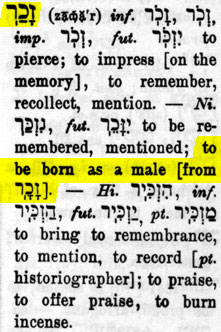
Gesenius’ Hebrew-Chaldee Lexicon to the Old Testament, 1979, p. 245, “2142” (2) specifies:
“2143”:
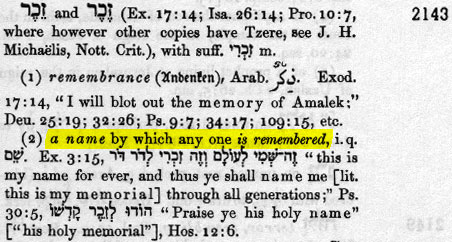
“2145”:

“2146”:
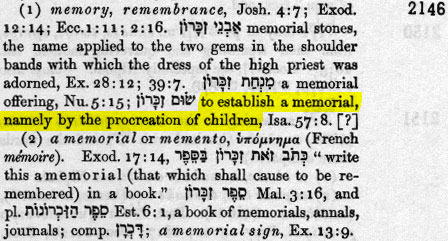
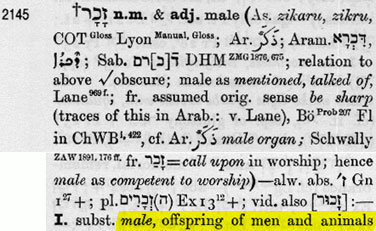
The Brown-Driver-Briggs Hebrew and English Lexicon, 1906 (reprinted 1997), p. 271, “2145”:
Langenscheidt Pocket Hebrew Dictionary to the Old Testament: Hebrew-English, Feyerabend, 1994, p. 84:
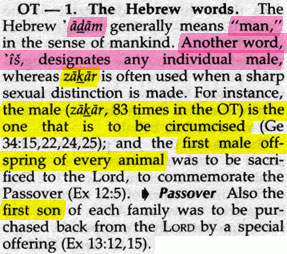
Zondervan Expository Dictionary of Bible Words, Richards, 1991, p. 426, “Male and Female”:
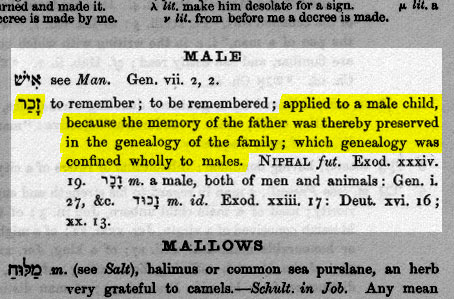
Wilson’s Old Testament Word Studies, 1990, p. 265, “Male”:
Hebrew # 2145:זָכָר or זכר (characters: Resh, Kaf, Zayin; with two vowel points: Qamats [A]) (transliteration: R [A] K {or KH} [A] Z), “zakhar” “zakar” “zaw-kawr” (Hebrew pronunciations are arbitrary).
Here’s actually the Hebrew word with the above word “bed” (#4904 in O.T. Interlinear) added:
Webster’s New World Hebrew Dictionary, Hayim Baltsan, 1992, (transliterated) Hebrew-English, p. 258, “meeshkav”:
First, “meeshk|av” means “bed; lying”:

Then, here are the two words together:
Pp. 459-460, “(meeshkav) zakhar”:
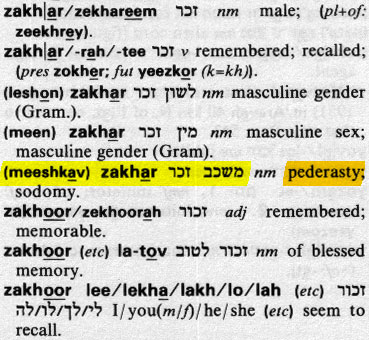
Now, pederasty is a specific kind of homosexuality / sodomy. Therefore, why is it specified if it does not lean toward the real meaning? For example, hypothetically, if the true meaning had to do with gay sex with foreigners, then that meaning would appear along side the corrupted / exaggerated word frequently (say, gay sex, period). Dictionary publishers’ job, to be thorough, is to show both the etymology and any and all other used meanings. Plus, “sodomy” is another homosexual meaning that has drawn conclusions with no concrete fact. If you want to say it was even sexual, you would have to conclude that the Sodomites wanted to have sex with ghosts (according to Genesis 19:1). And/or, one could simply conclude it as rape, or gang rape, since the Sodomites then wanted to do the same to Lot (Genesis 19:7,9; Strong Heb. # 7489). Take your choice. Sodomy is definitely an arbitrary and ambiguous term. It is not sufficient for denouncing a victimless sexual orientation, as God is unambiguous with stealing, killing, etc. I think God purposely made the story of Sodom ambiguous to show (for the long run) that people will conclude what they wish it to mean (for artificial salvation cop-out reasons, even to the extent to vent hatred). Otherwise, God would have been more conclusive. The New Testament specifies it had to do with “prostitution” and bestiality (Jude 7).
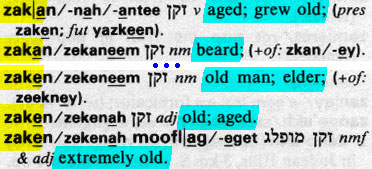
Incidentally, zak(h)ar pronounced with an “n” instead of an “r” at the end, speaks of a man of old age: possibly an opposite:
P. 459, “zaka/en”:
Perhaps this is better interlinear construction:
The Interlinear NIV Hebrew-English Old Testament, Kohlenberger III, 1987, p. 330, Leviticus 20:13:

Specific to MALE OFFSPRING:
Mounce’s Complete Expository Dictionary of Old & New Testament Words, 2006, pp. 434-435, “Male | Old Testament”:
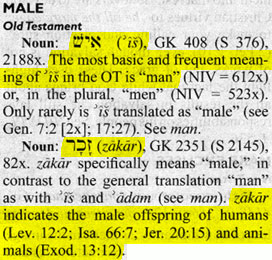
In both Greek and Hebrew, the word is also used in the context and perspective of a male offspring regardless of age, thereby indicating that one is not to have sex with his/her son, regardless of his age. (In it’s obviously near proximity to Leviticus 18:22; 20:13, I do think it’s kind of strange how the last chapter of the same scroll [Leviticus 27] and the first chapter of the next scroll [Numbers 1], are the only locations where a specific adult age is mentioned.) For example (KJV):
Leviticus 27:3:
And thy estimation shall be of the male from twenty years old even unto sixty years old, even thy estimation shall be fifty shekels of silver, after the shekel of the sanctuary.
Numbers 1:22:
Of the children of Simeon, by their generations, after their families, by the house of their fathers, those that were numbered of them, according to the number of the names, by their polls, every male from twenty years old and upward, all that were able to go forth to war;
Numbers 3:40:
And the LORD said unto Moses, Number all the firstborn of the males of the children of Israel from a month old and upward, and take the number of their names.
Likely corruption:
My guess is someone simply literally appended and prepended these additions to these sequential scrolls. All these chapters (Lev. 27 & Num. 1) do is add money to the priest’s pocketbooks via various prejudicial senseless age distinguishments, and it is repeated over and over for their military protection, all in a way that makes little sense other that giving a definition to this word. But, regardless, the context meaning a man and his offspring / son is stable, suggesting secondarily that possibly Leviticus 18:22; 20:13 may have been just being specific to a probably more popular father-son incestuous relationship, as non-related people would not normally be as close / available / approving; and therefore still not to general non-incestuous adult homosexuality. But extending this to all pedophilia gives more rationale to ethics. Even the last two verses of Leviticus 26 actually sound like an ending to a book:
The Oxford Bible Commentary, Barton / Muddiman, 2001, p. 108, “Leviticus | (Ch. 27)”:
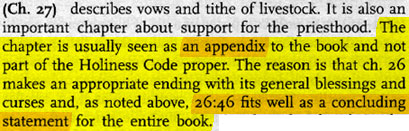
And of course the last four verses of the entire Bible is Jesus saying that God can’t stop true Scripture from being corrupted. And this is probably the reason why most all New Testament books end with “Amen,” even all of Paul’s letters.
Fathers are the opposite of male offsprings (back to the Greek):
Example of use of “man” in the non-offspring sense:
Exodus 13:15 (KJV):
And it came to pass, when Pharaoh would hardly let us go, that the LORD slew all the firstborn in the land of Egypt, both the firstborn of man (άνθρώπων), and the firstborn of beast: therefore I sacrifice to the LORD all that openeth the matrix (womb), being males (άρσενικά); but all the firstborn of my children I redeem.
(άνθρώ- is the main Greek word for “man” used in the context of the father.)
http://www.apostolicbible.com/downbook.htm, Septuagint Interlinear, “Exodus 13:15”:
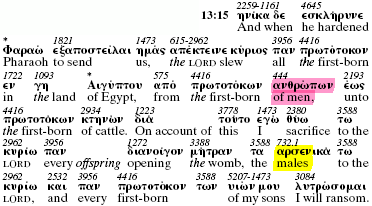
So when they talk about a father, they use a different word than when they talk about a son.