EROS in early CHRISTIAN ART: CATACOMBS
Short Dictionary of Classical Word Origins, Wedeck, 1957, p. 13, “Catacombs”:

http://www.infoplease.com/ipd/A0364535.html, Dictionary: catacomb:
the Catacombs,the subterranean burial chambers of the early Christians in and near Rome, Italy.
http://www.infoplease.com/ce6/sci/A0810813.html, Encyclopedia: catacombs:
catacombs , cemeteries of the early Christians, … The walls and ceilings of plaster were customarily painted with fresco decorations, and in these can be studied the beginnings of Christian art.
http://www.infoplease.com/ce6/ent/A0857856.html, Encyclopedia—Early Christian art and architecture: Earliest Works:
Little is known about Christian art in the first two centuries after the death of Jesus. Among the earliest manifestations extant are the early 3d-century paintings on the walls of the catacombs in Rome. … Following the official recognition of Christianity after the Edict of Toleration (313), the scope of Early Christian art was radically enlarged.
Art: An Introduction, Cleaver, 1972, p. 134, “Early Christian and Byzantine Art: 100-1453”:
P. 136, “Early Christian Period: 100-500 | Painting and Mosaics”:

http://www.newadvent.org/cathen/07664a.htm (Catholic Encyclopedia), Veneration of Images, “II. CHRISTIAN IMAGES BEFORE THE EIGHTH CENTURY”:
And the catacombs were covered with paintings. There are other decorations such as garlands, ribands, stars landscapes, vines-no doubt in many cases having a symbolic meaning.
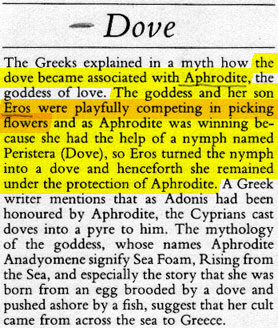
One sees with some surprise motives from mythology now employed in a Christian sense (Psyche, Eros winged Victories, Orpheus), and evidently used as a type of our Lord.
A World History of Art, Pischel, 1968, p. 144, “Early Christian Art | Catacomb Painting”:
That’s 750,000 early Christians supporting the erotic symbol.
http://www.newadvent.org/cathen/03417b.htm (Catholic Encyclopedia), Roman Catacombs:
In all quarters the example of Rome acted as a stimulus to the study of Christian antiquity and led to exploration and excavations; unexpected treasures of the first Christian centuries have been rescued from oblivion in other parts of Italy, in France, Illyria, Greece, North Africa, Egypt, Palestine, and Asia Minor. … In a large number of cases the graves of the martyrs mentioned in the old authorities (martyrologies, itineraries, the "Liber pontificalis", and the legendary accounts of the martyrs) were rediscovered. At the same time there was dug up a treasure, valuable beyond expectation, of early Christian epitaphs and paintings, which gave much unlooked-for information concerning the faith of the early Christians, their concepts of life, hopes of eternity, family relations, and many other matters. … Naturally, the older the epitaphs referring to dogma the greater their importance.
Art Through the Ages, Gardner, 1986, p. 250, “The Ancient World | Early Christian, Byzantine, and Islamic Art | Early Christian Art””:
The “mysteries” were reputed to hold sex orgies. See, my pages on the “mysteries.”
A Glossary of Liturgical and Ecclesiastical Terms, 1877, p. 72, “CATACOMB”:
Catacomb of Domilitta:
The Catacombs of Rome, and a History of the Tombs of the Apostles Peter and Paul, John Harvey Treat, 1907, p. 29, “The Catacomb of Domitilla”:

http://amoroma.it/turismo/itinerari/scavi/itin029.htm, Catacombe di San Domitilla (translated from Italian):
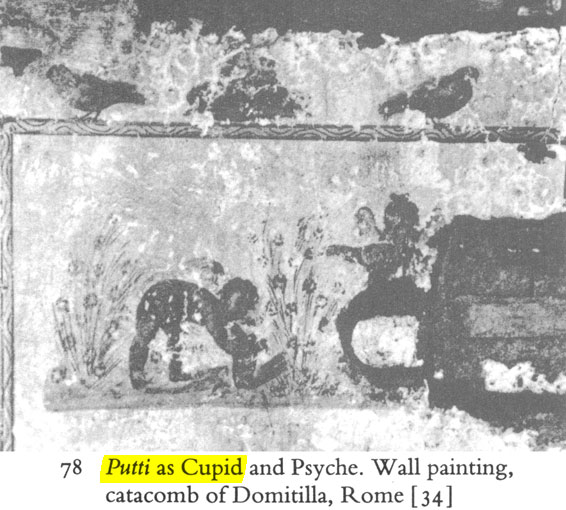
On the skillful wall of it knows it finds a small painted cubicle, dated to the end of the III sec. d.C., in which, between ghirlande, baskets of flowers and birds are represented the myth pagan of Amore and Psyche represents to you like putti that they collect flowers.
(Sulla parete destra della sala si trova un piccolo cubicolo dipinto, datato alla fine del III sec. d.C., nel quale, tra ghirlande, cesti di fiori e uccelli è raffigurato il mito pagano di Amore e Psiche rappresentati come putti che raccolgono fiori.)
Guide to Catacomb of Domitilla; Fasola; Pontifical Commission of Sacred Archaeology, Vatican City; English edition; 1974; p. 7; “The History | Love and Psyche picking flowers in the cubicle near the hypogeum of the Flavii”:
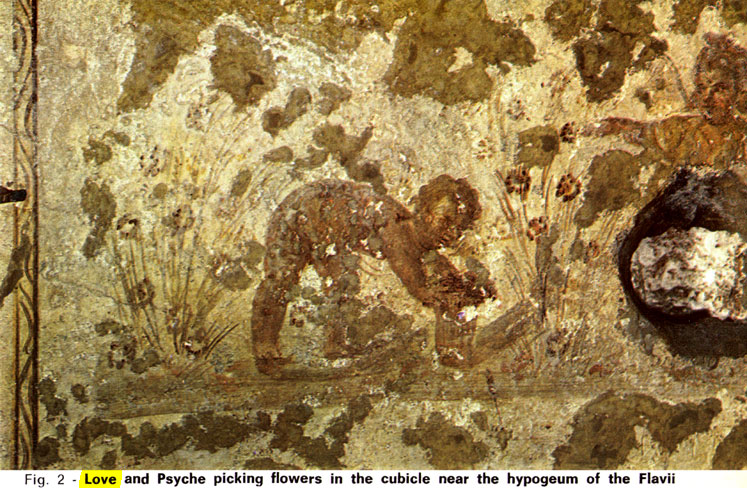
P. 8:
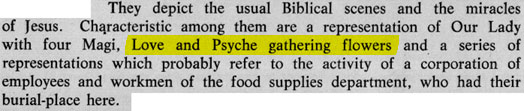
Concerning “Psyche,” the following is a ditto from my “Early Christian sex orgies (overview)” page:
http://www.scils.rutgers.edu/~mjoseph/apuleius-questions1.html, Apuleius: Questions 1:
In The Golden Ass [originally written in the late second century], the tale of Cupid and Psyche is told by an old woman who recounts the story of "Cupid and Psyche" in order to quell the fears of a terrified kidnap victim; we are going to read "Cupid and Psyche" as though it were told directly by Apuleius. Let's remember, by effacing the context of the story, we are inevitably distorting it; however, "Cupid and Psyche" does seem to stand on its own, and our authority for reading it as such derives from precedent: it has been interpreted as a unitary work since the fifth century when Fulgentius analyzed it as an allegory about Christ--an ingenious Christian appropriation of a pagan tale that underscores for us its mythic power
The story is kind of odd: It tells that Eros / Cupid visited his girl friend Psyche in bed every night, which modern text defines Eros / Cupid as her “husband.” But then later in the story they go out and get “married.” Why get married if he’s already your “husband”? But regardless, Eros / Cupid is the god of sexual love.
http://www.italysoft.com/curios/psyche.htm, Psyche: The Beautiful Princess loved by Cupid, “The Legend”:
Psyche loved her nightly visits with Cupid, though during the day she was sad and lonely. One night, she asked her husband to allow her to send for her two older sisters. … (near end:) Before Aphrodite could catch them, Cupid lifted Psyche from the ground and carried her high into the heavens to Mount Olympus to the home of Zeus, god of the skies; and he bid Zeus to officially marry them.
I’m guessing that since they had lots of pre-marital sex, the story needed some later touch up.
Early Christian Art: AD 200-395: From the Rise of Christianity to the Death of Theodosius, André Grabar, 1968, p. 95, “2. Christian Painting and Sculpture before the Peace of the Church | 91. Rome, Catacomb of Domitilla. Eros”:
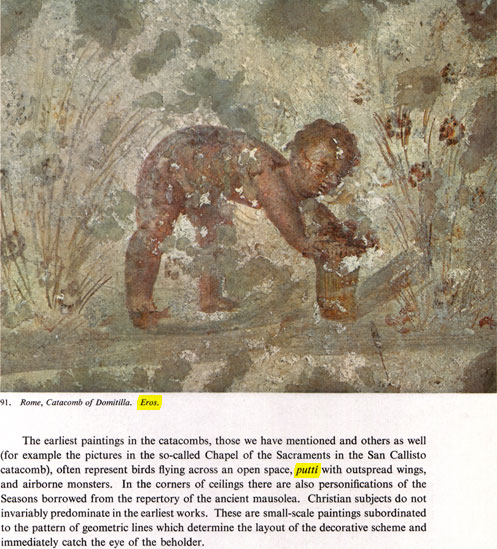
P. 319, “List of Illustrations”:
Early Christian Painting, Pierre du Bourguet, 1965, p. 39, “The Artistic Interest of Early Christian Painting | Scenes”:
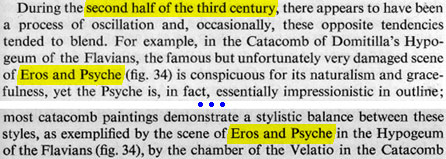
P. 24, “The Subjects Represented | Subjects”:

Figure 34:
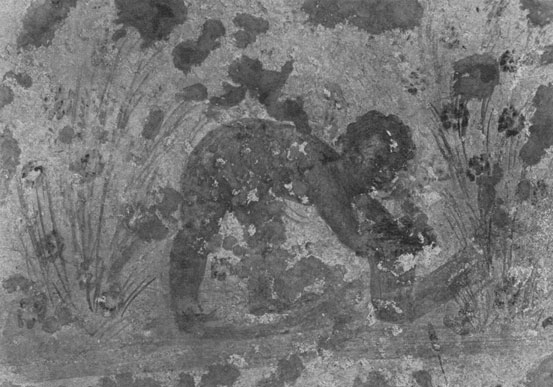
“List of Plates | Catacomb of Domitilla”:
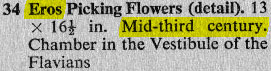
Christian Iconography: A Study of Its Origins, André Grabar, 1968, p. 34:
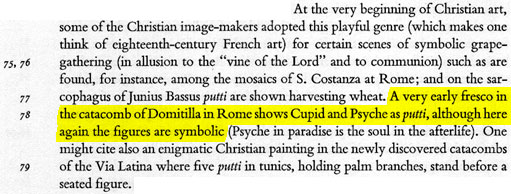
Illustration 78:
Encyclopedia of World Mythology, Warner, 1975, p. 212, “The Mythology of Animals | Dove”:
http://www.catacombe.domitilla.it/francese.htm, Catacombes S.Domitilla (translated from French):
On the right wall of the room (with always in front of oneself the entry of hypogean), opens, behind a metal grid, small a cubiculum painted, dated from the end of the III° century Ap.J.-C in which, between garlands, basket of flowers and small birds, develop the pagan myth "Amor and Psyché" preprésentés by putti gathering flowers.:
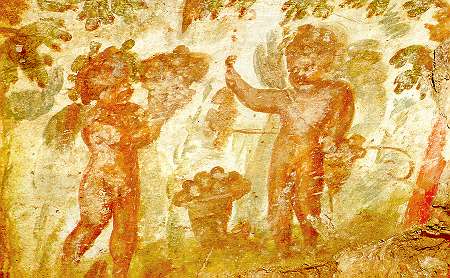
(Sur la paroi droite de la salle (avec toujours devant soi l’entrée de l’hypogée), s’ouvre, derrière une grille métallique, un petit cubiculum peint, daté de la fin du III° siécle Ap.J.-C. dans lequel, entre guirlandes, corbeilles de fleurs et petits oiseaux, se développe le mythe païen "d’Amour et de Psyché" preprésentés par des putti en train de cueillir des fleurs.)
http://www.catacombe.domitilla.it/inglese.htm, Catacombs S. Domitilla (English version of above):
On the right-hand wall of the room (looking at the entrance of the hypogeum), behind a metal grate is small painted cubiculum dating back to the end of the 3rd century AD. In amongst garlands, baskets of flowers and birds, is depicted the pagan myth of Love and Psyche, represented as two cherubs collecting flowers.:
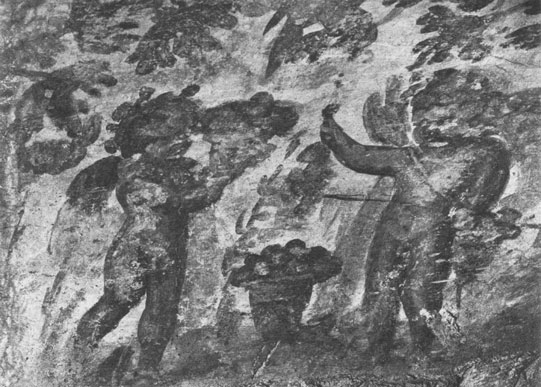
Early Christian Painting, Pierre du Bourguet, 1965, figure 33:
“List of Plates | Catacomb of Domitilla”:
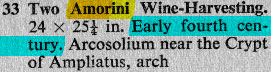
Guide to Catacomb of Domitilla; Fasola; Pontifical Commission of Sacred Archaeology, Vatican City; English edition; 1974; p. 37; “Fig. 18 – Vintage scenes”:
P. 38:
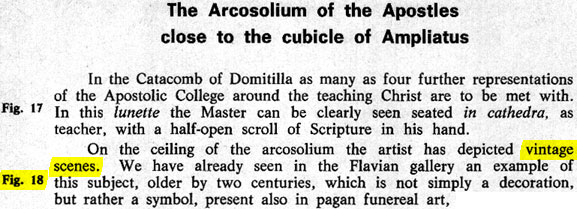
The Clash of Gods: A Reinterpretation of Early Christian Art, Mathews, 1993, p. 5, figure 2, “Christ Enthroned among His Apostles, Catacomb of Domitilla, Rome, c. 325”:
Origins of Western Art, Dr. Donald E. Strong, 1965, p. 44, “Early Christian Art | 4th century”:
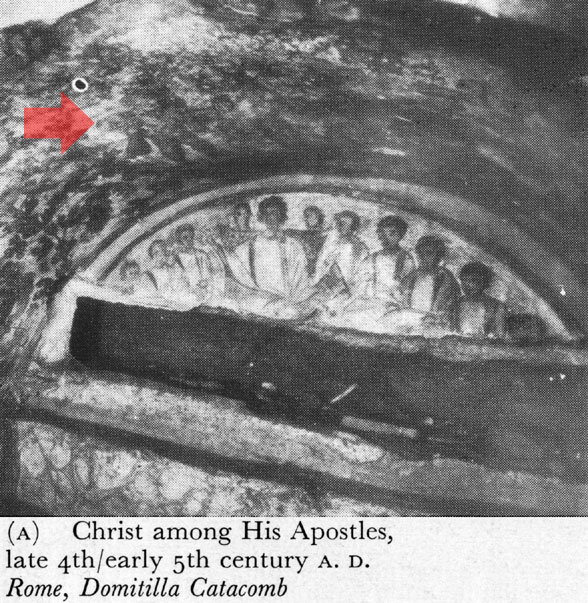
http://www.aug.edu/augusta/iconography/catacombs/apostolicCollege.html (via http://www.aug.edu/augusta/iconography/apostles.html) (Christian Iconography), The Apostolic College (Jesus’ Apostles), “Representation on a small arcosolium in Ampliatus' area, Roman catacombs”:
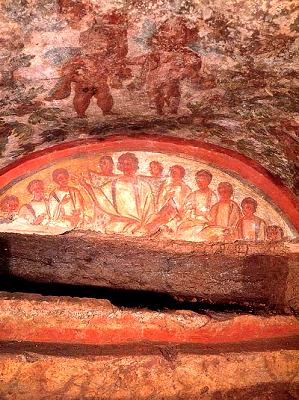
Early Christian Painting, Pierre du Bourguet, 1965, figure 29:
“List of Plates | Catacomb of Domitilla”:

Catacomb of Saint Callixtus / San Callisto:
The Catacombs of St. Callixtus; Baruffa; Published by L.E.V., Vatican City; 1993; p. 19:
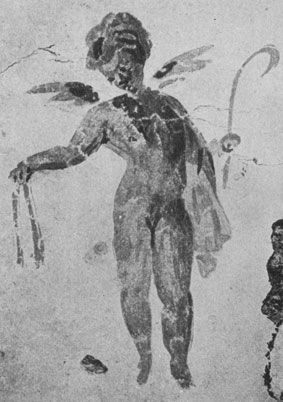
Imperial Rome and Christian Triumph, Elsner, 1998, p. 283, “Timeline | Monuments and art-historical events”:
http://www.jehovahs-witness.com/12/75216/1.ashx, Jehovahs-Witness Discussion forum, “When Jesus Christ was a man on earth, did he wear a beard?”:
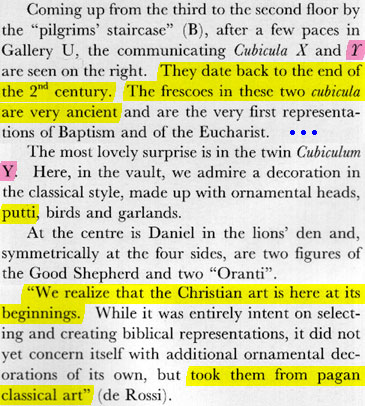
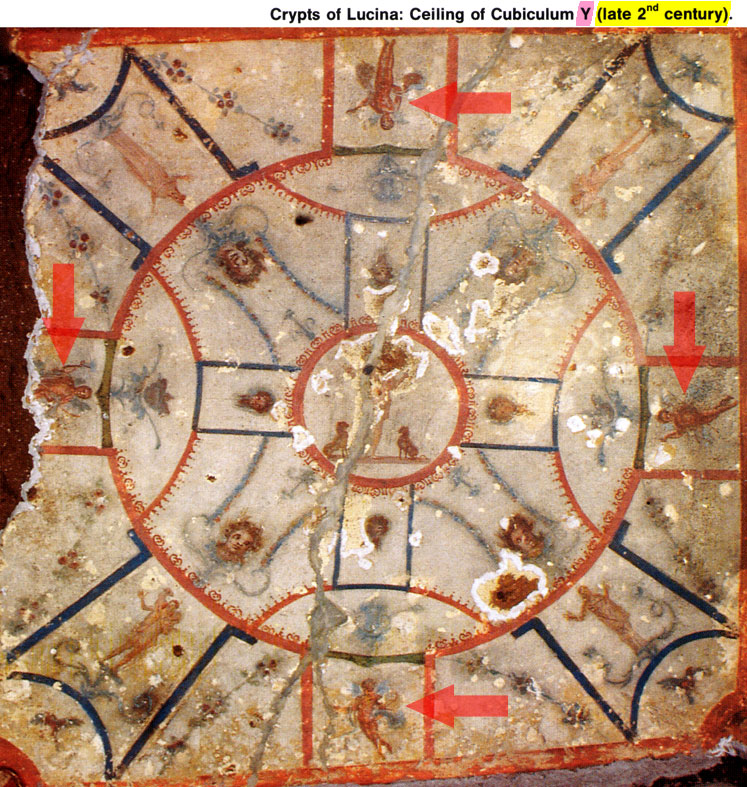
A ceiling painting dated a little later contains a Madonna with child, with a star above her head. In the Crypts of Lucina (in Catacomb of San Callixtus) a ceiling painting dated as the middle of the second century includes a little winged person, known as Erotes or Amoretti,
http://www.utoronto.ca/stmikes/courses/christianity/catacombs7.html (5-13-02), Initiation Art: The Catacombs:
Cat. Callixtus (4th c.); Orans Putti,tendrils, birds, cupids, flowers
The Catacombs of St. Callixtus; Baruffa; Published by L.E.V., Vatican City; 1993; pp. 148-149; “The Crypts of Lucina | Two Fishes and a Mysterious Basket”:
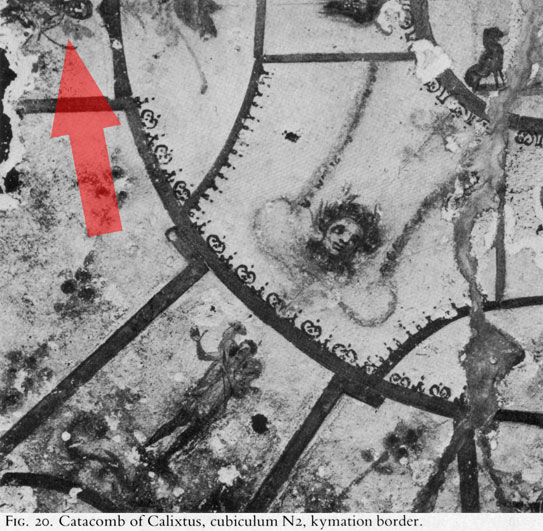
My arrows are pointing to Eros. The two Good Shepherds (which are Christ) and the two Oranti (praying Christians) are in the diagonal corners:
Early Christian & Byzantine Art, Lowden, 1997, p. 27, “Art before Iconoclasm | God and Salvation | The Formation of a Christian art”:
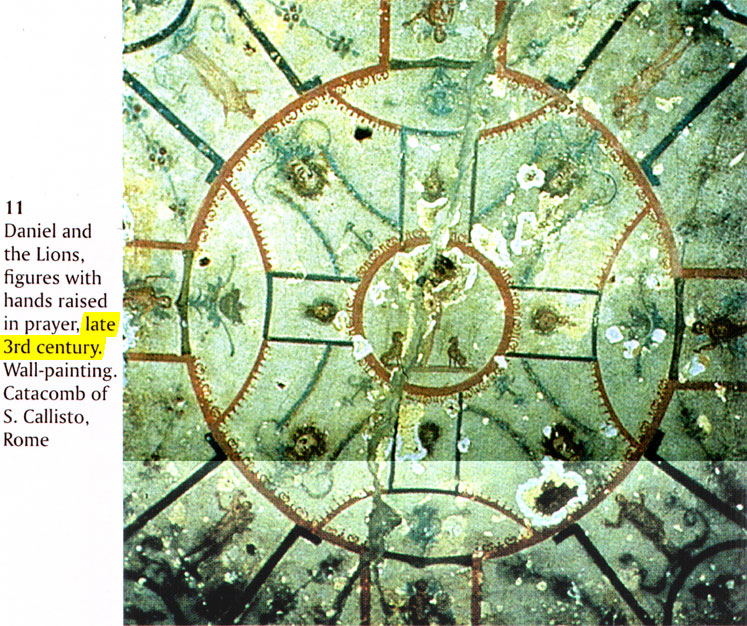
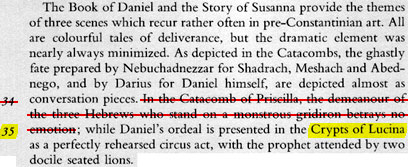
The Origins of Christian Art, Gough, 1973, p. 36, “Paganism baptized : Christian art before Constantine”:
 :
:
Pp. 36-37, illustration 35, “… 35 More stories of deliverance, told in a deliberately subdued fashion. … Daniel in the lions’ den, in the centre of a ceiling painted to suggest a dome”:
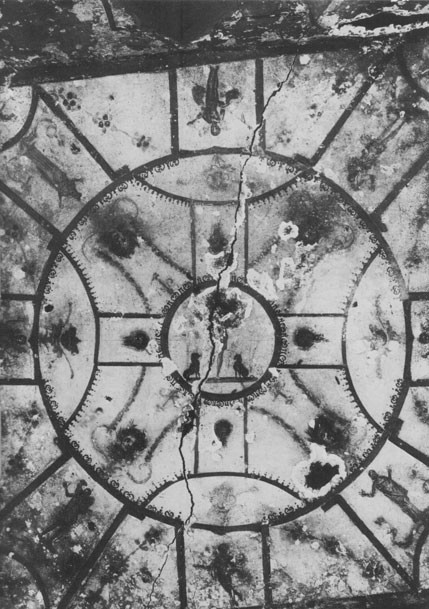
The Origins of Christian Art, Gough, 1973, p. 206, “List of Illustrations”:
Christian Iconography: A Study of Its Origins, André Grabar, 1968, illustration 1:
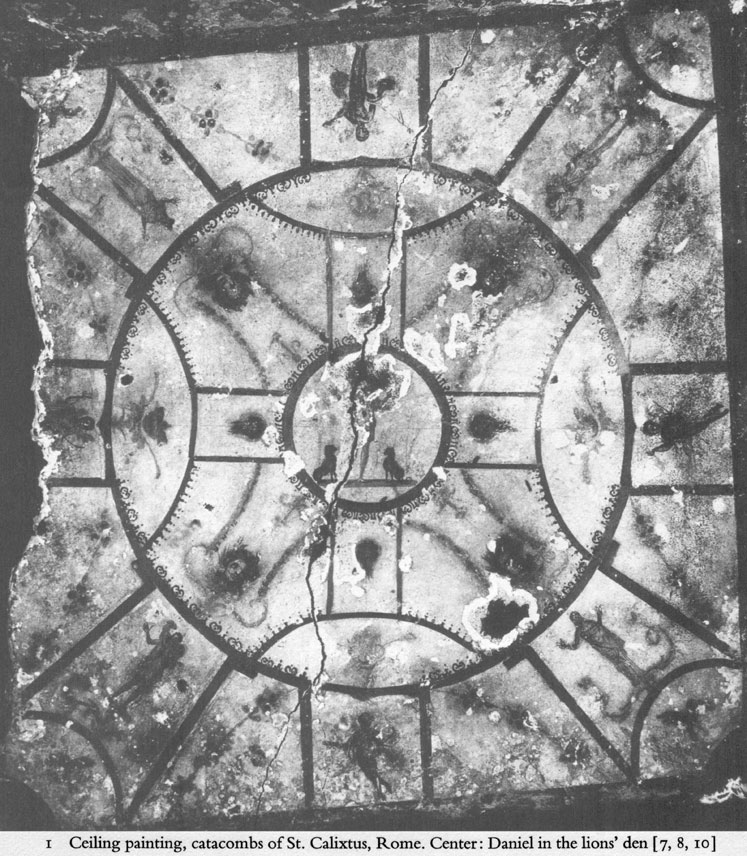
The Via Latina Catacomb, Tronzo, 1986, figure 20, (“Catacomb of Calixtus”) [Eros]:
Catacomb of Saints Marcellino and Peter:
http://vandyck.anu.edu.au/introduction/earlychristian/L21-06b.htm (via http://vandyck.anu.edu.au/introduction/earlychristian/earlychristian.html), Early Christain Art:
Catacomb of Saints Peter and Marcellinus, Rome 4th cen. CE, Ceiling Painting: Good Shepherd, Orants and Story of Jonah:
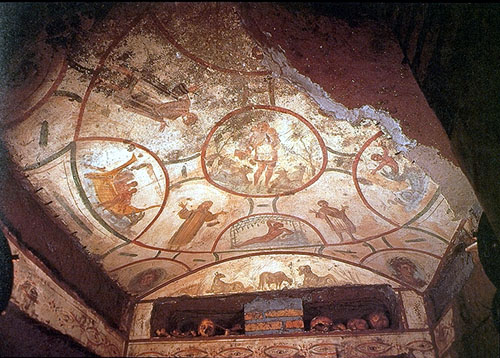
http://docushare.capousd.org/docushare/dsweb/Get/Document-1129/23, Art Through the Ages, 11e: Chapter 11: The art & Achitecture of Pagans, Christians, & Jews:
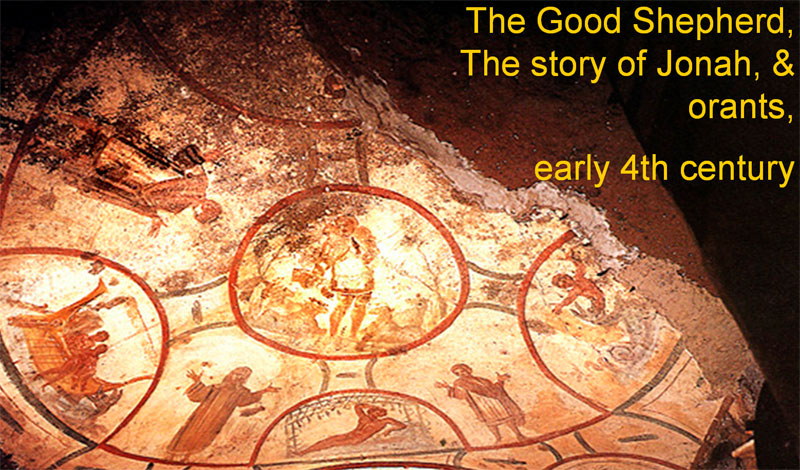
http://academic.udayton.edu/BrianMcconne...nt%20Peter/Vatican%20Christ%20Helios.jpg (via http://www.arthistory.upenn.edu/smr04/101910/101910lecture9.html), Lecture 9: : Early Christian-Byzantine, “Catacomb of Sts. Peter and Marcellinus, c. 340 CE, Rome”:
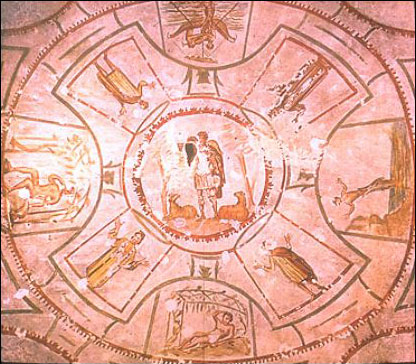
Die Katakombe „Santi Marcellino e Pietro“: Repertorium der Malereien (The Catacomb “Saints Marcellino and Peter”: Repertory of the Paintings), Deckers, 1987, Vol. 1, p. 378, “Ikonographische Indices (index) | 4 Pagan Themen”:
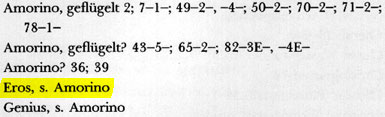 :
:
Die Katakombe „Santi Marcellino e Pietro“: Repertorium der Malereien (The Catacomb “Saints Marcellino and Peter”: Repertory of the Paintings), Deckers, 1987, Vol. 2, RC Lau (catalog painting) 7:
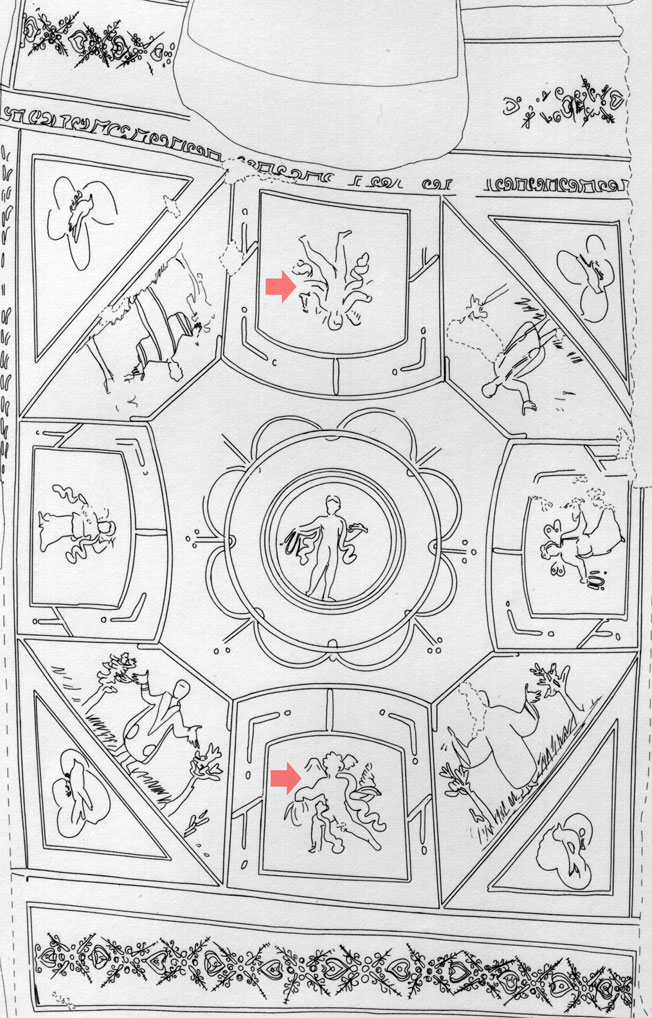
Die Katakombe „Santi Marcellino e Pietro“: Repertorium der Malereien (The Catacomb “Saints Marcellino and Peter”: Repertory of the Paintings), Deckers, 1987, Vol. 2, farbtafel (color plate page) 4, “Nr.(number) 7” (center right & lower center, in above):
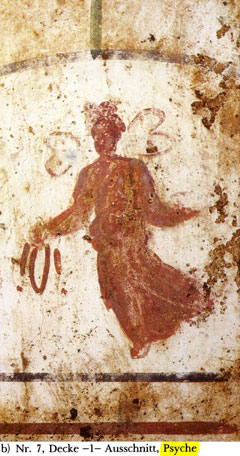
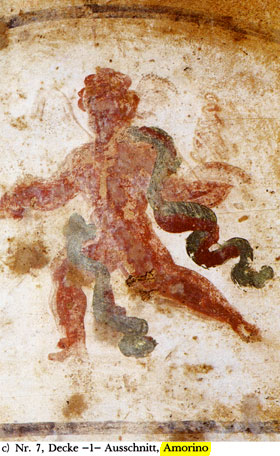
Eros looks pretty stocky there. Eros must work out.
Die Katakombe „Santi Marcellino e Pietro“: Repertorium der Malereien (The Catacomb “Saints Marcellino and Peter”: Repertory of the Paintings), Deckers, 1987, Vol. 2, RC Lau (catalog painting) 78, “1”:
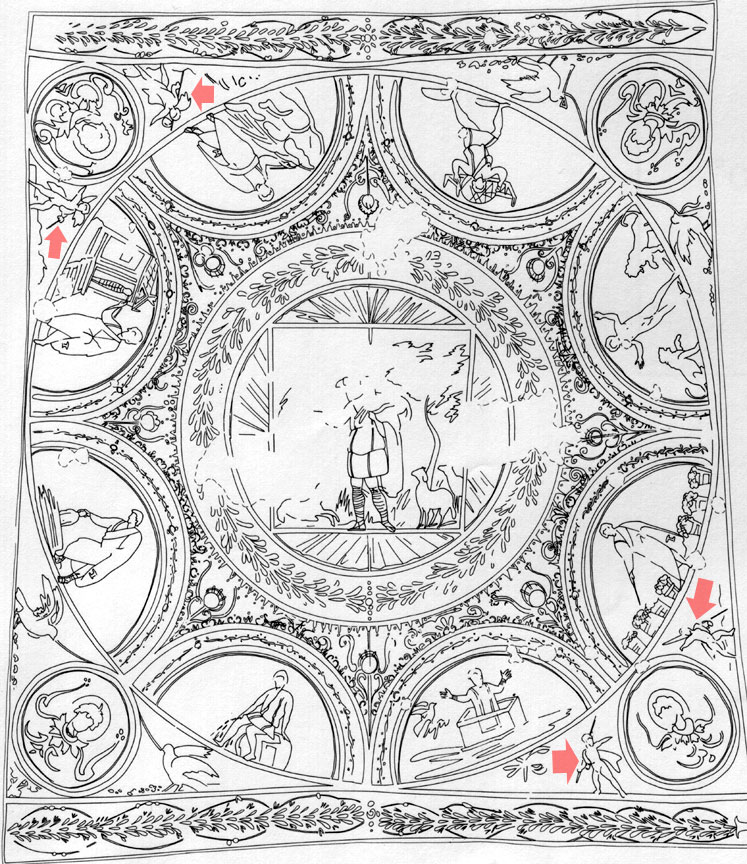
Die Katakombe „Santi Marcellino e Pietro“: Repertorium der Malereien (The Catacomb “Saints Marcellino and Peter”: Repertory of the Paintings), Deckers, 1987, Vol. 2, tafel (plate page) 57, “Nr.(number) 78”:
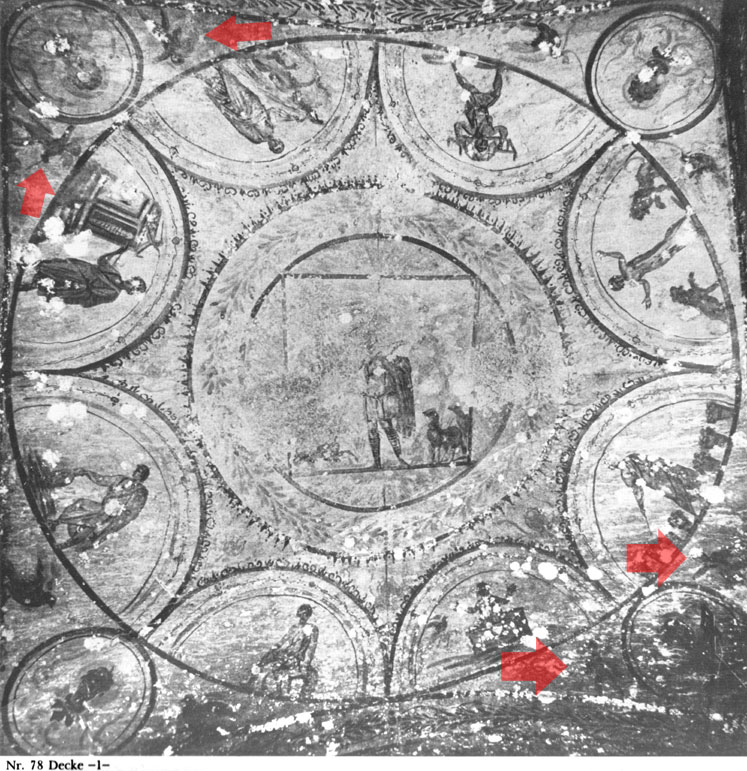
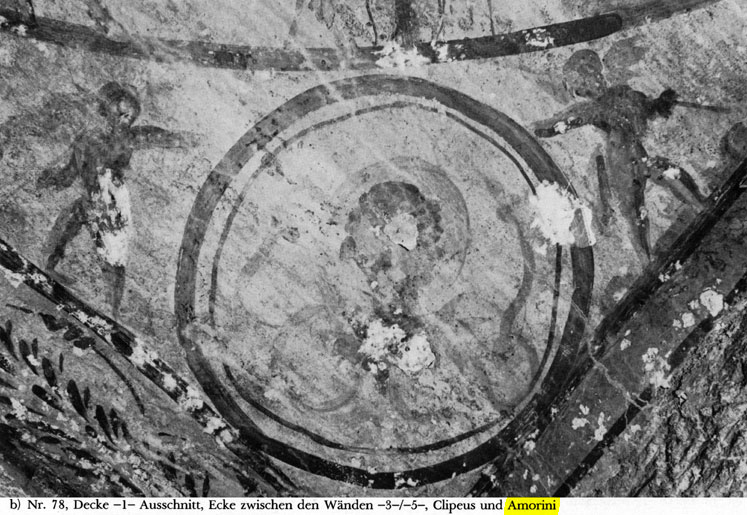
Die Katakombe „Santi Marcellino e Pietro“: Repertorium der Malereien (The Catacomb “Saints Marcellino and Peter”: Repertory of the Paintings), Deckers, 1987, Vol. 2, tafel (plate page) 62, “b) Nr.(number) 78” (upper left corner, above):
Die Katakombe „Santi Marcellino e Pietro“: Repertorium der Malereien (The Catacomb “Saints Marcellino and Peter”: Repertory of the Paintings), Deckers, 1987, Vol. 2, RC Lau (catalog painting) 50, “2”:
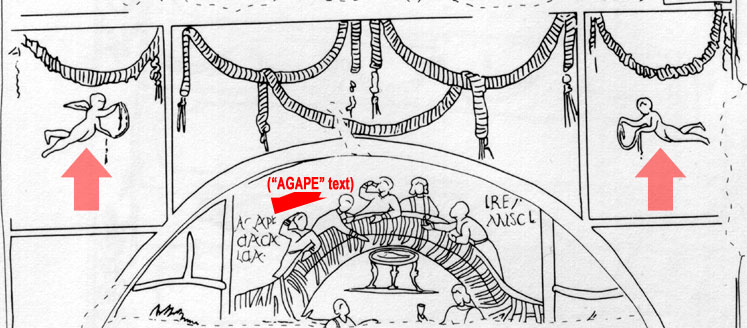
Die Katakombe „Santi Marcellino e Pietro“: Repertorium der Malereien (The Catacomb “Saints Marcellino and Peter”: Repertory of the Paintings), Deckers, 1987, Vol. 2, tafel (plate page) 36, “a) Nr.(number) 50 … Amorino” (center right, above):
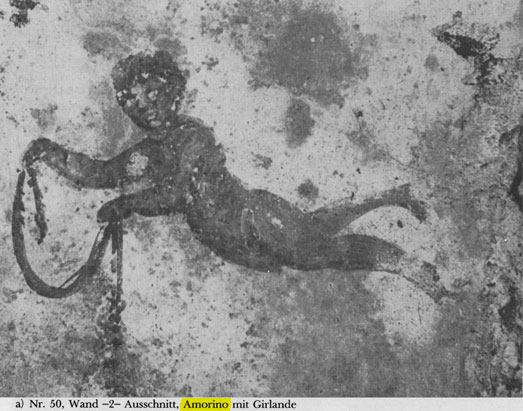
Die Katakombe „Santi Marcellino e Pietro“: Repertorium der Malereien (The Catacomb “Saints Marcellino and Peter”: Repertory of the Paintings), Deckers, 1987, Vol. 2, RC Lau (catalog painting) 49, “2”:
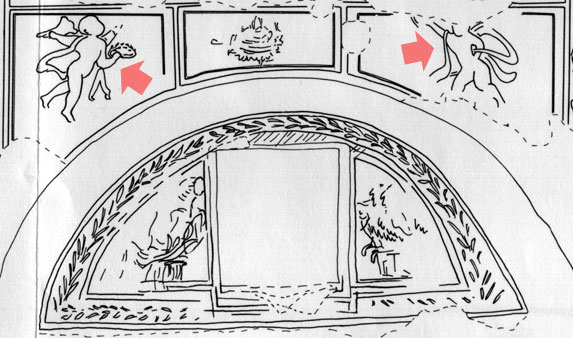
Die Katakombe „Santi Marcellino e Pietro“: Repertorium der Malereien (The Catacomb “Saints Marcellino and Peter”: Repertory of the Paintings), Deckers, 1987, Vol. 2, farbtafel (color plate page) 26, “b) Nr.(number) 49 … Amorino” (upper left, above):
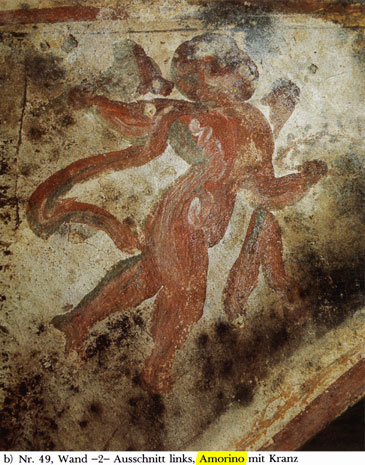
Die Katakombe „Santi Marcellino e Pietro“: Repertorium der Malereien (The Catacomb “Saints Marcellino and Peter”: Repertory of the Paintings), Deckers, 1987, Vol. 2, RC Lau (catalog painting) 49, “4”:
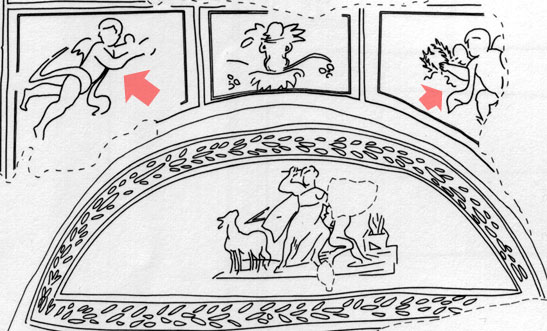
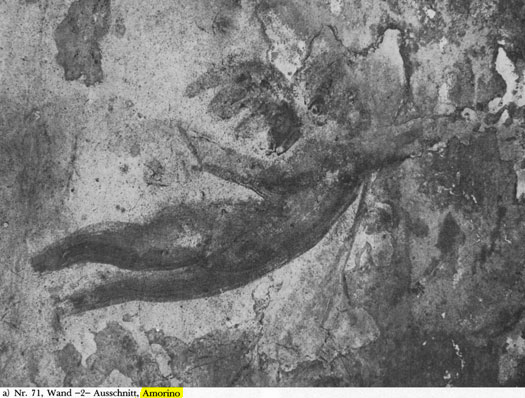
Die Katakombe „Santi Marcellino e Pietro“: Repertorium der Malereien (The Catacomb “Saints Marcellino and Peter”: Repertory of the Paintings), Deckers, 1987, Vol. 2, RC Lau (catalog painting) 71, “2”:
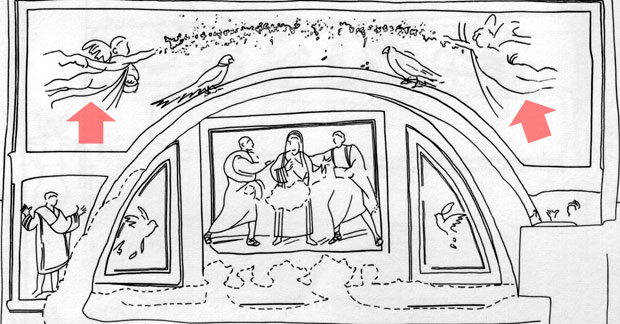
Die Katakombe „Santi Marcellino e Pietro“: Repertorium der Malereien (The Catacomb “Saints Marcellino and Peter”: Repertory of the Paintings), Deckers, 1987, Vol. 2, tafel (plate page) 53, “a) Nr.(number) 71 … Amorino” (upper left, above):
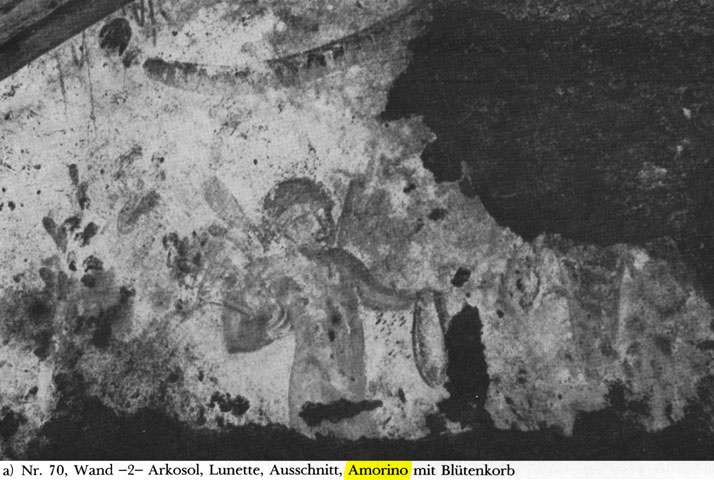
Die Katakombe „Santi Marcellino e Pietro“: Repertorium der Malereien (The Catacomb “Saints Marcellino and Peter”: Repertory of the Paintings), Deckers, 1987, Vol. 2, RC Lau (catalog painting) 70, “2”:
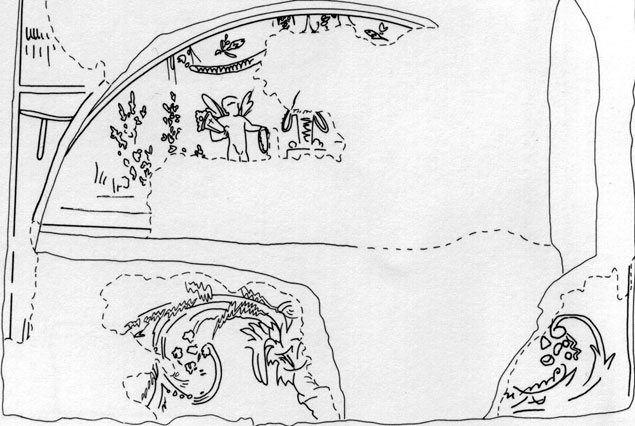
Die Katakombe „Santi Marcellino e Pietro“: Repertorium der Malereien (The Catacomb “Saints Marcellino and Peter”: Repertory of the Paintings), Deckers, 1987, Vol. 2, tafel (plate page) 51, “a) Nr.(number) 70 … Amorino”:
Die Katakombe „Santi Marcellino e Pietro“: Repertorium der Malereien (The Catacomb “Saints Marcellino and Peter”: Repertory of the Paintings), Deckers, 1987, Vol. 2, RC Lau (catalog painting) 2:
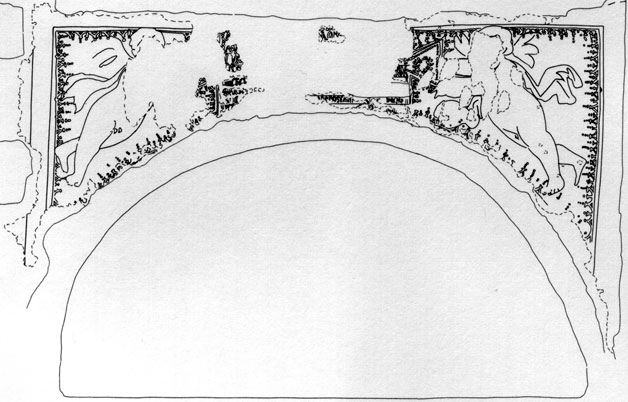
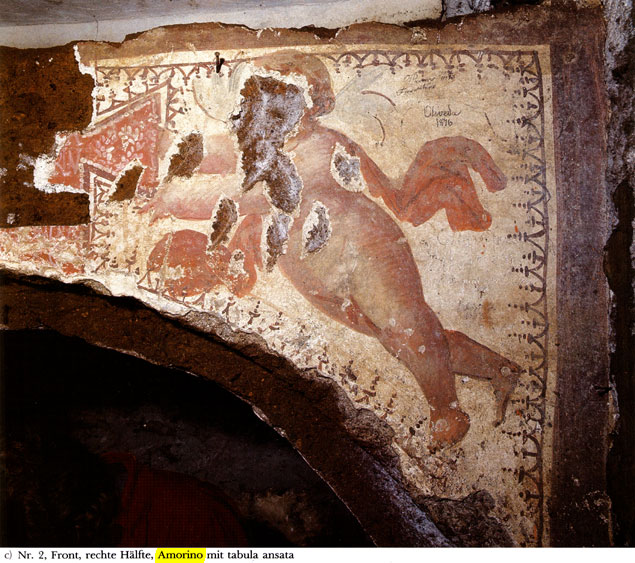
Die Katakombe „Santi Marcellino e Pietro“: Repertorium der Malereien (The Catacomb “Saints Marcellino and Peter”: Repertory of the Paintings), Deckers, 1987, Vol. 2, farbtafel (color plate page) 1, “c) Nr.(number) 2 … Amorino”:
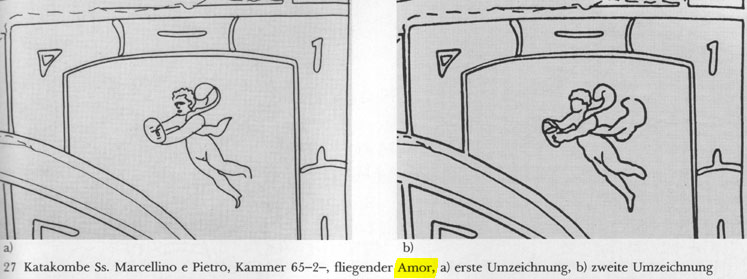
Die Katakombe „Santi Marcellino e Pietro“: Repertorium der Malereien (The Catacomb “Saints Marcellino and Peter”: Repertory of the Paintings), Deckers, 1987, Vol. 1, p. 41, illustration 27 … Amor:
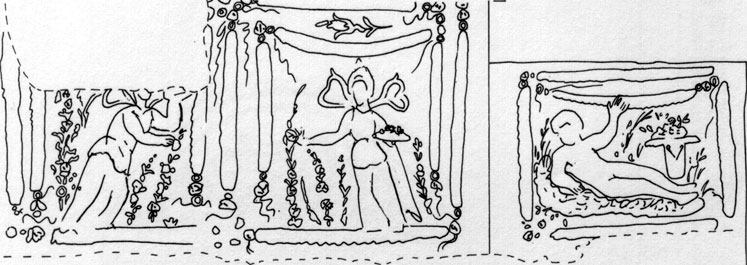
Die Katakombe „Santi Marcellino e Pietro“: Repertorium der Malereien (The Catacomb “Saints Marcellino and Peter”: Repertory of the Paintings), Deckers, 1987, Vol. 2, RC Lau (catalog painting) 82, “3”:
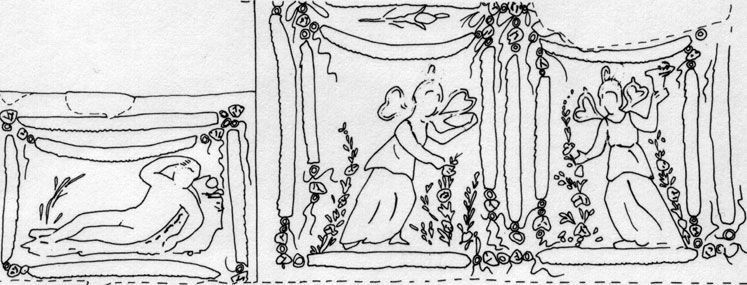
Die Katakombe „Santi Marcellino e Pietro“: Repertorium der Malereien (The Catacomb “Saints Marcellino and Peter”: Repertory of the Paintings), Deckers, 1987, Vol. 2, farbtafel (color plate page) 68, “a) Nr.(number) 82 … Amorino”:
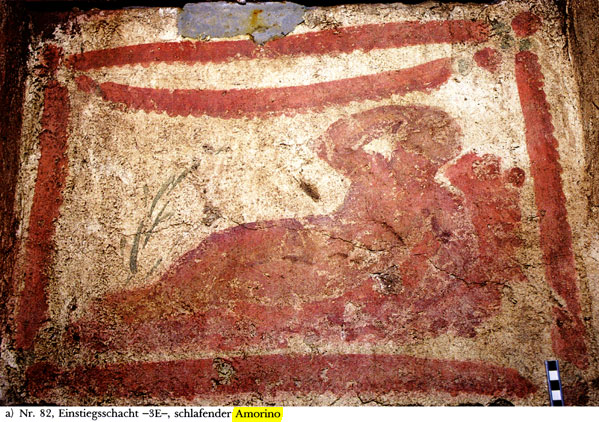
Die Katakombe „Santi Marcellino e Pietro“: Repertorium der Malereien (The Catacomb “Saints Marcellino and Peter”: Repertory of the Paintings), Deckers, 1987, Vol. 2, farbtafel (color plate page) 69, “a) Nr.(number) 82 … Psyche”:
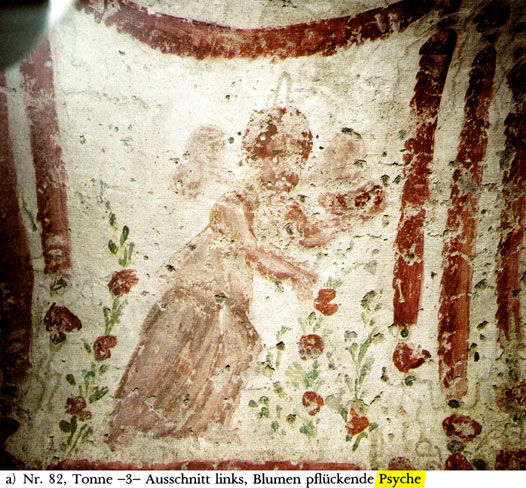
Die Katakombe „Santi Marcellino e Pietro“: Repertorium der Malereien (The Catacomb “Saints Marcellino and Peter”: Repertory of the Paintings), Deckers, 1987, Vol. 2, RC Lau (catalog painting) 82, “4”:
Die Katakombe „Santi Marcellino e Pietro“: Repertorium der Malereien (The Catacomb “Saints Marcellino and Peter”: Repertory of the Paintings), Deckers, 1987, Vol. 2, farbtafel (color plate page) 68, “b) Nr.(number) 82 … Amorino”:
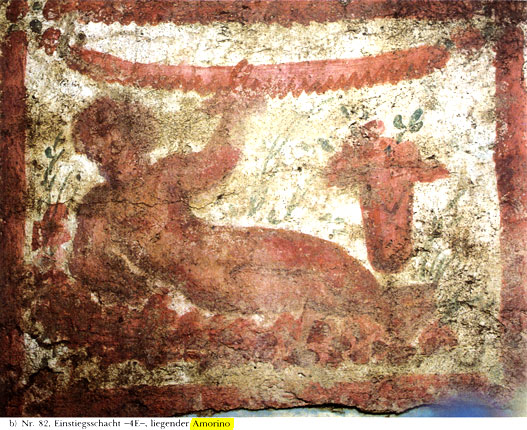
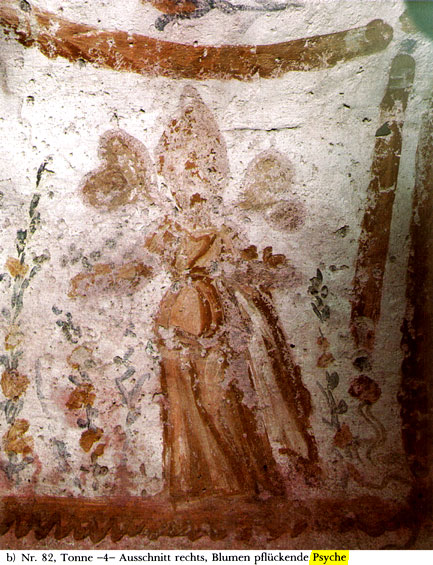
Die Katakombe „Santi Marcellino e Pietro“: Repertorium der Malereien (The Catacomb “Saints Marcellino and Peter”: Repertory of the Paintings), Deckers, 1987, Vol. 2, farbtafel (color plate page) 69, “b) Nr.(number) 82 … Psyche”:
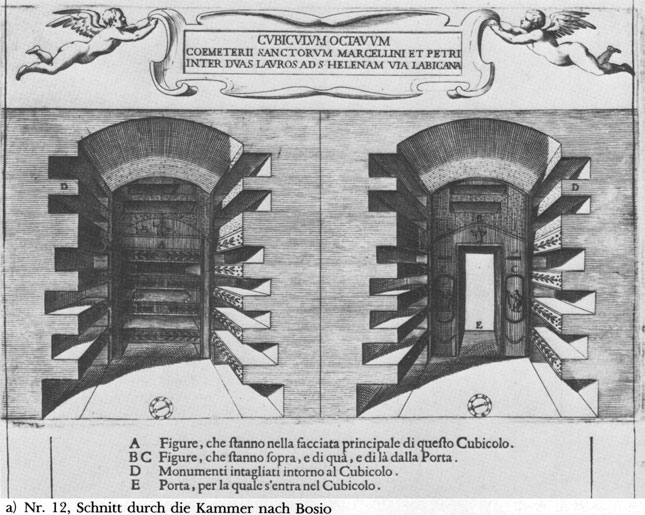
Die Katakombe „Santi Marcellino e Pietro“: Repertorium der Malereien (The Catacomb “Saints Marcellino and Peter”: Repertory of the Paintings), Deckers, 1987, Vol. 2, tafel (plate page) 3, “b) Nr.(number) 12”:
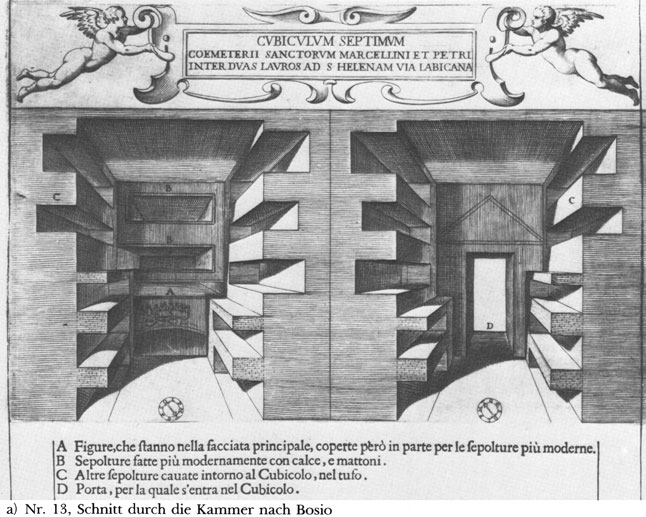
Die Katakombe „Santi Marcellino e Pietro“: Repertorium der Malereien (The Catacomb “Saints Marcellino and Peter”: Repertory of the Paintings), Deckers, 1987, Vol. 2, tafel (plate page) 5, “a) Nr.(number) 13”:
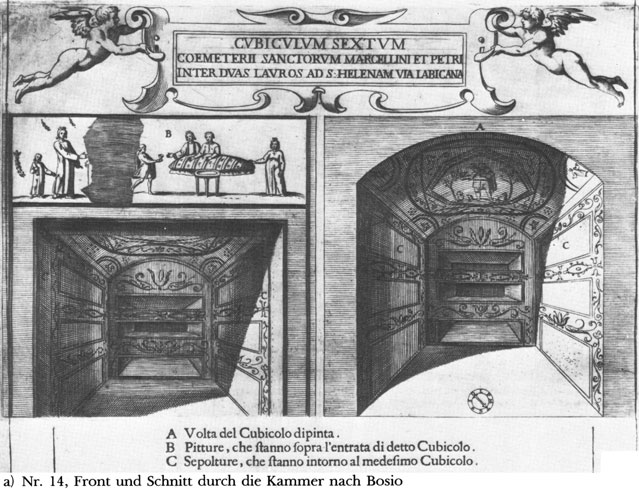
Die Katakombe „Santi Marcellino e Pietro“: Repertorium der Malereien (The Catacomb “Saints Marcellino and Peter”: Repertory of the Paintings), Deckers, 1987, Vol. 2, tafel (plate page) 7, “a) Nr.(number) 14”:
Catacomb of the Via Latina:
The Paintings of the ‘New’ Catacomb of the Via Latina and the Struggle of Christianity against Paganism, Bargebuhr, 1991, pp. 16-17, “Introduction”:
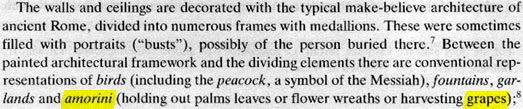 …
…

http://www.answers.com/topic/genii-1?hl=genii, Genii:
Genii (lat.) as the name for Æons, or angels, with the Gnostics. The names of their hierarchics and classes are simply legion.
http://www.answers.com/Gnosticism, Gnosticism:
The doctrines of certain pre-Christian pagan, Jewish, and early Christian sects that valued the revealed knowledge of God
The Paintings of the ‘New’ Catacomb of the Via Latina and the Struggle of Christianity against Paganism, Bargebuhr, 1991, p. 20, “The Pagan Tradition and Christianity”:

P. 35, “The Catacomb Paintings”:

P. 88, “‘Decorative’ Features”:

Plate 47:
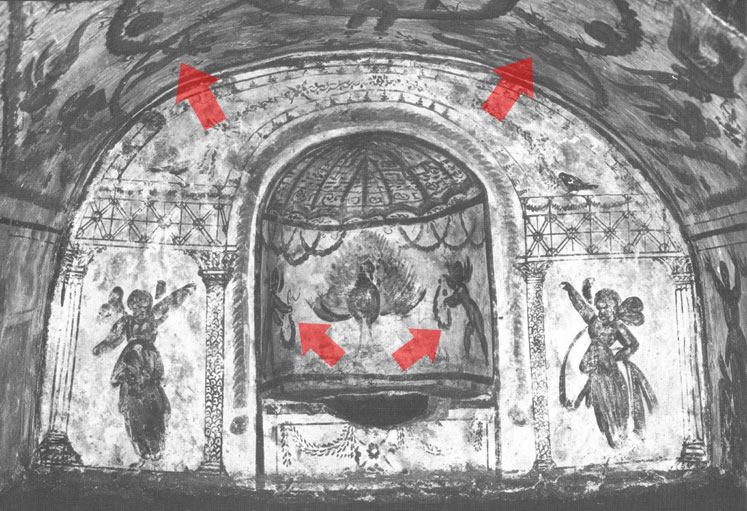
P. 88, “’Decorative’ Features”:

You see, if free sex was part of today’s Christian teaching, they would be telling how “amorini” represented the non-conditional (free) love of sexual enjoyment. But, they don’t. But they sure very easily could.
The Via Latina Catacomb, Tronzo, 1986, figure 47 [Eros]:
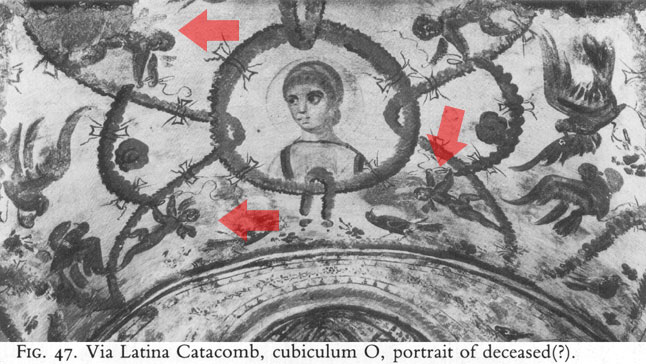
Figure 72 [Eros]:
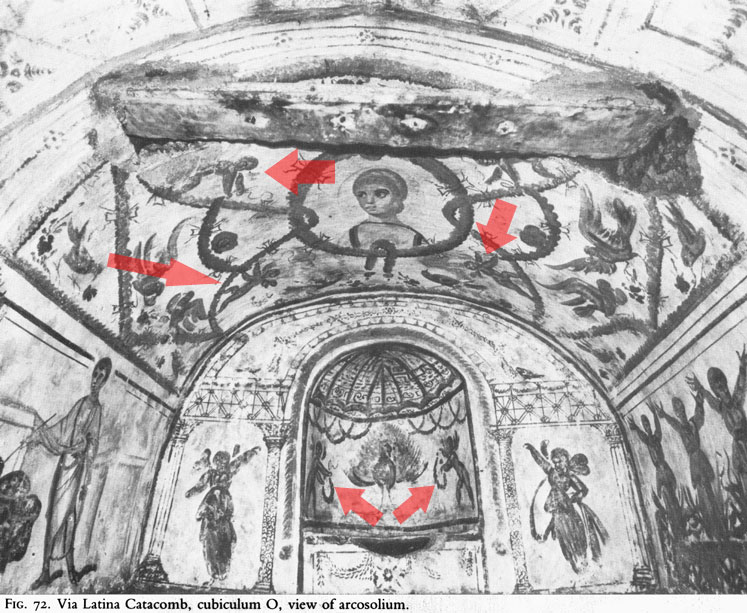
Figure 35, “cubiculum O, general view”:
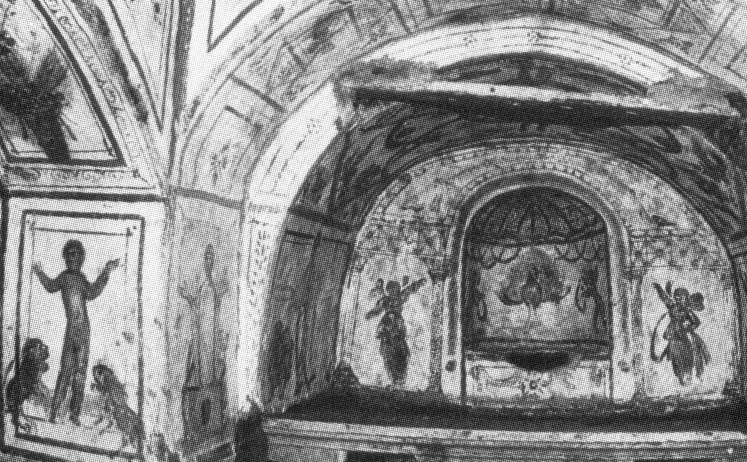
The Via Latina Catacomb, Tronzo, 1986, figure 34 [Eros]:
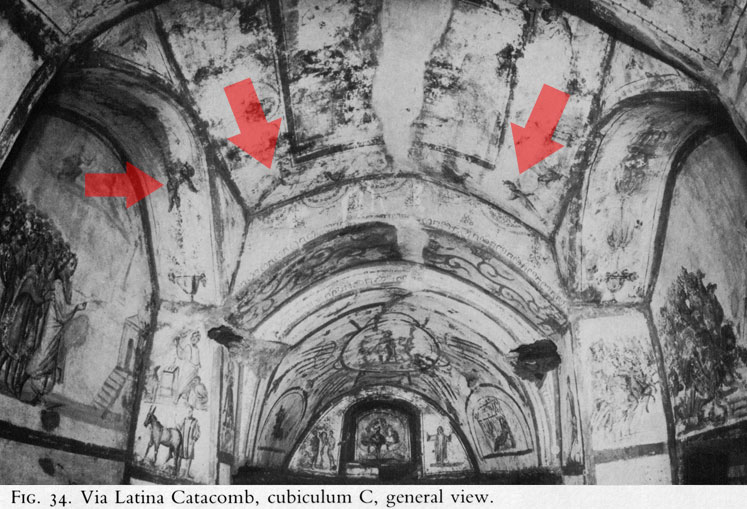
Figure 78 [Eros]:
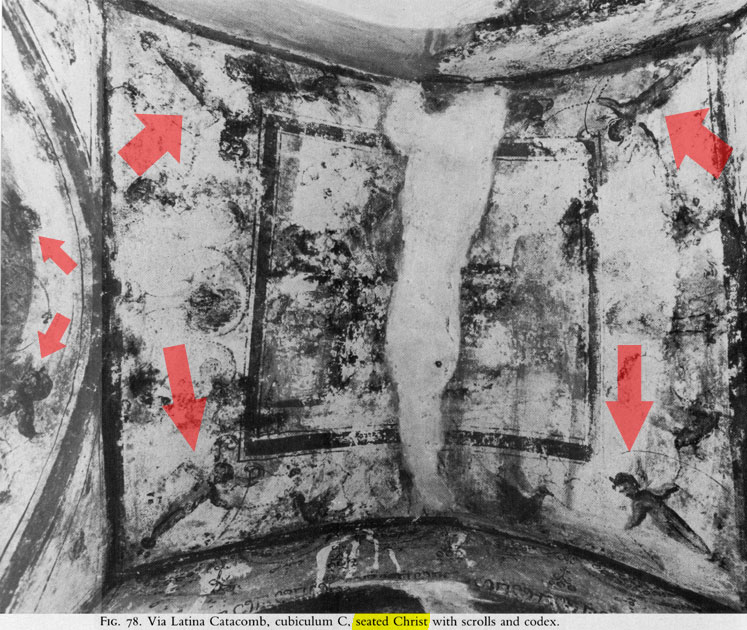
Figure 78A [Eros]:
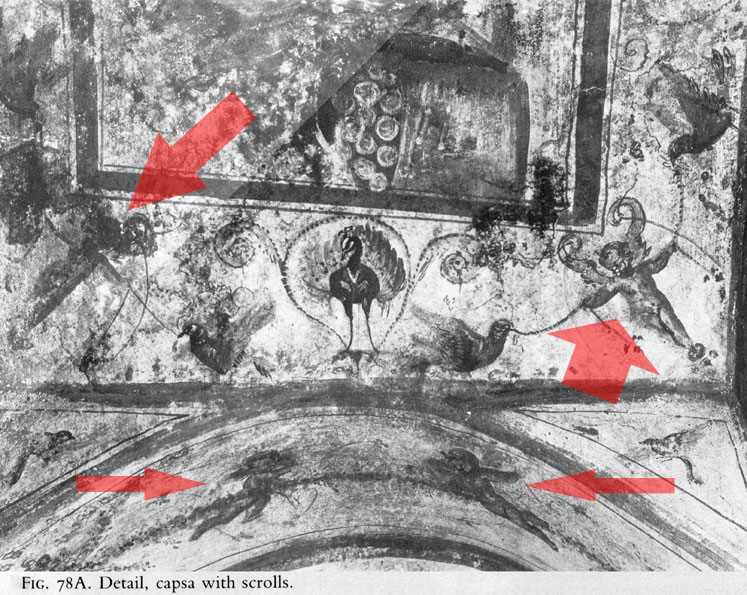
Figure 78B [Eros]:
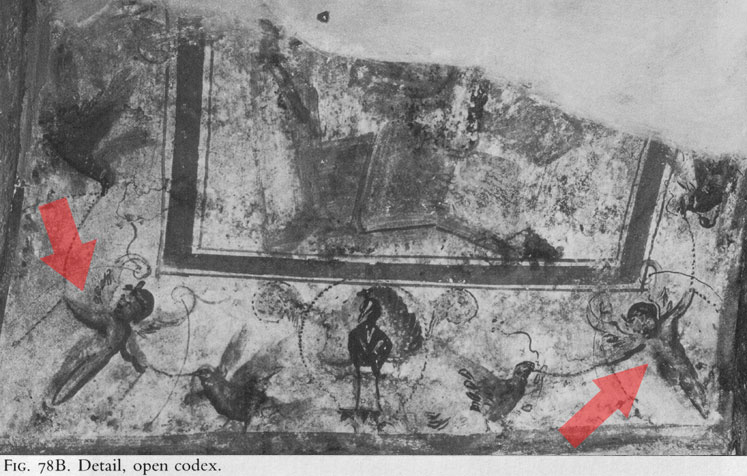
Early Christian Painting, Pierre du Bourguet, 1965, figure 115:
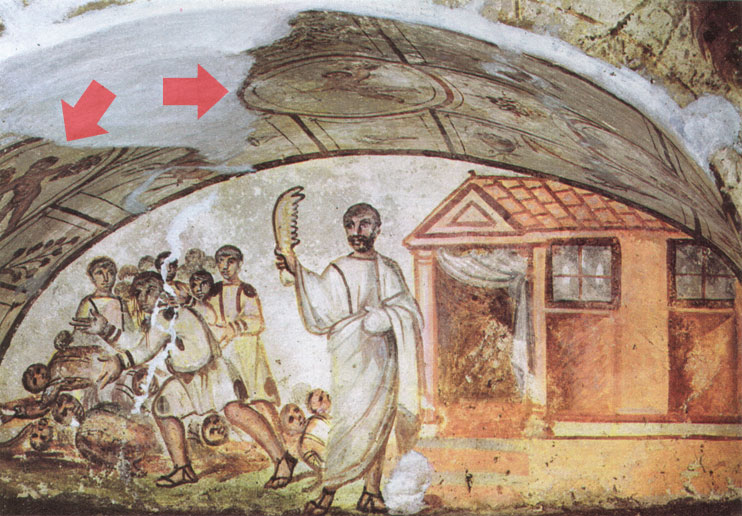
“List of Plates | New Catacomb of the Via Latina”:
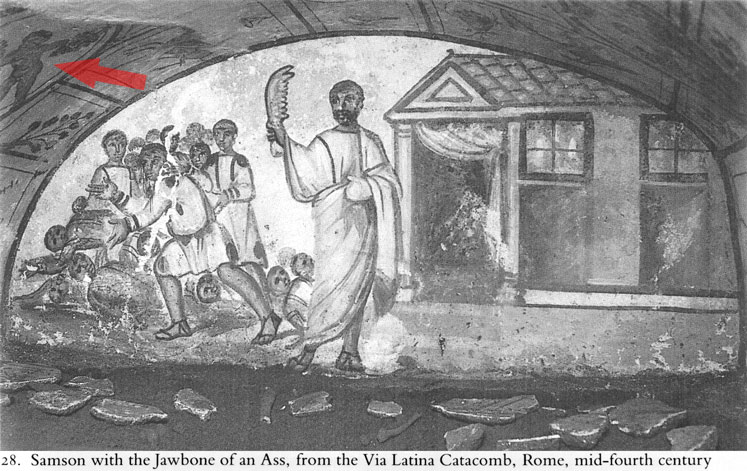
The Clash of Gods: A Reinterpretation of Early Christian Art, Mathews, 1993, p. 47, figure 28 (Eros with grapes):
The Paintings of the ‘New’ Catacomb of the Via Latina and the Struggle of Christianity against Paganism, Bargebuhr, 1991, plate 48:
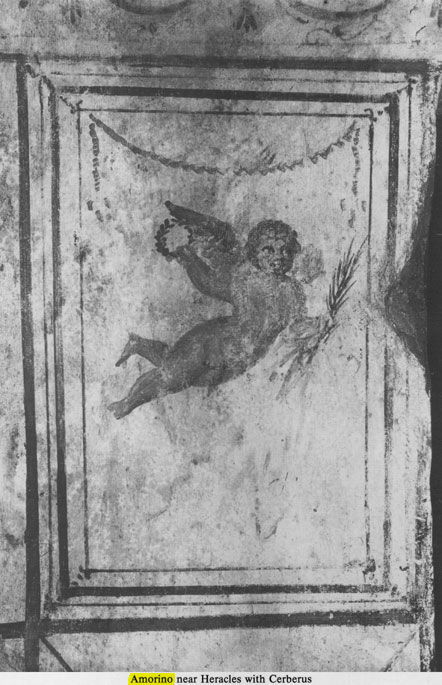
P. 89, “‘Decorative’ Features”:

http://au.encarta.msn.com/media_121618186_761579100_-1_1/Catacombs_Via_Latina.html:
Early Christian artistic expression was limited to hidden places like catacombs, such as those at Via Latina, Rome. The frescos are derived from the Roman style of art, and contain Christian iconography.
Early Christian Art: AD 200-395: From the Rise of Christianity to the Death of Theodosius, André Grabar, 1968, p. 228, “3. The Art of the Fourth Century | The Via Latina Paintings”:
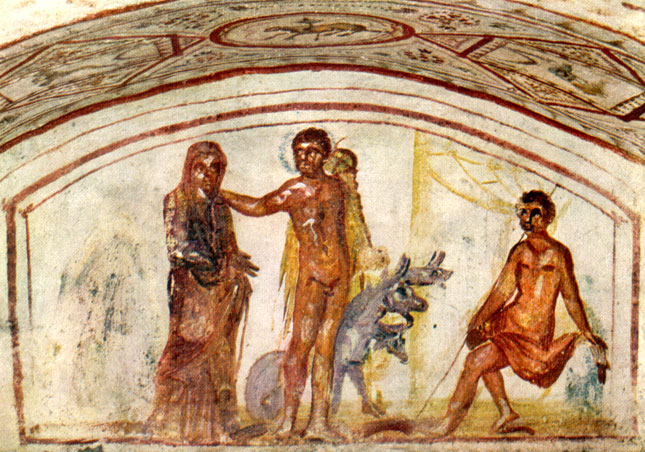
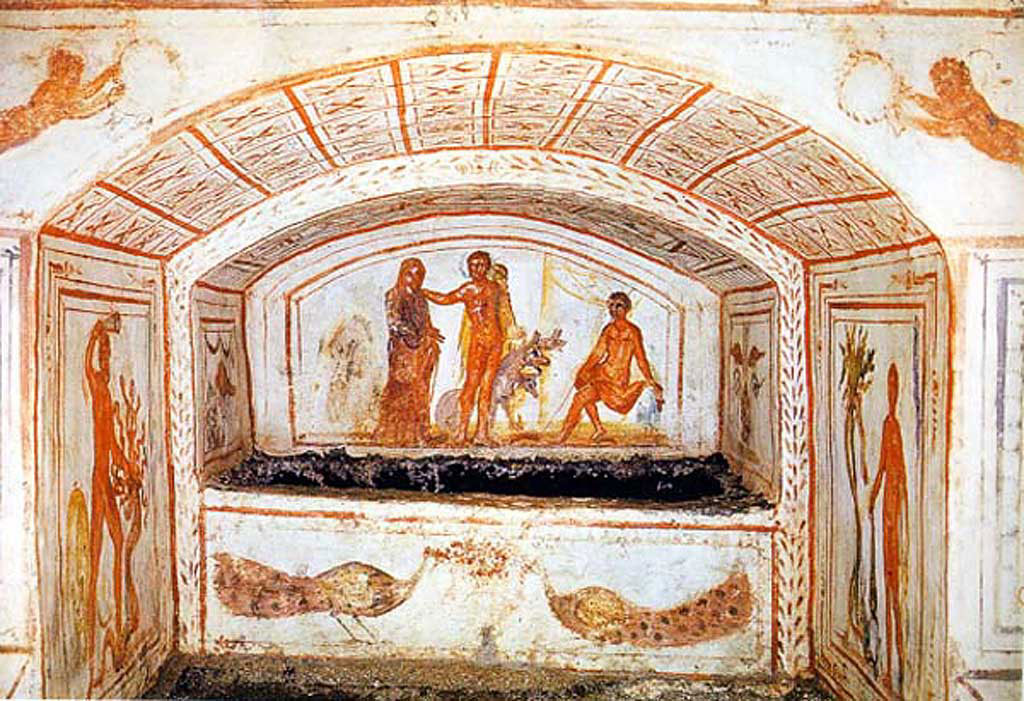
Imperial Rome and Christian Triumph, Elsner, 1998, p. 218, illustration 144, “arcosolium of Cubiculum N, Via Latina catacomb, Rome, third quarter of the fourth century AD”:
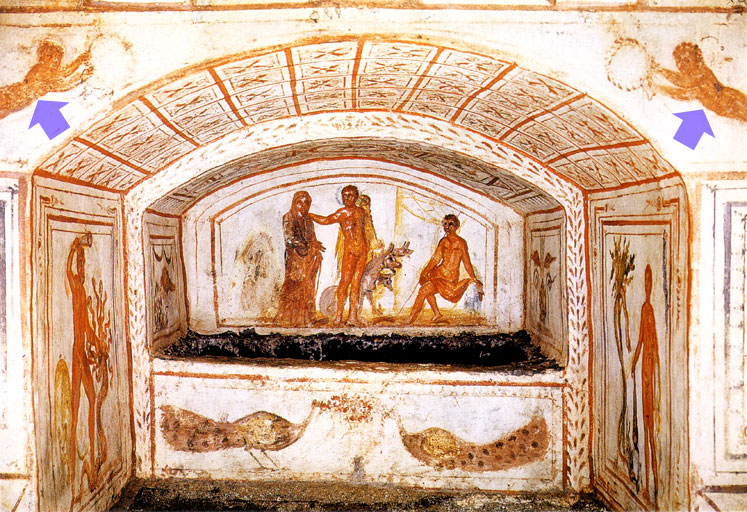
http://www.mcah.columbia.edu/dbcourses/klein/large/JE-144.jpg (via http://www.mcah.columbia.edu/cgi-bin/dbcourses/item?skip=1080), Cubiculum of Hercules:
Early Christian Art: AD 200-395: From the Rise of Christianity to the Death of Theodosius, André Grabar, 1968, p. 234, “3. The Art of the Fourth Century | The Via Latina Paintings | 258. Rome. Catacomb of the Via Latina: Partial View of Room N”:
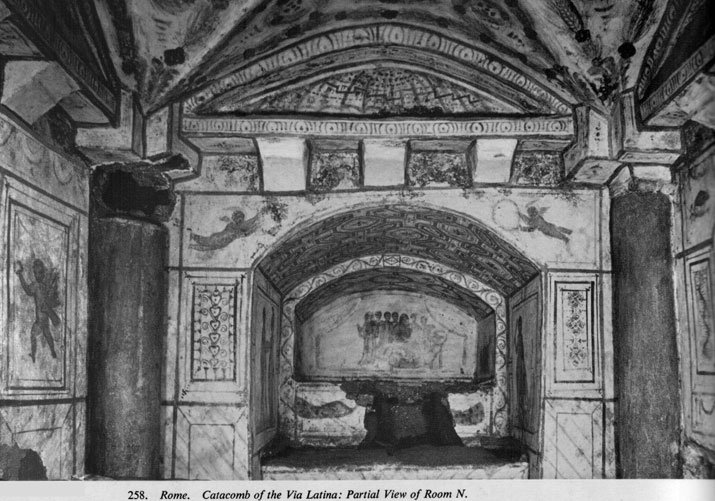
Enlargements:
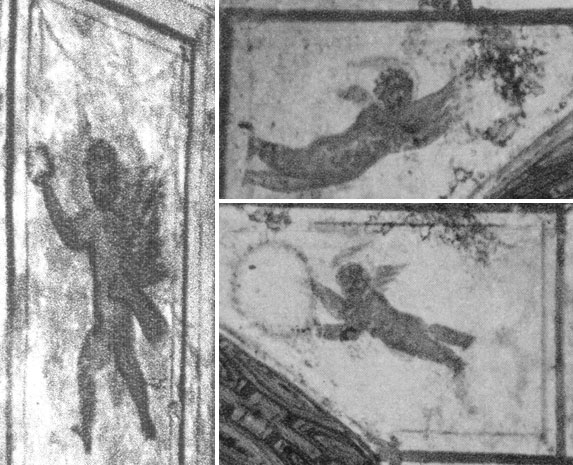
The Roman Empire: Art Forms and Civic Life; Hans Peter L’Orange; 1985; pp. 162-163, 166; illustration 102; “Hypogeum of Via Latina”:
 Extracts:
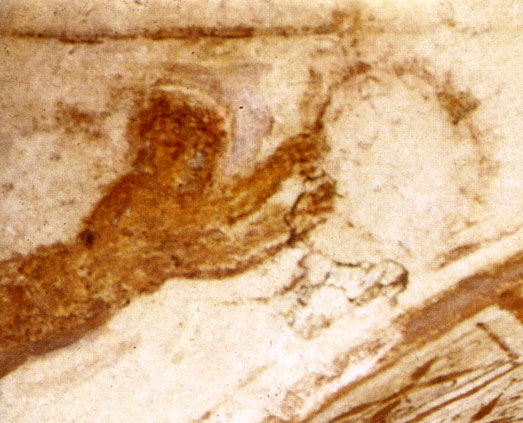
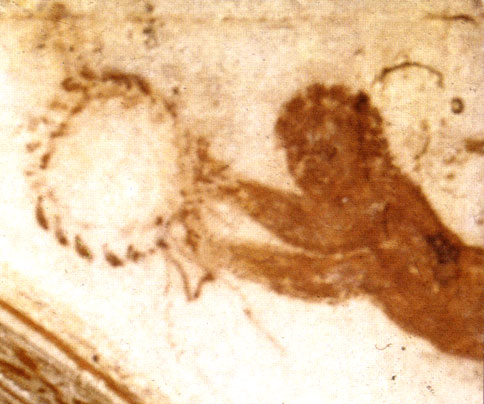
The Via Latina Catacomb, Tronzo, 1986, figure 51 [Eros]:
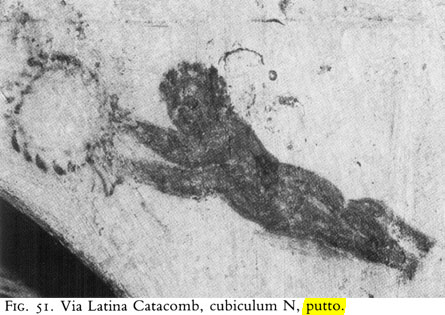
http://www.catacombsociety.org/nfr_3-30-2000.html, 10 Years of Restoration in the Hypageum of Via Dino Compagni (Via Latina Catacomb):
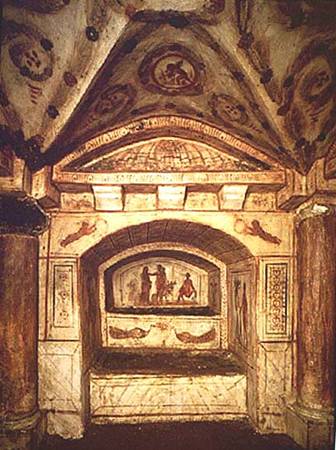
Columns flank an arcosolium in Cubiculum N, Via Latina Catacomb
Early Christian Art: AD 200-395: From the Rise of Christianity to the Death of Theodosius, André Grabar, 1968, p. 208, “3. The Art of the Fourth Century | Catacomb Paintings | 229. Rome. Catacomb of the Via Latina : Partial View of Room N”:
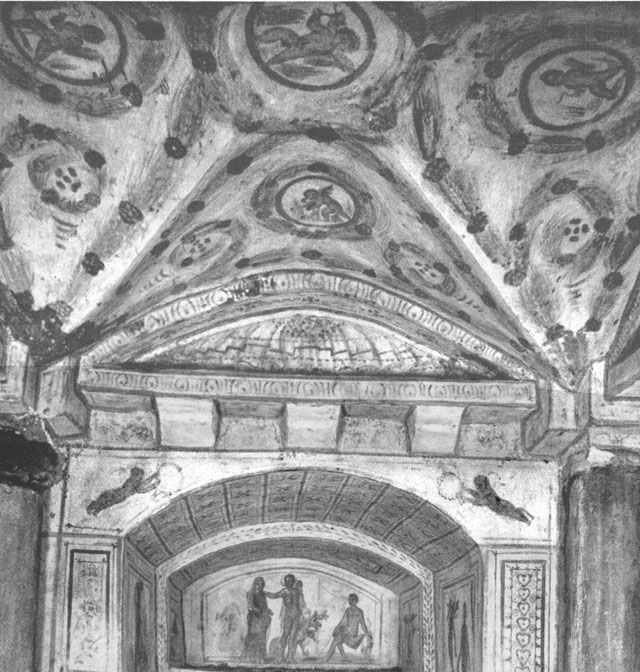
Eros / Erotes is “literally” erotic art.
http://www.catacombsociety.org/vom/107.html, Vaults of Memory:
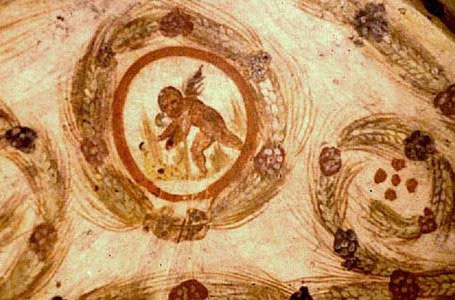
Putto at Work
107. ".
. . for whatsoever a man soweth, that shall he also reap" (Gal. 6:7). A putto framed in roses and wheat is shown
performing the traditional labor of the land. Vault painting. Sala N, catacomb of Via Latina.
http://campus.belmont.edu/honors/catacombs/arcosolium1.jpg (via http://campus.belmont.edu/honors/catacombs/catacombs.htm (Belmont University), The Christian Catacombs of Ancient Rome: An Introduction:
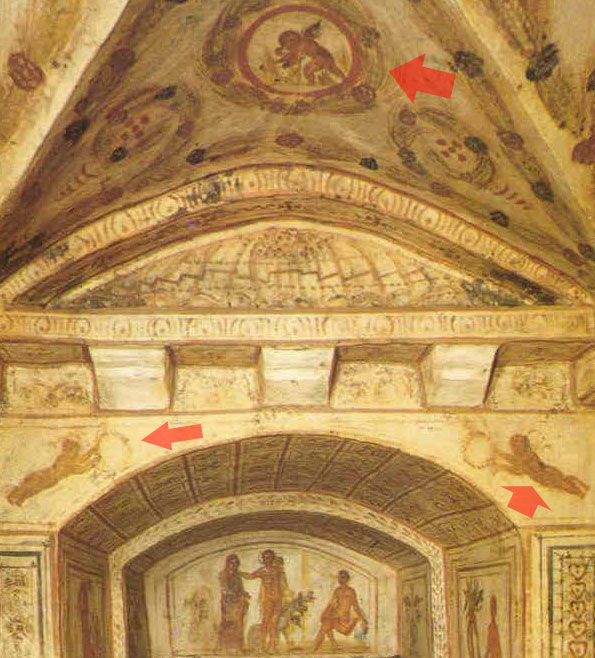
Around this arcosolium, also in Via Latina, we again see pagan images, including winged putti … Even with the official Roman sanctions on Christians, and active persecutions, much of Roman secular culture did seep into Christian culture, as any student of patristics or early art knows well. It was not a matter of beliefs, but of expression and idiom.
http://etd.lsu.edu/docs/available/etd-0404103-002340/unrestricted/West_thesis.pdf, p. 109 (pdf), p. 98 (paper):
Figure 1 : Arcosolium, Catacomb of Prisclla(?), Rome, late 3rd century
(Catacomb of Saint Sebastian):
The New American Desk Encyclopedia, 1997, pp. 246-247, “CATACOMBS”:
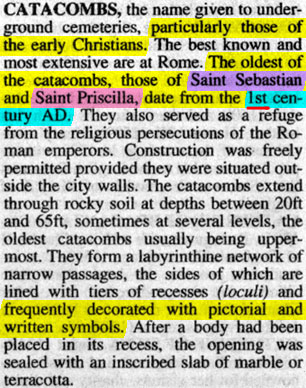
The Via Latina Catacomb, Tronzo, 1986, figure 102 (“S. Sebastiano”) [Eros]:
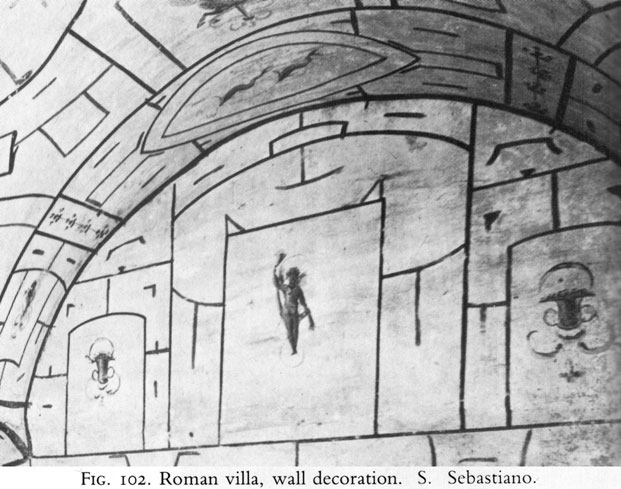
http://www.mcah.columbia.edu/dbcourses/klein/large/BISCO~97.jpg (via http://www.mcah.columbia.edu/cgi-bin/dbcourses/item?skip=1120), Room of the so-called villa piccolo; Complex of S. Sebastiano, Rome:
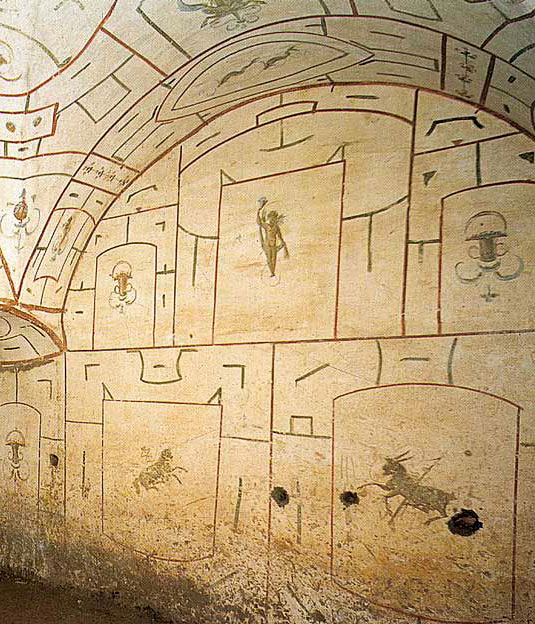
http://www.romeguide.it/MONUM/CATAC/foto/sebastiano_big.jpg (via http://www.romeguide.it/MONUM/CATAC/catnuoveeng.htm), Christian Catacombs, “San Sebastiano’s Catacombs”:
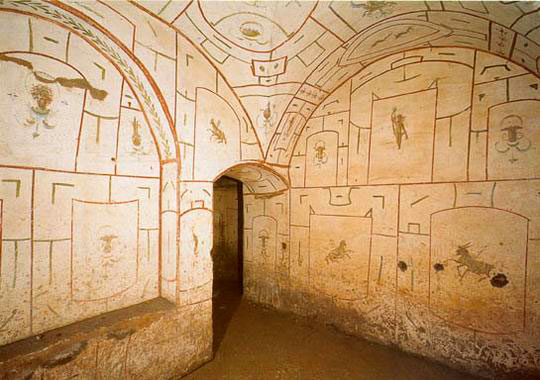
The Roman Empire: Art Forms and Civic Life, Hans Peter L’Orange, 1985, p. 82, illustration 37, “Catacomb of San Sebastiano”:
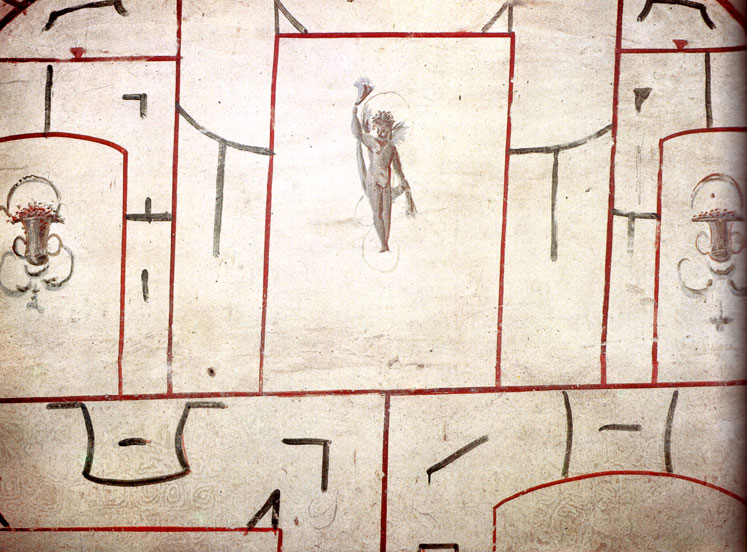
Enlargement:
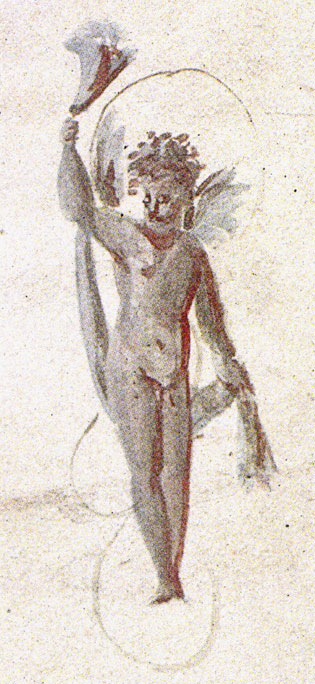
I believe they termed this “amorino” earlier.
http://campus.belmont.edu/honors/catacombs/vilpic.jpg (via http://campus.belmont.edu/honors/catacombs/catacombs.htm (Belmont University), The Christian Catacombs of Ancient Rome: An Introduction:
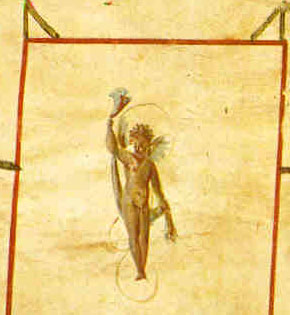
Catacomb of Praetextatus / Pretestato:
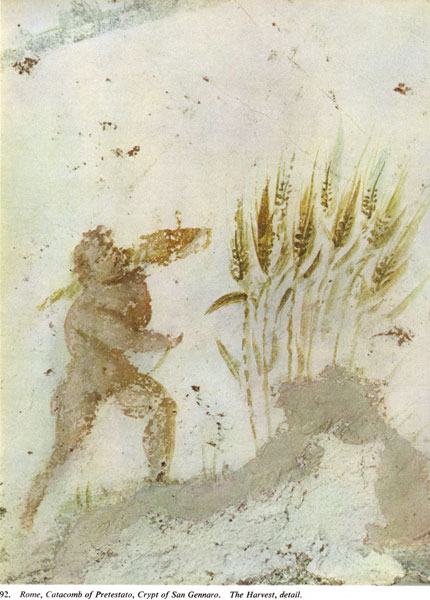
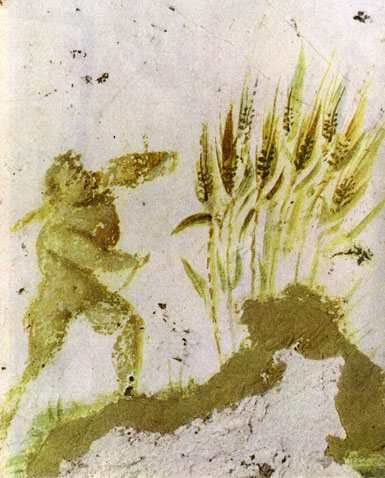
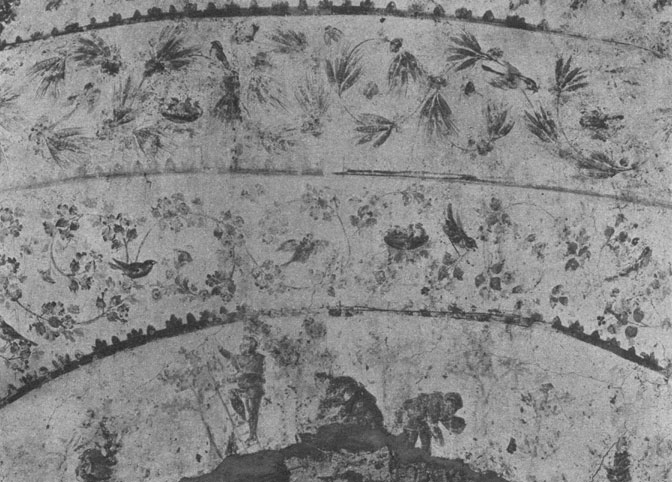
Early Christian Art: AD 200-395: From the Rise of Christianity to the Death of Theodosius, André Grabar, 1968, p. 96, “2. Christian Painting and Sculpture before the Peace of the Church (before 313 AD) | 92. Rome, Catacomb of Pretestato, Crypt of San Gennaro. The Harvest, detail”:
http://www.catacombsociety.org/vom/102.html, Vaults of Memory:
Barnyard Scenes
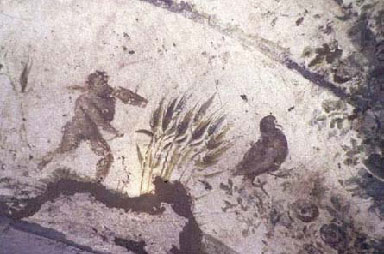
The Harvest
102.
Wheat is harvested in a metaphor for summer. Vault painting. Catacomb of Pretestato.
Early Christian Painting, Pierre du Bourguet, 1965, p. 27, “The Subjects Represented | Decorative Motifs”:
Figure 47 (Amorini):
“List of Plates | Catacomb of Praetextatus”:
(200-250 AD)
Figure 49 (Amorini):
“List of Plates | Catacomb of Praetextatus”:
Figure 51 (detail of figure 49) (Amorini):
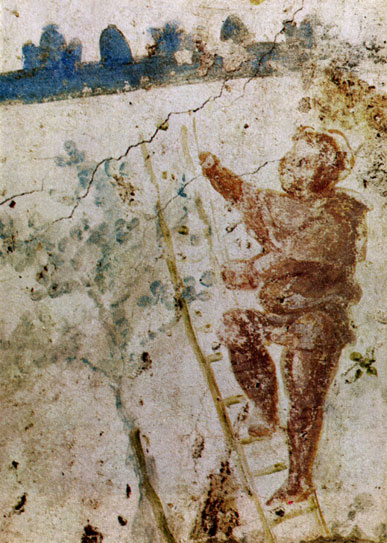
“List of Plates | Catacomb of Praetextatus”:

http://www.answers.com/Amoretti, Amoretti:
Amoretti or Amorini is an Italian term used to describe the small, winged babies who accompanied Cupid in the classicizing art of the Renaissance and late. Also called: Putti.
http://www.catacombsociety.org/vom/97.html, Vaults of Memory:
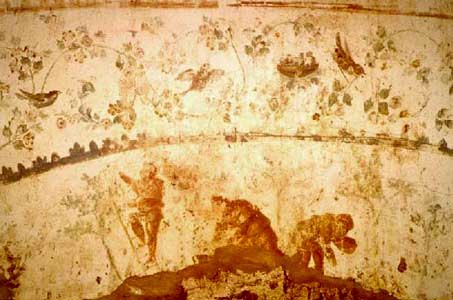
Olive Picking
97. Winter
is depicted in a vault painting from the catacomb of Pretestato.
Early Christian Art: AD 200-395: From the Rise of Christianity to the Death of Theodosius, André Grabar, 1968, p. 94, “2. Christian Painting and Sculpture before the Peace of the Church (before 313 AD) | 90. Rome, Catacomb of Pretestato, Crypt of San Gennaro. Winter”:
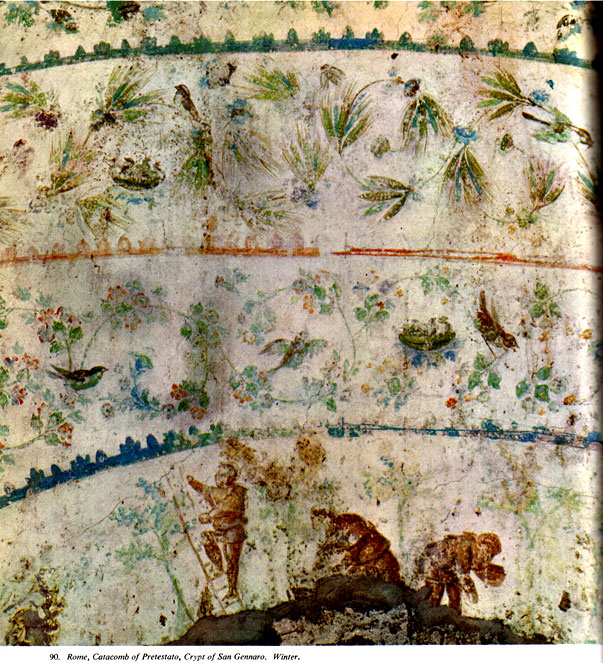
http://upload.wikimedia.org/wikipedia/commons/3/38/Praetextatus3.jpg (via http://www.freerepublic.com/focus/f-religion/2302991/posts), Indiana Jones and the Christian catacombs? Not quite:
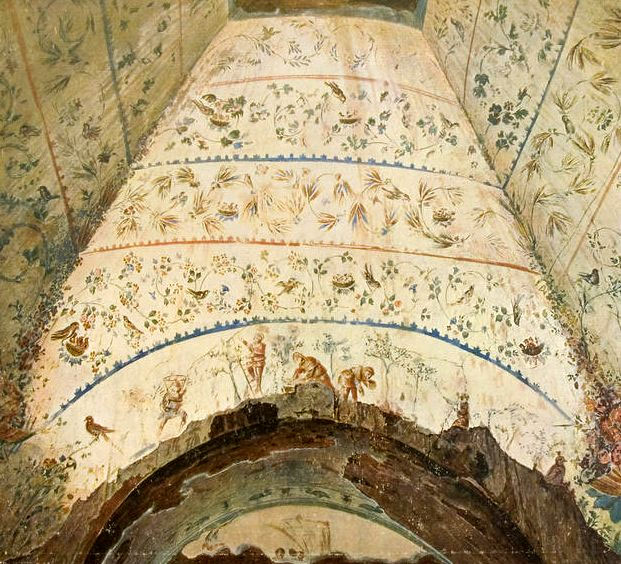
Season picture and olive harvest, air shaft, Crypt of San Gennaro, Catacomb of Pretestato, Rome (ca. 150-200
Catacomb of Vigna Randanini
http://www.catacombsociety.org/vom/100.html, Vaults of Memory:
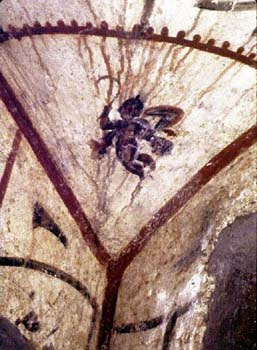
Genius of the Four Seasons
100. The
seasons are translated anthropomorphically into four winged putti or cupids
with such attributes as crooks, a mirror, and draperies. One of four painted pendentives.
Cubiculum II, catacomb of Vigna Randanini.
I don’t know: is that Eros?
http://www.catacombsociety.org/vom/108.html, Vaults of Memory:
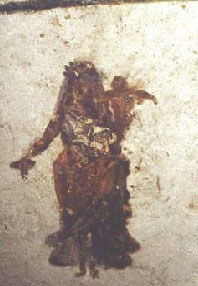
108. Fortuna or Tyche, a Graeco-Roman personification of nature's profusion, holds a cornucopia in her left hand and pours a libation with her right. Vault painting. Cubiculum II, catacomb of Vigna Randanini.