EROS / CUPID / “EROTIC” DEFINITION
“The god of love”: Eros (Greek Ερως or ερως); Cupid (Roman equivalent)
erotic = ερωτικός
He was simply the personification of love; therefore, his character sexual attributes are still intact (uncorrupted). Plus, he is totally left out of the New Testament for this to remain.
http://www.themoorings.org/life/basics/love.html (Bible Studies at The Moorings), Brotherly Love, “Four Faces of Love”:
Romantic love. Curiously, the Greek word for romantic love, eros, is missing from the New Testament. God chose not to use it, lest He confer validity on a faulty concept of love.
Then God should have used it to denounce it: to get the sex out of the Biblical “love.” It was left out for a purpose: to bypass Dark Age corruption, so “I” today would have its availability.
http://www.christiancourier.com/archives/agape.htm, The Challenge of “Agape” Love:
The New Testament was written in Koine Greek. … Koine Greek had several words representing different aspects of love. Eros generally had to do with sexual love. From this term derives the English “erotic.” This word, however, is never found in the New Testament.
Therefore, there’s nothing in the New Testament putting it down.
http://www.godchecker.com/pantheon/greek-mythology.php?deity=EROS, The Gods of Greek Mythology, “Greek Mythology : EROS”:
EROS: God of Love, Desire and Fertility. One of the most popular Gods of all time.
The Universe, the Gods, and Men: Ancient Greek Myths, Vernant, 2001, p. 192, “Eros”:

The “English” word for “love” meets the same parallel.
Crowell’s Handbook of Classical Drama, Hathorn, 1967, p. 135, “Eros”:

Oxford Latin Dictionary, Glare, 1982, p. 472, “Cupīdō”:

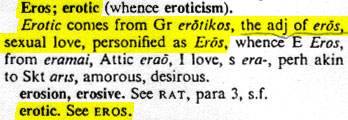
Origins: A Short Etymological Dictionary of Modern English, Partridge, 1983, p. 186, “Eros | erotic”:
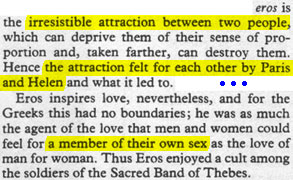
Collier’s Encyclopedia, 1993, vol. ?, p. 294, “EROS”:

A Concise Etymological Dictionary of Modern English, Earnest Weekley, 1924, p. 287:

An Etymological Dictionary of Modern English, 1967, Earnest Weekley, Vol. 1, p. 521:

Webster’s New World Dictionary and Thesaurus, 1996, p. 208, “Eros | erotic”:

Library of the World’s Myths and Legends: The Illustrated Dictionary of Greek and Roman Mythology, 1986, p. 80, “Eros”:
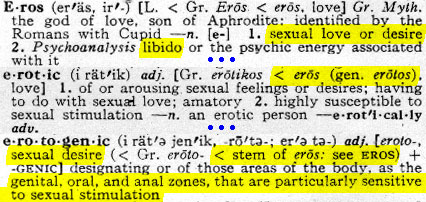
Webster’s New World Dictionary of the American Language, Second College Edition, 1982, Guralnik, p. 475:
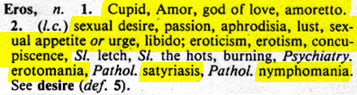
The Synonym Finder, Rodale, 1978, p. 363, “Eros”:
The Concise Oxford Dictionary, Pearsall, 1999, “Eros”:
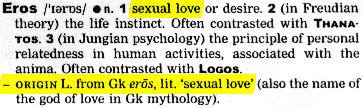
Encarta World English Dictionary, 1999, p. 606, “Eros | erotic”:
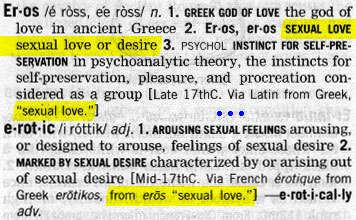
Merriam Webster’s Collegiate Dictionary, 1997, p. 283, “Cupid”:

P. 394, “Eros | erotic”:

The Stanford Dictionary of Anglicised Words and Phrases, Fennell, 1964, p. 367, “Eros”:

http://www.jahsonic.com/Eros.html, Eros:
In Greek mythology, Eros was a god who was in charge of passionate and physical love, as well as a fertility god. His name is the base of words such as erotic. His Roman equivalent was Amor ("love") or Cupid ("desire"). As Cupid, he was often accompanied by the Amoretti. Eros was associated with Aphrodite.
http://www.amystical1.com/greekgodsgoddesses.htm, Greek Gods and Goddesses, “Eros”:

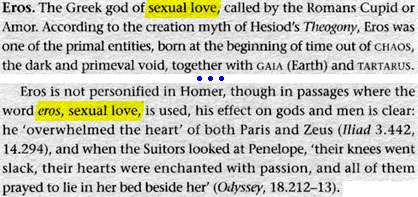
Cassell’s Dictionary of Classical Mythology, Jenny March, 2001, p. 299, “Eros”:
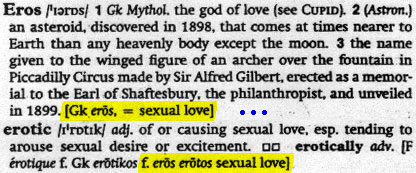
The Oxford Encyclopedic English Dictionary, Hawkins / Allen, 1991, p. 483:
The Greek Anthology and Other Ancient Greek Epigrams, 1973, p. 403:

http://www.scarletsbookofshadows.freewebspace.com/whats_new.html, Gods and Goddesses, “God”:
Eros:Greek God of romance and passionate love.
http://www.pagan-heart.co.uk/godsandgoddesses.html, Pagan God’s and Goddesses, ”Greek”:
Eros: God of Romance and Passionate Love.
http://www.kl.oakland.edu/kraemer/edcm/c.html, An Etymological Dictionary of Classical Mythology, “cupid”:
cupid n
[L Cupido, the Roman god of erotic love] : a figure that represents Cupid as a naked usu. winged boy often holding a bow and arrow
http://www.kl.oakland.edu/kraemer/edcm/e.html, An Etymological Dictionary of Classical Mythology, “Eros”:
Eros n
[Gk. Eros, fr. eros sexual love] 1 : the sum of life-preserving instincts that are manifested as impulses to gratify basic needs and to preserve the body and mind 2 : erotic love or desire
http://www.religioustolerance.org/valentine1.htm, St. Valentine and Valentine’s Day, “Cupid”:
Cupid in Roman mythology was the same god as Amor or Eros in ancient Greece. He was a minor god, the son of Venus, the Roman goddess of love and beauty. "Eros seems to have been responsible for impregnating a number of goddesses and mortals. The ancient Greeks believed Eros was the force 'love,' a force they believe was behind all creation." 8 He is portrayed today as a cute, chubby, cherub with bow and arrow, ready to shoot people and infect them with pangs of love. He is often associated with [Saint] Valentine's Day.
http://www.angelfire.com/ny4/sylverspage/gods/greekgods.html, Greek Gods and Goddesses:
Eros: Greek god of sexual desire.
http://conf.risquebbs.com/SPECIAL-INTEREST-GROUPS/PAGAN-WICCAN-Related/GOW.PDF, Gods of the World:
Eros
Greek god of sexual desire. See also Cupid.
Webster’s New World Dictionary of the American Language: Modern Desk Edition, 1979, p. 166, “erotic”:

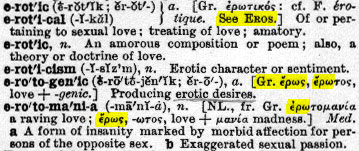
Webster’s New International Dictionary of the English Language, 1933, p. 746:
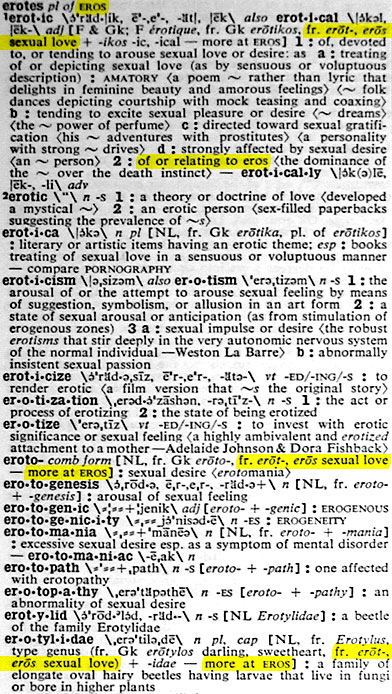
Webster’s Third New International Dictionary of the English Language (Unabridged), 1986, p. 772, “erot…”:
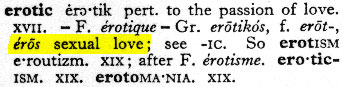
The Oxford Dictionary of English Etymology, Onions, 1966, p. 324, “erotic”:
The Oxford English Dictionary, 1989, “erotic”:

Oxford Universal English Dictionary on Historical Principles, 1937, vol. 3, p. 630, “Erotic”:

On abbreviations page, “ad.” means “(in etymologies) adaptation of,” and “f.” means “form of.”
Microsoft Encarta Dictionary (paperback), 2002, p. 296, “erotic”:
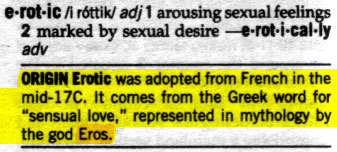
Reader’s Digest Family Word Finder, 1975, p. 269, “erotic”:
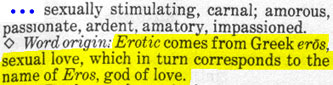
An American Dictionary of the English Language, Noah Webster, 1856, p. 407:

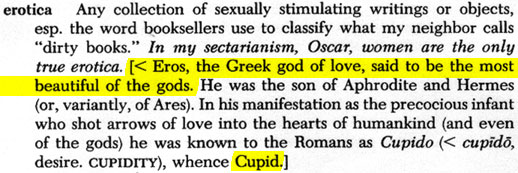
A Browser’s Dictionary, Ciardi, 1980, p. 121, “erotica”:
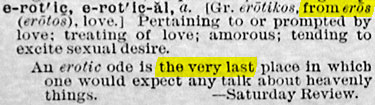
Webster’s Universal Dictionary of the English Language (unabridged), 1909, p. 579, “erotic”:
The American Heritage Dictionary of the English Language, 2000, p. 605, “erotic”:

Lempriere’s Classical Dictionary, 1853, p. 159, “Erotia”:

A Dictionary of Classical Names for English Readers, Jeffcott, 1914, p. 46:

Random House Word Menu, 1992, p. 564, “Dance | Dances of the World | erotic dance”:

The New Century Dictionary of the English Language, Emery / Brewster, 1952, vol. 1, p. 513:
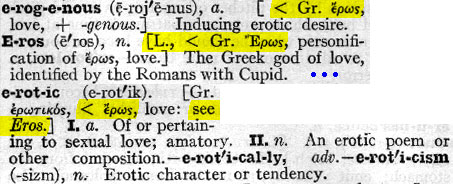
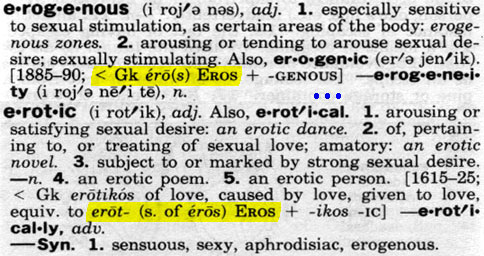
Random House Webster’s College Dictionary, 1991, p. 454:
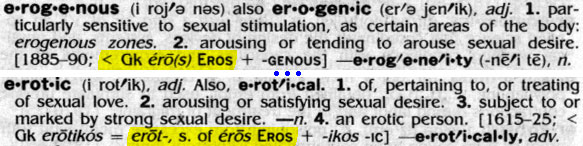
The Random House Dictionary of the English Language (Unabridged), 1987, p. 659:
The Pocket Oxford Greek Dictionary, Pring, 1995, p. 312 (English-Greek), “erotic”:

The relation of Eros with erotic is like the relation of Mars with Martian.
Cupid represents sex:
Dictionary of Sexual Slang, Richter, 1993, p. 60, “Cupid”:
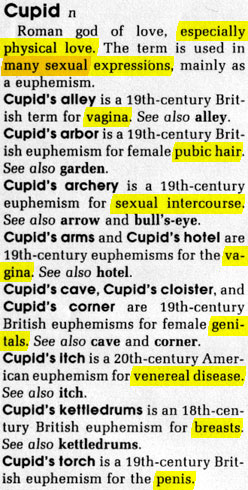
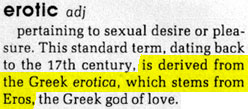
P. 74, “erotic”:
“EROSYN” is medication used for sexual enhancement:

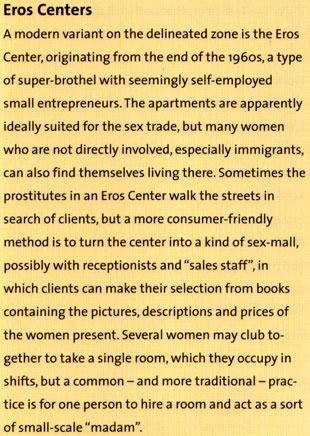
The prostitution industry uses the name Eros.
Sexualia: From Prehistory to Cyberspace, Bishop / Osthelder, 2001, p. 299, “From Streetwalking to Luxury Bordello | Eros Centers”:
http://www.paganpretties.com/ED.goddess.htm, Gods & Goddesses, “| Name | Tradition | Aspects |”:
|
Eros |
Greek |
God of passion & romance |
http://www.eskimo.com/~elladan/gods/description.html, Table of Gods:
|
Eros |
Greek |
A god of erotic love, passion & of sex |
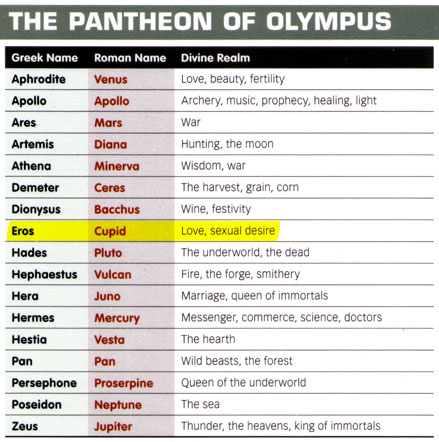
SparkCharts: Greek and Roman Mythology, 2002, “THE PANTHEON OF OLYMPUS”:
Some Greek:
A Greek-English Lexicon with a Revised Supplement (unabridged), Liddell & Scott, Oxford, 1996 (first edition 1843), p. 695, “έρως”:

Eros/erotic is also used in writings for non-sexual love, to express a strong generic concern for another (or thing) that equals the intensity of sex; thereby articulating quite a compliment. In language, to express an abstract comparison in words, one has to first relate it to a tangible or concrete known. Like the figurative metaphor: “You are the light in my life”: comparing the tangible “light” with the abstract feeling. To add the intensity of sexual love into today’s phony Christian love, is like making a mountain out of a mole hill.
A Lexicon to Herodotus, Powell, 1960, p. 143:

ΑΡΙΣΤΟΝ ΕΛΛΗΝΟΑΓΓΛΙΚΟΝ ΛΕΞΙΚΟΝ (Most Excellent Greek-English Dictionary), Michigan Press, 1969, Vol. A, p. 276, “έρως”:

I’m glad you all agree that Eros / Cupid has a lot to do with sexual / erotic love. Again, Eros / Cupid is the same definition of the English word for “love,” with an apparent maintained siding more for the sexual part. This tells that Jesus’ love sided more sexually than even today’s English definition; therefore, when Jesus was talking about the love between non-related adults, He was definitely talking about sexual love.
http://www.answers.com/love, “love”:
8. Love Mythology. Eros or Cupid.
9. often Love Christianity. Charity.
The New Century Cyclopedia of Names, Barnhart, 1954, Vol. 2, p. 1465, “Eros”:
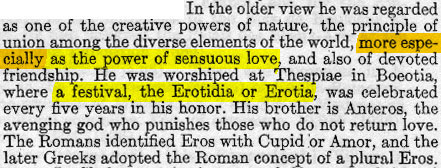
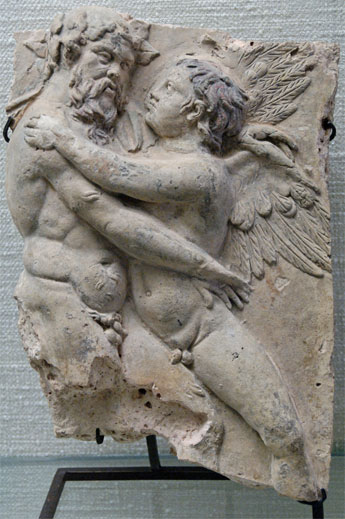
And, since most of the disciples where men, He was also elaborating homo- / bi-sexual love:
He also represented HOMO- / BI-SEXUALITY:
The Encyclopedia of Religion, Eliade, 1987, vol. ?, p. 148, “EROS”:
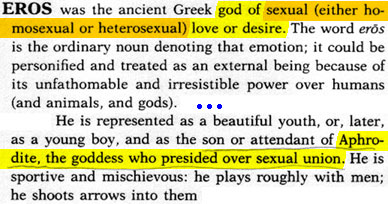
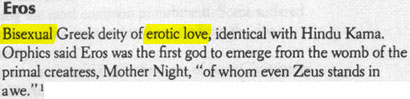
The Woman’s Encyclopedia of Myths and Secrets, Barbara G. Walker, 1983, p. 283, “Eros”:
http://en.wikipedia.org/wiki/Image:Silenus_Eros_CdM.jpg (via http://en.wikipedia.org/wiki/Homosexuality_in_ancient_Rome), Homosexuality in ancient Rome, “Eros and Silenus”:
A Dictionary of Comparative Religion, Brandon, 1970, p. 262, “Eros”:

http://www.magickmind.net/pagangods.html, Pagan Gods:
EROS God of love both heterosexual and homosexual, though his domain is not limited solely to sexual love and includes love in all its broadest senses.
Apparently Eros started out representing just sexual desire, then became used as any desire (for anything else not sexual) that met with the intensity level of sexual desire. If you have an eros for money, then you want it bad.
http://www.whitewicca.com/names_greek.asp, God and Goddess Names: Greece:
EROS; God of love both heterosexual and homosexual
http://80-www.xreferplus.com.ezproxy.jocolibrary.org/entry/773281 (Johnson County Library; subscription required), Eros:
The god of love (eros in Greek means love of the sexual kind). … In the classical period he was often regarded as the protector of homosexual love between men and youths
The Encyclopedia Americana International Edition, 1995, p. 327, “CUPID”:
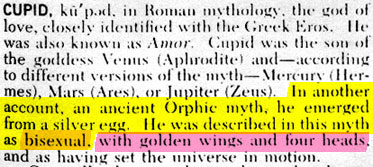
Interesting comparison:
Ezekiel 1:5-7 [NKJV] (describing the cherubs in Solomon’s Temple):
[5]… And this was their appearance: they had the likeness of a man. [6]Each one had four faces, and each one had four wings. [7]… the soles of their feet were like the soles of calves’ feet. They sparkled like the color of burnished bronze.
The Encyclopedia Americana International Edition, 1989, vol. 10, p. 555, “EROS”:
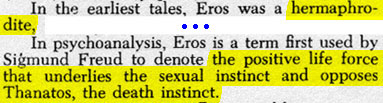
A hermaphrodite is someone with both male and female sexual characteristics.
Thanatos (the opposite of Eros):
The New American Desk Encyclopedia, 1997, p. 447, “EROS”:
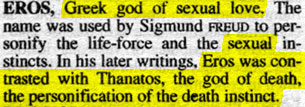
Dictionary of World Philosophy, Iannone, 2001, p. 325, “love”:
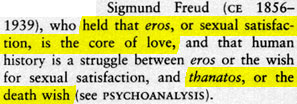
Yeah, when one is having sex, they’re kind of in the opposite mood of dying.
The Oxford Dictionary of English Etymology, Onions, 1966, p. 914, “thanatism”:

So, “Eros” can be “the soul” that lives in the Afterlife.
The Oxford English Dictionary, 1989, “Thanatos”:
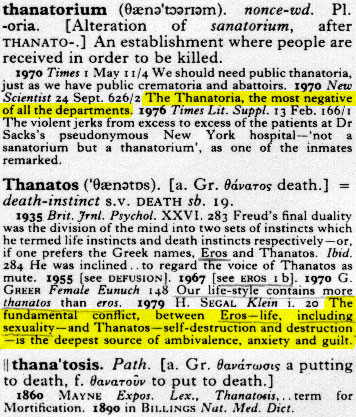
Miscellaneous:
Cliffs Notes on Mythology, 1973, p. 137, “Cupid”:

Aphrodite (Greek) and Venus (Roman) are the same “love” deities, just of the opposite gender. See my later Agapenor/Aphrodite page.
Direct Christ attributes:
Dictionary of Classical Mythology: Symbols, Attributes & Associations, Bell, 1982, p. 309, “Eros (Cupid)” (category):
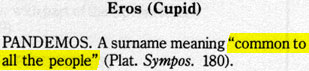
http://www.mythindex.com/greek-mythology/P/Pandemos.html, Greek Myth Index, “PANDEMOS ΠΑΝΔΗΜΟΣ”:
I e. "common to all the people," occurs as a surname of Aphrodite, and that in a twofold sense, first describing her as the goddess of low sensual pleasures as Venus vulgivaga or popularis, … Pandemos occurs also as a surname of Eros. (Plat. Symp. l. c.)
All Greek FORMS of Eros / erotic:
This was the list that I accumulated just for my reference, so there could be more (main ones in bold):
|
IS EROS: ερασ… ερατ… (probably) εραω
ερεω (possibly) εροεις ερον ερος
ερω (maybe) ερωμ… ερων ερως ερωσ
ερωτ ερωτα ερωτας ερωτ-αριον ερωτ-ε… ερωτ-ι… ερωτ-ικ ός (erotic) ερωτ-ισμός (erotic) ερωτ-ικως (erotically) ερωτ-ο… ερωτ-ομαν ία (eroticism) ερωτος ερωτυ… ερωτ-ωτερος |
NOT EROS:
ερεω (mostly, but not all) ask ερομαι ask
ερω ερωδ… ερω-εω ερω-η
ερωτ-αποκρι… ask
ερωτ-αω defined as: ask ερωτ-η… ask ερωτ-ιζω ask
ερωτ-ω defined as: ask |