GOD’S OPPOSITION
Today’s church has quite a problem if agape love used in John 13:34-35 had anything to do with sexual love: If it included any kind of sex in its definition, then that simple “including” allows sex to be part of the act which Jesus commands. Therefore, in the last century or so, there has been much pressure to take the sexual / erotic / Eros part out of the earlier definitions
Agape (Greek: αγαπ… or ηγαπ…)
Many times compared to Eros (Greek Ερως or ερως; ερωτικός [erotic]), a.k.a. Cupid or Amor; and/or the other parallel phil… (Greek φιλ…)
Human Sexuality, Masters / Johnson / Kolodny, 1992, p. 9, “Historical Perspectives on Sexuality | Early Times”:
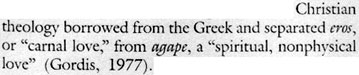
Apparently church leaders believe that the perfect way adults treat one another in today’s world proves that Jesus’ “non-sexual” love is a success.
The International Encyclopaedic Dictionary, 1901, p. 105, “ăg'-a-pē”:
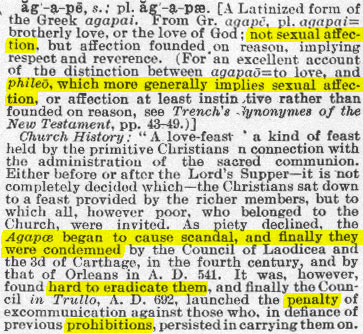
First of all, exactly what was the “scandal”? And, what kind of a scandal needs to be “condemned” and “eradicated” via a “penalty” if it was only a meal for the needy, and not a sex orgy? I mean, how can the standard Christian act of charity fall into a need for eradication, unless the “richer members” just decided to not be Christian anymore? And if that’s the case, then why would the “richer members” force others to not do it. I’m telling you, in a mind of higher intelligence, it doesn’t fit. The only thing that does make sense is how those later Church leaders who began to denounce the sex orgies (leading to what we have today) would feel the need for them to be stopped. Plus, if “the meal for the needy” was so awful, then why wasn’t the “love feast” stopped earlier – earlier toward the era of the people who actually knew Jesus? Some denominations today have “agape feasts” which includes a meal, feet washing, etc. (no sex orgy). No one today insists that they be stopped. Again, my job is to reveal the corruptions, and expose the real Jesus Christ no matter how many toes I’m stepping on: Ultimately, I serve only one, and that is God.
http://forum.wordreference.com/showthread.php?p=29544&highlight=agape#post29544, “agape”:
Actually "brotherly love" is the accepted translation of the greek word 'agape' which is used (in English, untranslated) to refer to non-sexual love. This word has been very Christian-ized of course. The idea of 'brotherly love' is supposed to apply to every person on the planet, not to the feelings between two individuals.
The Dictionary of Psychology, Corsini, 1999, p. 27, “agape”:
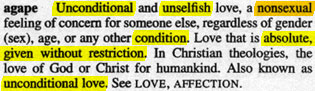
Well, sex only in marriage is definitely conditional, with all its restrictions, which is because married people are selfish/possessive, by restricting absolute (complete) love between others.
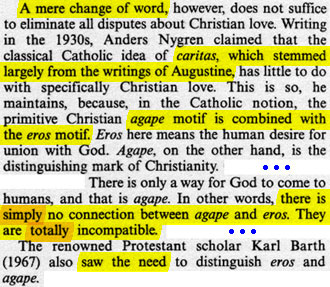
Routledge Encyclopedia of Philosophy, Craig, 1998, p. 280, “Charity | Christian love”:
http://www.etymonline.com/index.php?term=agape, Online Etymology Dictionary, “agape”:
1607, from Gk. agapan "greet with affection, love" (used by early Christians for their "love feast" held in connection with the Lord's Supper), from agapan "to love," of unknown origin. In modern use, often in simpler sense of "Christian love" (1856, frequently opposed to eros as "carnal or sensual love").
Except in the English and Greek where they both mean the equivalent of “love.”
http://scandinavian.wisc.edu/mellor/hca/glossary.html, The Tales of Hans Christian Andersen, “Glossary | agape”:
Agape: The concept of mutual love. This concept of love is used for a variety of ideas, one being spiritual love, in direct contrast to Eros. From a Christian perspective, it is the love that caused God to send Christ to Earth to save us. Therefore, Agape is merciful love.
Remove the sex and add a cop-out.
http://encarta.msn.com/dictionary_1861668827/agape.html, MSN: Encarta World English Dictionary, “agape”:
1. nonsexual love: love that is wholly selfless and spiritual
Now, love can definitely be nonsexual when it’s referring to the intense love for your children, parents, money, car, etc.; but, they are removing the very pertinent kind of love between non-related adults of either gender (whether it be man & woman, man & man, or woman and woman), which is manifested primary in sex. It’s like the gay marriage issue of today: no two guys or two girls wanted that much commitment before the popularity of gay sex. So, nonsexual love doesn’t really bring as much love as it does when it involves sex. So, sexually based love is much more powerful and therefore much more relevant than nonsexual love between non-related adults. It’s something you don’t “just” remove from the Bible word “agape” unless you seek your own corrupt desires. Plus, non of these definitions state a Biblical basis for their conclusion of removing the sex out of agape, other than the word “fornication” which was also corrupted, and is therefore used as a prerequisite to these agape pages. And, prostitution (the true definition of fornication) is just sex with conditions, not true love that has no conditions, which in the sexual case is a beautiful mutual love (in the true essence). You see, love for a child or a relative can definitely be one-sided, and sexual love (between non-related adults) is not mutual if it is prostitution or even most marriages / relationships that are really just sex for money / conditions. That’s right: When two people just pick up each other in a bar, that’s true mutual sexual love, believe it or not. Again, my thesis takes what we’ve been embeddedly taught and turns it just about completely around. That’s because it is the key to the Apocalypse. The only things that will be suffering in an allegoric war are only the minds of the adamant liars (and the prostitutes and gold diggers).
Harper’s Bible Dictionary, 1985, p. 14, “agape”:
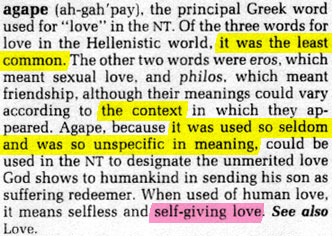
Our perspective that agape “was used so seldom” indicates that many documents may have been destroyed (likely by the church during the Dark Ages) to cover that small church problem of contextual meaning. This is indicated by the fact that agape is used much in the Greek Old Testament (The Septuagint) written before the Greek New Testament; therefore, it must have been a popular word to be used so much; and, it was used quite often in definite sexual context; which was the Old Testament predominately used by the early Christians, before the Latin Vulgate c. 400 AD. About this same date, it is documented that “Christians” did begin a very large campaign to burn books, mainly in the huge library in Alexandria, which was reported to house all the books of antiquity. By the way, oral sex is “self-giving.”
http://www.allwords.com/word-agape.html, “agape”:
Christian brotherly love, as distinct from erotic love.
Dictionary of Christian Lore and Legend, Metford, 1983, p. 18, “Agape”:
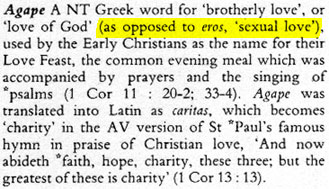
So, the greatest of these is (really) agape love.
http://www.answers.com/topic/agape, “agape”:
Love that is spiritual, not sexual, in its nature. … Greek philosophers at the time of Plato and other ancient authors use the term to denote love of a spouse or family or affection for a particular activity, in contrast to philia, an affection that could either denote brotherhood or generally a non-sexual affection, or eros, an affection of a sexual nature, usually between two unequal partners, the lover (eraste) and beloved (eromenos). The term is rarely used in ancient manuscripts.
–I believe they goofed there: “love of a spouse” is a sexual kind of love.
… Agape as a term for love or affection is rarely used in ancient manuscripts. A title of the goddess Isis was agape theon, or "beloved/darling of the gods", denoting her role as a fertility goddess and her pairing as a partner with multiple gods. While this pairing was often sexual in nature, the term "agape" implied a genuine affection and love for the goddess.
–Oops, there’s a direct contradiction.
… Agape and the verb agapao are used extensively in the Septuagint as the translation of the common Hebrew term for love which is used to denote sexual desire, affection for spouse and children, brotherly love and God's love for humanity.
–So in other words, regarding love between adults, it has a sexual meaning.
The HarperCollins Dictionary of Religion, 1995, p. 32, “agape”:
Encyclopedic Dictionary of Religion, 1979, vol. 2, p. 2169, “Love | Theology”:
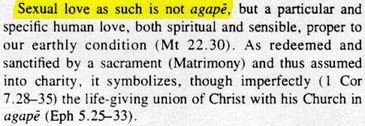
Again, “Jesus” said to not get married (Matt. 19:10-12), but did “command” to do the agape with “one another” (John 13:34-35). The truth should set [the world] free.
The Merriam-Webster Dictionary: Home & Office Edition, 1998, p. 10, “agape”:

Well, marriage / monogamy is definitely “conditional” and “selfish.”
Microsoft Encarta Dictionary (paperback), 2002, p. 15, “agape”:

The American Heritage Dictionary of the English Language, 2000, p. 31, “agape”:

All these definitions that define agape as “spiritual” love are just showing that they can’t locate a stable definition, after they’ve removed the sexual part. And, “selfless” is a (good) generic charity term; but, what’s so wrong if the love is mutual? Plus, oral sex is basically a “selfless” kind of giving. Charity (other than sex) is usually just one-sided. Well, that has some obvious drawbacks. The main one is that it’s not going to work overall. It’s definitely Christian and it’s definitely what the world needs more of, but it realistic can’t go as far as sexual love (with looks diversity). Plus, the world won’t “need” as much charity if the governments would implement my basic needs allotment idea presented 11-11-08 (see further in index [home] page].
Reader’s Digest Illustrated Reverse Dictionary, 1990, p. 323, “love”:
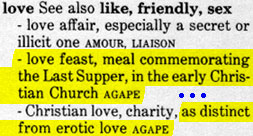
P. 95, “charity”:

The Concise Oxford Dictionary of Current English, 1964, p. 25, “ăg'-a-pē”:
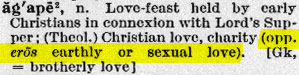
“Opp.” stands for opposite.
The Oxford Illustrated Dictionary, 1975, p. 14, “agape”:
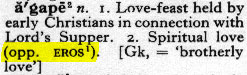
P. 284, “eros”:

The Oxford Encyclopedic English Dictionary, Hawkins / Allen, 1991, p. 24, “agape”:

The Oxford Dictionary of Philosophy, 1994, p. 9, “agape”:
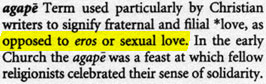
Note that a dictionary publisher’s job is to define it as the public demands it, and this word has apparently had much in demands to dictionary publishers from the “Christian” community.
The Oxford Dictionary of World Religions, Bowker, 1997, p. 28, “Agape”:
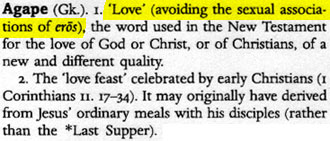
The Concise Oxford Dictionary, Pearsall, 1999, p. 24, “agape”:

The Oxford American Dictionary and Language Guide, 1999, p. 18, “agape”:

A Dictionary of Comparative Religion, Brandon, 1970, p. 188, “Charity”:
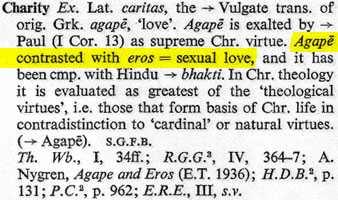
Westminster Dictionary of Theological Terms, McKim, p. 164, “love”:
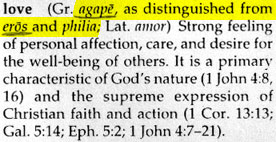
Dictionary of Philosophy, Angeles, 1980, p. 5, “agapē”:
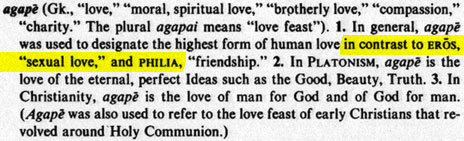
The New American Desk Encyclopedia, 1997, p. 28, “AGAPE”:
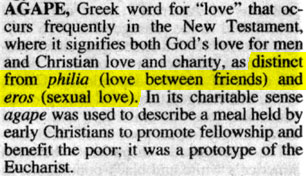
You see, it’s much harder the corrupt the attributes of all the “love” deities, when their stories have everything to do with sex. You would have to find all those writings and art, and destroy it all. A hundred years ago, it would have been impossible, unlike the obscurity of the English agape at the time. But, ALL “love” deities: Aphrodite, Eros, Venus and Cupid have to do with sexual love; so, Jesus made a big mistake using the same word to define His “new” instruction, for everyone (“one another) to do, if He was today’s said anti-sex bigot. Again, He would have said “except sexual love” if that was His real intention. And, He didn’t. The ONLY reason you just can’t believe it, is because you “trust” the wrong people way too much. And, I don’t know of anyone but me who has properly refuted the subject.
Random House:
The Random House Dictionary of the English Language: College Edition, 1968, p. 25, “agape2”:

P. 449, “Eros”:
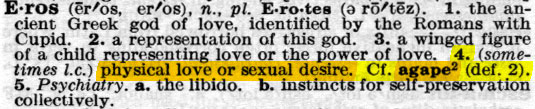
Notice how they removed “Cf. Eros” from “agape2” in the later edition, and stressing “non-erotic love”:
Random House Webster’s College Dictionary, 1991, p. 25, “agape2”:

Also they removed “Cf. agape” from “Eros” in the later edition:
P. 454, “Eros”:

This also appears to be about the same time Random House decided to “just” start using the name “Webster’s” of which they had no affiliation.
A change in an even later edition:
Random House Webster’s College Dictionary, 2000, p. 24, “agape2”:

It’s about time today’s church removed the problematic John 13:34 from the definition: “[agape love] one another.”
The Random House Dictionary of the English Language: The Unabridged Edition, 1983 (and older editions), p. 27, “agape2”:
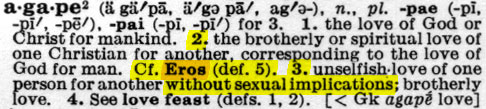
I think “(def. 5)” meant to say “(def. 4),” see below:
P. 484, “Eros”:
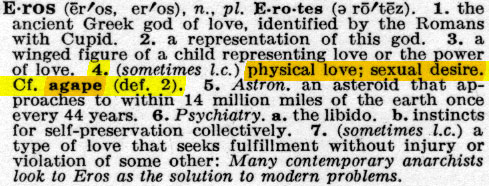
Notice how they removed “Cf. Eros” from “agape2” in the later edition:
The Random House Dictionary of the English Language: Second Edition: Unabridged, 1987 (and later editions), p. 37, “agape2”:
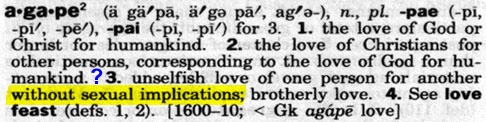
…but allowed “Cf. agape2” to remain under “Eros”:
P. 659, “Eros”:
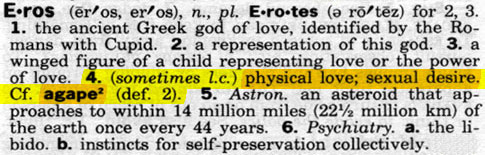
(An Internet source for above: http://dictionary.infoplease.com/eros, Eros.)
Plus, “without sexual implications” seems like a contradiction under this correlation. The process appears that someone told them to first add “without sexual implications,” then later noticed that the “Cf. Eros” needed to be removed. It is easy to see that the “Cf. Eros” was part of the original definition.
By the way: P. 1139, “love feast”:
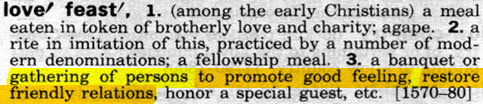
(“[Agape] love your enemies.”)
Realize, dictionary publishers’ job is to tell it as the public uses it. Therefore, meaning of words can be added or removed if, e.g., religious leaders group together to pressure dictionary publishers to change a meaning, which apparently gets accomplished.
Why do our religious leader think it’s so important to corrupt any connection between Jesus and sex? Can you see what I’m up against? They wouldn’t go to this much of an “extreme” on most any other Christian subject.