GOD’S OPPOSITION – REBUTTAL
Proof that sex is part of agape love
Agape (Greek: αγαπ… or ηγαπ…)
Many times compared to Eros (Greek Ερως or ερως; ερωτικός [erotic]), a.k.a. Cupid or Amor; and/or the other parallel phil… (Greek φιλ…)
A Concise Dictionary of Foreign Expressions, Phythian, 1982, p. 3, “agape”:

P. 49, “Eros”:

The Encyclopedia of Philosophy, Vol. 5, 1967, p. 91, “Love”:
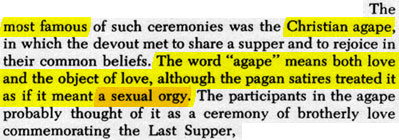
The “pagan” language was the definition of that age.
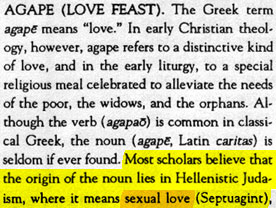
Encyclopedia of Early Christianity, 1990, p. 16, “AGAPE (LOVE FEAST)”:
1 Corinthians 13:13:
And now abide faith, hope, (agape) love, these three; but the greatest of these is (agape) love.
Dictionary of Theories, Bothamley, Gale Research International, 1993, p. 14, “agapism”:

Conversely, “erotic and sensual love” certainly can be “unselfish,” because sex is “mutual” pleasure, and it is the highest form of that.
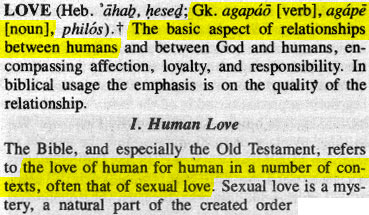
The Eerdmans Bible Dictionary, Myers, 1987, pp. 664-665, “LOVE”:
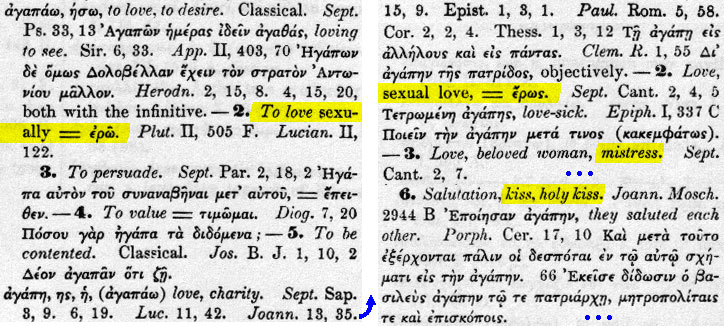
Greek Lexicon of the Roman and Byzantine Periods (From B.C. 146 to A.D. 1100), E. A. Sophocles (1807-1883), 1957, Vol. I, pp. 62-63:
“Thank you, you may step down. Next witness please:” “The people call Henry George Liddell, Vice-Chancellor of Oxford University and Dean of Christ Church; and Robert Scott, Master of Balliol College and Dean of Rochester to the stand”:
A Greek-English Lexicon (unabridged), Liddell & Scott, Oxford, 1871, p. 5, “αγαπάω”:
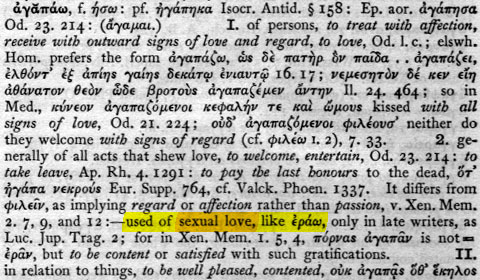
Apparently “late writers” includes c. 401 B.C.: “Luc. Jup. Trag. 2” (Lucianus Juppiter Tragoedus 2) was written c. 160 A.D., and “Xen. Mem. I. 5, 4” (Xenophon Memorabilia I. 5, 4) was written c. 401 B.C. which had everything to do with sexual love. Plus, there are many other B.C. agape sexual sources I’ve listed at this website.
The Vocabulary of the Greek Testament, Moulton / Milligan, 1930 (reprinted 1949), p. 2, “άγαπάω” (agapao):
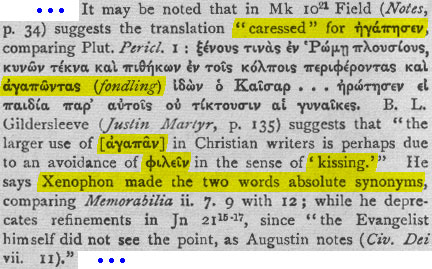
The Vocabulary of the Greek Testament, Moulton / Milligan, 1930 (reprinted 1949), p. 2, “άγάπη” (agape):
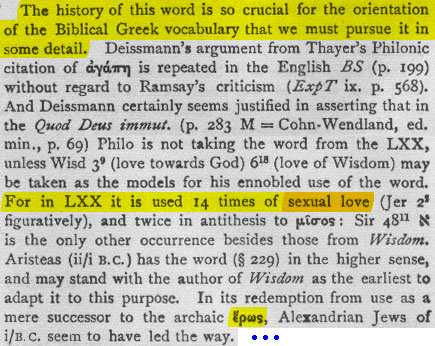
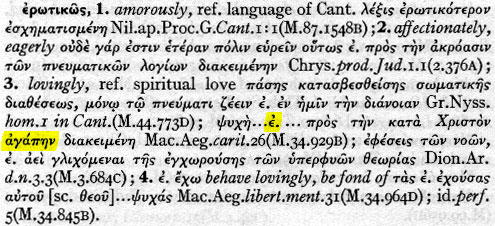
A Patristic Greek Lexicon, Lampe, Oxford, 1961, p. 7, “αγάπη”:
(“Patristic”: “Of or relating to the fathers of the early Christian church or their writings.”)
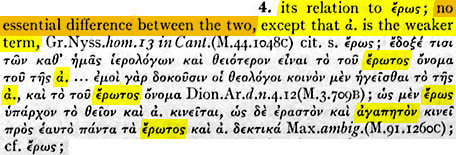
P. 550, “έρως”:
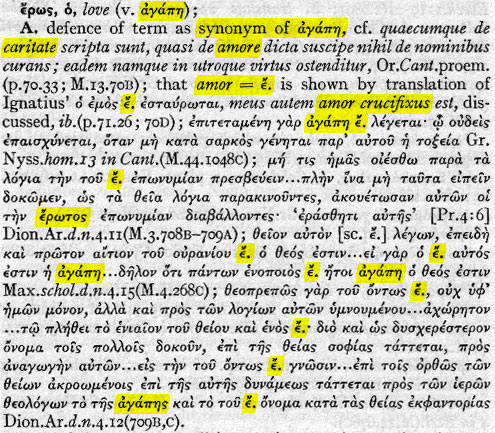
(Next column):
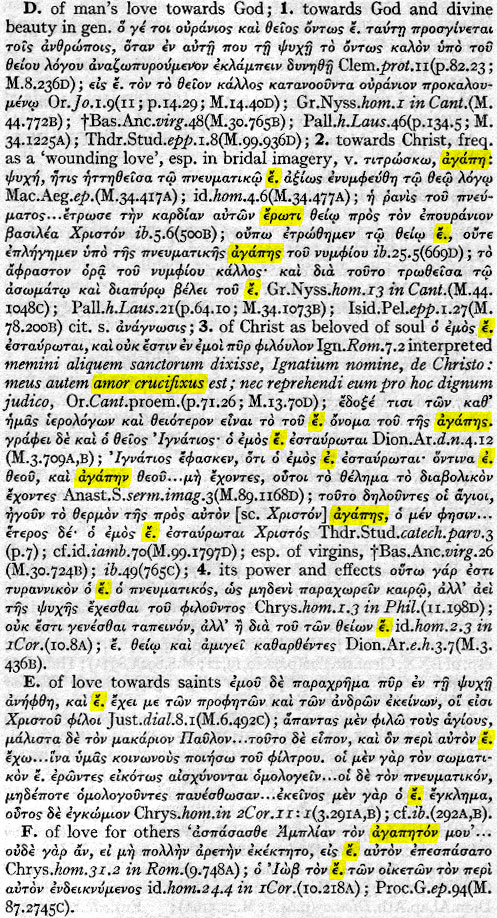
P. 551, “ερωτικως”:
http://members.ozemail.com.au/~moorea/index2.html, The Person Paradigm, “Agape”:
There is a link between Wisdom and Sexual Love in the term agape. We need to look at sexuality more profoundly than simply physical copulation, and we can be informed by some of the more obscure surviving texts of the primitive church.
http://www.agapetae.org/agapelxx.html, St. Ephrems Pearl, “Agape and the Septuagint”:
But other than a few very obscure occasions - one alluding to the Egyptian goddess Isis, (agapê theôn, title of Isis, POxy.1380.109) and another an erotic pet-name of a naked woman on a 5th century BC earthenware pot, the noun 'agape' was unknown.
http://www.wnblog.org/VinlandicSoldier, What They Don’t Want You To Know About, “Radical Nihilism by Richard McCulloch”:
It follows that gnosticism is completely egalitarian, regarding all as equal and the same, with no important differences or distinctions. The gnostic is especially egalitarian in love, believing it is immoral to love any person or people more than any other, but that all people and peoples should be loved and valued equally. This egalitarian form of love was called agape in Greek, and it was applied equally to all, impersonally, without differentiation, distinction or discrimination. … The gnostics were no more loyal or attached to their race, people or nation than they were to their sexual partners, professing themselves to be kosmopolites , cosmopolitans, or citizens of the world. … The "love" which was the leitmotif of the counterculture was agapic love, the egalitarian and promiscuous love that is characteristic of gnosticism; universal, impersonal and nondiscriminating, unfocused, without any special intensity of emotion or feeling for any particular person, people or thing. In sexual relations this promiscuous love (agape) was euphemistically referred to as "free love." In political and social matters it expressed itself as universalism and the cosmopolitan "One-World, One-Race, One-People" goal of Oneness. …
4. Thus gnostic sects often rejected monogamy and promoted either celibacy or a promiscuous community of sexual partners where exclusive relationships and strong personal attachments were forbidden. One Christian gnostic sect, the Phibionites, engaged in agapic orgies as part of their religious rites.
(text also at http://www.racialcompact.com/racialnihilism.html)
http://st-elizabet.narod.ru/raznoe/moss_english.htm, Marriage, Grace And The Law:
Philology also helps us to understand the original goodness of sexual desire. The word most commonly used for sexual love in the Greek Bible is agape. Since this is a purely biblical term not found in earlier Greek[34], we might think that it refers to some quite different kind of love from that referred to by the usual Greek word for sexual passion, eros. However, it is precisely agape which is used to refer, on the one hand, to Amnon's criminal passion for Themar (II Kings 13.15), and on the other to the nature of God Himself - "God is Love" (I John 4.8) and to the highest Christian virtue (I Corinthians 13.1). Moreover, as Fr. Gregory points out, the words eros and agape are virtual synonyms in the works of St. John Chrysostom [c. 347-407 AD] (p. 138, note 239).:
http://www.newadvent.org/cathen/08452b.htm (Catholic Encyclopedia), St. John Chrysostom:
born at Antioch, c. 347; died at Commana in Pontus, 14 September, 407. … is generally considered the most prominent doctor of the Greek Church and the greatest preacher ever heard in a Christian pulpit.
http://www.marquette.edu/maqom/Macmetho.html, A Testimony to Christianity as Transfiguration: The Macarian Homilies and Orthodox Spirituality:
The inner and deeper warfare requires divine assistance, precisely the "heavenly armor" mentioned above and borrowed from Ephesians 6:14-17. Heavenly aid begins and ends with love, the yearning desire for Christ which is at once the expression of the soul's own deepest longings and, simultaneously, the Lord's gift and presence. Like Origen and Gregory of Nyssa, Macarius uses eros and agape effectively as synonyms [35]. … 35. For Macarius on the equivalence of eros and agape, see II.5.5; 10.4; 15.37; and Great Letter 23; in Gregory Nyssa, e.g., Vita Moysii II.231-232 (SC 1:106-107), and for comment, J. Danielou, Platonisme et theologie mystique (Paris:1944) 201 ff., and Origen's "Prologue"to his commentary on The Song of Songs (tr. Lawson, Ancient Christian Writers 26, pp. 30-38).
Encyclopedia of the Early Church, Oxford, 1992, Vol. 1, p. 507, “LOVE of God and Neighbour”:

http://www.marquette.edu/maqom/Lumxida.html, Dionysius Areopagita: A Christian Mysticism?, “III. Epistle X, ‘To the Apostle John at Patmos’, as an Introduction to the Corpus Dionysiacum: A Response to Apocalyptic Literature and Visionary Practices Directed to a Monastic Audience”:
They depart with complete freedom from every evil, and with divine love [eros] for every good thing, they love [agaposi] peace and holiness. … Similarly, the verb, politeuomai, here meaning "to live a [disciplined] way of life", together with the nouns, apatheia or dispassion, eros, and the latter's effective equation with agape, both meaning love here, place this passage -- as well as other, lengthier ones in the CD -- in a long prior line of patristic thought to do with asceticism and mysticism, one which runs from Clement and Origen in Alexandria through Gregory of Nyssa in Cappadocia to the great Desert Father and mystic, Evagrius of Pontus. … ( --“VI. The Divine Names: Notes of Eschatological Anticipation and on ‘Spiritual Fatherhood’ as Illustration of the Trinity”:) The mysteriously impelling force which takes us over in this ascent is, as he spells out at length in DN 4 (94), nothing more nor less than God's own love, His eros or agape, which moved Him to create us and this world in the first place, and, in the second, to redeem His creatures in the Incarnation. … ( --“VII. The Mystical Theology: Ascending the ‘Mountain of the Church’ to Approach the Light of Christ, the Shekinah”:) Fourth, regarding love, Dionysius has already told us in the DN, and at length, that divine eros is the power which returns us all to God.
http://www.encyclopedia.com/html/D/DionysiuA1.asp, Dionysius the Areopagite, Saint:
1st cent. AD, Athenian Christian, converted by St. Paul. Acts 17.34. Tradition has made him a martyr and the first bishop of Athens.
1 John 4:12:
No one has seen God at any time. If we (agape) love one another, God abides in us, and His (agape) love has been perfected in us.
Since God is everything, then God is part of the sexual act.
Larousse Illustrated International Encyclopedia and Dictionary, 1972, Part 2: Dictionary, p. 13, “agape”:

P. 283, “eros”:

Longmans English Larousse, 1968, p. 17:
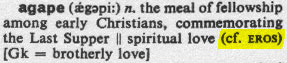
P. 373:
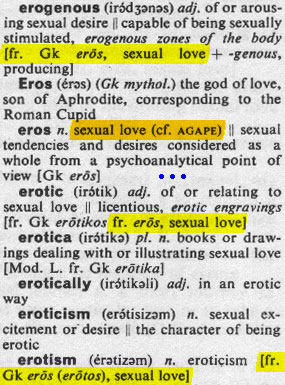
P. 686:

http://www.piney.com/AgapeSummary.html, The Agape or Agapae Pagan and Biblical Background:
"Agape the ruler of sacred sexual rites, and Chione was the new year, born at Winter Solstice, unapproachable and serene. The priestesses who served each avatar were the original angels, who developed calendars and sacred dances. While today their dances are mainly represented by the hora, an imitation of the spinning cycles of time, their work in the field of time keeping remains. … Agape as meaning "unconditional love" is popular among the feminist and justifies all forms of sexuality.
http://dance-of-ecstasy.net/dance/0302.html, 3.2 LUST/LOVE/ECSTASY:
Sex, prostituted by eros and then ultimately redeemed by amor, becomes finally the living manifestation of an all encompassing third level of love. In the New Testament, this third level of love is termed agape.
The Sacred Mushroom & The Cross, John M. Allegro, 1971, p. 173, “Death and Resurrection”:
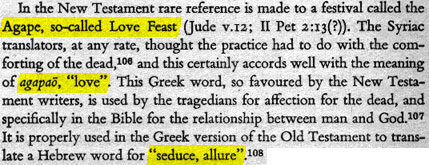
P. 176:

John M. Allegro was one of the original scholars who worked on the Dead Sea Scrolls. “Phallic” means a penis.
Encyclopedia of Values and Ethics, Hester, 1996, p. 19, “AGAPE”:
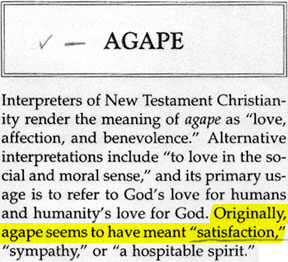
The Cambridge Dictionary of Philosophy, 1995, p. 12, “agape”:

“Quite general” includes sexual love.
Fundamentals of Human Sexuality, Katchadourian, 1989, p. 657, “Biblical Grounds”:
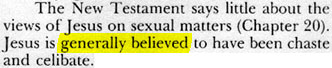
“Generally believed” means they don’t really know; and, their assumption is based on the corruption.
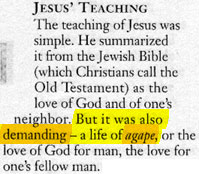
World Religions, Bowker, 1997, p. 136, “Christianity”:
http://www.quotesandpoem.com/quotes/showquotes/author/Martin-Luther-King-Jr./4722:
"Love [sex] is the only force capable of
transforming an enemy into friend." -
-- Martin
Luther King Jr.
No one really loves their enemy (in today’s status-quo). It’s phony-baloney: it ain’t gonna work, and we should all be repeatedly aware. But, one can certainly feel the touchable sexual satisfying advantage of their enemy.
http://apostolicbible.com/downbook.htm, The Apostolic Bible, Ephesians 5:23-27:
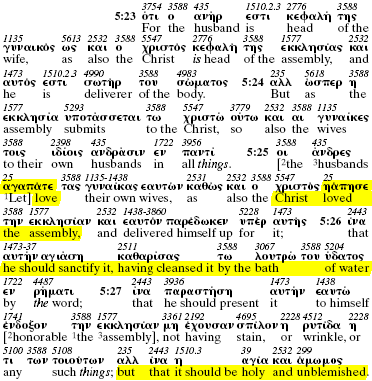
Here, Paul uses agape to describe the love between a husband and wife, which we know is sexual, which is the same kind of love Christ did for His “assembly”; explaining “that it should be holy and unblemished,” to overrule something apparently the Jews say isn’t, that Christ would need to wash clean. Why would anybody have a problem (“stain or wrinkle”) if Christ just liked / loved His followers in today’s sense? (By the way, “ηάπησε” above is misspelled; but, in my other Interlinear it is “ηγάπησε.”)
The Power of Sex:
http://web.ukonline.co.uk/john.mizarolli/guitaroverview.htm:
When Man Sacrifices the Love of Power for the Power of Love we will have Peace on Earth (Yogananda)
That kind of “Power of Love” can only be achieved via Sexual Love.
http://www.growthtrac.com/artman/publish/article_174.php, Giving Up Sex, By Fern Horst:
For 55 million dollars, would you
give up sex for the rest of your life?"
What a question! It invoked some interesting answers from
listeners to a radio talk show I was listening to recently. Some who called in
said they would be more than willing to forfeit sex forever for this amount of money;
others said, "no way!"
That just shows how powerful sex really is (for
the free / reality thinkers).
Agapet:
The Oxford English Dictionary, 1989, “agapet”:

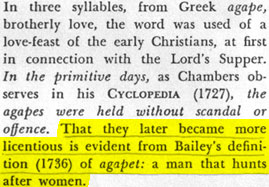
Dictionary of Early English, Shipley, 1955, p. 21, “agape”:
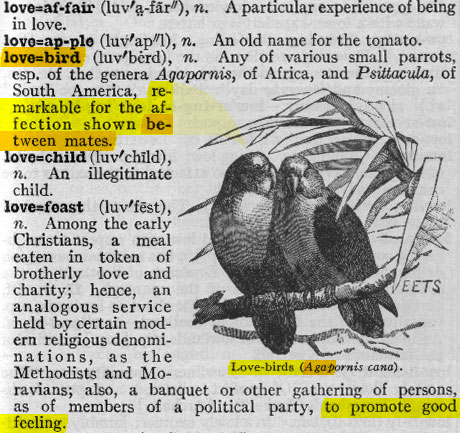
Agapornis cana:
The New Century Dictionary of the English Language, Emery / Brewster, 1952, vol. 1, p. 983, “love bird”:
Modern Greek:
http://translate.google.com/translate_t?langpair=el|en#el|en|%CE%B1%CE%B3%CE%B1%CF%80%CE%B7%CF%84%CE%B9%CE%BA%CE%B9%CE%AC (Google Translate), Greek-English, “αγαπητικιά”
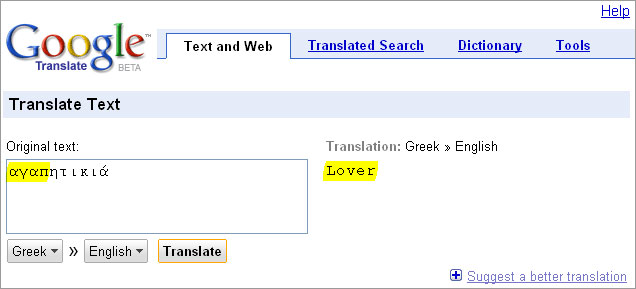
I bet a lot of you churches want to “Suggest a better translation.”
Update 7-15-09: Copy/pasting the above url (to your browser) now gives “loving” as the translation. The above original is a year or two old (shortly after Google added Greek). So, the church has now got to Google. It makes sense, as these new Google tools make accessing the Greek language much easier now-a-days, to clash the corrupted English.
Langenscheidt’s Standard Greek Dictionary, Magazis, 1990, p. 444 (Greek-English), “αγαπ…”:
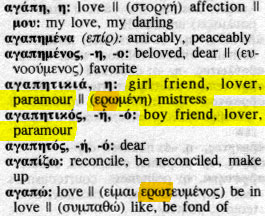
P. 587, “έρωτας”:

The Oxford Paperback Greek Dictionary, Watts, 1997, p. 78 (Greek-English), “έρωτα|ς”:

P. 399 (English-Greek), “sexual intercourse”:

The Oxford Paperback Greek Dictionary, Watts, 1997, p. 1 (Greek-English), “αγαπ…”:
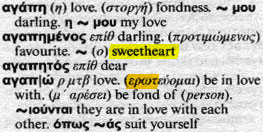
Oxford Greek-English Learner’s Dictionary, Stavropoulos, 1988, p. 3, “αγαπ…”:

The Pocket Oxford Greek Dictionary, Pring, 1995, p. 1 (Greek-English), “αγαπ…”:

Pocket English Dictionary: English-Modern Greek, Modern Greek-English, Efstathiadis Group, 1999, p. 245 (Greek-English), “αγαπ…”:
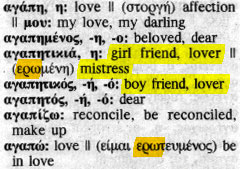
A Complete Greek-English Dictionary, Arnold Mandeson, vol. 1, p. 5:
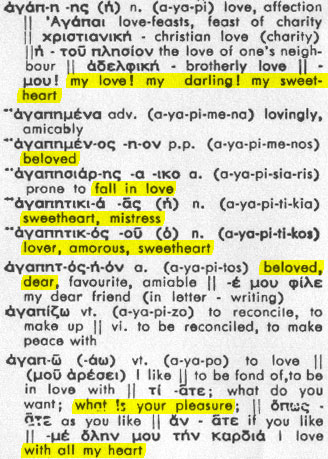
Sounds like a lot of romantic kind of love to me.
Hippocrene Standard Dictionary: Greek-English English-Greek, 1998, p. 8 (Greek-English), “αγαπ…”:
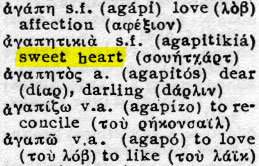
Okay, let’s give it a try:
John 13:34-35:
34A new commandment I give to you, that you be one another’s sweet hearts; as I have been a sweet heart to you, that you also be one another’s sweet hearts. 35By this all will know that you are My disciples, if you are one another’s sweet hearts." I bet they will. Again, “sweet heart” is the English equivalent definition. When you’re dealing with a bunch of adults of the same sex, whenever you take away the sexual part of “love”, “love” becomes a lie, as love between adults of the same sex could only best manifest in sexual love. Normally “love” is an extreme intensity for just one (or, however many wives you have, like if you’re Solomon); but, Jesus states “a new” that agape love is to be a non-monogamous love by commanding it done with “one another.” Or, “agape one another.” Therefore, the “lust” (extreme intensity / covetous) part of “love” should be removed, and more of a universal acceptance kind of love should be spread amongst as many non-related adults as reasonably possible, which can be attained in an open-sex environment with a desire for diversity in looks. Less bias “all your love” for one, and more of a seeing everyone as a physical “value” kind of love. That’s the only possible base for a future utopia. (Don’t implement it today because of all the STDs/AIDS. This perfection is for the future.)
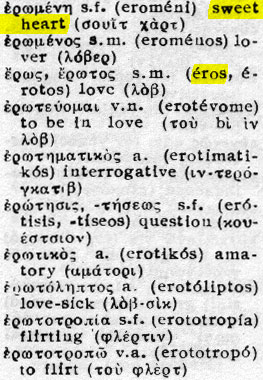
P. 145, “ερω…”:
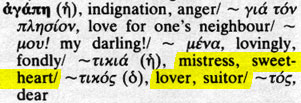
NTC’s New College Greek and English Dictionary, Nathanail, 1990, p. 1 (Greek-English), “αγάπη”:
P. 410 (English-Greek), “lovemaking”:
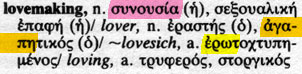
“συνουσία” is today’s Greek word for “sexual intercourse.”
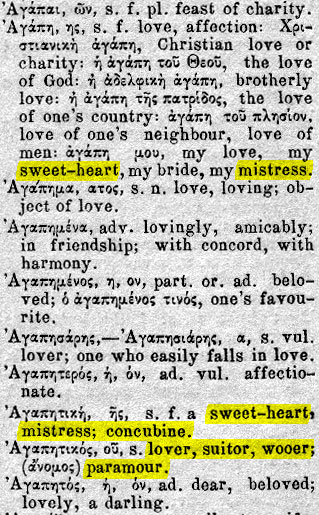
Kontopoulos Greek-English Dictionary, 1889, p. 3, “Αγαπ…”:
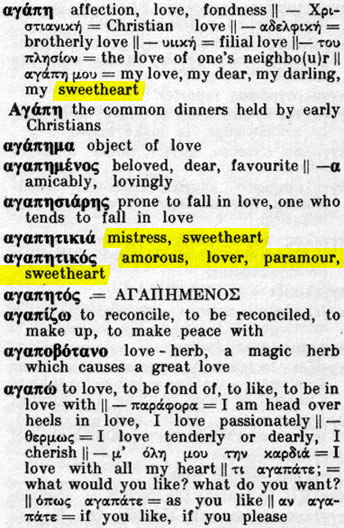
ΑΡΙΣΤΟΝ ΕΛΛΗΝΟΑΓΓΛΙΚΟΝ ΛΕΞΙΚΟΝ (Most Excellent Greek-English Dictionary), Michigan Press, 1969, Vol. A, p. 13, “αγαπ…”:
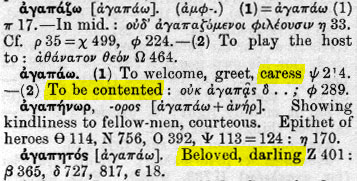
A Lexicon of the Homeric Dialect, Cunliffe, 1963, p. 2, “αγαπ…”:
Berlitz Greek Phrase Book & Dictionary, 1998, p. 189, “love | I love you”:
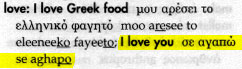
Essentials of New Testament Greek, Summers / Sawyer, 1995, (appendix) Greek-English Vocabulary, p. 173, “αγαπ…”:

Lonely Planet Language Survival Kit: Greek Phrasebook, Hellander, 1995, p. 187, “love”:
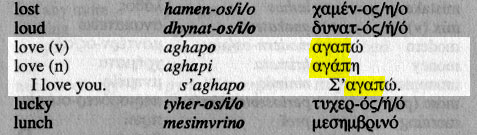
Some word form notes:
Word Parts Dictionary, 2000, p. 5:

An Intermediate Greek-English Lexicon, Liddell & Scott, Oxford, 1997 (first edition 1889), p. 347, “ηγάπ…”:

Complete Handbook of Greek Verbs, Marinone / Guala, 1961, p. 177, “ηγαπ…”:

http://www.gramcord.org//mac/bdag.htm, Greek-English Lexicon of the New Testament, “αγαπαω”: