EROS in early CHRISTIAN ART (miscellaneous)
Early Christian Art: AD 200-395: From the Rise of Christianity to the Death of Theodosius, André Grabar, 1968, p. 156, “3. The Art of the Fourth Century | Pagan Monuments”:

http://www.newadvent.org/cathen/07664a.htm (Catholic Encyclodedia), Veneration of Images, “II. Christian Images Before the Eighth Century”:
One sees with some surprise motives from mythology now employed in a Christian sense (Psyche, Eros winged Victories, Orpheus), and evidently used as a type of our Lord.
Via Olmetto, Milan (northern Italy)
http://www.pontos.dk/e_pub/TBNNets.htm (Danish National Research Foundation); Nets, boats and fishing in the Roman world:
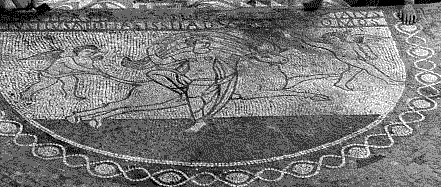
Although a few of the depictions of net fishing discussed here may relate to, or be inspired by, the Christian gospels … 12. Milan, Via Olmetto. Floor mosaic, 4th century century AD. A cupid standing in a rowing skiff, pulling at a purse-shaped net with both hands, one at each side of the net. The scene forms part of a larger programme of Christian symbols.
Ref.: Roberti 1980, 161-64; Pekáry 1999, I-M 6, p. 168.
(Bibliography … Roberti, Mario M. 1980. Un mosaico figurato in via Olmetto a Milano, in id. (ed.), Archaeologia e storia a Milano e nella Lombardia orientale, Como: Pietro Cairoli, pp. 157-68.)
Archeologia e storia a Milano e nella Lombardia orientale, Directed from Mario Mirabella Roberti, 1980, Published by Peitro Cairoli – Como, p. 163, “Milano, aula di via Olmetto: il pannello centrale, la pesca”,
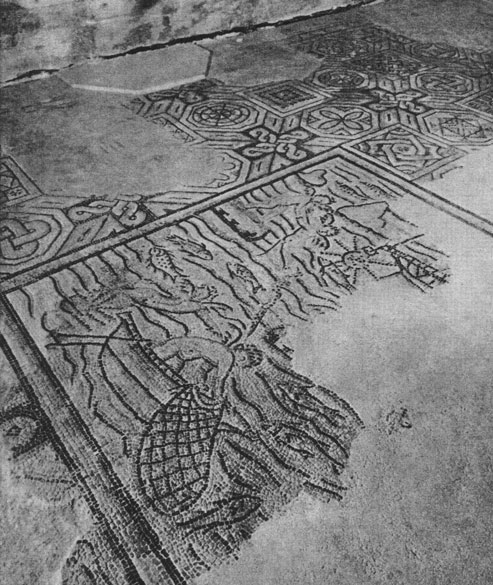
P. 164 (regarding the erotic fishing scene above) (translated from Italian):
But sure the Christian world, with the frequent references of the New Testament to the spiritual fishing, to the functions of the apostles fishermen of men, had to appreciate the subject, as I appreciate and use widely that one of the vine and the grape.
(Ma certo il mondo cristiano, con le frequenti allusioni del Nuovo Testamento alla pesca spirituale, alle funzioni degli apostoli pescatori di uomini, doveva apprezzare il soggetto, come apprezzò e usò largamente quello della vigna e dell'uva.)
Tomb of the Valerii under St. Peter’s:
http://classics.furman.edu/~rprior/imgs/RCU4/4-080.jpg (via http://classics.furman.edu/~rprior/courses/RA/RAU4.html) (Furman University), Roman Archaeology: Roman Art, Non-Stone Relief:
Stucco lunettes with allegories of fertility, from the Tomb of the Valerii in the cemetery under St. Peter's:
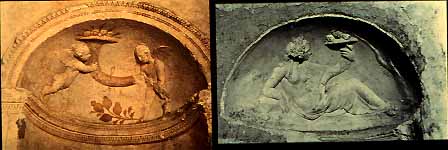
http://stpetersbasilica.org/Docs/JLM/SaintPeters-3.htm, Saint Peter’s:
Lastly, in the tomb of the Valerii the excavators revealed what they believe to be the head of St Peter drawn in faded red lead, with an inscription, 'Peter, pray Christ Jesus for the holy Christian men buried near your body.' Several experts have claimed that the drawing and inscription date from before the basilica was built.
http://www.saintpetersbasilica.org/Necropolis/MG/Fig-18-p72.jpg (via http://www.saintpetersbasilica.org/Necropolis/MG/TheTombofStPeter-4.htm), THE TOMB OF ST. PETER:
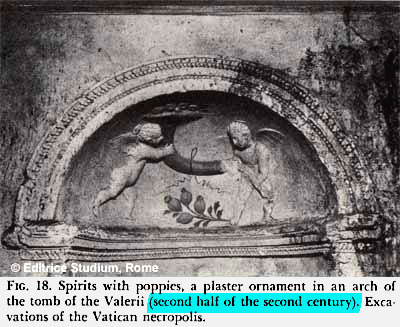
http://www.archaeologie-online.de/bibliothek/tagungsberichte/2008/cult-and-imagination/roman-sarcophagi-in-their-original-context-rome-and-vicinity/seite-1/, “Roman Sarcophagi in their Original Context, Rome and Vicinity”:
One of the few examples is the so-called "Tomb of the Valerii" on Via Latina, built around 160 A.D.
Lullingstone, Kent, UK:
http://www.english-heritage.org.uk/server/show/conProperty.195, Roman Villa, Kent:
A most exciting archaeological find. The villa was built c. AD 75, and extended several times during 300 years of Roman occupation: it includes a room decorated with Christian symbols, among the earliest evidence for Christianity in Britain. Much is still visible today, including mosaic-tiled floors, wall paintings, and the extensive 4th-century bath complex, built when the villa was at its most prosperous.
Imperial Rome and Christian Triumph, Elsner, 1998, p. 137:
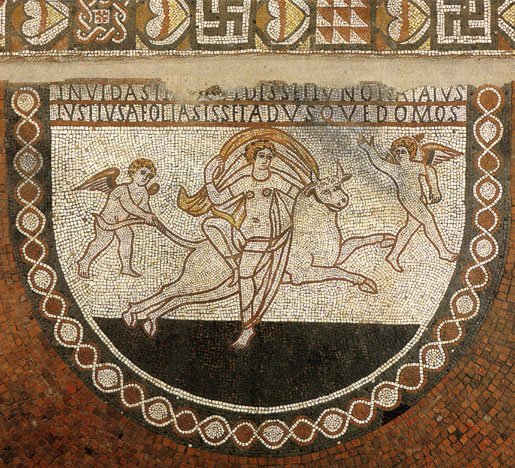
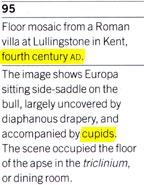
The Crucible of Christianity, Toynbee, 1969, p. 188, illustration 29, “Lullingstone”:
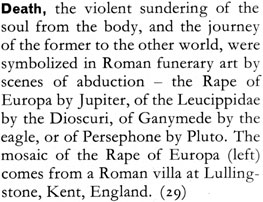
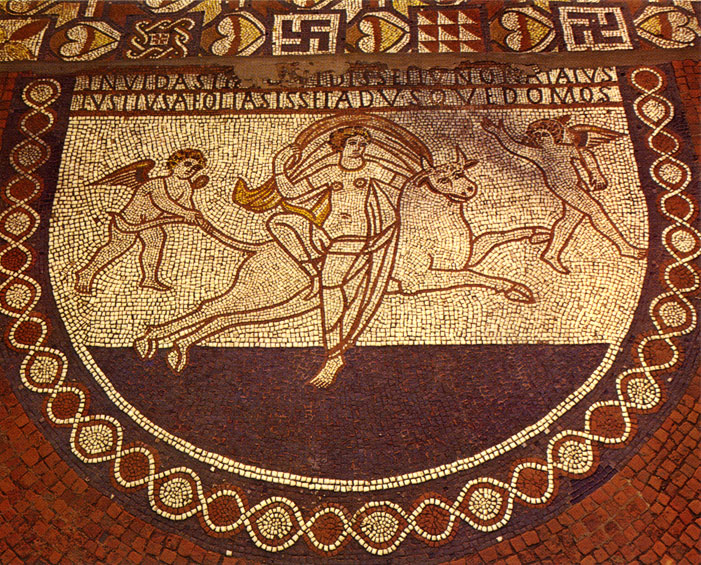
P. 360, “List and Sources of Illustrations | Away from sheer beauty”:
(I bet the Germans really liked those swastikas being there in Britain during WWII.
http://pro.corbis.com/, Search # HU020435, Excavating Roman Mosaic:
The mosaic of the floor of an 140 AD Roman villa dining room was unearthed and restored at a site in Lullingstone, Kent.
http://www.dartfordarchive.org.uk/early_history/buildings_r.shtml, Archaeology and Early History: Buildings and Architecture: Roman Dwellings, “Lullingstone Roman Villa: From Farm House To Luxury Residence”:
The buildings at Lullingstone remained empty and in ruins for almost a century. However, about A.D. 280 the villa was repaired, altered and enlarged and a granary was built near the river. By about A.D. 330 the house had entered the most luxurious period of its existence, and was extended to include a dining-room and reception room, both with elaborate mosaic floors. Christianity reached the villa soon after A.D. 360, and a house church with wall paintings was constructed above one of the rooms, whilst the pagan religion was still practised in the room below. Fire destroyed the villa early in the fifth century A.D.
http://www.asprom.org/resources/Lullingstone/LullingstoneHenig.html#12, Art, religion and letters in a fourth-century villa: the Lullingstone Villa mosaic:
Of wider interest and significance is the discovery of a Christian meaning hidden in the Lullingstone pavement. This does not come as a total suprise for, after all, the next generation (c. 380) saw a house-church at the villa, attested by frescoes in an upper suite of rooms, incorporating chi-rhos and a procession of Orantes.[12]
It is especially interesting to see how two religious and cultural traditions, pagan and Christian, were fused together in a way that extreme pagans (one thinks of Julian) and the most austere Christians would certainly not have liked (from today’s point of view). …
12 J. Liversidge in G. W. Meates, The Roman Villa at Lullingstone Kent, II: The Wall Paintings and Finds (Maidstone 1987), 11–49.
Lateran Baptistery:
http://www.sacred-destinations.com/italy/rome-lateran-baptistery.htm, San Giovanni in Fonte (Baptistery), Rome, “Narthex”:
The right apse in the narthex has a 5th-century mosaic of vines in gold and green set against a deep blue background. At the top of the mosaic are six golden crosses, the Lamb of God, and four doves. At the top of the wall left of the apse is a fragment of the 5th-century marble revetment that once decorated the baptistery interior.
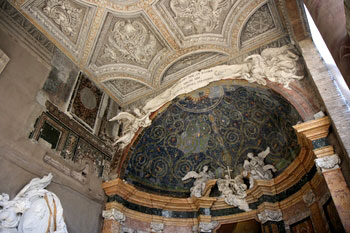
The narthex, with fifth-century apse mosaic.
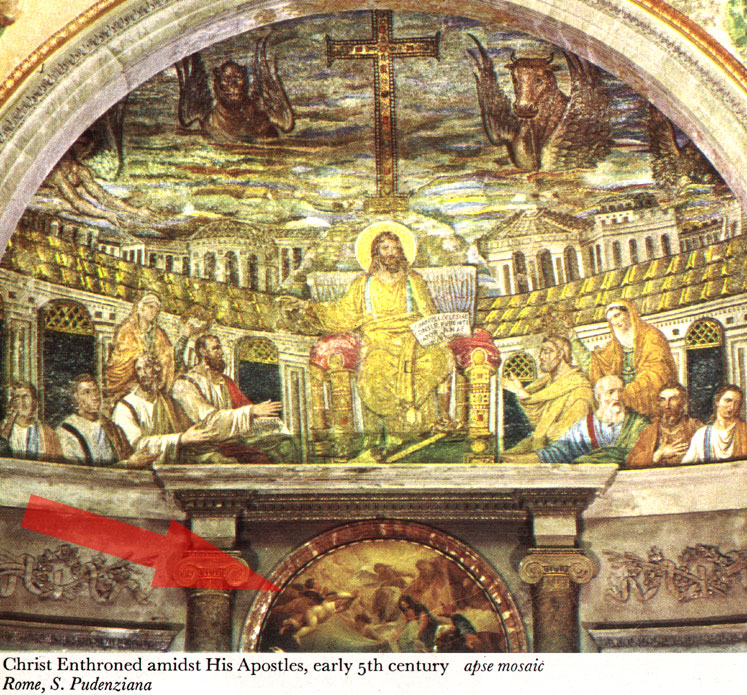
Origins of Western Art, Dr. Donald E. Strong, 1965, p. 49, “Early Christian Art | 5th century | Lateran Baptistery”:
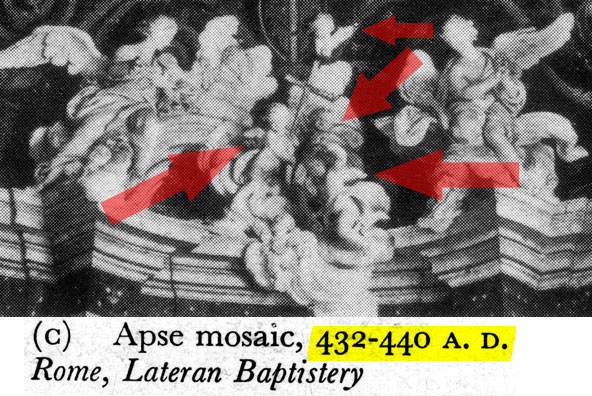
The Roman Empire: Art Forms and Civic Life, Hans Peter L’Orange, 1985, pp. 222-223, illustration 134, “Rome, Lateran Baptistery”:
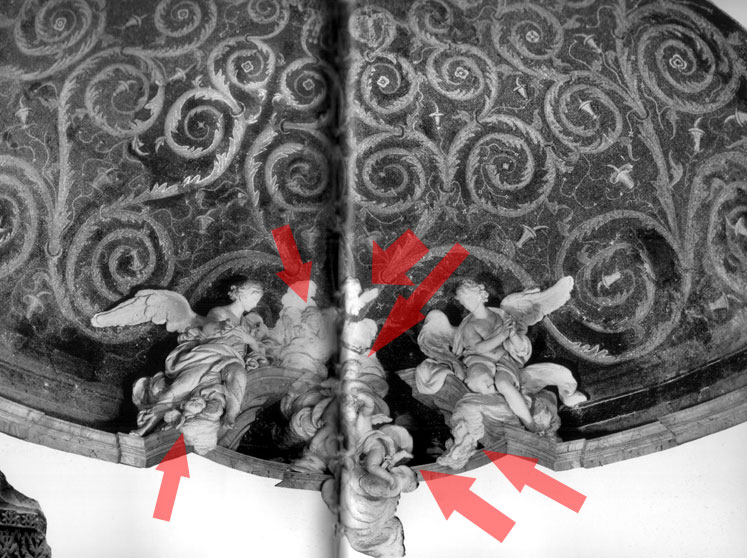
http://www.flickr.com/photos/antmoose/42278496/sizes/l/ (via http://www.flickr.com/photos/93226994@N00/42278496/), lateran baptistery, chapel of s venanzio:
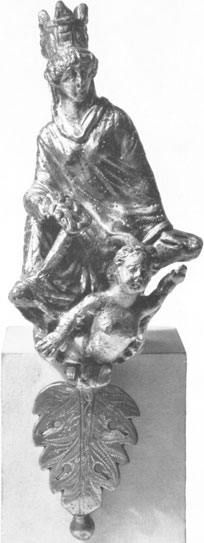
Personification of Antioch:
Early Christian Art, W. F. Volbach, 1961, plate 119, “”London, British Museum. Part of Esquiline Treasure. c. 380. Personification of Antioch”:
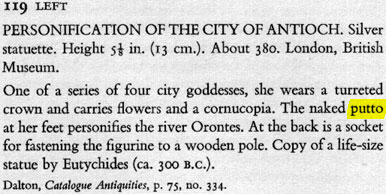
P. 333, “Notes to the Plates”:
http://www.npm.gov.tw/exh96/britishmuseum250/images/selections/05da.jpg (via http://www.npm.gov.tw/exh96/britishmuseum250/en/exh05.html), Reaching the Four Corners: Facets of Art in the Roman Empire:
Silver Tyche
(Personification) of Antioch
Rome, second half of the 4th century AD
Silver and gilt
Found at the foot of the Esquiline Hill, in Rome, Italy.
H14cm
Acquired as part of the Blacas Collection in 1866.
PE 1866.2-29.22
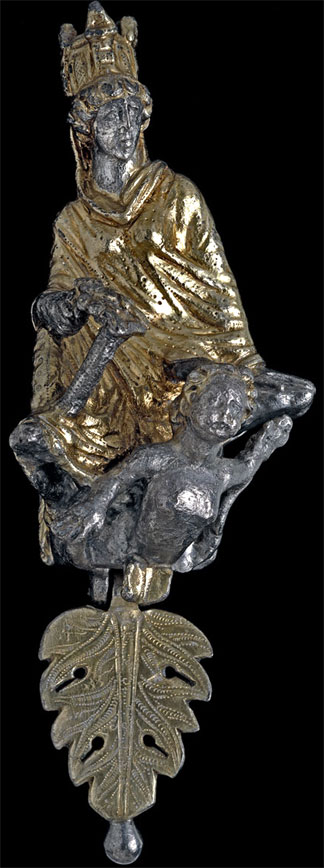
http://www.flickr.com/photos/8435962@N06/2686723149, Personification of Constantinople (10):
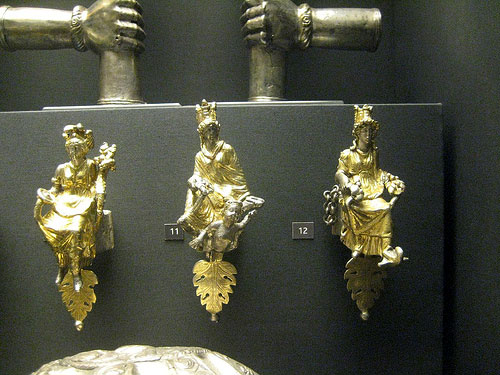
The Personification of Antioch (11)
Other:
Origins of Western Art, Dr. Donald E. Strong, 1965, p. 85, “Vatican Virgil”:
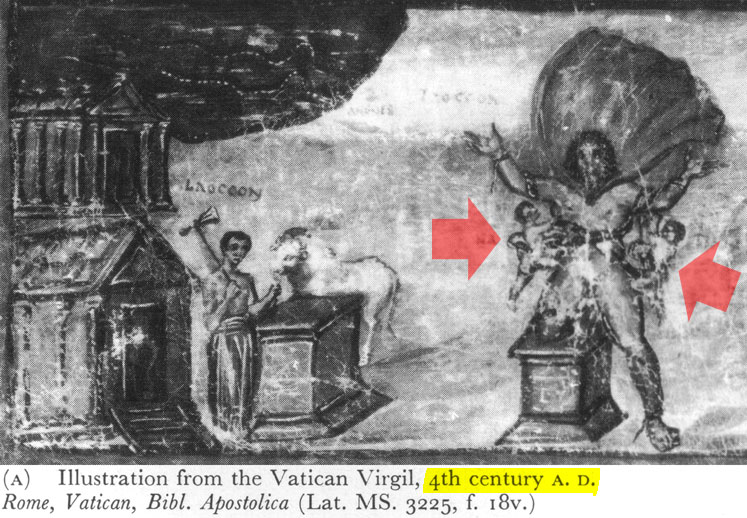
Origins of Western Art, Dr. Donald E. Strong, 1965, color plate p. 184:
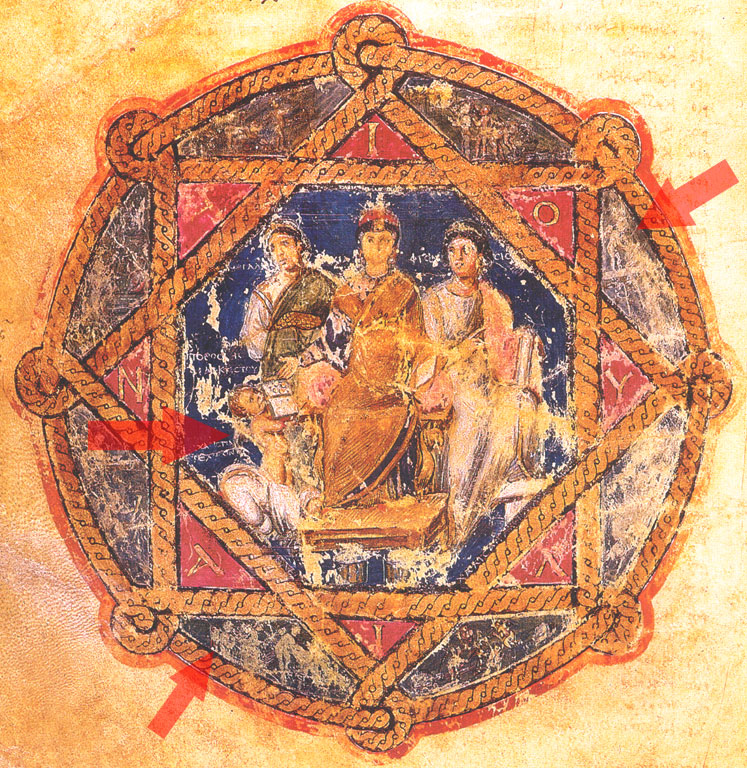
Early Christian & Byzantine Art, Lowden, 1997, pp. 96-97, illustration 54, “Art before Iconoclasm | Emperors and Holy Men | Constantinople and the East | Vienna Dioskurides, c. 512 … Juliana Anicia, folio 6v”:
Early Christian and Byzantine Art, Beckwith, 1979, p. 60, “Early Christian Art: The Eastern Provinces of the Empire and the Foundation of Constantinople”:

P. 61, illustration 44:
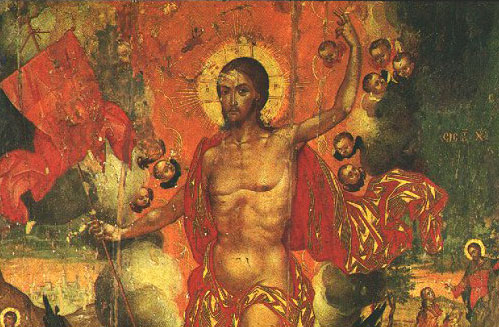
http://www.unf.edu/classes/freshmancore/coreabroad/pictures/ByzantineMuseum/ByzMusAthens-resurrection-latebyz.jpg (via http://www.unf.edu/classes/freshmancore/coreabroad/pictures/ByzantineMuseum/?C=N;O=A), Index of /classes/freshmancore/coreabroad/pictures/ByzantineMuseum, “ByzMusAthens-resurrection-latebyz.jpg”:
http://biblicalstudies.qldwide.net.au/pagan_christianity_today_part1.html#part1, PAGAN-CHRISTIANITY TODAY, “How the ancient mythological gods are depicted, and how many of them we still use today”:
CUPID, Roman mythology, son of Venus, goddess of love. His Greek counterpart was Eros, god of love. He is commonly represented in art as a naked infant, often blind-folded, and carrying both a bow and a quiver of arrows.
This little fellow is everywhere, especially during February , and even in so called Christian paintings and cards.