EROS in early CHRISTIAN ART: in JORDAN
The Beginnings of Christian Art, Rice, 1957, p. 147, “The Second Flowering in the East”:
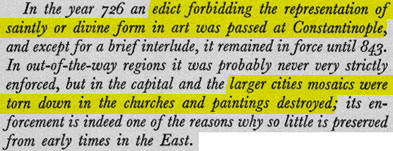
What were they trying to hide?
Madaba Map (St. George Church):
http://www.unitagco.com/Cities/madaba.html, Madaba – The City of Mosaics:
During In the early Christian Byzantine times, Madaba produced some of the finest collection of mosaics of the world which are well preserved and displayed throughout Madaba. The most remarkable of the mosaic collection is displayed in the Greek Orthodox Basilica of St. George - an original 6th century Byzantine map of the Holyland made up of more than two million tiny pieces of colored stone tesserae.
http://independenttraveler.igougo.com/planning/journalEntryActivity.asp?EntryID=18989, Travel Journals, “Madaba – The Madaba Map”:
This splendid mosaic map is housed in the Greek Orthodox Church of St George, which was built in 1896 over the remains of a Byzantine Church. The map was made to cover the floor of the Byzantine Church, and dates to around 560 AD.
http://www.christusrex.org/www1/ofm/fai/FAImap.html (Franciscan Archaeological Institute), The Madaba Mosaic Map:
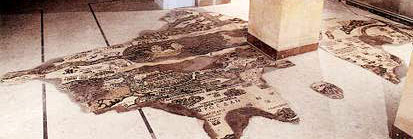
The most important geographic mosaic of the byzantine era was discovered in Madaba, a small village 30 km to the south of Amman, in December 1896. The map adorned the floor of a church situated close to the city's North Gate. … As to the rest of the contents it owes its sources to an antique journey diary, updated to cater for the needs of VI century christian pilgrims who visited the Holy Land, with the Bible at hand. … The christians living in the mid-VI century conceived and brought to conclusion this map in the church at Madaba. Seen in this perspective, the map is a witness to their faith.
http://www.christusrex.org/www1/ofm/fai/FAImpded.html, Madaba Mosaic Map: The Dead Sea or The Salt Sea:
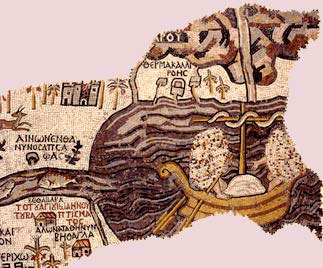
http://www.archart.it/archart/asia/giordania/madaba/img0012.htm (via http://www.archart.it/archart/asia/giordania/madaba/thumb0001.htm):
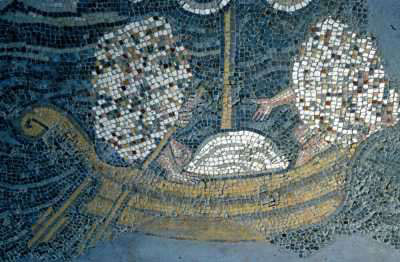
http://www.christusrex.org/www1/ofm/mad/sections/section3.html, Jordan: The Madaba Mosaic Map, “Section 3: Peraea and Dead Sea”:
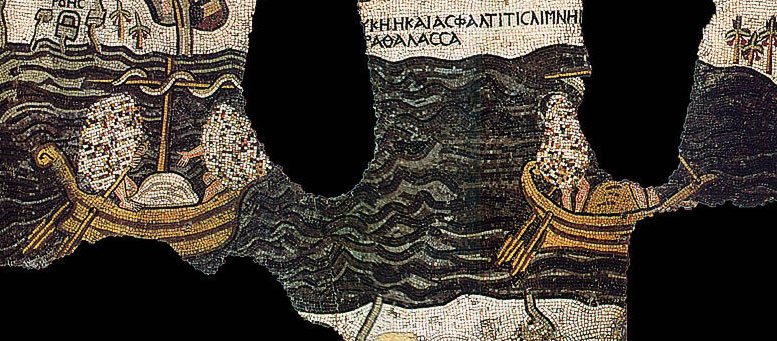
Who do you figure was sitting in these boats, with the little fat and naked arms and legs, desecrated by actually more mosaic? (Eros) Obviously someone reckoned these boaters should be covered from this early Christian art.
http://www.labeduinatours.com/Progs&Itin.htm, La Beduina Tours – Programs & Itineraries, “Madaba, Land of Mosaics,” Madaba Map:
Two boats on the Dead Sea have had their passengers erased—the supposed work of iconoclasts.
http://dictionary.reference.com/search?q=iconoclasts&r=67:
i·con·o·clast:
1. One who attacks and seeks to overthrow traditional or popular ideas or institutions.
2. One who destroys sacred religious images. …
Word History: An iconoclast can
be unpleasant company, but at least the modern iconoclast only attacks such
things as ideas and institutions. The original
iconoclasts destroyed countless works of art. Eikonoklast s, the
ancestor of our word, was first formed in Medieval Greek from the elements eik
s, the
ancestor of our word, was first formed in Medieval Greek from the elements eik n, “image,
likeness,” and -klasts, “breaker,” from kl
n, “image,
likeness,” and -klasts, “breaker,” from kl n, “to break.”
The images referred to by the word are religious
images, which were the subject of controversy among Christians of the Byzantine Empire in the 8th and 9th centuries, when
iconoclasm was at its height. In addition to destroying many sculptures and
paintings, those opposed to images attempted to have them barred from display and
veneration. During the Protestant Reformation images in churches were again
felt to be idolatrous and were once more banned and destroyed. It is around
this time that iconoclast, the descendant of the Greek word, is first
recorded in English (1641), with reference to the Byzantine iconoclasts. In the
19th century iconoclast took on the secular sense that it has today, as
in “Kant was the great iconoclast” (James Martineau).
n, “to break.”
The images referred to by the word are religious
images, which were the subject of controversy among Christians of the Byzantine Empire in the 8th and 9th centuries, when
iconoclasm was at its height. In addition to destroying many sculptures and
paintings, those opposed to images attempted to have them barred from display and
veneration. During the Protestant Reformation images in churches were again
felt to be idolatrous and were once more banned and destroyed. It is around
this time that iconoclast, the descendant of the Greek word, is first
recorded in English (1641), with reference to the Byzantine iconoclasts. In the
19th century iconoclast took on the secular sense that it has today, as
in “Kant was the great iconoclast” (James Martineau).
These desecrated Erotics are an “image” of the later Church trying to suppress sexual love.
http://www.christusrex.org/www1/ofm/mad/discussion/022discuss.html, Jordan: The Madaba Mosaic Map, “Discussion: Peraea and the Dead Sea”:
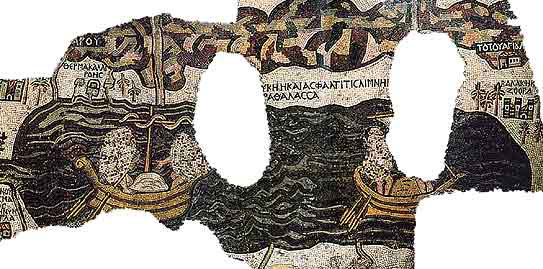
http://www.bibleplaces.com/madabamap.htm, Madaba Map, “Dead Sea”:
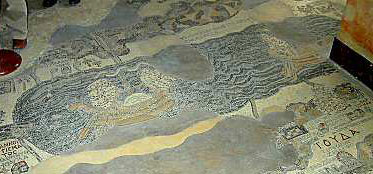
http://independenttraveler.igougo.com/photos/journal_photos/IMG_4056.jpg (via http://independenttraveler.igougo.com/planning/journalEntryActivity.asp?EntryID=18989):
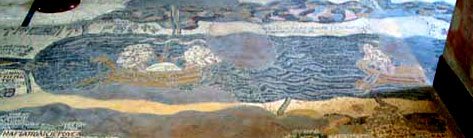
http://www.menavista.com/images/madabamap.jpg (via http://www.menavista.com/jordan.htm):
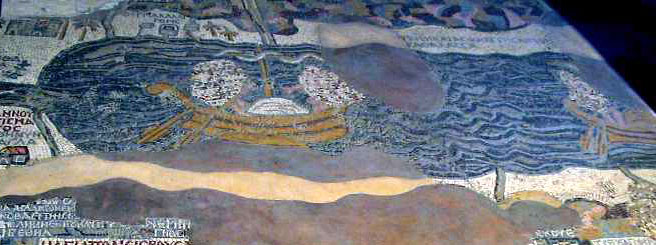
http://www.uflib.ufl.edu/maps/MAPHOLY042L.JPG (via http://www.uflib.ufl.edu/maps/MAPHOLY01.HTML) (Univ. of Florida), Madaba Mosaic Map (Facsimile):
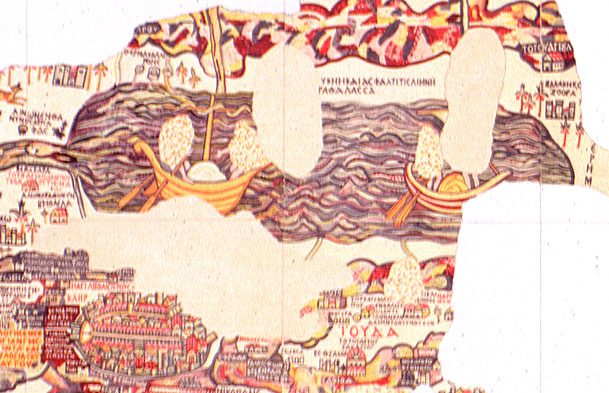
http://pro.corbis.com/, Search # CJ006711, Detail of Cargo Ship from Map of Christian Holy Lands Floor Mosaic:
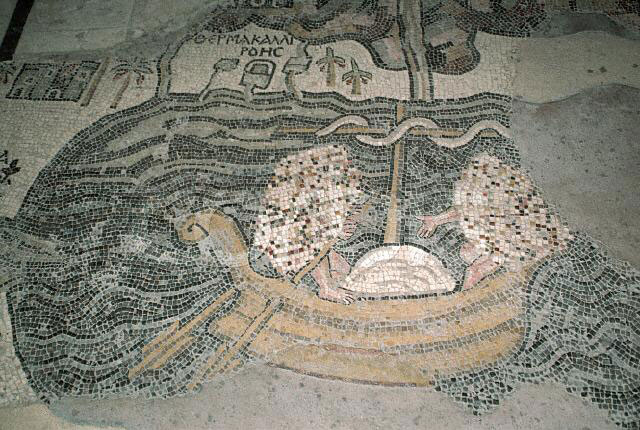
A 6th century mosaic depicting a cargo ship on the Dead Sea with the towns of Livias (top left) and Kallirhoe (top center).
Umm al-Rasas, Church of Saint Stephen:
http://www.christusrex.org/www1/ofm/fai/FAIrasas.html
“View of the extensive ruins of Umm al-Rasas
with the excavated Church of St. Stephen in the foreground”:
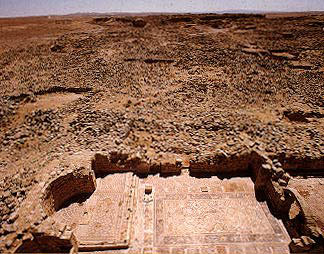
“Saint Stephen”:
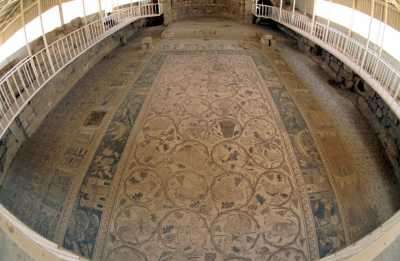
To date the mosaic floors of the church of Saint Stephen are the best dated evidence of the welfare of a flourishing urban Christian community in the region, still well organized as part of the bishopric of Madaba in the changed political context. The floor is composed of three different mosaics. The upper mosaic floor of the bema was completed by the mosaicist Staurachios Ezbontinos son od Zada with his colleague Euremios in the month of March A.D. 756 at the time of bishop Job, as written in the inscription on the side of the altar. The mosaic is aniconic. It covers a previous mosaic of which only a small part was visible. Stylistically it seems to be a VI century mosaic. The bases of the columns of the altar inserted in it point to the same dating.
“The mosaiced Church of Saint Stephen”:
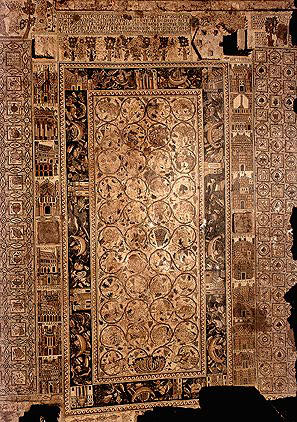
http://www.christusrex.org/www1/ofm/mad/articles/BlazquezNature.html#Blaz7, The Presence of Nature in the Madaba Mosaic Map, “The Jordan River and Dead Sea”:
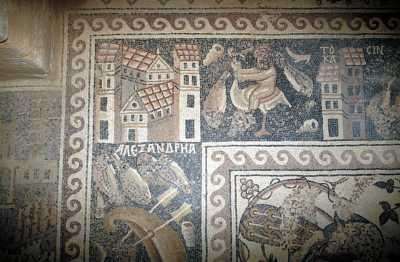
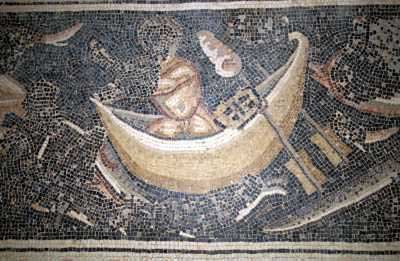
A great frieze with erotes sailing, fishing, hunting and rowing, in a stream full of fish, birds and aquatic plants, has been found in the mosaic of the Church of Saint Stephen at Umm er-Rasas, dated to the eighth century. 7 … 7. M. Piccirillo, The Mosaics of Jordan, Amman 1993, 219-230, 231, 239, figs. 380, 383; idem, I mosaici di Giordania, Rome 1989, 76-78; idem, Madaba, 96, 286-289; J.M. Blázquez, Arte bizantino antiguo de tradición clásica en el desierto jordano: Los mosaicos de Um er-Rasas. Goya 255, 1996, 130-143.
http://www.archart.it/archart/asia/giordania/umm_el_rasas/img0101.htm (ArchArt: archaeology & art), Umm el Rasas byzantine church, vedute02:
http://www.archart.it/archart/asia/giordania/umm_el_rasas/img0104.htm (ArchArt: archaeology & art), Umm el Rasas byzantine church, vedute05:
http://www.archart.it/archart/asia/giordania/umm_el_rasas/img0001.htm (ArchArt: archaeology & art), Umm el Rasas byzantine church, black01:
http://www.archart.it/archart/asia/giordania/umm_el_rasas/img0003.htm (ArchArt: archaeology & art), Umm el Rasas byzantine church, black03:
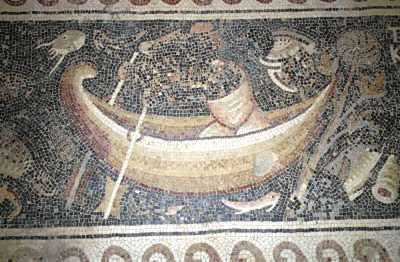
http://www.archart.it/archart/asia/giordania/umm_el_rasas/img0004.htm (ArchArt: archaeology & art), Umm el Rasas byzantine church, black04:
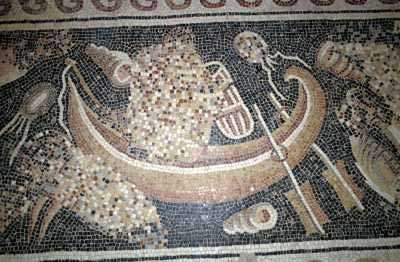
http://www.archart.it/archart/asia/giordania/umm_el_rasas/img0005.htm (ArchArt: archaeology & art), Umm el Rasas byzantine church, black05:
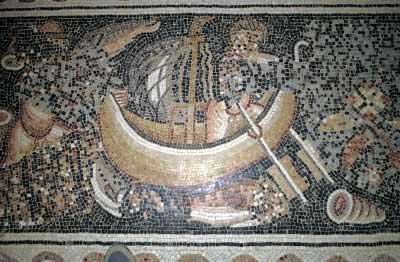
http://www.archart.it/archart/asia/giordania/umm_el_rasas/img0006.htm (ArchArt: archaeology & art), Umm el Rasas byzantine church, black06:
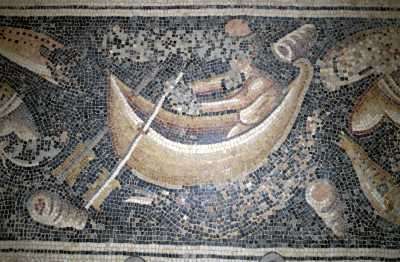
http://www.archart.it/archart/asia/giordania/umm_el_rasas/img0007.htm (ArchArt: archaeology & art), Umm el Rasas byzantine church, black07:
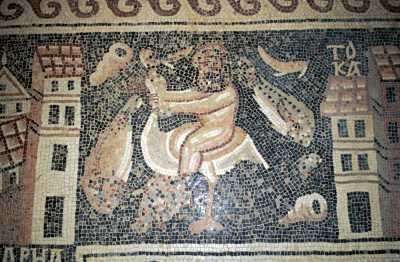
http://www.archart.it/archart/asia/giordania/umm_el_rasas/img0033.htm (ArchArt: archaeology & art), Umm el Rasas byzantine church, cities23:
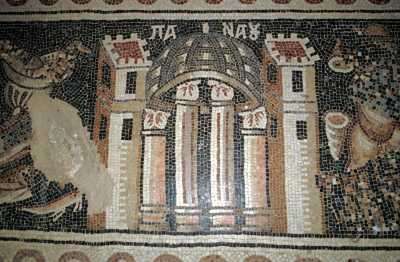
http://www.archart.it/archart/asia/giordania/umm_el_rasas/img0034.htm (ArchArt: archaeology & art), Umm el Rasas byzantine church, cities24:
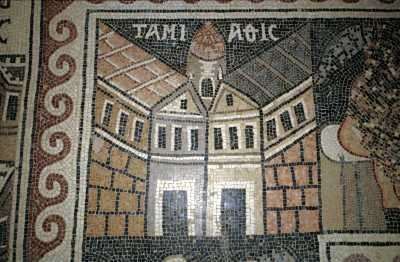
http://www.archart.it/archart/asia/giordania/umm_el_rasas/img0037.htm (ArchArt: archaeology & art), Umm el Rasas byzantine church, cities27:
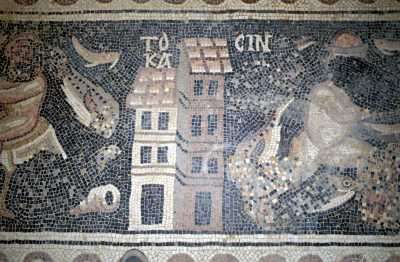
Church of the Apostles, Personification of the Sea -- Thalassa:
http://www.jordanjubilee.com/history/mosaics.htm, The Mosaics of the Madaba Plateau of Jordan, Madaba:
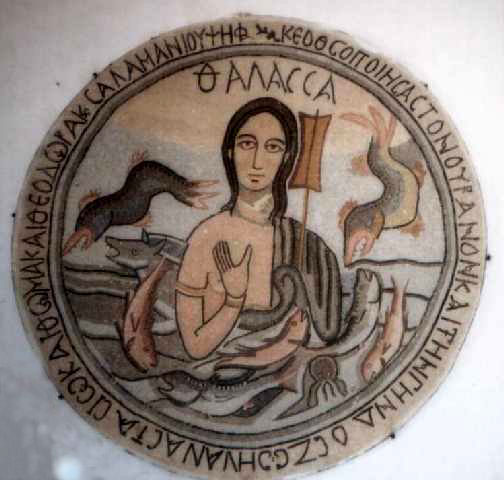
Here are two details of the work here : the beautiful medallion in the centre of the floor shows a personification of the Sea. Notice the rudder held in the left hand. I am voluntarily showing copies made at the Mosaics School rather than the original which is both very difficult to take in photo and very very dusty as you can see from the photo of the floor above. The colours show here much better and it is easier to appreciate the beauty of the work.
http://sirman.net/celayirs/jordan/nebo.html, Madaba, City of Mosaics & Mt. Nebo:
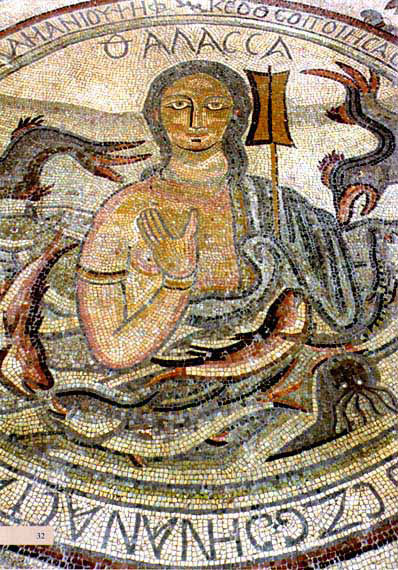
http://pro.corbis.com/, Search # LY005238, Detail of Thalassa Medallion from Nave Floor Mosaic of Apostles' Church by Salaman, Christian art, Nymph:
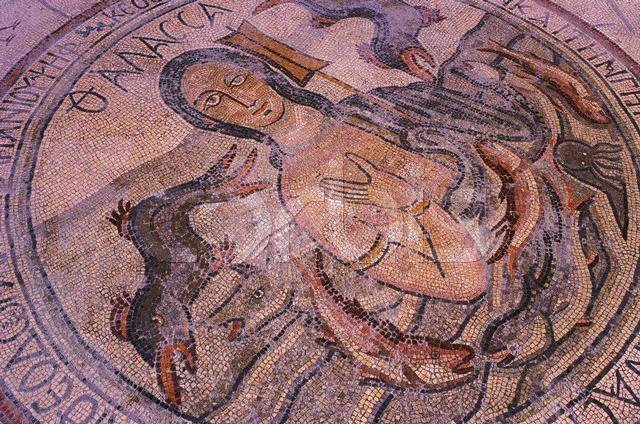
http://www.wink.com.au/babyboomers/jordan/madaba.html, Madaba:
The Church of the Apostles (right) dates to 578 AD and the mosaic here is the best we saw. It is called the "Personification of the Sea". The inscription reads "O Lord God who has made the heavens and the earth, give life to Anastasius, to Thomas, to Theodore and to Salamanios, who has made this (mosaic)" This makes it one of the few mosaics to whom we can attribute actual artists.
http://www.nebo.com.jo/jordan/holyland.htm, Madaba:
In Madaba, the floor of the Church of the Apostles is adorned with beautiful mosaic drawings. The most significant section of the main floor is the medallion which is known as the Personification of the Sea. It depicts a woman emerging from the sea, half-clad, raising what is thought to be a rudder in line with her head. The Sea, concealing her left breast suggests that the figure is part of the swirling water.
http://www.wildsurvivals.com/Madaba.htm, Madaba Archaeological Park, “The Church Of The Apostles” :
It was built at the time of Bishop sergius in 578 AD. A central medallion depicts the personification of the sea (thalassa) in the shape of a woman emerging from the waves raising a rubber like a flag in her left hand, While the right arm is aborned with bracelets.
Thalassa (ΘΑΛΣΣΑ / θαλσσα) is the Greek text above her head.
http://www.grazian-archive.com/quantavolution/QUANTAVOL/mm_docs/mm_2.pdf, Moon and Mars, Chapter Eight: The Two Faces of Love, “Turbulent Birth in Myths and Reality”:
The goddess Amphitrite Thalassa ("of the Sea") shares this epithet with Typhon and his paredra, "making one being with foam-born Aphrodite,"
http://www.gesundheit.com/well/well/frankreich.html, (translated from German) Thalasso - beauty from the sea:
Aphrodite could not suspect that their foam birth from the sea (Greek "thalassa") would help thousands of years later a whole industry to success. But very probably it would have been with the result most content. Because their name stands still for beauty. And Thalasso is today a synonym for beauty from the sea, which all life comes of.
http://members.tripod.com/~ismeik/madaba.html (9-4-02), About Madaba, “Uncover the Mosaics of Madaba”:
personification of the sea … The medallion is superimposed on the main “carpet’ of the mosaic, a grid pattern of long-tailed parrots interspersed with flowers, leaves, pomegranates, melons, pears and grapes.
Hippolytus Hall / Church of the Virgin (just NE of Dead Sea):
http://www.ucd.ie/classics/97/Dauphin97.html (University College Dublin, Ireland), Carpets of Stone: The Graeco-Roman Legacy in the Levant, “Classical themes in some Byzantine mosaics of the Levant”:
For all that Christianity had been the State religion of the Byzantine Empire since AD 392, Byzantine culture remained fundamentally classical in spirit. The mosaicists of the Justinianic Renaissance drew much of their inspiration from Greek mythology and Roman daily life. The excavation in 1982-5 of a mid-sixth century hall under the atrium and narthex of the Church of the Virgin at Madaba, disclosed three remarkable panels framed by an inhabited acanthus scroll. The upper panel showed Aphrodite and Adonis, the three Graces (each named as Charis), four Erotes and a peasant-woman (Agroikis). …
http://www.traveladventures.org/continents/asia/archaeologicalpark06.shtml, Eros and Haris mosaic, Madaba in Jordan:
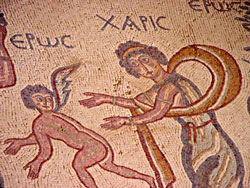
There’s the Greek text for Eros (ερως) spelled out, with a “Charis” (χαρις) (one of the three Charities, or “Graces”), not “Haris.” (The sigma at the last of both names is called a “lunate sigma.”) It’s the same “Grace” that’s used in the New Testament:
Interlinear Greek-English New Testament, Green, Baker Books, 1998, p. 283, “John 1:17”:

(Read my “Dilectio & caritas” page for more details about “The Three Graces.”)
The entire scene:
http://sirman.net/celayirs/jordan/jordan/madaba6.jpg (via http://sirman.net/celayirs/jordan/nebo.html), Madaba, City of Mosaics & Mt. Nebo:
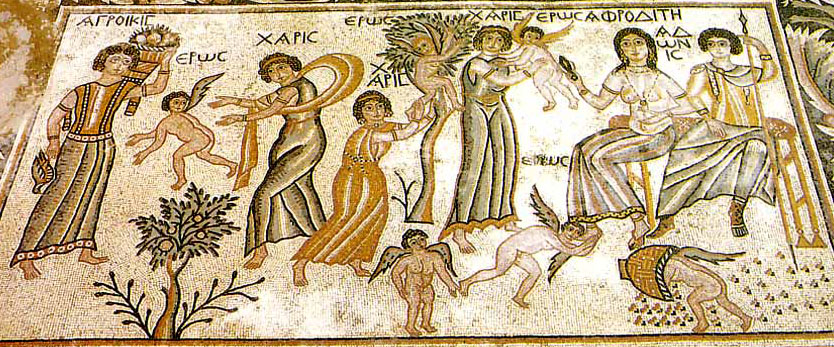
There are actually four “Eros” names in Greek text and two additional in image (total of six). There are three “Charis” names. Also, “Aphrodite” and “Adonis” are last two on right.” I don’t know who “Agroikis” is (far left) (could be a personal name).
http://sirman.net/celayirs/jordan/jordan/madaba7.jpg (via http://sirman.net/celayirs/jordan/nebo.html), Madaba, City of Mosaics & Mt. Nebo:
http://198.62.75.1/www1/ofm/fai/FAIpark.html, The Madaba Archaeological Park:
In the Summer of 1982, while probing the ground beneath the internal vestibule of the church we discovered the mosaic floor in the left sector of the Hyppolitus Hall. This mosaic is one of the masterpieces of the Madaba mosaicists which decorated the hall of a rich Byzantine Mansion.
http://members.tripod.com/~ismeik/madaba.html (9-4-02), Madaba, “Hippolytus Hall”:
The Church of the Virgin was built above the hall of an early 6thCentury Madaba house. Much of this hall has now been uncovered. … In the third panel, the goddess Aphrodite is shown, seated next to Adonis, who holds a lance; she is threateting a shown Cupid. In order to show that this scene takes place in the countryside, there is a peasant girl carrying a basket of fruit and a partridge. The other figures are Cupids and Graces.