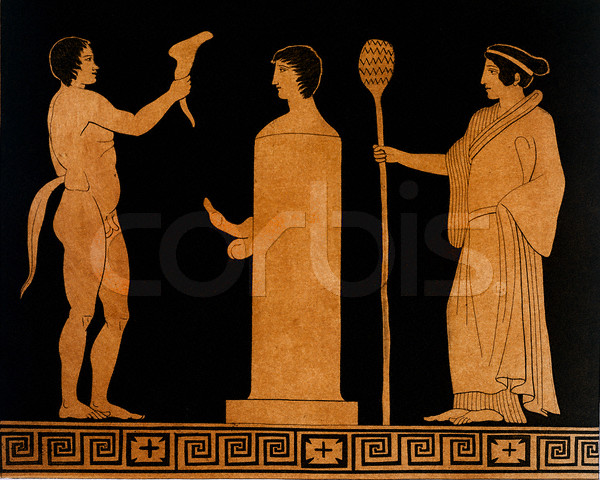
DIONYSUS – SATYR / PAN, Nymph, Maenad, Thiasos
The New American Desk Encyclopedia, 1997, pp. 1145-1146, “SATYR”:
http://www.timelessmyths.com/classical/beasts.html, Classical Mythology: Mythical Creatures, “Satyrs”:
The satyrs were woodland spirits, often depicted in arts with head and upper body of man, horns and pointy ears, and goat legs. They were also depicted with large erect phallus(penis).
They were often seen accompanying Dionysus, the god of wine and ecstasy. They were shown in drunken revelry and orgy, dancing with Dionysus' female followers, the maenads.
Pan, the god of shepherd was a satyr, so was probably Silenus or Seilenus. Silenus was one of the loyal followers of Dionysus, who brought up the wine god.
Dictionary of Philosophy and Psychology, 1925, p. 340, “Erotomania or Eroticomania”:
http://www.in2greece.com/english/historymyth/mythology/names/dionysus.htm, Dionysus:
Son of Zeus and Semele and god of wine, vegetation, fertility and often celebrated at theaters. He surrounded himself with maenads (orgiastic women) and satyrs, and held constant festivities in the forests. … The god was also connected to the orphicism
http://www.in2greece.com/english/historymyth/mythology/names/dionysus_zagreus.htm, Dionysus Zagreus:
The god of the orphicists
The Oxford Latin Minidictionary, Morwood, 1995, p. 644, “List of Historical and Mythological Proper Names | Satyrī”:

Sexualia: From Prehistory to Cyberspace, Bishop / Osthelder, 2001, p. 203, “The Classical World | Prostitutes, Concubines, and Courtesans”:
The New International Dictionary of New Testament Theology, Brown, Zondervan Publishing, 1976, vol. 2, p. 430, “Laugh”:

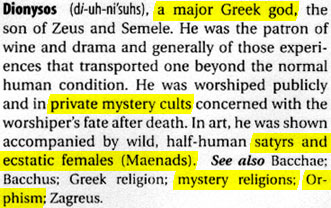
The HarperCollins Dictionary of Religion, 1995, p. 317, “Dionysos”:
http://www.cnr.edu/home/bmcmanus/bacchaebg.html, Background and Images for the Bacchae, “Attributes and Followers of Dionysus”:
The followers of Dionysus were denizens of the mountains and forests—sileni, satyrs, nymphs, maenads. Satyrs were half-man, half-animal creatures, represented as carefree, intoxicated, sexually aroused, and brutish (satyr and Dionysus; satyrs playing while a chorus of women dance); like the maenads, they were entranced by music and dancing. The female worshippers of Dionysus were called maenads (“raving women”), bacchae or bacchantes (“mad women”), or thyiads (“ecstatic women,” with a sexual connotation).
http://www.theoi.com/STUXZ.htm, Greek Mythology: Encyclopedia S-Z: A Guide to Greek Gods, Spirits & Monsters:
Satyrs (Satyroi) Mountain spirits of wilderness fertility. They appeared as animalistic men with the ears and tail of an ass, and erect phalluses (penises).
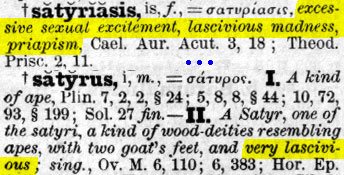
Harpers’ Latin Dictionary, Lewis / Short, 1879, p. 1636:
http://www.answers.com/satyr, “satyr”:
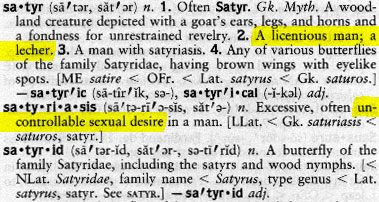
A licentious man; a lecher.
…
An immoral or licentious man
…
Satyrs were usually represented as being very hairy and having the tails and ears of a horse and often the horns and legs of a goat. An important part of Dionysus' entourage, they were lustful, fertile creatures, always merrily drinking and dancing.
…
In Greek mythology, satyrs (in Greek, Σάτυροι — Sátyroi) are a troop of male companions of Pan and Dionysus— "satyresses" were a late invention of poets— that roamed the woods and mountains. In mythology they are often associated with male sex drive and vase-painters often portrayed them with uncontrollable erections.
Lempriere’s Classical Dictionary, 1898, p. 546, “Satyri”:
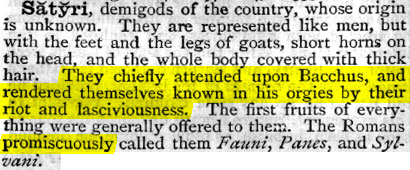
I think they mean “a wild or turbulent disturbance created by a large number of people” by “riot,” rather than “a violent disturbance of the public peace by three or more persons assembled for a common purpose.”
http://en.wikipedia.org/wiki/Faun, “Faun”:
In Roman mythology, fauns are place-spirits (genii) of untamed woodland. Romans connected their fauns with the Greek satyrs, wild and orgiastic drunken followers of Bacchus (Greek Dionysus).
“Panes” is plural for Pan.
http://www.yourdictionary.com/sylvan, “sylvan”:
one who lives in the woods
–Not much info on this little guy.
Reader’s Digest Illustrated Reverse Dictionary, 1990, p. 379, “MONSTERS AND MYTHOLOGICAL CREATURES”:
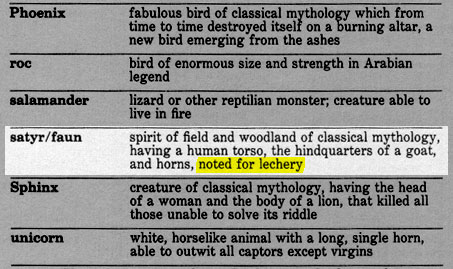
Random House Word Menu, 1992, p. 839, “Faith | Mythological and Folkloric Beings | satyr”:

Merriam Webster’s Collegiate Dictionary, 1997, p. 1039, “satyr”:

The Random House Dictionary of the English Language (Unabridged), 1987, p. 1706, “satyr play”:

Microsoft Encarta Dictionary (paperback), 2002, p. 778, “satyr”:
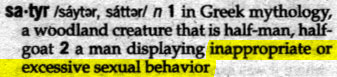
Eros: The God of Love in Legend and Art, Irene Korn, 1999, p. 104, “Venus and Amor”:

Cassell’s Dictionary of Classical Mythology, Jenny March, 2001, p. 688, “Satyrs and Silens”:
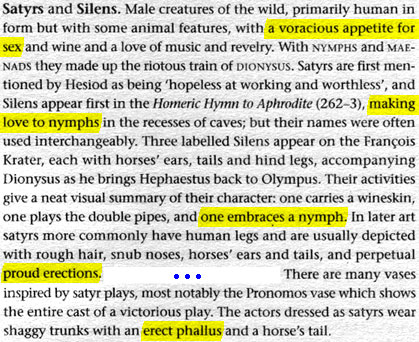
A phallus is a penis.
The American Heritage College Dictionary, 1997, p. 1213, “satyr…”:
The World Book Encyclopedia, 1987, Vol. 5: “D”, p. 174, “Dionysus”:
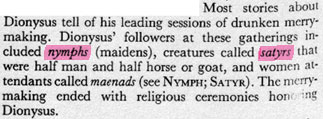
Better copy:
http://www.worldbookonline.com (subscription required), World Book: Encyclopedia, “Dionysus”:
Most stories about Dionysus tell of his leading sessions of drunken merrymaking. Dionysus' followers at these gatherings included nymphs (maidens), creatures called satyrs that were half man and half horse or goat, and women attendants called maenads (see Nymph; Satyr).
http://www.worldbookonline.com (subscription required), World Book: Encyclopedia, “Nymphs”:
Nymphs were sometimes shy. But at other times, they were passionate lovers. They were generally friendly and kind to mortals but occasionally punished people who offended them. Nymphs are represented with fauns and satyrs in the forest
http://www.worldbookonline.com (subscription required), World Book: Dictionary, “nymphomania”:
nym|pho|ma|ni|a «NIHM fuh MAY nee uh», noun.
1 abnormal, uncontrollable sexual desire in a woman.
2 uncontrollable
sexual desire in animals, especially in cattle.
http://www.worldbookonline.com (subscription required), World Book: Dictionary, “bacchanalia”:
bac|cha|na|li|a «BAK uh NAY lee uh, -NAYL yuh», noun (plural).
in form, sing. in use. a wild, noisy party; drunken revelry; orgy.
http://www.worldbookonline.com (subscription required), World Book: Encyclopedia, “Satyr”:
Satyrs followed Dionysus, the god of wine, and Pan, the god of woods and pastures. Most satyrs were young, playful, and mischievous. They sometimes became wild and uncontrolled but rarely harmed anyone. Their favorite occupations were drinking wine and pursuing lovely maidens called nymphs.
The Encyclopedia Americana: International Edition, 1989, Vol. 9, p. 137, “Dionysus”:
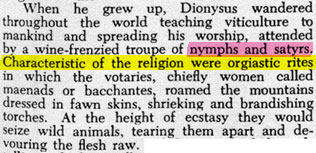
Concerning that tearing animals apart, like as I’ve always said, I’ve never found the perfect religious group. Technically, more perfect ethics are to be found in the future, not the past. Tearing animals apart would be the equivalent evil that the vast majority do today when they eat meat.
The Oxford Guide to Classical Mythology in the Arts, 1300–1900s, Reid, 1993, Vol. 1, p. 158:
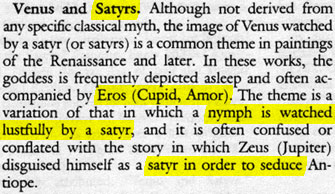
The Rapid Fact Finder: A Desk Book of Universal Knowledge, Weideman, 1958, p. 138, “MAENADS”:

http://www.godchecker.com/pantheon/greek-mythology.php?deity=MAENADS, The Gods of Greek Mythology, “Greek Mythology : MAENADS”:
Also known as BACCHAE, BACCHANTES
MAENADS: 'The Raving Ones'. Often labelled as NYMPHS, they are the debauched female followers of DIONYSUS, who drives them wild with passion.
The New Comprehensive A-Z Crossword Dictionary, Schaffer, 1995, p. 333, “Diony…”:
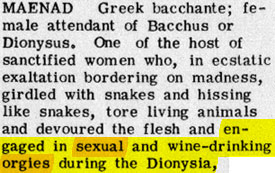
Dictionary of Mythology Folklore and Symbols, Jobes, Part 2, 1961, p. 1036, “Maenad”:
Dictionary of Satanism; Baskin; Philosophical Library, New York; 1972; p. 49:

P. 108:

P. 109:
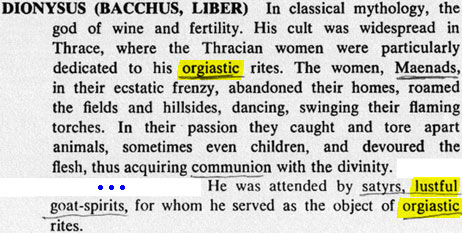
Funk & Wagnalls New Standard Dictionary of the English Language, 1963, “Agapetidæ”:

http://www.sacredsource.com/prodinfo.asp?number=DDP, Sacred Source: Ancient Images, Ancient Wisdom, “Dionysus Satyr maenad Plaque 10”:
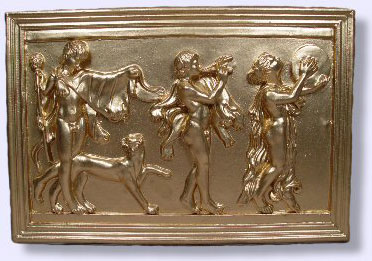
DIONYSUS -- God of Ecstatic Devotion
Bacchus, or Greek Dionysus, came to Europe from Crete and is thought to be the indigenous vegetation
God and consort of the Mother Goddess later displaced by patriarchal Jupiter.
His mystery school was closely linked with that of Goddess Cybele, brought to Rome from Asia Minor. Both enjoyed flamboyant
oriental priestesses and priests, clashing cymbals and blowing twisted reeds as
they danced barefoot with ecstatic abandon.
This plaque shows Dionysus in procession
with an aulos-playing Satyr and drumming
Maenad, and is the inspiration for our
frame drum design. The Maenad women drummers,
filled with erotic longing for union with Dionysus, developed a reputation for unbridled licentiousness and the ability to invoke trance with rhythm. Our word orgy comes from the annual Roman
celebration of Bacchanalia corresponding
with the fermenting of wine. Stands and hangs. [Roman Relief 100 C.E.]
http://blog.goo.ne.jp/ecotaka/e/cee160a5bf0f3b36d6033fa3d303d1e9:
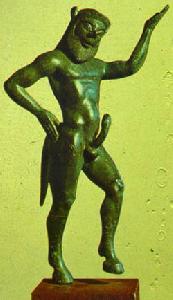
Bronze satyr (BC 700-500)
http://www.answers.com/satyr, “satyr”:
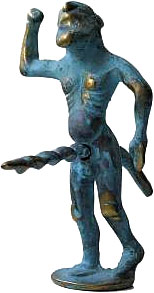
A satyr corkscrew. These small figurines are commonly sold in Greek tourist shops.
Eros in Pompeii: The Secret Rooms of the National Museum of Naples, Grant, 1975, p. 119, “Reclining Ithyphallic Satyr”:
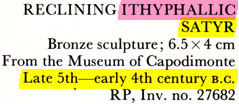
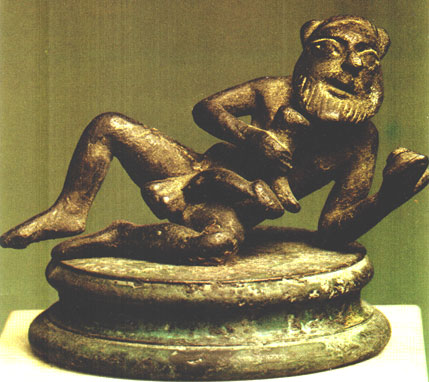
Pp. 86-87, “Satyr and Nymph”:
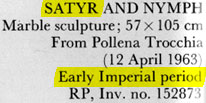
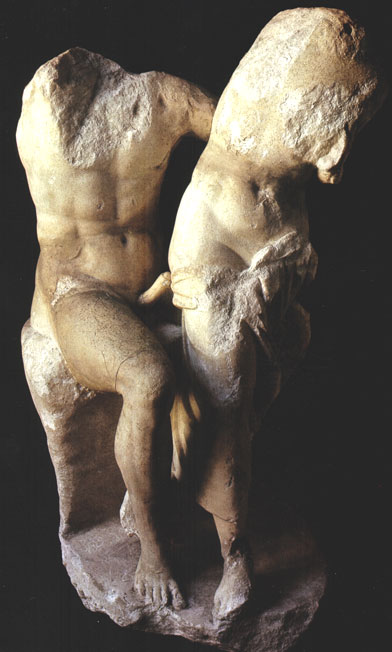
http://weimar.hku.nl/martin/reservoir/lichaam-lust/clodio.html:
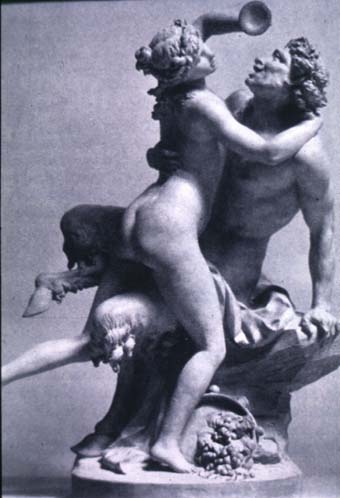
Satyr en Bacchante, ca. 1775.
http://www.androphile.org/preview/Museum/Rome/bacchanalia.htm, The World History of Male Love: Roman Hall, “Bacchanalia”:
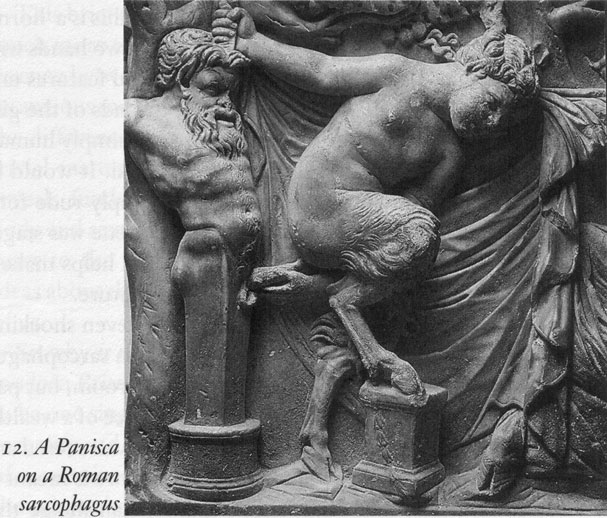
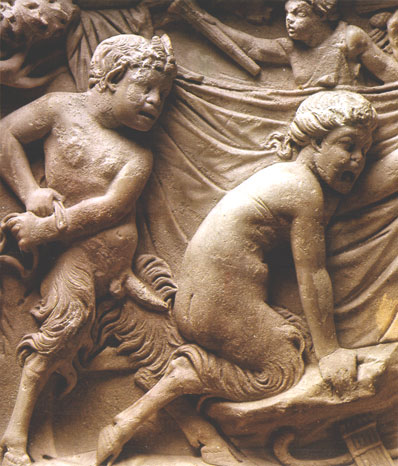
Young satyr making love to a herm of the god Pan. Bas-relief on a marble sarcophagus from late 2nd century CE. Originally part of the Farnese collection, now in the Archeological Museum, Naples.
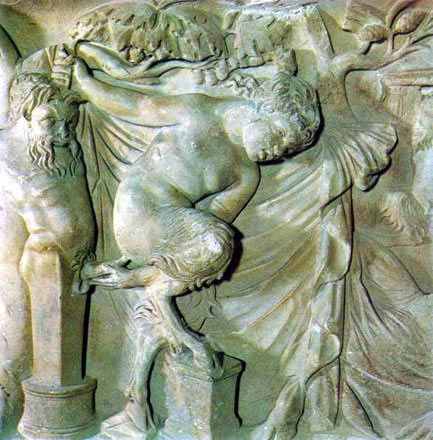
Love, Sex & Tragedy: How the Ancient World Shapes Our Lives, Goldhill, 2004, p. 36, figure 12:
Eros in Pompeii: The Secret Rooms of the National Museum of Naples, Grant, 1975, pp. 92-93, “Bacchanalian Scene—Marble Sarcophagus”:
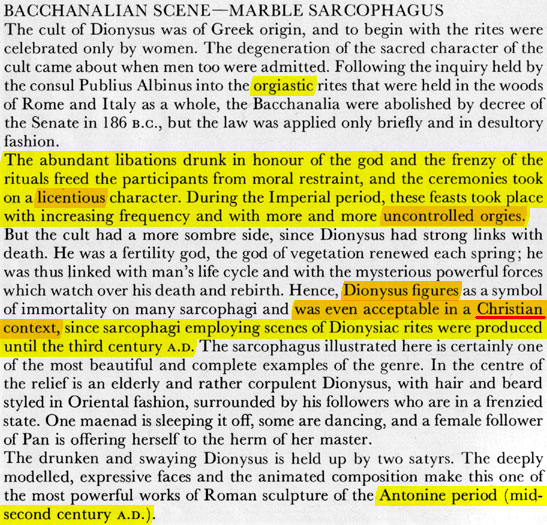
These licentious orgies appear to have been very well known during the time of Christ and the early Christians, who definitely expressed “was even acceptable.” Today’s Christian views on sex would definitely not support such iconography (and define it as the “worst” kind of evil), but Christians who chronologically lived closer to Christ did, and these were the Christians who emanated into the Catholic Church. So, something “changed.” Today’s “honored” Church leaders would explain that Christ was overwhelmingly and adamantly against sex orgies, then the Early Church supported sex orgies, then later things “changed” back to what Christ overwhelmingly taught against sex orgies. Any everybody will “just” believe it. And, I’m the one that’s called “stupid.”
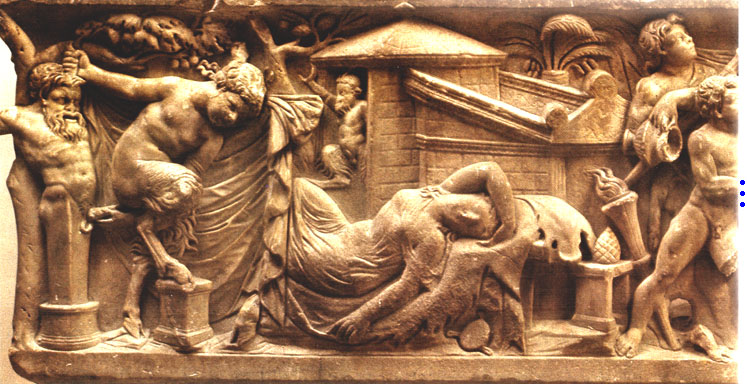
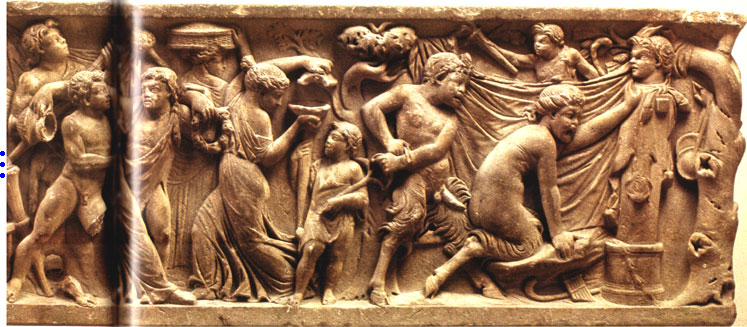
Pp. 90-91, “Bacchanalian Scene”:

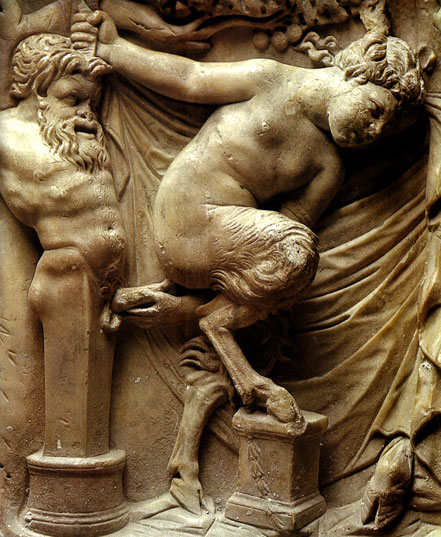
I think your gay community would like to interpret this.
Pp. 92-93, “Bacchanalian Scene”:
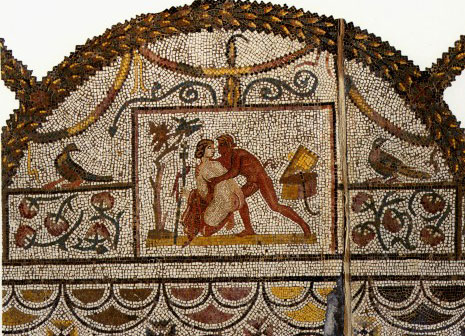
http://academic.reed.edu/humanities/110Tech/RomanAfrica2/mosaic23.jpg (via http://academic.reed.edu/humanities/110Tech/RomanAfrica2/), “Leda and the Swan; Satyr embracing a Maenad: notice satyr's skin color (Blanchard-Lemee fig. 196-97)”:
http://www.personal.psu.edu/users/w/x/wxk116/eros/sexart/sex16.html (via http://www.personal.psu.edu/wxk116/eros/refs.html) (Pennsylvania State University), Erotic Art of Ancient Rome:
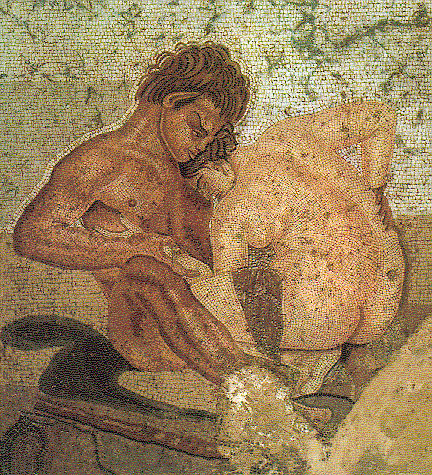
Mosaic panel from the House of the Faun in Pompeii, 1st century AD. The male figure is a satyr. London, The British Museum.
http://pro.corbis.com/, Search # MI001224, Ancient Roman Mosaic with Satyr and Nymph, Date Created: before 79 A.D.
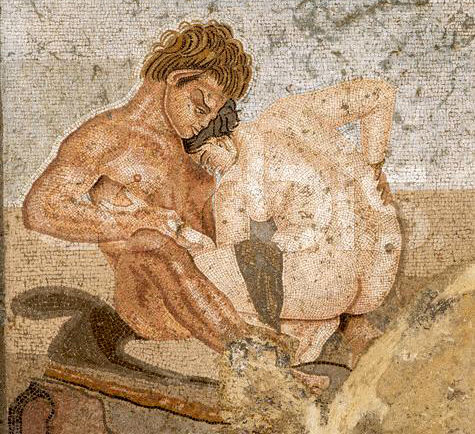
http://pro.corbis.com/, Search # MI001791, Woman and a Satyr Fresco Painting From Pompeii:
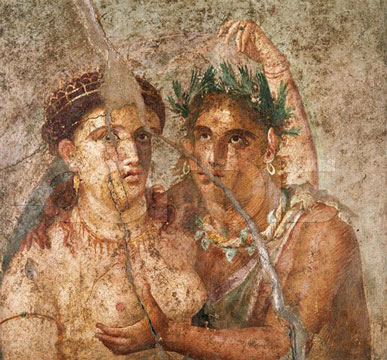
http://www.aztriad.com/gallaf.html, Satyr and Maenad:
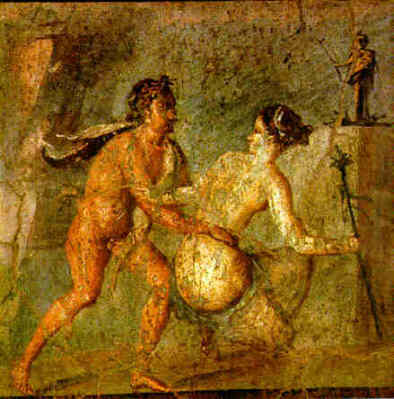
http://pro.corbis.com/, Search # MI001782, Satyr and Nymph Fresco Painting From Pompeii, Sexual activity:
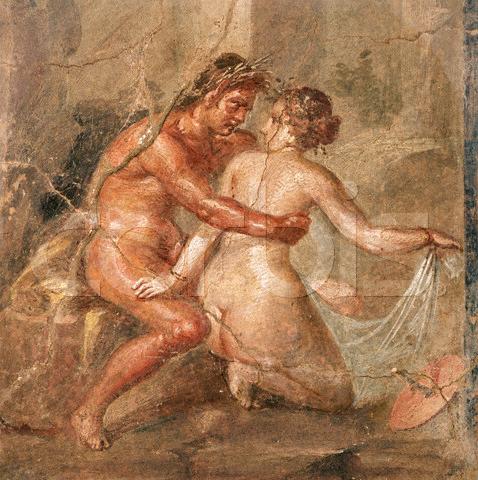
http://www.uark.edu/campus-resources/dlevine/SatyrMaenad2.jpg (University of Arkansas) (via http://www.uark.edu/campus-resources/dlevine/Satyr4.html):
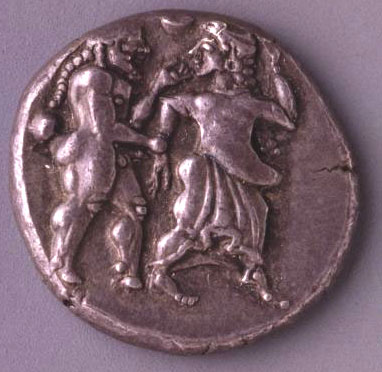
http://www.psicotecnica.org/PanNinfe.html, Pan e le Ninfe (Pan and the Nymphs), “Diverse versioni del conforto che Pan porta alla Ninfa (talvolta definita Psyche) che vanno dal quinto secolo ac fino a tempi contemporanei” (Various versions of the comfort that Pan carries to the Nymph (sometimes defined Psyche) that they go from the fifth century BC until contemporary times):
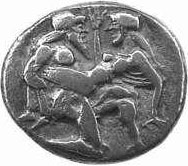
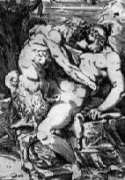
Eros in Pompeii: The Secret Rooms of the National Museum of Naples, Grant, 1975, pp. 98-99, “Lebes with Satyr and Nymph”:
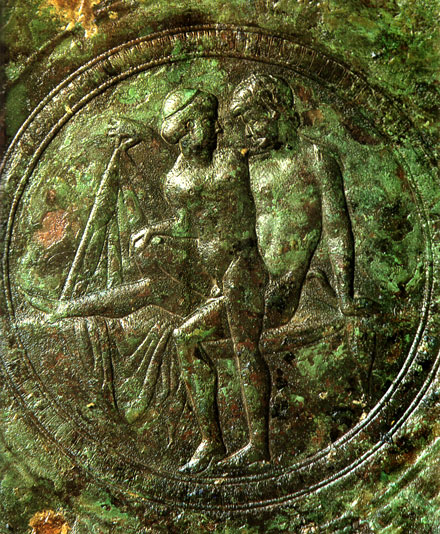
http://www.personal.psu.edu/users/w/x/wxk116/eros/sexart/sex22.html (via http://www.personal.psu.edu/wxk116/eros/refs.html) (Pennsylvania State University), Erotic Art of Ancient Rome:
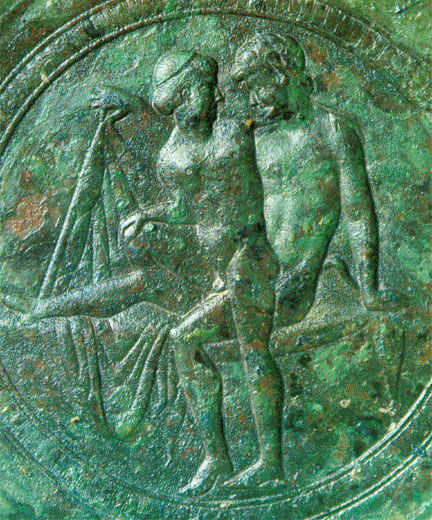
Low relief on a bronze bowl from Pompeii, 1st century AD. The male figure is a satyr. Naples, The National Museum.
http://www.ancientsculpturegallery.com/028.html, Ancient Sculpture Gallery, “Pan and Maenad large plaque”:
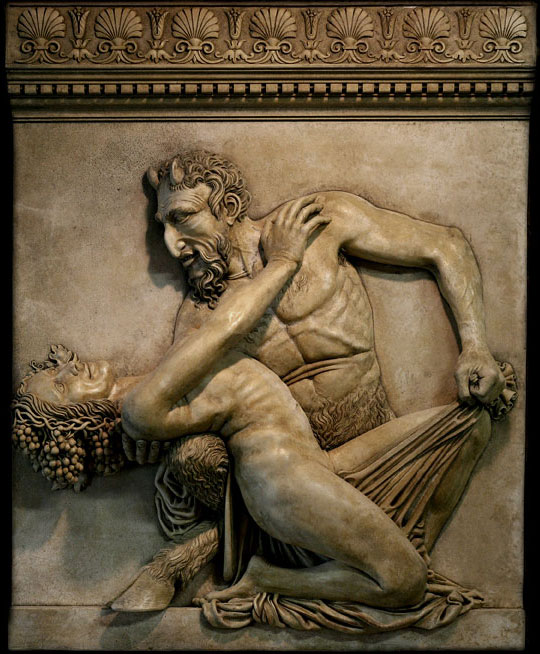
Pan is famous
for his sexual prowess - he had every
one of the Maenads in one orgiastic riot or another.
Maenads were female worshippers of Dionysus-Bacchus, the god of mystery, wine and intoxication.
They were known as wild, insane women who could not be reasoned with. The mysteries of Dionysus
inspired the women to ecstatic frenzy; they indulged in copious amounts of
violence, bloodletting, sex
and self-intoxication and mutilation. A group of Maenads
also killed Orpheus. They were usually pictured
as crowned with vine leaves. The Maenads were also known as Bassarids (or Bacchae or Bacchantes)
in Roman mythology, after the penchant for the equivalent Roman god, Bacchus.
http://www.vroma.org/images/mcmanus_images/maenad_satyr1.jpg (via http://www.vroma.org/images/mcmanus_images/index5.html), “detail, black-figure vase: amorous satyr and maenad; Greek, mid-fifth century BCE; Syracuse Museum. Keywords: Bacchus, bacchante, Dionysus, mythology, vase painting”:
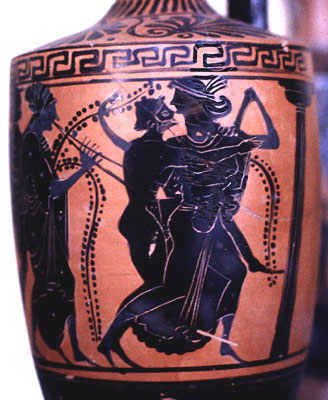
http://www.artlex.com/ArtLex/S.html:
satyr - In Greek mythology, a kind of demi-god or deity; a follower of Dionysus. He is wanton and lascivious
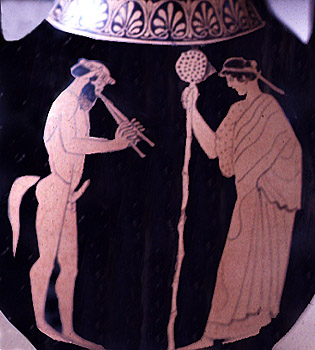
Greek, fifth century BCE, Ithyphallic Satyr Playing an Aulos for a Maenad, detail of a red-figure vase, Syracuse Museum.
http://www.vroma.org/images/mcmanus_images/satyr.jpg (via http://www.vroma.org/images/mcmanus_images/index5.html):
red-figure vase: Dionysus
holding thyrsus and satyr playing aulos
(double flute)
Syracuse Museum. Credits: Barbara McManus, 1982
Keywords: Bacchus, bacchante, Dionysus,
mythology, vase painting
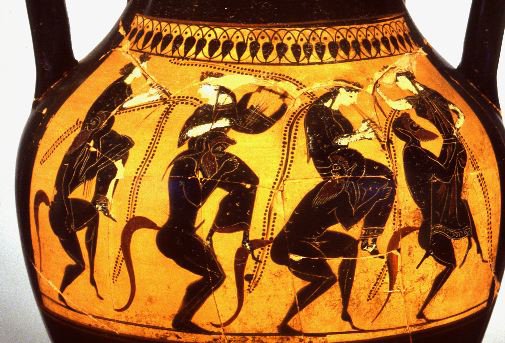
http://cnes.cla.umn.edu/courses/review%20for%20midterm/satyrs%20dancw%20with%20maenads.jpg (via http://cnes.cla.umn.edu/courses/Greek.html), “21. Satyrs dance with maenads”:
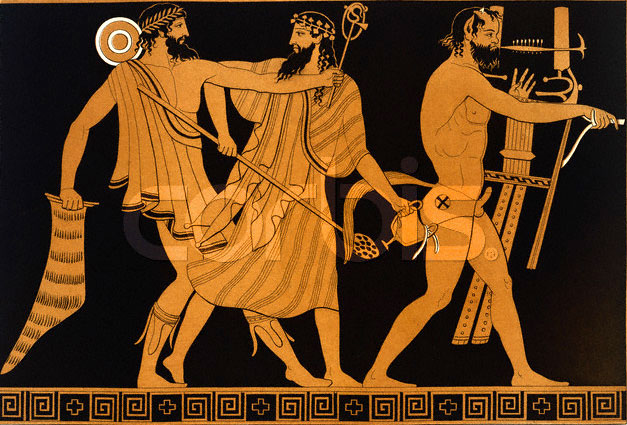
http://pro.corbis.com/, Search # AABR002839, God with Man and Satyr:
http://www.uwm.edu/Course/mythology/0700/dionysus.htm, “Associates of Dionysus: Satyrs and Maenads | Satyrs & Maenads”:
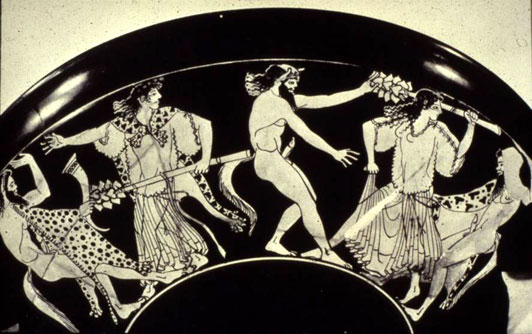
http://www.hfac.uh.edu/mcl/classics/Dion/Satyrs_maen.jpg (via http://www.hfac.uh.edu/mcl/classics/Dion_visuals.html), “With satyrs and maenads”:
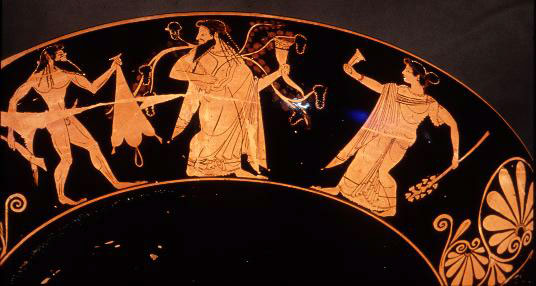
http://www.perseus.tufts.edu/cgi-bin/image?lookup=1990.01.1309, Dionysos with kantharos, flanked by four satyrs:
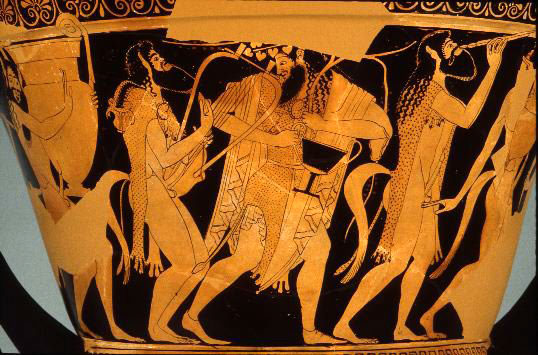
http://www.perseus.tufts.edu/cgi-bin/image?lookup=1990.01.1312, Side B: satyr with aulos and wineskin, satyr with cithara, Hephaistos:
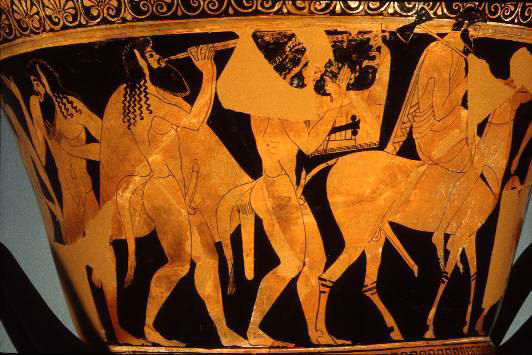
http://www.perseus.tufts.edu/cgi-bin/image?lookup=Perseus:image:1990.01.1311, Handle, side A at left: satyr with rhyton, gesturing satyr, satyr with aulos and wineskin:
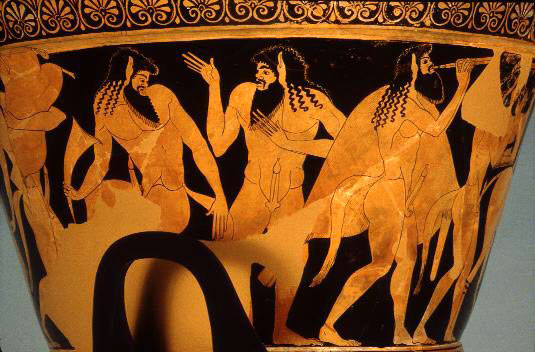
http://www.theoi.com/Olympios/Dionysos.html, Dionysus:
K12.7 "Dionysos and his retinue", Athenian Red Figure Column Krater C5th BC, Martin von Wagner Museum, University of Würzburg L 526:
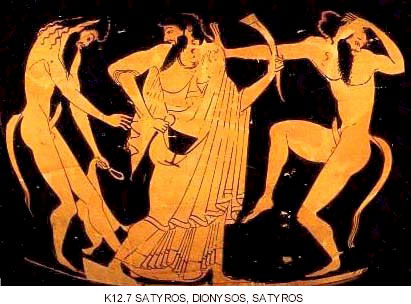 …
…
K12.6 "Dionysos and his retinue", Athenian Red Figure Klyix C5th BC, Boston, Museum of Fine Arts 13.67:
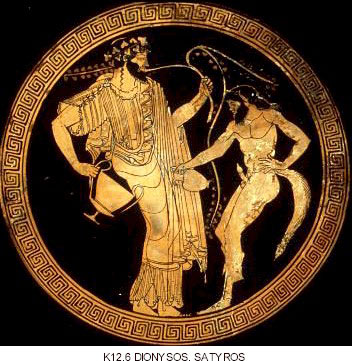
http://www.geocities.com/notosga/photogods/page_dio.htm, Dionysus, “Dionysos with Satyr”:
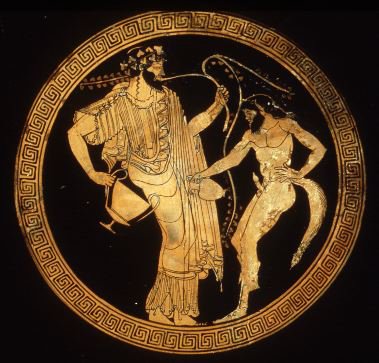
http://academic.brooklyn.cuny.edu/classics/hansen/graphics/maenad.jpg (via http://academic.brooklyn.cuny.edu/classics/hansen/dionfest.htm), Dionysos at Athens: Tragedy, Comedy, and Cult:
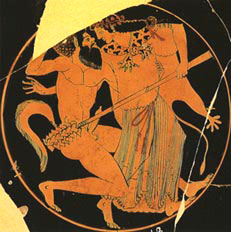
http://www.personal.psu.edu/users/w/x/wxk116/eros/sexart/sex41.html (via http://www.personal.psu.edu/wxk116/eros/refs.html) (Pennsylvania State University), Erotic Art of Ancient Rome:
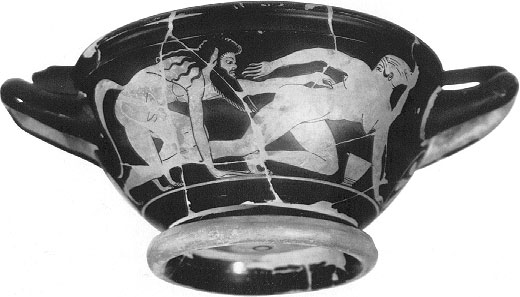
A cup by Epiktetos, showing a satyr pursuing a young girl. 6th century BCE. Naples, National Museum.
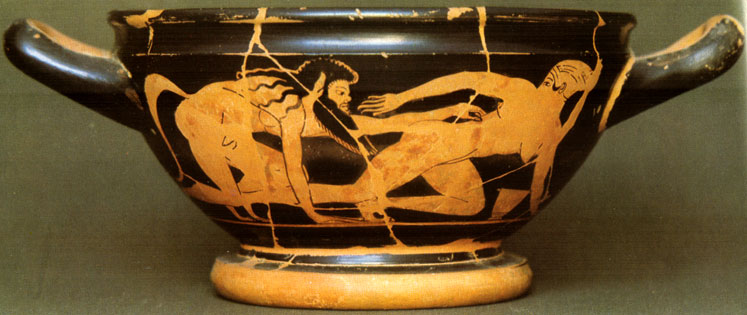
Eros in Pompeii: The Secret Rooms of the National Museum of Naples, Grant, 1975, p. 100, “Skyphos with Scene of Satyr and Maenad”:
http://www.theoi.com/image/K27.5Seilenoi.jpg (via http://www.theoi.com/IllustrationK4.html), Gallery: Myth in Classical Art, “K27.5 Seilenoi making wine”:
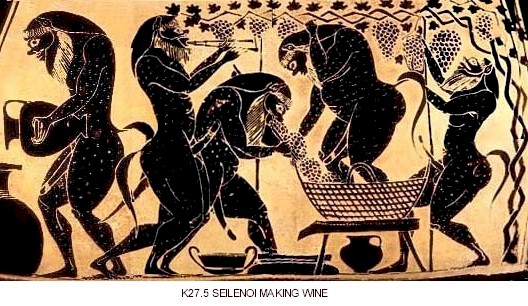
Summary: Side A: Silens making wine; Side B: Dionysos & Silens … Date: ca 530 - 520 BC
Love, Sex & Tragedy: How the Ancient World Shapes Our Lives, Goldhill, 2004, p. 68:
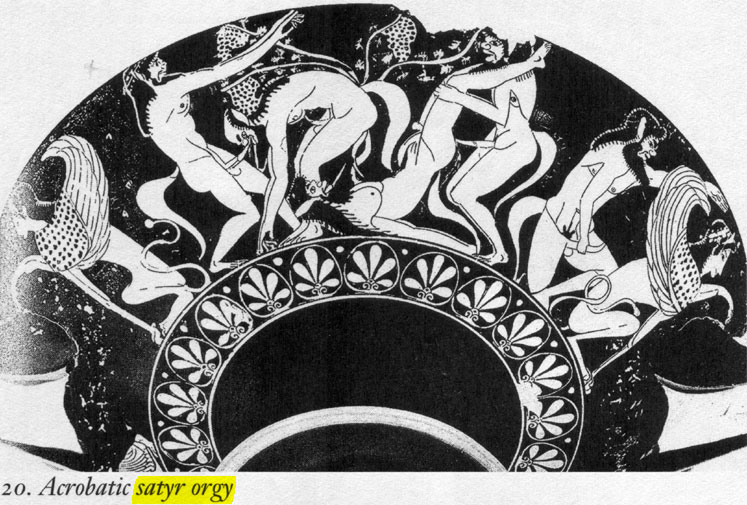
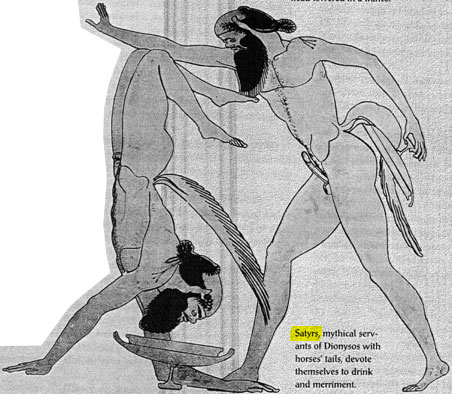
P. 69, figure 20, “Acrobatic satyr orgy”:
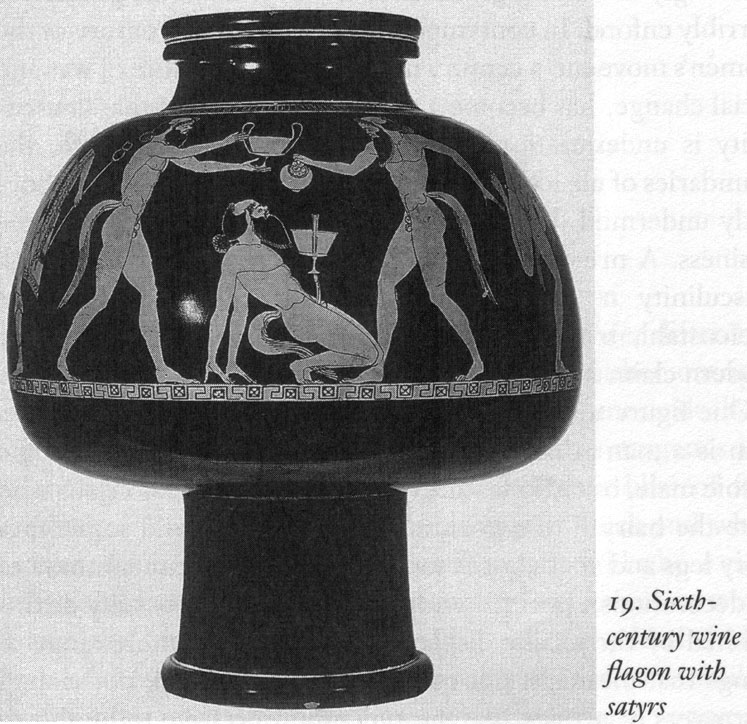
Love, Sex & Tragedy: How the Ancient World Shapes Our Lives, Goldhill, 2004, p. 68, figure 19, “Sixth century wine flagon with satyrs”:
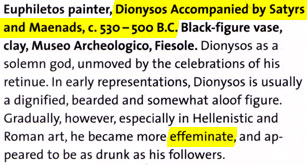
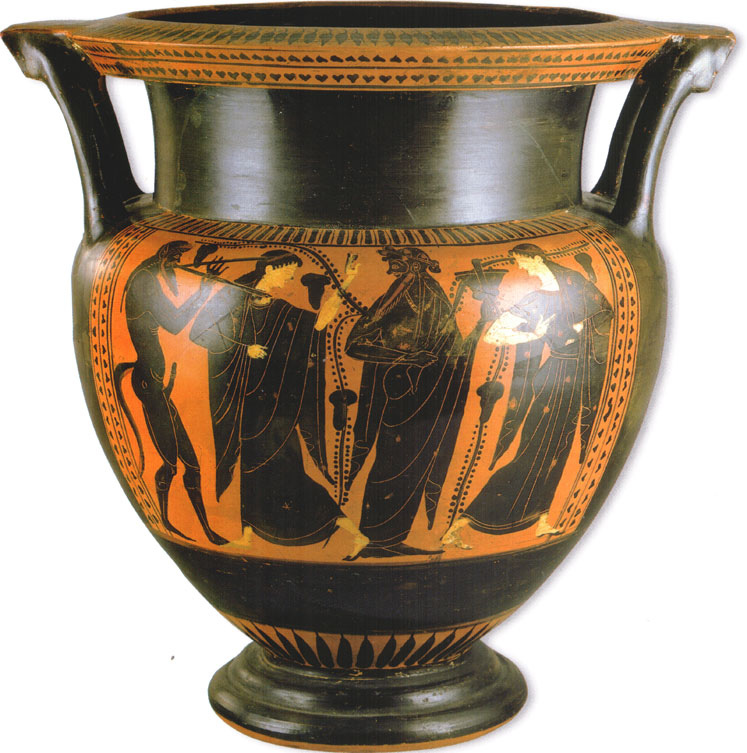
Sexualia: From Prehistory to Cyberspace, Bishop / Osthelder, 2001, pp. 212-214, “The Classical World | Festivals and Mysteries”:
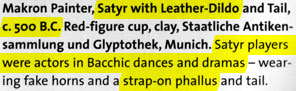 :
:
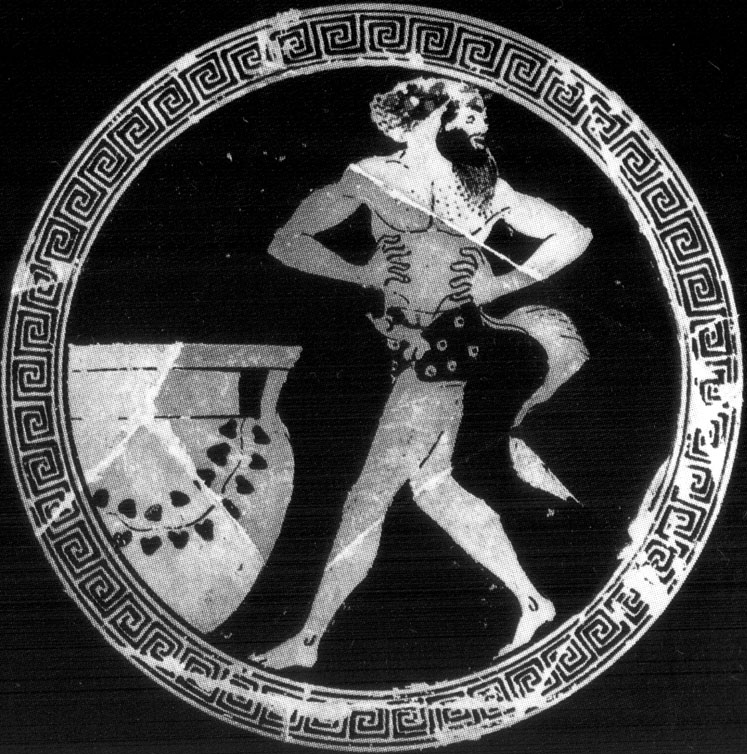
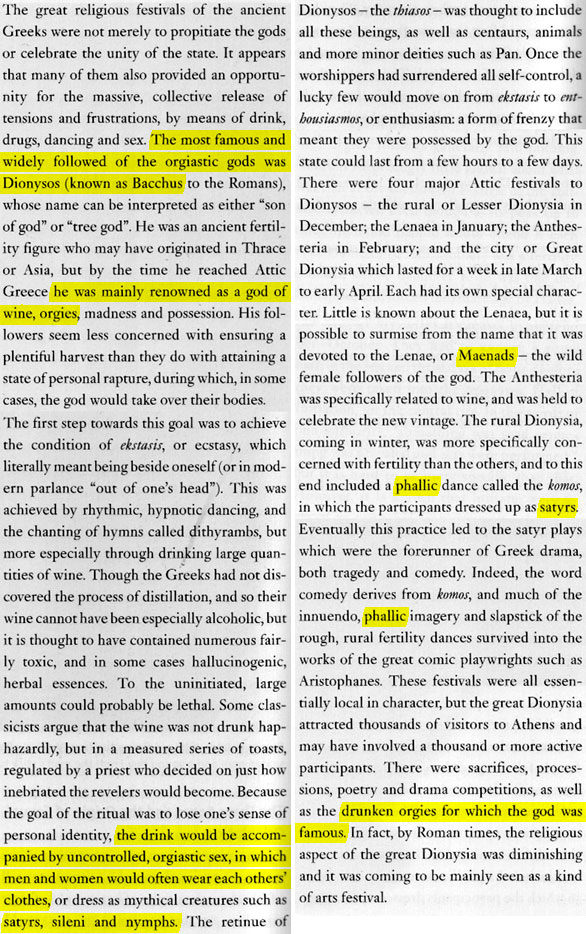
“Phallus” and “Phallic” means a penis.
Love, Sex & Tragedy: How the Ancient World Shapes Our Lives, Goldhill, 2004, p. 69:
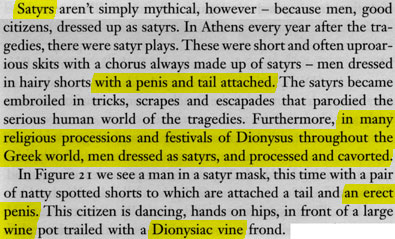
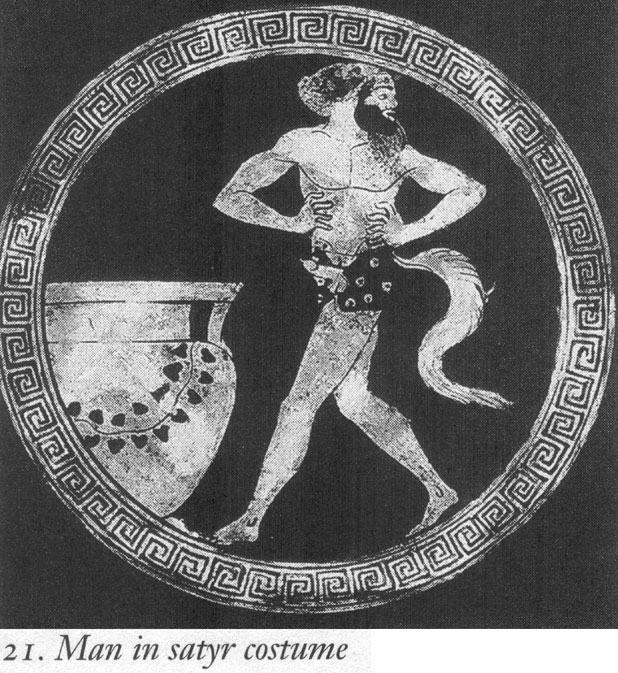
P. 70, figure 21, “Man in satyr costume”:
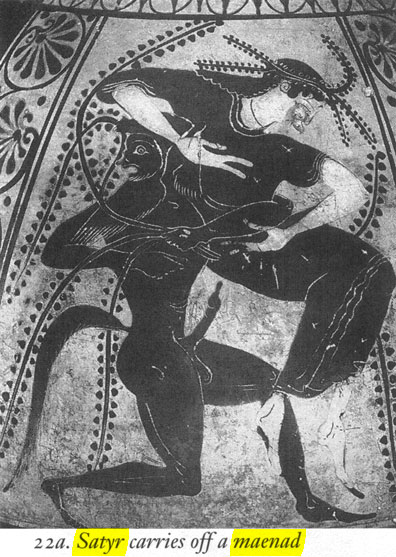
Love, Sex & Tragedy: How the Ancient World Shapes Our Lives, Goldhill, 2004, p. 71, figure 22a, “Satyr carries off a maenad”:
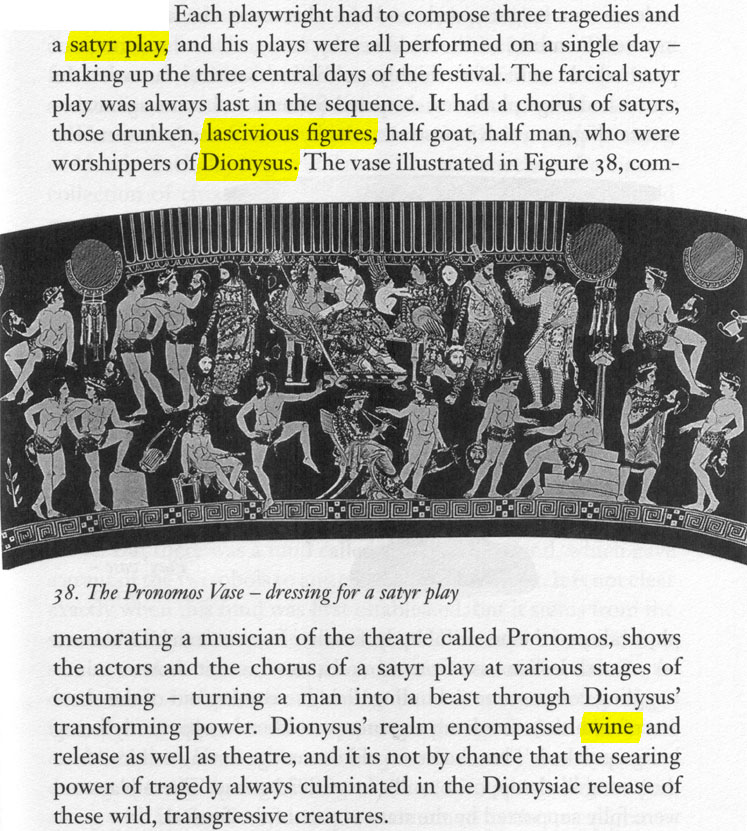
Love, Sex & Tragedy: How the Ancient World Shapes Our Lives, Goldhill, 2004, p. 221, figure 38, “The Question of Tragedy”:
P. 222, figure 39:
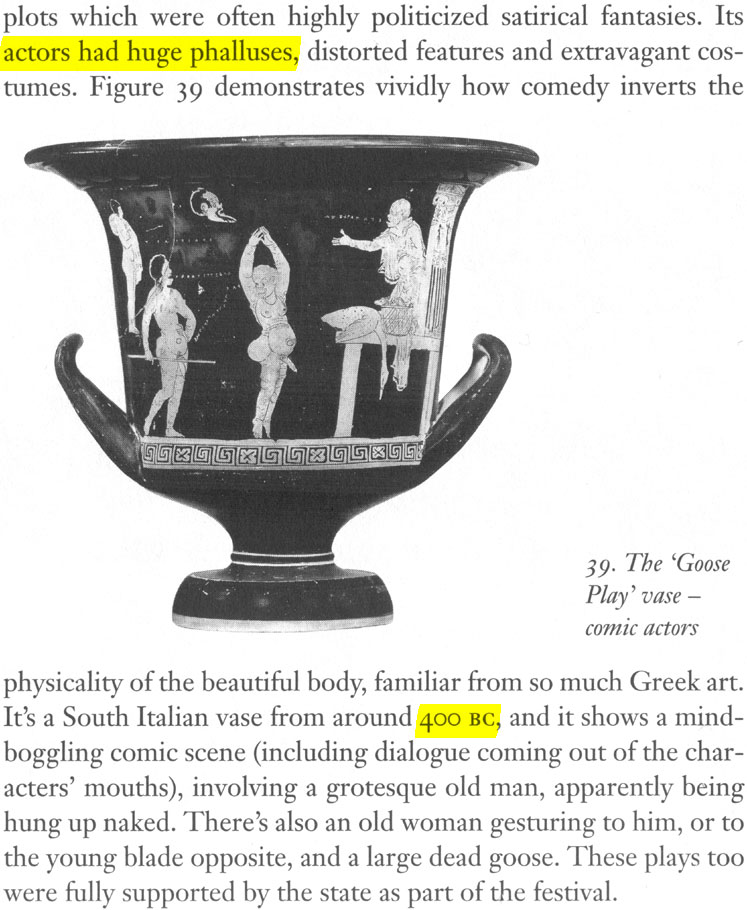
P. 223:
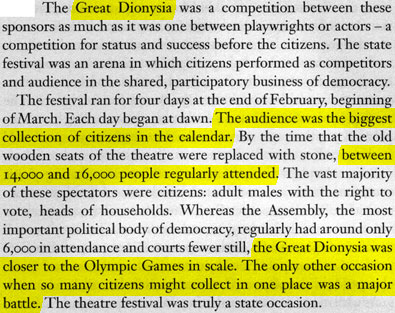
Dionysus was very well known.
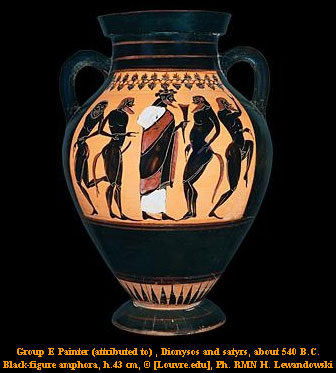
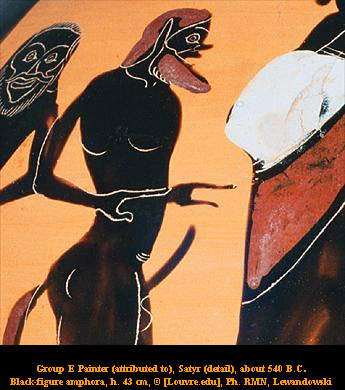
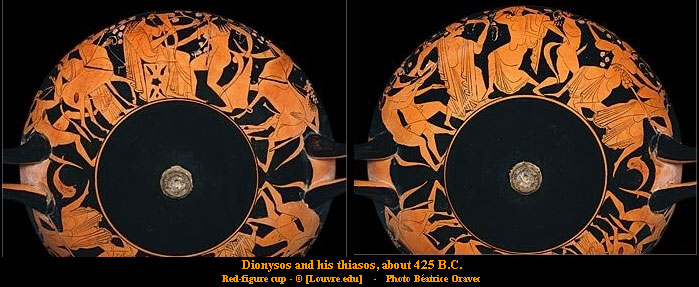
http://www.educnet.education.fr/musagora/dionysos/dionysosen/iconantiq.htm, Depictions of Dionysos:
Dionysos begins to appear in ceramics at the end of the VIth century B.C. in the form of an adult with a pointed beard, dressed in a long oriental robe over a tunic.
 …
…
 …
…
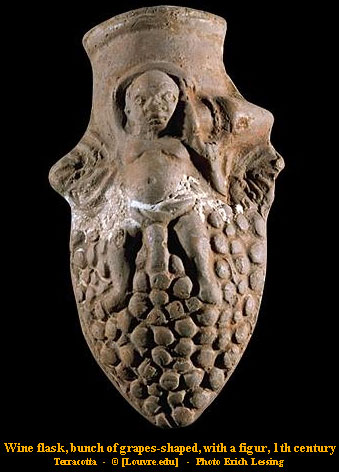 …
…
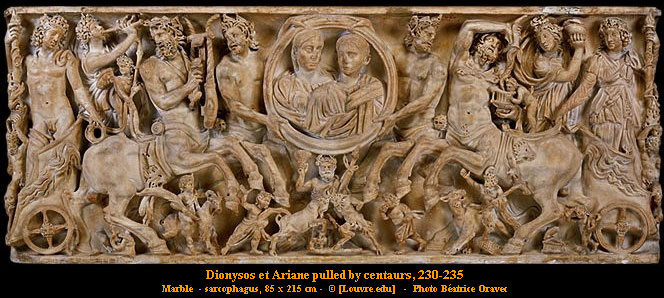
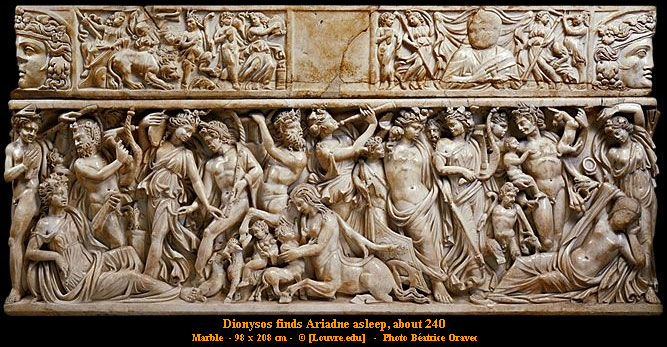 …
…
http://www.theoi.com/image/K22.1Pan.jpg (via http://www.theoi.com/IllustrationK4.html), Gallery: Myth in Classical Art, “K22.1 Pan”:
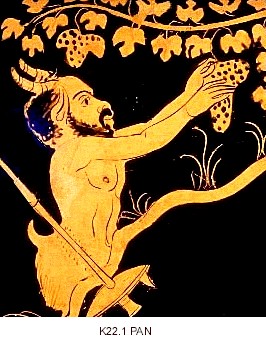
Summary: Side A: Dionysos and Ariadne. Pan picking grapes … Date: ca 380 - 360 BC
What Life Was Like at the Dawn of Democracy: Classical Athens 525-322 BC, Time-Life Books, 1997, no page number, “Dionysos and His Followers”:
http://www.magicalomaha.com/Greekgodgoddessstatury.htm, Greek/Roman God and Goddess Statues, “Satyr Herne Statue”:
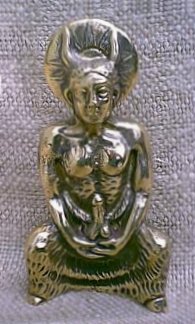
A few satyrs have horns. Without doing a bunch of research, I assume the later church has equated horns with the devil.
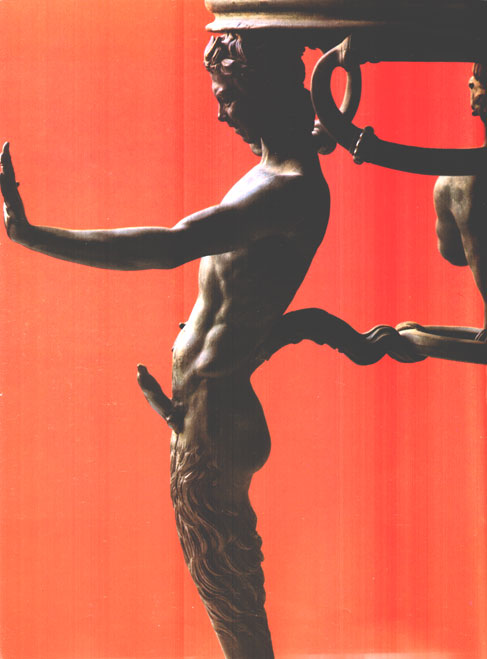
http://pro.corbis.com/, Search # DE006219, Tripod with Basin for Burning Coal, Date Created: ca. 1st century A.D., Satyrs:
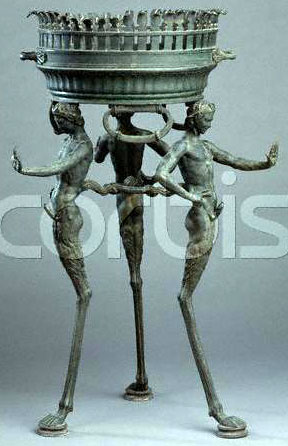
Eros in Pompeii: The Secret Rooms of the National Museum of Naples, Grant, 1975, p. 9, “Tripod with Ithyphallic Young Pans”:
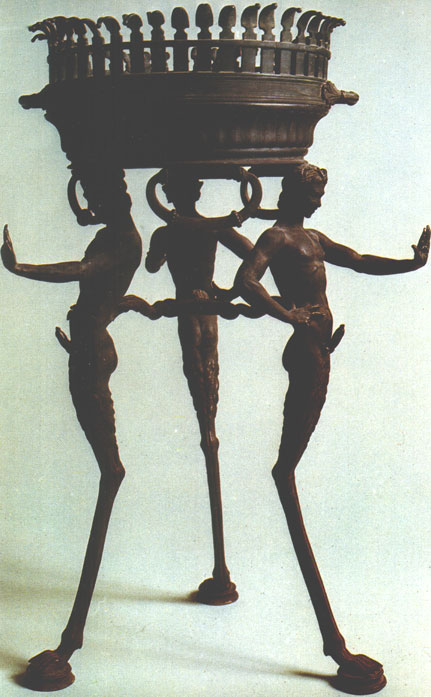

Pp. 84-85, “Tripod with Ithyphallic Young Pans”:
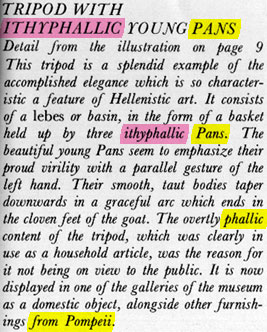
http://www.answers.com/ithyphallic, “ithyphallic”:
1. Of or relating to the phallus carried in the ancient festival of Bacchus.
2. Having the penis erect. Used of graphic and sculptural representations.
3. Lascivious; salacious.
A “phallus” is a penis.
http://www.androphile.org/preview/Museum/Rome/ficoronicist.htm, The World History of Male Love: Roman Hall, “Ficoroni cist”:
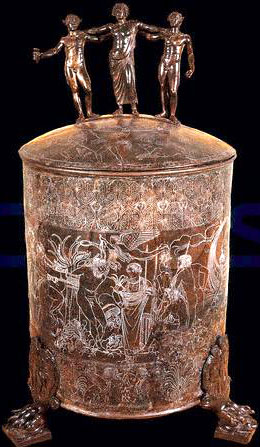
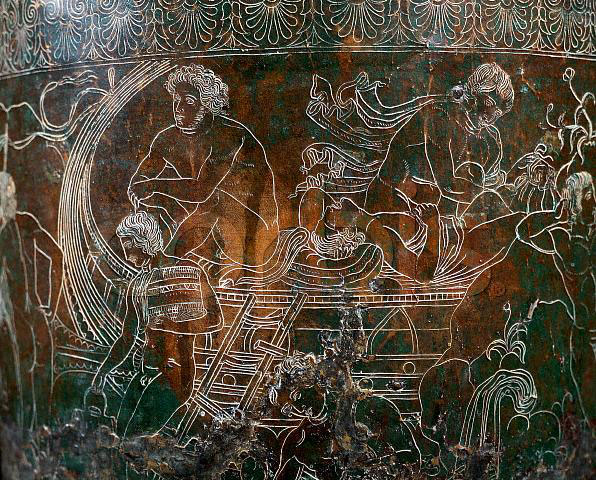
Bronze ritual vessel from women's Dionysiac procession featuring homoerotic symbols and engraved with scenes from the voyage of the Argo. The feet depict Hercules and Iolaus, with Eros standing in between. The finial group is made up of Dionysus flanked by two ithyphallic (sexually aroused) satyrs. One side of the engraving shows an embracing couple tentatively identified as Hercules and Hylas (closeup of engraving has been enhanced for clarity). Praeneste, 4th century BCE. Museo Nazionale di Villa Giulia, Rome.
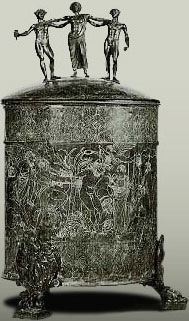
http://www.homoerotimuseum.net/eur/eur05/006.html (Homoerotic Art Museum), “6 – Ficoroni cist,” 4th century BC:
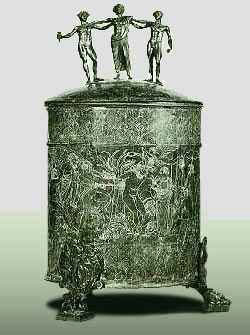
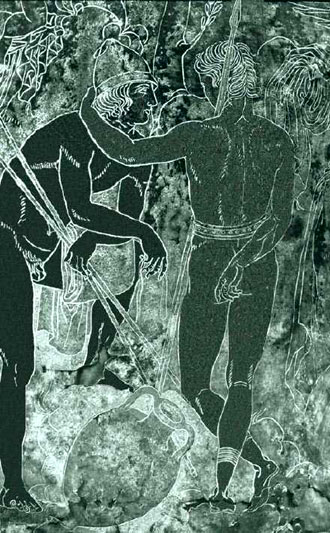
http://pro.corbis.com/, Search # IH050538, Ficoroni Cist by Novius Plautius, late 4th century BC:
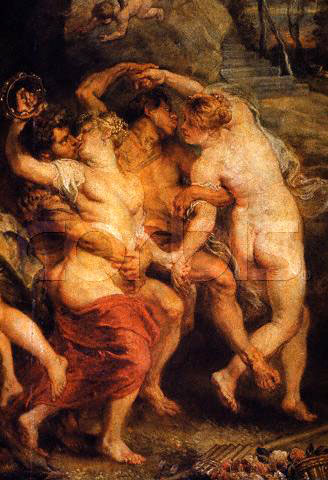
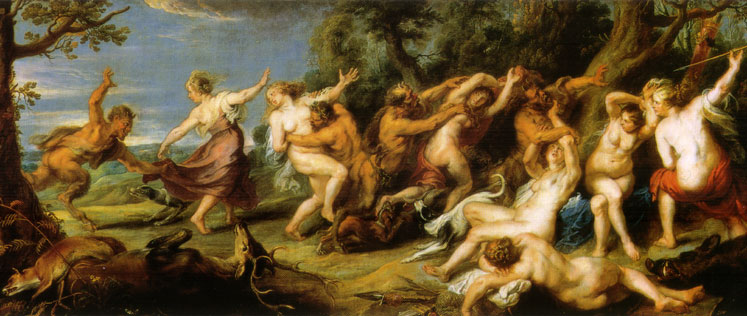
http://pro.corbis.com/, Search # BE087724, Detail of Nymphs, Satyrs and Pan from The Feast of Venus by Peter Paul Rubens:
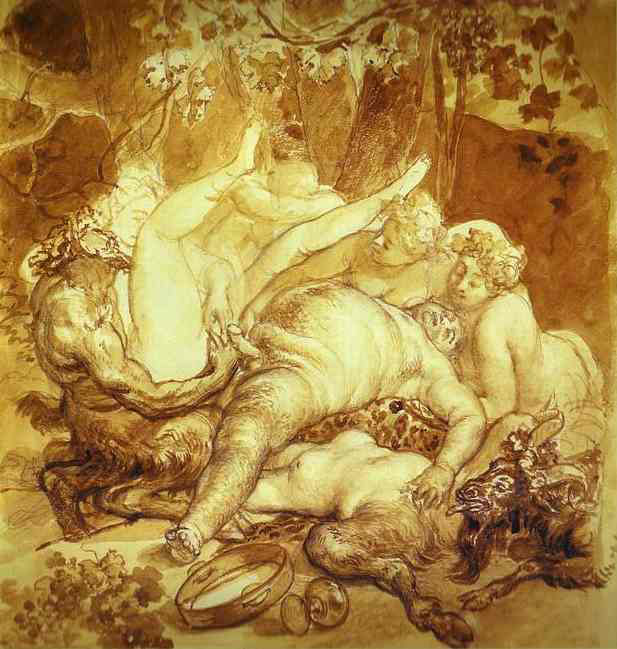
http://www.bestpriceart.com/painting/?pid=81240, Silen, Satyr and Bacchanals, by Karl Brulloff, Russia:
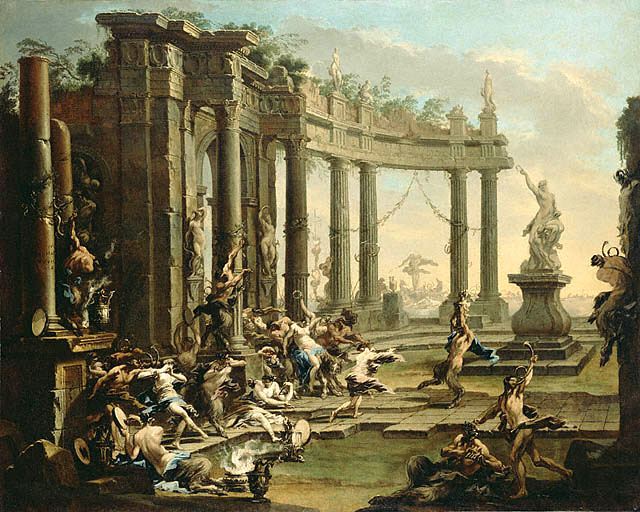
http://www.getty.edu/art/collections/objects/o739.html, Bacchanale, Alessandro Magnasco, Italian, about 1720-1730:
Nymphs and satyrs participate in an ancient pagan feast celebrating Bacchus, the god of wine.
The Ultimate Encyclopedia of Mythology, Cotterell / Storm, 1999, p. 61, “Satyrs”:
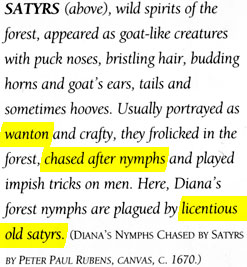
P. 81, “The Satyrs”:
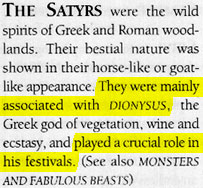
http://www.uwm.edu/Course/mythology/0700/dionysus.htm, “Associates of Dionysus: Satyrs and Maenads | Alma-Tadema”:
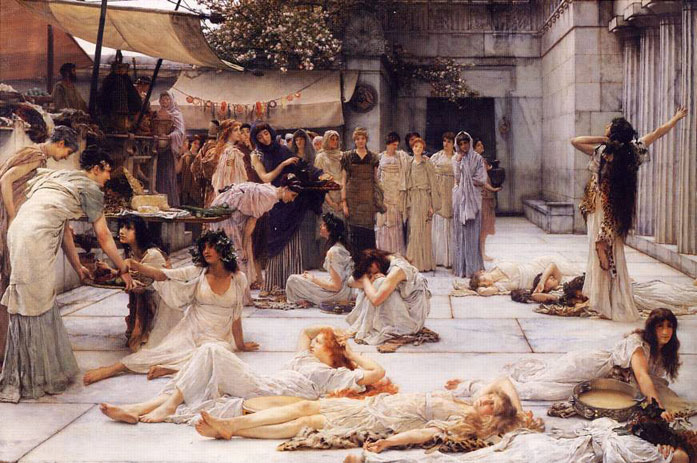
http://www.zeichen.dsl.pipex.com/jugs%20&%20general.htm:
A Charles Meigh Bacchanalian Dance jug in grey stoneware with scenes from "Bacchanalian Revel before a Herm of Pan by Poussin and Drunken Silenus by Rubens.
Thiasos:
http://www.winterscapes.com/thiasoslusios/festivals.htm, Thiasos Lusious - Festivals:
Here is the festival calendar for Dionysos: …
Propompeia - For satyrs,
maenads, etc.
Date: Mardi Gras Tuesday / mid-February
Synopsis: A Festival in honor of the Propompoi, the companions and
attendants of Dionysos in His revels -
the Maenads, the Satyrs, the Muses, the Nymphs,
the Graces, the Kouretes, etc.
Everyone's already honoring Dionysos
with drunken carousing, rampant silliness, and great phallic (penis) worship on this
day - we'll just rechristen it.
Anthesteria
Date: Anthesterion
11-13 (mid to late February)
Synopsis: The first day was called Pithoigia or the "Opening of the
Jars". This was when the wine casks
were opened for the first time, and masters and servants alike were allowed to
taste the new wine. The second day Khoes
or "Cups" was celebrated with a great public feast, and young
children were given their first drink of wine.
At Dionysos' oldest temple, the Lenaeon,
the wife of the Archon Basileus "King and Ruler" was wedded to Dionysos in a Sacred Marriage. The Basilissa
was thought to represent the country, and thus her wedding with Dionysos was seen as a way of uniting
fertility with the land once more. It's not sure how this was done, whether a
Priest of Dionysos functioned as a
stand-in for the God, or whether the Basilissa made love to the ancient phallic (penis)
wooden statue that was housed in the temple, or whether her husband the Archon Basileus
impersonated the God. There was a general sense of erotic expectation in the air, which may have culimnated in
nocturnal orgies. The third and final
day of the festival, Khutroi or "Pots", was entirely given over to the
spirits of the dead. Sacrifices of cooked vegetables and seeds were given to
Hermes and the dead. …
http://www.answers.com/phallic, “phallic”:
Of or relating to the third stage of psychosexual development in psycholanalytic theory during which the genital organs first become the focus of sexual feeling.
http://www.fortunecity.com/meltingpot/ukraine/231/dionysian/orphism.html, From Orphism to Gnosticism:
G.R.S Mead writes of other obscure sects, two of which he calls the Thiasi and the Orgeones, which emerged amongst the Dionysians
http://en.wikipedia.org/wiki/Ancient_Greek_clubs, Ancient Greek clubs:
the thiasi and orgeones seem connected more especially with foreign deities whose rites were of an orgiastic character.
http://www.csun.edu/~hcfll004/miscellaneous.html, Archaic Athens: Miscellaneous Texts, I, “Philochoros [FGrH 328] F 35a: (=Photios & Suda, s.v. orgeones)”:
orgeones: Those who perform orgiastic rites for their own privately erected gods; orgiazein means to carry out the orgia of the gods, that is to say, mysteries and nomima ['customary usages'].
http://www.1911encyclopedia.org/Dionysus, 1911 Edition of the Encyclopaedia Britannica, “DIONYSUS”:
In Homer, notwithstanding the frequent mention of the use of wine, Dionysus is never mentioned as its inventor or introducer, nor does he appear in Olympus; Hesiod is the first who calls wine the gift of Dionysus. On the other hand, he is spoken of in the Iliad (vi. 130 f oll., a passage belonging to the latest period of epic), as " raging," an epithet that indicates that in those comparatively early times the orgiastic character of his worship was recognized. In fact, Dionysus may be regarded under two distinct aspects: that of a popular national Greek god of wine and cheerfulness, and that of a foreign deity, worshipped with ecstatic and mysterious rites introduced from Thrace.
…
Dionysus was then conveyed by Hermes to be brought up by the nymphs of Nysa, a purely imaginary spot, afterwards localized in different parts of the world, which claimed the honour of having been the birthplace of the god. As soon as Dionysus was grown up, he started on a journey through the world, to teach the cultivation of the vine and spread his worship among men. While so engaged he met with opposition, even in his own country, as in the case of Pentheus, king of Thebes, who opposed the orgiastic rites introduced by Dionysus among the women of Thebes
…
At Orchomenus, the three daughters of Minyas refused to join the other women in their nocturnal orgies, and for this were transformed into birds (see Agr10nia).
…
The worship of Dionysus was actively conducted in Asia Minor, particularly in Phrygia and Lydia. Here, as Sabazius, he was associated with the:Phrygian goddess Cybele, and was followed in his expeditions by a thiasos (retinue) of centaurs and satyrs, with Pan and Silenus.
Silenus was a Satyr, or similar to a Satyr.
…
The former story has been connected with the sailors' custom of hanging vine leaves, ivy and bunches of grapes round the masts of vessels in honour of vintage festivals.
…
Dionysus further possessed the prophetic gift, and his oracle at Delphi was as important as that of Apollo. Like Hermes, Dionysus was a god of the productiveness of nature, and hence Priapus(god who had an enormous erect penis) was one of his regular companions, while not only in the mysteries but in the rural festivals his symbol, the phallus(penis), was carried about ostentatiously.
http://home.pon.net/rhinoceroslodge/thiasos.htm, Thiasos Olympikos:
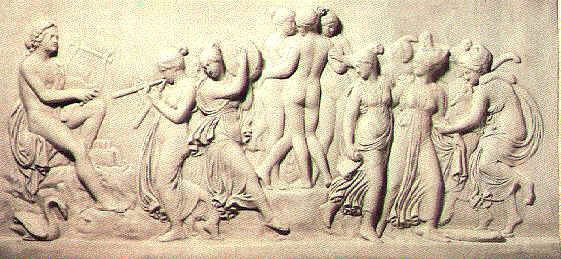
http://pro.corbis.com/, Search # AABR002864, Maenad with Thrysus and Satyr: