DIONYSUS – PHALLUS, PRIAPUS
A phallus is a representation of a penis
Fundamentals of Human Sexuality, Katchadourian, 1989, p. 575, “Greece and Rome | Erotic Art and Literature”:
The New Encyclopaedia Britannica, Macropaedia, 1993, Vol. 4, p.110, “Dionysus”:

http://www.answers.com/topic/dionysia, Dionysia, “Rural Dionysia”:
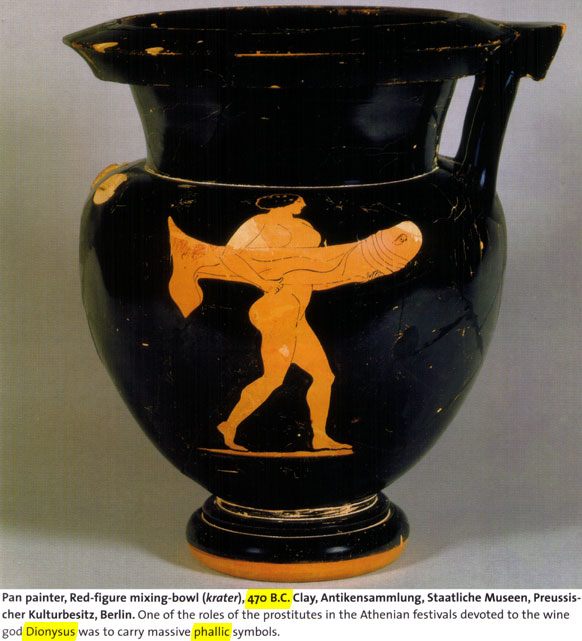
This "rural Dionysia" was held during the winter in the month of Poseideon (roughly corresponding to December). The central event was the pompe, the procession, in which phalloi were carried by phallophoroi.
http://www.answers.com/topic/dionysia, phallo-:
Penis
The New International Dictionary of New Testament Theology, Brown, Zondervan Publishing, 1978, vol. 3, p. 919, “Vine, Wine”:

The Oxford Guide to Classical Mythology in the Arts, 1300–1900s, Reid, 1993, Vol. 1, p. 349, “Dionysus”:
Greek & Roman Mythology, Translated by Elizabeth Burr, 1994, pp. 90-92:
http://www.piney.com/Charismatic.html, Charismatic Worship:
"Dionysos, of course, explicitly combined all these aspects: at once the ecstatic(expressing ecstasy) ithyphallic(erect penis, lascivious, salacious) god of orgy, … To produce ecstasy they may use alcohol and other drugs, music and dance, sexuality, or some combination of these; in short, orgies (Weber 1968b, 273).
http://www.1911encyclopedia.org/Dionysia, 1911 Edition of the Encyclopaedia Britannica, “DIONYSIA”:
'DIONYSIA, festivals in honour of the god Dionysus generally, but in particular the festivals celebrated in Attica and by the branches of the Attic-Ionic race in the islands and in Asia Minor. In Attica there were two festivals annually. (I) The lesser Dionysia, or T a /car e ypous, was held in the country places for four days (about the 19th to the 22nd of December) at the first tasting of the new wine. It was accompanied by songs, dance, phallic processions and the impromptu performances of itinerant players, who with others from the city thronged to take part in the excitement of the rustic sports.
http://members.tripod.com/great-bulgaria/Bulgaria/, Bulgaria, “Dionysus The Thracian”:
In his most ancient form Dionysus is a dark and angry god. A phallic(penis) diety, always depicted with an erect phallus(penis), he is the god who fertilizes the great mother godess so that the earth can be born. Rituals part of that belief still survive in modern Bulgaria. Most notable among them are those from the Strandja mountain range. Specificaly, the festivities (orgies) associeted with Saint Marina. According to legend she was born and grew up in a cave. Her mother had asked the sun to give her a child, which was born in the cave. This legend is a vivid description of ancent beliefs connected to a recently discovered cave shaped like a uterus, with an opening through which the sun produces the image of a phallus(penis) which grows and shrinks seasonaly. Also in the same region of Bulgaria, the traditional white Mummer dances with a giant red phallus(penis) and "fertilizes" the soil. … Dionysus died each winter and was reborn every spring, his rebirth was a time of great celebration. As Dionysus represented the sap, juice, or lifeblood element in nature, lavish festal orgies in his honor were widely instituted. … The Dionysia custom still survives in modern Bulgaria. When Bulgaria became Christian, the church changed all the names of gods and holidays to something Christian. In Dionysus' case the new name is St. Trifon. … One of Dionysus' major miracles was turning water into wine. Can you name a major modern religion which usurped that miracle? So apparently wine as the lifeblood was fine for the Church but orgiastic worship and the maenads had to go!?! Hopefuly we can bring both of those back.
http://www.eliznik.org.uk/RomaniaHistory/thracian-gods.htm, Balkan history: Thracians gods, “Dionysus - festive God of wine”:
Dionysus was, in ancient times, a dark and angry god who fertilized the great mother goddess so that the earth could be born. He developed into a more gentle festive god by the 6th century BC. The strange legends of Dionysus' birth and death and his marriage to Ariadne suggest that Dionysus had roots in the early, pre-Greek, people. Each winter Dionysus died and every spring his rebirth was marked by celebrations and lavish festive orgies.
Sexualia: From Prehistory to Cyberspace, Bishop / Osthelder, 2001, p. 39, “A Man’s Sex Organs | The Phallic Symbol”:

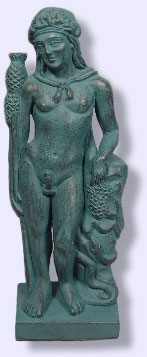
http://www.tantricgarden.com/prodinfo.asp?number=DY, Tantric Garden: Where Love & Pleasure Grow, “Young Dionysus 8” statue”:
|
|
Dionysus embodies gentleness and joy. Symbol of Divine Youth and Lord of Grain, Leaf and Vine, Dionysus was central to ancient Greek annual ceremonies involving blood sacrifice to ensure crop fertility. He carries the phallic (penis) wand, was escorted by maenad priestesses, and wears a panther skin. Celebrate joyful youth with Dionysus! |
Sexualia: From Prehistory to Cyberspace, Bishop / Osthelder, 2001, p. 204, “The Classical World | Prostitutes, Concubines, and Courtesans”:
http://barclay.e-city.tv/oldhist/persiaf_en.html, Fertility Rituals at Asukaza Shrine and Dithyrambos:
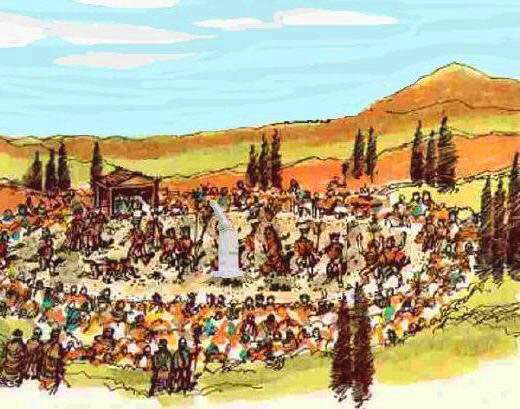
An ancient, drunken, dance-chant fertility ritual that celebrated the birth of the wine god, Dionysus and the vaunted fruit of the vine, developed, around the ninth and eighth centuries B.C., with the dithyrambos. The dithyrambos was performed yearly at four tribal festivals (called orgia--from which comes our word orgy). These Dionysian revels were held outside town, probably in and around broad, earthen threshing circles, where, at harvest time, sheaves were pounded to separate grains from the chaff. Such circles can still be found in rural Greece today. A sixteen-foot phallos (penis) was erected in the center of the circle as a focal point for the orgiastic festivities.
An Etymological Dictionary of the English Language, Skeat, 1983, p. 447, “PHALLUS”:

http://commons.wikimedia.org/wiki/Image:DelosPhallus.jpg (via http://www.answers.com/phallus), “Phallus”:
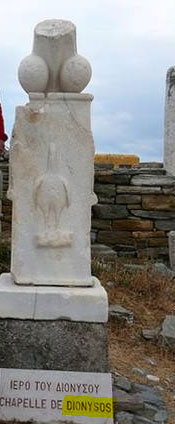
Phallus-shaped column from the sanctuary of Dionysus in Delos
(This one of course also honors the Bobbitt family.)
http://www.1911encyclopedia.org/Phallicism, 1911 Edition of the Encyclopaedia Britannica, “Phallicism”:
PHALLICISM, or Phallism (from Gr. φαλλος), an anthropological term applied to that form of nature worship in which adoration is paid to the generative function symbolized by the phallus, the male organ. It is common among primitive peoples, especially in the East, and had been prominent also among more advanced peoples, e.g. the Phoenicians and the Greeks. In its most elementary form it is associated with frankly orgiastic rites. This aspect remains in more advanced forms, but gradually it tends to give place to the joyous recognition of the principle of natural reproduction. In Greece for example, where phallicism was the essence of the Dionysiac worship and a phallic revel was the origin of comedy (see also Hermes), the purely material and the symbolical aspects no doubt existed side by side; the Orphic mysteries had to the intellectual Greeks a significance wholly different from that which they had to the common people. Phallic worship is specially interesting as a form of sympathetic magic: observing the fertilizing effect of sun and rain, the savage sought to promote the growth of vegetation in the spring by means of symbolic sexual indulgence.
…
In the Dionysiac rites the emblem was carried at the head of the processions and was immediately followed by a body of men dressed as women (the ithyphalli).
Eros in Pompeii: The Secret Rooms of the National Museum of Naples, Grant, 1975, p. 116, “Clothed Herm”:
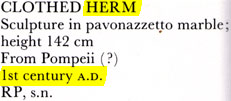
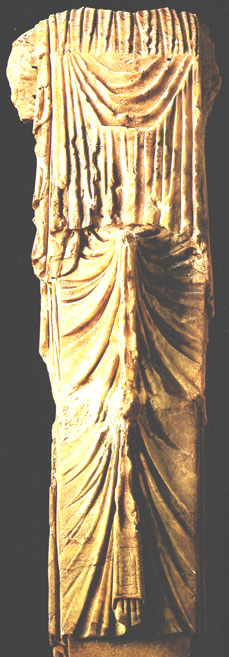
Priapus:
http://www.library.csi.cuny.edu/siias/romanempire.html (College of Staten Island), Roman Empire:
Mold-Made Lamps decorated with Erotica
SIIAS Ax56.30.18; Ax56.30.23
Harold Rome Bequest
Terracotta, 1st-2nd century CE
The discii of these lamps are decorated with scenes of sex-acts. The appearance of these scenes on objects as common-place as lamps reflects the prominence of sexuality and its association with fertility in Greco-Roman culture. The worship of Dionysos/Bacchus and Priapus featured orgiastic fertility rites
Eros in Pompeii: The Secret Rooms of the National Museum of Naples, Grant, 1975, pp. 124-125, “Priapus”:
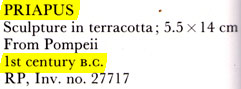
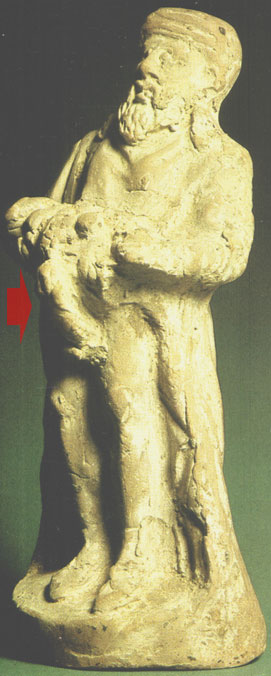
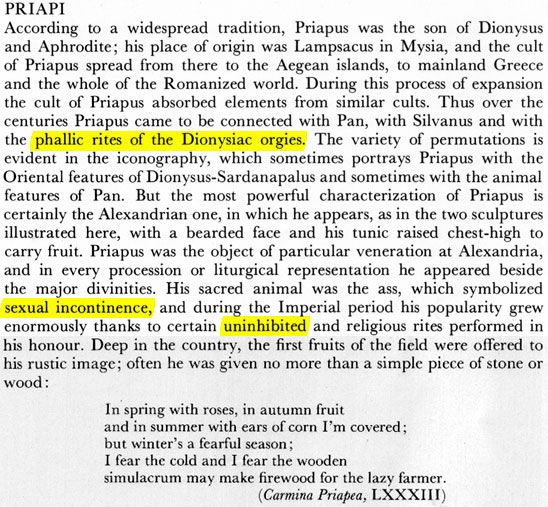
“Phallic” refers to the penis. “Incontinence” refers to the lack of sexual restraint.
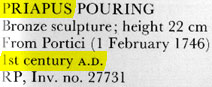
P. 126-127, “Priapus Pouring”:
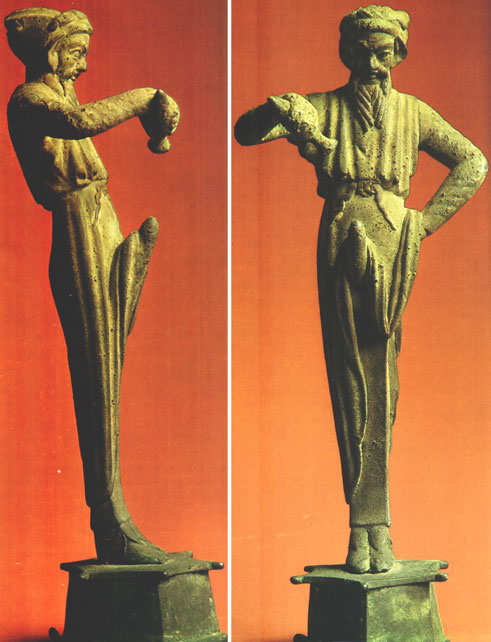
Bibliotheca Eliotae (Latin-English dictionary), Sir Thomas Elyot, 1548 (“M. D. XLVIII”), no page numbers, “Satyriacum” (form of Satyr):

Translated from Elizabethan English:
Satyriacum, an image of Priapus.
Sexualia: From Prehistory to Cyberspace, Bishop / Osthelder, 2001, p. 216, “Hermaphroditus”:
Christian connection:
The Paintings of the ‘New’ Catacomb of the Via Latina and the Struggle of Christianity against Paganism, Bargebuhr, 1991, p. 38, “Representations of Pagan Themes”:
The phallic symbol is a penis.
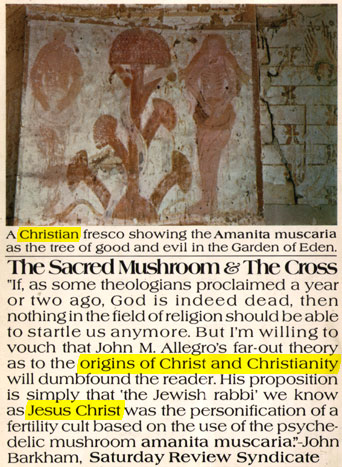
The Sacred Mushroom & The Cross, John M. Allegro, 1971, back cover:
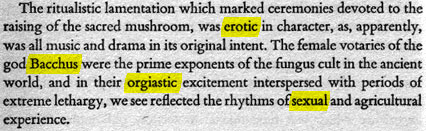
P. 85, “Religious Lamentation”:
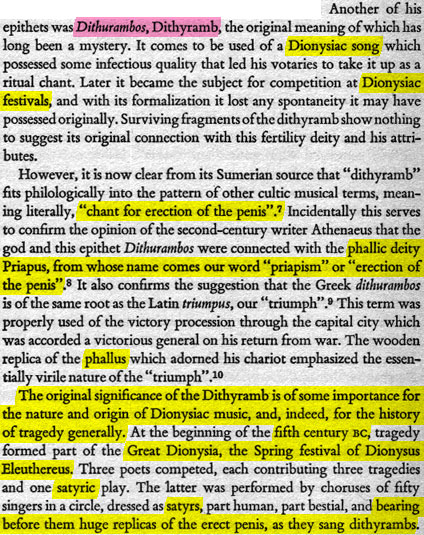
http://www.pantheon.org/articles/d/dithyrambos.html (Encyclopedia Mythica), “Dithyrambos”:
A frequent epithet of Dionysus, possibly meaning "he of the double door", i.e. twice born, alluding to his premature birth. The term also refers to the solemn odes and hymns sung to Dionysus at his festivals.
The Sacred Mushroom & The Cross, John M. Allegro, 1971, p. 90, “Religious Lamentation”:
John M. Allegro was one of the original scholars who worked on the Dead Sea Scrolls.
http://www.balaams-ass.com/journal/homemake/lewsdion.htm, Further Into the Depths of Satan, in C.S. Lewis' Chronicles of Narnia, “Dionysus, Bacchus, Silenus and the Maenads: Page 7”:
As if what we have already been over is not enough, we find what a gross pagan Lewis really was when we notice that he portrayed Dionysus (Bacchus), Silenus and the Maenads as good characters in his stories!
…
In Greece a dancing circle surrounded his altar. Through this complete, unconditional surrender to the devils in this orgy, they believed they could cross over into the eternal, spiritual realm.
The phallus (penis symbol) was a prominent symbol in Dionysus' rituals and was carried in processions in his honor. One of the oldest known prayer-hymns is one used by the followers of Dionysus and is addressed to the genitals.[1] His followers included fertility spirits, such as satyrs.
…
The most revolting thing, which has been evident right along, is stated plainly in the quote on p. 192. Aslan is leading! Now, if Aslan is supposedly the Lord Jesus Christ, as many assure us and as Lewis himself allowed, then what we find here is the grossest blasphemy!! This is then supposedly Jesus Christ leading a Satanic orgy of Bacchus!! This is sick beyond description!!
I’m fully aware of what we’ve been taught to think.