JORDAN
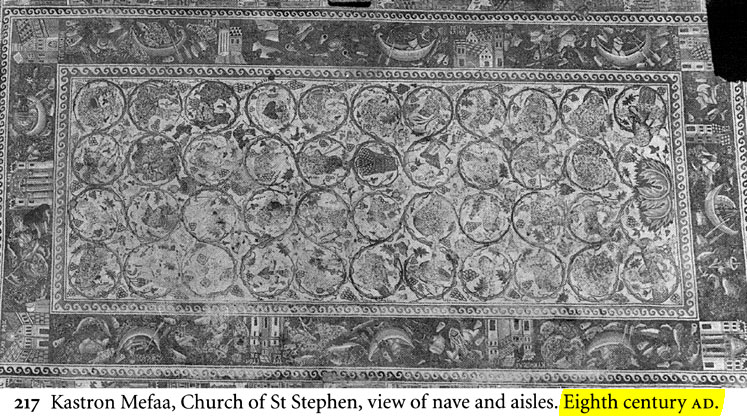
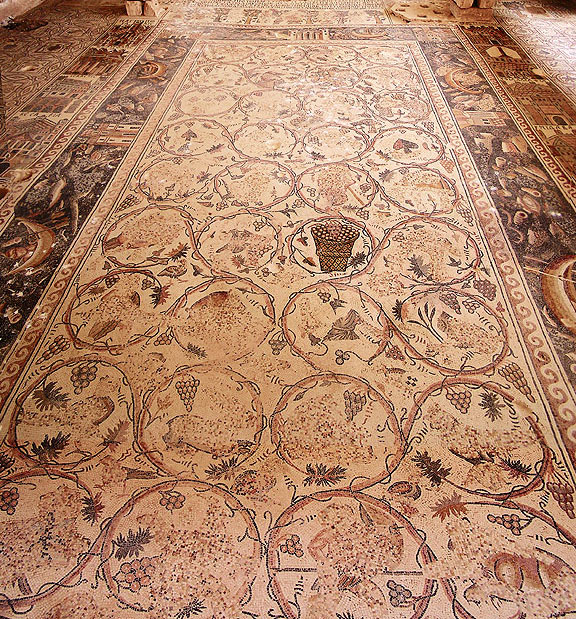
Church of Saint Stephen, Umm Al Rasas, Jordan, c. 756 AD:
Mosaics of the Greek and Roman World, Dunbabin, 1999, p. 204, figure 217, “Kastron Mefaa, Church of St. Stephen”:
http://www.atlastours.net/jordan/umm_arrasas.html, Umm Arrasas, Jordan, “Church of Saint Stephen” (756 A.D.?), Christian art:
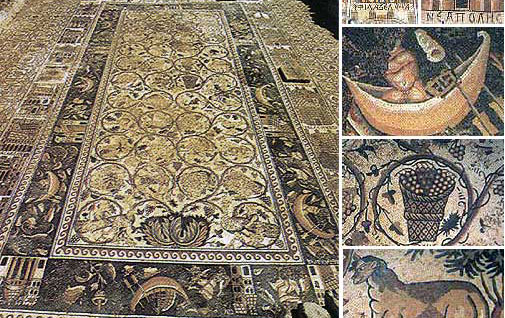
The Old and New Testaments mention it, the Romans fortified it, and the local Christians were still embellishing it with Byzantine-style mosaics well over 100 years after the beginning of Muslim Umayyad rule: Kastron Mefaa, modern Umm Arrasas, indeed, has a long history to tell.
http://www.christusrex.org/www1/ofm/sbf/escurs/Giord/05GiordEn.html, Studium Biblicum Franciscanum, Jerusalem, “The nave of the Church of St. Stephen”:
http://www.archart.it/archart/asia/giordania/umm_el_rasas/img0118.htm (ArchArt: archaeology & art), Umm el Rasas byzantine church, vedute19:
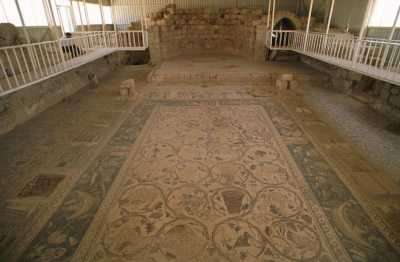
http://www.archart.it/archart/asia/giordania/umm_el_rasas/img0111.htm (ArchArt: archaeology & art), Umm el Rasas byzantine church, vedute12:
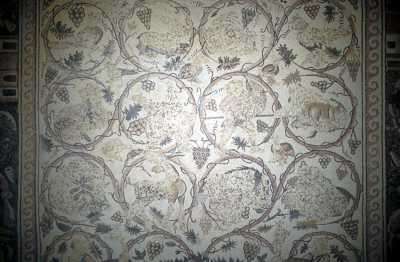
http://www.archart.it/archart/asia/giordania/umm_el_rasas/img0105.htm (ArchArt: archaeology & art), Umm el Rasas byzantine church, vedute06:
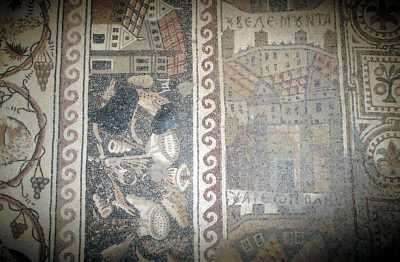
http://www.archart.it/archart/asia/giordania/umm_el_rasas/img0043.htm (ArchArt: archaeology & art), Umm el Rasas byzantine church, other03:
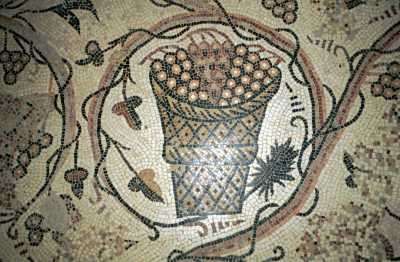
http://www.archart.it/archart/asia/giordania/umm_el_rasas/img0044.htm (ArchArt: archaeology & art), Umm el Rasas byzantine church, other04:
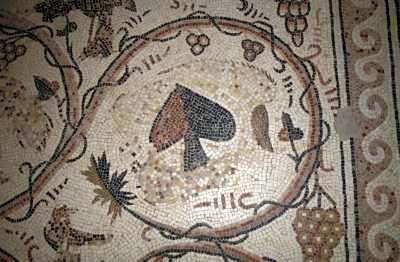
http://www.archart.it/archart/asia/giordania/umm_el_rasas/img0045.htm (ArchArt: archaeology & art), Umm el Rasas byzantine church, other05:
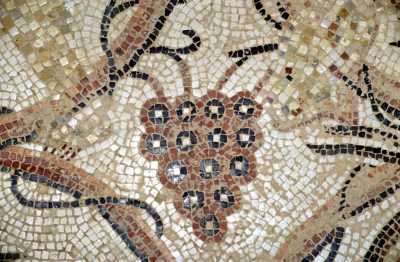
http://www.archart.it/archart/asia/giordania/umm_el_rasas/img0046.htm (ArchArt: archaeology & art), Umm el Rasas byzantine church, other06:
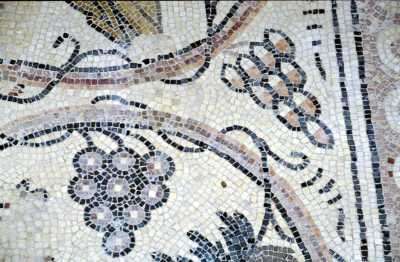
http://198.62.75.1/www1/ofm/fai/FAIrasas.html, Umm al-Rasas, Jordan, ”The presbytery of the Church of the Lions,” “at the end of the sixth century,” Christian art:

To date the mosaic floors of the church of Saint Stephen are the best dated evidence of the welfare of a flourishing urban Christian community in the region, still well organized as part of the bishopric of Madaba in the changed political context. The floor is composed of three different mosaics.
Church of Saint Sergius of Nitl, Jordan, c. 500’s:
http://www.christusrex.org/www1/ofm/fai/FAIexp98.html, The Church of St. Sergius of Nitl:
a name which can be read in an inscription written in one of the vine shoots scrolls. These vine shoots spring forth from four handled jars placed in the corners of the eastern panel of the mosaic carpet
http://www.christusrex.org/www1/ofm/fai/FAIexp98a.html, The Church of St. Sergius of Nitl, “General View”:
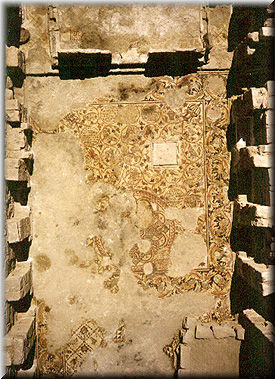
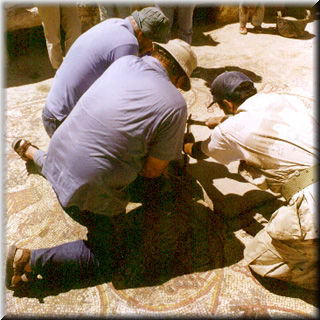
“Opening the tomb”:
http://198.62.75.1/www1/ofm/sbf/Books/LA51/LA51267Piccirillo_tavCol.pdf, The Church of St. Sergius at Nitl - Jordan:
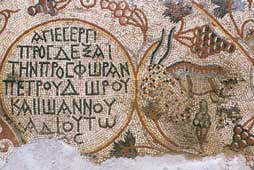
II-V. Nitl, The Church of St. Sergius. The Greek Inscriptions of the South Church.
http://servus.christusrex.org/www1/ofm/sbf/Books/LA51/LA51tav07Piccirillo.pdf:
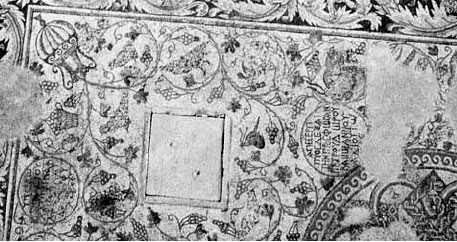
Photo 22 Nitl. The Diakonikon of the South Church of St. Sergius seen from the North.
http://198.62.75.1/www1/ofm/sbf/Books/LA51/LA51285Shahid_Nitl.pdf, The Sixth-Century Church Complex at Nitl, Jordan. The Ghassanid Dimension, “Fig. 2 Nitl. The nave of the South Church of St. Sergius (M. Forgia – S. Deruvo)”:
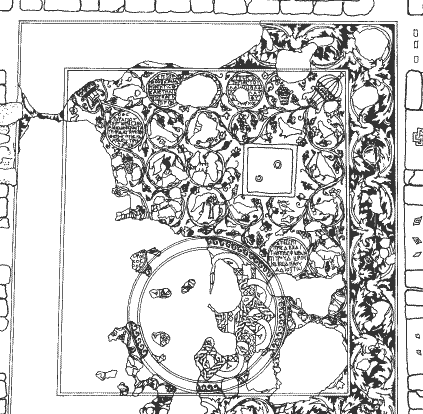
http://servus.christusrex.org/www1/ofm/sbf/Books/LA51/LA51267TavoleFuoriTesto.pdf:
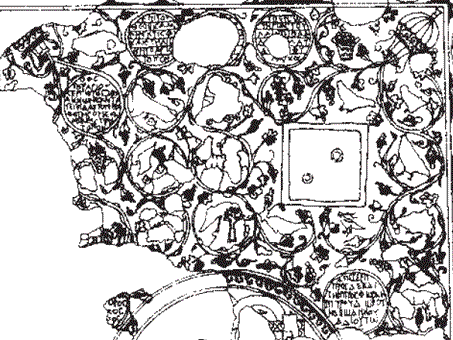
http://servus.christusrex.org/www1/ofm/sbf/Books/LA51/LA51267Piccirillo_Nitl.pdf, The Church of Saint Sergius at Nitl:
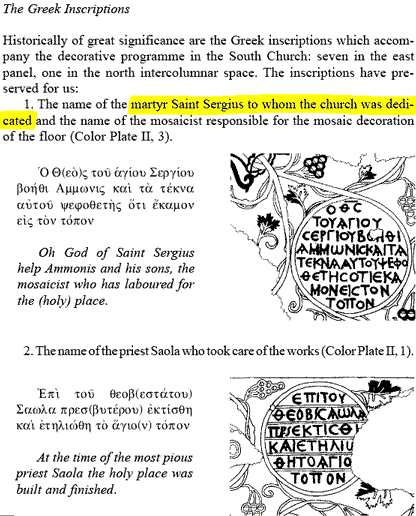
http://www.banner-net.com/Society/Religion_and_Spirituality/Christianity/People/Saints/S/Saints_Sergius_and_Bacchus, Saints Sergius and Bacchus:
Military Martyrs
Information on the cultus of the late Roman martyrs SS. Sergius and Bacchus. Includes a translation of the Passion of SS. Sergius and Bacchus from the Acta Sanctorum. Also ikon, bibliography.
site exerpt
Ss. Sergius and Bacchus Damaskenos to commemorate the victory of the European forces against the Turks, in the naval battle of Naupactos in 1571. From the Byzantine Museum of Panaghia Antivouniotissa, Kerkyra, Greece. Contents Origin of Cult Translation of: BHL 7599 Other Sources Select Bibliography More Images Resafa in Syria Select Links Excavation of 6th-century Church of St. Sergius, Nitl, Jordan The...
http://www.ucc.ie/milmart/Sergius.html
Moses Memorial Church, Mount Nebo, Jordan, 597AD:
http://www.freezone.co.uk/stuartfarrell/jordan/jordann.htm (9-4-02), Around Amman, “Day 4: Amman – Karak – Petra”:
Leaving Amman for Petra, our first stop was at Mount Nebo, where Moses apparently saw the Promised Land and later died there. Here the Moses Memorial Church has a large well preserved mosaic (pictured left) with scenes of wine-making, hunting and animals now extinct in Jordan.
http://www.bg-bab.ac.at/jordan/english/enebo.htm, Mount Nebo:
The Moses-church was built by the early Christians.
http://www.jordanjubilee.com/history/mosaics.htm, The Mosaics of the Madaba Plateau of Jordan, “Mount Nebo”:
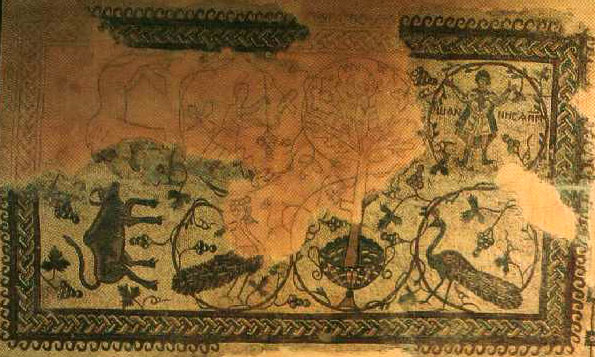
Mount Nebo usually means the Moses Memorial Church and the viewpoint from outside it (see "Photos of Jordan - Mount Nebo"). The church is a simple one nowadays, but in the sixth century it was the church for a important monastery with all that this implies. In particular, the floor was covered with mosaics of different periods. The mosaic shown above dates from 597AD when the church was rebuilt and greatly enlarged. Again the left and right hand photos are details of the central one. Today it is displayed on the wall.
http://198.62.75.1/www1/ofm/fai/FAImukh9a.html:
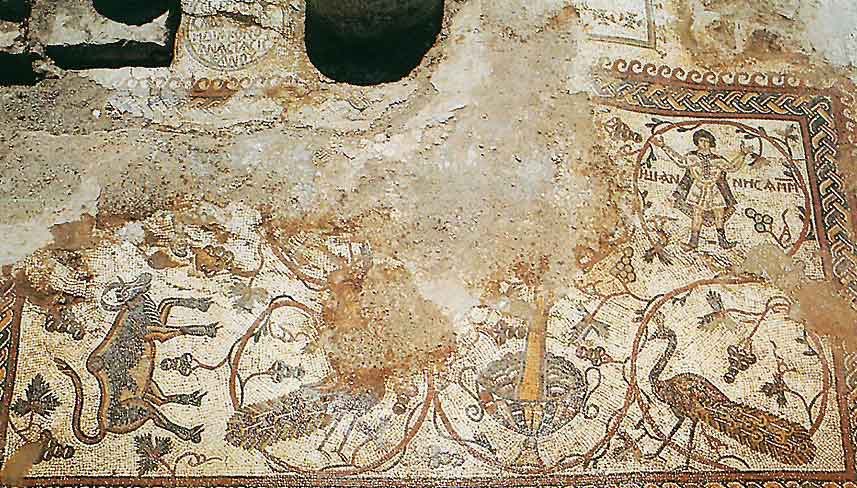
http://www.petramoon.com/madaba&nebo.html, Madaba and Mt. Nebo:
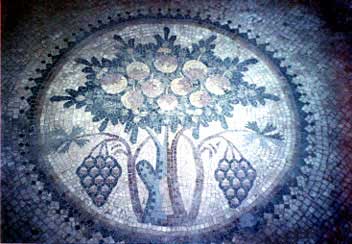
Wadi Siyagh, around Mt. Nebo, has a collection of several other early Byzantine church establishments with interesting architecture and mosaic.
Church of Lot and Procopius, Khirbat al-Mukhayyat, Jordan, c. 550 AD:
Mosaics of the Greek and Roman World, Dunbabin, 1999, p. 198, figure 210, “Nebo, Church of SS. Lot and Procopius, view of nave”:
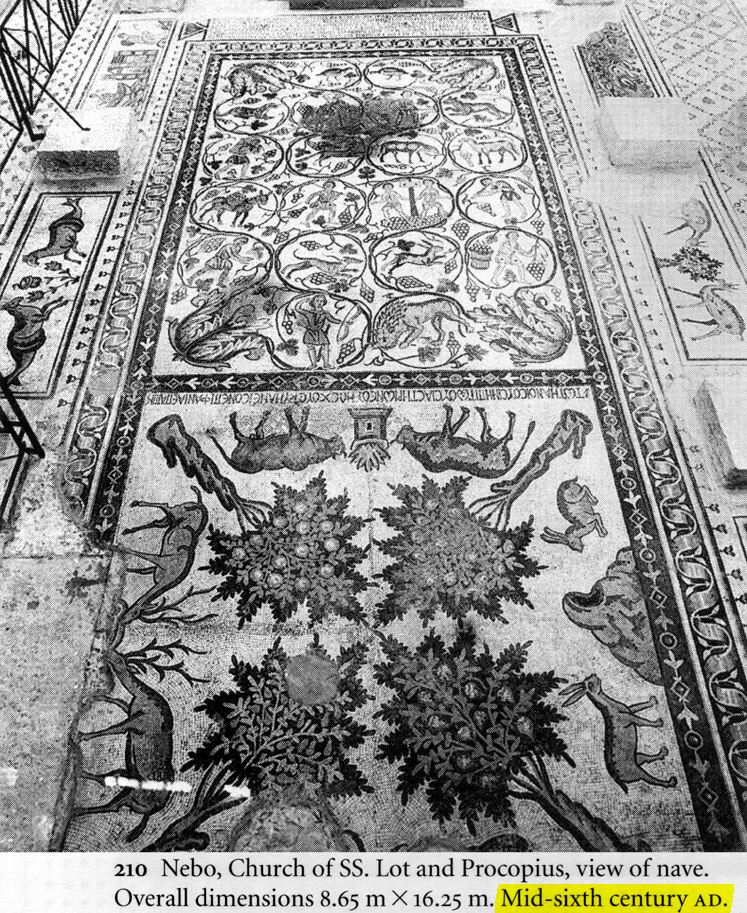
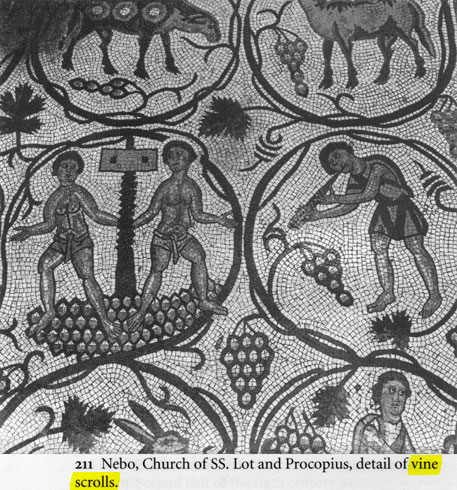
Figure 211, “Nebo, Church of SS. Lot and Procopius, detail of vine scrolls”:
http://www.jordanjubilee.com/history/mosaics.htm, The Mosaics of the Madaba Plateau of Jordan, “Khirbet al-Mukhayyat”:
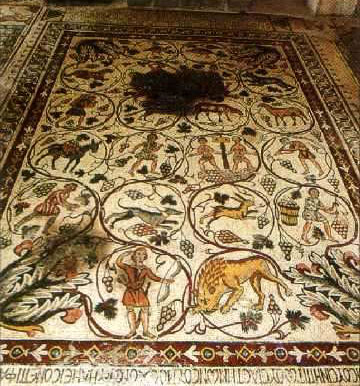
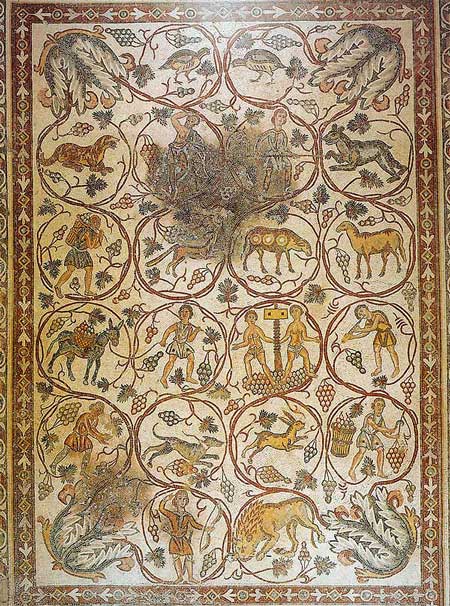
This village just off the road from Madaba to Mount Nebo is mostly neglected by tourists, but it contains one of the most beautiful mosaics discovered in Jordan, almost perfectly preserved. A shelter has been built to protect it in the ruins of the church of St Lot and St Procopius. It is pity that no public transport goes to Khirbet al Mukhayyat.
http://198.62.75.1/www1/ofm/fai/FAImukh9d.html, Khirbat al-Mukhayyat – The Church of Lot and Procopius Pictures, “Central nave”:
http://pro.corbis.com/, Search # AW011343, Mosaic of a Hunter and Lion, Christian art, Grapevine:
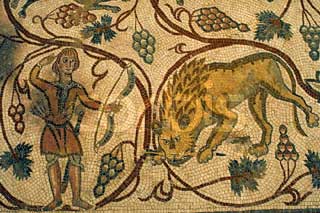
A mosaic depicting a lion toying with an arrow fired by a huntsman surrounded by vines. Jordan.
http://pro.corbis.com/, Search # AW011347, Mosaic of a Grape Harvester, Christian art, Grapevine:
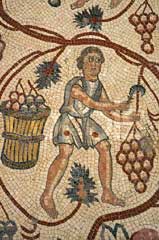
A mosaic of a man harvesting grapes. Jordan.
http://www.jordanjubilee.com/history/mosaics.htm, Khirbat al-Mukhayyat: The Church of the Holy Martyrs Lot and Procopius:
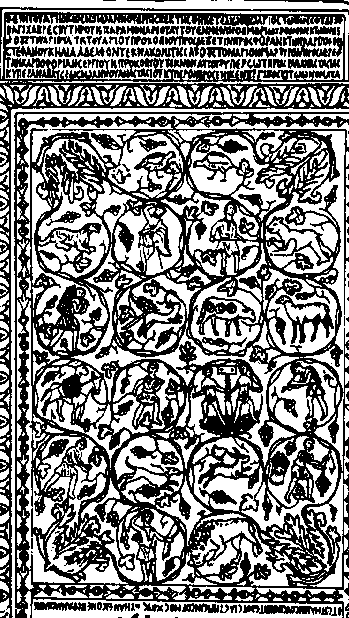
The little apsed church (16.25 m x 8.65 m) on the acropolis, which was identified in 1913, was built at the time of Bishop John of Madaba, in the middle of the VIth century A.D. Two sheep facing a tree decorate the elevated presbyterium, and traces of two birds are still visible at the side of the altar. In the nave, along the step, runs a long dedicatory inscription: “At the time of the most holy and most saintly Bishop John, Your holy place was built and finished by its priest and paramonarius, Barichas, in the month of November of the time of the 6th indiction [A.D. 557]. … The eastern panel is decorated with hunting, pastoral, and wine-making scenes, all enclosed in twenty volutes of vines arranged in six rows of four scrolls each. The four vines proceed from the four corners of the field, each from a clump of acanthus leaves.
The Lower Chapel of Priest John, Khirbat al-Mukhayyat, Jordan:
http://198.62.75.1/www1/ofm/fai/FAImukh9c.html, Khirbat al-Mukhayyat Pictures, The Lower Chappel of the Priest John, “The sanctuary”:
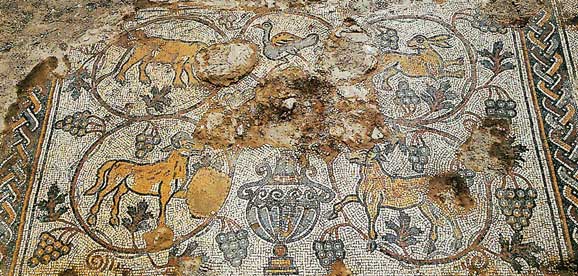
http://198.62.75.1/www1/ofm/fai/FAImukh9c.htm, Khirbat al-Mukhayyat Pictures, The Lower Chappel of the Priest John, “General view of the Nave”:
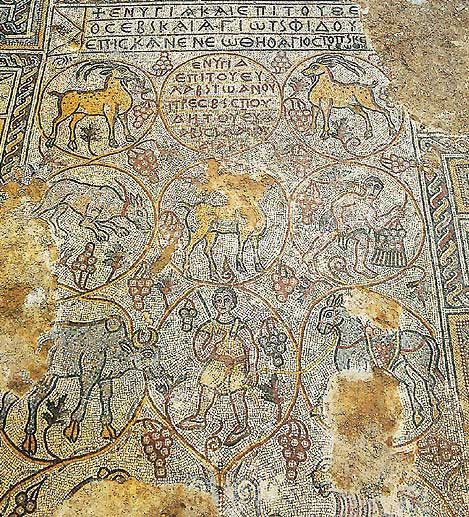
Church of Saint George, Khirbat al-Mukhayyat, Jordan, 536 AD:
http://198.62.75.1/www1/ofm/fai/FAImukh1.html, Khirbat al-Mukhayyat - The Church of St. George:
At the time of the most beloved by God … was built and finished, during the consulate of the most illustrious Flavius, in the month of Dius of the fourth indiction [A.D. 536]
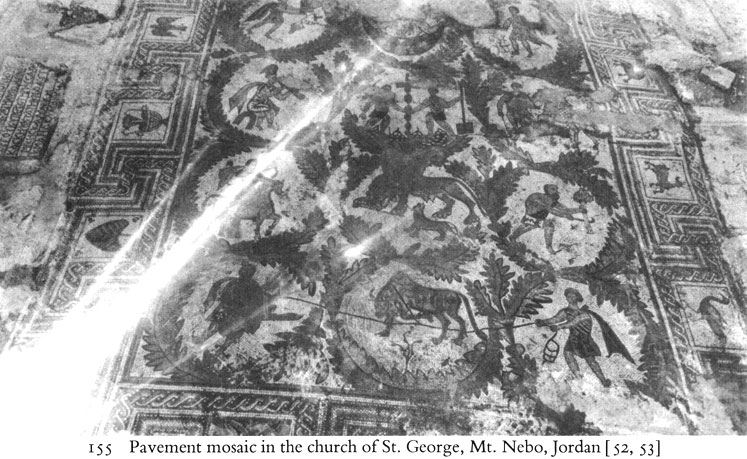
Christian Iconography: A Study of Its Origins, André Grabar, 1968, p. 52:

Illustration 155, “Church of St. George, Mt. Nebo, Jordan”:
Other Jordan:
http://pro.corbis.com/, Search # SK002368, Jerash Church Floor Mosaic:
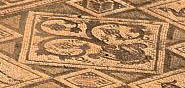
A tilework mosaic adorns the floor of a 6th Century church in Jerash, Jordan.
http://pro.corbis.com/, Search # SK002371, Jerash Church Floor Mosaic,:
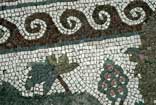
A tilework mosaic adorns the floor of a 6th Century church in Jerash, Jordan.
http://www.christusrex.org/www1/ofm/fai/FAIexp96.html, KASTRON MEFA'A – JORDAN: A "New" Church amongst its ruins, “The mosaic floor,” 578 or 593 A.D.:
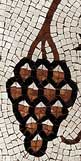
A detail: grapes … From the tree foliage sprout vine shoots with leaves, bunches of grapes and tendrils.
http://198.62.75.1/www1/ofm/sbf/escurs/Giord/04aGiordEn.html (Stadium Biblicum Franciscanum, Jerusalem), Biblical Excursions: Jordan, “Madaba”:
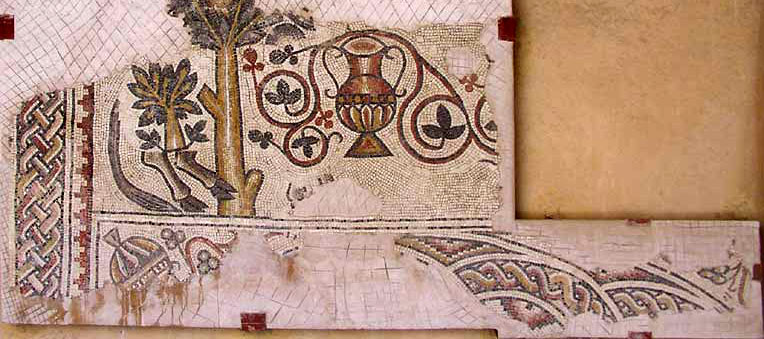
Detail of a mosaic floor from Ma'in. The iconoclastic conflict (8th cent. A.D.) left traces in the obliteration of a biblical scene (still pointed out in the Greek inscription: the lion shall eat straw like the ox, Is 65:25) and its later substitution by floral motifs.
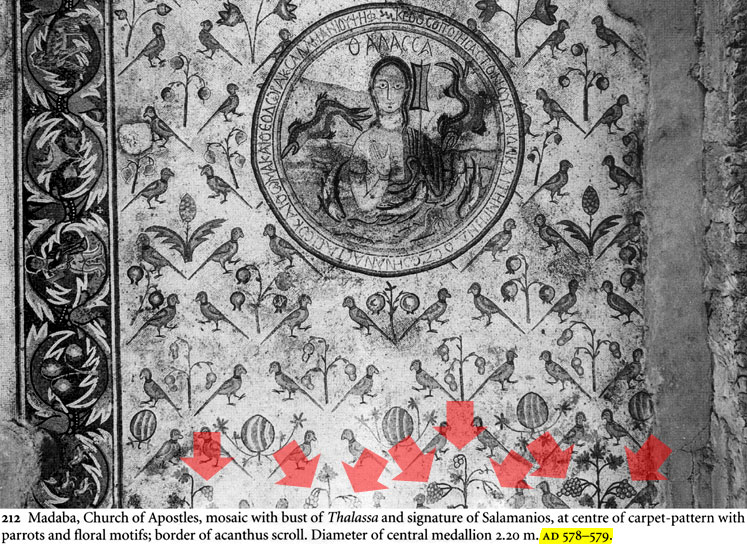
Mosaics of the Greek and Roman World, Dunbabin, 1999, p. 200, figure 212, “Madaba, Church of Apostles … Thalassa”: