DIONYSUS – JESUS’ NAME CONNECTION
IHS:
http://www.greenspun.com/bboard/q-and-a-fetch-msg.tcl?msg_id=006PZM, What does the IHS stand for on vestments, missals etc.?:
The Greek has two versions of our vowel, "e", one called "epsilon" and the other "eta." Well, in the Greek alphabet, the second letter of Jesus's name, eta, looks just like our capital "H"! According to the explanation I was given, the first three letters of Jesus's name, in upper-case Greek, look very much like IHS (Iota "H"eta Sigma).
That’s correct: Ιησ(ς) is the first three characters of Jesus’ name; in uppercase: ΙΗΣ, or transliterated as IHS / ihs. The Greek eta: η / Η has a long e sound.
http://www.jcsm.org/StudyCenter/kjvstrongs/STRGRK24.htm, The KJV Bible: Strong’s Greek Dictionary:
|
IhsouV |
of Hebrew origin (Yhowshuwa` 3091); Jesus (i.e. Jehoshua), the name of our Lord and two (three) other Israelites:--Jesus. |
Greek doesn’t have a character for “J” but it emanates from “I”.
http://www.adelphiasophism.com/gog/gg18.html, God or Goddess? Christian Symbols, “The Cross”:
As with the cross and the labarum, so it is with many other Christian symbols. They are borrowed from paganism. The insignia on the walls of the Temple of Bacchus in Rome was a Roman cross and I H S—the three mystical letters to this day retained in Christian churches, and falsely supposed to stand for Jesus hominum salvator—Jesus mankind's saviour. Christian women who work this sign on altar cloths for their churches little think that they are working a pagan sign. The same monogram was that of the heathen sun god Bacchus. But they are not far astray, for Bacchus in Hebrew was Joshua which in Phoenician is Ies (IHS in Greek capital letters), and in Greek Iesous, pronounced Yeasoos, from which Jesus is derived. The embroiderers of alter cloths unwittingly admit the pagan origin of their god. The monogram represented phallic (penis) vigour.
http://www.tyndale.cam.ac.uk/Scriptures/www.innvista.com/scriptures/compare/heathen8.htm, Words with Heathen Origins in the Scriptures, “Jesus”:
The Greek abbreviation for Iesous is IHS, which is found on many inscriptions made by the Church during the Middle Ages. IHS was the mystery name of Bacchus (Tammuz), another Sun-deity.
http://www.newadvent.org/cathen/07421a.htm (Catholic Encyclopedia), Holy Name of Jesus:
The emblem or monogram representing the Holy Name of Jesus consists of the three letters: IHS.
http://www.theosophy-nw.org/theosnw/ctg/i-im.htm
TG I. H. S. … It is, however, well known that the Greek GREEK was one of the most ancient names of Bacchus.
…
SD INDEX IHS, symbol of savior Bacchus II 313
http://www.wisdomworld.org/setting/hypatia.html, THEOSOPHY, Vol. 25, No. 5, March, 1937, (Pages 197-207; Size: 31K), (Number 12 of a 29-part series): GREAT THEOSOPHISTS: HYPATIA: THE LAST OF THE NEOPLATONISTS:
Constantine, the first Christian Emperor … Constantine's conversion to Christianity, as the result of a psychic vision, is described by Eusebius, who was his close friend and companion as well as his famous biographer. On the night before his final battle with Maxentius, who had denounced him as a usurper to the throne, Constantine appealed to his own god for help. According to Eusebius,
While he was praying with fervent entreaty, a most marvelous sign appeared in the heavens, the account of which, related by any other person, would be difficult of belief. But since the victorious Emperor himself declared it to the writer of this history, and confirmed his statement with an oath, who could hesitate to credit it? He said that when the sun was beginning to decline, he saw with his own eyes the trophy of a Cross of blazing light, with this inscription: "I. H. S. In this sign thou shalt conquer." (Vita Constantin.)(Vita Constantini)
On the following night Constantine had another psychic vision. This time the figure of Christ himself appeared, wearing the same cross that Constantine had seen the night before. Constantine declared that on this occasion Christ spoke to him, telling him to place this cross on his battle flag and to march against Maxentius with full assurance of victory. Constantine obeyed, and Maxentius was defeated. In adopting this symbol -- henceforth placed upon the Imperial banner and carried at the head of the army in its conquest for Christ and the Church -- Constantine added two more pagan symbols to Christianity. For the long lance crossed at right angles by a staff was the ancient sign of Osiris, and the letters I. H. S. one of the names of Bacchus.
http://www.truthbeknown.com/footnote3.htm, The Origins of Christianity, by Acharya S:
The Eucharist, or the sharing of the god's blood and body, has been a sacred ritual within many ancient mystery religions and is part of the Mythos and Ritual. In a standard ritual that was practiced around the world, and which continues in some places, participants in the ritual actually ate and drank the "god's" body and blood, which was in reality that of a sacrificed human (king) or animal. The Christian form of the Eucharist is very similar to the ritual that was practiced as part of the Greek Eleusinian Mysteries, in detail, as is outlined by Taylor. The Eleusinian Eucharist honored both Ceres, goddess of wheat, and Bacchus/Dionysus, god of the vine. The Christians also adopted the Bacchanal symbol IHS (Greek) or IES - Iesu/Jesus.
In Greek “H” (long “e”) and “E” (short “e”) are both e’s.
http://www.unsolvedmysteries.com/usm49841.html (Unsolved Mysteries), The First Miracle Of Jesus, “Replies”:
Date: 11/6/2000 12:09:00 PM From Authorid: 11528 This is an interesting post but did You know that Dionysius performed this same miracle before Jesus was even born. He was also called the "God of the vine" "King of Kings" "Only Begotten Son" "Saviour" "Sin Bearer" "Annointed One" "Alpha and Omega"and "Redeemer" Dionysius had a major cult centre in Jerusalem in 1 BCE and several aspects of this cult worship was adopted by the early christian church and are still in use to day. One that comes to mind is the symbol IHS which was the symbol of Dionysius/Bacchus and can still be seen in christian churches today. This comment is for information purposes only and not to start an arguement.
http://coohmp.homestead.com/wouldwe.html, Come Out Of Her My People:
As I have stated, there is no resemblance between the Name Yahushúa and the name Jesus. neither is there any resemblance between their meanings. Yahushúa means: "the Salvation of Yah or Yahu." "Jesus" is derived from Iesus, derived from Iesous (IHSOUS) derived, most probably, from the Greek goddess of healing, Ieso or Iaso. her name was derived from iasis ,which means "healing". Further, the short form, or original source of the name Iesous (IHSOUS) is Ies (IHS), the very surname of Bacchus, the Sun-deity. Therefore, the two names differ completely in their origin, and in their meaning.
http://www.geocities.com/Heartland/Pointe/7336/tubeschristsymbols.htm, Christian Symbols Tubes:
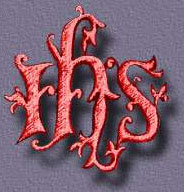
IHS - Jesus' name in Greek was IHCOYC, which was abbreviated to IHC. The "C" and the "S" are variants within the Greek alphabet. This widely used monogram of Christ is often incorporated into Latin cross designs. The IHS is an ancient Christian symbol.
To confuse things even more, the Greek “C” is called a “lunate sigma” which is the same as the transliterated “S”; and, the “Y” is the Greek upper case “u”, which can be transliterated either “u” or “y”. So, they’re still talking about the same thing.
http://home.rochester.rr.com/gocek/images/christn/, Christian Symbols and Glossary:
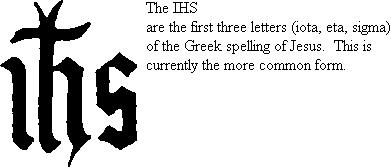
http://myweb.lmu.edu/fjust/Koch-ChristianSymbols.htm, Christian Symbols drawn by Rudolf Koch (1976-1934):
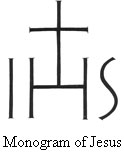
http://rubens.anu.edu.au/raid1cdroms/england/london/churches/soutwark/cathedral/P1011772.JPG:
Fish: Ichthus / Ichthys:
http://scripture_keywords.tripod.com/Babylon-Rome-Mysteries/07-Rome-Symbolism.html, Symbolism of the Church of Rome:
Another title of Bacchus was "Ichthys," or "The Fish!"
http://www.tractsforfree.com/Fossilized_Customs.pdf, Fossilized Customs: The Pagan Sources of Popular Customs, p. 9:
The Greek word ichthys (ikhthus) spelled iota (Ι), chi (X), theta (Θ), upsilon (Υ), sigma (Σ) — spells “ICHTHYS” (“fish”). ΙΧΘΥΣ doesn’t mean “Christ”, but fish.
http://www.sa-hebroots.com/2babylons.htm, The Two Babylons, by Rev. Alexander Hislop, 1853:
Now, Jerome calls Dagon, the well known Fish-god Piscem moeroris (BRYANT), "the fish of sorrow," which goes far to identify that Fish-god with Bacchus, the "Lamented one"; and the identification is complete when Hesychius tells us that some called Bacchus Ichthys, or "The fish." … It was then precisely that our Lord Jesus Christ began to be popularly called Ichthys, that is, "the Fish," … We have seen that Ichthys, or the Fish, was one of the names of Bacchus
http://www.seedofabraham.net/smpf.html, SET MY PEOPLE FREE! ACTS 15:20, by Avram Yehoshua:
Hesychius tells us that some called Bacchus, Ichthys, or 'The fish.' Ibid. p. 114 in the footnote. (my note: The symbol for Ichthys is commonly seen on car bumper stickers of many Christians who think it represents Jesus.)
http://www.innvista.com/culture/religion/deities/words.htm, Heathen Words, “Jesus”:
The common abbreviation for Iesous was IHS, which is found on many inscriptions of the "Church." IHS was the mystery name of Bacchus, aka Tammuz. Both were known as "The Fish" god. Jesus was also associated with fish, and thus his name was used synonymously -- Jesus/Iesous/Ichthus (fish).
http://coohmp.homestead.com/NAMES.html, Come Out Of Her My People, “Names”:
The most disturbing evidence is yet to follow. The abbreviated form of the name Iesous is: Ies or in capitals: IHS, or in Greek the capital for "e" id "H". This is to be found on many inscriptions made by the Church during the dark Middle Ages. This fact is also well documented and is generally admitted by scholarly sources and ordinary English dictionaries.191 These dictionaries bear witness to the fact if IHS (Ies) being an abbreviated form of IHSOUS (Iesous).
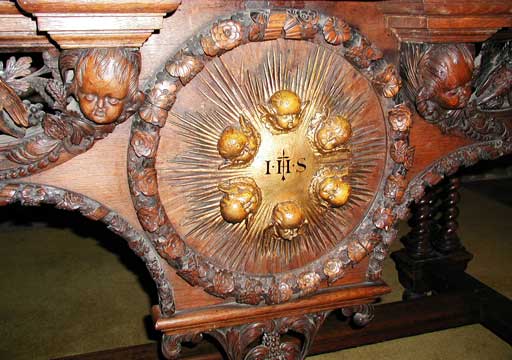
Furthermore, the shocking fact has also been recorded for us that IHS was a mystery surname of Bacchus, and was afterwards taken as initials for Iesous, capitals: IHSOUS.192 We discovered this in a dictionary of mythology and in an encyclopaedia of religion.192 This revelation was confirmed by a third witness, Dr. E.W. Bullinger, The Apocalypse, footnote p. 396, "Whatever meanings of ... IHS may be given, the fact remains that it was part of the name of Bacchus ..." We then realised, most painfully, that our beloved Messiah was identified with the Greek deity Bacchus, by giving Yahushúa the surname or other name of Bacchus, namely: IHS or Ies! Bacchus was well known to be a Sun-deity. Bacchus was also a commonly known name for Tammuz among classical writers.193 Tammuz, as you will remember, was known to be the young returning Sun-deity,194 returning in spring. Bacchus, also known as Dionysus, was expressly identified with the Egyptian Osiris,195 the well-known Egyptian Sun-deity. Bacchus was also called Ichthus, the Fish.196 So, yet another group, the worshippers of Bacchus, the Sun-deity, alias Ies (IHS), were conciliated, were made welcome, with the foreign-to-the-Hebrew name of Iesous (IHSOUS) or Iesus. This most appalling revelation startled us, indeed. After being enlightened about the solar origin of the word IHS and its fuller form IHSOUS (Iesous), we are no longer surprised to find the ecclesiastical emblem, IHS, encircled by sunrays, commonly displayed on church windows:
http://www.angelfire.com/ma4/namesofmen/chap5.html, Chapter Five …Something Fishy… (5-3-02):
IHS is a mystic surname of Bacchus: I(ota) = Iacchus; H(eta) = Helios, the sun; S(sigma) = son or incarnation of the sun.”[25] … All major dictionaries and reference works recognize that “IHS” is shortened from of the name “IHSOUS”--the name commonly attributed to the Messiah. However, it has been learned that “IHS” was a hidden or mysterious surname for the mythical god Bacchus. Bacchus was known as a sun-deity who also had the symbol of the “Tau cross” as well as the Fish symbol and was also recognized by many of the classical writers as Tammuz, the youthful returning sun-deity. … Now that brings us again to the fish story. Bacchus was also called the ICHTHUS, or the Fish.
http://www.theosophy-nw.org/theosnw/ctg/i-im.htm, Collation of Theosophical Glossaries, “I – Im”:
SD INDEX Ichthys (Gk)
fish,
Pisces, as messiah & Vishnu I 653-4
symbol of Bacchus II 313
Other:
http://www.theosociety.org/pasadena/etgloss/ia-iz.htm, Encyclopedic Theosophical Glossary: Ia-Iz:
Iao (Gnostic) A three-letter mystery-name, parallel in one sense with the Sanskrit pranava, and reminiscent of triune deities represented by a triplicity of sounds. It occurs in many variations: Io, the Grecian moon goddess; Iaho, Jevo, Jehovah, and other Hebraic forms; Iaso, the possible origin of the name Jesus; Iacchos, the Bacchus of the Mysteries. It is at once threefold, fourfold, and sevenfold in meaning.
…
I. H. S. Well-known Christian monogram, taken as being the initials of Iesus Hominum Salvator (Jesus Savior of Men); and the first three letters of the Greek Iesous ({Greek char}, Jesus). It is also a monogram representative of Dionysos used in the Mysteries. As a Latin abbreviation, having mystic significance, it means acrostically, In hoc signo victor eris (in this sign thou shalt be victorious). See also JESUS