DIONYS- / BACCH- – CHURCHMEN
Dionysius Exiguus (Schthian monk who lived in Rome, c. 500-50 AD):
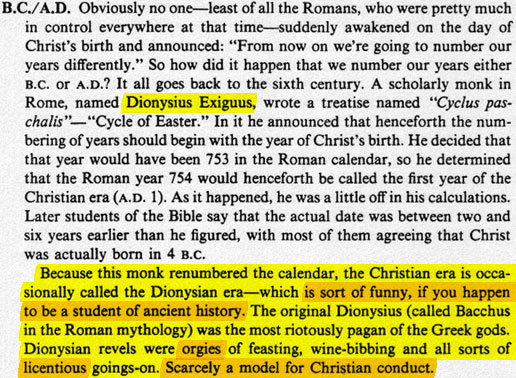
Morris Dictionary of Word and Phrase Origins, William and Mary Morris, 1977, p. 48, “B.C./A.D.”:
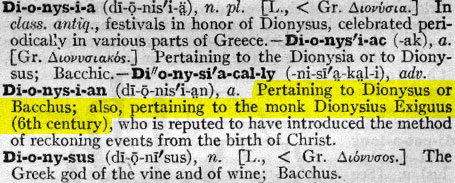
The New Century Dictionary of the English Language, Emery / Brewster, 1952, vol. 1, p. 423, “Dionys…”:
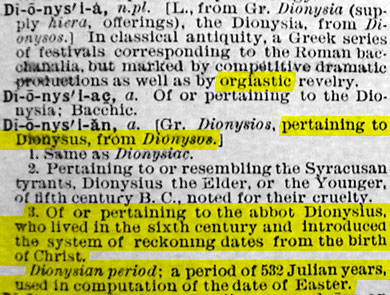
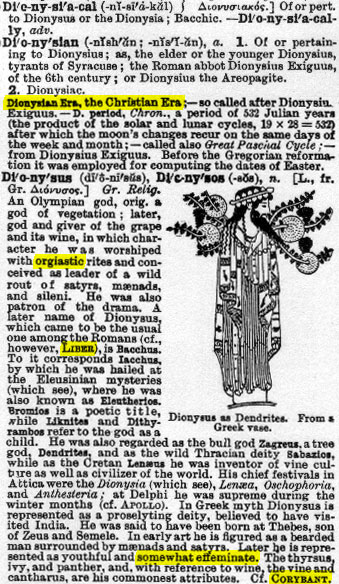
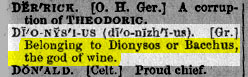
Webster’s Universal Dictionary of the English Language (unabridged), 1909, p. 477, “diony…”:
http://www.newadvent.org/cathen/05010b.htm (Catholic Encyclopedia), Dionysius Exiguus:
dying before the year 544. … he was in character a true Roman and thorough Catholic, most learned in both tongues–i.e., Greek and Latin–and an accomplished Scripturist.
http://www.newadvent.org/cathen/03738a.htm (Catholic Encyclopedia), General Chronology, “Christian Era”:
This was introduced about the year 527 by Dionysius Exiguus, a Scythian monk resident at Rome, who fixed its starting point in the year 753 from the foundation of Rome, in which year, according to his calculation, the birth of Christ occurred. Making this the year 1 of his era, he counted the years which followed in regular course from it, calling them years "of the Lord", and we now designate such a date A.D. (i.e. Anno Domini). The year preceding A.D. 1 is called Ante Christum (A.C.) or Before Christ (B.C.).
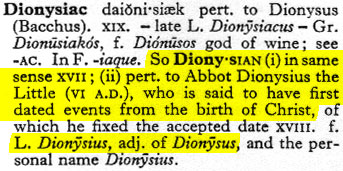
The Oxford Dictionary of English Etymology, Onions, 1966, p. 269, “Dionysiac”:
Webster’s New International Dictionary of the English Language, 1933, p. 627:
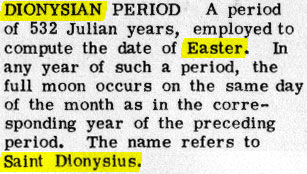
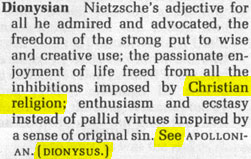
Dictionary of Mythology Folklore and Symbols, Jobes, 1961, Vol. 1, pp. 446-447, “Dionysian Period”:
P. 449, “Dionysianism”:
The New Encyclopaedia Britannica, Macropaedia, 1993, Vol. 4, p.109, “Dionysius Exiguus”:
Sergius and Bacchus (c. 303 AD):
http://www.newadvent.org/cathen/13728a.htm, Sergius and Bacchus:
Martyrs, d. in the Diocletian persecution in Coele-Syria about 303. Their martyrdom is well authenticated by the earliest martyrologies and by the early veneration paid them, as well as by such historians as Theodoret. They were officers of troops on the frontier, Sergius being primicerius, and Bacchus secundarius. According to the legend, there were high in esteem of the Caesar Maximianus on account of their bravery, but this favour was turned into hate when they acknowledged their Christian faith.
http://www.everything2.com/index.pl?node_id=1673140, Saint Sergius and Saint Bacchus: Christian saints, lovers and martyrs:
Inseparable in life, faith and even in death, Sergius and Bacchus were Christians, soldiers and possibly even gay lovers in the 3rd century. … One thing is certain, that they were primarily soldiers of Christ. …
So, were they lovers?
There is some dispute and controversy about this aspect of their lives. Certainly they were close. There is evidence to support it, however - Severus of Antioch stated that "we should not separate in speech [Serge and Bacchus] who were joined in life", and in a 10th-century document, Serge was described as the "sweet companion and lover" of St. Bacchus.
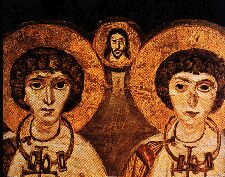
But it does not end there. An icon was discovered in the monastery of Saint Catherine on Mount Sinai, which is said to feature pictures of Serge and Bacchus. It depicts two men, with Christian haloes, between them being an image of a Roman pronubus (the equivalent of a best man), that image said to be Christ. This is often purported to be the final proof of their relationship, furthermore, one recognised and respected by the Church. Certainly, Roman sexuality was such that a love would not be considered necessarily abnormal, either.
So what remains today? They are remembered and celebrated on the dates of their martrydom, 1st and 7th of October. Many gay Christians call on them for support and point to their example. Finally, a church and monastery was built in their memory in the town of Malula in Syria (incidentally, said to be the only town which still speaks a dialect of the Aramaic common in Jesus' time).
Sergius is still honoured to a greater degree than his companion, poor Bacchus labouring with the name of the Roman god of wine, hence being largely ignored by the (modern day) Church, although both have become icons in a new generation of gay Christians.
http://stbacchus.free.fr/BE/legende.htm, Geschiedenis en legende van Saint Bacchus (History and legend of Saint Bacchus):
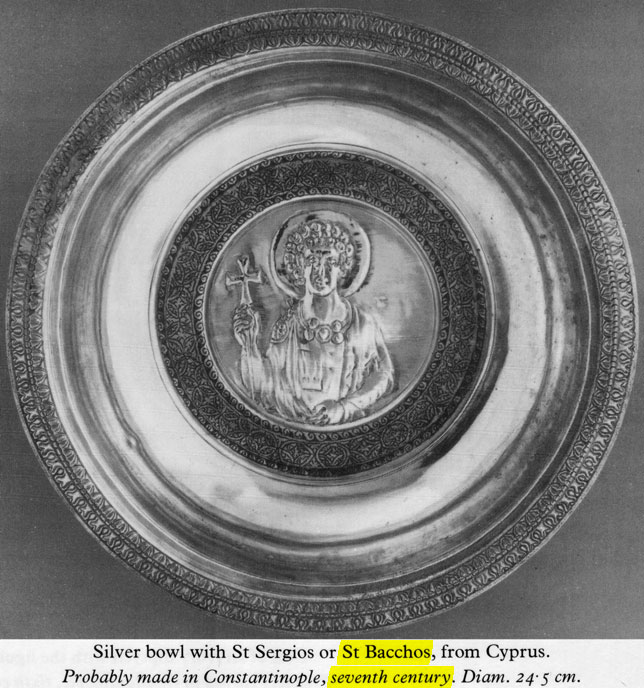
Wat Bacchus betreft, omwille van zijn naam, heidense god van de wijnstok en de wijn, werd hij door ontketende soldaten tegen de grond gegooid, gegeseld en vertrappeld zoals druiven. De legende zegt dat twee engelen hem ten hemel opnamen terwijl zijn bloed langs alle kanten spoot , te vergelijken met druivensap dat uit de druiven spuit. …
Terwijl de naam Serge nog herhaaldelijk voorkomt is die van Bacchus zo goed als verdwenen, waarschijnlijk omwille van de slechte reputatie van zijn naamgenoot de heidense god Bacchus. Niettemin blijven er nog veel sporen over. In het oosten, de kerk St.Bacchus in Cairo, de kerk St.Bacchus en St.Serge in Libanon en in Istanboel de kerk St.Bacchus die omgevormd werd tot een moskee. In het westen de voor zichzelf sprekende fresco's van de kapel van Berze la Ville nabij Mâcon.
Het is St.Bacchus waarvan het martelaarschap een middeleeuwse schilder, Geoffroy de L'Isle de France, inspireerde. Hij vergeleekde marteling met deze die een druiventros ondergaat om ons de wijn te geven die gekozen werd door onze stichter in zijn kruistocht voor de verdediging van de "vin vray".
Translated from Dutch:
What Bacchus concerns, because of his name, pagan god of the stock and the wine, he by unchained soldiers against the ground was thrown, and vertrappeld whipped such as grapes. The legend says that two angels him at sky prerecordings whereas is blood along all sides spouted, with grape juice compare that from the grapes spouts. …
Whereas the name prevents serge still repeatedly is which of Bacchus as well as disappeared, probably because of the bad reputation of his namesake the pagan god Bacchus. Nevertheless tracks still many remain. In the east, the church Saint Bacchus in Cairo, the church Saint Bacchus and Saint serge in Lebanon and in Istanboel the church Saint Bacchus which was transformed to a mosque. In the west for itself speaking frescos of the vault of Berze the drawer Ville close Mâcon.
It is Saint Bacchus It is Saint Bacchus whose martyrdom a medieval painter, Geoffroy de L'Isle de France, inspired. He vergeleekde torment with these that a grape mooring rope undergo to give us the wine which was chosen by our founder in its crusade for the maintaining of the "vin vray".
http://www.lezbeout.com/ancientgaymarriageoftwomalesaints.htm, Christian attitude towards same sex unions may not always have been as "straight" as is now suggested:
A Kiev art museum contains a curious
icon from St. Catherine's monastery on Mt. Sinai. It shows two robed Christian
saints. Between them is a traditional Roman pronubus (best man) overseeing what in a standard Roman icon would be the
wedding of a husband and wife. In the icon, Christ is the pronubus. Only one thing is unusual. The
"husband and wife" are in fact two men.
Is the icon suggesting that a homosexual "marriage" is one sanctified
by Christ? The very idea seems initially shocking. The full answer comes from
other sources about the two men featured, St. Serge and St. Bacchus, two Roman
soldiers who became Christian martyrs. …
Contrary to myth, Christianity's concept of marriage has not been set in stone since the days of Christ, but has evolved as a concept and as a ritual.
I guess Jesus commanding His Disciples to “love one another” (John 13:34) and the fact that they were all / mostly men, isn’t good enough; simply because, today’s Church tells us that Jesus’ definition of love excludes sex, and we… “just believe it,” even though the dictionaries state otherwise. A good example is the use of, and our understanding of, the word “lover” above, which is simply the action form of the word “love.” And Jesus makes it clear He wants the action of the word to be accomplished, to the extent that other people will notice: “By this all will know that you are My disciples” (John 13:35).
Early Medieval Art, Kitzinger, 1983, p. 34, figure 10, “The Late Antique and Early Christian Period”:
Dionysius the Areopagite: Acts 17:34, first bishop of the Church at Athens (c. 50 AD):
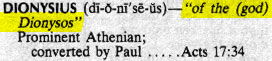
The Three-in-One Bible Reference Companion, 1982, p. 188, “DIONYSIUS”:
http://www.catholiconline.org/saints/saint.php?saint_id=2899, Catholic Online Saints, “St. Dionysius”:
St. Dionysius
Feastday:
October 9
1st century
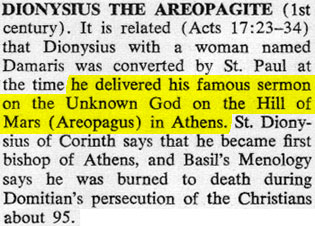
Called ”the Areopagite,” also called Denis. He was converted in Athens, Greece, with a woman named Damaris, by St. Paul. There he delivered his sermon to the Unknown God on the Hill of Mars, hence his name. Some records indicate that he became the first bishop of Athens. Other records state that he was martyred.
Dictionary of Saints, Delaney, 1980, p. 180:
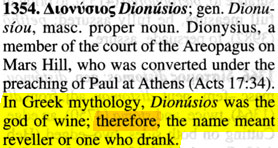
The Complete Word Study Dictionary of the New Testament, Zodhiates, 1993, p. 471, “1354. Διονύσιος Dionúsios”:
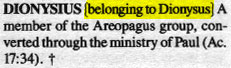
Young’s Compact Bible Dictionary, 1989, p. 172, “DIONYSIUS”:
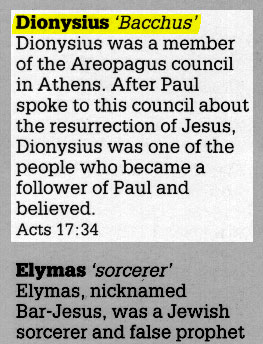
The Student Guide to Bible People, Backhouse, 1996, p. 30, “Paul’s Converts and Opponents”:
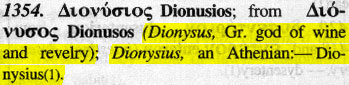
The New Strong’s Complete Dictionary of Bible Words, James Strong 1822-1894, Thomas Nelson Publishers, 1996, “Greek Dictionary of the New Testament” p. 604, “1354”:

New American Standard Exhaustive Concordance of the Bible: Hebrew-Aramaic and Greek Dictionaries, 1998, p. 1521:
The Greek English Concordance to the New Testament with the New International Version, Kohlenberger III / Goodrich / Swanson, 1997, p. 1049 (“A Concise Greek-English Dictionary”), “(G/K #) 1477”:

Merriam Webster’s Collegiate Dictionary, 1997, p. 326, “Dionysian”:

The Vocabulary of the Greek Testament, Moulton / Milligan, 1930 (reprinted 1949), p. 164 (Dionysios / Dionysius):
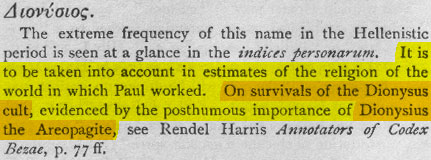
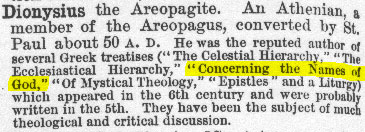
The Century Cyclopedia of Names, Benjamin E. Smith, 1897, p. 328:
http://www.winterscapes.com/dionysus/otherdio.htm, Dionysos’ Counterparts: The Other Dionysos:
St. Dionysius
There are a few Greek Orthodox saints that can be linked to Dionysos, at least etymologically.
St. Dionysius of Zakynthos - feast day: December 17
St. Dionysius the Areopagite - feast day: October 3
St. Denis - The name Denis is linguistically derived from Dionysos.
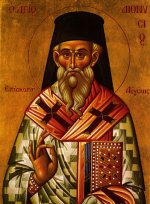
http://magnificat.ca/cal/engl/10-09.htm, Lives of the Saints, “Saint Dionysius the Areopagite”:
in Egypt … he saw for himself, in his early twenties, the eclipse of the sun contrary to all the laws of nature, which occurred at the death of the Son of God. His teachers could not explain it to him otherwise than as a sign of changes in divine matters.
So God gave this man a well timed hallucination for some reason.
(Do not confuse with Dionysius the Pseudo-Areopagite, c. 500.)
Dionysius the Pseudo-Areopagite (C. 500 AD. Probably in Syria):
http://en.wikipedia.org/wiki/Pseudo-Dionysius, “Pseudo-Dionysius the Areopagite”:
Pseudo-Dionysius the Areopagite, also known as Pseudo-Denys, is the anonymous theologian and philosopher of the late 5th to early 6th century whose Corpus Areopagiticum (before 532) was pseudonymously ascribed to Dionysius the Areopagite, the Athenian convert of St. Paul mentioned in Acts 17:34. The author was historically believed to be the Areopagite because he claimed acquaintance with biblical characters.
Pope / Saint Dionysius (d 268 AD –Cath. Ency.):
My notes:
Was Bishop of Rome from 259. Pope from about 260 to 268. He became pope probably on July 22, 260.
Pope (r.259-268). Was probably of Greek origin. Pope from July 22, 259, to Dec. 26, 268 (Britannica).
(Different person than Dionysius of Alexandria)
http://catholiconline.com/saints/saint.php?saint_id=2909, Catholic Online Saints, “Pope St. Dionysius”:
He rebuilt many areas after Emperor Gallienus issued an edict of toleration of Christians. Dionysius died in Rome, was the first pope not listed as a martyr,
Saint Dionysius of Alexandria: (or)
Dionysius the Great, Bishop of Alexandria (Pupil of Origen, c. 265 AD):
http://www.newadvent.org/cathen/05011a.htm (Catholic Encyclopedia), Dionysius of Alexandria (Bishop from 257-8 to 264-5):
Called "the Great" by Eusebius, St. Basil, and others, was undoubtedly, after St. Cyprian, the most eminent bishop of the third century.
The Century Cyclopedia of Names, Benjamin E. Smith, 1897, p. 328:
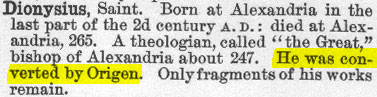
http://www.catholiconline.org/saints/saint.php?saint_id=2905, Catholic Online Saints, “St. Dionysius of Alexandria”:
St. Dionysius of Alexandria
Feastday:
November 17
265
Bishop of Alexandria, Egypt, called the Great. Born in Alexandria, Dionysius had a vision and converted to Christianity. He entered a catechetical school and studied under Origen, whom he succeeded as master of the school. Bishop Heraclas named him to this position in 232. In 247, Dionysius was elected bishop of Alexandria. During the persecution of the Church in 249, Dionysius was arrested but rescued and taken to the Libyan desert. He returned to Alexandria but had to flee again in another persecution. Dionysius supported Pope St. Cornelius in his battle against Novatian. After his second exile, this time to Kephro in the Libyan desert, Dionysius returned to Alexandria to find plague and civil unrest. He comforted the plague victims and protected Christians. St. Athanasius called Dionysius “the Teacher of the Catholic Church.” St. Basil surnamed him “the Great.”
Saint Dionysia (in Alexandria) (c. 250 AD):
http://www.catholic-forum.com/saints/saintd1g.htm (The Catholic Community Forum), Patron Saints Index: Dionysia (female):
Memorial: 12 December
Profile: Mother martyred in the persecutions of Decius. No other information has survived.
Died: martyred c.250 in Alexandria, Egypt
Saint Dionysius, Martyr of Alexandria (c. 257 AD):
http://www.catholiconline.org/saints/saint.php?saint_id=2901, Catholic Online Saints, “St. Dionysius”:
St. Dionysius
Feastday:
October 3
257
Martyr of Alexandria, Egypt, with Faustus, Gaius, Peter, Paul, and companions. In 250, these Christians were banished to Libya. They were then arrested and brought to Alexandria, where they were martyred.
Saint Dionysia (African Sees) (c. 484 AD):
St. Dionysia (female)
Feastday:
December 6
In the year 484, the Arian King,
Huneric, banished the Catholic bishops from their African Sees, and began a
violent persecution of orthodox Christians, many of whom were put to death.
Dionysia, a woman remarkable for beauty, zeal and piety, was scourged in the
forum till her body was covered with blood. Seeing Majoricus, her young son,
tremble at the site, she said to him, "My son, do not forget that we have
been baptized in the name of the Holy Trinity. We must not lose the garment of
our salvation, lest the Master of the feast find us without wedding clothes and
cast us into outer darkness." The boy, strengthened by her words, suffered
a most cruel martyrdom with constancy. Dionysia and Majoricus died at the
stake.St. Dionysia feast day is December 6th.
http://www.wargoddess.net/essay/ivycross/info.php, Enyo’s Workshop, “The Ivy-Covered Cross, by Sannion”:
St Dionysia - feast day: December 6. A beautiful woman scourged to death in the forum by Arian Christians in 484.
http://search.famsf.org:8080/view.shtml?record=17209&=list&=1&=&=And, Jacques Callot, artist, French, 1592 - 1635, “St. Dionysia with her Son, December 6”:
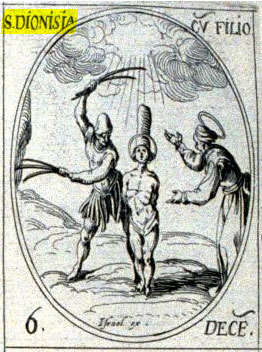
Saint Dionysius of Augsburg (c. 303 AD):
http://www.catholiconline.org/saints/saint.php?saint_id=2906, Catholic Online Saints, “St. Dionysius of Augsburg”:
St. Dionysius of Augsburg
Feastday:
February 26
303
First bishop of Augsburg, Germany. St. Marcellus converted and baptized him. He is reported to have been martyred.
Saint Dionysius of Corinth: (OR)
Saint Dionysius, Bishop of Corinth (c. 170 AD):
http://www.newadvent.org/cathen/05010a.htm (Catholic Encyclopedia), St. Dionysius:
Bishop of Corinth about 170. The date is fixed by the fact that he wrote to Pope Soter (c. 168 to 176; Harnack gives 165-67 to 173-5). Eusebius in his Chronicle placed his "floruit" in the eleventh year of Marcus Aurelius (171). When Hegesippus was at Corinth in the time of Pope Anicetus, Primus was bishop (about 150-5), while Bacchyllus was Bishop of Corinth at the time of the Paschal controversy (about 190-8). … To the Church of Amastris in Pontus he wrote at the instance of Bacchylides and Elpistus
He is described in Eusebius’ Ecclesiastical History.
Bacchylus, Bishop of Corinth (c. 195 AD):
http://www.newadvent.org/cathen/02189b.htm (Catholic Encyclopedia), “Bacchylus”:
Bishop of Corinth, whom Eusebius mentions among the prominent second-century churchmen (H. E., V, xxii) … he had held a provincial synod about 195, with eighteen other bishops; and St. Jerome attests that his letter, qualified as elegantem librum, was written in the name of the bishops of Achaia (De vir. ill., c. xliv). … No text of the letter is extant
http://www.ccel.org/fathers2/NPNF2-01/footnote/fn33.htm, Early Church Fathers, “Footnotes”:
341 This Bacchylus is possibly identical with the Bacchylides who is mentioned in Bk. IV. chap. 23 as one of those who had urged Dionysius, bishop of Corinth, to write a certain epistle.
Saint Dionysia (died in Lampsacus) (c. 1st century AD):
http://www.catholiconline.org/saints/saint.php?saint_id=2895, Catholic Online Saints, “St. Dionysia”:
St. Dionysia (female)
Feastday: May 15
1st century
Martyr, who died at the age of sixteen in Lampsacus, Mysia. Dionysia witnessed the trial of three Christians, Nichomacus, Peter, and Andrew. During a torture on the rack, Nichomacus recanted and denied Christ. Dionysia rebuked him for his cowardice and was arrested. She was tortured and turned over to three men for physical assault. An angel halted their advances, and Dionysia escaped. She did not flee the area, but went to the arena where Andrew and Peter hadjust died. There, she demanded martyrdom beside the two saints, but soldiers carried her to another site, where she died by the sword.
http://www.geocities.com/markd4good/index.html, Dionicia’s Page:
Find out who I'm name for St. Dionysia or if you prefer Dionysus, who was probably more fun to have at parties.
Saint Dionysius of Milan (c. 359 AD):
http://www.catholiconline.org/saints/saint.php?saint_id=2908, Catholic Online Saints, “St. Dionysius of Milan”:
St. Dionysius of Milan
Feastday:
May 25
359
Bishop of Milan, Italy, the successor of St. Protasius in 351. Dionysius attended the Synod of Milan called by Arian Emperor Constantius II to condemn St. Athanasius. When Dionysius defended Athanasius, he was banished to Cappadocia with Eusebius of Vercelli and Lucifer of Cagliari. Dionysius died in exile, but St. Ambrose had his remains enshrined in Milan.
Saint Bacchilus, First Bishop of Messina:
http://www.newadvent.org/cathen/10216a.htm (Catholic Encyclopedia), Archdiocese of Messina (Messinensis):
According to the legend, Christianity was brought hither by Saints Peter and Paul, and there is still preserved at Messina a letter attributed to the Blessed Virgin, which, it is claimed, was written by her to the Messenians when Our Lady heard of their conversion by St. Paul. St. Bachiritis or Bacchilus is venerated as the first Bishop of Messina.
Saint Dionysius (Uncle of Saint Pancras) (c. 304 AD):
http://www.catholiconline.org/saints/saint.php?saint_id=2902, Catholic Online Saints, “St. Dionysius”:
St. Dionysius
Feastday:
May 12
304
Martyr and uncle of St. Pancras. An Asiatic by birth, Dionysius brought St. Pancras to Rome, where they became Christians. Dionysius died in a Roman prison.
Saint Dionysius of Paris (St. Denis) (c. 250 AD):
“Holy martyr of Gaul, was the first Bishop of Paris”
Brewer’s Dictionary of Phrase and Fable, 1981, p. 325:
Saint Dionysius (Seven Sleepers) (250 AD):
http://www.catholiconline.org/saints/saint.php?saint_id=753, Catholic Online Saints, “St. Dionysius”:
St. Dionysius
Feastday: July 27
St. Maximian, Malchus, Martinian, Dionysius, John Serapion, and Constantine "The Seven Sleepers" (Martyrs) July 27 A.D. 250 Having confessed the faith before the proconsul at Ephesus under Decius in 250, they were walled up together in a cave in which they had hid themselves, and there slept in the Lord.
Saint Dionysius, Bishop of Vienne (c. 193 AD):
http://www.catholiconline.org/saints/saint.php?saint_id=2900, Catholic Online Saints, “St. Dionysius”:
St. Dionysius
Feastday:
May 8
193
Bishop of Vienne, in Dauphine, France, successor of St. Justus. He was one of the ten missionaries sent with St. Peregrinus to Gaul, by Pope St. Sixtus I (Pope 115-125).
Dionysius the Carthusian (Denys van Leeuwen, Dinys Ryckel, theologian and mystic, 1402-71 AD):
My notes:
Flemish Denys Van Leeuwen, or De Leeuwis, also called Denys Ryckel, or Van Rijkel (b. 1402-1403, Rijkel, Lower Lorraine [now in The Netherlands], theologian and mystic)
Dionysius, Physician and Priest (first half of the 3rd century):
The Catacombs of St. Callixtus; Baruffa; Published by L.E.V., Vatican City; 1993; p. 153; “The Crypts of Lucina | Dionysius, Physician and Priest”:
Dionysius Telmaharensis (845 AD):
Also called Dionysius of Tell Mahre (d. Aug. 22, 845), patriarch of the Syrian Jacobite church. (Britannica)
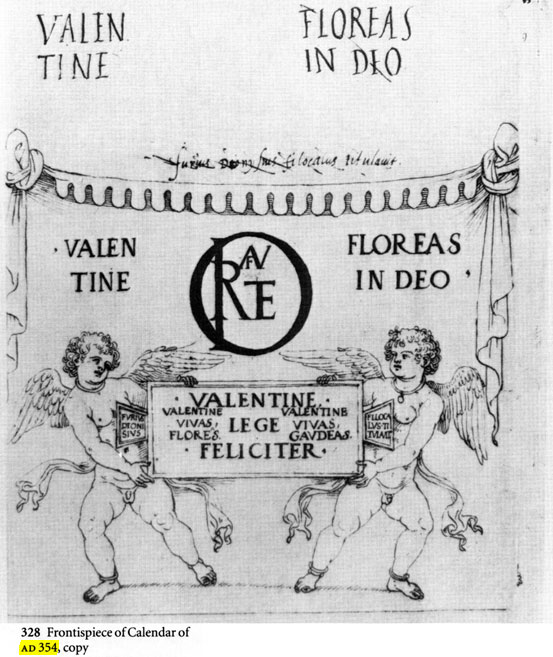
Furius Dionysius Filocalus (354 AD):
The Oxford History of Classical Art, Boardman, 1993, pp. 327-328, “(illustration) 328”:
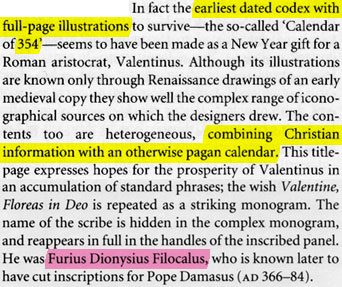
P. 328, illustration 328, “Calandar of AD 354” (Eros):
I bet there’s no one named Dionys… or Bacch… in the church today.
Generic:
http://www.thesacredheart.com/saints.htm, Saints:
St. Bacchus
…
St. Dionysia
St. Dionysia
St. Dionysius
St. Dionysius
St. Dionysius
St. Dionysius
St. Dionysius
St. Dionysius
St. Dionysius
St. Dionysius
St. Dionysius
Bl. Dionysius
St. Dionysius of Alexandria
St. Dionysius of Augsburg
St. Dionysius of Corinth
St. Dionysius of Milan
St. Pope Dionysius
St. Dionysius Sebuggwao
http://www.catholiconline.org/saints/stindex.php?lst=D (Catholic Online), Saints and Angels, “Saints Index | D”:
(No St. Bacchus here)
St. Dionysia
St. Dionysia
St. Dionysius
St. Dionysius
St. Dionysius
St. Dionysius
St. Dionysius
St. Dionysius
St. Dionysius
St. Dionysius
Bl. Dionysius
Bl. Dionysius Fugishima
St. Dionysius of Alexandria
St. Dionysius of Augsburg
St. Dionysius of Corinth
St. Dionysius of Milan
St. Pope Dionysius
St. Dionysius Sebuggwao
http://www.wargoddess.net/essay/ivycross/info.php, Enyo’s Workshop, “The Ivy-Covered Cross, by Sannion”:
Many of the early Popes had names related to Dionysos. For instance, there was: St. Linus (67-76), St. Soter (166-175), St. Eleutherius (175-189), St. Victor I (189-199), St. Anterus (235-36), St. Dionysius (260-268), Liberius (352-66), and Sabinian (604-606). (The Catholic Encylopedia)
There were an exceptional number of Dionysian Saints as well:
Ss Sergius and Bacchus - feast day: October 7. Syrian soldiers and lovers who were tortured for refusing to participate in State sacrifices. Paraded through the streets dressed as women, they persevered because, as St. Bacchus reassured his partner, "the delights of heaven were greater than any suffering, and that part of their reward would be to be re-united in heaven as lovers." St. Denys - feast day: October 9. Patron of France. After having his head cut off, he carried it to France. Vines grew up on the spot where he finally came to rest. St Dionysia - feast day: December 6. A beautiful woman scourged to death in the forum by Arian Christians in 484. St Dionysia - feast day: May 15. A 16 girl who rebuked a Christian when he recanted, took his place. St Dionysius - feast day: July 27. One of the 'seven sleepers' who were walled up, and then awoke about two hundred years later. St Dionysius - feast day: February 8. Armenian monk and martyr. St Dionysius - feast day: September 20. Martyred in Asia Minor. No account remains. St Dionysius - feast day: February 14. Martyred in Alexandria, when his head was cut off. St Dionysius the Aeropagite - feast day: October 9. Converted by St Paul. First Bishop of Athens. St Dionysius - feast day: May 8. Bishop of Vienne, in Dauphine, France, successor of St. Justus. St Dionysius - feast day: October 3. Martyred in Alexandria in 250 St Dionysius - feast day: May 12 Martyred in Rome in 304 Blessed Dionysius - feast day: November 29. A Carmelite martyr called Dionysius of the Nativity. Slain in Sumatra, Indonesia in 1638. Blessed Dionysius Fugishima - feast day: March 5. A Japanese-born Jesuit novice, slain at Shimabara in 1622. St Dionysius of Alexandria - feast day: November 17. Called 'the Great' because he comforted plague victims, and the "Teacher of the Catholic Church" because of his learning. St. Dionysius of Augsburg - feast day: February 26. Martyred in Germany in 303. St. Dionysius of Corinth - feast day: April 8. Famed for his letters. St. Dionysius of Milan - feast day: May 25. Banished for defending St. Athanasius; died in exile. St. Pope Dionysius - feast day: December 26. Rebult the Church after the persecutions of Emperor Valerian. St. Dionysius Sebuggwao - feast day: June 3. Martyred in Uganda, Africa by King Mwanga in 1885. St. Eleutherius(from the Eleusinian mysteries) - feast day: August 4. Martyr of Tarsus, Turkey. St. Eleutherius - feast day: August 16 Bishop of Auxerre, France. He was a patron of the monastic movement and known for his care of the poor. St. Eleutherius feast day: October 2. A soldier in the army of coEmperor Diocletian in Nicomedia. He was accused of setting fire to the emperor's palace and was burned to death after being tortured with companions. (Catholic Saints Online)
Webster’s New International Dictionary of the English Language, 1933, p. 627:
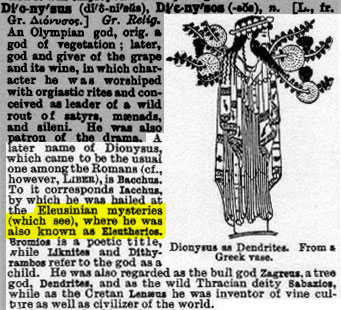
http://www.giveshare.org/babylon/paganismsurviving/, Paganism Surviving in Christianity, by Abram Herbert Lewis, D.D. … 1892, “Paganism in Christianity, Chapter I”:
The simple people believe them to have been two holy bishops. I have myself witnessed this near Florence, and even Bacchus is not without his votaries, under the ecclesiastical name of St. Bacco. The principle and practice of papal Rome are identical with the practice of pagan Rome. … The two holies of the Gnostics and Neo-Platonists, Sophia and Eirene — Wisdom and Peace — were adopted as saints in the calendar of Constantinople. Dionysius, the god of the mysteries, reappears as St. Denys in France, St. Liberius, St. Eleutherius, and St. Bacchus
Dionysius is simply a form of Dionysus / Bacchus:
A Dictionary of the English Language: Academic Edition, Noah Webster, 1867, (supplement): Common English Christian Names, p. 521, “Dionysius”:
http://www.zelo.com/firstnames/findresults.asp?name=dionysus, What Does Your Name Mean:
|
DIONYSUS |
|
|
Gender: |
Male |
|
Root: |
DIONYSIUS |
|
Origin: |
Greek |
|
Meaning: |
God of wine & Revelry |
http://www.zelo.com/firstnames/findresults.asp?name=DIONYSIUS, What Does Your Name Mean:
|
DIONYSIUS |
|
|
Gender: |
Male |
|
Origin: |
Greek |
|
Meaning: |
God of wine & Revelry |
The Holy Bible: Clarified Edition (KJV), Consolidated Book Publishers, 1957, no page number, “Encyclopedic Index: Concordance and Dictionary, Gilbert James Brett, Editor | DIONYSIUS”:
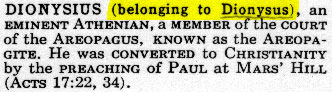
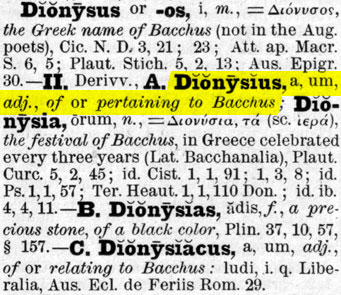
Harpers’ Latin Dictionary, Lewis / Short, 1879, p. 583, “Dionysus … Dionysius”:
Bibliotheca Eliotae (Latin-English dictionary), Sir Thomas Elyot, 1548 (“M. D. XLVIII”), no page numbers, “Dionysius”:
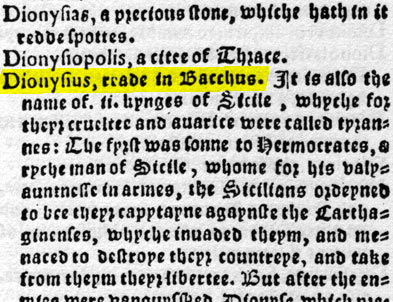
(Highlighted part) translated from Elizabethan English:
Dionysius, read in Bacchus.
http://www.thebabyoutlet.com/html/additional_channels/names/boys_d.html, baby naming, “Boys | D”:
|
Denney |
English |
Variant of Dionysius. Dionysius is the mythological Greek god of wine responsible for growth of the vines and the originator of winemaking: (equivalent to the Roman god Bacchus.) |
http://www.cfimages.com/Baby/Names/girlsd.html, Baby Shop, “Girls’ names: D”:
Dionisia From the Greek festival Dionisya which took its name from the god of wine called Dionysius
History of Christian Names, Yonge, 1884, p. xlvii, “Glossary”:
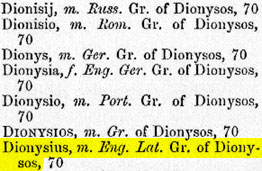
Dionysos is the more correct / direct transliteration from the Greek god Dionysus (Διόνυσος).
http://www.behindthename.com/php/view.php?name=Dionysius, Behind the Name: the etymology and history of first names, “View Name: Dionysius”:
DIONYSIUS
Gender: Masculine
Usage: Ancient
Roman
Extra Info: Related Names, Namesakes
Options: Contribute Information, Add to List
Latin form of DIONYSIOS. This was the name of several early saints including a 3rd-century pope.
http://www.behindthename.com/php/view.php?name=dionysios, Behind the Name: the etymology and history of first names, “View Name: Dionysios”:
DIONYSIOS
Gender: Masculine
Usage: Greek,
Ancient Greek
Other Scripts: Διονυσιος (Greek)
Extra Info: Related Names
Options: Contribute Information, Add to List
Greek personal name derived from the name of the Greek god DIONYSOS. Famous bearers include two early tyrants of Syracuse and a 1st-century BC Greek rhetorician.
http://www.behindthename.com/php/view.php?name=dionysos, Behind the Name: the etymology and history of first names, “View Name: Dionysos”:
DIONYSOS
Gender: Masculine
Usage: Greek
Mythology
Other Scripts: Διονυσος (Greek)
Pronounced: dee-o-NOO-sos [key]
Extra Info: Related Names, Namesakes
Options: Contribute Information, Add to List
From Greek Διος (Dios) meaning "of ZEUS" combined with Νυσα (Nysa), the name of a legendary mountain. In Greek mythology Dionysos was the god of wine, revelry, fertility and dance. He was the son of Zeus and Semele.
http://www.behindthename.com/php/view.php?name=bacchus, Behind the Name: the etymology and history of first names, “View Name: Bacchus”:
BACCHUS
Gender: Masculine
Usage: Greek
Mythology (Latinized)
Extra Info: Namesakes, Comments
Options: Contribute Information, Add to List
From Greek Βακχος (Bakchos), derived from ιαχο (iacho) meaning "to shout". This was another name of the Greek god Dionysos, and it was also the name that the Romans commonly used for him.
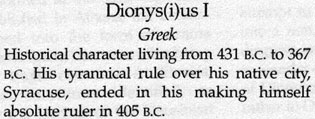
Encyclopedia of Greco-Roman Mythology, Mike Dixon-Kennedy, 1998, p. 113, “Dionys(i)us I”:
http://www.umr.edu/~ddani/name.html (University of Missouri – Rolla), In the name of Onomatology: Name origins, “First Name: Dionysios”:
In Greek, Dionysios means a follower of the Greek god Dionysos. Dionysos was the god of fertility, vine, ecstatic dance, theater, tragedy and comedy, orgiastic religion, phallic(penis) worship, joy and ecstasy, madness, and mysteries among others. In Greek "Dionysos" means "born from Deus( Zeus)". (Zeus stitched Dionysos into his thigh to hold him until he was ready to be born). Written with a different orthography "Dyo-nisos" means 'Twice born" or "Reborn", which also makes sense. According to the myth, Dionysos was slain and then reborn. …
Dionysios in Christianity:
St.Dionysios the Areopagite (or St.Dennis) was the judge of the Areopagus who, as mentioned in Acts 17:34, was converted to Christianity by the preaching of St. Paul. He was Bishop of Athens and he is the patron Saint of Athens, Greece.
St. Dionysius: Bishop of Corinth about 170.
St.Dionysius, holy martyr of Gaul, was the first Bishop of Paris.
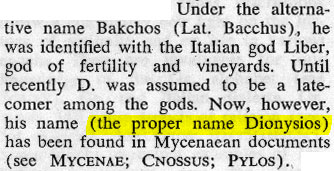
The Encyclopedia of the Classical World, 1965, p. 70, “Dionysus”:
http://www.newadvent.org/cathen/14747a.htm (Catholic Encyclopedia), Tius:
Titular see, suffragan of Claudiopolis in Honorias. According to Strabo (542, 545) the town was not remarkable save as the birthplace of Philetaerus, founder of the royal dynasty of Pergamus. The coins give Dionysius as the founder; in fact it was the site of a temple of Dionysius and one of Jupiter.
Webster’s Dictionary of Proper Names, 1970, pp. 193-194:
http://religion.mrugala.net/Grece/Anglais/Greec%20gods.txt:
DIONYSOS
(Dionysus, Dionysius, Roman Bacchus)
Greek god of wine and intoxication. … His cult is believed to have originated in either Thrace, Phrygia or perhaps Lydia. … He was credited with having the introduction of the vine and the art of making wine. In some legends he was said to have descended to the underworld to bring back his mother Semele, and this presumably led to his role in Orphism, which equated him with Zagreus. His worship was characterized by orgiastic and often violent rites. His female worshippers, known as Bacchants or Maenads, ran and danced through the woods in a drunken frenzy bearing torches and thyrsus staves (made of vine leaves and ivy). The frenzy was believed to give them occult powers as well as superhuman strength, with which they were said to tear sacrificial animals to pieces. … Phallic(penis) symbolism was particularly prominent at the Dionysia,
Being named Dionysius is today’s equivalent of saying: “Hi, my name is Greek Sex Orgy.”