DIONYSUS – THE BACCHANTES (or, THE BACCHAE) by EURIPIDES
Greek play, c. 404 B.C.
Some “orgy,” “Dionysus,” or “Bacchus” definitions try to imply that the orgies of Dionysus / Bacchus were not sexual; so to refute:
The movie:
Euripedes Bacchantes (Italian/French movie, filmed in Greece 1960, rel. 1961, English language version 1988 VHS [original Italian version: “Le Baccanti”; French version: “Les Bacchantes”; aka Bondage Gladiator Sexy (USA 1963)], Play was written 404 BC); Starring Pierre Brice (Dionysian stranger), Alberto Lupo (Pentheus), Akim Tamiroff (Teiresias), Taina Elg (Dirce), Alessandro Panaro (Manto); Directed by Giorgio (George) Ferroni; rated PG (try Amazon.com, half.ebay.com, etc):
(Timer 0:10:27):
Dirce (Pentheus’s betrothed, speaking to Manto--who removes her burka to drink the forbidden wine): … in my heart there exists another life; a life far away from these dismal walls of the court. A gay, free life, full of songs and dances and love.
(Timer 0:21:30):
Pentheus (king of Thebes [in Greece]): with inebriating wine, and with orgies of impure women
(Timer 0:53:08):
Messenger: A great number of the Theban youths have assembled on Mount Cithaeron, to celebrate the forbidden Bacchanal. Cups overflowing with wine are circulating among the women, and they have abandoned themselves to all matter of orgies. But, rendering homage to Venus, not Bacchus.
Pentheus: Who is the leader of this orgy?
Messenger: It was the stranger -- he provided the wine. And profiting by its potency he incited the youths and their maidens to defy their purity.
Agave (mother of Pentheus): Such conduct deeply offends the customs of Thebes.
Pentheus: And they have made a mockery of the law.
(Timer 1:08:40):
Pentheus: What is it then that brought you to Thebes?
Dionysian stranger: Dionysus has brought me to Thebes, to celebrate his rituals among you.
Pentheus: And what are they -- tell me, these rituals?
Dionysian stranger: They are not revealed to anyone profane.
Pentheus: Especially if the profane one is a just king, who forbids such impure Bacchanal.
Dionysian stranger: He who sees evil where there is none is impure himself.
Pentheus: You claim then that I am wrong when I say that these orgies we speak of are soaked with wine; and that the women drunk with liquor dance disrobed and abandon themselves without any restraint whatsoever?
Dionysian stranger: No, you’re not wrong; but, there is nothing bad in that. In the holy ritual is born a great joy, sacred and divine. In freeing the senses you liberate the spirit. The enjoyment of liberty -- that is the only happiness nature meant for us; which satisfies our god.
Pentheus: Then how is it they are held only in the night, these sacred honest rituals?
Dionysian stranger: The night is much sweater, and the darkness divine
Pentheus: And a beautiful accomplice to the corruption of women.
(Pentheus is a denseus)
http://www.channel4.com/film/reviews/film.jsp?id=100756, The Bacchantes, “The Bacchantes Film Review”:
Euripedes' The Bacchae gets a 60s makeover, with Elg as the ballerina who flits from relationship to relationship, unable to stay with one man for long until she strikes up a romance with the hedonistic, dangerous Dionysius (Brice).
The actual play:
http://www.mala.bc.ca/~johnstoi/euripides/euripides.htm, Euripides: The Bacchae, 404 BC [the actual play]:
(Supplementary List of Characters and Places: …
Aphrodite: goddess of erotic love and sexuality.)
…
EIGHTH VOICE: O you dark chambers
of the Curetes,
[120]
you sacred caves in Crete,
birthplace of Zeus,
where the Corybantes in their caves,
men with triple helmets,
made for me
this circle of stretched
hide.
In their wild ecstatic
dancing,
160
they mixed this drum beat
with the sweet seductive tones
of flutes from Phrygia,
then gave it to mother Rhea
to beat time for the Bacchae,
when they sang in
ecstasy.
Nearby, orgiastic satyrs [“satyrs” alone
indicates sex],
[130]
in ritual worship of the mother goddess,
took that drum, then
brought it
into their biennial
dance, 170
bringing joy to
Dionysus.
…
[Enter Pentheus, with some armed attendants. At first he does not notice Cadmus and Tiresias, not until he calls attention to them]
PENTHEUS:
| It so happens I've been away from Thebes,
270
| but I hear about disgusting things going on,
| here
in the city—women leaving home
| to
go to silly Bacchic rituals,
| cavorting
there in mountain shadows,
| with
dances honouring some upstart god,
| this
Dionysus, whoever he may be. Mixing
bowls
[220]
| in the middle of their meetings are filled
with wine.
| They creep off one by one to lonely spots
| to have sex with men, claiming they're Maenads
| busy worshipping. But they rank
Aphrodite,
280
| goddess of sexual
desire, ahead of Bacchus.
…
Once
I've clamped them all in iron fetters,
I'll quickly end this perverse nastiness,
this Bacchic
celebration. People
say
290
some
stranger has arrived, some wizard,
a conjurer from the land
of Lydia—
with sweet-smelling hair
in golden ringlets
and Aphrodite's(sexual love’s)
charms(“charitas”) in wine-dark eyes.
He hangs around the young
girls day and night,
dangling in front of them
his joyful mysteries(“sungignetai”: “to have
sex with”).
If I catch him in this
city, I'll stop him.
He'll make no more
clatter with his thyrsus,
[240]
or
wave his hair around. I'll chop off his head,
slice it right from his
body. This man
claims 300
that
Dionysus is a god,
…
TIRESIAS: …
So
welcome this god into your country.
Pour libations to him, then
celebrate
these Bacchic rites with
garlands on your head.
On women, where Aphrodite(sexual love)
is concerned, [315]
Dionysus will not enforce restraint—
400
…
PENTHEUS: [Moving up close to Dionysus, inspecting him carefully] …
Well,
stranger, I see this body of yours
is not unsuitable for women's pleasure—
that's why you've come to
Thebes. As for your hair,
it's long, which suggests
that you're no wrestler.
It flows across your
cheeks That's most seductive.
You've a white skin,
too. You've looked after it,
avoiding the sun's rays
by staying in the
shade,
570
while
with your beauty you chase Aphrodite(sexual love). [459]
…
MESSENGER: …
Once
she heard my horned cattle lowing,
your mother stood up amid
those Bacchae,
then called them to stir
their limbs from sleep.
They rubbed refreshing
sleep out of their eyes,
[690]
and
stood up straight there—a marvelous sight,
to see such an orderly
arrangement,
women young and old and still unmarried girls.
First,
they let their hair loose down their
shoulders,
860
tied
up the fawn skins (some had untied the knots
to loosen up the chords).
…
MESSENGER: … My
lord,
940
you must welcome this god
into our city,
whoever he is. He's
a mighty
god
[770]
in
many other ways. The people say,
so I've heard, he gives
to mortal human beings
that vine which puts an
end to human grief.
Without wine, there's no more Aphrodite(sexual
love)—
or any other pleasure
left for men.
…
PENTHEUS:
You've made some arrangement,
you and your god, so you
can always dance
your Bacchanalian orgies. [807]
…
DIONYSUS: You'll find
just the sort of hiding place
a spy should find who
wants to hide himself,
so he can gaze upon the Maenads.
PENTHEUS: That's
good. I can picture them right
now,
1180
in
the woods, going at it like rutting birds,
[957]
clutching each other as they make sweet(“lektrôn”:
a couch, bed) love.
http://www.answers.com/rutting, rut:
A condition or period of mammalian sexual activity, such as estrus. … A regular period of sexual excitement in female mammals: estrus, heat, season. See sex/asexual.
http://www.perseus.tufts.edu/cgi-bin/ptext?doc=Perseus%3Atext%3A1999.01.0092&layout=&loc=220, Euripides, Bacchae (ed. T. A. Buckley) [English], “Pentheus” (speaking):
[215] I happened to be at a distance from this land, when I heard of strange evils throughout this city, that the women have left our homes in contrived Bacchic rites, and rush about in the shadowy mountains, honoring with dances [220] this new deity Dionysus, whoever he is. I hear that mixing-bowls stand full in the midst of their assemblies, and that they each creep off different ways into secrecy to serve the beds of men, on the pretext that they are Maenads worshipping; [225] but they consider Aphrodite before Bacchus.
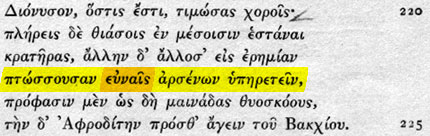
The original Greek (of the actual play):
http://www.perseus.tufts.edu/cgi-bin/ptext?doc=Perseus:text:1999.01.0091:line=215, Euripides, Bacchae (ed. Gilbert Murray) [portion of original Greek transliterated], “Pentheus” (speaking):
(Greek in black, English word definitions [via links at site] in blue):
ekdêmos from home, gone on a journey ôn to be, exist men on the one hand, on the other hand têsd' this etunchanon to hit chthonos the earth, ground, [line 215]
kluô to hear de but neochma new tênd'
this ana up, upon
ptolin a city kaka
bad; in moral sense: base, evil+,
[line 216]
gunaikas a woman hêmin ego
dômat' a house ekleloipenai to leave out, omit, pass over [line 217]
plastaisi formed, moulded bakcheiaisin Bacchic, of or belonging to Bacchus, en in, among de but daskiois
thick-shaded, bushy [line
218]
oresi a mountain, hill thoazein to move quickly, ply rapidly, ton the, that neôsti lately,
just now daimona a god, goddess [line 219]
Dionuson Dionysus, hostis any one who, anything which esti to be, to exist, timôsas to
pay honour to chorois a round dance: [line 220]
plêreis filled or infected by de but thiasois a band or company
marching through the streets with dance and song, esp. in honor of Bacchus en
in, among mesoisin in
the middle hestanai to make to stand [line 221]
kratêras a mixing vessel, allên alius, another, one besides d' but allos' at another time,
at other times eis into, to erêmian a solitude, desert, wilderness [line 222]
ptôssousan to crouch
without any notion of fear eunais
a bed arsenôn male hupêretein to be a servant, do
service, [line 223]
prophasin that which is alleged as the cause, and
allegation, plea men on the one hand, on the
other hand hôs thus, as, so that, since dê
exactness mainadas raving,
frantic, esp. Bacchante, Maenad, pornê, causing madness, esp. of love thuoskoous
the sacrificing priest, [line 224]
tên the, that d' but
Aphroditên Aphrodite (goddess of sexual love) prosth'
before agein to lead
or carry, to convey, bring tou the, that Bakchiou
Bacchic, of or belonging to Bacchus+.
[line 225]
Portion of original Greek text:
Euripides Bacchae, E. R. Dodds, Oxford University Press, 1944, no page numbers, (line 223):
P. 80, “Commentary” (for lines 120-34):
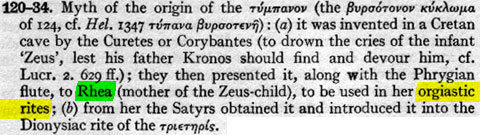
P. 93, (for lines 222-3):

P. 185, (for lines 957-60):

Miscellaneous:
Penguin Classics: Euripides: The Bacchae and Other Plays, 1973, “The Bacchae,” p. 198, (same Greek lines 215-225, Pentheus speaking):
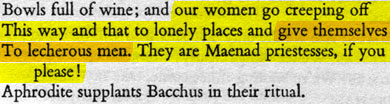
http://www.answers.com/lechery, lechery:
Excessive indulgence in sexual activity; lewdness. … unrestrained indulgence in sexual activity
http://greek-myth.com/Mythology/Ancient_Theatre/bacchantes.htm, Ancient Theatre: Euripides’ The Bacchantes, “Discussion of The Bacchantes”:
Specifically, the rites of Dionysus strike at the heart of marriage, taking women from the home and family, from underneath male dominance and allowing them to participated in unbridled orgy.
SparkCharts: Greek and Roman Mythology, 2002, “INTRODUCTION”:
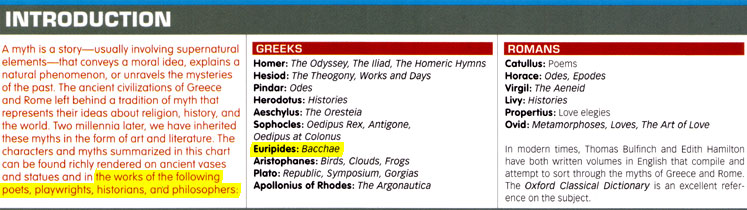
“Euripides: Bacchae” – Apparently a rather popular story: only ten authors mentioned.
http://www25.brinkster.com/finhollywood/Taina%20Elg/filmography04.html, Taina Elg, The Finnish Hollywood star, “The Bacchantes [Le Baccanti] (1961)” [the above movie]:
The basic story of The Bacchantes might seem familiar to first-year students in Greek drama. And well it should: the film is essentially an update of Euripides' The Bacchae.
Cliff Notes on Greek Classics, 1988, pp. 207-208, “Greek Tragedy | Euripides | The Bacchae”:
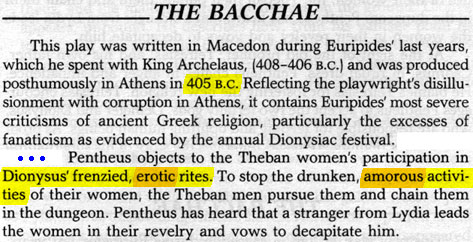
http://www.hermetic.com/sabazius/dionysus.htm, Dionysus:
As Dionysus and his retinue traveled the world spreading his cult, those who accepted him were rewarded with ecstasy. Those who opposed him were stricken with madness, and brought down by the hideous results of their own deranged atrocities. After establishing his cult across the known world, he returned to Greece, bringing his orgiastic Phrygian rites with him. He was not well received. Pentheus, king of Thebes, had him arrested, tried, scourged and thrown into prison. For this, Dionysus drove all the women of Thebes mad, including Agave, Pentheus's mother. They became maenads, and went out into the hills to conduct their Dionysian orgies. Pentheus imprudently followed them. Agave and her companions detected the spy, and in wild rage they fell upon him and tore him to pieces. Thus was Hellas converted to the religion of Dionysus; and Dionysus moved on.
Gods and Heroes: A Quick Guide to the Occupations, Associations and Experiences of the Greek and Roman Gods and Heroes, Caroline Thomas Harnsberger, 1977, pp. 17-18:
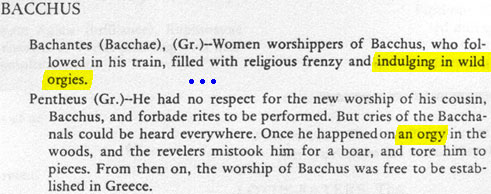
Benét’s Reader’s Encyclopedia, 1996, p. 70:
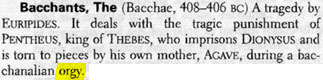
http://www.noteaccess.com/APPROACHES/AGW/Dionysos.htm, Ancient Greek Culture: Dionysos:
There king Pentheus of Thebes refused to recognize his divinity with the result that Pentheus was torn to pieces by his mother Agave who was struck with madness by the god. The same fate awaited those who throughout the world dared to oppose his worship which was in the nature of an orgiastic ritual. To his followers his worship was an uninterrupted series of festive days in which pandemonium reigned and often terminated in orgies in which women for the most part participated.
http://www.uark.edu/campus-resources/achilles/tragedy/tragedy.html, Tragedy:
Pentheus is really in trouble now. The maenads are dragging him down, and breaking rocks over his head; his mother, Agave, takes hold of his head from the left. Roman wall painting, Pompeii, House of the Vettii, c.70 CE.:
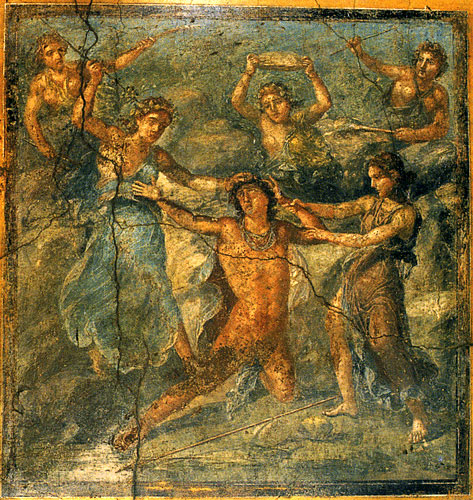
This shows that in the days of Christ, Euripedes’ Bacchantes (over 400 year old) play was popular all over the Roman Empire (e.g., even in Pompeii).
http://academic.reed.edu/humanities/110Tech/Bacchants.html, Euripides’ Bacchae, “The Iconography of Dionysus and the Bacchants”:
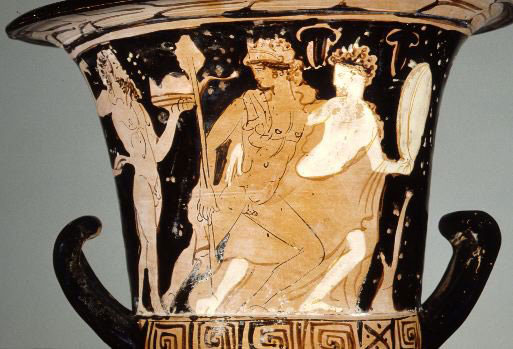
Maenads were not always depicted as chaste, however. The painter of this Attic Red Figure calyx krater of c. 420 BC thinks of the rites in the same way Pentheus does; here a beardless voluptuary Dionysus embraces an unresisting maenad.
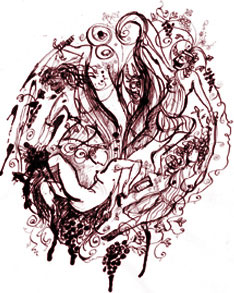
http://www.shotgunplayers.org/archive/seas8/bacchae/bacchae.cfm, The Bacchae by Euripides, directed by Patrick Dooley:
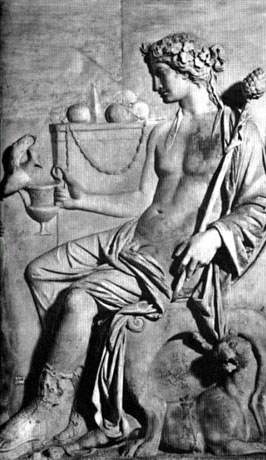
http://itw.sewanee.edu/Huber/dionysus/sld035.htm (The University of the South, Sewanee, TN), Euripides’ Bacchae: Orgy and Agony, “Dionysus from Herculaneum, (National Museum, Naples) Italy”:
The justification for my opposition:
http://www.fjkluth.com/festival.html, Ancient Greek Festivals:
A less common festival was the orgy. In fact this was a festival of worship of the God Dionysus. As described in the Bacchae by Euripides the festival is somewhat different than commonly described.
- Participants wear a wild fawn skin and carry a thyrsus.
- The festival is held upon a bare mountainside.
- Woman lead the festival but men follow.
- A sacrifice is made by tearing a young hill goat apart [pagan, Jewish, morally anyone who eats meat today].
- Wine is consumed and participants dance and pray.
- The festival celebrates the fact that Dionysus "...found the liquid shower hid in the grape. He rests man's spirit dim from grieving when the vine exulteth him. He giveth sleep to sink the fretful day in cool forgetting.
- the activities are justified by the fact that "Prophesy cleaves to all frenzy, but beyond all else to frenzy of prayer.
- Sexual license is not the purpose of the activities because "in the wildest rite cometh no stain to her whose heart is pure."
“No stain” and “heart is pure” can certainly pertain to non-marital sex: Such are not limited to today’s brainwash. My evidence from the original language above proves sex was part of Euripides’ description. However, it makes sense that many of the “orgiastic” festivals of Dionysus (and others) would have left the sex part out, depending on the location, etc.; as many people in that era were against open sex (especially of their women), or sex of some kind occurred during the festival only and not any other time; especially after the 186 BC persecution. Plus, these “mystery religions” are known to have kept these sex orgies a secret to avoid public scrutiny; that’s why they were called “mystery religions.” Sure, eventually they would become known, but many people would still believe they needed to worship the deity, even when the sex parts were eliminated.
http://www.eioba.com/a70752/orgies_a_brief_history, Orgies, a brief history, “II. Ancient Greece”:
Dionysus. He was the Greek god of mystery, wine and intoxication. He was venerated in secret ceremonies (orgeia that originally referred to ritual matters, religious ceremonies carried out in secluded places). These Dionysian mysteries were widely adopted by women. The stimulation of the dancing, music and wine, to which they were not accustomed, drove them to ecstatic frenzy (enthusiasmos) during which they indulged in copious sexual activity10 & 13.
…
10 Partridge, B. History of Orgies (1958). …
13 Historia de las orgias.