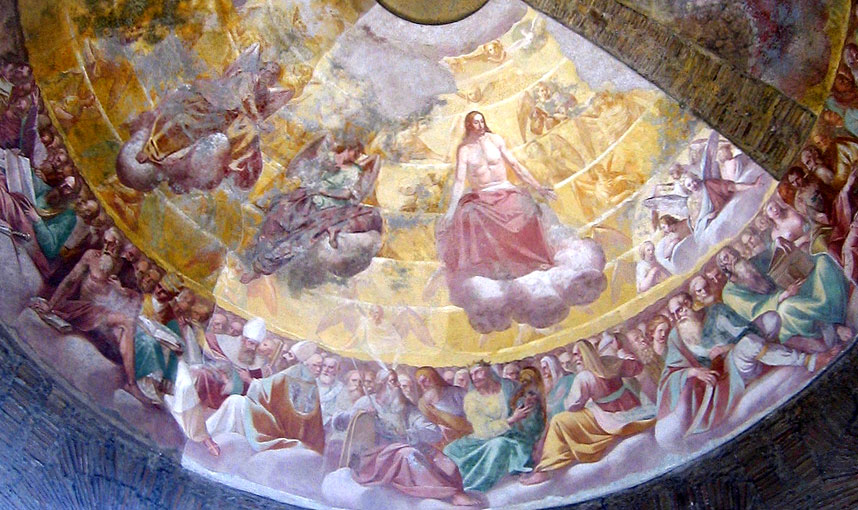
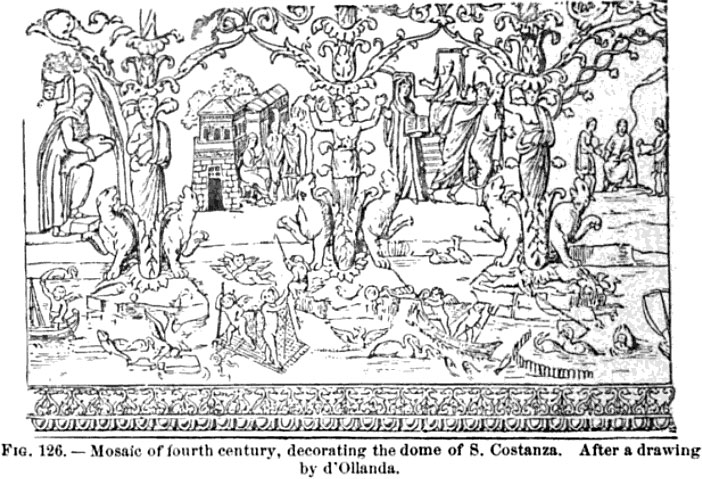
SANTA COSTANZA – ORIGINAL DOME MOSAIC (removed in 1620):
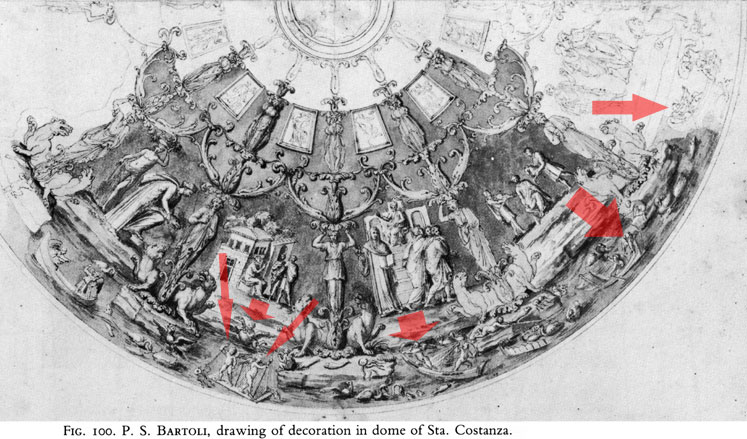
“Bacchic” imagery and Cupids in boats, mixed with Christian themes.
http://www.sacred-destinations.com/italy/rome-santa-costanza.htm, Sacred Destinations, “Santa Costanza, Rome”:
The Mausoleo di Santa Costanza has been periodically restored over the years, but it remains primarily a 4th-century structure. One major restoration took place in 1620 under Cardinal Veralli, during which the mosaics in the dome were destroyed.
…
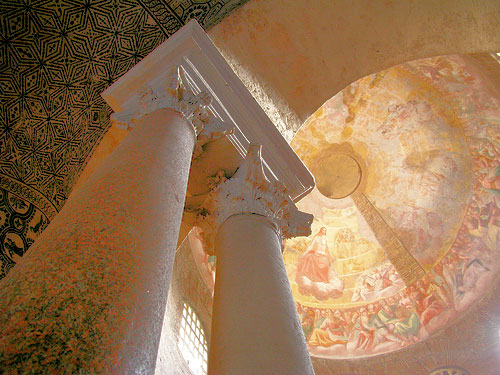
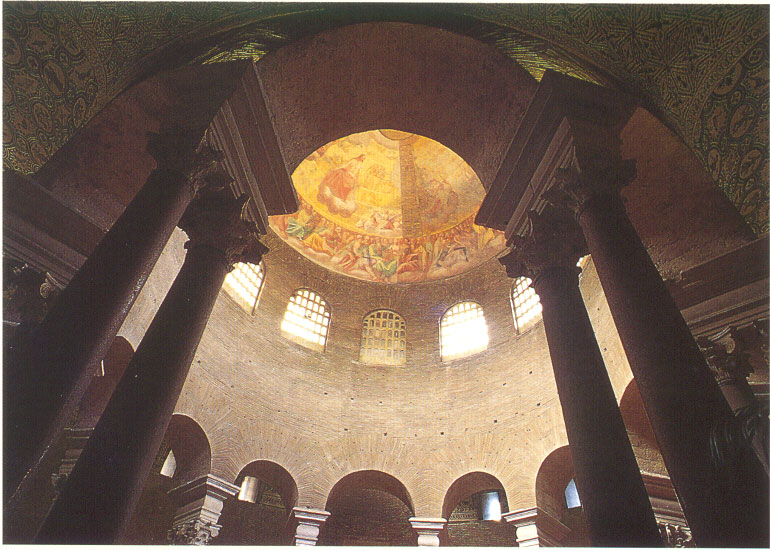
Originally, the walls were covered in marble and the dome was covered in mosaics. The dome mosaics, now destroyed, are known from 16th- and 17th-century paintings: they depicted New Testament scenes behind a golden screen of Bacchic imagery beyond the river Styx. A 16th-century antiquarian also reported seeing mosaics of two seated saintly women, which supports the theory that this mausoleum housed the bodies of both Constantia and Helena. Today, the dome contains faded 17th- and 18th-century paintings.
Ancient Mosaics, Ling, 1998, p. 106, “Wall and Vault Mosaics”:
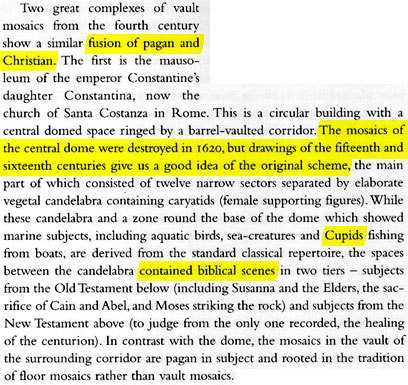
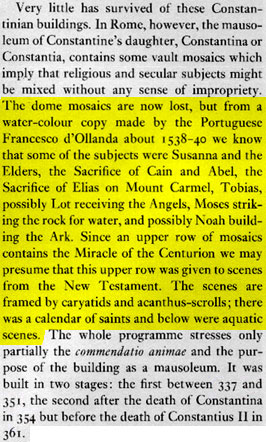
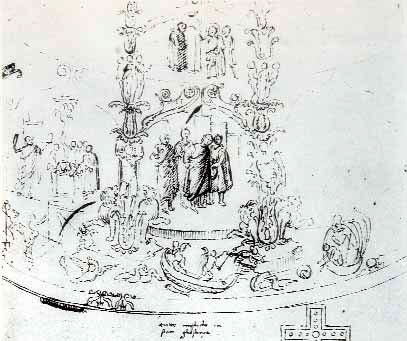
The water-color copy of the dome was made by the Portuguese Francesco d’Ollanda about 1538-40:
Early Christian and Byzantine Art, Beckwith, 1979, p. 27, “Early Christian Art: Rome and the Legacy of the Caesars”:
Christian Iconography: A Study of Its Origins, André Grabar, 1968, p. 137, “Dogmas Represented by Juxtaposed Images”:
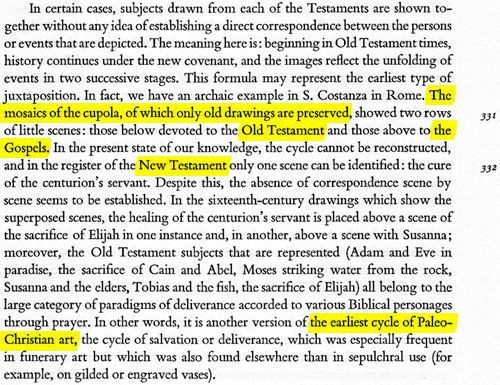
Illustration 331:
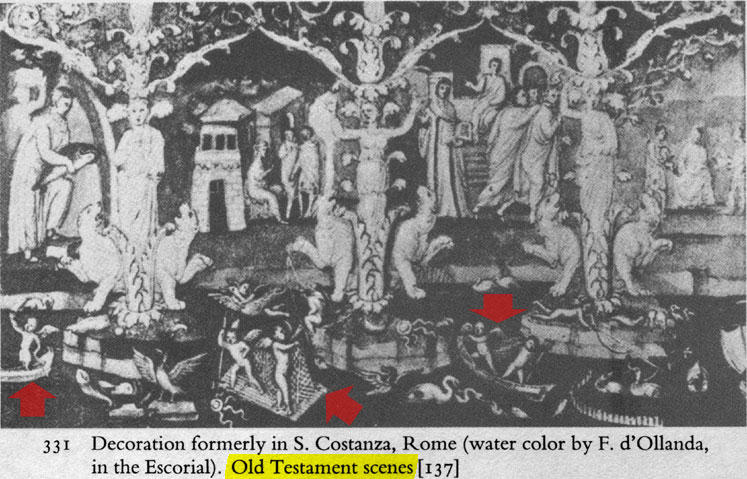
Illustration 332:
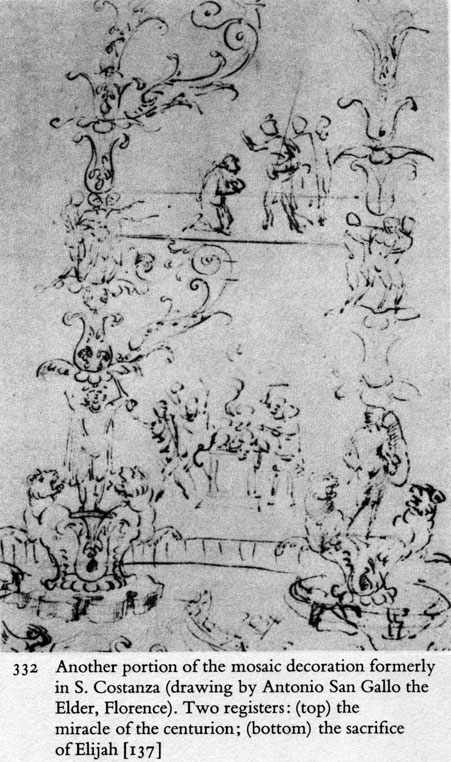
Looks like some naked people to me.
The Via Latina Catacomb, Tronzo, 1986, p. 67, “Cubiculum O—A Decoration for New Christians”:
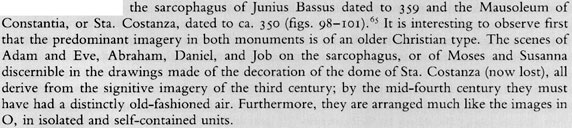
P. 68:
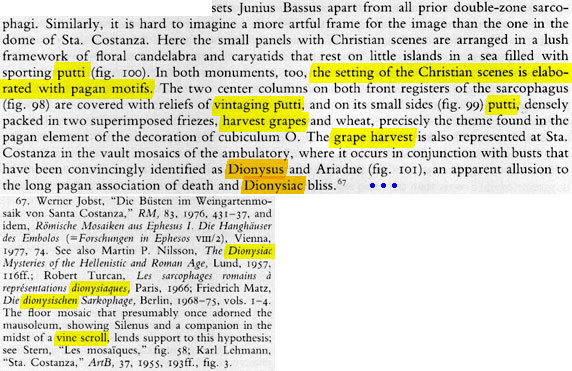
Figure 100 [Eros in boats]:
Enlargement:
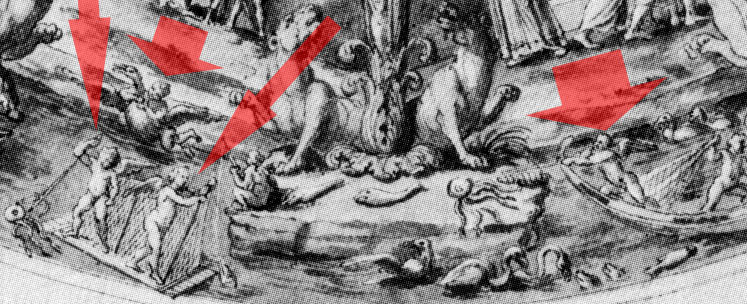
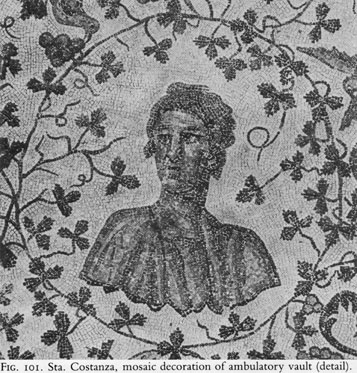
Figure 101:
http://www.zabern.de/pdfs/3908_1.pdf, 4. SANTA COSTANZA, p. 63:
http://web.abo.fi/fak/hf/konstvet/stcostanza.pdf, SONGS OF OSSIAN, “DOLPHINS AND MORTAR DATING– SANTA COSTANZA RECONSIDERED,” pp 30-31 (print pages 34-35):
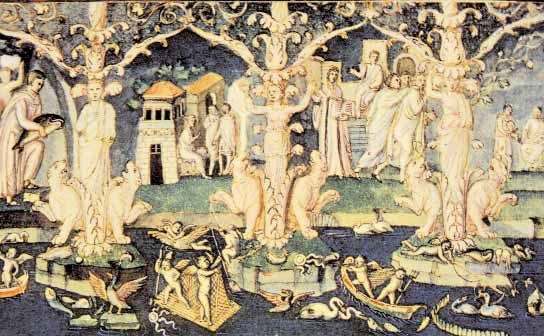
The most important and detailed of these documentations is a watercolour by d’Ollanda (Francesco de Hollanda; fi g. 8), who studied in Rome for two periods in 1539 and 1553. Pier Sante Bartoli (1635- 1700) later studied the drawings from the Escorial collection for his final reconstructed versions of the dome mosaics.31 It is quite remarkable that the majority of these early eyewitnesses interpreted the building as a pagan temple devoted to Bacchus, mainly on account of the mosaics (especially those in the dome).32 The drawings of the dome differ from each other in such a radical way that they can do little more than reaffirm the inconclusiveness which we may feel from the fragmentariness of the mosaics.33 Pomponio Ugonio, who documented the mosaics verbally in 1594, accompanying his work with simple sketches, is the first commentator of the mosaics to give them a Christian interpretation. He saw the mosaics of the central dome as illustrations of the Old and the New Testament. Among scenes that he identified from the Old Testament were Susanna and the Elders, the sacrifice of Abel, the sacrifi ce of Elias, Tobias, Lot and the Angels, Moses at the well, Noah in the ark, the three boys in the furnace, Daniel and the Lions, and Jonah.34 Foremost among these Renaissance sources, in addition to the drawing of Francesco da Hollanda, is the verbal description of Pomponio Ugonio. The man carrying a huge fish, to the far left in Hollanda’s water colour, whom Ugonio interpreted as Tobias, is of special interest for this study. Hollanda’s painting and Ugonio’s written description also lay the foundation for the two diverging interpretations of the mosaics, the pagan, and the Christian, which still today dominates the research of Santa Costanza.
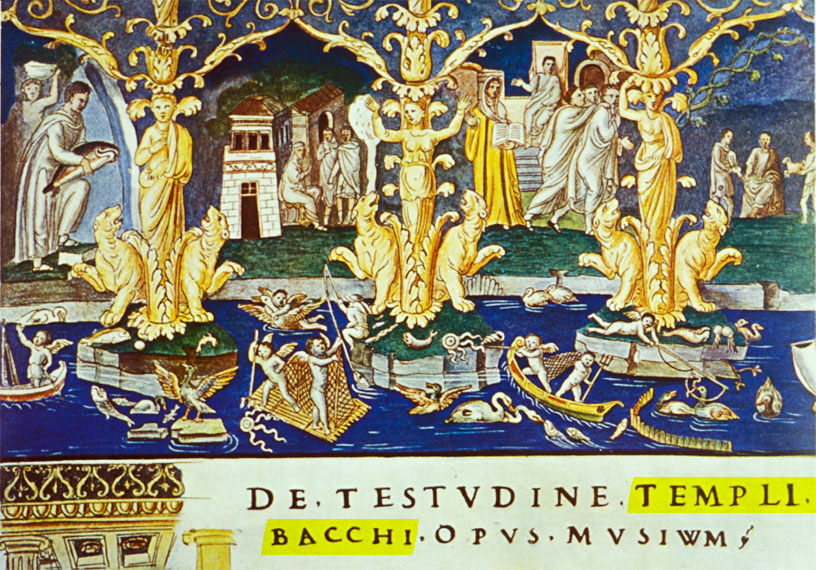
Fig. 8. The mosaics of the cupola, watercolour by Francesco d’Ollanda, documented between 1539 and 1557. The sketchbook by d’Ollanda belongs to the Royal Court Library in Escorial, (sign. 28 – 1- 20), published by Wilpert & Schumacher, Tafel 5.
…
P. 34 (print page 38), “Dolphins”:
We found that the dolphin (obviously enough, as the attribute of both Apollo and Dionysos), was simultaneously the symbol of both light and darkness. It is well known that Constantine the Great closely affiliated himself with Apollo, the Light God, and Sol Invictus. The dolphins of his lamp donations are therefore to be interpreted as light symbols. In the case of Santa Costanza, however, it seems logical to concentrate on the dark side of the iconography, on the symbolism of death and the death cult which (in the case of the dolphin), is also connected with both Apollo and Dionysos.
P. 35 (print page 39):
All these dolphins, together with the panthers and the vine harvesting scenes both in the mosaics of the ambulatory and the grand porphyry sarcophagus, provided reason enough for the early eyewitnesses during the Renaissance to ascribe Santa Costanza to an original Templum Bacchi.
But, as Karl Lehmann pointed out, there is even further proof of the Bacchic origin of Santa Costanza. In his book on ancient deities from 1566, V. Cartari published an image of the Dionysos legend (fig. 15) from the Homeric Hymns of the seventh century BC. The legend tells how Dionysos was kidnapped by Etruscan pirates, and taken out to sea. The pirates planned to extort a handsome ransom from the parents of the beautiful youngster, whom they did not identify. To punish his kidnappers, Dionysos transformed them into dolphins, after which they all panicked and jumped overboard. A complementary comment in the second edition from 1581, informs us that “this type of Bacchic ship could still be admired among the most beautiful mosaics in Rome, in the church by Saint Agnes, formerly a temple of Bacchus”.38 The legend of Dionysos and the Etruscan pirates was deeply rooted in Classical Greece. It often recurred in the vase paintings and in sculptures. Best known and breathtakingly beautiful is the scene on a cylix painted by Exekias (fig. 16).
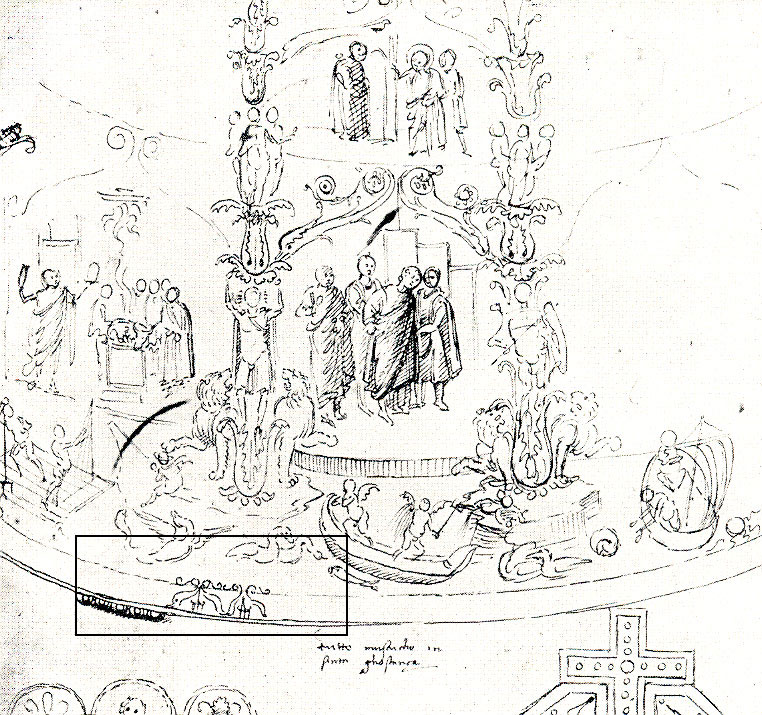
Fig. 13. Anynomous drawing of the cupola mosaics in Santa Costanza during the Early Renaissance, “Zu unterstein Eierstabgesimse und ein Fries mit Delphinen zur Seite eines Dreizacks, vgl. Fol. 7”, from Egger, Codex Escurialensis
…
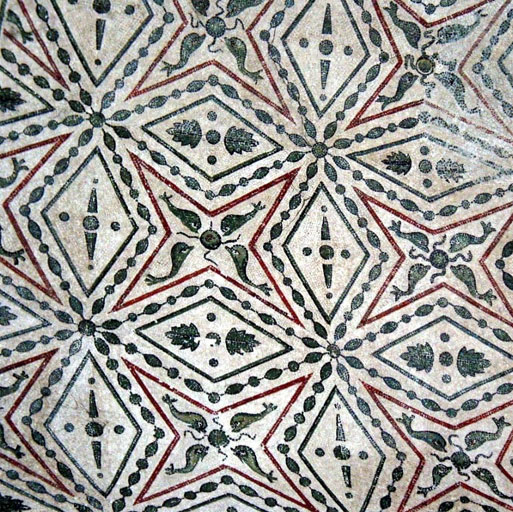
Fig. 14. Mosaics in the sections flanking the entrance, heraldic dolphins arranged four and four towards an octopus in the middle. Photo Åsa Ringbom.
…
P. 36 (print page 40):
Dionysian or Bacchic mysteries are mainly known through the arts in Italy.
P. 37 (print page 41):
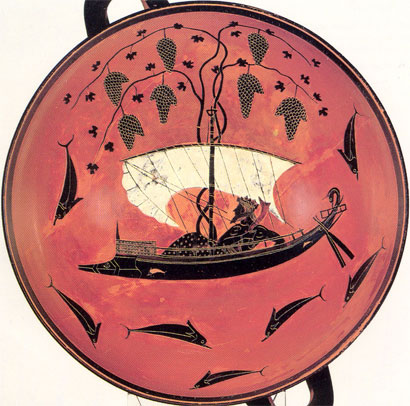
Fig. 16. Dionysos transforming the Etruscan pirates into dolphins, cylix with black figure painting by Exekias, ca 530 BC, found in Vulci, Munich, Antikensammlungen, from postcard.
http://books.google.com/books?id=-r4BjEw1ZgIC&pg=PA300&lpg=PA300&dq=%22dominus+pacem+dat%22&source=bl&ots=CGQevBOTBB&sig=epkX9jbY78jjH6Vjb-gySgaRzVw&hl=en&ei=nJ3ESdyiIZrsnQenkMjyDA&sa=X&oi=book_result&resnum=1&ct=result, Monuments of the Early Church –Google Books Result, by Walter Lowrie, 1906, p. 300, “The Constantinian Mosaics”:
Today’s dome:
http://www.flickr.com/photos/seier/502583017/, santa constanza, rom marts 2003:
the
ancient, roman ambition to make their massive concrete and brick domes seem to
float on air is achieved brilliantly in the santa constanza. the large windows
high above the floor concentrate the light on the dome which - in apparent
denial of its weight - is supported on columns only.
santa constanza, rome, probably mausoleum to constantia, daughter of emporer constantine, AD 350.
the original roman mosaics that covered the inside
of the dome survived into the era of the counter-reformation when all the ancient churches of rome were
done up with devastating results.
http://campus.belmont.edu/honors/ECArchThree/RomeStaCostanzaIntToDome.jpg (via http://campus.belmont.edu/honors/ECArchThree/ECArchThree.html), Early Christian Architecture:
ROME: Santa Costanza
Built c.350 as a mausoleum for the daughter of Constantine (Lowden 40-43)
http://www.santagnese.org/foto/cupola.jpg (via http://www.santagnese.org/galleria_foto.htm), Il Mausoleo di S. Costanza, “Vista interna della cupola”:
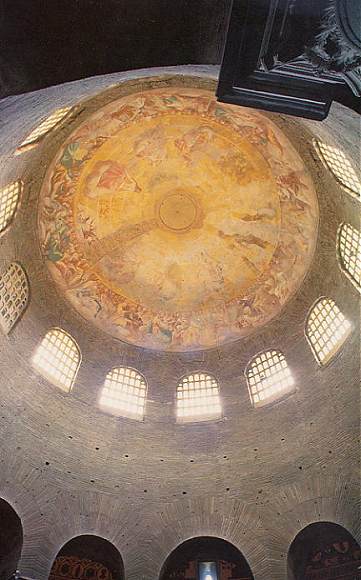
http://www.sacred-destinations.com/italy/rome-santa-costanza-pictures/slides/eosa_099.htm, Sacred Destinations, “Italy | Santa Costanza, Rome”:
The dome of Santa Costanza. Originally, the dome was covered in mosaics. Now destroyed, their content is known from 16th- and 17th-century paintings of them: they depicted New Testament scenes behind a golden screen of Bacchic imagery beyond the river Styx. A 16th-century antiquarian also reported seeing mosaics of two seated saintly women, which supports the theory that this mausoleum housed the bodies of both Constantia and Helena. Today, the dome contains these pastel 17th- and 18th-century paintings.
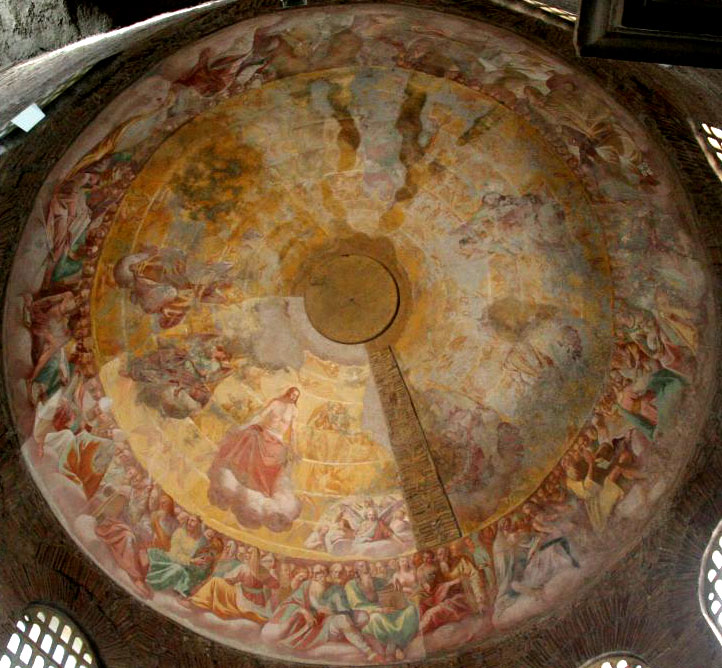
http://www.flickr.com/photos/72134509@N00/138533376, Santa Costanza Dome:
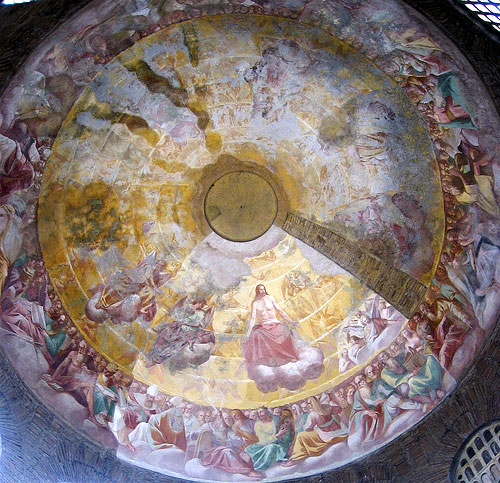
Enlarged:
http://www.flickr.com/photos/ecormany/138533376/sizes/l/, Santa Costanza dome: