CONSTANTINE THE GREAT
Constantine I the Great, Roman emperor from 306-337 AD, who legalized Christianity in 313 AD with his Edict of Milan
Father of Saint Constantina, and son of Saint Helen
http://xenohistorian.faithweb.com/worldhis/Hist08b.html, Ancient Rome, Part II, “Constantine”:
The most important change made by Constantine involved Christianity. According to the story, in 312 Constantine marched on Rome, and he saw a vision of a cross in front of the sun surrounded by these words: "In hoc signo vinces" (By this sign conquer). He marched his troops into a river, declared them baptized, and ordered them to paint the Greek letters chi and rho (an abbreviation for the name of Christ) on their shields. He may have done this to embarrass his rivals, who were all anti-Christian. When the following battle ended in victory he became a lifelong friend of Christianity, legalizing it in the areas he ruled.
Who Was Who in the Roman World, Diana Bowder, 1980, pp. 67-68, “Constantine I (‘the Great’) Emperor AD 306-37”:
Encyclopedia of the Roman Empire, Bunson, 1994, p. 108, “Constantine”:
The New Encyclopaedia Britannica, Macropaedia, 1995, Vol. 16, p. 688, “Constantine”:
A Chronology of Western Architecture, Yarwood, 1987, p. 24, “Fourth-Century Early Christian Churches in Rome”:
http://www.sinclair.edu/sec/artman263/ma263tl1.htm, Time LIne:
|
AD 37-313 |
Era of Persecution - the time when catacombs were made and used for burials, and the Christian Church was an "underground" organization. During this time, Early Christian Art was humble. |
|
AD 303-305 |
Reign of Roman Emperor Diocletian. Persecutions peak. |
|
AD 306-337 |
Reign of Roman Emperor Constantine the Great. Makes Christianity not only legal but the official religion of the empire. Constantine the Great starts commissioning grand churches — including Old St. Peter's — and other structures. |
…
|
AD 333 |
Approximate date of foundation of Old St. Peter's. (Exact date disputed). Also during Constantine's era was the dedication of the Mausoleum of S. Costanza in Rome, the Cathedral of Naples, as well as many other Early Christian basilicas |
Christianity wouldn’t be anywhere near as big as it is today if it wasn’t for Constantine I. In fact, it probably wouldn’t exist at all today (as much persecution prior years indicated). For some reason, most Christians have never heard his name. For some reason someone changed Constantina to Costanza.
http://www.cwo.com/~pentrack/catholic/chron.html, Chronology of Christianity (1AD-Present):
321 Constantine decrees Sunday as offical Roman-Christian day of rest
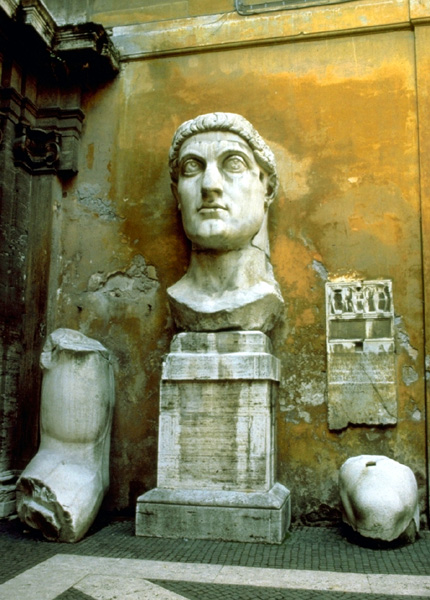
http://harpy.uccs.edu/roman/html/archconslides.html, The Art and Architecture of Constantine, “Colossal statue of Constantine as Cosmocrator from the Basilica of Constantine on the Roman Forum (Rome, Museo Conservatori)”:
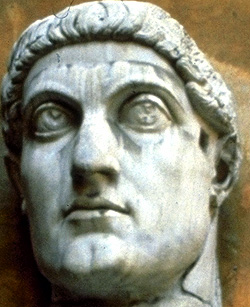
http://www.livius.org/cn-cs/constantine/constantine.html, Constantine the Great, “Constantine I the Great: emperor of the Roman world (306-337)”:
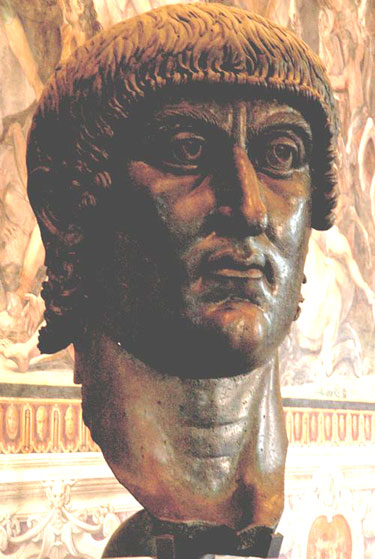
The Roman Empire: Art Forms and Civic Life, Hans Peter L’Orange, 1985, pp. 192-193, illustration 119 & 120:

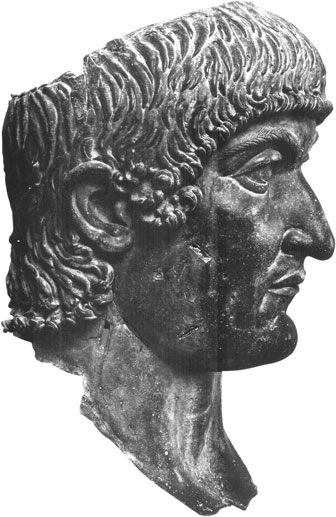
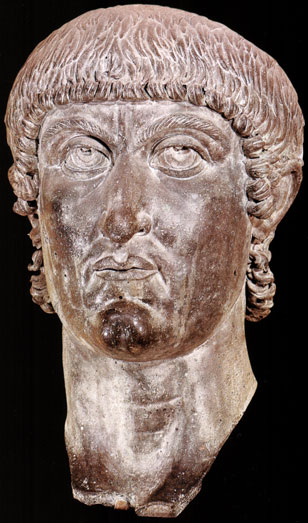
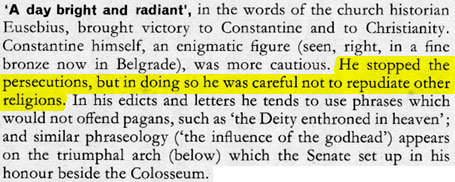
The Crucible of Christianity, Toynbee, 1969, p. 344, illustration 33, “The Persecutions | Christianity’s Encounter with the Roman Imperial government”:
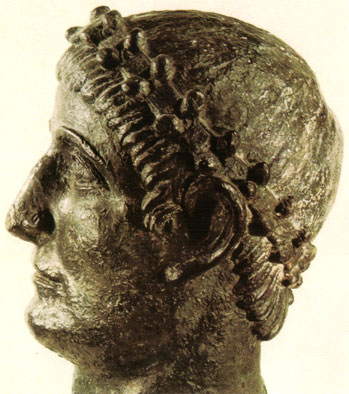
P. 362, “List and Sources of Illustrations | The persecutions”:
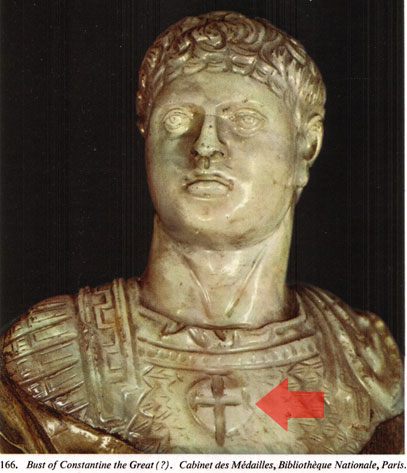
Early Christian Art: AD 200-395: From the Rise of Christianity to the Death of Theodosius, André Grabar, 1968, p. 161, “3. The Art of the Fourth Century | The Work of Contantine and his Family | 166. Bust of Constantine the Great (?)”:
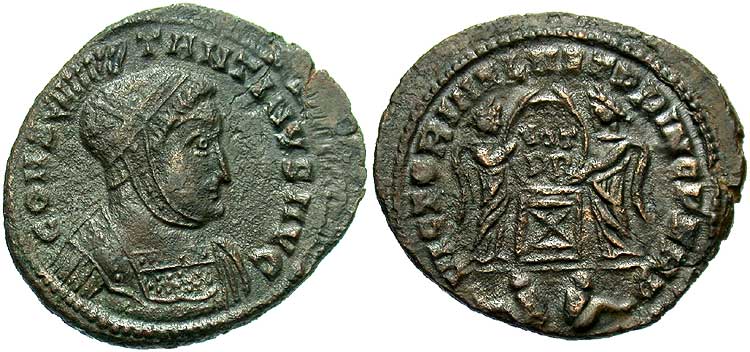
http://www.beastcoins.com/Topical/VLPP/Coins/Lugdunum/ConstantineI-RICVII-65-twocaptives.jpg (via http://www.beastcoins.com/toc.htm):
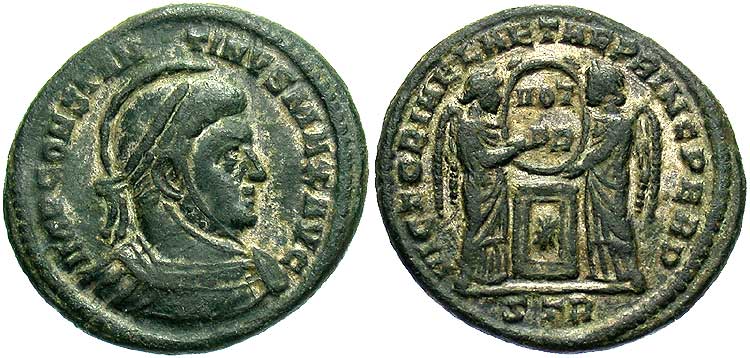
http://www.beastcoins.com/Topical/VLPP/Coins/Trier/ConstantineI-RICVII-213-STR.jpg (via http://www.beastcoins.com/toc.htm):
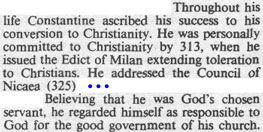
The New Encyclopedia Britannica, 1995, Vol. 3, p. 563, “Constantine I (Constantine the Great)”
Many of you should be familiar with the Nicene Creed:
http://gbgm-umc.org/umw/bible/cea.stm, The Christian Empire: 313-476, “Authority and the Bible”:
Constantine was not a theologian, but he took steps during his rule to try to make Christianity less conflictual by calling the Council of Nicea to settle the Arian controversy. One result of the the council was the drafting of a version of what we now call the Nicene Creed.
http://gbgm-umc.org/umw/bible/ncreed.html, The Nicene Creed:
We believe in one God,
the Father, the Almighty,
maker of heaven and earth,
of all that is, seen and unseen.
We believe in one Lord,
Jesus Christ,
the only Son of God,
eternally begotten of the Father,
God from God, Light from Light,
true God from true God,
begotten, not made,
of one Being with the Father.
through him all things were made.
For us and for our salvation
he came down from heaven;
by the power of the Holy Spirit
he became incarnate from the Virgin Mary,
and became truly human.
For our sake he was crucified under Pontius
Pilate;
he suffered death and was buried.
On the third day he rose again
in accordance with the Scriptures;
he ascended into heaven
and is seated at the right hand of the
Father.
He will come again in glory to judge the
living and the dead,
and his kingdom will have no end.
We believe in the Holy
Spirit, the Lord, the giver of life,
who proceeds from the Father and the Son.
Who with the Father and the Son
is worshiped and glorified,
who has spoken through the Prophets.
We believe in one holy catholic*
and apostolic Church.
We acknowledge one baptism
for the forgiveness of sins.
We look for the resurrection of the dead,
and the life of the world to come. Amen.
http://www.britannica.com/ebc/article?tocId=9361456, Constantine I (Constantine the Great):
First Roman emperor
to profess Christianity. … Constantine is revered as a saint in the
Orthodox church.
Art and Archaeology of Rome: From Ancient Times to the Baroque, Augenti, 2000, p. 61, “The Age of Constantine (Fourth Century)”:
http://www.kentoncityschools.org/kms/art/?7reading.html (Kenton Middle School), 7th Grade Art Readings:
A typical mausoleum is the domed, circular Church of Santa Costanza (4th cent.) in Rome, built as the tomb of Constantia, daughter of Constantine the Great. Her magnificently carved porphyry sarcophagus, now in the Vatican Museums, Rome, stood under the dome.
http://au.encarta.msn.com/encyclopedia_761579100/Early_Christian_Art_and_Architecture.html, Early Christian Art and Architecture:
The domed, circular church of Santa Costanza (4th century) in Rome is a typical early Christian mausoleum. It was built as the tomb of Constantia, daughter of Constantine the Great; her magnificently carved porphyry sarcophagus, now in the Vatican Museum in Rome, stood under the dome.
Early Christian Art: AD 200-395: From the Rise of Christianity to the Death of Theodosius, André Grabar, 1968, p. 237, “3. The Art of the Fourth Century | Mosaics on Individual Tombs | 263. Kelibia. Tomb Mosaic” [Constanti- name; Christian symbols; grape vines]:
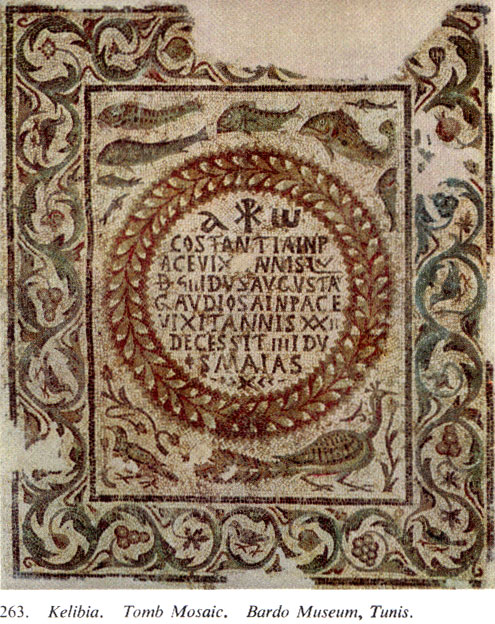

Early Christian and Byzantine Art, Beckwith, 1979, p. 25, “Early Christian Art: Rome and the Legacy of the Caesars” [vines]:
The Arch of Constantine:
http://www.students.sbc.edu/smith04/ancientrome.html, Art and Propaganda in Ancient Rome, “Constantine and the Late Empire | The Arch of Constantine”:
The Arch of Constantine was erected between 312 and 315CE by the Senate in honor of his military triumph over Maxentius at the Battle of the Milvian Bridge.
http://www.arch.cam.ac.uk/~dir21/gallery/tn/arch_of_constantine_from_the_colosseum.png.html, Arch of Constantine, from the Colosseum [looking WSW]:
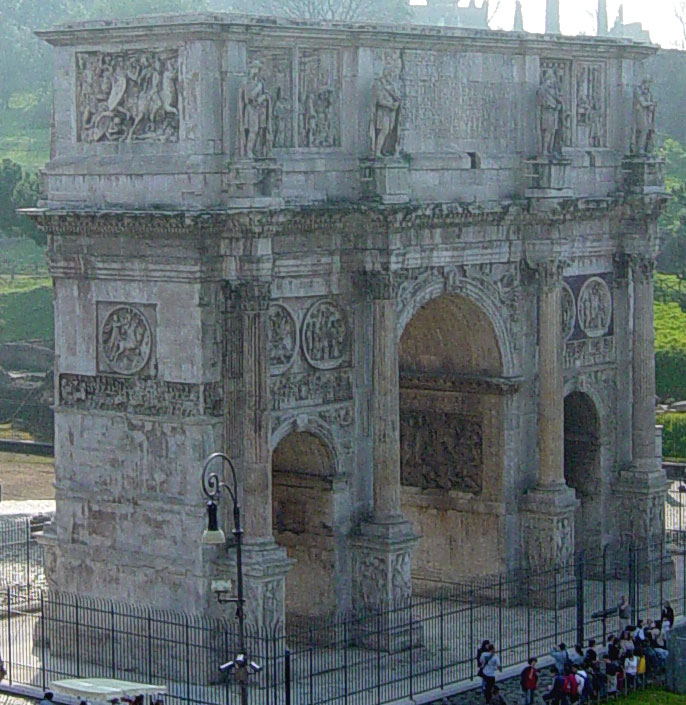
East-South-East side:
http://manheimtwplions.org/images/Arc%20de%20Constantine.JPG:
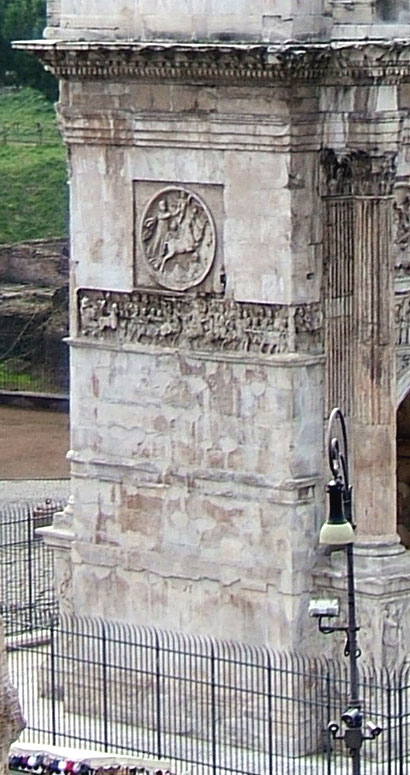
http://www.prompterinc.com/Photographs/Rome1/Rome1/Rome-14-Arch-of-Constantine.jpg (via http://www.prompterinc.com/Photographs/Rome1/Rome_1.html):
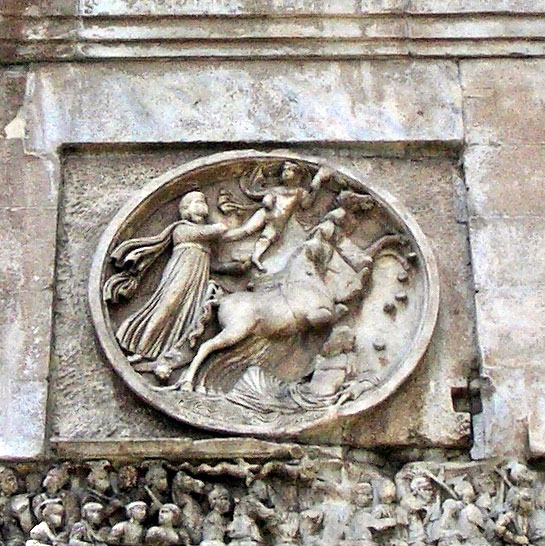
http://www.cavazzi.com/roman-empire/tours/rome/arch-of-constantine.html, Arch of Constantine:
The arch of Constantine was dedicated by the senate in AD 315 in honour of Constantine's victory over Maxentius. … this arch celebrates the triumph over Maxentius, a victory Constantine later credited to the 'God of the Christians'.
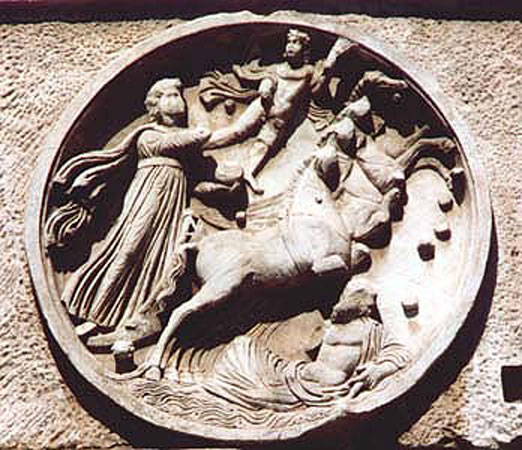
http://catholic-resources.org/Photos/Rome99/Const-02.jpg (via http://catholic-resources.org/AncientRome/ArchConst.htm), The Arch of Constantine, “North [actually East-South-East] Side Medallion”:
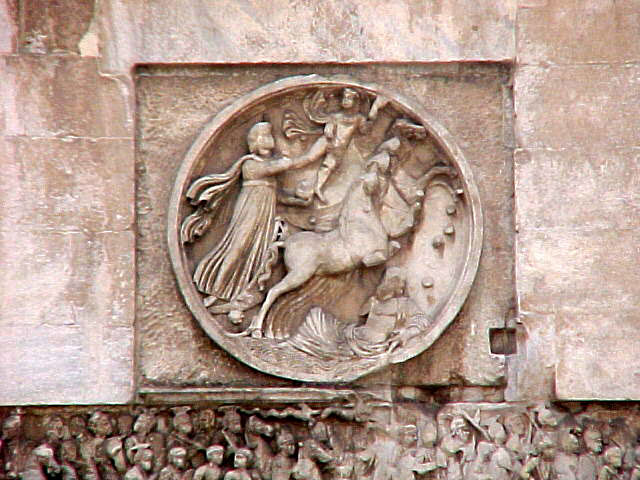
West-North-West side:
http://catholic-resources.org/Photos/Rome99/Const-12.jpg (via http://catholic-resources.org/AncientRome/ArchConst.htm), The Arch of Constantine, “North [actually West-North-West] Side Overview (see Colosseum to left)”:
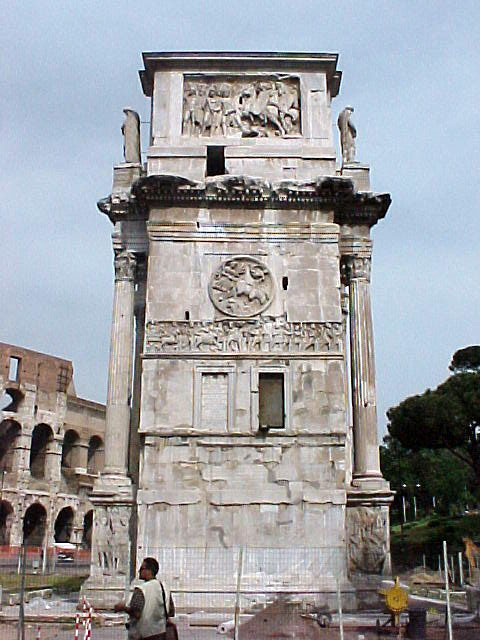
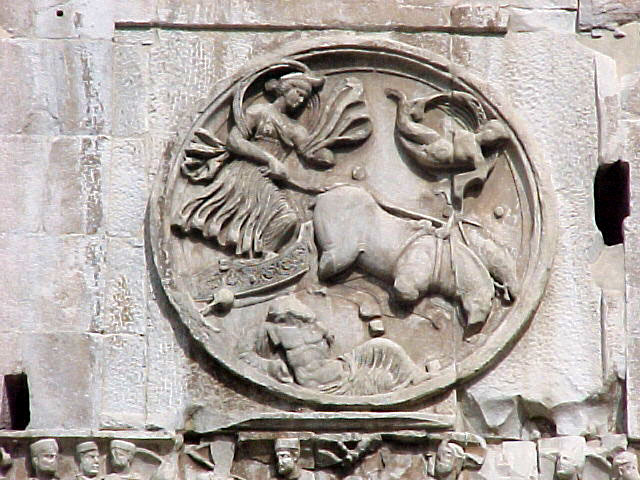
http://catholic-resources.org/Photos/Rome99/Const-11.jpg (via http://catholic-resources.org/AncientRome/ArchConst.htm), The Arch of Constantine, “South [actually West-North-West] Side Medallion”:
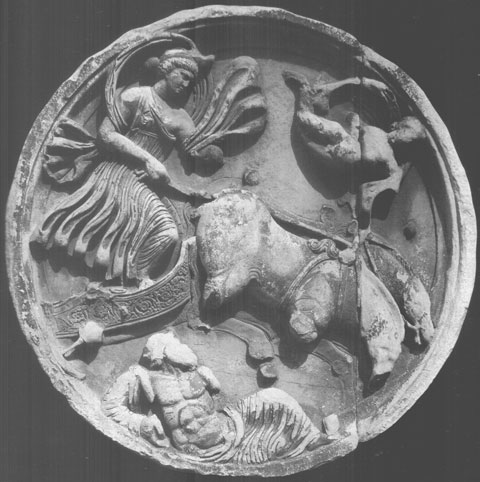
The Roman Empire: Art Forms and Civic Life, Hans Peter L’Orange, 1985, pp. 51-52, illustration 88:

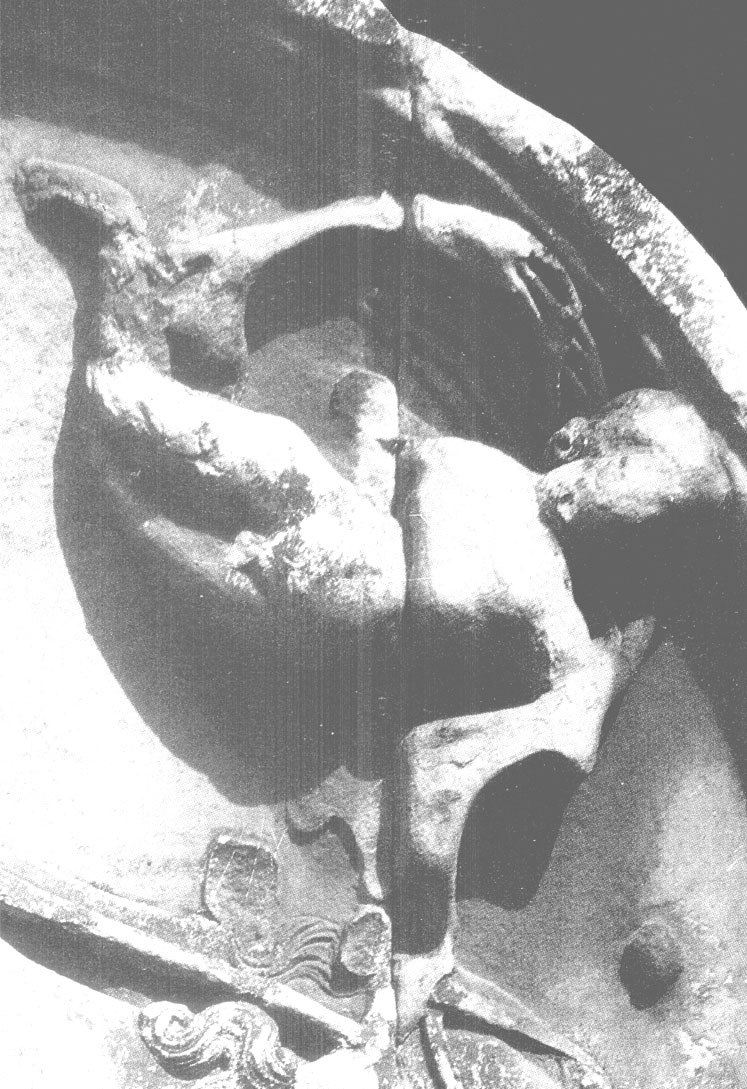
Enlargement:
Other views:
http://vr.theatre.ntu.edu.tw/hlee/course/th9_1000/images/12-s-05x.jpg (via http://vr.theatre.ntu.edu.tw/hlee/course/th9_1000/open-12-broadcast.htm), Period Style in the Western Arts, “Arch of Constantine”:
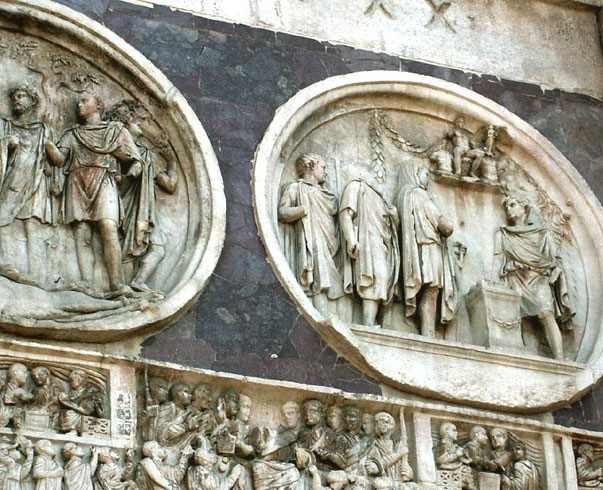
http://faculty.cua.edu/pennington/Bologna2001/Arch%20of%20Constantine/RondelsFrieze.htm (via http://faculty.cua.edu/pennington/Bologna2001/Arch%20of%20Constantine/ConstantineArch.htm), The Secrets of the Arch of Constantine, “Rondels and Frieze”:
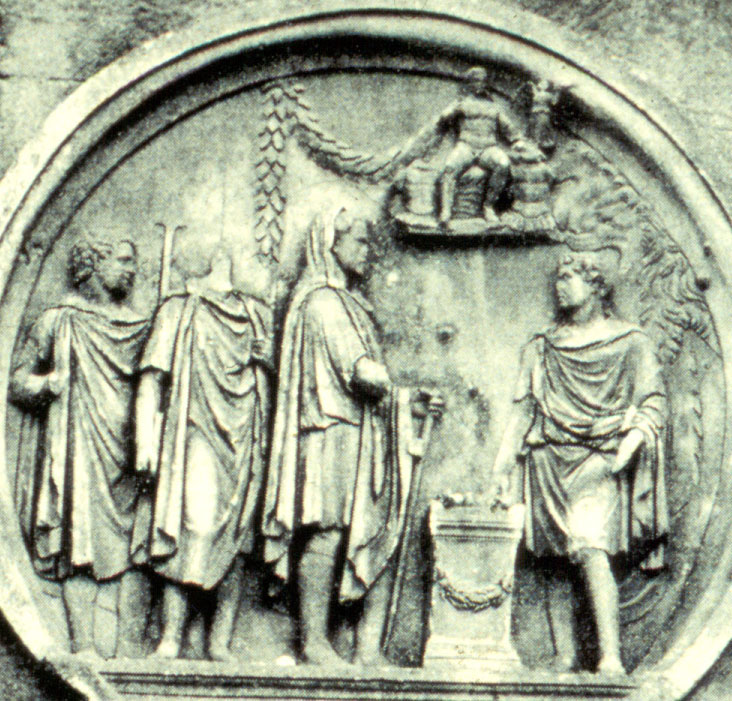
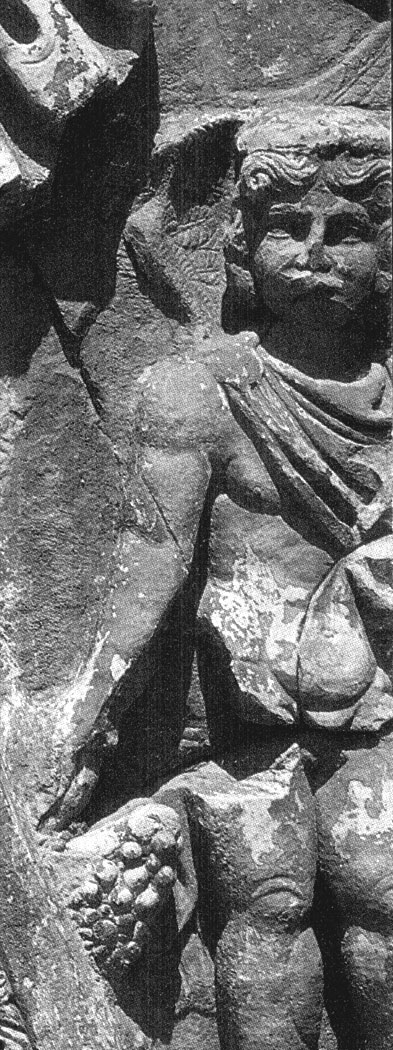
The Roman Empire: Art Forms and Civic Life, Hans Peter L’Orange, 1985, pp. 148-149, illustration 86 (Eros holding grapes):
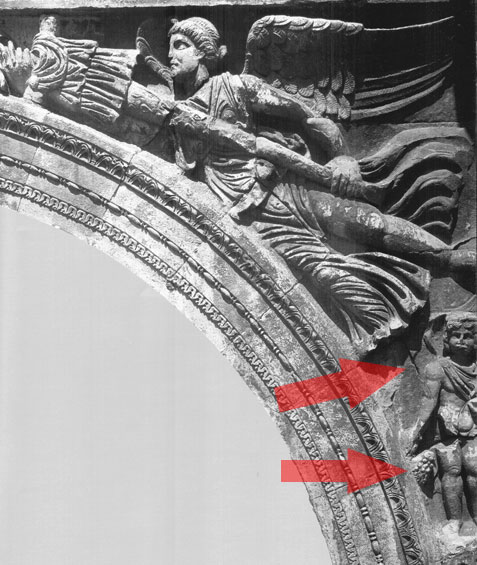
Enlargement:
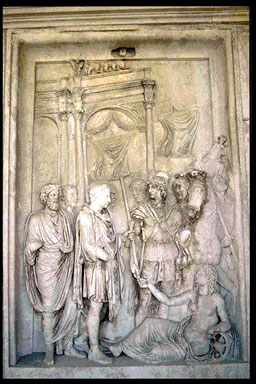
http://research.yale.edu/divdl/images/cd6/6im58.gif (via http://research.yale.edu:8084/divdl/adhoc/objectdetail.jsp?objectid=2629), The AdHoc Image and Text Database on the History of Christianity, “Arch of Constantine, Aurelian reliefs”:
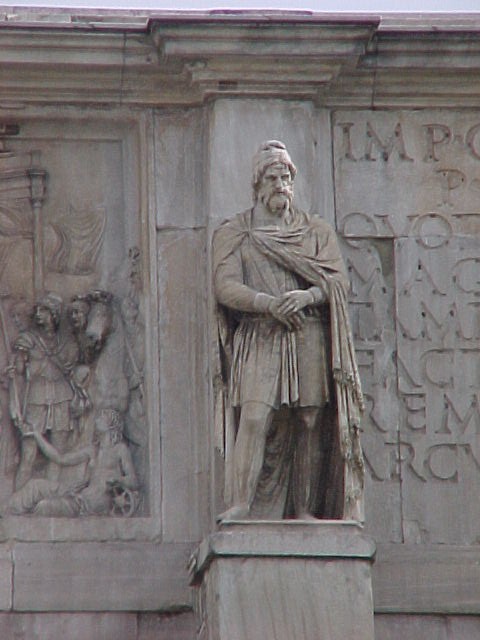
http://catholic-resources.org/Photos/Rome99/Const-15.jpg (via http://catholic-resources.org/AncientRome/ArchConst.htm), The Arch of Constantine, “Statues of Captives on the East [actually North-North-East] Side (close-up photos)”:
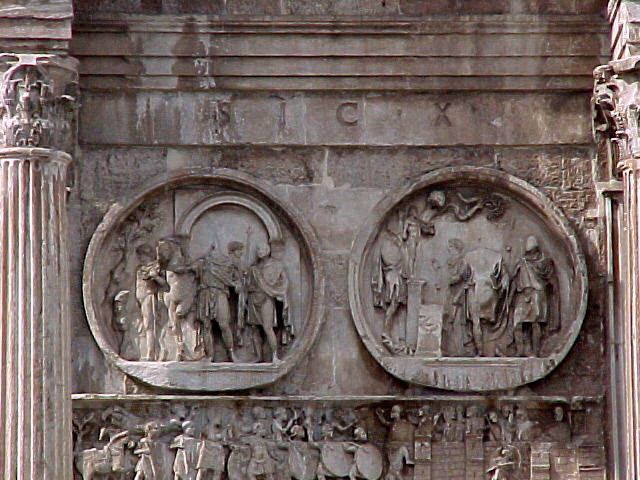
http://catholic-resources.org/Photos/Rome99/Const-24.jpg (via http://catholic-resources.org/AncientRome/ArchConst.htm), The Arch of Constantine, “The West [actually South-South-West] Façade (view looking East [actually looking North-North-East]) | Left-Side Medallions”:
http://www.flholocaustmuseum.org/history_wing/antisemitism/roman_empire.cfm#constantine, Roman Empire, “Constantine”:
During a dream the night before an important battle, Emperor Constantine the Great claimed he had a sign from the God of the Christians. Emperor Constantine won this battle and thereafter showed his gratitude to the Christian God by turning his entire empire over to this new religion.
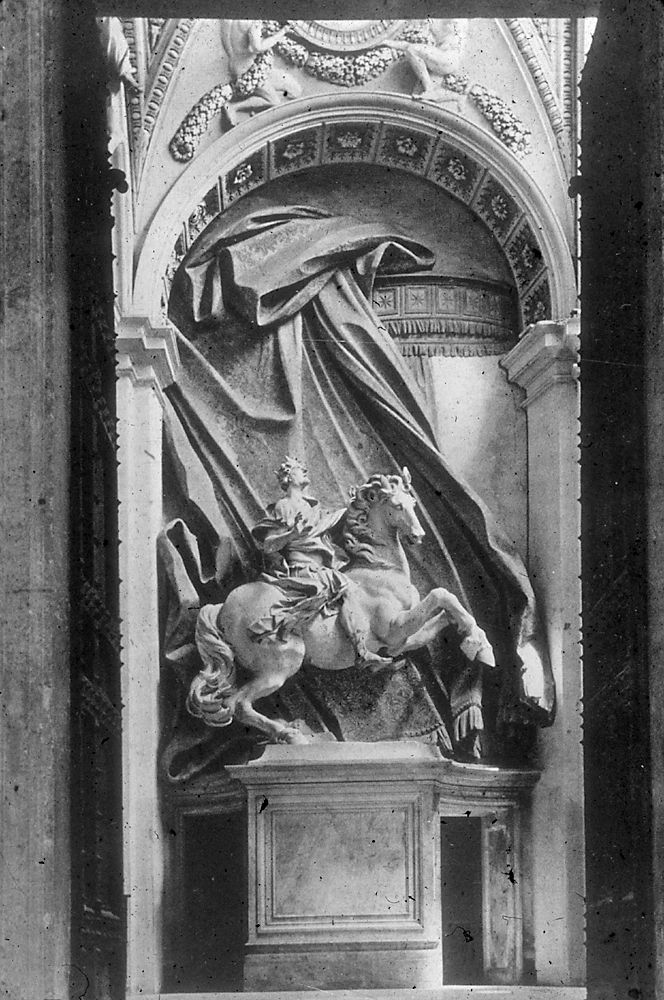
http://www.flholocaustmuseum.org/history_wing/antisemitism/roman_empire.cfm#constantine, Roman Empire, “Constantine | Image: Emperor Constantine (Vision) 1654-70, BERNINI, Gian Lorenzo, Marble Palazzi Pontifici, Vatican”:
http://www.royalcollection.org.uk/eGallery/object.asp?maker=BELLI&object=43918&row=2&detail=magnify, Model of the Arch of Constantine, 1808-15.