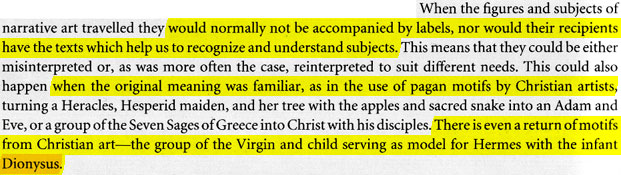
DIONYSUS WITH HALO (PAGAN ART)
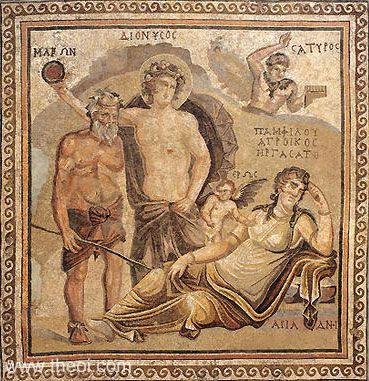
http://theoi.com/Gallery/Z12.14.html, Z12.14 DIONYSOS & ARIADNE:
Museum Collection: Miho Museum, Kyoto, Japan
Catalogue Number: N/A
Type: Floor Mosaic
Context: Probably f rom Syria
Date: C3rd -
C4th AD
Period: Imperial Roman
(With DIONYSOS Greek text in actual mosaic:)
SUMMARY
Dionysos rouses the sleeping Ariadne, who has been abandoned by Theseus on Naxos. The god is accompanied by the Seilen Maron, a Satyros (with panpipe) and winged Eros (love god).
http://www.miho.or.jp/booth/html/imgbig/00001176e.htm (via http://www.ac-nancy-metz.fr/enseign/lettres/LanguesAnciennes/Ariane/fichiers/ariane_dionysos.htm) (translated from Italian), Images of Dionysos and Ariadne in antiquity:
Roman art. Syria. Mosaïque
signée par Pamphilos : Mosaics Pamphilos signed by:
Dionysos découvrant Ariane à Naxos .Dionysus discovers Ariadne on Naxos.
352
X 357 cm.352 X
357 cm.
IIIe - IVe s.Third -
fourth century après J.-C. AD
A
gauche, Maron âgé (cf. Odyssée : prêtre de Thrace, il a donné à Ulysse
le vin qui a permis d'enivrer Polyphème), sous l'apparence de Silène (dont il
est le compagnon dans Euripide).On the left, Maron old (cf. Odyssey: priest of Thrace, he gave Ulysses the wine that
helped to intoxicate Polyphemus),
under the guise of Silenus
(which is the companion in Euripides).
Miho Museum.:
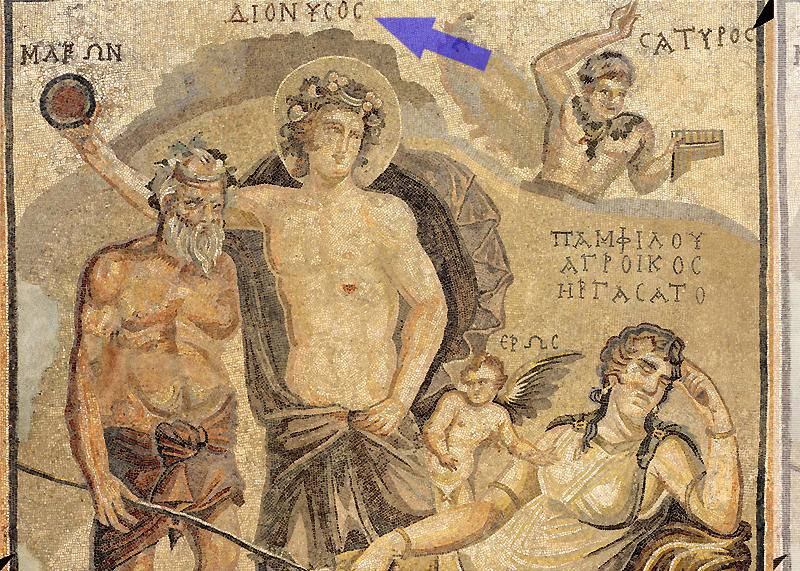
Note on Greek text:
http://www.behindthename.com/namesakes/lists/greekmyth.php, Behind the Name: the etymology and history of first names, “Characters in Greek Mythology”:
The names presented here are of course transcribed from the original Greek. There are many different methods for doing Greek transcriptions, with the result that the name you are looking for may be spelled in an unexpected way. Greek κ (kappa) may be represented by the Roman letter K or C; the Greek nominative suffix ος (omicron sigma) may be represented by OS or US. In both cases, the names here use the latter strategy, though searches for either form (eg Clitus or Kleitos) should return the same result.
Also, artist used the “lunate” sigma (transliterated as “S”), which looks like a “C”, instead of today’s “Σ”, “ς” or “σ”.
http://altreligion.about.com/library/weekly/aa052902a.htm (http://altreligion.about.com/library/graphics/savior1.jpg) & http://altreligion.about.com/library/graphics/bl_saviors.htm?once=true&, “Dionysus”:
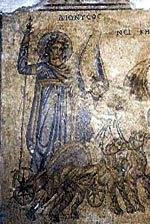
The Greek characters above the halo reads Dionysos (ΔΙΟΝΥςος).
http://www.zeugmaweb.com/zeugma/images/koleksiyon/dionysos1024.bmp (via http://www.zeugmaweb.com/zeugma/english/download.htm):
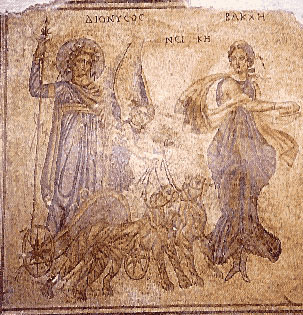
The Oxford History of Classical Art, Boardman, 1993, p. 315, “(illustration) 312”:
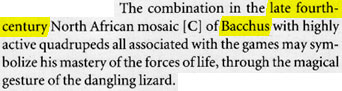
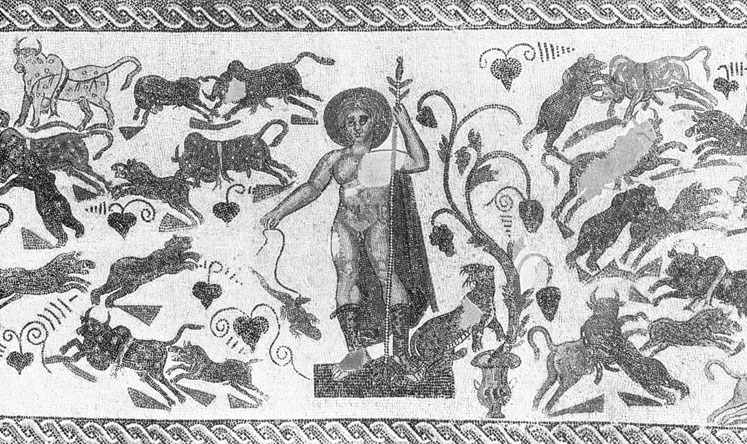
P. 316, Illustration 312-C, “Animal catalogue mosaics … ‘C’ El Djem, Tunisia":
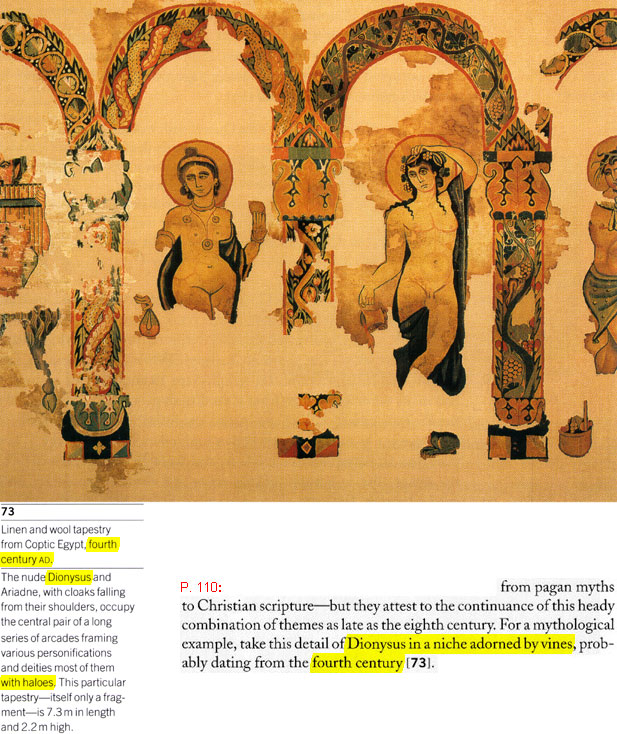
Imperial Rome and Christian Triumph, Elsner, 1998, p. 111, illustration 73:
http://altreligion.about.com/library/graphics/bl_saviors.htm?once=true&, Savior/Madonna Gallery One, “Infant Dionysuis”:
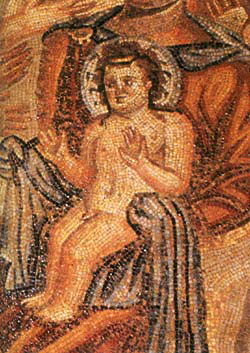
http://www.bibleorigins.net/VictoryNikeCherubimAngels.html (Bible Origins), Angel Illustrations, The Evolution of Christianty's Pictorial Representation of Cherubim and Angels From Hellenistic Roman Victory and Greek Nike Exemplars:
Of interest is the god Dionysus as a "Divine Child" with a halo about his head in a mosaic from Cyprus of the fourth century BCE (cf. fig. 27. Charles Freeman. .The Closing of the Western Mind: The Rise of Faith and the Fall of Reason. New York. Alfred A. Knopf, Publisher. 2004. ISBN 1-4000-4085-X):
http://www.bibleorigins.net/DionysusInfantHaloHermesMosaic.html (Bible Origins), DionysusInfantHaloHermesMosaic:
The below illustration is a portion of a 4th century BCE mosaic from Cyprus showing the god Dionysus as the "divine child" _with a HALO about his head_ being presented by Hermes (who has wings on his head and feet) to the Nymphs for safe-keeping. In Greek Orphic myths the infant was born of an earthly mother and of Zeus, who intended to make him a ruler of the earth. Hera (who is “the goddess of marriage”), seeking the child's life, was successful in getting the 12 Titans to murder the child and then eat him. Zeus in revenge, vaporized the Titans and from their ashes made mankind. Thus man has the divine "good" of a god in him (Dionysus) and evil body (of the Titans). (For the photo, cf. fig. 27. Charles Freeman. The Closing of the Western Mind: The Rise of Faith and the Fall of Reason. New York. Alfred A. Knopf, Publisher. 2004. ISBN 1-4000-4085-X)
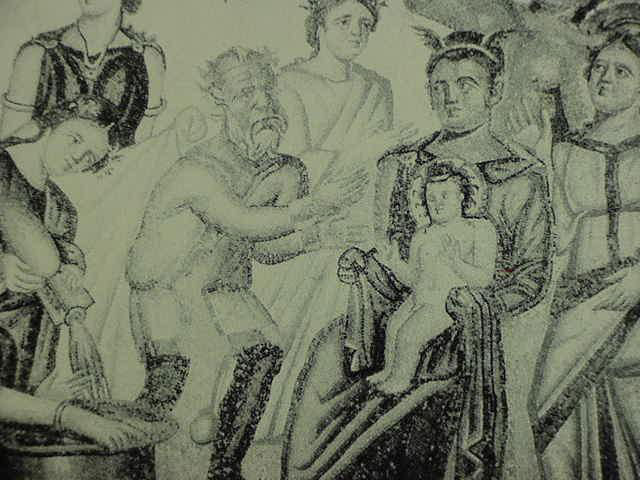
Imperial Rome and Christian Triumph, Elsner, 1998, p. 146, illustration 146:
(With DIONYSOS Greek text in actual mosaic:)
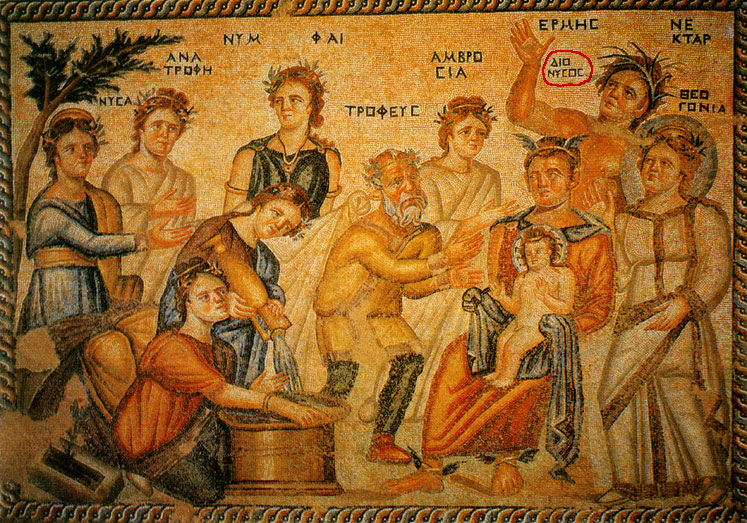
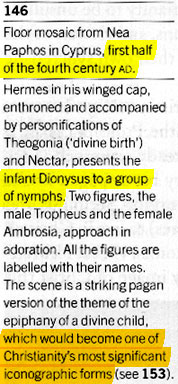
The Oxford History of Classical Art, Boardman, 1993, p. 348, “The Diffusion of Classical Art”: