APHRODITE HAD MANY LOVERS
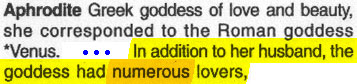
A.k.a. VENUS in Roman / Latin
Greek & Roman Mythology, Translated by Elizabeth Burr, 1994, p. 26, “Aphrodite”:
http://www.crystalinks.com/venusmyth.html, Venus Mythology:
Venus is the goddess of Love and Beauty. She along with her son Cupid (Eros) became a metaphor for sexual love. … Venus married and bore children but did not stay focused on her home affairs. In fact, she concentrated almost completely on her extramarital affairs. Her many lovers include Aries, the God of War, and the handsome Adonis.
Encyclopedia of Ancient Deities, Coulter/Turner, 2000, p. 24, “Aphrodite”:
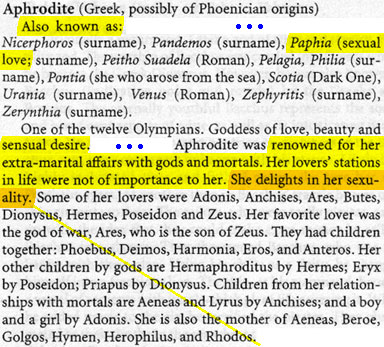
Yep, sounds like she got around. “Paphia (sexual love)” as in Paphos, the city founded by Agapenor.
http://www.geocities.com/lilith1969_my_t_fine/aphrodite.html, Aphrodite, Greek Goddess, Goddess of Love, Life and Sex:
Aphrodite
Source; Hrana Janto: The Goddess Calendar July 1993
Greek myths tell of how Aphrodite was born of sea foam. When she swam to the island of Cyprus, she was met by the Horae (other goddesses), who gave her garments befitting her beauty and grace. She was shining with divine light and when she shook the water from her hair, the droplets became pearls. This myth explains how a great Mother Goddess came to Greece. The Greeks tried to contain her vastness by labeling her Goddess of Love, Beauty and Sex, but she is also the Goddess of Life and Death. She is a virgin, in the original sense of the word (meaning "one-within-herself." [not married]) The dove that often accompanied her was a rich symbol. It was the soul, flying back to its source after death; it was sexual passion; it was peace. Aphrodite's girdle is legendary for its ability to arouse desire and create the magick of love. Of her many lovers, her favorite was handsome Adonis, whom she had to share with Persephone, Queen of the Underworld. …
APHRODITE
Stone, Merlin Ancient Mirrors of
Womanhood. Boston Beacon Press. 1990 376-377
Hellenic Greeks came to regard Aphrodite primarily as the essence of erotic love. This attitude may have developed in response to the sexual rituals, so closely associated with the Goddess as Ashtart and Ishtar in Canaan and Babylon, continuing in the Greek temples of Aphrodite, …
Aphrodite
THE FRMINIST COMPANIONTO MYTHOLOGY. edited
by Larrington, Carolyn. Hammersmith, London. Pandora Press. 1992, 68 - 69
Aphrodite was the goddess of sexual love, allegedly born from the sea-tossed genitals of the castrated Ouranos. The island of Cyprus also claimed to be her birthplace (hence she is sometimes referred to as the Cyprian), as did the island of Paphos.
The Oxford Guide to Classical Mythology in the Arts, 1300–1900s, Reid, 1993, Vol. 1, p. 159, Aphrodite:
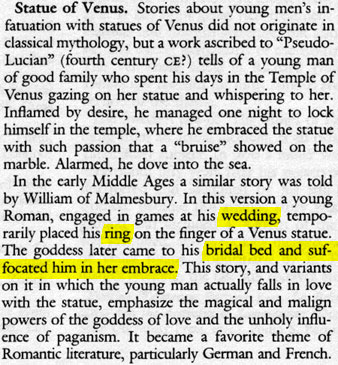
Or, the meaning of the story could be that Aphrodite didn’t like a wedding ring on her hand.
The Illustrated Who’s Who in Mythology, Senior, 1985, p. 27, “Aphrodite”:
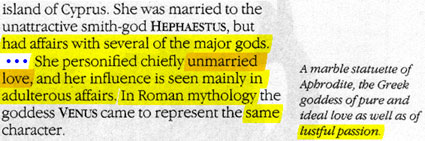
http://uploads.pacifica.edu/gems/ginetteparis/DivinitiesofMarriage.pdf; The Dallas conference on Marriage, Intimacy and Freedom. 1993: The Dallas Institute of Humanities and Culture. Ginette Paris: Divinities of Marriage:
For example, it is quite clear that Aphrodite, although married, is not a Goddess of marriage: that is Hera's domain.
http://80-www.xreferplus.com.ezproxy.jocolibrary.org/entry/772909 (subscription required), Aphrodite:
One of the twelve great Olympians, she was the giver of beauty and sexual attraction … based on the supposed derivation of her name from aphros ‘foam’, by which she emerged fully-grown from the sea at Paphos in Cyprus … Aphrodite was not a faithful wife to Hephaestus; representing sexual passion rather than the bond of marriage (which was protected by Hera), she was seen as utterly irresponsible by the earlier Greek mythology.
http://www.paleothea.com/SortaSingles/Aphrodite.html, Aphrodite: Goddess of Love, “Realm of Love”:
Originally, orgiastic tendencies were respected and revered by everyone. They were holy and sacred, and so Aphrodite's position as the Great Goddess of Love and Desire was not one to be sneezed at. Her sex-orgies were "solemn," but later were viewed by the Hellenes as "adulterous indescretions."
http://www.lunaea.com/goddess/love/aphrodite.html, Aphrodite:
All acts of love and pleasure are my rituals.
Aphrodite, the Greek Goddess of love, is one of the best-known of all Goddesses. The Golden One, she is the personification of passion, sensuality and earthly bliss. Aphrodite blesses all true lovers with beauty and grace, but she is not overly involved with fidelity or commitments. Being true to your own heart is what pleases Aphrodite, and her myths involve her with many lovers.
Technically, she would have been worshiped in any kind of sexual encounter including prostitution and marriage; but, sex outside of marriage better suited her personal character. And, Jesus should not have supported this kind of love if He was the anti-sex bigot today’s church makes Him out to be – that is, He would have done better supporting Hera, whom He said nothing of, except for her connection with the fig, which He did denounce.
http://www.pantheon.org/articles/a/aphrodite.html, Aphrodite:
In Greek mythology, Aphrodite is the goddess of love, beauty and sexual rapture. According to Hesiod, she was born when Uranus (the father of the gods) was castrated by his son Cronus. Cronus threw the severed genitals into the ocean which began to churn and foam about them. From the aphros ("sea foam") arose Aphrodite, and the sea carried her to either Cyprus or Cythera. Hence she is often referred to as Kypris and Cytherea. … Aphrodite loved and was loved by many gods and mortals. Among her mortal lovers, the most famous was perhaps Adonis. Some of her sons are Eros, Anteros, Hymenaios and Aeneas (with her Trojan lover Anchises). She is accompanied by the Graces. … Her festival is the Aphrodisiac which was celebrated in various centers of Greece and especially in Athens and Corinth. Her priestesses were not prostitutes but women who represented the goddess and sexual intercourse with them was considered just one of the methods of worship.
This castration part can be Aphrodite’s support for eunuchs, whom Jesus also supported, as eunuchs in that day were people of guaranteed effective birth control, thereby rarely marrying as they were invited to please many different women sexually. Today’s church has tried to convey that eunuchs can’t have sex, but the truth is they can; and, that fact can make all the difference in the world concerning Jesus’ teaching.
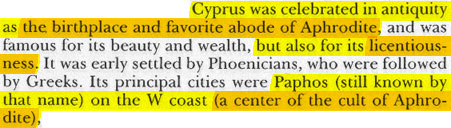
The New Century Handbook of Classical Geography, Avery, 1972, p. 109, “Cyprus”:
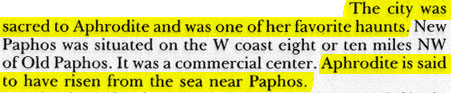
P. 247, “Paphos”:
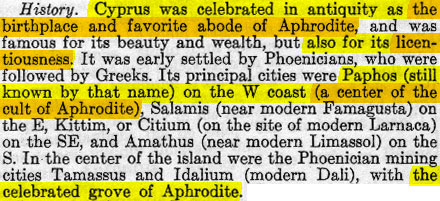
The New Century Cyclopedia of Names, Barnhart, 1954, Vol. 1, p. 1162, “Cypress | History”:
Encyclopedia of Greco-Roman Mythology, Mike Dixon-Kennedy, 1998, pp. 35-36, “Aphrodite”:
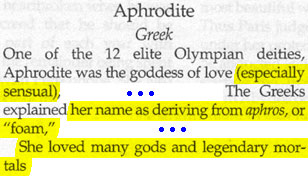
The Dictionary of World Myth, Bently, Facts On File, 1995, pp. 22-23, “Aphrodite”:
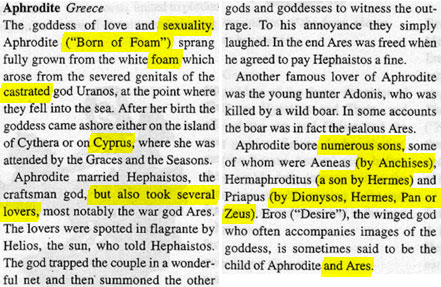
A Classical Dictionary of Greek and Roman Biography, Mythology and Geography, Smith, 1852, p. 74, “Aphrodite”:
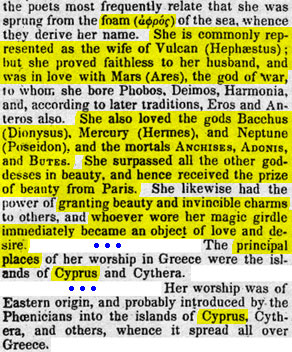
The Oxford Classical Dictionary, 1996, p. 120, “Aphrodite”:
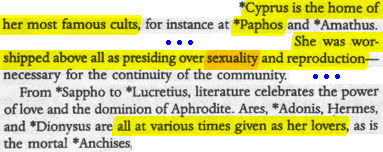
Sounds pretty sexually promiscuous to me.
http://www.arthistory.sbc.edu/imageswomen/papers/lombardiaphrodite/aphrodite.html (Sweet Briar College), Aphrodite: Her Power and Her Art, “Aphrodite's Behavior--And What it Says About Her”:
Without doubt, Aphrodite earned her reputation for frivolity and promiscuity as a result of her very liberated sexuality. However, this reputation was not so much a condemnation of her behavior as it was a fear of her uncontrollable nature.
Aphrodite was one of the most unique of the Greek deities in the freedom of her sexual life.
Sexualia: From Prehistory to Cyberspace, Bishop / Osthelder, 2001, p. 196, “The Classical World | Divine Sexuality”:
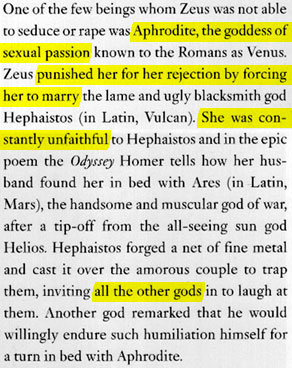
Slutty enough?
http://www.britishmuseum.co.uk/Product.aspx?ID=994 (The British Museum Store), The Story of Venus (book):
Her son Eros(Cupid), her many lovers and her amorous adventures have taken root in our collective consciousness ever since. This 'biography' of Venus is ideal reading for all who enjoy mythology and storytelling.
The Ultimate Encyclopedia of Mythology, Cotterell / Storm, 1999, p. 21, “Aphrodite”:
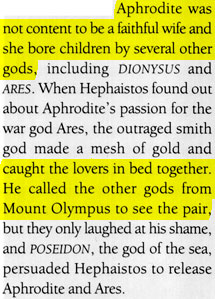
Who’s Who in Greek and Roman Mythology, Kravitz, 1976, pp. 27-28, “APHRODITE (Venus)”:
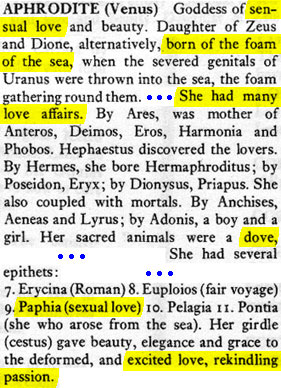
http://www.kypros.org/PIO/cyprus_today/jul_dec97/aphrodite_of_cyprus.htm (3-16-02), Aphrodite of Cyprus, Jacqueline Karageorghis:
Cyprus does not pay enough tribute to the memory of this ancient divinity, and is not sufficiently proud of having been her chosen birthplace and of sheltering her greatest sanctuary. There is no doubt that Christian moral tradition has contributed towards stifling the memory of a far too pagan cult, considered to be generating licentiousness even though Christian religion in Cyprus has sometimes adopted certain sites and aspects of ancient worship. Indeed, Aphrodite of Cyprus is not merely the blonde goddess of love, grace and beauty, who indulges in her amorous whims, as depicted in a simplistic mythology. She is and ancient-old divinity whose origins are linked to the worshipping of the powers of life. … Tradition says that the goddess was born from the foam of the sea and was carried by the sea waves on the coasts of Cyprus, to Paphos, which has become the sacred place where Aphrodite was venerated. … The link between Aphrodite and Paphos was, however, well established among the Ancients. Cyprus and in particular Paphos, is the birthplace of Aphrodite, writes Aeschylus (quoted by Strabon). Pomponius Mela, a Latin poet of the 1st century A.D. mentions Paphos as the place where the goddess was said to have touched ground: Paphos and Palaepaphos, where Venus emerged for the first time from the sea, as its inhabitants confirm it (II, 7). Nonnos, a poet of the 5th century A.D. mentions that the inhabitants of Cyprus still show traces of Aphrodite’s footprints. The mythical place where she was said to have come ashore is called “Petra tou Romiou” or the “Rock of the Greek”, associated by popular tradition to Dighenis Akritas, the legendary hero of the Byzantine era in Cyprus. The site is certainly of sublime beauty, with three large rocks protruding above the water in a small bay lined on the east by white cliffs. The question that arises is: why precisely in this spot? Several explanations have been put forward, some more convincing than others: the sea is more foamy at this spot. When there is a storm, the waves strike the beach and -break’ into foam; in exceptional cases the “breaker” shoots up in a column like a water-spout and falls back in an outward cascade of foam in which one can imagine seeing a human figure rising from the sea (a phenomenon described by J.L. Myres in BSA, 41, p. 99). … British excavations in 1888 and then systematic excavations carried out by a Swiss-German mission from 1973 to 1979 have brought to light the ruins of the temple of Aphrodite in Palaepaphos, the most ancient vestiges of which dating back to the 12th century B.C.; … the construction of the enclosure wall out of enormous blocks is characteristic of the architectural style imported in the island by the Achaeans who are said to have arrived and settled in Cyprus in the 12th century B.C. … Pausanias says that Agapenor, king of the Arcadians, returning from Troy, reached the shores of Cyprus and founded the city of Paphos and the sanctuary of Aphrodite. … Homer in his epics and Hymns resumes undoubtedly ancient traditions, going back probably to the end of the Bronze Age, and describes in numerous passages the arrival of Aphrodite at her Sanctuary in Paphos, where she used to come to be bathed and dressed by the sacred servants called the Hours or the Charites. … According to mythology, Aphrodite had numerous love affairs, most of them in Cyprus. We know that she was the object of desire of all the gods and married the ugliest of all, Hephaistos, the smith-god. (She even supports my non-“looks discrimination” rule.)
Myths and Legends of the World, Wickersham, 2000, Vol. 1, pp. 49-50, “Aphrodite”:
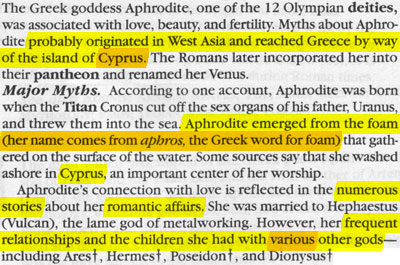
You see, pagan deities were the language of Jesus’ day. Therefore, their attributes are the definitions of the words.
http://community-2.webtv.net/Ace-Detective/Venus/, Venus: The Goddess of Sex & Love:
NAME: Venus. (Greek) Aphrodite which means Foam Born. …
MAJOR TABOOS: Celibacy (modern non-sex sense). While in one of her forms she protected women who wished to remain chase. She also often dealt harshly with those who rejected sex or love in their life. …
she is born from the sea-foam that formed around the divine naughty bits. …
As the Goddess of sexual passion & love the immaterial girl was naturally noted for her many lovers both among the gods and with mortals.
SparkCharts: Greek and Roman Mythology, 2002, “The Pantheon of Olympus | Aphrodite”:
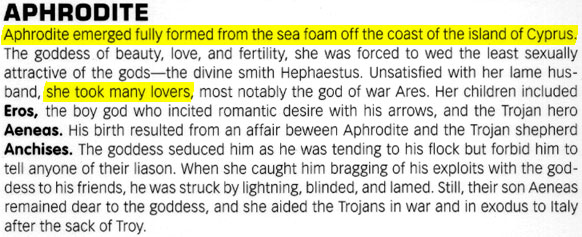
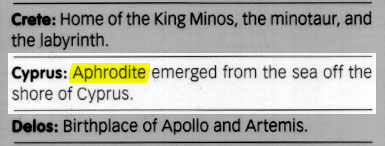
“Ancient Places | Cyprus”:
http://aphroditesdelight.com/, Aphrodite’s Delight:
Legend has it that it was with these natural spring waters that Aphrodite ( Goddess of love) skilfully created a most enticing dessert which she shared with her many lovers, for , it seemed to posses wonderful powers of enchantment.
Namesakes: An Entertaining Guide to the Origins of More Than 300 Words Named for People, Tuleja, 1987, p. 7, “Aphrodisiac”:
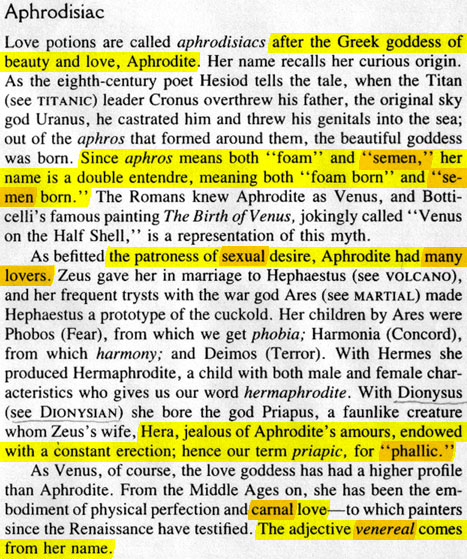
Hera was the goddess of marriage, and a “phallic” is a penis.
http://www.in2greece.com/english/historymyth/mythology/names/aphrodite.htm, Aphrodite (foam-risen):
… she was born by the sea-foam, which is also the meaning of her name. … After she was born, she is said to have stepped up on a beach on Cyprus. … Her animal was the dove … Aphrodite was married to the ugliest god, the fire-god and black-smith Hephaestus, but she had many lovers, among them Ares and Adonis. With Ares she had the daughter Harmonia. With Hermes she had Hermafroditus who was half man, half woman. With Dionysos she had the ugly, but popular Priapos.
Cassell’s Dictionary of Classical Mythology, Jenny March, 2001, pp. 106-110, “Aphrodite”:
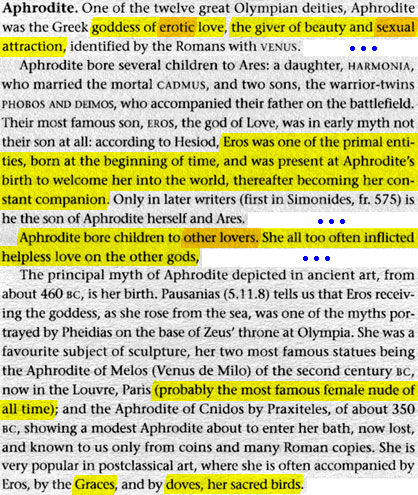
Simonides, Greek poet, c. 556-469 BC.
http://www.flyfishinghistory.com/atraeus_myths.htm, Myths and Macedonia:
But because Eos slept with Ares, Aphrodite turned her into a nymphomaniac. There were much worse curses, and Eos seems to have a reasonably good time after this; among her many lovers were Tithonus, Cephalus and Orion.
The New American Desk Encyclopedia, 1997, p. 76, “APHRODITE”:
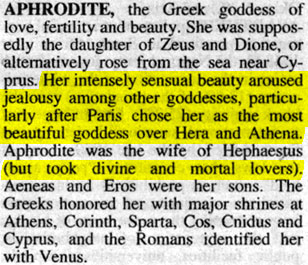
Sexualia: From Prehistory to Cyberspace, Bishop / Osthelder, 2001, p. 196, “The Classical World | Divine Sexuality”:
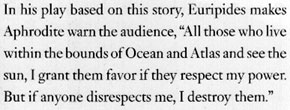
Regarding the superior power of promiscuous sex… the goddess has spoken – heed her advice.
Adonis (“Lord”):
http://www.ucd.ie/classics/97/Dauphin97.html (University College Dublin, Ireland), Carpets of Stone: The Graeco-Roman Legacy in the Levant, “Classical themes in some Byzantine mosaics of the Levant”:
For all that Christianity had been the State religion of the Byzantine Empire since AD 392, Byzantine culture remained fundamentally classical in spirit. The mosaicists of the Justinianic Renaissance drew much of their inspiration from Greek mythology and Roman daily life. The excavation in 1982-5 of a mid-sixth century hall under the atrium and narthex of the Church of the Virgin at Madaba, disclosed three remarkable panels framed by an inhabited acanthus scroll. The upper panel showed Aphrodite and Adonis, the three Graces (each named as Charis), four Erotes and a peasant-woman (Agroikis).
http://www.traveladventures.org/continents/asia/archaeologicalpark02.shtml, Afrodite and Adonis mosaic, Madaba in Jordan:
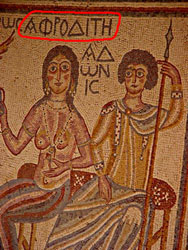
http://www.themystica.org/mythical-folk/articles/aphrodite.html, Aphrodite:
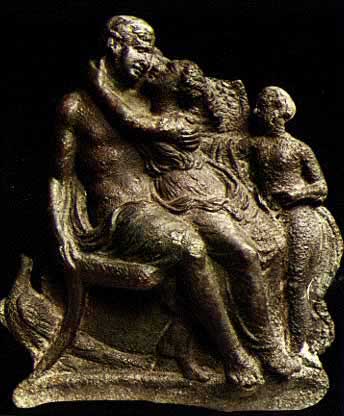
Being the goddess of love, myth would have it that Aphrodite took many lovers. From her Oriental period Aphrodite's most beloved the Syrian god Adonis, who was adopted by Greek mythology.
http://web.uvic.ca/grs/bowman/myth/images/haifa/h95.jpg (via http://web.uvic.ca/grs/bowman/myth/gods/aphrodite_i.html), Aphrodite and Adonis: Bronze mirror cover, ca 4th century BC:
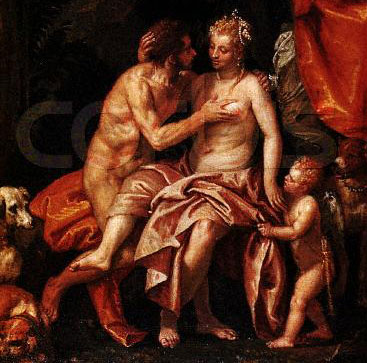
http://pro.corbis.com/, Search # BE007385, Venus and Adonis by Veronese:
http://www.cyber-christians.com/articles/24/greek-god-names.html, greek god names:
Adonis: Greek God of Vegetation. Consort to Aphrodite.
http://www.meta-religion.com/Spiritualism/Wicca/goddesses_and_gods.htm, Goddesses And Gods, “Gods”:
Adonis: Greek; consort of Aphrodite. Also another name for "Lord." In Phoenician his counterpart is Astarte. A vegetation God.
http://www.pantheon.org/articles/a/adonis.html, Adonis:
The name "Adonis" is a variation of the Semitic word "Adonai", which means "lord", and which is also one of the names used to refer to YHWH in the Old Testament.
http://www.themystica.org/mythical-folk/articles/adonis.html, Adonis:
Adonis is derived from the Canaanite title, adon, meaning lord, or the Phoenician term, adoni, my lord.
http://www.choronzon.com/tocmirror/tzimon/Magidict/magdic2.html, “ADONAI”:
(Greek Adonis). Hebrew for "Lord"
http://www.bartleby.com/61/55/A0095500.html, “Adonai”:
|
NOUN: |
Lord. Used in Judaism as a spoken substitute for the ineffable name of God. |
|
ETYMOLOGY: |
Hebrew ’ |
 dôn
dôn y, my lord : ’
http://www.icgatlanta.org/sn6.htm, Sacred Names 6, “Concerning the Preference for the Hebrew Names and Titles of God”:
One might also compare the Hebrew word Adonai, which means Lord, to the name of the Greek god Adonis, a god apparently adopted into their worship from the Phoenicians. Adonis is the equivalent of Tammuz, according to Hislop (THE TWO BABYLONS, p. 314). The name Adonis also means lord, and it is derived from the Phoenician word adon (CHIRON, p. 6); a word which the Phoenicians had in common with the Hebrews. Note that Sarah called Abraham "lord" (Genesis 18: 12), which in the Hebrew is "adon" (STRONG’S, #113).
Any jurors want to announce a conviction yet?