APHRODITE: THE GODDESS OF “AGAPE”
(Monolingual Greek)
Aphrodite (Greek: Αφροδίτη)
Agape (Greek: αγαπ…)
Sexual Aphrodite is the goddess of “agape”:
http://www.onassis.gr/greek/assoc/enim_deltio/22_03/p20.html, ΑΩ | ΕΝΗΜΕΡΩΤΙΚΟ ΔΕΛΤΙΟ | ΣΥΝΔΕΣΜΟΣ ΥΠΟΤΡΟΦΩΝ ΚΟΙΝΩΦΕΛΟΥΣ ΙΔΡΥΜΑΤΟΣ ΑΛΕΞΑΝΔΡΟΣ Σ. ΩΝΑΣΗΣ (ΑΩ | INFORMATIVE BULLETIN | CONTACT of SCHOLARS of INSTITUTION BENEFICIAL TO THE PUBLIC ALEXANDROS S. ONASIS):
Οι περισσότεροι αρχαιολόγοι συμφωνούν ότι η θεότητα Αφροδίτη πρωτοεμφανίστηκε ως Ιστάρ, θεά της σεξουαλικότητας από την Μεσοποταμία. Ο μύθος της σταδιακά ύφανε τον δρόμο του προς τα δυτικά, τη Συρία και την Παλαιστίνη, όπου ήταν γνωστή ως Αστάρτη, και στην Κύπρο, όπου απέκτησε τα χαρακτηριστικά της θεάς της Αγάπης. Στην Ελληνική μυθολογία, η Κύπρος θεωρείται ως η γενέτειρα της Αφροδίτης –στα ποιήματα του Ομήρου αναφέρεται ως «η κυρία της Κύπρου».
Translated from Greek:
Most archaeologists agree that the goddess Aphrodite originated as Istar, goddess of sexuality from Mesopotamia. The myth of gradually wove its way to the west, Syria and Palestine, which was known as Astarte, and in Cyprus, where it acquired the characteristics of the Goddess of Agape. In Greek mythology, Cyprus is regarded as the birthplace of Aphrodite – the poems of Homer referred to her as “the lady of Cyprus.”
http://www.coinsmania.gr/cm/ancient/roman_coins/part10.htm, Θεοι και θεές (Gods and goddesses):
Αφροδίτη : Αφροδίτη, θεά της αγάπης.
Translated from Greek:
Aphrodite : Aphrodite, goddess of agape.
http://www.gnosi.gr/Project%202002/PROJECTS%202002/Basta%20Eleni.htm, Η γλώσσα των λουλουδιών (The language of flowers):
Αυτή μια μέρα βρήκε το άψυχο σώμα μιας νύμφης στο δάσος και το μεταμόρφωσε σε λουλούδι. Κάλεσε τότε την Αφροδίτη τη θεά της αγάπης και το Διονύσιο το θεό του κρασιού.
Translated from Greek:
This one day he found the lifeless body of a nymph in the forest and this transformed into a flower. It called then Aphrodite the goddess of agape and the Dionysus the god of wine.
7-21-09: I phrase searched "Αφροδίτη τη θεά της αγάπης" in Google and it returned “about 5,610” hit results.
http://www.typos.com.cy/nqcontent.cfm?a_id=6335 (The online newspaper of Cyprus), Η ονομασία της Κύπρου (Μέρος 2ο) (The name of Cyprus [Part 2]):
Πρόσφατα, ανακαλύφθηκε μια ουμβρική επιγραφή που γράφει στη γενική cubrarmatris (αγαπητή μητέρα), κάνοντάς μας να εξάγουμε το συμπέρασμα ότι το Κύπρα είναι επίθετο και σημαίνει αγαπητή· η ετυμολογική της συγγένεια με το λατινικό cupio (αγαπώ, επιθυμώ, ποθώ) και το cupido (έρωτας), μας επιβεβαιώνουν ότι από το Κύπρα έχουμε το επίθετο Κυπρίς (θεά της Αγάπης), επίθετο που αποδίδεται στην Αφροδίτη. Μιας και σχετίζεται άμεσα με το νησί μας, μπορούμε να δεχθούμε τη σχέση Κύπρα > Κυπρίς > Κύπρος και να ερμηνεύσουμε ότι το Κύπρος μπορεί να σημαίνει «Αγαπητό Νησί» ή «Νήσος της Αγάπης».
Translated from Greek:
Recently, we discovered an oumbrikee (ancient dialect of northern Italy) inscription, which reads in the general cubrar matris (agape mother), making us to conclude that Cypra (Cyprus) is the epithet / surname and means agape: the etymological kinship with the Latin cupio (Cupid) (I agape, I desire, I long for / I yearn after) and the cupido (Cupid) (eros / erotic), to us confirms that from Cypra (Cyprus) we have the epithet / surname Kypris (goddess of Agape), epithet / surname that is attributed to Aphrodite. Once directly related to our island, we can accept the relationship Cypra (Cyprus) > Kypris > Cyprus and we see / interpret that Cyprus could mean “Agape Island” or “Island of Agape.”
http://www.cc.uoa.gr/ptde/epet/Book/b9420.html, Αναλυτική παρουσίαση βιβλίου (Analytic presentation of book), “Περίληψη” (“Summary”):
Σ' αυτό το βιβλίο διαβάζουμε για μερικούς από τους θεούς που οι αρχαίοι Έλληνες πίστευαν ότι κατοικούσαν στον Όλυμπο: για την Ήρα, τη γυναίκα του Δία, που τον ζήλευε για τα καμώματά του, για τον τεχνίτη Ήφαιστο, το θεό της φωτιάς, για την Αφροδίτη, τη θεά της αγάπης και της ομορφιάς και τέλος για τον Άρη, το θεό του πολέμου.
Translated from Greek:
In this book we read certain gods, believed by the ancient Greeks, lived on Olympus: Hera, wife of Zeus, jealous for his affectation; for the craftsman Hephaestus, the god of fire; for the Aphrodite, the goddess of agape and beauty; and finally for Mars, the god of war.
http://www.athensinfoguide.com/gr/historymythologyolympians.htm (Athens Info Guide), Οι Ολύμπιοι (The Olympians), (in list of deities) “ΑΦΡΟΔΙΤΗ” (“APHRODITE”):
|
ΑΦΡΟΔΙΤΗ |
αγάπη, σεξ |
Translated from Greek:
|
APHRODITE |
agape, sex |
… Οι Δώδεκα Ολύμπιοι (The twelve Olympians), “Αφροδίτη” (“Aphrodite”):
Αφροδίτη: Η Αφροδίτη είναι η θεά της αγάπης. Είναι η προστάτιδα θεά των ιερόδουλων.
Translated from Greek:
Aphrodite: Aphrodite is the goddess of agape. Being the guardian goddess of prostitutes.
I thing that “prostitution” became one of the “branches” of Aphrodite’s sexual love, not that Aphrodite’s sexual love first was an attribute of prostitution, simply because all of Aphrodite’s love affairs were of “free” love, not of material gain.
http://horoscopes.pathfinder.gr/index.php?hor=6§ion=5 (Pathfinder Horoscopes), Ερωτοσκόπιο για τον Ζυγό:
Παρ' όλα αυτά, με την Αφροδίτη, τη θεά της αγάπης, σαν κυβερνήτη του Ζωδίου σας, θα πρέπει να θεωρείστε ευλογημένος. Η αγάπη κατά κανόνα έρχεται προς το μέρος σας επανελλημμένως.
Translated from Greek:
Nevertheless, with Aphrodite, the goddess of agape, as captain of the Sign of the Zodiac, you need to be considered blessed. The agape typically comes toward you repeatedly.
All I can say is if God meant agape to not include sexual love then He made a major goof.
http://arcadia.ceid.upatras.gr/arkadia/arcadia-hist/topics/istories_asterismon.html, Ιστορίες των Αστερισμών του Ζωδιακού Κύκλου, Βασ. Ν. Ζαφειρόπουλος, Επικ. Καθηγητής Τμήματος Φυσικής, Πανεπιστημίου Πατρών; Από το υπό Έκδοση Βιβλίο: "ΓΝΩΡΙΜΙΑ ΜΕ ΤΟΝ ΟΥΡΑΝΟ" (Histories of Constellations of the Zodiac Cycle, Vas. N. Zafiropoulos, Assist. Professor, Department of Physics, University of Patras; From the Publication Book: "ACQUAINTANCE WITH THE SKY"), “Ιχθείς” (“Pisces”):
Στους διάφορους χάρτες του ουρανού ο αστερισμός αυτός αντιπροσωπεύεται από δύο ψάρια, των οποίων οι ουρές είναι δεμένες με ένα σχοινί. Σύμφωνα με την Ελληνική μυθολογία τα δύο ψάρια παριστάνουν την Αφροδίτη, την θεά της αγάπης και τον φτερωτό γιό της τον Έρωτα. Κατά την διάρκεια της Γιγαντομαχίας μαζί με τους άλλους θεούς, εγκατέλειψαν και αυτοί τον Όλυμπο.
Translated from Greek:
In various maps of the sky this constellation is represented by two fish whose tails are tied with a rope. According to Greek mythology, the two fish depict Aphrodite, the goddess of agape and her winged son Eros. During the War of giants with the other gods, they left Mount Olympus.
Eros and Aphrodite were both the “personifications” of agape.
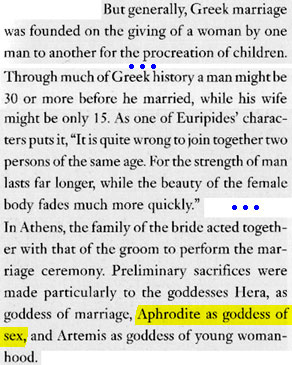
Sexualia: From Prehistory to Cyberspace, Bishop / Osthelder, 2001, p. 199, “Greek Marriage and the State”:
Looks discrimination:
Again, Aphrodite is the goddess of sexual love and beauty. So, let’s give her a try:
John 13:34-35:
34A new commandment I give to you, that you see sexual beauty in one another; as I have seen sexual beauty in you, that you also see sexual beauty in one another. 35By this all will know that you are My disciples, if you see sexual beauty in one another."
Sounds pretty diverse in sexual attraction to me; thereby eliminating the unfairness and prejudice of looks discrimination. Isn’t that the way Jesus would want it? I wouldn’t have to interview too many “ugly” people to find them agreeing with me.
Matthew 5:28-29 states that one is to not “lust,” meaning a strong, intense sexual desire or longing; but, logic dictates that it is what one does in a monogamous based society, gaming for the more “attractive” for a wife, etc. “Seeing sexual beauty in one another” lessens the “intensity” for just one and shares its love power with the entire community. Beneficially, it creates a better subconscious tangible “value” for everyone more equally and more fairly, lessening animosities, wars, etc. Today, when one angers another (either justly or unjustly), down deep the other tends to hate or dislike that individual for (basically) life. Jesus additionally states a harsh “pluck [your eye] out and cast it from you” for those who more sexually desire the “attractive” (as “ugly” people don’t invite “lust”). Well, I thank Jesus for the overwhelming support which I do need on this subject, but I think I can explain the pitfalls of looks-discrimination without having to pluck the eyes out. But, today’s clerics should cut out their tongues before they verbally oppose my most fitting logic.
“I don’t want her, you can have her: She’s too fat for me.” –Arthur Godfrey, 1947.
I’ll tell you another pitfall about desiring the more attractive: Most attractive women I’ve met “think” they’re very intelligent simply because no one tells them when they’re wrong. And, what can drive a man crazy is when he’s having a relationship with an attractive woman who lacks intelligence, where he has to constantly live out their dumb ideals and suggestions, or risk losing them. So, in a true Jesus based society, the truth can become more known. It’s really so bad today (more so pre-1970s: pre-women’s lib) that women have gained a firm reputation of not being very rational and logical, but they all have the same mental capabilities of men.