AGAPENOR / PAPHOS, CYPRUS
“Agapenor” one of the commanders during the Trojan War (12th or 13th century BC), later established Aphrodite (and founded the city of Paphos) on Cyprus, is possibly the root etymology of “agape”
Agapenor (Greek: Αγαπήνωρ)
Aphrodite (Greek: Αφροδίτη)
The Greek word agape may have derived from the Greek leader Agapenor who was a king who had very strong ties with the birth of Aphrodite, the goddess of agape love, and with the building of a very early and very famous temple dedicated to her at the city of Paphos on the island of Cyprus, at which nearby is the origin point of her birth. Since I cannot find anything that directly asserts this coinage, this is therefore my own finding. It is very likely that modern day Christian scholars have seen this obvious correlation, but decided to ignore it because of the strong sexual characteristics of Aphrodite’s (aphrodisiac) love. In fact, many Christian-published books, ludicrously, stating that the word “agape” was invented by the writers of the New Testament, so to support whatever modern Christian doctrine they want it to mean (to get the sex out of it). But, the obvious correlation rests with the fact that “agape” is the main shortened part of Agapenor’s name and that Aphrodite is the (female) personification of the same: “love.” I think it is more likely that “agape” simply became short for Agapenor because of his strong connection to Aphrodite’s “love,” instead of Agapenor being named after “agape,” then by coincidence bearing the legend of Aphrodite and a very large temple to her dedication. But, either way, the connection remains.
Today’s etymology consensus:
The New International Dictionary of New Testament Theology, Brown, Zondervan Publishing, 1976, vol. 2, p. 539, “Love | αγαπάω”:

http://www.etymonline.com/index.php?search=agape&searchmode=none, Online Etymology Dictionary:
agape
1607, from Gk. agapan "greet with affection, love" (used by early Christians for their "love feast" held in connection with the Lord's Supper), from agapan "to love," of unknown origin. In modern use, often in simpler sense of "Christian love" (1856, frequently opposed to eros as "carnal or sensual love").
AGAPENOR:
Crowell’s Handbook of Classical Mythology, Tripp, 1970, p. 29, “Agapenor”:
http://homepage.mac.com/cparada/GML/ACHAEANLEADERS.html, Greek Mythology Link: Achaean Leaders, “Agapenor”:
Agapenor. King of the Arcadians. Agapenor was one of the SUITORS OF HELEN, and he is counted among those who hid inside the WOODEN HORSE. After the war he founded Paphos in Cyprus. Agapenor was son of Ancaeus 1 and Iotis. Ancaeus 1, one of the ARGONAUTS, was son of King Lycurgus 2 of Arcadia, son of Aleus, son of Aphidas 1, son of Arcas 1, son of Zeus and Callisto [Apd.3.10.8; Hom.Il.2.609; Pau.8.5.2; QS.12.314ff.].
Who’s Who in Classical Mythology, Grant/Hazel, 1973, p. 17, “Agapenor”:
The Oxford Companion to Classical Literature, 1989, p. 16, “Agapē'nor”:
Gods and Mortals in Classical Mythology, Grant / Hazel, 1973, p. 31, “Agapenor”:
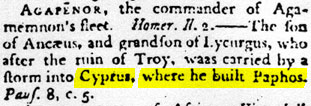
Bibliotheca Classica; or, A Classical Dictionary, containing A full Account of all the Proper Names, Lemprière, 1788, (no page numbers), “Agapēnor”:
Lempriere’s Classical Dictionary, 1898, p. 21, “Agapēnor”:
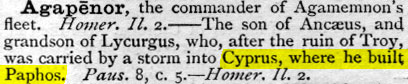
He built a prominent temple to Aphrodite:
Encyclopedia of Greece and the Hellenic Tradition, Speake, 2000, Vol. 2, pp. 1252-1253, “Paphos: City in Cyprus”:
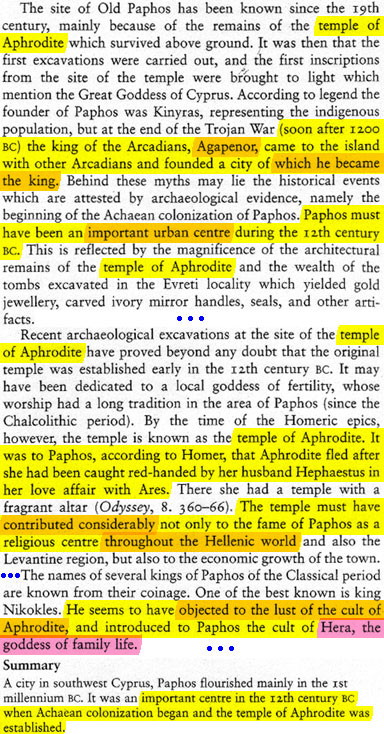
Hera was “the goddess of marriage.” This indicates that Aphrodite’s “love” was in contrast with the marriage and family standard.
http://149.144.201.234/~myths/islands.html (3-16-02), Classical Mythology: Islands, “Cyprus”:
Cyprus was one of principal cult centers of Aphrodite. … Two Greek leaders, who had fought at Troy, migrated to Cyprus founding cities. Agapenor, king of Arcadia, founded the city called Paphos. While Teucer, son of Telamon, king of Salamis, and Hesione, founded the city, which he named after his home, Salamis.
http://www.cyprusculture.com/product.asp?sku=463, Guide to Palaipaphos (Kouklia):
The Paphian Sanctuary of Aphrodite was one of the most famous of shrines of the goddess in Antiquity, renowned throughout the Greek and Roman world.
The Oxford Companion to Classical Civilization, 1998, p. 49, “Aphrodite”:

A Dictionary of Greek and Roman Biography and Mythology, Smith, 1967, Vol. 1, p. 59, “AGAPE'NOR (’Αγαπήνωρ)”:
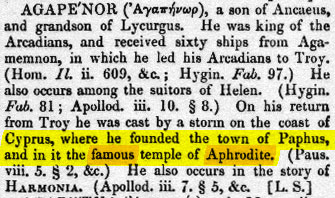
A Classical Dictionary: Containing an Account of the Principal Proper Names Mentioned in Ancient Authors, Anthon, 1855, p. 156, “Aphrodisĭa”:

The Oxford Classical Dictionary, 1949, p. 20, “AGAPENOR (’Αγαπήνωρ)”:
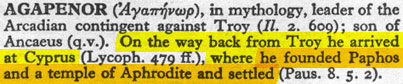
The Rise of the Greeks, Michael Grant, 1987, p. 205, “2 Cyprus: Salamis, Paphos”:
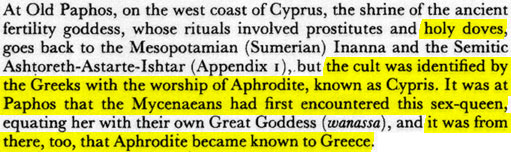
Benét’s Reader’s Encyclopedia, 1996, p. 42, “Aphrodite”:

The Greek Anthology and Other Ancient Greek Epigrams, 1973, p. 413:

A Classical Dictionary of Greek and Roman Biography, Mythology and Geography, Smith, 1852, p. 29, “Agapēnor (’Αγαπήνωρ)”:
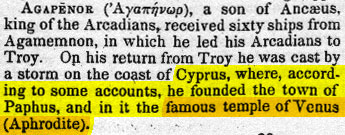
A Classical Dictionary of Greek and Roman Biography, Mythology and Geography, Smith, 1894, p. 34, “Agapēnor (’Αγαπήνωρ)”:
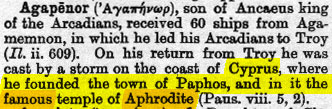
The New Century Classical Handbook, Avery, 1962, p. 46, “Agapenor”:
http://www.villamiretta.com/cy-cyprusholidays/history/index.htm, Cyprus History, “2300-1250 BC - Bronze Age”:
1200 BC ONWARDS: Large Aphrodite cult in Palea Pafos (Old Paphos).
http://www.perseus.tufts.edu/cgi-bin/ptext?lookup=Paus%2e+8%2e5%2e2, Pausanias, Description of Greece, Book 8: Arcadia, Chapter 5.2 (1183 BC):
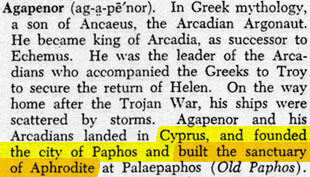
Agapenor, the son of Ancaeus, the son of Lycurgus, who was king after Echemus, led the Arcadians to Troy. After the capture of Troy the storm that overtook the Greeks on their return home carried Agapenor and the Arcadian fleet to Cyprus, and so Agapenor became the founder of Paphos, and built the sanctuary of Aphrodite at Palaepaphos (Old Paphos).
Greek & Roman Mythology, Translated by Elizabeth Burr, 1994, p. 11, “Agapenor”:

Who’s Who in Greek and Roman Mythology, Kravitz, 1976, p. 12, “AGAPENOR”:
http://pythagoras.perseus.tufts.edu/svn/repository/1999.01.0022.xml, Library and Eptiome (Apollodorus Library, Part 37):
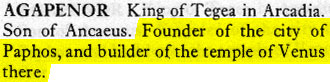
Agapenor founded Paphos and built the sanctuary of Aphrodite at Old Paphos.
http://www.pio.gov.cy/cyprus_today/jul_dec97/aphrodite_sanctuary.htm (3-16-02), The Sanctuary of Aphrodite:
According to Pausanias, Aphrodite’s temple was built by Agapenor, the Arcadian king of Tegea and hero of the Trogan war.
Reader’s Digest Illustrated Reverse Dictionary, 1990, p. 28, “Aphrodite”:

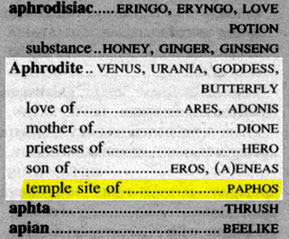
The New Comprehensive A-Z Crossword Dictionary, Schaffer, 1995, p. 47, “Aphrodite”:
http://www.hist.uzh.ch/ag/paphos/project/aphrodite/start.html, Aphrodite at Paphos: The History of the Sanctuary (Site TA)
The continuity of cult in the sanctuary has been definitely established for more than 1500 years, from the Late Bronze Age (c.1200 BC) to the end of the 4th century AD (when the Christian Emperor Theodosius outlawed paganism). …
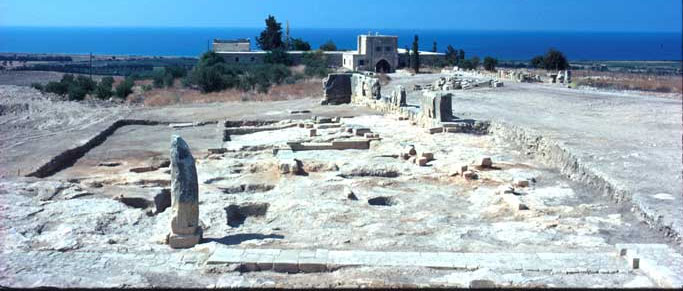
1. Sanctuary of Aphrodite and the Royal Manor House from the air:
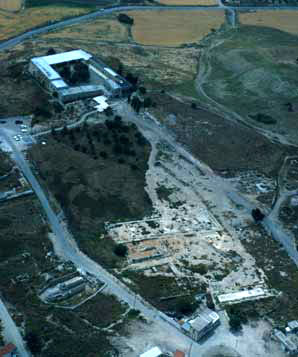
5. Remains of the Late Bronze Age Sanctuary:
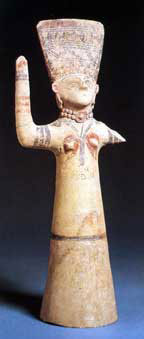
7. Archaic Terracotta figurine of the goddess with uplifted arms:
Moreover, it’s the “birthplace” of Aphrodite:
The Oxford Companion to Classical Literature, 1989, p. 408, “Paphos”:
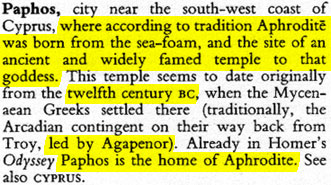
P. 165, “Cyprus”:
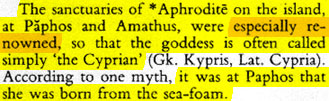
P. 43, “Aphrodite”:
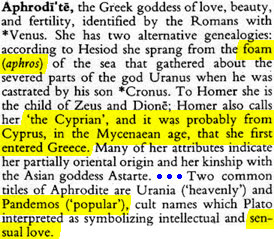
http://websrv5.sdu.dk/tonnes/paphos.htm, The Foundation of Nea Paphos:
Without doubt, the most famous of all the myths set in Cyprus was the tale of how the goddess Aphrodite was born from the sea, on the coast a short distance from the city of Palaipaphos. Old Paphos, Palaipaphos, was the original capital of the Paphian kingdom. According to legend, it was founded by Agapenor, son of Ankaios, from the Arkadian city of Tegea. He, too, fought at Troy (as one of those who had courted Helena, he was obliged to do so). In the Catalogue of Ships, he is named as a leader of the Arcadians, commanding a force of sixty ships.5 Later, he founded the kingdom of Paphos and, according to Pausanias,6 built the sanctuary of Aphrodite in the city of Palaipaphos. It is interesting to note that there was a temple of the Paphian Aphrodite in Tegea: this could indicate a historical connection between Agapenor, Paphos and Arcadia. …
5. Iliad, 2.609.
6. 8.5.2; also Strabo, 14.6.3.
http://www.agapinorhotel.com.cy/english.html, Agapinor Hotel (Paphos, Cyprus):
Paphos town lies on the attractive South West Coast of the island, just eleven kilometers from the new international airport. Sheltered from the North by the spectacular Troodos Mountains it is the legendary birthplace of Aphrodite, Goddess of love and beauty. The attractive harbor and sea front is ringed by tavernas and small restaurants and many bars and discos await the more adventurous.
http://www.agapinorhotel.com.cy/index.html, Agapinor Hotel:
The Ultimate Encyclopedia of Mythology, Cotterell / Storm, 1999, p. 21, “Aphrodite”:
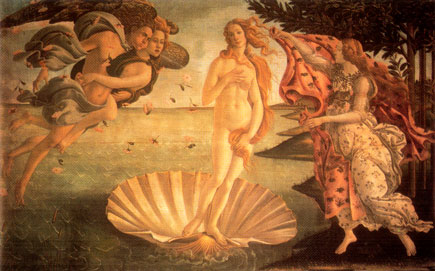
http://opera.prohosting.com/sarir/venus.html, Venus.Zodiac Signs of Apocalypse Horoscope:
She was born when Gaia, Goddess of Mother Earth, got so angry at her husband Uranus that she sliced off his genitals and threw them into the sea. They mixed with the foam of the ocean and formed Venus, a symbol unconcerned with maternal issues and focused on sensuality and pleasure.
Eros: The God of Love in Legend and Art, Irene Korn, 1999, p. 15, “The Birth of Venus”:

http://www.ranone.com/whatsnew_ranone/ONEderings.asp, “Cyprus -- The Island of legends”:
It’s even said that the goddess Aphrodite made her home on Cyprus, and for thousands of years travelers have come here to pay her tribute. … In the afternoon, stop at Petra tou Romiou, the boulder where according to legend Aphrodite rose from the sea. This will prepare you for two nights in Pafos. You might stop at Kouklia/Palea Pafos, the antecedent to present-day Pafos.
http://www.pedagogtreff.com/gdok/obus/Kypros/kyp9.htm, Pafos, “Afroditeklippen” (Petra tou Romiou: Birthplace of Aphrodite):
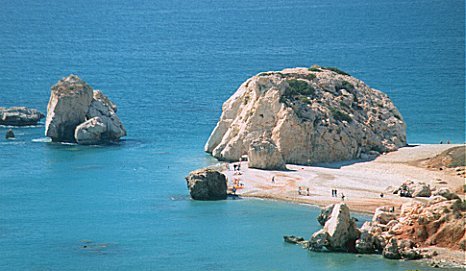
http://www.bahighlife.com/Arts-And-Culture/Cyprus-Aphrodites-island.html, Cyprus: Aphrodite's island:

Petra tou Romiou, pictured here, is the legendary birthplace of Aphrodite, in Paphos, Cyprus
http://www.selectresorts.co.uk/properties.php?act=display_location&catCountry=S403339442a852&cat=rent&country=cyprus, Aphrodite Hills:
Aphrodite Hills
It is
located in the south west of Cyprus overlooking the very place where the legendary Aphrodite
rose from the waves.
It is secluded and tranquil; a place to escape the pressures of the world.
http://www.golfingcy.com/aphrodite_hills_golf_resort.htm, Villa Rentals at Aphrodite Hills, “Aphrodite Hills Golf Resort - The Resort”:
An exceptional golf, leisure and residential resort, Aphrodite Hills stands in a beautifully scenic setting on two gently slopping plateaux overlooking the Mediterranean.
In total sympathy with its surrounding, it blends everything you would expect from a world class, purpose-built resort with the ambience and charm of a traditional Cyprus village. And its location in Pafos, overlooking the sea where the goddess Aphrodite rose from the waves is, quite simply, heavenly.
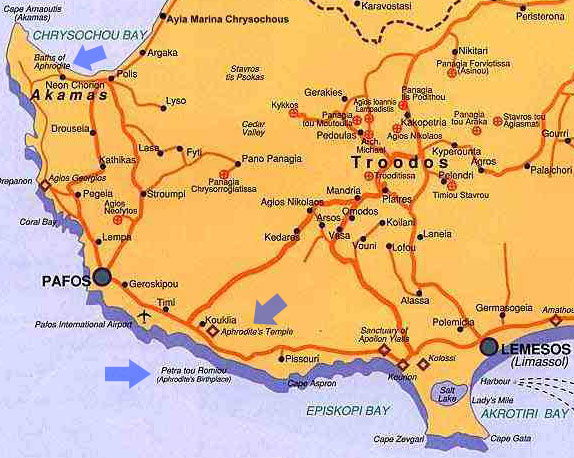
http://www.astrofegia.com/Cyprus_Maps/images/Cyprus_3.jpg, Map of Cyprus:
http://gowealthy.com/scripts/info.asp?aid=1709, Aphrodite of Cyprus:
Aphrodite's Temple at Paphos was renowned throughout the ancient world for its antiquity and fabulous wealth. The sanctuary was one of the great religious centres of the Greek and Roman world: the blend of age-old Aegean and Oriental rites in the cult ceremonies lent it a particular attraction. Prominence and distinction of the Paphian shrine amongst Aphrodite's sanctuaries rested on the widely accepted claim that the Paphos coast had seen the goddess rise from the foam of the sea near the rock of Petra tou Romiou, a few miles southeast of Kouklia.
http://rentcyprusvillas.com/cyprus/history-aphrodite.htm, History of Cyprus:
Introducing Aphrodite 1200BC
It was around 1200 BC when Aphrodite, Goddess of Love and Beauty, emerged from the gentle jade-colored sea foam at Petra tou Romiou, a boulder that juts up from the south coast of Cyprus as majestically today as it did then. The name Aphrodite, in fact, means "foam born." She was the most ancient goddess in the Olympian pantheon.
http://homepage.mac.com/cparada/GML/Aphrodite.html, Greek Mythology Link, “Aphrodite”:
The most famous story about Aphrodite's birth is the one told by Hesiod, who said that she had sprung from the foam (aphros in Greek) that gathered round the severed genitals of Uranus (Sky) as they floated in the sea. … Hesiod's account of Aphrodite's birth makes her the most ancient of the Olympian gods.
The Oxford Guide to Classical Mythology in the Arts, 1300–1900s, Reid, 1993, Vol. 1, pp. 112-113, “APHRODITE”:
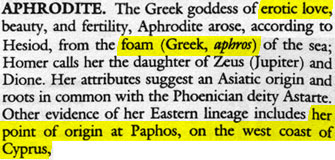
http://www.theoi.com/ABC.htm, Greek Mythology: Encyclopedia A: A Guide to Greek Gods, Spirits & Monsters:
Aphrodite The goddess of love, beauty and intercourse. Aphrodite was one of the twelve great Olympian gods. She was born of the sea foam generated from the castrated genitals of the sky-god Ouranos.
http://www.magickmind.net/pagangods.html, Pagan Gods:
APHRODITE Goddess of fertility, love and beauty. When Zeus killed his father, Uranus, he cut off his father's genitals and cast them into the sea. The sea foamed and boiled and Aphrodite arose from the waters. As Aphrodite stepped from the ocean, flowers grew wherever her feet touched. Paphos, the place where Aphrodite supposedly rose from the waters, was her most important place of worship, and at Corinth she was worshipped with sacred whores. Aphrodite is clearly related to Ishtar and Astarte and very much loves the company of the male gods. While married to Hephaestus, she also dallied with Ares, Poseidon, Adonis, and Dionysius.
Concise Dictionary of Greek Literature, Mantinband, 1962, p. 40, “Aphrodite”:
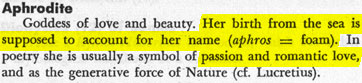
The Greek Anthology and Other Ancient Greek Epigrams, 1973, p. 396, “APHRODITE”:
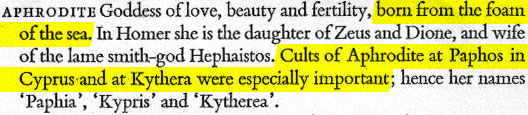
Brewer’s Dictionary of Phrase and Fable, 1981, p. 41, “Aphrodite”:
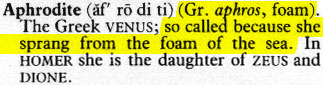
Encyclopedia of the Ancient Greek World, Sacks, 1995, p. 24, “Aphrodite”:
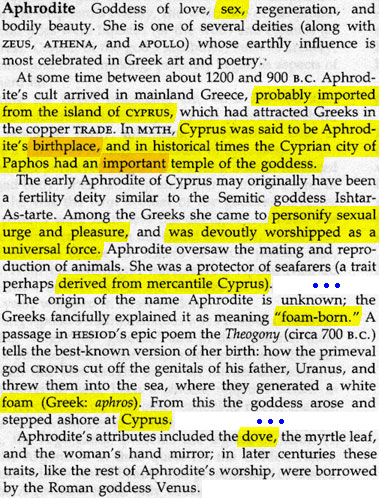
What Men or Gods Are These?: A Genealogical Approach to Classical Mythology, Boswell, 1980, p. 274, “Aphrodite”:

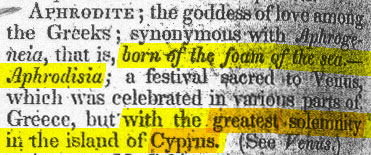
Encyclopaedia Americana, Vol. I, 1829, p. 294, “Aphrodite”:
http://www.worldbookonline.com/wb/Article?id=ar025820&st=Aphrodite (subscription required) , “Aphrodite”:
Aphrodite,
 «AF roh DY tee», was a major
Greek goddess. … Many myths report
that she instigated human love affairs. … In
the works attributed to the Greek poet Homer, Aphrodite was the daughter of the
goddess Dione and Zeus, the king of the gods. In
earlier myths, Aphrodite rose full-grown from sea foam. The name Aphrodite
may come from aphros, the Greek word for foam.
«AF roh DY tee», was a major
Greek goddess. … Many myths report
that she instigated human love affairs. … In
the works attributed to the Greek poet Homer, Aphrodite was the daughter of the
goddess Dione and Zeus, the king of the gods. In
earlier myths, Aphrodite rose full-grown from sea foam. The name Aphrodite
may come from aphros, the Greek word for foam.
http://www.worldbookonline.com/wb/Article?id=ar582860&st=Venus (subscription required) , “Venus”:
Venus, «VEE nuhs», was a major goddess in Roman mythology. … Venus was born full-grown from the foam of the Mediterranean
Sea
and came to land on the island of Cyprus.
A Guide to the Ancient World: A Dictionary of Classical Place Names, Grant, 1986, p. 472, “Paphos”:
http://www.goddess.ws/aphrodite.html, Aphrodite, Greek Goddess of Love and Beauty:
Ancient Greek goddess of sexual love and beauty, identified by the Romans with Venus. Because the Greek word aphros means "foam," the legend arose that Aphrodite was born from the white foam produced by the severed genitals of Uranus(Heaven), after his son Cronus threw them into the sea. … Many scholars believe Aphrodite's worship came to Greece from the East, and many of her characteristics must be considered Semitic. Although Homer called her "Cyprian" after the island chiefly famed for her worship, she was already Hellenized by the time of Homer, … Of Aphrodite's mortal lovers, the most important were the Trojan shepherd Anchises,
The Oxford Companion to Classical Literature, 1959, p. 129, “Cyprus”:
P. 33, “Aphrodite”:
The Encyclopedia of Religion, Eliade, 1987, vol. ?, p. 333, “APHRODITE”:
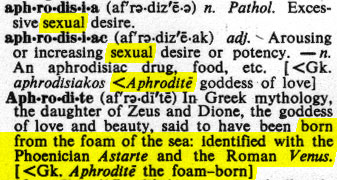
Funk & Wagnalls Standard Dictionary of the English Language: International Edition, 1966, p. 68:
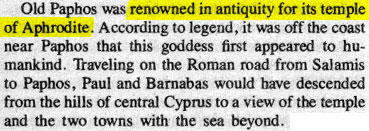
The Eerdmans Bible Dictionary, Myers, 1987, p. 792, “PAPHOS”:
http://www.gothikangel.com/Goddess/Greek.htm, Greek Gods and Goddesses, “Aphrodite”:
Greek Goddess of passion and sexual love, and womanly beauty. She is considered the epitome of beauty and femininity. Said to have been born of sea-foam. … She symbolizes feminine prowess, sexuality, relationships, flower magic.
http://www.sacredsource.com/prodinfo.asp?number=PS-V, Sacred Source: Ancient Images, Ancient Wisdom, “Venus indoor/outdoor 16””:
|
Detailed Description |
|
Venus,
Goddess of Sexual Love. |
see also: Sacred Sexuality
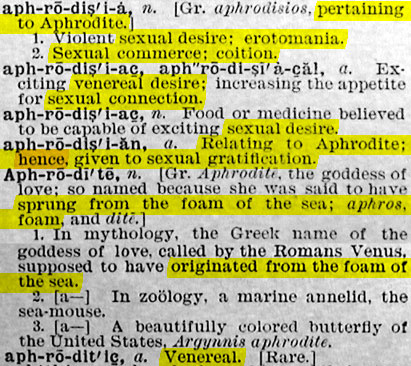
Webster’s Universal Dictionary of the English Language (unabridged), 1909, p. 79, “aphrodi…”:
Bibliotheca Classica; or, A Classical Dictionary, containing A full Account of all the Proper Names, Lemprière, 1788, (no page numbers), “Aphrodīte”:

Translated: Aphrodīte, the Grecian name of Venus, from αφρος froth, because Venus is said to have been born from the froth of the ocean.
“Froth” is: “A mass of bubbles in or on a liquid; foam.”
http://alipso.com/monografias/2066_afrodita/, Aphrodite, Goddess of Love, Beauty, Fertility & Desire:
HOMERIC HYMN TO APHRODITE (VI. 2)
The breath of the west wind bore her
Over the sounding sea,
Up from the delicate foam,
To wave-ringed Cyprus, her isle.
The Oxford English Dictionary, 1989:
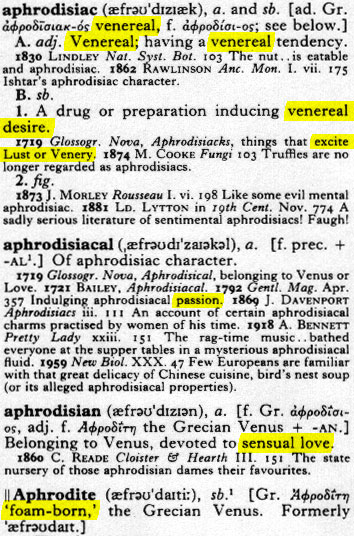
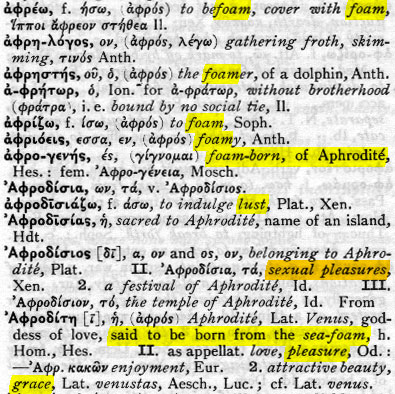
An Intermediate Greek-English Lexicon, Liddell & Scott, Oxford, 1997 (first edition 1889), p. 140:
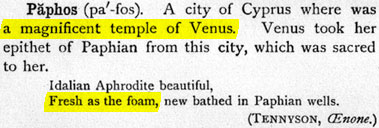
A Dictionary of Classical Names for English Readers, Jeffcott, 1914, p. 78, “Păphos”:
Webster’s Dictionary of Proper Names, 1970, p. 32, “Aphrodite Anadyomene”:
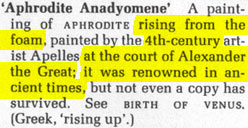 --That’s 4th-century B.C.
Became a reputation:
The New Roget’s Thesaurus in Dictionary Form, 1978, p. 17, “amorous”:

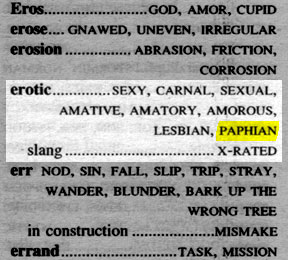
P. 140, “erotic”:

Random House Crossword Puzzle Dictionary, 2001, p. 36, “Aphrodite”:
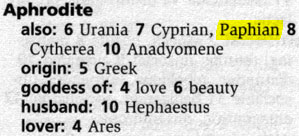
The New Comprehensive A-Z Crossword Dictionary, Schaffer, 1995, p. 398, “erotic”:
http://dictionary.reference.com/browse/Cyprian, “Cyprian”:
a. Of or relating to the ancient worship of Aphrodite on Cyprus.
b. Licentious; wanton.
…
2. resembling the ancient orgiastic worship of Aphrodite on Cyprus
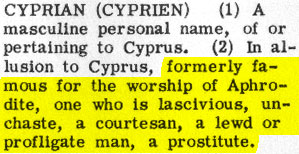
Dictionary of Mythology Folklore and Symbols, Jobes, 1962, Vol. 1, p. 403, “CYPRIAN (CYPRIEN)”:
http://www.mala.bc.ca/~johnstoi/euripides/euripides.htm, Euripides: The Bacchae, 404 BC:
“Supplementary List of Characters and Places”:
The following names are frequently mentioned but are not speaking characters in the play.:
Aphrodite: goddess of erotic love and sexuality. …
The play (Choral Interlude I, Greek lines 402-406):
Would
I might go to Cyprus,
island of Aphrodite,
where the Erotes,
bewitching goddesses of love,
soothe the hearts of
humankind,
or to Paphos,
This states that the followers of Aphrodite on Cyprus are Erotics.
http://www.perseus.tufts.edu/cgi-bin/ptext?doc=Perseus:text:1999.01.0091:line=402, Euripides, Bacchae (ed. Gilbert Murray)
[in transliterated Greek, with its text links word definitions in blue]:
Choros
hikoiman to come poti motion from Kupron Cyprus, [line 402]
nason an island tas the,
that Aphroditas Aphrodite, [403]
hin' in that place, there hoi the, that thelxiphrones (θελξίνους)
charming the heart nemon- [404]
tai to deal out, distribute, dispense thnatoisin
liable to death, mortal Erôtes Loves (erotic), [405]
Paphon Paphos th' han this,
that [406]
http://www.newadvent.org/fathers/2801.htm (Catholic Encyclopedia), St. Athanasius – Against The Heathen (c. 335 AD):
“But others, straining impiety to the utmost, have deified the motive of the invention of these things and of their own wickedness, namely, pleasure and lust, and worship them, such as their Eros, and the Aphrodite at Paphos.”
Again, this was said in the era of strong Christian change and mixed views.
http://www.perseus.tufts.edu/cgi-bin/ptext?doc=Perseus%3Atext%3A1999.04.0057%3Aentry%3D%23350, Henry George Liddell, Robert Scott, A Greek-English Lexicon, “agap-ênôr”:
agap-ênôr , oros, ho, <*> ênoreên agapôn,
A. loving manliness, manly, epith, of heroes, Il.(Iliad, Homer) 8.114, etc.
http://www.perseus.tufts.edu/cgi-bin/ptext?doc=Perseus%3Atext%3A1999.04.0058%3Aentry%3D%23108, Henry George Liddell, Robert Scott, A Greek-English Lexicon, “agapênôr”:
agapênôr = ênoreên agapôn, loving manliness, manly, Il.
http://www.perseus.tufts.edu/cgi-bin/ptext?layout.reflang=greek;layout.refembed=2;layout.refwordcount=1;layout.refdoc=Perseus%3Atext%3A1999.04.0058;layout.reflookup=h%29nore%2Fhn;layout.refcit=entry%3Da%29gaph%2Fnwr;doc=Perseus%3Atext%3A1999.04.0058%3Aentry%3D%2314794, Henry George Liddell, Robert Scott, An Intermediate Greek-English Lexicon, “ênorea” (base form of ênoreên):
ênorea 1 [anêr] [epic for andreia,] manhood, Hom.: manly beauty, Il.:--in pl. praises of manhood, Pind.
Possibly he took the agape-of-manly-beauty name in his comparable affiliation with the birth of Aphrodite.
“Mysteries”:
A Dictionary of Greek and Roman Antiquities, Smith / Anthon, 1870, p. 68, “APHRODIS'IA (’Αφροδίσια)”:
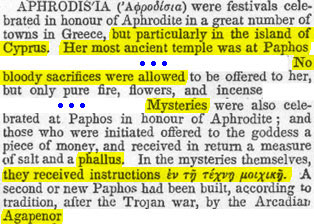
“έν τη τέχνη μοιχικη” translates as “In the art adulterous.” A “phallus” is a representation of a penis.
Astarte / Ishtar / Aphrodite:
http://www.searchgodsword.org/enc/isb/view.cgi?number=T6678, The International Bible Study Encyclopedia: Paphos, “3. History of New Paphos”:
New Paphos, originally the seaport of the old town, was founded, according to tradition, by Agapenor of Arcadia (Iliad ii.609; Pausan. viii.5, 2).
“4. The Temple and Cult”:
The goddess, identified with the Greek Aphrodite, who was said to have risen from the sea at Paphos, was in reality a Nature-goddess, closely resembling the Babylonian Ishtar and the Phoenician Astarte, a native deity of Asia Minor and the Aegean Islands. Her cult can be traced back at Paphos to Homeric times (Odyssey viii.362) and was repeatedly celebrated by Greek and Latin poets (Aeschylus Suppl. 555; Aristoph. Lys. 833; Virgil Aen. i.415; Horace Odes i.19 and 30; iii.26; Statius Silvae i.2, 101, etc.). The goddess was represented, not by a statue in human form, but by a white conical stone (Max. Tyr. viii.8; Tacitus History ii.3; Servius Ad Aen. i.724), of which models were on sale for the benefit of pilgrims (Athenaeus xv.18); her worship was sensuous in character and she is referred to by Athanasius as the deification of lust (Contra Genres 9). … Its site may be sought at Xylino, a short distance to the North of Kouklia (D.G. Hogarth, Times, August 5, 1910),
http://www.vt-2004.org/Background/Infol2/EIS-D9.html, Venus in Mythology:
Ishtar
This story is very similar to the Story of the Sumerian goddess Ishtar. The Sumerians from whom Greek astronomy derived many of its ideas saw this planet as Inanna, also Ishtar or Eshtar. It was the morning star and the goddess of love - particularly sexual and erotic love,
http://www.topical-bible-studies.org/37-0012.htm, Ashtoreth, The Queen of Heaven:
Astarte ... a Semitic goddess of fertility and sexual love, worshiped by the Phoenicians and others: see also ASHTORETH, ISHTAR."
http://www.eskimo.com/~elladan/gods/, Table of Gods:
|
Astarte/ Ashtoreth |
Phoenicia/ Babylon/ Assyria/ conference/ Canaan |
A goddess of fertility, sacred love, sexuality & of sex & the moon |
…
|
Ishtar/ Inanna |
Babylonia |
She was the goddess of sexuality & of love and war |
http://wuzzle.org/cave/lovegods.html, Goddesses and Gods Love and Sexuality:
|
Astarte |
Phoenician goddess |
Fertility/Love/Sacred sexuality/Sex |
…
|
Ishtar |
Assyrian goddess |
Fertility/Love/Sex |
The New Century Cyclopedia of Names, Barnhart, 1954, Vol. 3, p. 3085, “Paphos”:
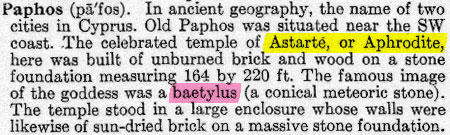
http://en.wikipedia.org/wiki/Baetylus, “Baetylus”:
The worship of baetyli was widespread in the Phoenician colonies, including Carthage, even after the adoption of Christianity, and was denounced by St. Augustine of Hippo [354-430 AD].
http://www.answers.com/astarte, “Astarte” (or “Ashtart”):
Ashtart was accepted by the Greeks under the name of Aphrodite. The island of Cyprus, one of ‘Ashtart's greatest cult centers, supplied the name Cypris as Aphrodite's most common byname.
http://www.trocadero.com/xanthos/items/318920/item318920store.html, Phoenician Statuette of the Goddess Astarte:
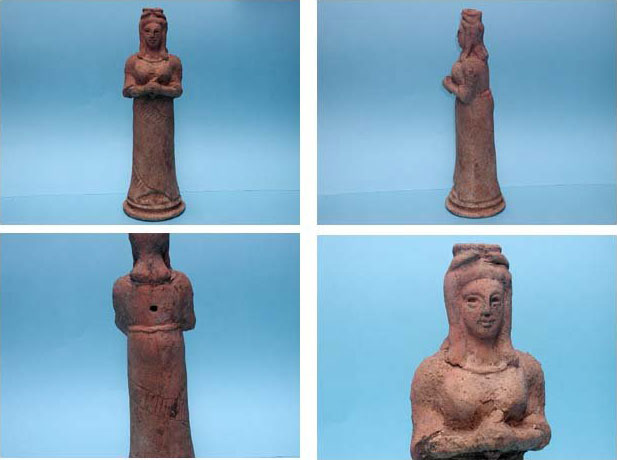
http://www.pantheon.org/areas/gallery/mythology/other/astarte.html, Astarte:
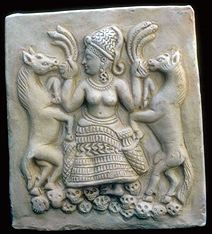
http://www.goddess-gallery.com/neolithic.html, Early Goddesses - Paleolithic, Neolithic, Old Europe, and early historic times, “Ishtar”:
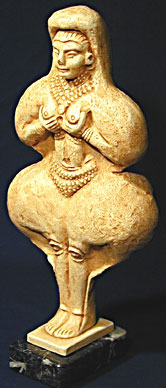
http://www.crystalinks.com/sumergods.html, Sumerian Gods and Goddesses, “Ishtar”:
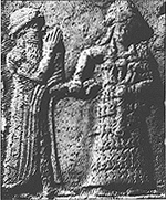
http://z.about.com/d/ancienthistory/1/0/p/c/2/Ishtar.jpg, via http://ancienthistory.about.com/od/godsmyth/tp/LoveGoddesses.htm, Top 8 Love Goddesses, “Ishtar”:
Ishtar was the heir to the Sumerian goddess Inanna but was more promiscuous. … She was the wife of a human king, Sargon of Agade.
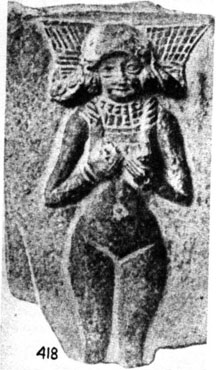
… http://z.about.com/d/ancienthistory/1/0/r/c/2/Ashtart.jpg, “Ashtart”:
Ashtart or Astarte is a Semitic goddess of sexual love, maternity and fertility, consort of El at Ugarit.
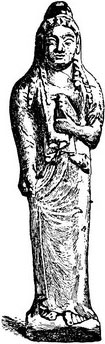
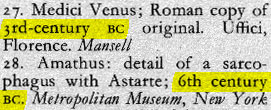
The Crucible of Christianity, Toynbee, 1969, p. 109, illustration 27 & 28, “A Taste for Things Greek: Hellenism in Syria and Palestine” (Medici Venus | Astarte):
 (pagan art):
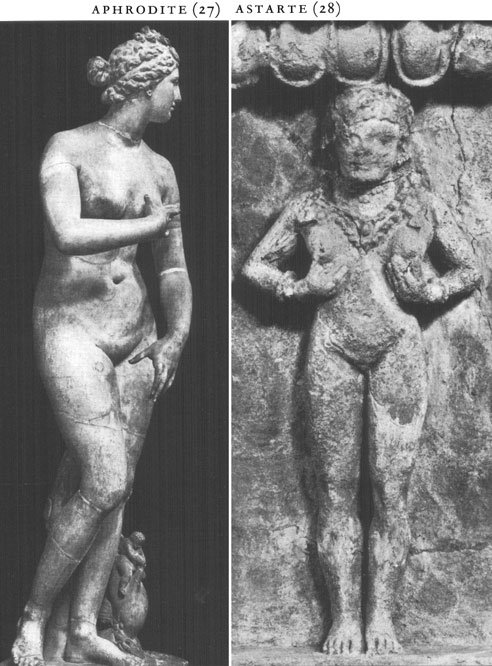
P. 359, “List of Sources of Illustrations | A taste for things Greek”:
http://www.greenspun.com/bboard/q-and-a-fetch-msg.tcl?msg_id=00CbuJ, The Jewish "Queen of Heaven":
According to the Book of Jeremiah, a community of Jews in Egypt worshipped a goddess that he calls the 'Queen of Heaven,' a deity that scholars identify with Anath or Astarte, both of them goddesses in the pantheon of the ancient Near East. Like other goddess worshippers, the Jewish women in the Egyptian diaspora light altar fires to the Queen of Heaven, bake and eat 'crescent-cakes marked with her image' (Jer. 44.19)