SAINT AGAPE
The Woman’s Encyclopedia of Myths and Secrets, Barbara G. Walker, 1983, p. 12:
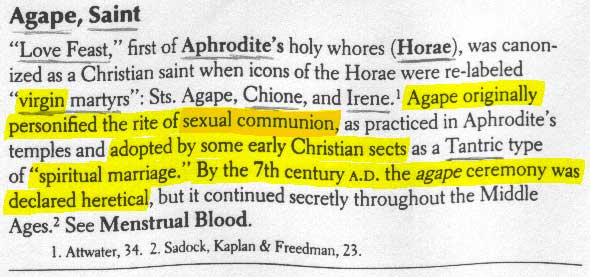
She was martyred (burned alive) in 304 AD (The Acta of Agape).
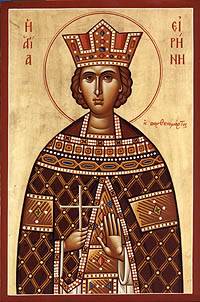
An icon of Saint Irene is all I could find:
http://www.catholic-forum.com/saints/sainti07.htm:
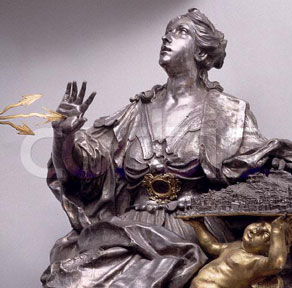
http://pro.corbis.com/, Search # MI002307, Sculpture of Saint Irene (with Eros), Located in: Cathedral of San Gennaro, Christian art:
http://www.geocities.com/cas111jd/rome/rome_gods1.htm (4-18-04), Gods and Goddesses of Rome, Abeona to Averruncus, “Anastasia, St.”:
Christian title of Rome’s 'Great Goddess', personified as a pseudo-saint. Her three attendants Agapeta, Theonia, and Irene were originally the three Horae or Graces who attended the Goddess, or they were herself in triad from. Her holy day coincided with the winter solstice, when the Great Mother gave birth to the sun, beginning on its eve, December 24, called Matrum Noctem, ‘Night of the Mother’. Angerona was probably part of this tradition.
http://www.coyotela.org/history.html, The Authentic Herstory [sic] of Prostitution: A Brief Chronicle of Sacred Whoredom:
ORIGINS OF THE WORD "WHORE"
The word whore is an English corruption of the Old Semitic word hor, meaning "hole," "cave," or "pit." Hor, in turn, is a derivation of the pre-Judaic Indo-European word, hora, meaning "hour." In fact, our modern English word "hour" derives from hora. In ancient Greece, for instance, prostitutes were called horae; in Persia, houri; in Babylon, harines; and in Israel, hors.
…
Saint Chionia, Saint Agape, and Saint Irene, were nothing more than christianizations of the three far older Pagan Holy Whores or Horae named: Eunomia ("Good Order"), Dike ("Justice"), and Eirene ("Peace").
http://www.answers.com/prostitution, Wikipedia, “prostitution”:
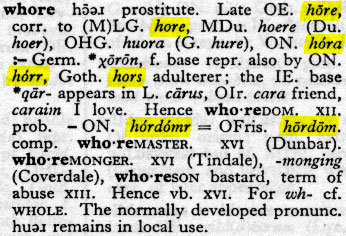
The English word whore, referring to (female) prostitutes, is taken from the Old English word hōra
http://www.etymonline.com/index.php?term=whore, Online Etymology Dictionary, “whore”:
O.E. hore "prostitute, harlot,"
Mythologies of the World: A Concise Encyclopedia, Shapiro & Hendricks, 1979, p. 17:

“Charites” are also called “Graces.”
An American Dictionary of the English Language, Noah Webster, 1856, p. 1263, “WHORE”:
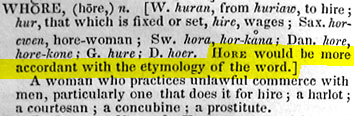
The Oxford Dictionary of English Etymology, Onions, 1966, p. 1005, “whore”:
http://www.catholic.org/saints/saint.php?saint_id=468 (Catholic Online), St. Agape:
St. Agape
Feastday: April 3
Agape and her sisters Chionia and Irene, Christians of Thessalonica, Macedonia, were convicted of possessing texts of the Scriptures despite a decree issued in 303 by Emperor Diocletian naming such possessions a crime punishable by death. When they further refused to sacrifice to pagan gods, the governor, Dulcitius, had Agape and Chionia burned alive. When Irene still refused to recant, Dulcitius ordered her sent to a house of prostitution. There she was unmolested after being exposed naked and chained, she was put to death either by burning or by an arrow through her throat.
Free love is the opposite of prostitution (and marriage).
http://www.thesacredheart.com/sts/sa0119.htm, SAINT AGAPE:
Martyr and follower of St. Valentine. She belonged to a group of virgins started by St. Valentine. A church in Termi was dedicated to her until the twelfth century, and she is listed in early martyrologies. Died: 273, Feastday: February 15.
Must be another one (different feastday).
http://www.catholic.org/saints/saint.php?saint_id=1156 (Catholic Online), St. Agape:
St. Agape
Feastday: February 15
273
Martyr and follower of St. Valentine. She belonged to a group of virgins started by St. Valentine. A church in Termi was dedicated to her until the twelfth century, and she is listed in early martyrologies.
http://www.icon-art.info/masterpiece.php?lng=en&mst_id=1086, St. Lyubov (St. Agape):
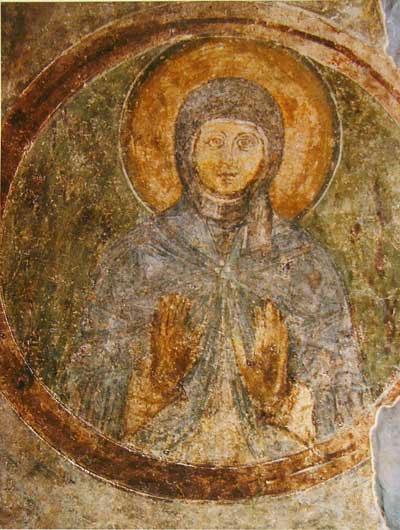
11th century
St. Sophia Cathedral, Kiev, Ukraine