AGAPEtae
Early nuns who group lived and slept with the clergymen and monks without marriage, from the beginnings of Christianity
Predominately in the first 200 years, but continued up to 1139 AD
Encyclopædia Britannica, 1771, vol. 1, p. 36, “AGAPETÆ”:
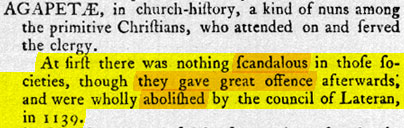
Translated from Elizabethan English:
AGAPETÆ, in church-history, a kind of nuns among the primitive Christians, who attended on and served the clergy.
At first there was nothing scandalous in those societies, though they gave great offence afterwards, and were wholly abolished by the council of Lateran, in 1139.
The International Cyclopædia, 1898, Vol. 1, p. 146:

The New International Encyclopædia, 1912, Vol. 1, p. 193, “Agapetæ | Agapeti”:
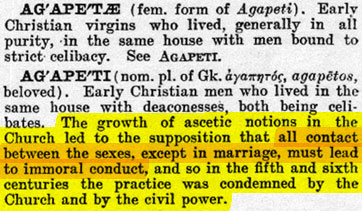
That’s right, even if they didn’t have sex, the obvious strong desire would cause a need for gender separation – totally against the generic fellowship that Christ said was so important. Whether we like it or not, there can never be a perfect Christ-like world with sexual controls. So… like it.
A Dictionary of Christian Antiquities. Being a continuation of the ‘Dictionary of the Bible’, 1877, Vol. 1, p. 42, “Agapeti, and Agapetae”:
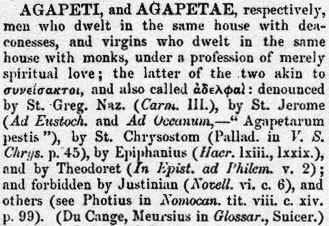
(Above died respectively: AD 604, 420, 407, 403, 457, 565?, 892.)
http://www.newadvent.org/cathen/01202a.htm (Catholic Encyclopedia), Agapetae:
The Agapetae are sometimes confounded with the subintroductae, or woman who lived with clerics without marriage, a class against which the third canon of the Council of Nice (325) was directed.
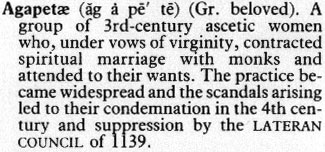
Brewer’s Dictionary of Phrase and Fable, 1981, p. 15:
http://members.ozemail.com.au/~moorea/agapetti.html, Primitive Christianity: The Agapetae:
I blush to speak of it, it is so shocking; yet though sad, it is true. How comes this plague of the agapetae(1) to be in the church? Whence come these unwedded wives, these novel concubines, these harlots, so I will call them, though they cling to a single partner? One house holds them and one chamber. They often occupy the same bed, and yet they call us suspicious if we fancy anything amiss. A brother leaves his virgin sister; a virgin, slighting her unmarried brother, seeks a brother in a stranger. Both alike profess to have but one object, to find spiritual consolation from those not of their kin; but their real aim is to indulge in sexual intercourse. It is on such that Solomon in the book of proverbs heaps his scorn. "Can a man take fire in his bosom," he says, "and his clothes not be burned? Can one go upon hot coals and his feet not be burned?"(2)
From:
http://www.cyberscriptures.com/record/jero1_1.htm, Jerome 384 AD: Letter to Eustochium (The Church) – Rome, “Chapter 4”:
14. Such may have eulogizers of their own, and may fetch a higher price in the market of perdition, merely because they are called virgins. But to such virgins as these I prefer to be displeasing.
15. I blush to speak of it, it is so shocking; yet though sad, it is true. How came this plague of the Agapetus to be in the church? Whence come these unwedded wives, these novel concubines, these harlots, so I will call them, though they cling to a single partner?
16. One house holds them and one chamber. They often occupy the same bed, and yet they call us suspicious if we fancy anything amiss. A brother leaves his virgin sister; a virgin, slighting her unmarried brother, seeks a brother in a stranger.
17. Both alike profess to have but one object, to find spiritual consolation from those not of their kin; but their real aim is to indulge in sexual intercourse.
http://www.adventist4truth.com/Library/victory.html, Catholic Victory in 1960?:
Jerome (d. 420), famous Bible translator, Bible commentator, Father of the Church and Saint, who lived right in Rome, asked: "How come this plague of the Agapetae (nuns) to be in the Church? Whence come these unwedded wives, these new kind of concubines, these prostitutes ... their real aim is to indulge in sexual intercourse" (Migne, P.L. 22, 402).
The Encyclopædia Britannica, Vol. 1, 1910, p. 366:

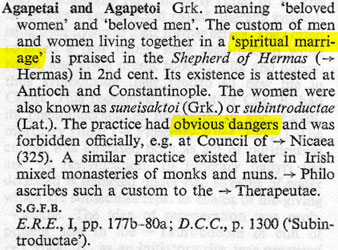
A Dictionary of Comparative Religion, Brandon, 1970, p. 45:
http://books.google.com/books?id=7OZciq66Ya4C&pg=PA129&dq=Agapetae&lr=lang_en&num=50&as_brr=3&ei=LAlZSOnYMpWmigGO-5mMDA&sig=NDTypgKddiwcWHoK_j5DWJaK7TYa#v=onepage&q=Agapetae&f=false, 5000 Years of Popular Culture: Popular Culture Before Printing (Google Books Result), by Fred E. H. Schroeder, 1980, p. 129, “Possession, Sex and Hysteria”:
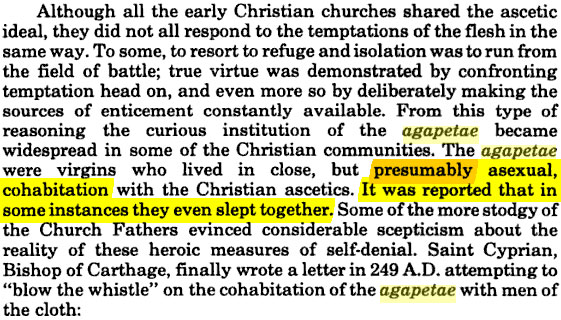
Of course, no one today would think that they were having sex. “Virgin” just meant “not married” back then (see my research at my home / index). Cyprian was one of the Christians who had to talk against sexual freedom, or face death. See my research on Cyprian at my home / index).
http://www.reuniting.info/wisdom/agapetae, Spiritual Brides of Early Christianity:
Did you know that "spiritual brides" lived and snuggled with early Christian holy men, such as (possibly) St. Paul?1 They were known as the "agapetae,"2 based on the Greek word agape. Agape is defined as "spiritual, selfless, chaste love" - in contrast with eros or "sexual love."[Again, that’s the modern day corruption] "Agapetae" is most often translated as "the beloveds." The most famous was Paul's companion, Thecla, although her existence may have been apocryphal.
…
As the Catholic Church moved away from the tenets of early Christianity (and rejected the gnostic viewpoint), it championed unrestrained procreation (when sanctioned by the Church) as God's will. Priests' children were so common that in some regions there were even legal mechanisms by which priests could pass on an inheritance to their children. This changed around the end of the first millennium when the practice of priests openly keeping mates was forbidden, perhaps influenced by the purity of the Cathars. [The Cathars were widely known for open sex. See my Cathars page.] The Cathars, however, seemed to follow a practice that was much closer to the agapetae concept, where men and women lived together but did not seek to procreate. For this view, among others, thousands of them were burned alive. [They were burned by the Catholics to stop the free love.] For a century or so, in other corners of the Catholic world, priests continued to keep mistresses. In fact, priests fathering children were so common that the German word for "pastor's son" (Pfaffenkind) was synonymous with "bastard."3 [There’s a difference between affairs and free love.]
…
We know few details, and most of those come from polemics against the agapetae custom [because I’m sure later Catholics burned any supportive information]. However, it appears that the practice of a man and woman sleeping together in a lust-free manner represented practical application of one of Christianity's loftiest aims — overcoming lust and thereby freeing oneself of the pull of earthly desires. This discipline was apparently employed widely until at least the middle of the 3rd century.
According to modern observer Andrew Moore … There was something [unusually] profound about male female 'companionship' in the primitive Church - it is the missing piece of the puzzle - ignored by both the establishment and gnostics alike. Mary Magdalene was perhaps the first agapetae.
As he says, the agapetae were not a short-term or small-scale aberration in the first several centuries of the Christian Church. The whole dynamic of both nakedness and the [agapetae] centered around the understanding of body beyond lust [lust is a strong / longing desire for one] and the desires of the flesh, and without a dualistic divide. When it was all finally suppressed and expunged from the official history, the space was filled by asceticism and monasticism.
“More Evidence of the Practice”:
St. Chrysostom5 [born 347 AD] wrote a polemic against this practice called, Against Those Who Keep Virgins in their Houses. Here 19th century writer, Havelock Ellis6 (who eloquently argued for restraint in marriage), describes St. Chrysostom’s rant:
"Our fathers," Chrysostom begins, "only knew two forms of sexual intimacy, marriage and fornication. Now a third form has appeared: men introduce young girls into their houses and kept them there permanently, respecting their virginity." [If it has to do with the modern definition of “virginity,” the how can it be a “third form” of “sexual intimacy”? And, if “fornication” means all unmarried sex, then how can there be any third forms?]
…
This refinement of tender chastity, which was to arise again in the middle ages (perhaps via the Cathars) in the form of courtly love, was apparently widespread among early Christians. Desert ascetic St. Jerome, [died 420 AD]7 writing to Eustochium, comments:
I blush to speak of it, it is so shocking; yet though sad, it is true. How comes this plague of the agapetae to be in the church? Whence come these unwedded wives, these novel concubines, these harlots, so I will call them, though they cling to a single partner? One house holds them and one chamber. They often occupy the same bed, and yet they call us suspicious if we fancy anything amiss. … Both alike profess to have but one object, to find spiritual consolation from those not of their kin; but their real aim is to indulge in sexual intercourse.
…
Similarly Cyprian8 (Epistola 62) is unable to approve those men of whom he hears - and one a deacon! - who live in familiar intercourse with virgins, even sleeping in the same bed with them. [See, “virgin” back then just meant “an unmarried girl.”]
“Sacrament of the Bridal Chamber”:
It is unknown whether there was a direct connection between the agapetae tradition and a similar practice mentioned in several of the Nag Hammadi gnostic gospels.11 However, it seems possible that there was. These gospels speak of a Sacrament of the Bridal Chamber.
Seek the experience of the pure embrace [translated from the Coptic word koinonia, which is defined as 'marital fellowship'][see my Fellowship page]; it has great power.12[Gospel of Philip, trans. Jean-Yves Leloup, L.60]
Some form of the "bridal chamber" ritual appears to have made it as far as the Rhone Valley. We know because self-appointed "heretic buster" Irenaeus13 accused the prophet Marcus, who headed a popular spiritual movement, of practicing ritual sex with numerous women who were seduced into joining his cult. The Marcosians evidently observed a rite called the "bridal chamber" in which they entered a "spiritual marriage."
Sounds like a “bridal chamber” of “spiritual marriage” was open sex.
…
The Gospel of Philip describes the sacrament of the bridal chamber as the 'holy of holies,' the way in which couples cans awaken spiritually.
…
a number of the Nag Hammadi documents appear to be speaking of actual intercourse:
All those who practice the sacred embrace will kindle the light; they will not beget as people do in ordinary marriages, which take place in darkness.18[Gospel of Philip, trans. Jean-Yves Leloup, L.126]
Those who are to have intercourse with one another will be satisfied with the intercourse. And as if it were a burden [a good chunk of society has low libidos], they leave behind them the annoyance of physical desire and they do not separate from each other. They become a single life….For they were originally joined to one another when they were with God. This marriage brings them back together again.19[Exegesis on the Soul, The Nag Hammadi Library in English, ed. James M. Robinson]
What is the bridal chamber, if not the place of trust and consciousness in the embrace? It is an icon of Union, beyond all forms of possession [therefore, it’s not prostitution or ordinary conditional marriage]; here is where the veil is torn from top to bottom; here is where some arise and awaken.[Yeah, yeah: I’m writing all about it]20[Gospel of Philip, trans. Jean-Yves Leloup, L.76]
Well, I’d say there’s definitely sex going on in the Agapetae (whether you like it or not). Yet, today’s conclusion is:
http://www.babylon.com/definition/agapetae/English, “agapetae”:
Agapetae
In the first century CE to the third century CE, the Agapetae were Christian virgins who consecrated themselves to God with a vow of chastity. They were one of a number of early Christian 'classes' of virgins who associated with men as 'sisters'. The Agapetae lived with laymen, originally in a spiritual community of mutual support. The laymen too took vows of chastity, and looked after the material interests of their 'sisters'.
Again, I’m just researching this one because it’s another explanation of agape love. And, the co-ed group living tells the story best.