AGAPEmone
Free Love community near Spaxton, England, c. 1845 to c. 1900
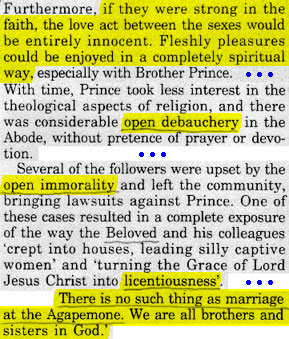
Man, Myth & Magic: The Illustrated Encyclopedia of Mythology, Religion and the Universe, Cavendish, 1995, p. 2092, “PRINCE – Abode of Love: Agapemone”:

An Etymological Dictionary of Modern English, Earnest Weekley, 1967, Vol. 1, p. 21, “agapé”:
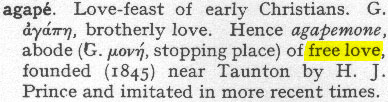
A Concise Etymological Dictionary of Modern English, Earnest Weekley, 1924, p. 14, “agapé”:
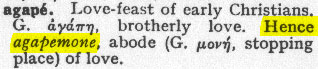
Webster’s New International Dictionary of the English Language, 1940, p. 47:
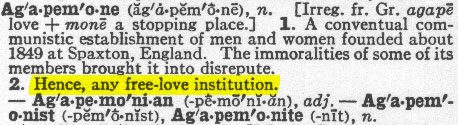
Yeah, to add to my list, if you’re stopping somewhere for love, it surely has to do with sex.
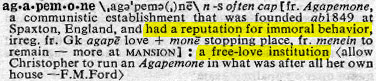
Webster’s Third New International Dictionary of the English Language (Unabridged), 1986, p. 39, “agapemone”:
http://www.infoplease.com/dictionary/brewers/agapemone.html, Agapemone:
A somewhat disreputable association of men and women living promiscuously on a common fund, which existed for a time at Charlynch, near Bridgewater, in Somersetshire. (Greek, agape, love.)
Source: Dictionary of Phrase and Fable, E. Cobham Brewer, 1894
Well, they needn’t live on “a common fund,” because those who worked the less desirous jobs should have been paid “more.” That could simply be the reason communal community didn’t survive. Plus, there’s another reason.
A Dictionary of Foreign Words & Phrases in Current English, Bliss, 1967, p. 68, “agapemone”:

The Stanford Dictionary of Anglicised Words and Phrases, Fennell, 1964, p. 37, “agapemone”:
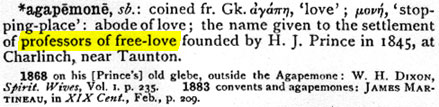
Webster’s Universal Dictionary of the English Language (unabridged), 1909, p. 32, “Agapemone”:
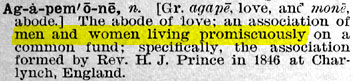
The People’s Almanac # 3, Wallechinsky / Wallace, 1981, p. 583, “Henry James Prince (1811-1899):

Well… So it wasn’t all sex.
Incidentally:
The New International Encyclopædia, 1912, Vol. 1, p. 193, “Agapemone”:
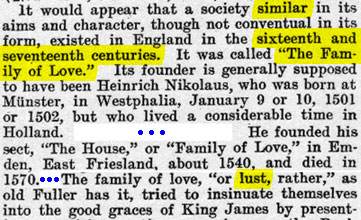
A Dictionary of English Phrases, Hyamson, 1970 (facsimile reprint of the 1922 edition), p. 7:
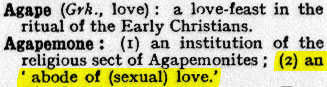
The Dictionary of Psychology, Corsini, 1999, p. 28:

A Supplement to the Oxford English Dictionary, Vol. 1, 1972, p. 40:
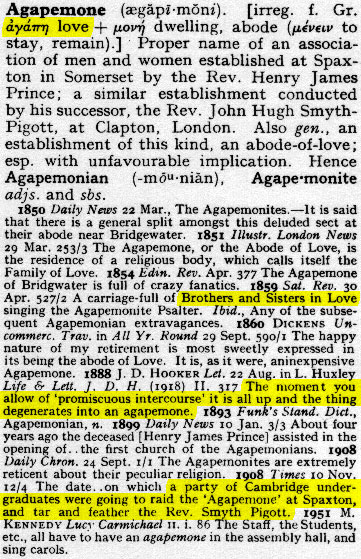
Hopefully, you can see why these past free love communities “didn’t work.”
The Oxford Dictionary of the Christian Church, 1974, p. 23, “Agapemone, Church of the”:
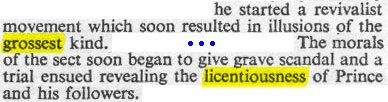
Brewer’s Dictionary of Phrase and Fable, 1981, p. 15:
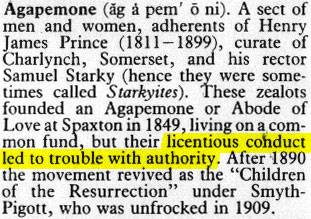
Webster’s New International Dictionary of the English Language, 1933, p. 41, “Agapemone”:
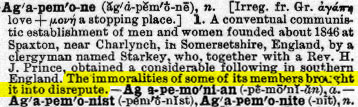
The Concise Oxford Dictionary of the Christian Church, 1977, p. 10:
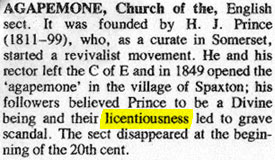
Random House Word Menu, 1992, p. 842:

http://www.robotwisdom.com/jaj/theosophy.html, Theosophy and mysticism for Joyceans:
1840s: Anglican curate HJ Prince founds Agapemone (Abode of Love) in Spaxton, England [mbb6] later declares public sexual intercourse a sacrament
Dictionary of Mythology Folklore and Symbols, Jobes, 1961, Vol. 1, p. 45:
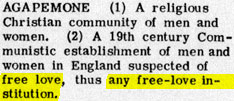
Jarrolds’ Dictionary of Difficult Words, Hill, 1944, p. 18:
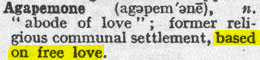
The Oxford Illustrated Dictionary, 1975, p. 14, “Agapemone”:
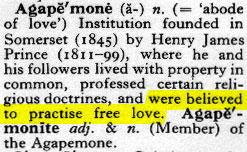
The Concise Oxford Dictionary of Current English, 1964, p. 25:
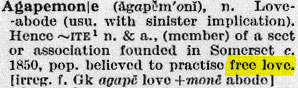
The International Encyclopaedic Dictionary, 1901, p. 105:
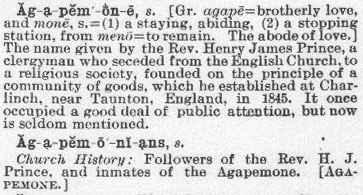
http://www.apologeticsindex.org/453-agapemone, Agapemone:
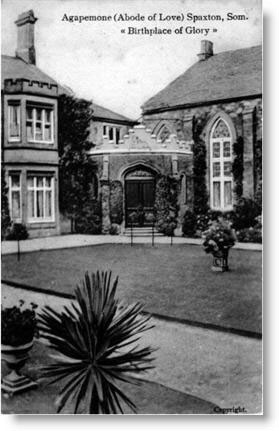
http://carolineld.blogspot.com/2008/12/somerset-and-abode-of-love.html, Somerset and the Abode of Love:
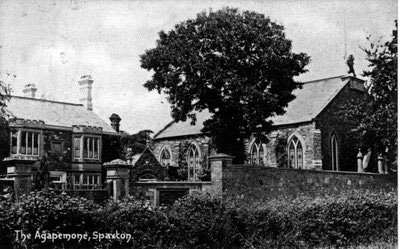
http://www.utopia-britannica.org.uk/pages/abode%20of%20love.htm, The Abode of Love:
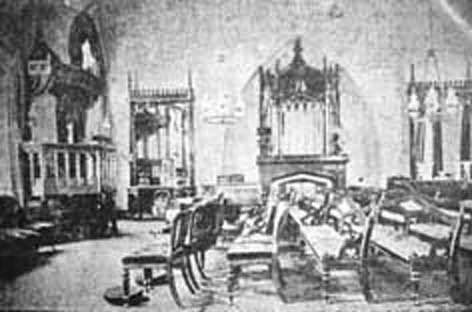
Interior of Agapemone Chapel
…
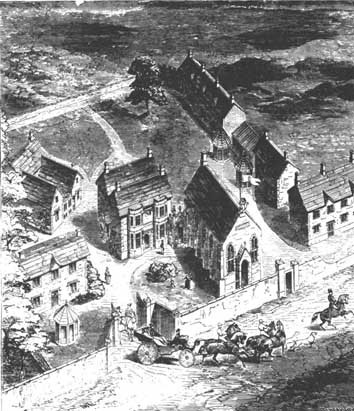
Man, Myth & Magic: The Illustrated Encyclopedia of Mythology, Religion and the Universe, Cavendish, 1995, pp. 2091-2092, “PRINCE – Abode of Love: Agapemone”:
It’s located at the northwest corner of Barford Road and Barford Close in the hamlet of Four Forks, between Spaxton and Charlynch, straight west of Bridgwater, England.