PHIL...
The third parallel Greek word for LOVE, in addition to AGAPE and EROS/EROTIC
They all meant the same thing (in the days of Christ).
phil… = Greek: φιλ…
(agape = Greek: αγαπ… or ηγαπ…; Eros = Greek Ερως or ερως; ερωτικός [erotic])
God’s Opposition (those who separate the three loves):
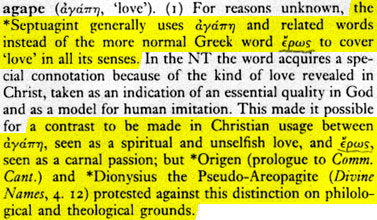
Dictionary of Christian Theology, Angeles, 1985, p. 5, “agapē”:
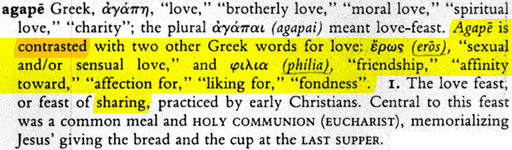
(A love “sharing” thing – got it.)
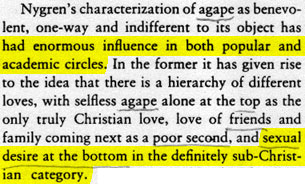
There have been several books and websites written solely to get the Eros / erotic (sex) out of agape; confused with a lot of other blabber, they incorporate the aid of phil… to better trick into distinguishing all three (and sometimes more). One of the most popular was Agape and Eros, by Anders Nygren, written in various editions during the 1930s:
Dictionary of Ethics, Theology and Society, Clarke / Linzey, 1996, p. 535, “LOVE”:
A Handbook of Theological Terms, Harvey, 1964, p. 14, “Agape and Eros”:
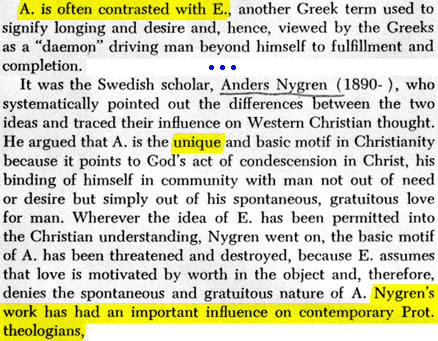
Sounds like fabricated purposeful separation to me.
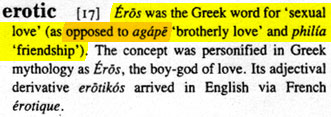
Arcade Dictionary of Word Origins, Ayto, 1990, p. 206, “erotic”:
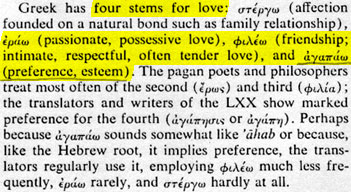
New Catholic Encyclopedia, 1967, vol. ?, p. 1043, “LOVE (IN THE BIBLE)”:
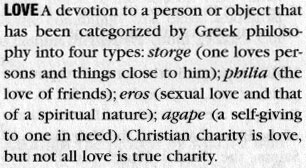
Catholic Word Book: Hundreds of Words Defined, Farren, 1999, p. 44, “LOVE”:
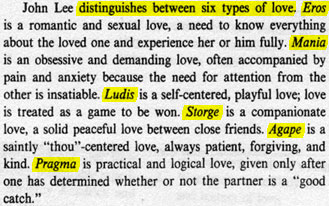
Concise Encyclopedia of Psychology, Corsini, 1987, p. 676, “Love”:
Again, because Eros is deliberately not mentioned in the New Testament, and the fact that Eros is the name of the deity, whose stories and characteristics better sustain, Eros is the only word of the three that hasn’t been corrupted. If agape’s definition was different, and if God didn’t want us to do the Eros (sexual) stuff with one another, He would have simply stated it. But, since all three words are the same, how could God have said to do agape one another but also to not Eros one another? It’d be a direct contradiction. It’d be like me saying to “build a large house, but don’t build a big house.”
Dictionary of Theology, Rahner / Vorgrimler, 1981, p. 282, “LOVE”:

This is like distinguishing the differences between the English words “big” and “large.”
Ready Reference: Ethics, Roth, 1994, vol. ?, p. 510, “Love”:
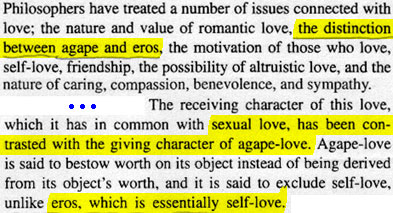
Sexual love is not “self-love”: it’s “mutual” love. Sex is one of the few things two people can do which is mutually satisfying. The Goldenrule is all over its essence.
Or, they’ll use phil- to get the sex out of agape:
The Encyclopædia Britannica, 1911, vol. ?, p. 871, “CHARITY AND CHARITIES”:
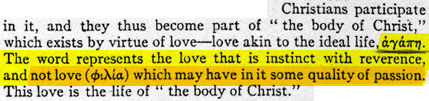
My rebuttal (Jesus-Peter conversation: John 21:15-17):
Now I call to the stand, Jesus Christ and Saint Peter. Do you guys swear to convey the truth, the whole truth and nothing but the truth? …. Be seated:
John 21:15-17 (NKJV):
15So when they had eaten breakfast, Jesus said to Simon Peter, “Simon, son of Jonah, do you love [agap-] Me more than these?” He said to Him, “Yes, Lord; You know that I love [phil-] You.” He said to him, “Feed My lambs.” 16He said to him again a second time, “Simon, son of Jonah, do you love [agap-] Me?” He said to Him, “Yes, Lord; You know that I love [phil-] You.” He said to him, “Tend My sheep.” 17He said to him the third time, “Simon, son of Jonah, do you love [phil-] Me?” Peter was grieved because He said to him the third time, “Do you love [phil-] Me?” And he said to Him, “Lord, You know all things; You know that I love [phil-] You.” Jesus said to him, “Feed My sheep.
Interlinear Greek-English New Testament: With Strong’s Concordance Numbers above Each Word, Green, Baker Books, 1996, pp. 362-363, “John 21”:

Well, if anyone could believe anything these two guys say, sounds to me that they’re STATING that agap- and phil- are equals: total matching synonyms. You see, “I” could use that kind of support today to refute all the books and websites designed to separate the two… again, just to get the Eros/erotic out of agap-. Eros/erotic is cleverly left out of the New Testament, to at least have “one” Greek word for love that doesn’t get corrupted, or its more stable characteristics being associated with the deity, would have caused the elimination of Christianity if Middle Age corruptors were unable to spin the Bible to what they required. You see, the marriage based Romans were intensely trying to end Christianity for the first 300 years; then Constantine’s war support reversed the entire situation; then when the dust settled, a re-analyzation supported by the financial obligations of the family standard would have ended Christianity if they wouldn’t have been able to spin it to their verbal favor.
http://www.biblicalstudies.org.uk/article_language.htmlhttp://www.biblicalstudies.org.uk/article_language.html, Language, Robert I Bradshaw:
Table 1: Love in John 21:15-17
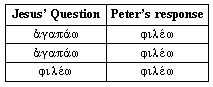
From Carson, Fallacies, 52.
Christian Words, Nigel Turner, 1980, pp. 261-266:
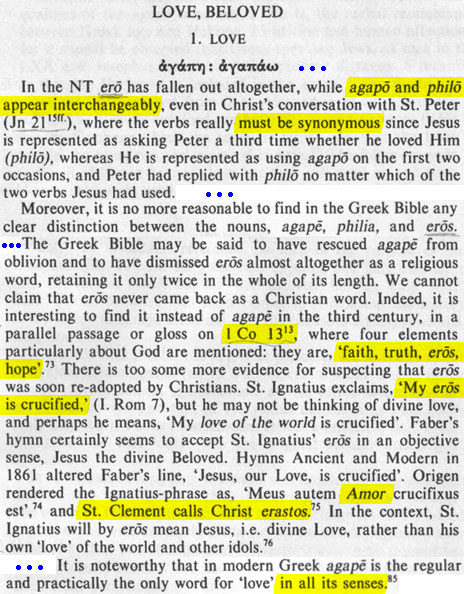
I mean there’s no other purpose for this other than to help me today, in refuting those who try to separate the meanings of the three words, just to get the Eros / erotic out of agape. (“Amor,” as well as Cupid, are Latin names for Eros. If I tried to get the sexual based love attributes of Cupid off all the Valentine cards, it’d be rather difficult.)
Mounce’s Complete Expository Dictionary of Old & New Testament Words, 2006, p. 428, “Love | New Testament”:
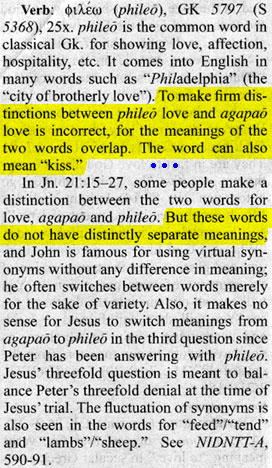
http://theologytoday.ptsem.edu/jan1973/v29-4-article2.htm, The Sensuousness of Agape:
Scholars generally maintain that the translators and authors of the Greek Bible selected agape in order to avoid the sensual association that was connoted by the Greek noun eros. Catholic theologian Ceslaus Spicq, in his voluminous Agape in the New Testament, claims that agape is "completely different" in meaning from erotic love.4( 4 C. Spicq, Agape in the New Testament (St. Louis, 1965), p. 80.) Karl Barth has declared that there is an "antithesis" between agape and every other type of love.5(5 K. Barth, Church Dogmatics (Edinburgh, 1956), IV/2, p. 740.) Denis de Rougemont, in his acclaimed Love in the Western World, divorces agape from the emotions.6 (6 D. De Rougemont, Love in the Western World (New York 1956), pp. 71, 311.) Liberal theologian Willard Sperry has asserted that agape and sexual love have "no connection whatever."7( 7 W. L. Sperry, Jesus Then and Now (New York, 1949), p. 130.) In an influential essay entitled "Love is not Liking, "ethicist Joseph Fletcher states unequivocally that to love Christianly is not a matter of feeling.8(8 J. Fletcher, Situation Ethics (Philadelphia, 1966), p. 103.) Classicist Thomas Gould holds that for the Christian libidinous desire "is inconceivably remote from the love which is the key to everything."9(9 T. Gould, Platonic Love (New York, 1963), p. 18.) Definitions given agape in biblical dictionaries and lexicons characteristically assume a sharp dichotomy between agape and eros.10(10 G. Johnston defines agape as "passionless love" in "Love in the New Testament, " Interpreter's Dictionary of the Bible (New York, 1962); cf. F. L. Cross, ed. "Agape " The Oxford Dictionary of the Christian Church (London, 1957); W. F. Arndt and F. W. Gingrich, A Greek-English Lexicon of the New Testament and Other Early Christian Literature (Cambridge, 1955); C. Abbott-Smith, A Manual Greek Lexicon of the New Testament (Edinburgh, 1937); D. G. Kittel, Lexicographia Sacra (London, 1938), pp. 19, 25-26. No hint is usually given in lexicons that agape and agapan are most commonly used in the Bible to refer to marital relations.) All of these treatments have been influenced by the Agape and Eros monographs of Anders Nygren. He contended that agape is opposed to all kinds of natural human love. Whereas human love is egocentric and possessive, Christian love "has nothing to do with desire and longing."11(11 A. Nygren, Eros and Agape (Philadelphia, 1953), pp. 210, 236.) … Soren Kierkegaard and Anders Nygren, both Lutherans, have attempted, with considerable success, to impose on the interpretation of Scripture a radical differentiation between divine and human love. However, in an effort to accentuate the significance of Christianity, they have twisted beyond recognition the authentic meaning of agape. Nygren's juxtaposition of agape and eros is not only without linguistic foundation, in the Greek Bible and in other ancient Greek literature, but it is also psychologically damaging. By cutting off agape from down-to-earth love he tended to present a disembodied religion suitable only for bloodless saints. Reinhold Niebuhr, in one of his last articles before his death, puzzled over the "mystery that the Christian faith is consistently embarrassed by all efforts to relate love to eros." "The sexual impulse may," he admitted, "become the perverse center of human activity, as is attested to by modem pornography, sexual promiscuity, and all manner of sexual perversion. On the other hand, it may become the sacrament of love between man and wife."
I don’t think today’s churches want it to have anything to do with sex, even in marriage; because, again, Jesus commanded everyone to do it with “one another.” And the main reason today’s church leaders won’t accept the truth is just to save face; because, they are really not righteous people. There are so many artificial salvation cop-outs today that they’re not worried. But they should be, because Jesus actually prophesied that they will eventually exist, and that they are going down. They’re going to have one big surprise.
http://ccat.sas.upenn.edu/bmcr/1995/95.09.16.html (Bryn Mawr Classical Review 95.09.16), Catherine Osborne, Eros Unveiled, Plato and the God of Love. Oxford: Clarendon Press, 1994. Pp. xiii + 246. $48.00. ISBN 0-19-826761-4. Reviewed by Wendy Elgersma Helleman, Erindale College, University of Toronto (whellema@credit.erin.utoronto.ca):
With this study of Eros, Catherine Osborne challenges contemporary and widely held assumptions regarding eros and agape as two divergent, if not opposing forms of love. The position articulated by Anders Nygren1 has found a receptive audience for a number of generations. Osborne's argument, however, has to contend with more than popularized Christian teaching, for non-Christian popular understanding of erotic love … Recognizing that Origen [“Christian” theologian, c. 185-254 AD] considered eros and agape as interchangeable terms for love (73), Osborne in the third and fourth chapters examines Plato's Symposium and Lysis (56-61) … Here she most clearly challenges Nygren's claim regarding eros as appetitive love … The attempt made here to distinguish genuine erotic love from more particularized or partial love as it is connected with bodily eros most clearly reveals the philosophical conditions to be met for accepting eros and agape as fundamentally indistinguishable when applied to divine love (207-8). … Osborne can certainly count on scholarly support for her effort to add nuance to the differentiation between agape and eros as, respectively, Christian and pagan concepts of love.
http://www.shef.ac.uk/~psysc/psychoanalytic-studies/msg08481.html, Psychoanalytic Studies:
Under the influence of the official Christian Church of the Middle Ages, the "higher" Eros was eventually removed entirely from the spiritual domain … During the medieval and Renaissance epochs various attempts were made to repair the split in the Western Eros – both by Christian theologians (e.g. Origen) and by Neoplatonists (e.g. Ficino). Both Origen and Ficino equated agape with eros as two terms for the same spiritual "love". Needless to say, however, their views were not endorsed by the official Christian church. Most recently – to cut a very long history very short – the theologian Anders Nygren wrote a highly influential book in the 1930s in which he re-affirmed the official Christian dichotomy of a "higher" spiritual and a "lower" sexual love (agape and eros).
http://www.iep.utm.edu/o/origen.htm (The Internet Encyclopedia of Philosophy), Origen of Alexandria (185 - 254 A.D.):
Origen of Alexandria is considered one of the greatest of all Christian theologians.
http://www.jacksequeira.org/dyunit02.htm (The Dynamics of the Everlasting Gospel, by E.H. “Jack” Sequeira), Chapter 2 – God’s Redemptive Love, “Agape and the Great Controversy”:
He was succeeded by Origen (died in 254 A.D.) who actually changed John’s sublime statement “God is agape” [1 John 4:8] to “God is eros.” … Augustine [354-430 AD] realized how futile it was to substitute eros for agape. Instead he did a very smart thing. By using Greek logic, he took the concepts of agape as well as eros and married the two together, producing a synthesis which he called caritas (Latin) and from which we get our English word charity, the word that is often used in our KJV for agape.
http://www.secondspring.co.uk/archive/gawronski.htm, Balthasar on Eros:
Recalling Nygren's harsh criticism of Ficino for equating eros and agape
The Oxford Dictionary of the Christian Church, Cross / Livingstone, 1997, p. 26, “agape”:
http://www.ccel.org/ccel/dionysius/works.ii.ii.ii.iv.html, DIONYSIUS THE AREOPAGITE, ON DIVINE NAMES, “CAPUT IV |SECTION XII.”(4:12):
And yet it seemed to some of our sacred expounders that the Name of Love (ἔρως) is more Divine than that of loving-kindness (ἀγάπης). But even the Divine Ignatius writes, “my own Love (ἔρως) is crucified;” and in the introductions to the Oracles you will find a certain One saying of the Divine Wisdom, “1 became enamoured of her Beauty.” So that we, certainly, need not be afraid of this Name of Love (ἔρως), nor let any alarming statement about it terrify us. For the theologians seem to me to treat as equivalent the name of Loving-kindness (ἀγάπης), and that of Love (ἔρως); and on this ground, to attribute, by preference, the veritable Love (ἔρως), to things Divine, because of the misplaced prejudice of such men as these. For, since the veritable Love (ἔρως) is sung of in a sense befitting God, not by us only, but also by the Oracles themselves, the multitude, not having comprehended the Oneness of the Divine Name of Love (ἔρως), fell away, as might be expected of them, to the divided and corporeal and sundered, seeing it is not a real love (ἔρως), but a shadow, or rather a falling from the veritable Love (ἔρως). For the Oneness of the Divine and one Love (ἔρως) is incomprehensible to the multitude, wherefore also, as seeming a very hard name to the multitude, it is assigned to the Divine Wisdom, for the purpose of leading back and restoring them to the knowledge of the veritable Love (ἔρως); and for their liberation from the difficulty respecting it. And again, as regards ourselves, where it happened often that men of an earthly character imagined something out of place, (there is used) what appears more euphonius. A certain one says, “Thy affection fell upon me, as the affection of the women.” For those who have rightly listened to things Divine, the name of Loving-kindness (ἀγάπης) and of Love (ἔρως) is placed by the holy theologians in the same category throughout the Divine revelations, and this is of a power unifying, and binding together, and mingling pre-eminently in the Beautiful and Good; pre-existing by reason of the beautiful and good, and imparted from the beautiful and good, by reason of the Beautiful and Good; and sustaining things of the same rank, within their mutual coherence, but moving the first to forethought for the inferior, and attaching the inferior to the superior by respect.
I’m assuming the above “Loving-kindness” is all Agape love, and all other Love is Eros love.
http://christiantherapist.com/Morris/journl4.htm (Christian Counselors Directory), The Journal of Redemptive Therapy: A Doubletake on Love, “How agape is Used in the New Testament”:
Let me remind us once again that agape is the logical corollary to aheb in the Old Testament. It is used over 300 times in the New Testament. In every way that phile is used, agape is also used. It appears in the NT three times to phile's one. In that sense one may say it is the more common word for love, not necessarily the most important and certainly not the superior.
Mounce’s Complete Expository Dictionary of Old & New Testament Words, 2006, p. 427, “Love”:
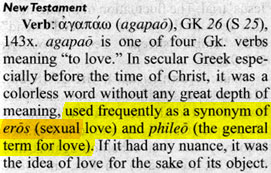
Expository Dictionary of Bible Words, Richards, Zondervan, 1991, p. 420, “LOVE | The Greek words”:
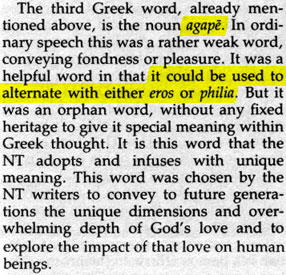
http://gs.fanshawec.ca/astracuzzi/Lecture%20Notes/Plato%20-%203%20kinds%20of%20Love%20-%20Overhead.doc, Plato’s 3 Concepts of Love:
Agape - refers to the paternal love of God for man and of man for God but it also includes brotherly love for humanity - agape love combines the elements of both Eros and Philia that would symbolized the perfect kind of love. Christianity takes the concept of Agape from the Greeks in “you shall love the Lord your God with all your heart, and with all your soul, and with all your might” (Deuteronomy 6:5) The love of God requires absolute devotion.
http://www.websters-online-dictionary.org/definition/english/lo/love.html, “Love”; &, http://www.findthelinks.com/romance/love.htm, “Love”; &, http://www.iridis.com/glivar/Love, “Love”; &, http://www.linuxnews.ws/l/lo/love.html, “Love”; & more:
Some languages, such as ancient Greek, are better than English at distinguishing between the different senses in which the word love is used. For example, ancient Greek has the words philia, eros, agape, and storge, meaning love between friends, romantic/sexual love, unconditional (possibly sacrificial, unreciprocated) love, and affection/familial love respectively. However, with Greek as with many other languages, it has been historically difficult to separate the meanings of these words totally, and so we can find examples of agape being used with much the same meaning as eros. At the same time the ancient Greek text of the Bible has examples of the werb agapo being used with the same meaning as phileo. –Basically same at: http://en.wikipedia.org/wiki/Love, http://www.free-definition.com/Love.html, http://copernicus.subdomain.de/love, http://www.infowrangler.com/phpwiki/wiki.phtml?title=What_is_love_%3F, http://reeselovespink.blogdrive.com/, http://www.web-dictionary.org/encyclopedia/lo/Love.html, etc.
http://christiantherapist.com/Morris/journl4.htm (Christian Counselors Directory), The Journal of Redemptive Therapy: A Doubletake on Love, “How agape is Used in the New Testament”:
Equated with phile:
Jesus loved (agape) Martha and her sister and Lazarus.(14) (--John 11:5) Then the Jews said, "See how he loved (phile) him!"(15) (--John 11:36) … What can one make of all this? Simply this: there is little if any difference between agape and phile. Friedrich puts it very bluntly: “. . . throughout the Gospel . . . agapao and phileo are synonymous.(16)> … 16. Friedrich, Gerhard. Theological Dictionary of the New Testament. Geoffrey W. Bromiley, Translator and Editor. Wm. B. Eerdman's Publishing Company, Grand Rapids. Vol. IX. p. 135. 1974
Eros is simply the personification (the deity character / idol / image) of agape; therefore, agape, Eros and phil- are all synonymous (also Aphrodite); like how Mars/Ares is to war; like how fire is to pyro- and flames; like how big is to large; like how equal is to identical, the same; etc. You can’t have one meaning sexual love, then the others meaning non-sexual love. That is what is called an “opposite” (or contradiction or reverse). You can’t have opposites when each definition of the word is love. It all has to do with modern day Church corruption to get the real sexual meaning out of Christ’s love commandment. When followers had to play out their worship to these love deities (Eros and Aphrodite) they had to primarily do it sexually, simply because sexual touching is the most predominate way to act-out the part (between adults, where the need is the greatest). There was no god or goddess named for the characteristic of “non-sexual love,” because it wouldn’t be love: you really can’t act out non-love. Remember, to pagans, Jesus was a “love deity” who personally commanded his followers to act out their love in John 13:35: “By this all will know that you are My disciples, if you have love for one another.” Otherwise, it would be like saying that the words Mars and Ares represent war where people kill other people; but the word “war” represents war where people don’t kill one another.
The other corrupt correlation:
Longman Dictionary of Contemporary English, 1995, p. 1307, “sex”:

Orchestrated by the church, sex is such a taboo that today it equates with “violence.” Also the “s” word. You see, God’s greatest gift to Mankind should not be equated with the two most extreme negatives of Mankind.
Phil… in context with Eros/erotic:
Aristotle: Vol. 19: The Nicomachean Ethics (350 BC); H. Rackham, M.A., Fellow of Christ’s College, Cambridge; Harvard University Press, London; 1926, revised 1934, reprinted 1975; pp. 464-465; Book VIII, Chapter IV.2:
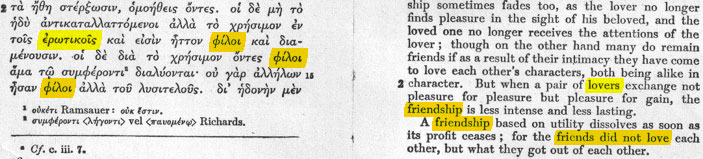
There’s Aristotle putting eros / erotic and phil… into the same context. (Today, there’s a difference between “friends” and “lovers”; so, the “friendship”/”friends” translation above should just be “love”/”lovers” or “sexual relationship”/”lovers.” Again, the translator is having to work with today’s corruption of phil…; that’s why the translation doesn’t sound/connect right.)
Here’s a different one in another context:
Aristotle: Vol. 19: The Nicomachean Ethics (350 BC); H. Rackham, M.A., Fellow of Christ’s College, Cambridge; Harvard University Press, London; 1926, revised 1934, reprinted 1975; pp. 572-573; Book IX, Chapter I.2:
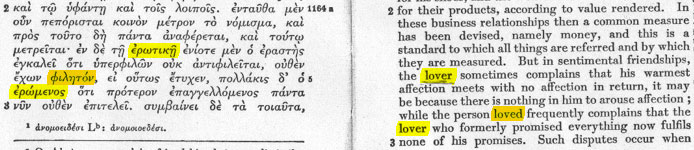
Here’s a good context in the Septuagint (the Early Christian Old Testament):
The Septuagint with Apocrypha: Greek and English, Brenton, 1998 (Originally published by Samuel Bagster & Sons, Ltd., London, 1851), p. 794, Proverbs 7:18”:

Indisputable.
A Greek-English Lexicon of the Septuagint, Lust / Eynikel / Hauspie, 1996, part two, p. 503, “φιλία,-ας”:
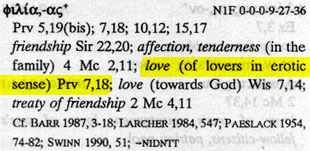
Ouch, that’s gotta hurt (if you be today’s religious leaders).
http://www.thefamily.org/dossier/books/book5/main.htm, Christianity and Sex, “Are We Now Entering the Dawning of a Christian Sexual Reformation?”:
And passages like the following from the Book of Proverbs, compiled and written by that wisest of Israel's king, Solomon, is helping more than a few find out that foreplay is fun: “Let her be as the loving(φιλιας, philias) hind and pleasant roe; let her breasts satisfy thee at all times; and be thou ravished always with her love(φιλια, philia)” ( (Proverbs 5:19).
(Greek from the Septuagint, which was the Early Christian Old Testament.) All I can say is that you’re the boob if you can’t believe it now.
Phil… in context with Aphrodite:
Hesiod: The Homeric Hymns and Homerica (c. 775 BC); translated by Hugh G. Evelyn-White, M.A.; Harvard University Press; 1914, reprinted 1977; pp. 150-151 (The Theogony, II. [lines] 979-983:

Miscellaneous sexual:
A Greek-English Lexicon (unabridged), Liddell & Scott, Oxford, 1871, p. 1756, “φιλ…”:
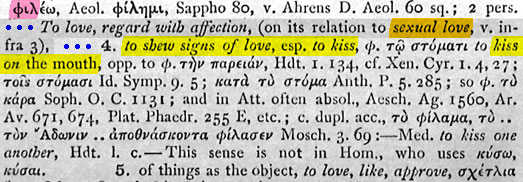
And, of course, “φιλέω” is the exact text of Jesus’ and Peter’s agape-phileo conversation in John 21:15-17 (discussed above).
P. 1757:

P. 1764:

…
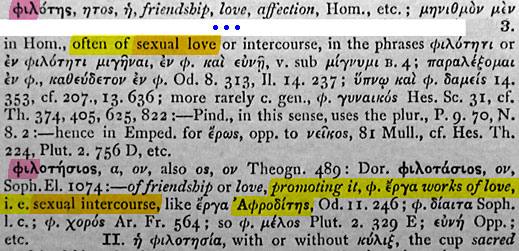
Regarding “φιλοστοργέω” above and below:
The Word Study Concordance, Wigram/Winter, Tyndale House Publishers, 1978, p. 787, “5387 | φιλόστοργος, philostorgos” (Romans 12:10):
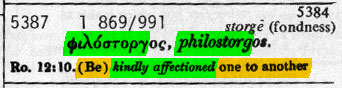
Thanks Paul. See the “sexual love” above and below for this Greek word. Also, the definitions tell e.g. “freq. of family affection”; therefore, Paul’s use of the word for everyone to have it for “one to another” moves away from the traditional family. This is apparently Paul’s parallel to Jesus’ John 13:34-35. (This also indicates that “storge” has “sexual love” in its definition. Other lexicons tell the same for storge alone.)
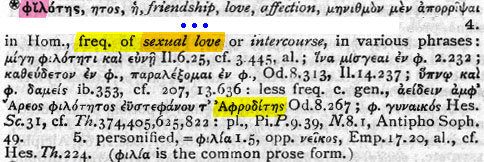
A Greek-English Lexicon with a Revised Supplement (unabridged), Liddell & Scott, Oxford, 1996 (first edition 1843), p. 1933, “φιλ…”:

P. 1940:
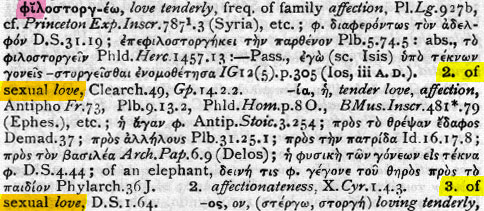
P. 1941:
ΑΡΙΣΤΟΝ ΕΛΛΗΝΟΑΓΓΛΙΚΟΝ ΛΕΞΙΚΟΝ (Most Excellent Greek-English Dictionary), Michigan Press, 1969, Vol. A, pp. 714-718, “φιλ…”:
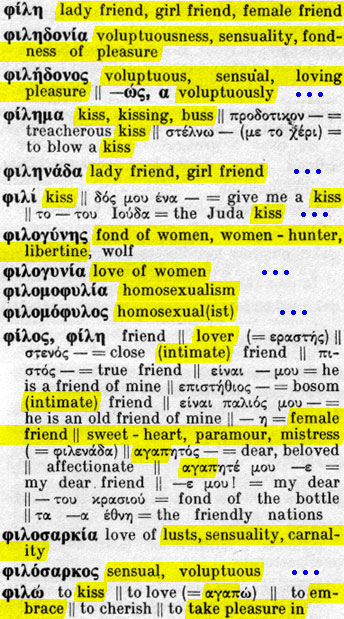
Oxford Greek-English Learner’s Dictionary, Stavropoulos, 1988, p. 938, “φίλος”:

A Lexicon of the Homeric Dialect, Cunliffe, 1963, pp. 408-409, “φιλ…”:
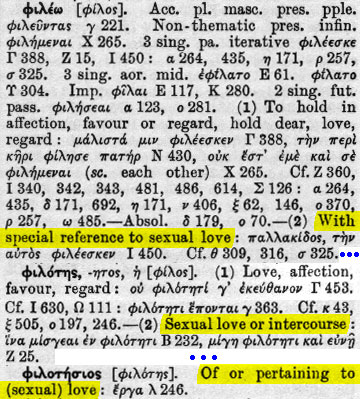
Again, regarding Jesus’ and Peter’s agape-phileo (φιλέω) conversation in John 21:15-17:
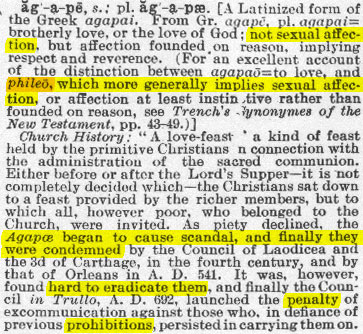
The International Encyclopaedic Dictionary, 1901, p. 105, “ăg'-a-pē”:
http://ancienthistory.about.com/od/sexualit1/a/LoveMagic.htm, Greek Eros and Philia Love Magic:
The agape or philia of the Greeks included affection, and also the sexual passion felt towards our mates, according to the University of Chicago's Christopher A. Faraone.
A Greek and English Lexicon, Wright, 1861, p. 461:

An Etymological Dictionary of the English Language, Skeat, 1983, p. 447, “PHILANDER”:

“ανδρος” is “men”; therefore “φιλ” is simply “sexual loving.”
The Word Study Concordance, Wigram/Winter, Tyndale House Publishers, 1978, p. 786, “5362 | φίλανδρος, philandros”:
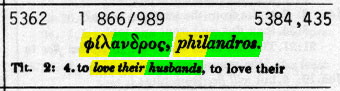
That’s Titus 2:4. And, ανδρος can be either “men” or “husbands” depending on however you want it. Either way it’s sexual.
Work Origins and Their Romantic Stories, Funk, 1978, p. 43, “PHILANDER”:
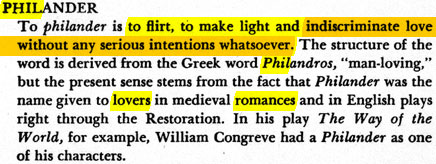
http://www.answers.com/philander&r=67, (Dictionary), (GIF image):
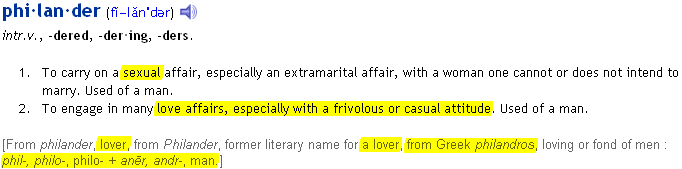
From the Greek, it definitely has a “sexual” meaning.
http://www.everything2.com/index.pl?node=philter, Philter@Everything2.com:
Phil"ter (?), n. [F. philtre, L. philtrum, Gr. , fr. to love, dear, loving.]
A potion or charm intended to excite the passion of love. …
Phil"ter, v. t. [imp. & p. p. Philtered (?); p. pr. & vb. n. Philtering.]
1.
To impregnate or mix with a love potion; as, to philter a draught.
2.
To charm to love; to excite to love or sexual desire by a potion.
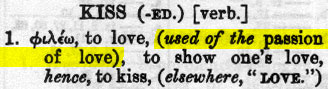
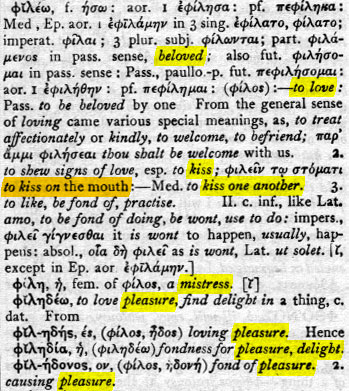
Kiss:
And, of course, “φιλέω” is the exact text of Jesus’ and Peter’s agape-phileo conversation in John 21:15-17 (discussed above).
A Critical Lexicon and Concordance to the English and Greek New Testament, Bullinger, 1908 (republished 1999), p. 484, “KISS (-ED.) [verb.] | φιλέω”:
Greek-English Lexicon: Abridged Edition, Liddell & Scott, Oxford, 1871, impression of 1994, p. 758, “φιλέω”:
Lonely Planet Language Survival Kit: Greek Phrasebook, Hellander, 1995, p. 185, “kiss”:

Harrap’s Greek Phrase Book, Lexus, 1989, p. 118, “φίλ…”:

Greek-English Lexicon of the New Testament Based on Semantic Domains, Louw & Nida, United Bible Societies, 1989, Vol. 1, p. 455, “Kiss, Embrace | 34.62 φιλέω”:
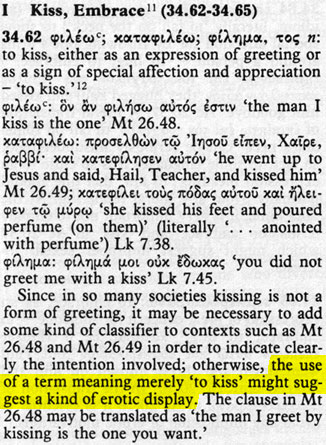
P. 456:
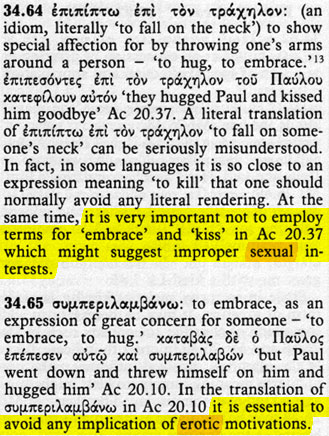
Why would Paul order it if it had strong “sexual” and “erotic” implications?