AMOR
Another Latin name for Eros / Cupid
Eros (Greek Ερως or ερως; ερωτικός [erotic])
Mythologies of the World: A Concise Encyclopedia, Shapiro & Hendricks, 1979, p. 12, “Amor”:

Who’s Who in Greek and Roman Mythology, Kravitz, 1976, p. 92, “Eros”:

Classics Illustrated Dictionary, Fuchs, 1974, p. 13, “Amor”:

Greek & Roman Mythology, Translated by Elizabeth Burr, 1994, p. 76, “Cupid”:

Merriam-Webster’s Encyclopedia of World Religions, 1999, p. 271, “Cupid”:

Homosexual:
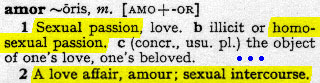
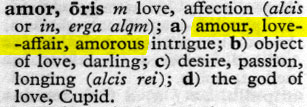
Oxford Latin Dictionary, Glare, 1982, p. 120, “amor”:
(There’s more later.)
Amor part of agape definition:
Pequeño Larousse Ilustrado (Short Larousse Illustrated) (monolingual Spanish), 1966, p. 1094, “Ágape”:

(Ágape (del gr. agape, amor), convite de caridad de los primeros cristianos en recuerdo de la ùltima Cena de Jesucristo y durante el cual cambiaban el beso de Paz. Habiendo dado lugar a abusos, fueron suprimidos por la Iglesia.)
Entire definition translated from Spanish:
Ágape (of the gr. agape, amor), banquet of charity of the first Christians in memory of Last Supper of Jesus Christ and during which they exchanged the kiss of Peace. Having given rise to abuses, was suppressed by the Church.
P. 1110:

Enciclopedia Vniversal Ilvstrada: Evropeo-Americana (Illustrated Universal Encyclopedia: European-American) (monolingual Spanish), 1908, Vol. 3, p. 267, “ÁGAPE”:
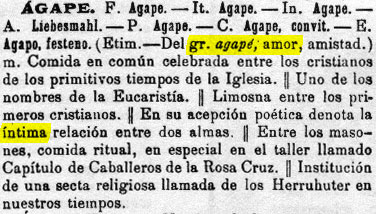
Lexipedia (Encyclopedia Britannica of Mexico), 1991, Vol. 1, p. 29, “ÁGAPE”:
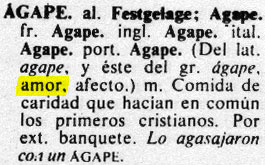
In text:
ÁGAPE. al. (alemán) Festgelage; Agape. fr. (francés) Agape. ingl. (ingles) Agape. ital. (italiano) Agape. port. (portugués) Agape. (Del lat. (latin) agape, y éste del gr. (griego) ágape, amor, afecto.) m. (masculino) Comida de caridad que hacian en común los primeros cristianos. Por ext. banquete. Lo agasajaron con un ÁGAPE.
Translated from Spanish, via http://dictionary.reference.com/translate/text.html & http://wordreference.com/:
ÁGAPE. german Festgelage; Agape. french Agape. english Agape. italian Agape. portuguese Agape. (Of Latin agape, and this one of the greek ágape, amor, affection.) masculine [form] Food of charity that do/make in common the first Christians. By extensión banquet. They smother with attentions it with an ÁGAPE.
P. 63:

Translated from Spanish:
Amor, reciprocal (mutual/common) sexual attraction.
http://www.nadiagreco.hpg.ig.com.br/mulher.htm, (in Portuguese):
Estes devotos providos de “ágape” - “deleite de amor” ou “casamento espiritual” - praticado pelos Cristãos Gnósticos como os Ofitas. Outro nome para o “agape” era “synesaktism”, “O Caminho de Shaktism” significando o Tântrico culto à yoni. Synesaktism foi declarada heresia antes do século 7. Subseqüentemente o “deleite de amor” desapareceu, e as mulheres foram esquecidas da participarem diretamente na devoção Cristã de acordo com a regra de São Paulo (1 Timóteo 2: 11-12) .
Of course, “deleite de amor” is “delight of Eros” as it defines “agape.”
Translation from Portuguese:
These devotees provided with “agape” – “delight of amor” or “spiritual marriage” - as practiced by the Christian Gnostics Ophite. Another name for the “agape” was “synesaktism,” “The Way of Shaktism” meaning the Tantric worship to Yoni. Synesaktism was declared heresy before the 7th century. Subsequently the “delight of amor” disappeared, and women have forgotten the part directly in the Christian religion in accordance with the rule of St. Paul (1 Timothy 2: 11-12).
AMORous, AMORist, etc.:
Random House Word Menu, 1992, p. 733, “Character and Behavior | Sex, Love, and Romance | amorous”:

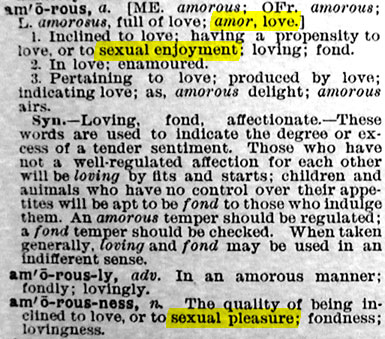
Webster’s Universal Dictionary of the English Language (unabridged), 1909, p. 55, “amorous...”:
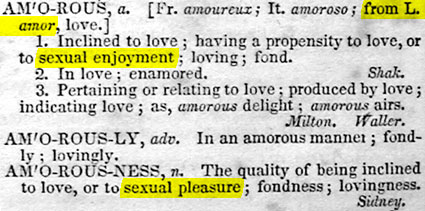
An American Dictionary of the English Language, Noah Webster, 1856, p. 43, “AMOROUS…”:
Merriam Webster’s Collegiate Dictionary, 1997, pp. 38-39, “amor…”:
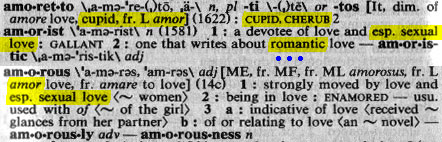
The Concise Oxford Dictionary of Current English, 1964, p. 39, “amorist”:

AMORe (Italian); AMOuR (French):
Enciclopedia Vniversal Ilvstrada: Evropeo-Americana (Illustrated Universal Encyclopedia: European-American) (Spanish), 1909, Vol. 5, p. 237, “AMOR”:

Key:
F. = Francés / French
It. = Italiano / Italian
In. = Inglés / English
A. = Alemán / German
P. = Portugués / Portuguese
C. = Catalán / Catalonian (northeast region of Spain)
E. = Esperanto / Esperanto (artificial international language)
Enciclopedia Italiana: Di Scienze, Lettere ed Arti (Italian Encyclopedia: Of Sciences, Letters and Arts), 1950, Vol. 3, p. 30, “AMORE”:

Collins Latin Gem Dictionary, Kidd, 1957, p. 374 (English-Latin), “amorous”:

http://www.weddingmuseum.com/tools/song233.htm, That’s Amore Lyrics - Dean Martin:
When the
moon hits your eye like a big pizza pie
That's amore
http://www.newadvent.org/cathen/03510a.htm (Catholic Encyclopedia), Early Roman Christian Cemeteries, “The Vatican Cemetery”:
In the fifth century members of the imperial family found a resting-place in the vicinity of the Apostle's tomb. It was long a favourite burial-place; in 689 the Saxon king, Cedwalla, was laid to rest there, "ad cujus [sc. apostolorum principis] sacratissimum corpus a finibus tenae pio ductus amore venerat', says Bede (H.E., v, 7), who has preserved the valuable metrical epitaph put up by order of Pope Sergius ending with: "Hic depositus est Caedual, qui et Petrus, rex Saxonum," etc. The "Grotte Vecchie" and the "Grotte Nuove", or subterraneous chapels and galleries in the vicinity of the tomb of St. Peter, cover the site of this ancient Christian cemetery; in them lie buried also a number of popes; St. Gregory I, Boniface VIII, Nicholas V, Alexander VI.
Translation from Latin (main source: http://lysy2.archives.nd.edu/cgi-bin/words.exe [Univ. of Notre Dame]):
|
ad cujus [sc. apostolorum principis] sacratissimum corpus a finibus tenae pio ductus amore venerat |
to of whom [? apostles leader] sacred body from boundaries/limits hold/keep affectionate/holy/cleanse/pious conducting love, affection; the beloved; Cupid; affair; sexual/illicit/homosexual passion had come by; venerate/worship |
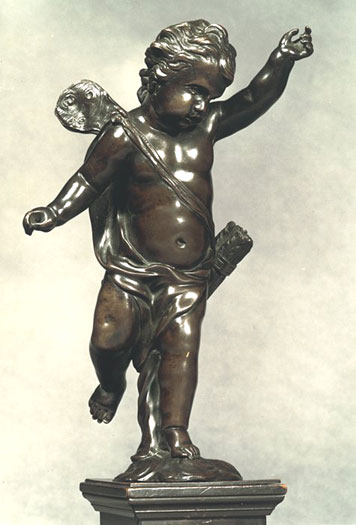
http://www.patwengraf.com/dellaValle1.htm, The model attributed to FILIPPO DELLA VALLE (Florence, 1698 – Rome, 1768), Standing Amore:
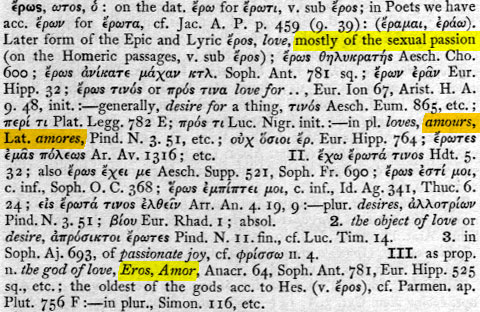
A Greek-English Lexicon (unabridged), Liddell & Scott, Oxford, 1871, p. 608, “έρως”:
Langenscheidt’s Pocket Latin Dictionary, Handford / Herberg, 1966, p. 37, “amor”:
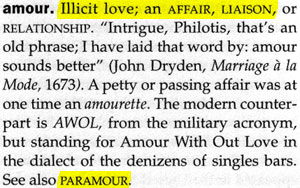
Rawson’s Dictionary of Euphemisms and Other Doubletalk, 1995, p. 26, “amour”:
Larousse du XXe Siècle (Larousse of the 20th Century) (monolingual French)), 1928, “AGAPE”:

… “AMOUR”:

Larousse du XXe Siècle (Larousse of the 20th Century) (monolingual French), 1930, “EROTIQUE”:

No wonder the French are more open minded.
Petit Larousse (Short Larousse) (monolingual French), 1967, p. 21, “AGAPE”:

(AGAPE n. f. (gr. agapê, amour). Dans la primitive Eglise, repas que les fidèles prenaient en commun. (V. Part. Hist.) – Pl. Par est. Repas entre amis.)
Translated from French:
AGAPE n. f. (gr. agapê, amour). In the primitive Church, meal that the faithful ones took jointly. (V Part. Hist.) | – Pl. By is. Meal between friends.
P. 393 (Eros & erotic forms):

Nouveau Petit Larousse illustré Dictionnaire Encyclopédique (New Short Illustrated Larousse Dictionary Encyclopedia) (monolingual French), 1940, p. 38, “AMOUR”:

P. 372 “ÉROTIQUE” (erotic):

ÉROTIQUE adj. (du gr. erôs, -ôtos amour). Qui a rapport à l’amour : les poésies érotiques de Catulle. Licencieux.
Translated from French:
EROTIC adj. (of the gr. erôs, -ôtos amour). Who has connection with the love : erotic poetries of Catullus (born 82 BC). Licentious.
http://homepage.mac.com/cparada/GML/000Free/000Psyche/source/6.html, Psyche Album 6/10:

4125: Joseph-Marie Vien 1716-1809: Psyché reconnaissant l'Amour endormi, 1761. Palais des Beaux-arts, Lille.
http://homepage.mac.com/cparada/GML/000Free/000Psyche/source/9.html, Psyche Album 9/10:
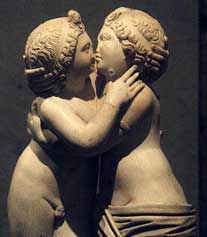
5811: Amour et Psyche IV siècle après J.-C. Ostia Antica, Musée.
Latin Vulgate – 1 Peter 1:22 & 2 Peter 1:7 :
http://www.quicklatin.com, QuickLatin: A Latin-to-English Translation Assistant (a $29 download program [free 30 day evaluation available]):
(Latin / Vulgate text is copy-pasted from http://www.sacred-texts.com/bib/vul/, Vulgate (Latin Bible).)
The upper left panel is the Latin / Vulgate text, and the upper right panel is the translated English. When I place my cursor over the word “amore” I get the Latin definition in the lower panel:
1 Peter 1:22-23:
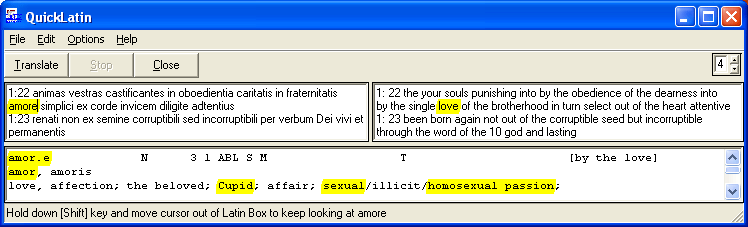
2 Peter 1:7-8:
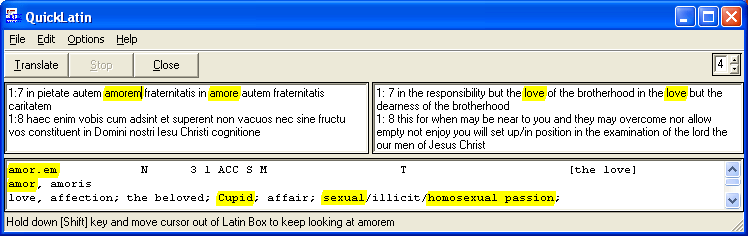
Yep, that’s what it is saying. Peter, who wrote both of these, was one of Jesus’ principal disciples. Yeah, now I can see why the Catholics didn’t want anyone to read the Latin Bible. They want to keep the people dumb – that’s the way they like it, uh-huh, uh-huh.
(The same Latin definition can be found at http://lysy2.archives.nd.edu/cgi-bin/words.exe?amore OR http://lysy2.archives.nd.edu/cgi-bin/words.exe?amor [Univ. of Notre Dame].)
http://www.perseus.tufts.edu/cgi-bin/ptext?doc=Perseus%3Atext%3A1999.04.0059%3Aentry%3D%232295, Charles T. Lewis, Charles Short, A Latin Dicitionary, “ămor”:
Vulg. 2 Reg. 1, 26 : in paternitatis amore, brotherly love (Gr. philadelphia), ib. 1 Pet. 1, 22; ib. 2 Pet. 1, 7 bis: amplecti aliquem amore, Cic. Att. 7, 1 : habere amorem erga aliquem, id. ib. 9, 14 : respondere amori amore, id. ib. 15, 21 : conciliare amorem alicui, id. de Or. 2, 51 et saep.--Of sexual love, whether lawful or unlawful: Medea amore saevo saucia, Enn. Med. ap. Auct. ad Her. 2, 22 (as a transl. of the Gr. erôti thumon ekplageis Iasonos, Eur. Med. prol. 8): videbantur illi (septem anni) pauci dies prae amoris magnitudine, Vulg. Gen. 29, 20 ; 29, 30: is amore projecticiam illam deperit, … Vulg. 2 Reg. 13, 15 : ambo vulnerati amore ejus, ib. Dan. 13, 10 al.
Daniel 13 is not in the KJV. It’s in the Catholic bibles, e.g., Douay-Rheims Version (transated from Latin in 1582), (and is Susanna 1 in the Apocrypha):
http://drbo.org/chapter/32013.htm, Latin Vulgate: Douay-Rheims Bible, Daniel 13:10-11:
10 So they were both wounded with the love (amore) of her, yet they did not make known their grief one to the other: 11 For they were ashamed to declare to one another their lust, being desirous to have to do with her.
http://www.usccb.org/nab/bible/daniel/daniel13.htm, New American Bible (NAB, Catholic, translated 1970): Daniel, Chapter 13:10-11:
10 Though both were enamored (amore) of her, they did not tell each other their trouble,
11 for they were ashamed to reveal their lustful desire to have her.
http://exodus2006.com/susanna.htm, Susanna: (Chapter 13 of the Greek Version of Daniel):
10Both were overwhelmed with passion (amore) for her, but they did not tell each other of their distress,11for they were ashamed to disclose their lustful desire to seduce her.
Therefore, Jerome, who translated the Greek to the Latin Vulgate, around 400 AD, had to be aware of the meaning and context of “amore,” stating that the Christian brotherhood / brethren were in sexual love with one another, which sounds like an orgy to me.
http://vulsearch.sourceforge.net/html/Dn.html, Vulgata Clementina, Prophetia Danielis (The Vulgate, Daniel 13):
10 Erant ergo ambo vulnerati amore ejus, nec indicaverunt sibi vicissim dolorem suum : 11 erubescebant enim indicare sibi concupiscentiam suam, volentes(wishing) concumbere(to lie with / together [for sexual intercourse]) cum(with) ea(she).
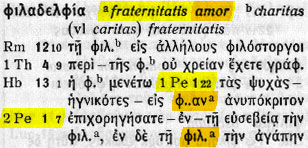
By the way, fraternitatis is the Greek phil… (φιλ…):
Handkonkordanz zum griechischen Neuen Testament (Pocket Concordance to the Greek New Testament) (from Greek to Latin Vulgate words), Schmoller, 1994, p. 507, “φιλαδελφία”:
1 Peter 1:22 (NKJV):
Since you have purified your souls in obeying the truth through the Spirit in sincere love of the brethren, love one another fervently with a pure heart,
2 Peter 1:5-7:
5But also for this very reason, giving all diligence, add to your faith virtue, to virtue knowledge, 6to knowledge self-control, to self-control perseverance, to perseverance godliness, 7to godliness brotherly kindness, and to brotherly kindness love.
http://www.perseus.tufts.edu/cgi-bin/ptext?layout.reflang=la;layout.refdoc=Perseus%3Atext%3A1999.04.0060;layout.reflookup=fraternitatis;layout.refcit=;doc=Perseus%3Atext%3A1999.04.0059%3Aentry%3D%2318710, Charlton T. Lewis, Charles Short, A Latin Dictionary, “fraternitas”:
|
Some Words that Regularly Appear with fraternitas |
|||||
|
In Latin Prose (2 total): |
caritas |
amor |
- |
- |
- |
|
In Latin Texts (2 total): |
caritas |
amor |
- |
- |
- |
|
Click on a corpus name to see more co-occurring words |
Click on a word to see its definition |
Click here for help with this tool |
|||
http://www.perseus.tufts.edu/cgi-bin/ptext?doc=Perseus%3Atext%3A1999.04.0059%3Aentry%3D%232295, Charlton T. Lewis, Charles Short, A Latin Dictionary, “ămor”:
Of sexual love, whether lawful or unlawful: Medea amore saevo saucia, Enn. Med. ap. Auct. ad Her. 2, 22 (as a transl. of the Gr. erôti thumon ekplageis Iasonos, … Personified: Amor, the god of love, Love, Cupid, Erôs:
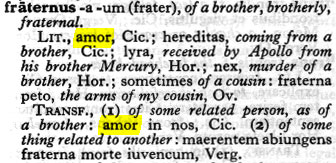
Cassell’s Latin Dictionary, Simpson, 1968, p. 255 (Latin-English), “frāternus”:
http://www.rostra.dk/latin/saxo.html, Saxo Grammaticus (monolingual Latin) “F | fraterne”:
fraterne i.q. cum amore fraterno
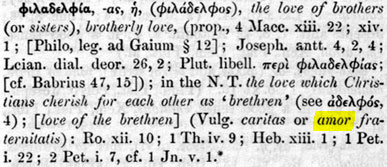
Thayer’s Greek-English Lexicon of the New Testament, 1889, Baker Books 1997, p. 653, “φιλαδελφία”:
There’s just so much “evil” mixed up with these Bible words, if sex is evil.