DILECTIO / DILIGO & CARITAS / CHARITAS
Agape’s parallel words in the Latin Vulgate, translated from Greek c. 400 by Jerome, for the Roman people. Base forms: dilect… / dilig… & carit… / chari….
(Agape [Greek: αγαπ… or ηγαπ…]; Eros [Greek Ερως or ερως; ερωτικός {erotic}])
Keywords: A Vocabulary of Culture and Society, Williams, Oxford, 1976, p. 45, “Charity”:

Again, in Latin “amor” also “amo”(a form of amor) represent Eros and Cupid:
http://www.newadvent.org/fathers/120114.htm (Catholic Encyclopedia), The City of God (Book XIV) (by Saint Augustine of Hippo, c. 412-426 AD), “Chapter 7.—That the Words Love and Regard (Amor and Dilectio) are in Scripture Used Indifferently of Good and Evil Affection”:
“Peter, too, throughout used one word for the one thing, and the third time also replied, Lord, You know all things, You know that I love (amo) You.
I have judged it right to mention this, because some are of opinion that charity or regard (dilectio) is one thing, love (amor) another. They say that dilectio is used of a good affection, amor of an evil love. But it is very certain that even secular literature knows no such distinction. However, it is for the philosophers to determine whether and how they differ, though their own writings sufficiently testify that they make great account of love (amor) placed on good objects, and even on God Himself. But we wished to show that the Scriptures of our religion, whose authority we prefer to all writings whatsoever, make no distinction between amor, dilectio, and caritas”
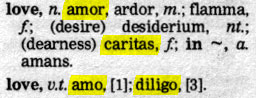
The Oxford Latin Minidictionary, Morwood, 1995, p. 487 (English-Latin), “love”:
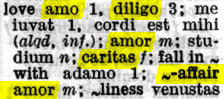
Langenscheidt’s Universal Latin Dictionary, Costa / Herberg, no date, p. 349 (Latin-English), “love”:
http://www.rostra.dk/latin/saxo.html, Saxo Grammaticus (monolingual Latin) “C | caritas”:
caritas, -tis I de pretio (opp. vilitas) II de amore A accedit is qui amatur 1 per gen.obi.2 per adi. B accedit is qui amat 1 per gen. 2 per adi. C abs. ponitur III vergit in notionem cupiditatis
“D | dilectio”:
dilectio, -nis i.q. amor 1 c.gen.obi. 2 c.adi.
“D | diligo”:
diligo, , -lexi, -lectum, -ligere i.q. amo
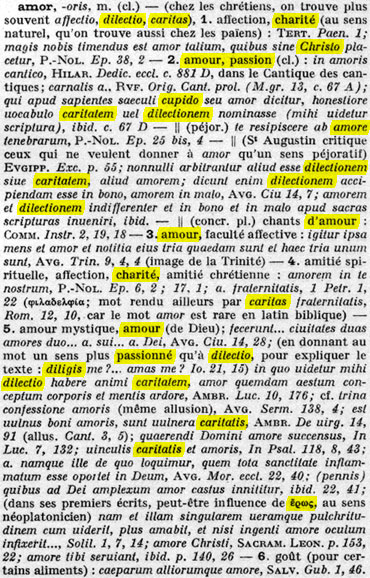
Dictionnaire Latin-Français des Auteurs Chretiéns (Latin-French Dictionary of the Christian Authors), Chirat, 1954, p. 78, “amor”:
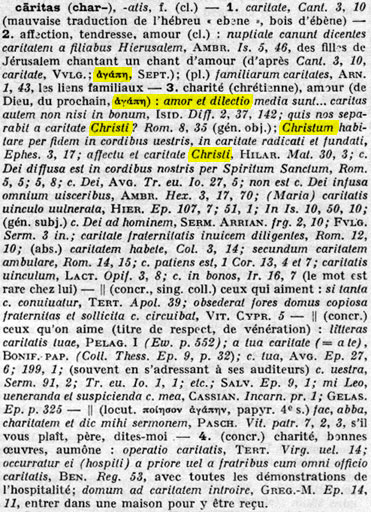
P. 134, “caritas”:
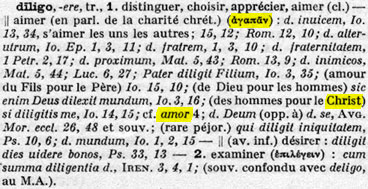
P. 273, “diligo”:
A few Bible examples:
Base form: dilectio / diligo:
http://www.biblegateway.com/passage/?book_id=50&chapter=13&version=4, Biblia Sacra Vulgata (Jerome’s Latin Vulgate, c. 405 AD), “Ioannes 13” (John 13:34):
34mandatum novum do vobis ut diligatis invicem sicut dilexi vos ut et vos diligatis invicem
John 13:34 (NKJV):
A new commandment I give to you, that you love one another; as I have loved you, that you also love one another.
Base form: caritas / charitas:
Matthew 24:11-12 (Douay-Rheims version, 1899):
11And many false prophets shall rise, and shall seduce many.
12And because iniquity hath abounded, the charity [Greek: agape love] of many shall grow cold.
Romans 8:39 (Douay-Rheims version, 1899):
Nor height, nor depth, nor any other creature, shall be able to separate us from the (sexual) love of God, which is in Christ Jesus our Lord.
Also “agape” love: Song of Solomon love. Notice how by just adding the “sexual” word changes the entire meaning from a cop-out to an instruction.
Romans 12:10 (KJV):
Be kindly affectioned one to another with brotherly love; in honour preferring one another;
(Vulgate: caritatem fraternitatis invicem diligentes honore invicem praevenientes)
Jude 1:2:
Mercy unto you, and peace, and love, be multiplied.
(Vulgate: misericordia vobis et pax et caritas adimpleatur)
Some opposition:
http://www.perseus.tufts.edu/cgi-bin/ptext?doc=Perseus%3Atext%3A1999.04.0059%3Aentry%3D%232295, Charlton T. Lewis, Charles Short, A Latin Dictionary, “ămor”:
I. love (to friends, parents, etc.; and also in a low sense; hence in gen., like amo, while caritas, like diligere, is esteem, regard, etc.; hence amor is used also of brutes, but caritas only of men; (but, they appear to have started out as the same meaning) … Of sexual love, whether lawful or unlawful … Personified: Amor, the god of love, Love, Cupid, Erôs
Specific dilectio / diligo:
The New College Latin & English Dictionary, Traupman, 1966, p. 85 (Latin-English), “dīlect·us”:

A Latin-English Dictionary of St. Thomas Aquinas, Deferrari, 1960, p. 298, “diligo”:
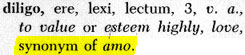
Harpers’ Latin Dictionary, Lewis / Short, 1879, p. 579, “dīlect…”:
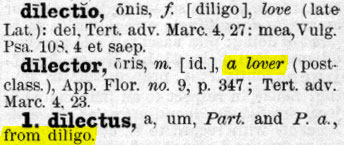
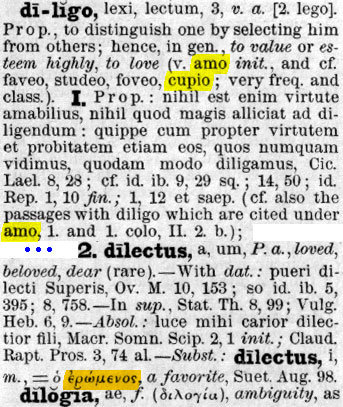
P. 580, “dīlĭgo | dīlectus”:
Dilectus / dilectis example:
Romans 1:7:
To all who are in Rome, beloved [erotic] of God, called to be saints: Grace to you and peace from God our Father and the Lord Jesus Christ.
http://speedbible.com/vulgate/B45C001.htm, Jerome's Latin Vulgate (405 A.D.), “Romans | Chapter 1”:
7 |
omnibus qui sunt Romae dilectis Dei vocatis sanctis gratia vobis et pax a Deo Patre nostro et Domino Iesu Christo |
Dilect… is used a lot in Song of Solomon.
http://www.perseus.tufts.edu/cgi-bin/ptext?doc=Perseus%3Atext%3A1999.04.0060%3Aentry%3D%234611, Charlton T. Lewis, Charles Short, A Latin Dictionary, “dīligō”:
dīligō lēxī, lēctus, ere [dis- + 2 lego] , to single out, value, esteem, prize, love: alqm: se ipse: inter se: civitates eum diligebant, Cs.: magno dilectus amore,
A Glossary of Later Latin: To 600 A.D., Souter, Oxford, 1957, p. 104, “dilectio”:

Specific caritas / charitas:
Dictionary of Ecclesiastical Latin (Latin-English), Stelten, 1995, p. 40, “cháritas”:

http://learningtogive.com/papers/index.asp?bpid=8, Charity (Informational Paper), “Historic Roots and Meaning”:
The English word "charity" can be traced back to the 4th Century when St. Jerome translated the Bible from Greek into Latin. … St. Jerome chose the word "caritas" or "charitas" as a synonym for "agape."
http://www.whyplato.info/Plato's_Importance_body.html, Plato's Unique Importance:
Through its distinctions the will affirms the causally freely choosing active power of the supreme soul, which has the unity of intelligence, will and desire for joy. It defines the name of Plato's 'Creator God', whose generosity shares His joys of possible beauty and intricacy with the human race by creating it in His 'likeness'. Neither determinism nor necessity are His motives, or qualities that force Him to do anything. Generosity is the characteristic of His activity that is the expression of love. It is 'the law of love'. It rules with the tripartite unity of love as 'Eros'-'caritas' and 'agape'; representing moments of orgiastic, uniting joy; taking on the sharing care for other lives; and joyful thanksgiving to the Creator of the Cosmos.
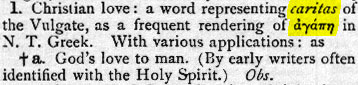
The Oxford English Dictionary, 1933, “Charity”:
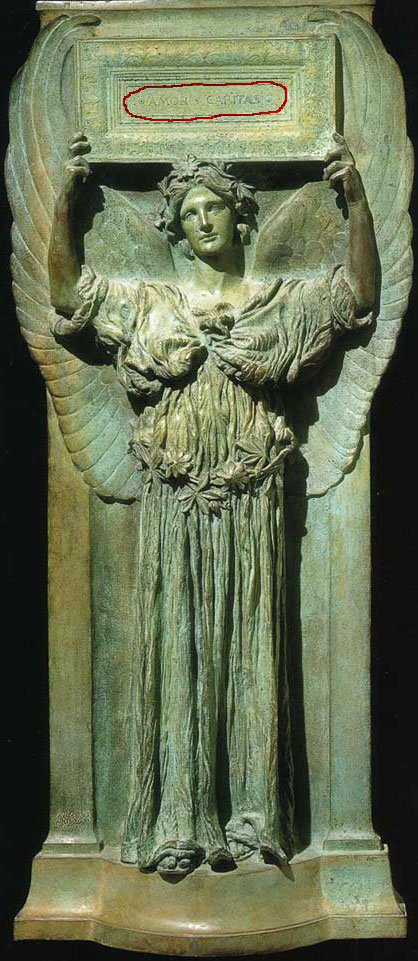
http://www.listonart.com/Art_Of_The_Month/2005/Pages/Amor_Caritas.htm, Amor Caritas, 1899, by Augustus Saint-Gaudens:
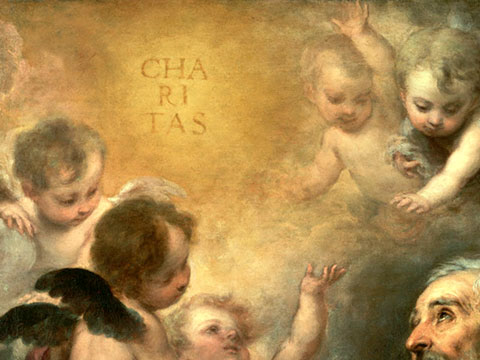
http://www.getty.edu/art/acquisitions/murillo.html, The Vision of Saint Francis of Paola:
Spanish, Seville, about 1670 … Spanish painter Bartolomé Esteban Murillo … Saint Francis founded the austere but charitable monastic order of the Minims, alluded to in his vision of the word charitas (charity) surrounded by hovering putti (erotes):

“Detail: CHARITAS and putti”:
Clicking hyperlink “putti” above (at website) begets:
http://www.getty.edu/art/collections/glossary/g1246.html, “putti”:
putti
A nude infant frequently depicted in Renaissance and Baroque art, derived from representations of the god of love, Eros, in ancient Greek and Roman art. A putto may be called a cherub when shown with wings.
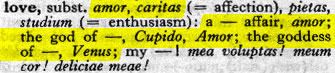
Cassell’s Latin Dictionary, Simpson, 1968, p. 756 (English-Latin), “love”:
http://es.wikipedia.org/wiki/C%C3%A1ritas (monolingual Latin), “Cáritas”:
El nombre Cáritas (del latín caritas 'amor, caridad', pronunciado ['karita:s]), proviene de la teología católica y es una de las tres virtudes teologales.
New Catholic Encyclopedia, 1967, Vol. 4, p. 395, “Courtly Love”:
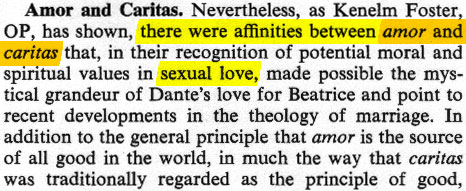
Affinity means likeness / alike. I guess the above is a roundabout Catholic acknowledgement that Christ did order “sexual” love (via John 13:34) between His disciples (and everyone), in hopes to “save their souls,” but I still don’t clearly / understandably hear it for the public at Mass, or on the ten o’clock news. The above is not included in The Catholic Encyclopedia online (http://www.newadvent.org/cathen/), showing they’re now aware of the “problem” of that statement. (But, it’s a lot harder to remove something from a book than it is the Internet, eh?)
Webster’s New International Dictionary of the English Language, 1933, p. 372, “charity”:
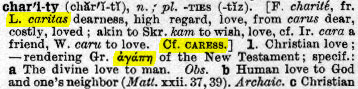
A Glossary of Later Latin: To 600 A.D., Souter, Oxford, 1957, p. 40, “caritas”:
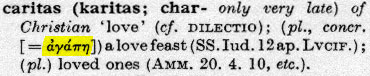
Some opposition:
The New Testament of the New American Bible: Saint Joseph Edition, 1986, “Bible Dictionary” p. 440, “CHARITY”:
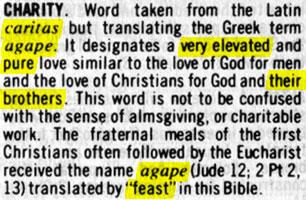
“Pure” is apparently added to get the sex – which “they” define as impure – out of caritas. Again, they have to completely remove all kinds of sex, including sex in marriage, out of these words, because both Jesus and Paul instructed to do this with one another, with each other, with everyone non-discriminately.
http://www.perseus.tufts.edu/cgi-bin/ptext?doc=Perseus%3Atext%3A1999.04.0059%3Aentry%3D%236811, Charlton T. Lewis, Charles Short, A Latin Dictionary, “cārĭtas”:
II. Trop., regard, esteem, affection, love (cf. amor, I.; in good prose; … Cic. Part. Or. 25, 88 ; hence, opp. amor, as esteem to personal affection
Charity:
Dictionary of Religion and Philosophy, MacGregor, 1989, p. 12, “Agape”:

The HarperCollins Bible Dictionary, Achtemeier, 1996, p. 174, “charity”:
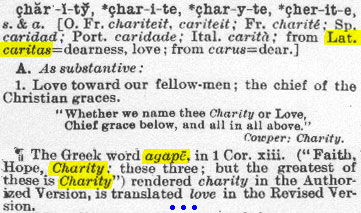
The International Encyclopaedic Dictionary, 1901, pp. 831-832:
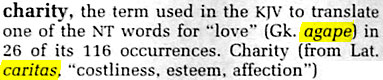
Random House Webster’s College Dictionary, 1995, p. 228, “charity”:

You know, I could easily just say that “agape” love didn’t include “charitable” love and only included sexual love, then I’d ethically be just like today’s church, but in reverse. But, I can’t because true love includes both sexual love and charitable love.
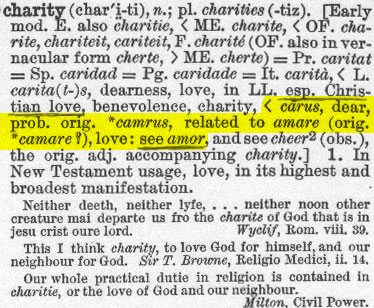
The Century Dictionary and Cyclopedia, 1897, p. 931, “charity”:
Bibliotheca Eliotae (Latin-English dictionary), Sir Thomas Elyot, 1548 (“M. D. XLVIII”), no page numbers, “Agape”:

Translated from Elizabethan English:
Agape … charity, mutual love.
The Barnhart Dictionary of Etymology, 1988, p. 160, “charity”:
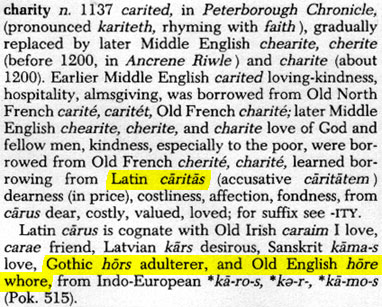
Origins: A Short Etymological Dictionary of Modern English, Partridge, 1983, p. 92, “charitable”:
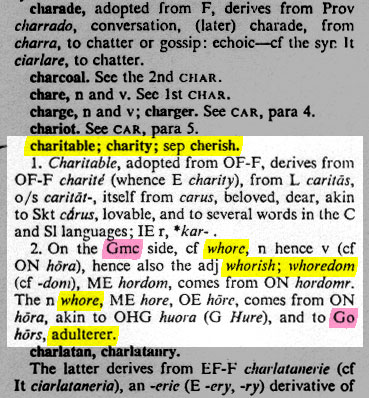
According to the abbreviations section on page xvi, “Gmc” means Germanic, and “Go” means “Gothic.”
An Etymological Dictionary of Modern English, 1967, Earnest Weekley, Vol. 1, p. 282, “charity”:
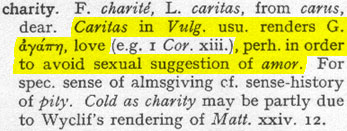
Some opposition there.
Duh, I don’t see any evidence where Jesus’ definition of love got corrupted:
http://members.iinet.net.au/~gduncan/images/BombingofDresden-dead2.jpg, via http://members.iinet.net.au/~gduncan/massacres_axis.html:

DRESDEN In one of the city squares 6,865 bodies were cremated.
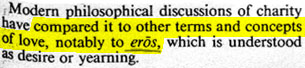
The New Encyclopædia Britannica, 1997, p. 103, “charity”:
Encyclopedia of Monasticism, 2000, Vol. 2, p. 1167, “Social Services: Eastern Christian”:
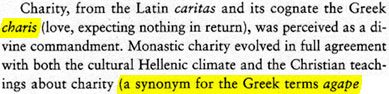
http://www.piney.com/Charismatic.html, Charismatic Worship:
Liddell and Scott
charis or pleasure includes:
4. love-charm, philtre, Luc. Alex.5, Merc.Cond.40.
2. esp. in erotic sense, of favours granted (v. charizomai 1.3 ), alochou charin idein Il.11.243 , cf. A.Ag.1206: more freq. in pl., X.Hier.1.34, 7.6, etc.; biai d' epraxas charitas ê peisas korên; Trag.Adesp.402; in full, charites aphrodisiôn erôtôn Pi.Fr.128 , cf. Pl.Phdr.254a, al.
Acts 2:46-47 (NKJV):
46So continuing daily with one accord in the temple, and breaking bread from house to house, they ate their food with gladness and simplicity of heart, 47praising God and having favor (Greek charis) with all the people. And the Lord added to the church daily those who were being saved.
“Grace” (Greek charis): Sure, it’s possible that a sexual word would be changed to not only remove the sex, but to support a large artificial salvation cop-out. That’s what’s called hitting two birds with one stone.
Acts 28:27-28:
27And when he desired to cross to Achaia, the brethren wrote, exhorting the disciples to receive him; and when he arrived, he greatly helped those who had believed through grace (Greek charis); 28for he vigorously refuted the Jews publicly, showing from the Scriptures that Jesus is the Christ.
Of course, this relates to Jesus’ command:
John 13:34-35:
34A new commandment I give to you, that you love one another; as I have loved you, that you also love one another. 35By this all will know that you are My disciples, if you have love (agape) for one another.”
Acts 20:24:
But none of these things move me; nor do I count my life dear to myself, so that I may finish my race with joy, and the ministry which I received from the Lord Jesus, to testify to the gospel of the grace (Greek charis) of God.
Any other pleasantries / joys than sex, would not be as powerful. If it’s not sex, someone could easily more impress with Heavenly / religiously accepted sex. Since sex is God’s greatest gift to mankind, giving another gift would not impress as much (unless they could somehow financially support everyone, and the apostles stated they accomplished this with little money). I don’t think the Christians could have grown so much of a following if all they were teaching is like the Romans are forgiven for wronging the people; which is what today’s definition of grace is.
The New Testament of the New American Bible: Saint Joseph Edition, 1986, “Study Guide | New Testament Themes” p. 429, “28. Grace”:
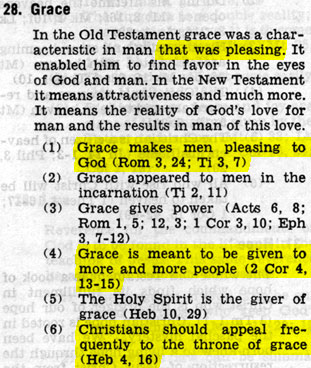
All these verses can be interpreted as grace being sexual pleasure with multiple partners as it helps in many other matters. Today’s church interprets all as salvation cop-outs. It’s like we can all be happy (have grace) for “a reason” or we can all be happy because it’s okay to sin. So, it’s how your soul wants to interpret it.
A Dictionary of Euphemisms, Holder, 1995, p. 60, “charity girl”:
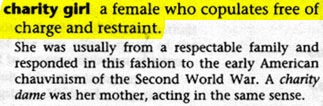
So “charity” between people is really free sex.
The Random House Dictionary of the English Language (Unabridged), 1987, p. 348, “Charites | charity”:
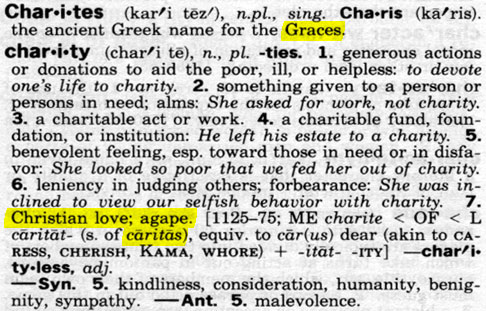
The Three Graces / Charites (pagan deities):
Cassell’s Latin Dictionary, Simpson, 1968, p. 102 (Latin-English), “Chărĭtes”:

Harpers’ Latin Dictionary, Lewis / Short, 1879, p. 325, “Chărĭtes”:
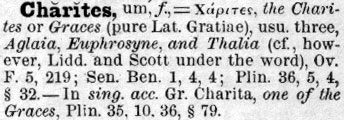
Larousse Greek and Roman Mythology, English translation 1980, pp. 63-64, “Charites”:
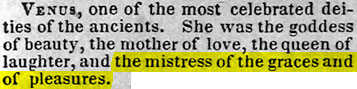
Lempriere’s Classical Dictionary, 1853, p. 416, “Venus”:
Funk & Wagnalls Standard Dictionary of Folklore, Mythology and Legend, 1972, p. 212, “Charites (Latin Gratiæ)”:
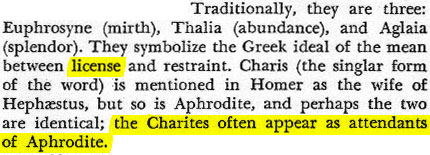
Classics Illustrated Dictionary, Fuchs, 1974, p. 44, “Chárites”:

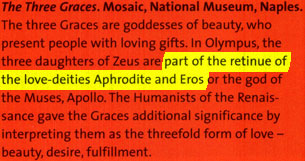
Αφροδίτη is Greek for Aphrodite, the goddess of sexual love.
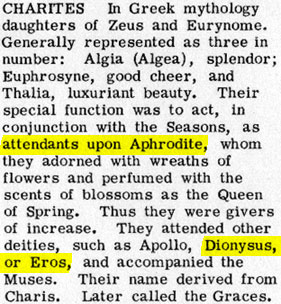
Dictionary of Mythology Folklore and Symbols, Jobes, 1962, Vol. 1, p. 314, “CHARITES”:
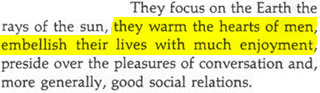
Sexualia: From Prehistory to Cyberspace, Bishop / Osthelder, 2001, p. 189, “The Classical World”:
Webster’s Universal Dictionary of the English Language (unabridged), 1909, (supplement:) A Dictionary of Noted Names in Standard Fiction, Mythology, Legend, Etc., p. 56, “Aphrodite”:
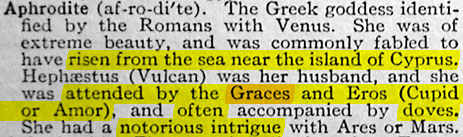
(Eros / Cupid / Amor is the god of sexual love.)
Random House Word Menu, 1992, p. 838, “Faith | Mythological and Folkloric Being”:

A Smaller Classical Dictionary, 1934, p. 197, “Dionysus”:

A Classical Dictionary of Greek and Roman Biography, Mythology and Geography, Smith, 1852, p. 265, “Dionysus”:

Dionysus / Bacchus was the god of wine, and most popular for having sex orgies.
Dictionary of Classical Mythology: Symbols, Attributes & Associations, Bell, 1982, p. 275, “CHARITES”:

http://www.johnny.moped.btinternet.co.uk/mythology/gods_goddesses/mythology_gods_... (10-30-02), Mythological gods and creatures of the night, “Charites”:
In Greek mythology the Charites (also known as the Graces) were beautiful sister goddesses, the daughters of Zeus, most often represented as three in number. Their names are synonymous with their attributes: Aglaia (“brilliance”, Euphrosyne (“joy”), and thalia (“bloom”). Their charm and winning manner made them welcome as the companions of the Muses and the attendants of Aphrodite, Eros, and Dionysus.
Mythologies of the World: A Concise Encyclopedia, Shapiro & Hendricks, 1979, p. 17, “Aphrodite”:

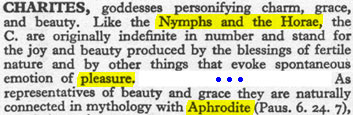
“Horae” relates to prostitution by the hour.
The Oxford Classical Dictionary, 1949, p. 184, “CHARITES”:
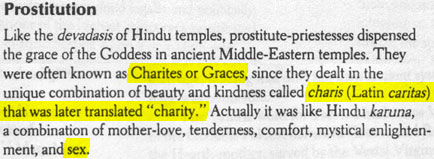
The Woman’s Encyclopedia of Myths and Secrets, Barbara G. Walker, 1983, pp. 819-820, “Prostitution”:
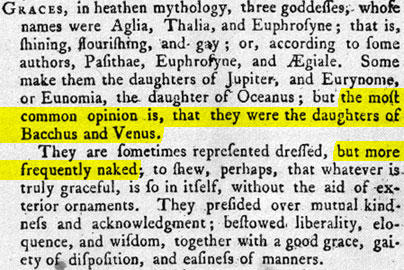
Encyclopædia Britannica, 1771, vol. 2, p. 727, “Graces”:
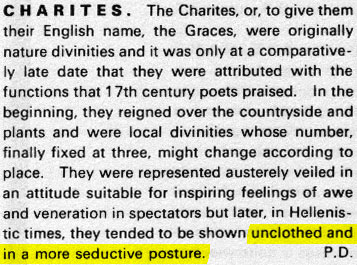
The Praeger Encyclopedia of Ancient Greek Civilization, 1967, p. 104, “CHARITES”:
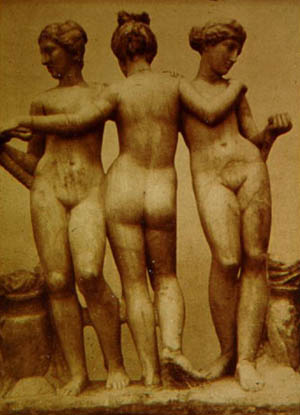
http://www.uwm.edu/Course/mythology/0400/635.jpg (via http://www.uwm.edu/Course/mythology/0400/aphrodite.htm), Aphrodite (Venus), Ares (Mars) and Hephaestus (Vulcan), “Associates of Aphrodite: Eros (Cupid) and the Graces”:
The first view below is a Hellenistic (323-146 BC) sculpture:
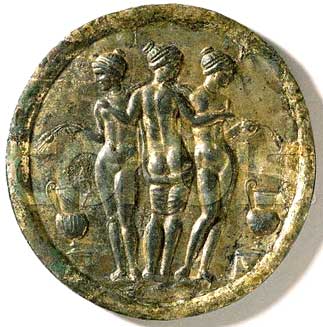
http://pro.corbis.com/, Search # NC002113, Roman Mirror With Representation of the Three Graces, 150-31 B.C.:
http://www.sculpturegallery.com/sculpture/three_graces_relief.html, A Hellenistic Relief: The Three Graces (1st century B.C.) – The Louvre, Paris:

http://www.truthdig.com/eartotheground/item/200601002_only_in_america_seriously/, Only in America. Seriously:

A fifth-grade teacher is out of a job after leading a class through an art museum in Dallas. One of her students saw nude art; the student’s parent complained; the teacher is suspended.
http://homepage.mac.com/cparada/GML/000Free/000CHARITES/source/4.html, Charites Album 4/6:
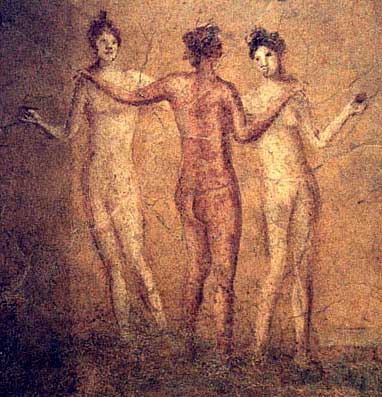
Les trois Grâces. Milieu du IIe siècle après J.-C. Fresque.
http://pro.corbis.com/, Search # DE003818, Roman Fresco of The Three Graces, Ancient period:
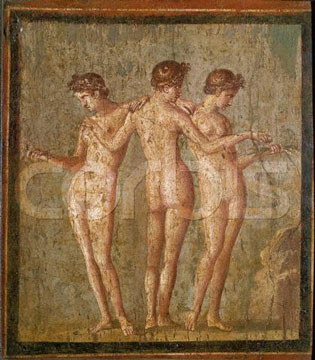
http://pro.corbis.com/, Search # MI001585, Ancient Roman Fresco Painting of The Three Graces, ca. 60 A.D.:
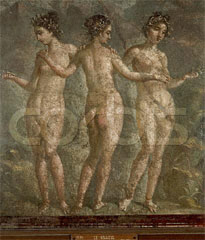
A painting from the House of Titus Dentatus Panthera in Pompeii.
http://riccardi.intrasun.tcnj.edu/Courses/Art%20300/art_300.htm, “The Three Graces, Pompeii”:
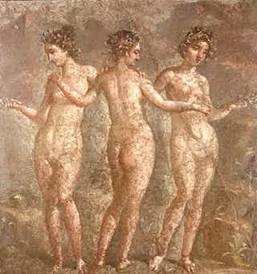
http://pro.corbis.com/, Search # RW004059, Roman Mosaic Depicting the Three Graces, 1st century A.D.:
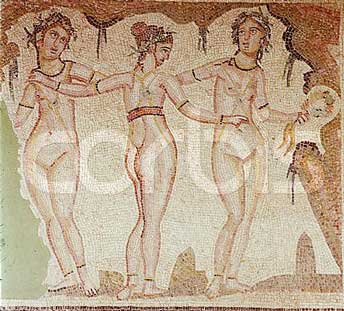
Mosaic of the three graces found at Sabrata in a house behind the Temple of Antoniniano, Libya
http://pro.corbis.com/, Search # RW006924, The Three Graces, 180 A.D.:
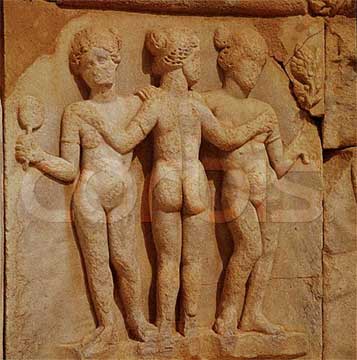
Sculptural relief of the three graces theme on the proscenium façade of the theater at Sabrata, Libya.
http://mbourguignon.free.fr/carnetsvoyages/siteegylibytuni/libye.htm, Libye:
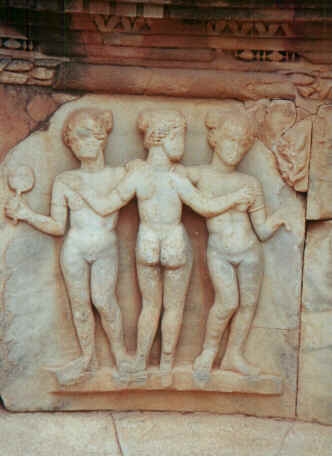
Les Grâces romaines
(ou Charites = déesses grecques de la Grâce)
sont généralement au nombre de trois.
…
Compagnes de Vénus
http://pro.corbis.com/, Search # CAL-F-008534-0000, Reverse of the Medal of Giovanna Tornabuoni Depicting the Three Graces, ca. 1490:
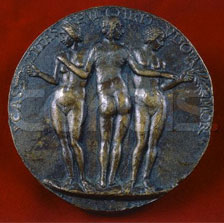
http://www.bodenheimer.com/2.0/lethbridge/text/meme.html, Bodenheimer Gallery - Meme:
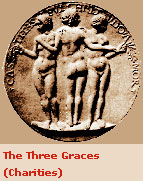
http://pro.corbis.com/, Search # DE002423, Detail of The Three Graces from Wedding of Cupid and Psyche by Raphael:
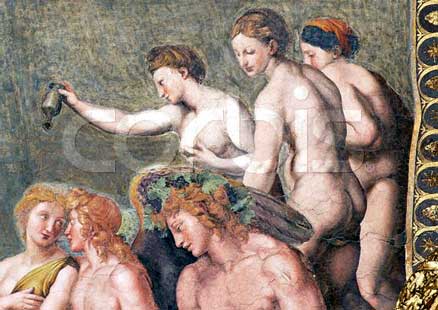
Eros: The God of Love in Legend and Art, Irene Korn, 1999, pp. 20-21, “Cupid and the Three Graces”:
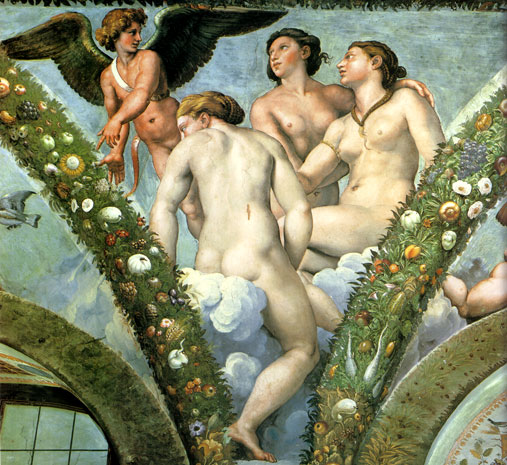
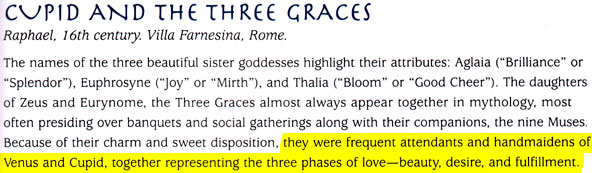
P. 21, “Venus and the Three Graces”:
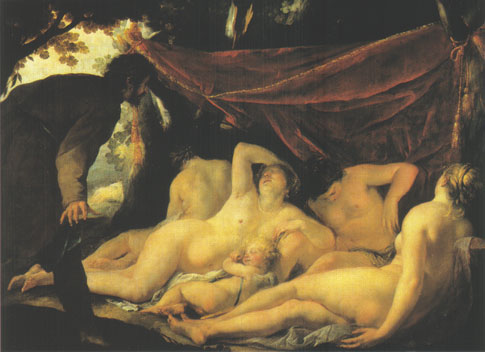 Eros there.
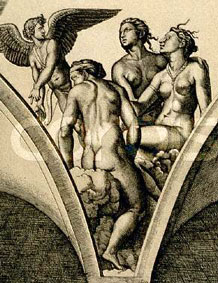
http://pro.corbis.com/, Search # HT009148, Engraving of Pendentive Painting Depicting Cupid and the Three Graces by Marcantonio Raimondi, ca. 1500-1534:
http://homepage.mac.com/cparada/GML/000Free/000CHARITES/source/5.html, Charites Album 5/6:
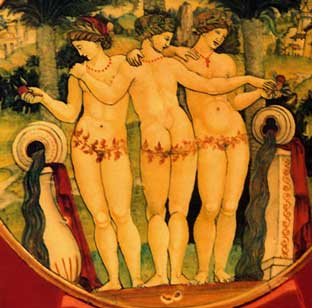
Roundel painted with the Three Graces. Italian, 1525.
http://pro.corbis.com/, Search # EL002983, Fresco Depicting The Three Graces by Studio of Giovanni of Udine, 1555-60:
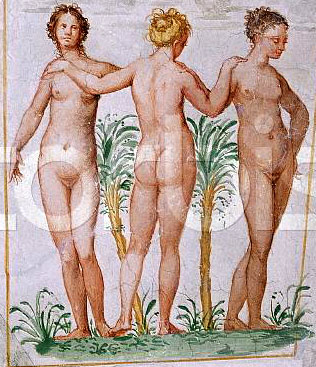
http://homepage.mac.com/cparada/GML/000Free/000CHARITES/source/1.html, Charites Album 1/6:
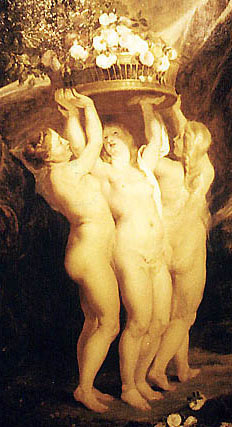
http://homepage.mac.com/cparada/GML/000Free/000CHARITES/source/2.html, Charites Album 2/6:
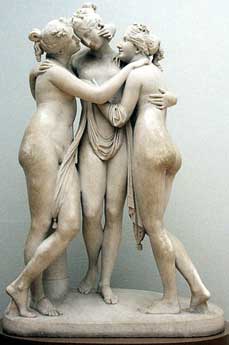
Antonio Canova, 1757-1822: The three Graces.
http://homepage.mac.com/cparada/GML/000Free/000CHARITES/source/6.html, Charites Album 6/6:
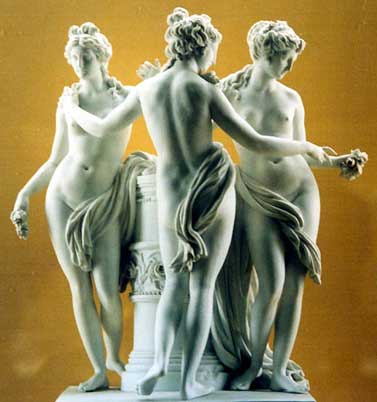
Meissen about 1790: The Three Graces.
http://pro.corbis.com/, Search # MI001716, The Three Graces by Antonio Canova, 1813-1816:
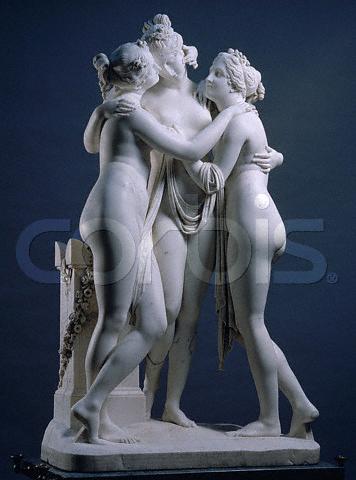
http://towerwebproductions.com/alt-lib/myth/three_graces.shtml, Classical Mythology, “The Three Graces”:

In Greek mythology, the three goddesses of joy, charm, and beauty. The daughters of the god Zeus and the nymph Eurynome, they were named Aglaia (Splendor), Euphrosyne (Mirth), and Thalia (Good Cheer). The Graces presided over banquets, dances, and all other pleasurable social events, and brought joy and goodwill to both gods and mortals. They were the special attendants of the divinities of love, Aphrodite and Eros
http://homepage.mac.com/cparada/GML/000Free/000CHARITES/source/3.html, Charites Album 3/6:
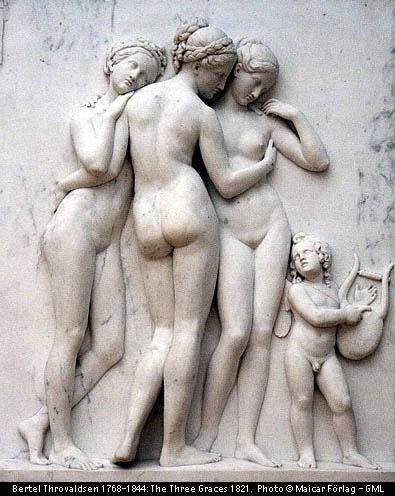
http://pro.corbis.com/, Search # CS001701, Three Graces and Cupid:

http://www.jimrogers.com/content/photos/full/denm_10.jpg (via http://www.jimrogers.com/content/stories/story_19991008.html):
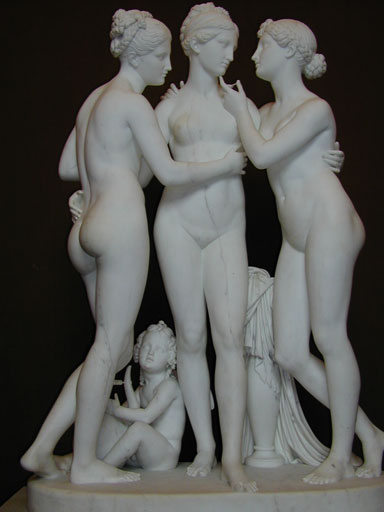
Thorvaldsen's Three Graces with Cupid, located in the Thorvaldsen Museum established in 1848
http://www.iconoclasm.dk/?p=22, Iconoclasm - Before the Fig Leaf: Christian Response to Nude Statuary:
There were many different motives for Christians to smash pagan sculpture, and one of them was an aversion to nudity. This is clear from a series of sculptures, whose genitalia have been mutilated. A good example is this statue group of the Three Graces:
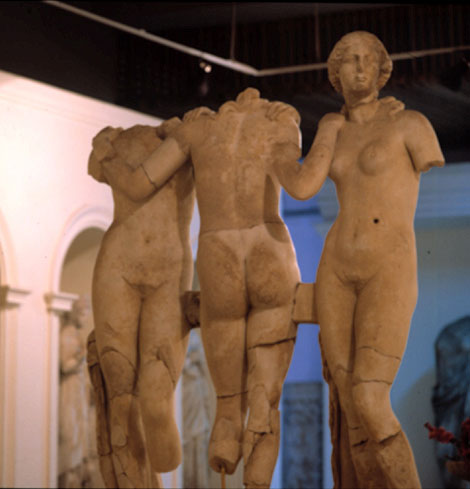
The group is from the Southern Baths at Perge. These baths seem to have been the scene of systematic attacks from iconoclasts, and there are several sculptures from this site, including a Marsyas, a Meleagros and a Horus, that all appear to have been mutilated in much the same way. The baths were excavated mainly in the 1980s, and are still awaiting full publication.
http://www.answers.com/topic/iconoclast, “iconoclast”:
One who destroys sacred religious images. … One who attacks and seeks to overthrow traditional or popular ideas or institutions.