EROS: THE GOD OF “AGAPE”
(Monolingual Greek)
Agape (Greek: αγαπ… or ηγαπ…)
Eros (Greek Ερως or ερως; ερωτικός [erotic])
(See the end of my “Eros / Cupid / erotic definition” page for a complete list of all Greek FORMS of Eros / erotic)
This also includes some context on the equal Greek word “phil…” (φιλ…)
The god of “agape”:
Monolingual Greek Dictionary:
ΝΕΟΝ ΟΡΘΟΓΡΑΦΙΚΟΝ ΕΡΜΗΝΕΥΤΙΚΟΝ ΛΕΞΙΚΟΝ (NEW ORTHOGRAPHIC EXPLANATORY DICTIONARY) (this is an abridgment of a large 9 volume dictionary), Δ. ΔΗΜΗΤΡΑΚΟΥ, 1969, ΚΥΡΙΩΝ ΟΝΟΜΑΤΩΝ ΚΑΙ ΠΡΑΓΜΑΤΩΝ ΓΕΩΓΡΑΦΙΚΩΝ & ΙΣΤΟΡΙΚΩΝ (MAJOR NAMES AND THINGS GEOGRAPHICAL & HISTORICAL), p. 1532, “Έρως”:

In text:
Έρως-ωτος ό, θεος της άγάπης, υίος Άφροδίτης κ.(και) Άρεως, ά.(άλλως) Πόθος, Ίμερος κ.(και) Φιλότης ή λατρεία του ήτο άρχαιοτάτη είς όλην την Έλλάδα.
Translated from Greek:
Eros, the god of agape, son of Aphrodite and Ares, alias Longing / Desire, Imeros and Philotes or ancient worship in all of Greece.
The god of agape:
http://www.diipetes.gr/html/dx_52.html, Η ΠΟΡΕΙΑ ΚΑΙ Η ΜΟΙΡΑ ΤΟΥ ΑΝΘΡΩΠΙΝΟΥ ΓΕΝΟΥΣ ΜΕΣΑ ΑΠΌ ΤΗΝ ΕΛΛΗΝΙΚΗ ΜΥΘΟΛΟΓΙΑ (The COURSE AND the FATE of HUMAN GENDER IN FROM the GREEK MYTHOLOGY):
Από το αυγό βγήκε ο γιος του ανέμου που φυσά, ένας θεός με χρυσά φτερά. Ονομαζόταν Έρως, και ήταν Θεός της αγάπης.
Translated from Greek:
From the egg came out the son of wind that blows, a god with golden feathers. Was named Eros, and was God of agape.
Also in defining context with the female “love” parallel: Aphrodite:
http://www.geocities.com/Athens/Acropolis/1838/venus_g.html, Αφροδίτη (Aphrodite):
Ως θεά της ομορφιάς συνοδεύεται και από τις Χάριτες και τις Ώρες που της φορούν διάφορα στολίδια. 0 Έρωτας την προσδιορίζει ως θεά της αγάπης
Translated from Greek:
As a goddess of beauty and accompanied by the Graces / Charities and the times where they wear various ornaments. The passionate love identifies as a goddess of agape
Other agape-Eros definitions:
Eros and agape as synonyms:
http://www.ellinikilatreia.gr/O_Heros, ΕΛΛΗΝΙΚΗ ΛΑΤΡΕΙΑ (GREEK ADORATION), “Ο Έρως” (The Eros):
Στην ελληνική παράδοση, ο ΕΡΩΣ ( =ΑΓΑΠΗ , κάθε είδους Αγάπη ) … Όλα τα γεννήματα του Έρωτος (της Αγάπης)
Translated from Greek:
In Greek tradition, the EROS (= AGAPE, all kinds Agape) … All the origins of Erotos (the Agape)
(text also at http://el.wikibooks.org/wiki/%CE%97_%CE%B1%CE%B3%CE%AC%CF%80%CE%B7_%CF%83%CF%84%CE%B7%CE%BD_%CE%91%CF%81%CF%87%CE%B1%CE%AF%CE%B1_%CE%95%CE%BB%CE%BB%CE%B7%CE%BD%CE%B9%CE%BA%CE%AE_%CE%98%CF%81%CE%B7%CF%83%CE%BA%CE%B5%CE%AF%CE%B1/%CE%9A%CE%B5%CF%86%CE%AC%CE%BB%CE%B1%CE%B9%CE%BF_3)
Monolingual Greek Dictionary:
http://www.gnosinet.gr/ez/irsearch.asp?Query=áãÜðçò (ψηφιακή βιβλιοθήκη [Digital Library]), e-ncyclopedia, “ερωτικά τραγούδια”:
|
ερωτικά τραγούδια |
|
Στην κατηγορία αυτή ανήκουν ορισμένα τραγούδια του λαού μας. Λέγονται και τραγούδια της αγάπης. |
Translated from Greek:
erotic songs
This category includes some songs of our people. It is said also songs of agape.
In monolingual Ancient Greek:
http://www.magenta.gr/en/en_demos.htm, Ancient-Modern & Modern-Ancient Greek dictionary, (free 15-minute demo download [anc_setup_en.exe 2-16-04]), “αγαπη” (key-in “agaph”):
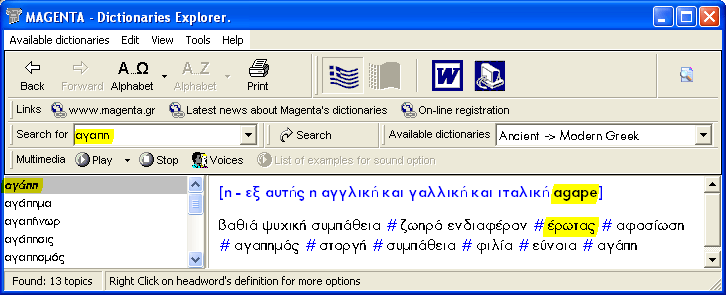
“ερως” (key-in “ervw”):
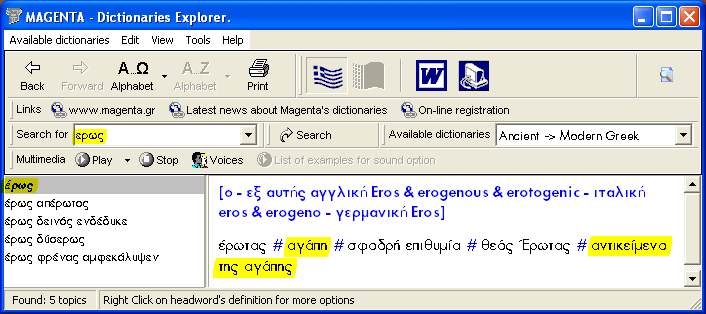 :
:
http://babelfish.altavista.com/ (phrase translations), Greek-English, (the above text via copy-paste):
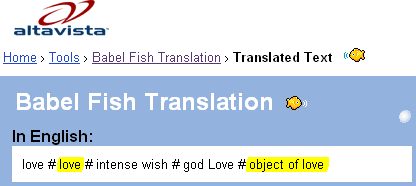
Again, each highlighted “love” is “agape.” So, Eros is the “object of agape.”
Divry’s Modern English-Greek Desk Dictionary, 1996, p. 107, “erotic” (prerequisite to next):
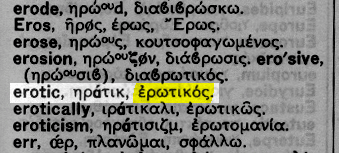 :
:
http://www.magenta.gr/en/en_demos.htm, GOLDEN VERSION – English-Greek & Greek-English electronic dictionary, (free 15-minute demo download [anc_setup_en.exe 2-16-04]), “ερωτικός”:
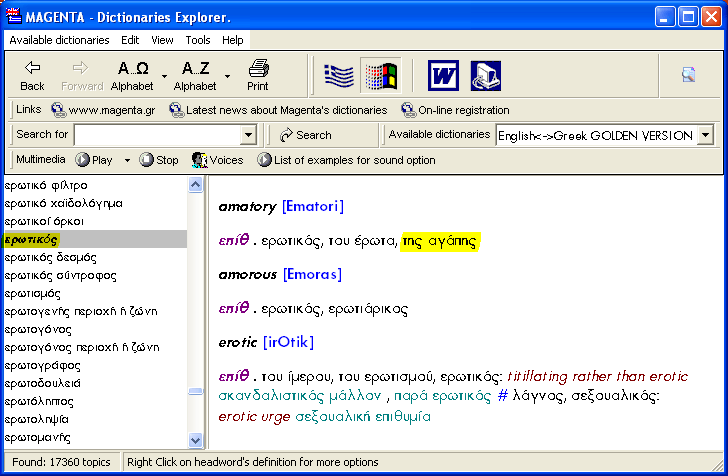
“της αγάπης” is “the agape.” So “the agape” is also “erotic.”
Bilingual Greek-English dictionaries define “αγαπ…” with several instances of the English word “love.” But, to see exactly which ones of the three Greek words for love are used:
MONOLINGUAL GREEK DICTIONARY (where both the base word and its definition are in Greek):
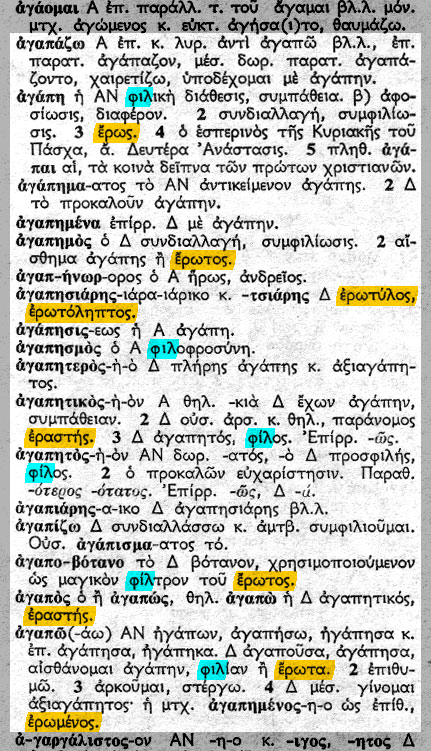
ΝΕΟΝ ΟΡΘΟΓΡΑΦΙΚΟΝ ΕΡΜΗΝΕΥΤΙΚΟΝ ΛΕΞΙΚΟΝ (NEW ORTHOGRAPHIC EXPLANATORY DICTIONARY) (this is an abridgment of a large 9 volume dictionary), Δ. ΔΗΜΗΤΡΑΚΟΥ, 1969, pp. 6-7, “αγαπ…” (agape):
(Orange is Eros / erotic or forms of, and blue is phil… love):
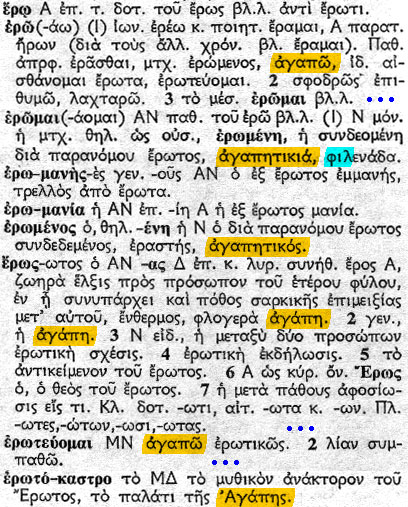
Pp. 616-617, “ερω… | ερωτ…” (Eros / erotic):
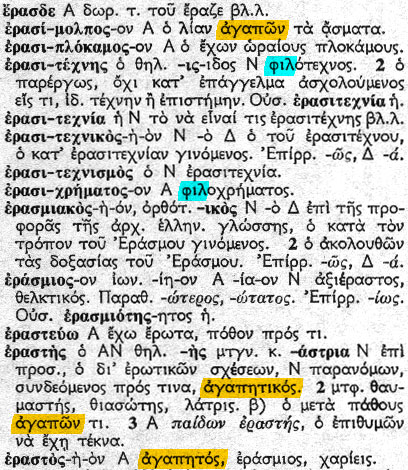
(Orange is agape or forms of, and blue is phil… love):
P. 609, “ερασ…” (another form of Eros / erotic):
A DIFFERENT MONOLINGUAL GREEK DICTIONARY:
ΝΕΟ ΕΛΛΗΝΙΚΟ ΛΕΞΙΚΟ ΤΗΣ ΣΥΓΧΡΟΝΗΣ ΔΗΜΟΤΙΚΗΣ ΓΛΩΣΣΑΣ: ΓΡΑΠΤΗΣ ΚΑΙ ΠΡΟΦΟΡΙΚΗΣ (NEW GREEK DICTIONARY OF CONTEMPORARY PRIMARY LANGUAGE: WRITTEN AND ORAL), ΕΜΜΑΝΟΥΗΛ ΚΡΙΑΡΑ (EMMANUEL KRIARA), ΕΚΔΟΤΙΚΗ ΑΘΗΝΩΝ (PUBLISHING OF ATHENS), 1995, p. 5, “αγαπ…”:
(Orange is Eros / erotic or forms of, and blue is phil… love):
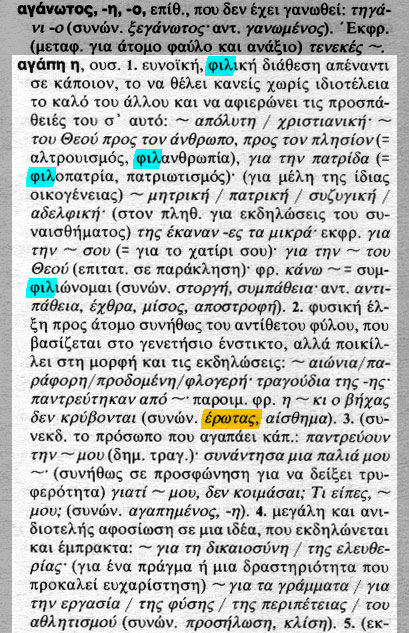
(Continued, next column):
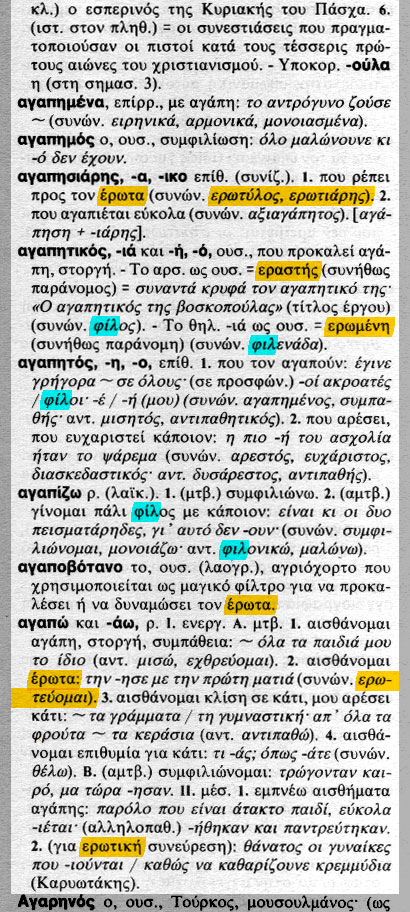
Pp. 530-531, “ερω… | ερωτ…” (Eros / erotic):
(Orange is agape or forms of):
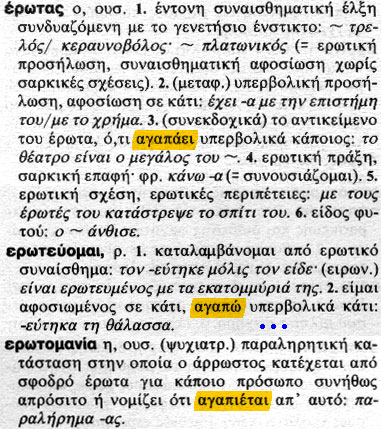
P. 524, “ερασ…” (another form of Eros / erotic):
Agape-Eros in defining context:
Agape in monolingual Greek context:
http://www.kastorianet.gr/ert6.htm, Νηφάλιος Μέθη (Sober Intoxication) (2-12-04):
Για τον έρωτα της όντως αγάπης μιλώ, για τον έρωτα του Θεού
Translated from Greek:
For the erota of indeed agape I speak, for the erota of God
Agape in monolingual Greek context:
http://www.protoporia.gr/protoporia/product.asp?sku=68401 (a psychology book:), Έρως και πάθος: Τα όρια της αγάπης και του πόνου (Eros and passion [title]: The limits of agape and pain [subtitle]), Carotenuto, 2002, ISBN : 960-85689-0-0 (€19.97):

Other agape-sex in defining context:
Agape in monolingual Greek context:
http://www.focusmag.gr/articles/view-article.rx?oid=353996, Έρως, αγάπη και νευρώνες (Eros, agape and neurons) (some medical talk):
Πώς, λοιπόν, λειτουργεί ο «εγκέφαλος του σεξ»; Ποιες είναι οι οδοί της ευχαρίστησης; Ιδού η βιοχημεία της αγάπης.
Translated from Greek:
How, therefore, does function the “brain sex”? What are the avenues of pleasure? That is the biochemistry of agape.
Anterotas:
Monolingual Greek Dictionaries:
http://www.gnosinet.gr/ez/irsearch.asp?Query=ÜíôÝñùôáò (ψηφιακή βιβλιοθήκη [Digital Library]), e-ncyclopedia, “Αντέρωτας”:
|
Αντέρωτας |
|
Γιος της Αφροδίτης και του Άρη, αδερφός του Έρωτα. Ήταν η προσωποποίηση της ανταποκρίσεως της αγάπης ή η προσωποποίηση του άτυχου έρωτα ή ακόμα η προσωποποίηση του παιδικού έρωτα. |
Translated from Greek:
Anterotas
Son of Aphrodite and Ares, brother of Eros. He was the personification of the correspondence of agape or the personification of an accidental eros or even the personification of childhood eros.
ΝΕΟΝ ΟΡΘΟΓΡΑΦΙΚΟΝ ΕΡΜΗΝΕΥΤΙΚΟΝ ΛΕΞΙΚΟΝ (NEW ORTHOGRAPHIC EXPLANATORY DICTIONARY), Δ. ΔΗΜΗΤΡΑΚΟΥ, 1969, p. 162, “αντ-ερω…”:
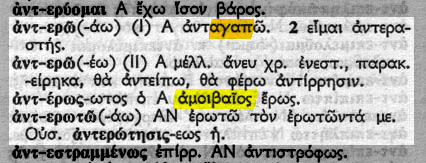
“άμοιβαιος” means a “mutual,” “mutual affection,” “reciprocal,” “shared,” “felt,” “returned,” “interchanged” erotic love, which is fully parallel with agape love.