ARISTOTLE
NICOMACHEAN ETHICS, Book 9, Chapter 12
Agape in context with Eros, 350 BC
Agape (Greek: αγαπ… or ηγαπ…)
Eros (Greek Ερως or ερως; ερωτικός [erotic])
[Also: Agab… (Hebrew: …עגב)]
The context of a word in Aristotle is like a B.C. (or prerequisite to Christ era) Greek dictionary:
Aristotle: Vol. 19: The Nicomachean Ethics; H. Rackham, M.A., Fellow of Christ’s College, Cambridge; Harvard University Press, London; 1926, revised 1934, reprinted 1975; pp. 572-573; Book IX, Chapter XII.1:
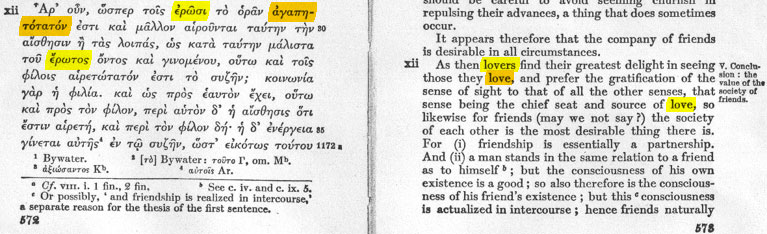
There’s Aristotle in 350 BC putting eros / erotic and agape into the same context. Agape is literally surrounded by eros / erotic. And, it’s in the context of erotic visual desire. Okay, let’s give it a try: John 13:34-35 (NKJV): “[34] A new commandment I give to you, that you erotically visually desire [between adults] one another; as I have erotically visually desired you, that you also erotically visually desire one another. [35]By this all will know that you are My disciples, if you erotically visually desire one another.” It sounds to me like Jesus overruling “looks discrimination” of sexual partners. And, Jesus tells that it is His unique (the only one of its kind) commandment, via “new” and “all will know that you are My [unique] disciples.” You see, in the Old Testament, we only had the wisdom of the then prophets; but, Jesus Christ was the only full voice of God. I am like a secular prophet (“a person gifted with profound moral insight”) but with all the answers; therefore, supported by Jesus / God 2000 years ago. Since God can not successfully intervene directly with mankind’s problems, someone like me is the only way details can be laid out / explained. And, most importantly, all my bases, explanations and details “fit” (are functionally rational, consistent, and non-contradicting). I’m now only required to pull up all this supportive evidence.
The above English text can also be found at:
http://www.perseus.tufts.edu/cgi-bin/ptext?doc=Perseus%3Atext%3A1999.01.0054;query=bekker%20page%3D%23162;layout=;loc=1172a%201 (Tufts University); Aristotle, Nicomachean Ethics (ed. J. Bywater); Book 9 (sixth paragraph):
XII. As then lovers (eros) find their greatest delight in seeing those they love (agape), and prefer the gratification of the sense of sight to that of all the other senses, that sense being the chief seat and source of love (erotica), so likewise for friends (may we not say?) the society of each other is the most desirable thing there is. For (i) friendship is essentially a partnership. And (ii) a man stands in the same relation to a friend as to himself2 ; but the consciousness of his own existence is a good; so also therefore is the consciousness of his friend's existence; but this3 consciousness is actualized in intercourse;
And, the transliterated Greek text:
http://www.perseus.tufts.edu/cgi-bin/ptext?doc=Perseus:text:1999.01.0053:bekker%20page=1171b:bekker%20line=1 (Tufts University); Aristotle, Nicomachean Ethics (ed. J. Bywater); Book 9 (second paragraph):
ar' oun, hôsper tois erôsi to horan agapêtotaton esti (30) kai mallon hairountai tautên tên aisthêsin ê tas loipas hôs kata tautên malista tou erôtos ontos kai ginomenou, houtô kai tois philois hairetôtaton esti to suzên; koinônia gar hê philia, kai hôs pros heauton echei, houtô kai pros ton philon: peri hauton d' hê aisthêsis hoti estin hairetê, kai peri (35) ton philon dê: hê d' energeia ginetai autês en tôi suzên,
Another translation of the above:
http://classics.mit.edu/Aristotle/nicomachaen.9.ix.html (Massachusetts Institute of Technology), Nicomachean Ethics, by Aristotle, written 350 B.C.E, translated by W. D. Ross, Book IX, Chapter 12:
Does it not follow, then, that, as for lovers (eros) the sight of the beloved (agape) is the thing they love most [“greatest delight”], and they prefer this sense to the others because on it love (erotica) depends most for its being and for its origin [“chief seat”], so for friends the most desirable thing is living together? For friendship is a partnership, and as a man is to himself, so is he to his friend; now in his own case the consciousness of his being is desirable, and so therefore is the consciousness of his friend's being, and the activity of this consciousness is produced when they live together, so that it is natural that they aim at this.
Today’s “Christians” assert that agape is exclusively a Christian word, e.g.:
A Critical Lexicon and Concordance to the English and Greek New Testament, Bullinger, 1908 (republished 1999), p. 469, “LOVE [noun.] | αγάπη, love”:
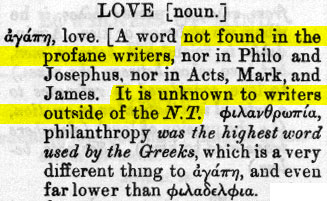
(“Profane” means “secular.”)
P. 145, “CHARITY | αγάπη, love”:

Dictionary of World Philosophy, Iannone, 2001, p. 324, “love”:

Dictionary of Religion and Philosophy, MacGregor, 1989, p. 12, “Agape”:
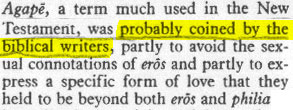
And then again it might not have been coined by the biblical writers, because it does include the sexual connotations of eros. Plus, no writer can make up (coin) a word unless they explain the, or new, meaning; and, agape in the New Testament is not explained so as to eliminate those “sexual connotations.” “Beltcapolia”: I just made it up, so do you know what it means? Your guess is as good as mine; but, you are “commanded” to do it! (I bet it really tuckers out Mr. Google puttin’ that word in there.)
http://www.bruceallan.org/agape.htm, “agaph (agape - 26)” (5-24-02):
A purely biblical and ecclesiastical word…Profane authorship from Aristotle, Plutarchus on used agaphsiV.
(To contradict.)
Thayer’s Greek-English Lexicon of the New Testament, 1889, Baker Books 1997, pp. 653-654, “φιλέω”:
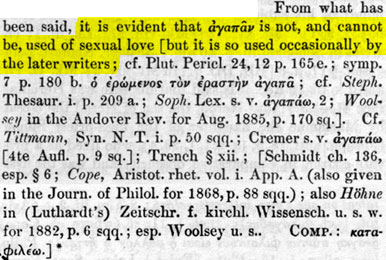
(To also contradict, and for sources.)
Here’s another idea someone’s tried to get the sex out of agape. The only problem is, the Septuagint project began about 100 years after Aristotle. Therefore, agape was already a Greek word. And, Hebrew ahab… (below) has sexual love context all over it, same as the Greek agape:
http://www.logon.org/english/s/p145.html (Christian Churches of God), Song of Songs (No. 145):
There are Hebrew words in the Song of Songs which do not occur anywhere else in the Bible. The Greek word love, agape, which refers only to the love of God, is not a Greek word. It is a transliteration of the Hebrew word SHD 158 ‘ahab in the feminine form SHD 160 ‘ahabah which occurs in the Song of Songs with other words for love (SHD 157; ‘ahab; SHD 1730; dowd as a love token and even an uncle; SHD 7474; ray’ah a female associate, hence love). Ahabah has nothing to do with sexual erotic love when used in relation to these concepts (see esp. Jer. 31:3). Isaiah 63:9 shows that it is this word that applies to the love of God through the Angel of the Presence and the redemption of Israel. The word for love here is ahabah and that is where the Greeks got their word agape. Agape was not a word in the Greek language until they translated the Hebrew Bible into Greek in the Septuagint (LXX). They developed the word agape to transliterate the Hebrew word ahabah because the Greeks didn’t have a word for divine love. They had erotic love, eros, and they had the word for filial love, philadelphia, but they did not have a word for Godly love, agape. So they had to transliterate the word ahabah and it became the word agape and then they try to tell the elect what it means. In fact, Greek philosophy and theology is so totally deficient, because all of their philosophical ideas are founded upon erotic and filial love and they do not comprehend the concept of agape love.
Again, if they added a word to a Greek document that no Greek was familiar with, they would have had to include a side dictionary or something to explain it.
Agab… (Hebrew: …עגב)
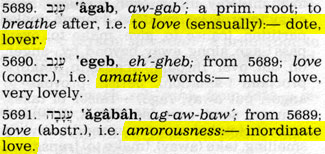
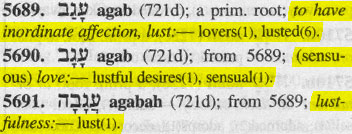
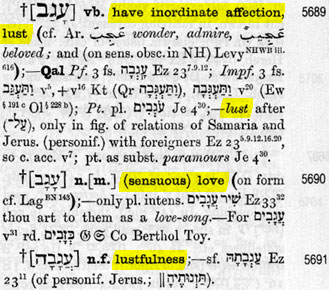
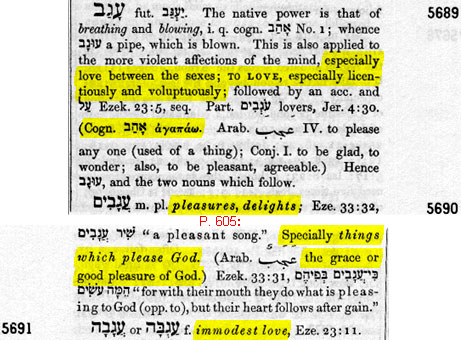
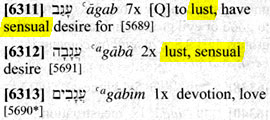
Now, there likely is a much earlier connection to the Greek word agap… and the Hebrew words ahab… and agab… (Jer. 4:30; Ez. 23:5,7,9,11,12,16,20; 33:31,32), both having sexual content.
http://www.bibleanswerstand.org/nuggets_7.htm, Nuggets # 7: Agape and Phileo Part Two: One Expresses the Other:
Some scholars believe agape might have originated from the ancient Hebrew word “agab” (OT:5689):
· LOVE = OT:5689 `agab (aw-gab'); a primitive root; to breathe after, i.e. to love (sensually)
The New Strong’s Complete Dictionary of Bible Words, James Strong 1822-1894, Thomas Nelson Publishers, 1996, “Hebrew & Aramaic Dictionary” p. 468, 5689, 5690, 5691:
New American Standard Exhaustive Concordance of the Bible: Hebrew-Aramaic and Greek Dictionaries, 1998, p. 143:
The Brown-Driver-Briggs Hebrew and English Lexicon, 1906, p. 721:
Gesenius’ Hebrew-Chaldee Lexicon to the Old Testament, 1847 (republished 1979, Baker Books), pp. 604-605:
The Complete Word Study Dictionary: Old Testament, Baker / Carpenter, AMG Publishers, 2003, p. 803:
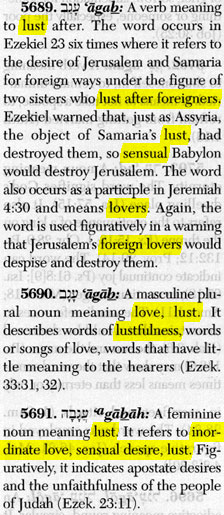
The Complete Word Old Testament, Zodhiates, Warren Baker, 1994, “Lexical Aids to the Old Testament,” p. 2347:
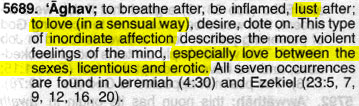
The Hebrew-English Concordance to the Old Testament with the New International Version, Kohlenberger III / Swanson, 1998, “A Concise Hebrew-English Dictionary to the Old Testament,” p. 2143 (G/K numbering, not Strong’s):

The Meridian Hebrew/English English/Hebrew Dictionary, Dov Ben-Abba, 1994, p. 250 (Hebrew order) “lust; make love”:

The Compact Up-to-date English-Hebrew Hebrew-English Dictionary, Zilberman, 1995, (Hebrew order) p. 202:

The New Bantam-Megiddo Hebrew & English Dictionary, Sivan / Levenston, 1975, (Hebrew order) p. 185:

Mounce’s Complete Expository Dictionary of Old & New Testament Words, 2006, p. 1005:
Ahab… (Hebrew: …אהב): the other Hebrew word for love:
Gesenius’ Hebrew-Chaldee Lexicon to the Old Testament, 1847 (republished 1979, Baker Books), pp. 167-168 , “אהב”:
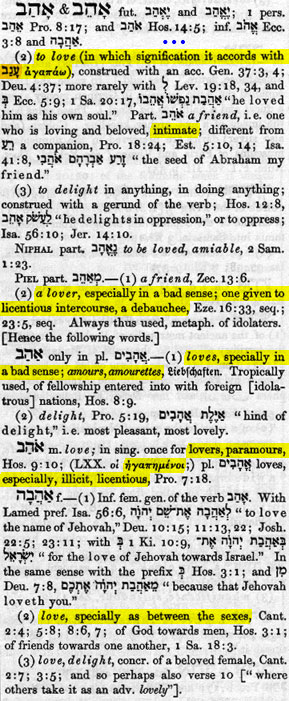
[See my “Septuagint (quotes)” page for more on this Hebrew word.]