1 Cor. 6:9 – Soft-Effeminate
(“μαλακ…”)
The slam is a sham!
If you’re gay, here’s more proof that there’s a God, and that Jesus is the Son of God:
(Released 12-18-07 )
1 Corinthians 6:9:
(KJV): Know ye not that the unrighteous shall not inherit the kingdom of God? Be not deceived: neither fornicators, nor idolaters, nor adulterers, nor effeminate, nor abusers of themselves with mankind,
(NKJV): Do you not know that the unrighteous will not inherit the kingdom of God? Do not be deceived. Neither fornicators, nor idolaters, nor adulterers, nor homosexuals, nor sodomites,
(NIV): Do you not know that the wicked will not inherit the kingdom of God? Do not be deceived: Neither the sexually immoral nor idolaters nor adulterers nor male prostitutes nor homosexual offenders
Interlinear Greek-English New Testament, Green, Baker Books, p. 523, 1 Corinthians 6:9:
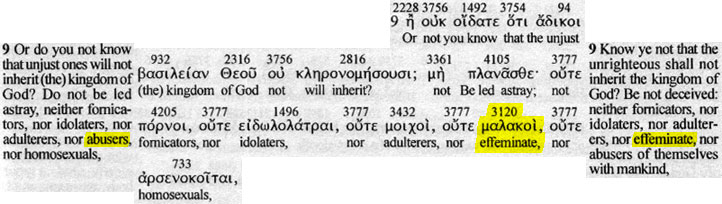
Some are obviously so confused that they don’t know which word (# 3120 or 733) to use against homosexuals, simply because there is no firm basis (today). (I covered #733 in an earlier email here, which only meant sex with male children, which is the same word used in Leviticus 18:22; 20:13. Also see here concerning Romans 1:26-29.)
Jesus parallel (Strong # 3120):
http://www.jcsm.org/StudyCenter/kjvstrongs/CONGRK311.htm#S3119, The Greek Concordance with Strong’s Numbering:
|
3119 |
malakia |
malakian |
|
3120 |
malakoV |
malaka malakoiV malakoi |
So how did Jesus define it:
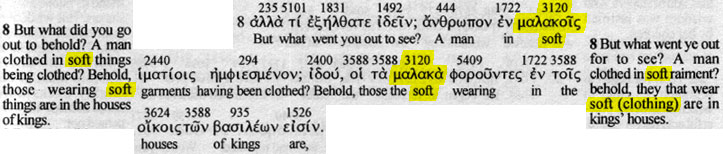
Matt 11:8:
(KJV): But what went ye out for to see? A man clothed in soft raiment? behold, they that wear soft [clothing] are in kings’ houses.
(NKJV): But what did you go out to see? A man clothed in soft garments? Indeed, those who wear soft clothing are in kings’ houses.
(NIV): If not, what did you go out to see? A man dressed in fine clothes? No, those who wear fine clothes are in kings’ palaces.
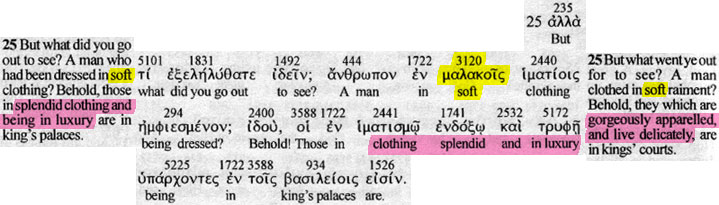
Luke 7:25:
(KJV): But what went ye out for to see? A man clothed in soft raiment? Behold, they which are gorgeously apparelled, and live delicately, are in kings’ courts.
(NKJV): But what did you go out to see? A man clothed in soft garments? Indeed those who are gorgeously appareled and live in luxury are in kings’ courts.
(NIV): If not, what did you go out to see? A man dressed in fine clothes? No, those who wear expensive clothes and indulge in luxury are in palaces.
So, Paul was making a slam against the very wealthy, not against homosexuals. The pink highlight is Luke’s definition of Matthew’s word “soft” exclusively:
Interlinear Greek-English New Testament, Green, Baker Books, p. 33, Matt 11:8:
P. 202, Luke 7:25:
Same form (Strong # 3119):
http://www.eliyah.com/cgi-bin/strongs.cgi?file=greeklexicon&isindex=3120, Strong's Greek Lexicon Search Results, “3120”:
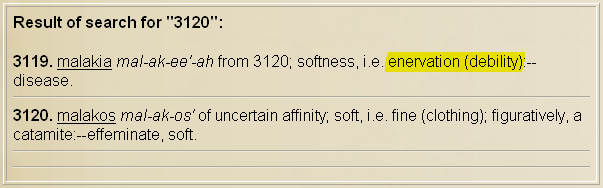
http://www.jcsm.org/StudyCenter/kjvstrongs/STRGRK31.htm, Strong’s Greek Dictionary:
|
3119 |
malakia |
from malakoV - malakos 3120; softness, i.e. enervation (debility):--disease. |
|
3120 |
malakoV |
of uncertain affinity; soft, i.e. fine (clothing); figuratively, a catamite:--effeminate, soft. |
Merriam Webster’s Collegiate Dictionary, 1997, p. 383, “enervate”:
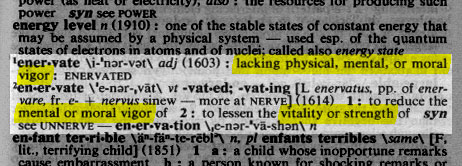
So it’s a twofold explanation: both physical strength, and mental / moral strength. Very wealthy people (especially of that day) would have lacked in both physical strength, because they didn’t have to do manual labor, and mental / moral strength because they usually didn’t care too much about overall fairness, especially for the poor and needy. It makes sense that there would be a word that derived from the “soft” “gorgeously appareled,” “live[d] delicately” “expensive” “splendid” “luxury” which would correlate with the self-centeredness evil of the very wealthy. This Greek word was apparently the concise construal. Today the English equivalent might be the reference to someone as a “suit,” meaning men who wear suits and ties, who generally are of today’s upper classes. “There are lots of suits in this restaurant during lunch.” You generally don’t want to look like that when you have car trouble in the poor part of town. Jesus was a strong advocate for the poor, and strongly criticized the rich, so “my” finding is the only one that concurs with the type of person Paul could be putting down: the selfishly rich. I.e., putting down a meek person doesn’t make any sense, since the Bible says the meek will inherit the earth. Putting down just everyone who is muscularly weak doesn’t make any sense either. But, the correlation that muscularly weak people would have been a common attribute of rich people, does “fit.” Using the word “effeminate” really just says that all women are evil. That’s how ludicrous the corruption really is.
The Complete Word Study Dictionary – New Testament, Zodhiates, 1973, p. 940:
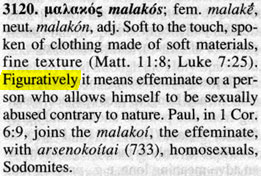
Yeah, well like “figuratively” (“not literal, symbolic”) doesn’t give a solid definition. “Figuratively” just means the “homosexual” definition is just a big lie. Jesus / God did speak “figuratively,” but this is a word used by Paul, and Paul did not speak figuratively. But, Jesus did purposely speak this word, so we today could know the true meaning. How about it “literally” meaning just the part above “figuratively”? Then we can quit condemning innocent people. Jesus / God was aware that Paul would later use this word; therefore, if it referred to homosexuality, then God / Jesus would have defined it as such, instead of defining it they way They did. Plus, there’s no apparent or good reason otherwise for Jesus to bring up this subject, as He was just giving an extended example of what John the Baptist was not – except for Him also denouncing “soft.” So, since Jesus denounced “soft” in His definition, then Paul used the same word, what makes all of you think Paul was using it in a different way? It’s because somebody else you trust has told you that!
Merry Christmas,
Mr. Critical – I am it.
TO SEE PRIOR TIMELESS WRITINGS (and more):
http://www.the-Goldenrule.name/