GENESIS 9:3-4
Vegetarian support in the Bible (correcting the corruption)
http://en.wikipedia.org/wiki/Kosher_foods, Kosher foods, “Blood and fat”:
One of the main biblical food laws is the forbidding of eating blood on account of the life [being] in the blood; this ban and reason are listed in the Noahide Laws[12], and twice in Leviticus[13][14], as well as by Deuteronomy[15]
You know, that’s true: God wrote that we should not eat anything that has blood going thought it (Genesis 9:4; Leviticus 3:17; 17:11), as that’s the best way to describe an ovo-lacto vegetarian diet.
The classical rabbis argued that, in a number of cases, the prohibition against consuming blood was impractical, and there should be exceptions; they claimed that consuming the blood which remained on the inside of meat (as opposed to the blood on the surface of it, dripping from it, or housed within the veins), would be permitted, and that the blood of fish and locusts could also be consumed.[17][18][19][20]
Well, that makes sense since Jews are sinners.
To comply with this prohibition, a number of preparation techniques became practiced within traditional Judaism. The main technique, known as melihah, involves the meat being soaked in water for about half an hour, which opens pores;[21] after this, the meat is placed on a slanted board or in a wicker basket, and is thickly covered with salt on each side, and left for between twenty minutes and one hour.[22] The salt covering draws blood from the meat by osmosis, and so the salt must be subsequently removed from the meat (usually by trying to shake most of it off, and then washing the meat twice [23]) in order to complete the extraction of the blood.
You know, the Protestants have refined this to allow one to just do whatever he wants.
Genesis 9:3-4 [NKJV]:
3Every moving thing that lives shall be food for you. I have given you all things, even as the green herbs. 4But you shall not eat flesh with its life, that is, its blood.
I know this has been spun out of the original Hebrew and is therefore contradicting (the “shall be” is really “has been” or “is”); but, doesn’t that even pretty much openly explain what Eve was not supposed to eat in the Garden of Eden? I.e.: any “flesh” elaborated as anything that has “blood.” (Compare Genesis 2:29 and 2:9,16-17; 3:2-6.)
Okay, you say how about the radical spin I “just” said about “shall be” really meaning “has been”? Why does it always have to be me that uncovers thousands of years of corruption?:
The Complete Word Study Old Testament, Zodhiates, AMG Publishers, p. 25, “Noahic Covenant” (Genesis 9:3-4):
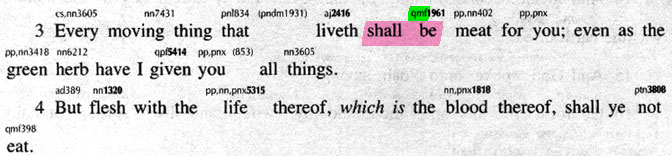
(The “1961” is the Strong number.)
P. 2282, “Grammatical Notations | 95. The Qal Imperfect (qmf)”:
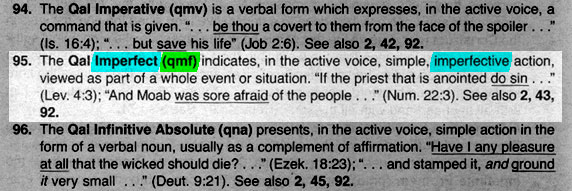
The Merriam-Webster Dictionary: Home and Office Edition, 1998, p. 260, “imperfect”:
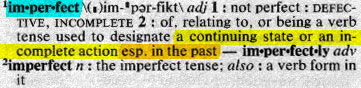
http://www.answers.com/imperfective, “imperfective”:
Of, related to, or being the aspect that expresses the action denoted by the verb without regard to its beginning or completion.
Either way, it’s not in the future tense, making it sound like God is allowing or commanding it. God is just saying that it’s the state of being, beginning from an unspecified time in the past.
http://www.answers.com/topic/imperfective-aspect-1, “Imperfective aspect”:
The imperfective aspect is a grammatical aspect. It refers to an action that is viewed from a particular viewpoint as ongoing, habitual, repeated, or generally containing internal structure.
Other examples of the Hebrew Qal imperfect:
http://books.google.com/books?id=Ng6zLq_w6VIC&dq=%22in+the+beginnings%22+dill&printsec=frontcover&source=bl&ots=N55_9ERjL4&sig=kp6U0hyWWLcip1uArYKGklzWVNA&hl=en&ei=wFZOSuuyC4u4lAegyOmTDQ&sa=X&oi=book_result&ct=result&resnum=1, In the Beginnings (Google Book Result), by Steven E. Dill, 2007, p. 347, “Chapter Twelve: The Meaning of HAYAH (which is the pertinent Strong #1961)| Qal Imperfect”:
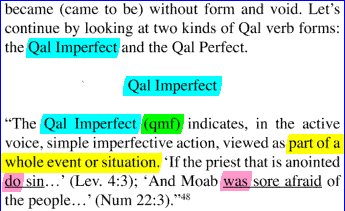
P. 348 (continuation):
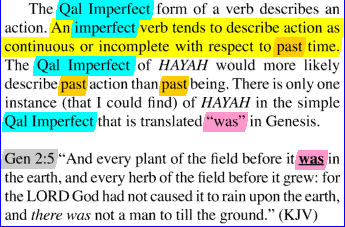
That “Gen 2:5” example is the same “qmf1961” as Gen. 9:3 above (both the same Hebrew characters of יהיה), but translates as “was”:
The Complete Word Study Old Testament, Zodhiates, AMG Publishers, p. 6, “Adam and Eve in the Garden” (Genesis 2:5):

http://catdir.loc.gov/catdir/toc/ecip046/2003015640.html, Table of contents for Hebrew for biblical interpretation / by Arthur Walker-Jones:
Chapter 6-Qal Imperfect, Part I .
Qal Stem .
Imperfect Conjugation .
Use for Past Narration .
http://hebrew.wisc.edu/103syll.Fall2007.kirk.pdf, Hebrew 103/303: Biblical Hebrew, First Semester, Department of Hebrew and Semitic Studies, University of Wisconsin–Madison, Fall 2007:
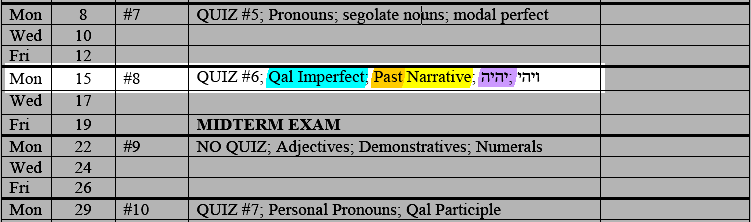
Our Hebrew text is the same as the example they use above (יהיה):
The Interlinear NIV Hebrew-English Old Testament, John R. Kohlenberger III, Zondervan Publishing House, 1987, p. 20, “Genesis 9:2-12”:
(Hebrew is read from right to left then down)
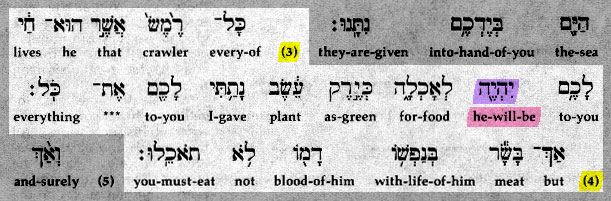
Notice how the sequence of words in verse 4 really more says “but meat with life’s blood you must not eat,” which has lots more vegetarian command than “But you shall not eat flesh with its life, that is, its blood [NKJV]”, which sounds more like it’s okay to eat meat if you drain the blood. You see, God just defined exactly what “meat” / flesh is, by elaborating that it’s anything moving where blood flows. Therefore, this includes fish; and, allows the eating of eggs and milk. Also, Hebrew “life” (or “living”) is not defined as plants: the word doesn’t start until God made the animals and moving things in Genesis 1:20, and defines it as such. Apparently, like lots of words, the base word got extended to later include plants, like it can also be extended today to include cars, your computer, your phone, etc., as opposed to “dead.”
Another source:
The Interlinear Bible: Hebrew-Greek-English, Jay P. Green Sr., Sovereign Grace Publishers, 1985, p. 7, “GENESIS | CHAPTER 9”:
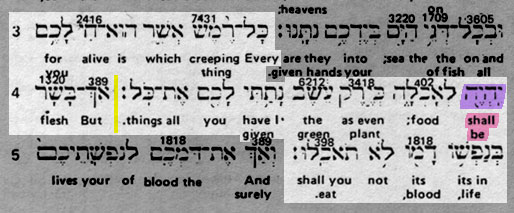
In translation, Google returns just “Be” not “Shall be”:
http://translate.google.com/translate_t?hl=en#iw|en|%D7%99%D7%94%D7%99%D7%94, Google translate: Hebrew > English, “יהיה”:
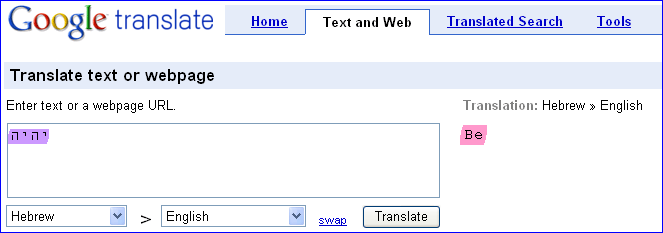
… indicating a current state.
See how the form of the word can make a world of difference? And, how just rearranging words to the more correct sequence can give a different / correct meaning (in verse 4)? I mean, it doesn’t make any sense why God would allow or command us to eat meat, then say to not in the next verse. Nor does it make any sense why God would want us to eat meat, but no blood; especially with there really being no way to get rid of all the blood fluid and cells.
What do you bet I’m the only vegetarian advocate that has this? And, it’s a big one.
Here’s another’s best explanation:
http://www.all-creatures.org/cva/hgc_print.htm (The Christian Vegetarian Association), Honoring God’s Creation: How is vegetarianism good stewardship?:
Why did God give Noah permission to eat meat (Gen. 9:2–4)?
Virtually all plants were destroyed by the Flood. Alternatively, God allowed Noah limited freedom to express human violence, since unrestrained violence responsible for the Flood itself (Gen. 6:11-13). Importantly, this passage does not command meat-eating nor indicate that the practice is God’s ideal. Indeed, eating meat came with a curse – animals would no longer be humanity’s friends: “The fear and the dread of you shall rest on every animal…” (Gen. 9:2) While eating meat is not prohibited, it represents a complete break from God’s ideal of animals and humans living peacefully together, as depicted in Eden and by the prophets.
Pitiful.
Leviticus 11:
This chapter is the “Lord” overruling “God” in Genesis 9:3-4 by allowing the Jews to eat certain kinds of animals, defining the animals to not eat as “unclean.” Thank “God” for the New Testament: In Acts 10:10-15, Peter has a dream where Jesus is telling him that it’s also okay to eat animals (as “God has cleansed”). First of all, why would Jesus need to instruct Peter to eat meat if it’s already in Leviticus 11 (which “He” “cleansed” then); in which Peter contradictorily stated was not to be eaten? Secondly, it’s a “dream,” and I personally have had characters in my dreams lie to me. But, Peter made a firm indication that Jesus (the one in the dream) was obviously overruling the real, living Jesus, that Peter once walked with, as he knew very well. So, who are we supposed to believe today, the “one” real, walking Jesus, or every dream we have that overrules it? If we can allow our dreams today to overrule Jesus, then everyone can have a different interpretation of Jesus. I mean, if we dream it, and we like it, then we’ll let that overrule our obligations in the Bible, right? Wrong! I think God was behind it to bypass the selfish wants of Dark Age church corruption, to allow the New Testament to be followed, as He would know that someone in the future would be able to logically explain the situation, which I just did.
Actually, Leviticus 11 seems to contradict itself over the kinds of animals one may eat, to the result that no animals or fish are allowed to be eaten. Example:
Leviticus 11:
9‘These you may eat of all that are in the water: whatever in the water has fins and scales, whether in the seas or in the rivers—that you may eat. 10But all in the seas or in the rivers that do not have fins and scales, all that move in the water or any living thing which is in the water, they are an abomination to you. 11They shall be an abomination to you; you shall not eat their flesh, but you shall regard their carcasses as an abomination.
Is seems the orange overrules the yellow. Kind of like a trick question. (Again, they didn’t have punctuation when this was written.)
24‘By these you shall become unclean; whoever touches the carcass of any of them shall be unclean until evening;
Doesn’t that just overrule all that’s previously mentioned? I mean, if you can’t touch it how can you realistically eat it. I mean, can’t your mouth touch things?
39‘And if any animal which you may eat dies, he who touches its carcass shall be unclean until evening. 40He who eats of its carcass shall wash his clothes and be unclean until evening. He also who carries its carcass shall wash his clothes and be unclean until evening.
In other words, any animal that’s dead cannot be eaten (which is allowed to eat). So, you can only eat it alive? What if it dies while you’re eating it? Then you’d better spit it out, I guess.
41‘And every creeping thing that creeps on the earth shall be an abomination. It shall not be eaten. 42 Whatever crawls on its belly, whatever goes on all fours, or whatever has many feet among all creeping things that creep on the earth—these you shall not eat, for they are an abomination.
I think that covers just about everything, doesn’t it? Doesn’t all land animals “crawl” or “creep” at some point during their life?
And, where’s any kind of logic or reason why God would say some animals are okay to eat and some aren’t. Like when God said to not steal, we can all understand the logic; but, where’s real criteria basis for Leviticus 11?
I think it is a trick to see who remains a vegetarian after they think God allows the eating of animals, for God to easily see who is really His, and who doesn’t really care if they are cruel. The gift of Afterlife is not based on those who just go by the rules, it’s for those who have a good heart down deep. You see, the perfect utopia doesn’t have limiting laws and rules, and therefore police, jails, or discipline; it just has to make sure it only lets those with kind hearts in. Otherwise, having people there who only follow the punishable rules in a place that works best without any punishments, will corrupt or even destroy the place. That place is supposed to be here on earth in the future. How will future “people” know who to bring back to life if they can’t easily “see” who has a worthy heart and who doesn’t? Well, if you’ve chosen to be a vegetarian in today’s anything goes world for ethical reasons, then you might just meet the criteria.
CONTINUE TO NEXT PHASE