ORPHEUS – SEXUAL ATTRIBUTES
(More On This Subject)
http://www.perseus.tufts.edu/cgi-bin/ptext?doc=Perseus:text:1999.02.0029:book=11:line=85, P. Ovidius Naso, Metamorphoses (ed. Hugo Magnus [Latin]), [Book 11:91-93]:
ruricolae cepere Phryges vinctumque coronis
ad regem duxere Midan, cui Thracius Orpheus
orgia tradiderat cum Cecropio Eumolpo.
http://www.perseus.tufts.edu/cgi-bin/ptext?doc=Perseus:text:1999.02.0028:book=11:line=85, P. Ovidius Naso, Metamorphoses (ed. Brookes More [English translation]), Book 11[:91-93]. “BACCHUS AND MIDAS”:
The Phrygian folk had captured him, as he was staggering, faint with palsied age and wine. And after they bound him in garlands, they led him to their king Midas, to whom with the Cecropian Eumolpus, Thracian Orpheus had shown all the Bacchic rites(orgia).
http://www.perseus.tufts.edu/cgi-bin/ptext?doc=Perseus%3Atext%3A1999.02.0074&layout=&query=card%3D%23105&loc=11.1, P. Ovidius Naso, Metamorphoses (ed. Arthur Golding [English translation]), [Book 11:91-93]:
The Phrygian ploughmen found
Him reeling bothe for droonkennesse and age, and brought him
bound
With garlands unto Midas, king of Phrygia, unto whom
The Thracian Orphye and the preest Eumolphus
comming from
The towne of Athens erst had taught the Orgies.
http://easyweb.easynet.co.uk/~orpheus/page3.htm, Orpheus:
J.B. Friedman: Orpheus-Christus in the Art of Late Antiquity, from Orpheus in the Middle Ages, Cambridge, 1969.
Certainly, we have much to set straight if we could. Orpheus was a Greek who in Thrace tried to substitute the quietude of the Greek Apollo for the frenzy of the Thracian Dionysus, and met his death at the hands of the Maenads, the followers of Dionysus. Or he came from Crete and introduced the orgiastic cults into Greece from Asia.
The Paintings of the ‘New’ Catacomb of the Via Latina and the Struggle of Christianity against Paganism, Bargebuhr, 1991, p. 48, “Representations of Pagan Themes”:
http://academic.reed.edu/humanities/110Tech/Diodorus1.96-98.html, Diodorus on the Greek Cultural Debt to Egypt (based on Oldfather's tr.):
Orpheus, for instance, brought from Egypt most of his mystic ceremonies, the orgiastic rites that accompanied his wanderings,
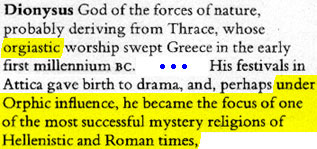
Funk & Wagnalls Standard Dictionary of Folklore, Mythology and Legend, 1972, p. 313, “Dionysus”:

A Classical Dictionary of Greek and Roman Biography, Mythology and Geography, Smith, 1852, p. 583, “Orpheus”:

Gods and Mortals in Classical Mythology, Grant / Hazel, 1973, pp. 308-309, “Orpheus”:

Random House Word Menu, 1992, p. 846, “Faith | Magic and the Occult | Individuals and Objects | Orphic”:

The Oxford Companion to Classical Literature, 1989, p. 399, “Orpheus”:

Funk & Wagnalls Standard Dictionary of Folklore, Mythology and Legend, 1972, p. 834, “Orpheus”:

Benét’s Reader’s Encyclopedia, 1996, p. 762 “Orpheus”:

Benét’s Reader’s Encyclopedia, 1996, p. 275, “Dionysus”:

Encyclopaedia of Religion and Ethics, Hastings, Vol. 12, Latest impression 1980, p. 327: 2nd column, “Thrace”:
http://www.johnwilliamwaterhouse.com/paintings/painting1392.aspx, Nymphs finding the Head of Orpheus:
Orpheus himself was later killed by the women of Thrace. The motive and manner of his death vary in different accounts, but the earliest known, that of Aeschylus, says that they were Maenads urged by Dionysus to tear him to pieces in a Bacchic orgy because he preferred the worship of the rival god Apollo. His head, still singing, with his lyre, floated to Lesbos, where an oracle of Orpheus was established. … Source: Encyclopaedia Britannica
The Oxford Guide to Classical Mythology in the Arts, 1300–1990s, Reid, Vol. 2, p. 773, “Orpheus”:
Dictionary of Mythology Folklore and Symbols, Jobes, 1961, Vol. 2, p. 1216, “Orpheus”:
Encyclopaedia Britannica, 1973, Vol. 16, p. 1116, “Orpheus | Orpheus in Legend”:
The New Encyclopaedia Britannica, 1993, Vol. 8, p. 1012, “Orpheus”:
Le Mot Juste: A Dictionary of Classical & Foreign Words & Phrases, 1981 (reprinted 1991), p. 157, “orphic/orphean (GK)”:
http://members.tripod.com/~american_almanac/venhuth.htm, Venice: The Methodology of Evil -- Part III, “The Cabala”:
The Orphic hymns were part of violent orgiastic rituals, in which maddened women, known as Maenads, drugged or otherwise intoxicated, roamed through the forests at night, tearing animals from limb to limb; the same fate befell any man who was unfortunate enough to cross the path of one of these rampaging bands.
New Larousse Encyclopedia of Mythology, 1968, p. 90, “Orphic Cosmogonies”:

The Oxford Classical Dictionary, 1949, p. 628, “Orphism”:
A Greek and English Lexicon, Wright, 1861, “Part IV: Proper Names | (p. 203)”:

http://www.english.uiuc.edu/maps/poets/g_l/hd/myth.htm, Eurydice in Classical Myth:
The presence of this rival ought to inhibit the presence of any woman, which is why the original Orpheus in Greek mythology may have been agamos (without a wife). In a crucial article, Jacques Heurgon took care to remind us that 'there is no evidence of Eurydice's existence on the fifth-century vases, the Petelia tablets, the frescoes at Pompeii, or the paintings in the catacombs'
The Facts On File Encyclopedia of World Mythology and Legend, Mercatante, 1988, p. 500, “Orpheus”:
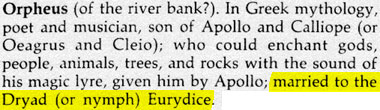
Pronouncing Dictionary of Proper Names, 1993, p. 601, “Orphic”:
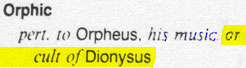
Webster’s New World Dictionary of the American Language, College Edition, 1964, p. 1035, “Orphic”:

Webster’s New World Dictionary of American English, Macmillan, 1994, p. 956, “Orphic”:

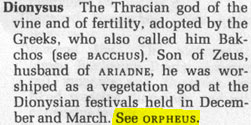
Webster’s Dictionary of Proper Names, 1970, p. 194, “Dionysus”:
http://www.eunet.bg/books/history/thracians.html, Bulgaria - a brief history outline: The Thracians:
Particularly indicative of the rich spiritual make-up of the Thracians, of the freedom-loving spirit of this land-tilling and stock-breeding population, was the multiplicity of religious cults it upheld: they worshipped the Horseman and his female counterpart Bendida; they partook of the Dionysian orgies (mainly the southern Thracians); upheld the Orphic teaching, based on the Dionysian cult, which was born in Thrace but later spread to and further developed in the Greek world. … The name of Orpheus, whose Thracian origin is indisputable and who is believed to have really lived as a singer, preacher and oracle, is related to the transformation of the Dionysian cult to something superior, of higher spiritual value. Enriched through Orphism, the Dionysian cult and the related orgies, supplemented and fecundated Greek thinking and it was from the Dionysian cult that the ancient Hellenic tragedy and comedy developed.
The Lincoln Library of Essential Information, 1970, p. 483, “Religious Conceptions”:

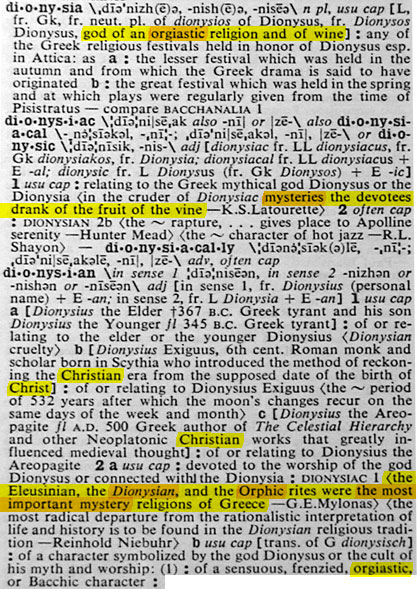
Webster’s Third New International Dictionary of the English Language (Unabridged), 1986, p. 636, “dionysia…”:
P. 1593, “orphic | orphism”:
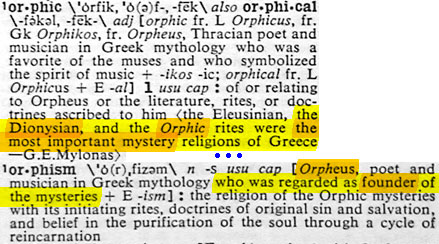
The Making of the Past: The Greek World, Ling, 1988, pp. 141-142, “Glossary”:
Webster’s Dictionary of the English Language Unabridged: Encyclopedic Edition, 1977, p. 1263, “Orphic”:

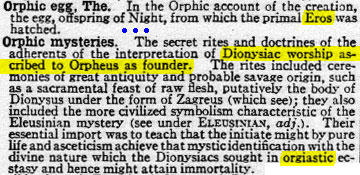
Webster’s New International Dictionary of the English Language, Second Edition, Unabridged, With Reference History, 1940, Vol. II, p. 1723:
Webster’s Third New International Dictionary of the English Language Unabridged, 1966, p. 1593, “Orphic”:
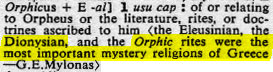
--They removed “orgiastic” in the newer edition.
The American Heritage Dictionary of the English Language, 1969, p. 928, “Orphism”:

The American Heritage Dictionary of the English Language, 1992, p. 1278, “Orphism”:

--They removed “Dionysus” from the definition.
Cliffs Notes on Mythology, 1973, pp. 93-94, “Orpheus”:

An Encyclopedia of Religion; Ferm; Philosophical Library, New York; 1945; p. 311; “Greek religion”:
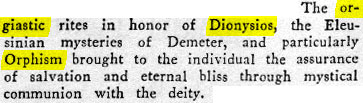
The Facts On File Dictionary of Religion, Hinnells, 1984, p. 223, “Mysteria”:
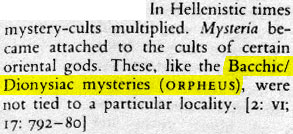
Oxford Latin Dictionary, Glare, 1982, p. 1268, “orgia” (orgies):
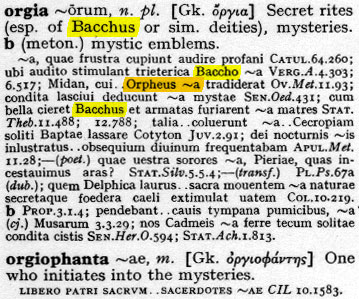
A Greek-English Lexicon (unabridged), Liddell & Scott, Oxford, 1871, p. 1129:

http://www.answers.com/hierophant, “hierophant”:
1. An ancient Greek priest who interpreted sacred mysteries, especially the priest of the Eleusinian mysteries.
2. An interpreter of sacred mysteries or arcane knowledge.
Longmans English Larousse, 1968, p. 822, “orgy”:
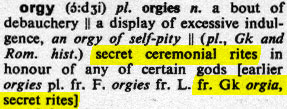
Longmans English Larousse, 1968, p. 823, “Orphic”:
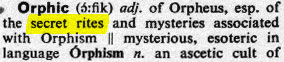
Larousse Illustrated International Encyclopedia and Dictionary, 1972, Part 2: Dictionary, p. 615, “orgy”:
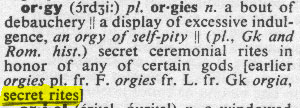
P. 616, “Orphic”:

The American College Dictionary, Random House, 1966, p. 856, “Orphic”:

The Random House Dictionary of the English Language (Unabridged), 1987, p. 1367, “Orphic”:

The Random House Dictionary: Concise Edition (paperback), 1980, p. 621, “Orpheus”:
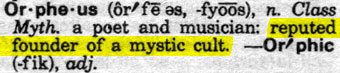
“Mystic”: “Of or relating to religious mysteries or occult rites and practices.”
Crowell’s Handbook of Classical Mythology, Tripp, 1970, p. 436, “Orpheus”:

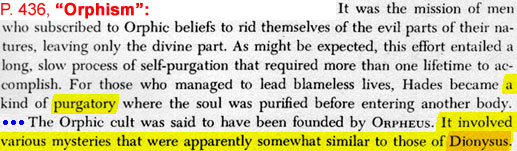
The Praeger Encyclopedia of Ancient Greek Civilization, 1967, p. 328, “Orpheus”:
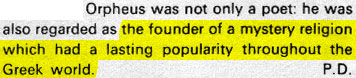
P. 328, “Orphism”:

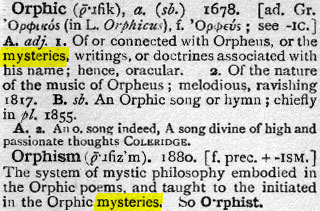
Oxford Universal English Dictionary on Historical Principles, 1937, vol. 6, p. 1387, “Orphic | Orphism”:
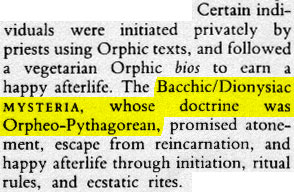
The Penguin Dictionary of Religions, Hinnells / Allen Lane, 1984, p. 242, “Orpheus, Orphism”:
The Columbia Encyclopedia, 1963, p. 1566, “Orphic Mysteries or Orphism”:
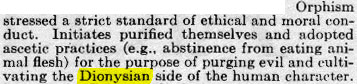
The New Schaff-Herzog Encyclopedia of Religious Knowledge, Jackson, Funk & Wagnalls, 1912, Vol. XII, p. 13, “Tribal and Cultic Mysteries | 2. Dionysiac-Orphic Mysteries”:
Referring to Orpheus:
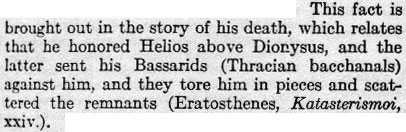
The Concise Columbia Encyclopedia, 1983, p. 630, “Orpheus”:

A Latin Dictionary, Lewis and Short, 1955, p. 1281, “Orphne”:

http://www.deccaclassics.com/newsandnewreleases/september2001/468035.html, Decca Music Group, “Recording Information”:
The Poème de l’extase by Alexander Scriabin was also orphic and "orgiastic" and made its debut in New York on 14 March 1907.
http://www.rotten.com/library/sex/group-sex/orgies/, Orgies:
The original orgies were associated with the Greek cults of Orpheus and Dionysus, who was literally the god of sex, drugs and rock-n-roll (or as they were known then, sex, wine and ritual dance). A fertility icon, Dionysus was attended by mythical creatures known as satyrs and nymphs, who later lent their names to the Freudian complexes that house sex-crazed quacks.
http://www.theage.com.au/articles/2003/05/09/1052280438807.html, Punk maestro:
Jones is making his opera debut with Orpheus in the Underworld, composed by German-born, French composer Jacques Offenbach, first staged in Paris in 1858. Based on the Greek myth of Orpheus, the comic operetta is, you guessed it, a tale of love, death and intrigue, although in this case the love is rather dysfunctional and degenerates into an orgiastic feast. Orpheus is married to Eurydice, but that does not stop him chatting up the odd nymph. Eurydice, meanwhile, is making love to the local shepherd. Ironically, the philandering Orpheus has a jealous streak and lays poisonous snakes to kill Eurydice's lover but accidentally kills her instead.
Connection with Eros (the god of sexual love):
Webster’s New International Dictionary of the English Language, 1923, p. 745, “Eros”:
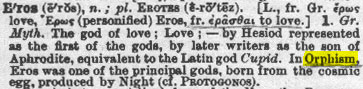
The Encyclopedia of Religion, Eliade, 1987, vol. ?, p. 148, “EROS”:
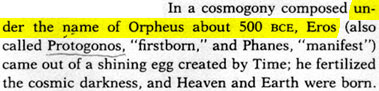
The Encyclopedia of the Classical World, 1965, p. 81, “Eros”:
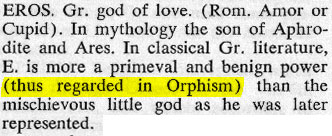
http://www.sacred-texts.com/cla/af/af10.htm, Orphic Fragments, “From Orpheus”:
And Metis (Counsel) the primeval father, and all-delightful Eros (Love).
All these things are United in the vast body of Zeus. …
“From Aristophanes”:
The race of the Immortals was not, till Eros mingled all things together;
But when the elements were mixed one with another, Heaven was produced, and
Ocean,
And Earth, and the imperishable race of all the blessed Gods. …
“Orphic Hymn to Protogonus”:
Come, then, blessed being, full of wisdom and generation,
come in joy
To thy sacred, ever-varying mystery. Be
present with the Priests of thy Orgies.
Images:
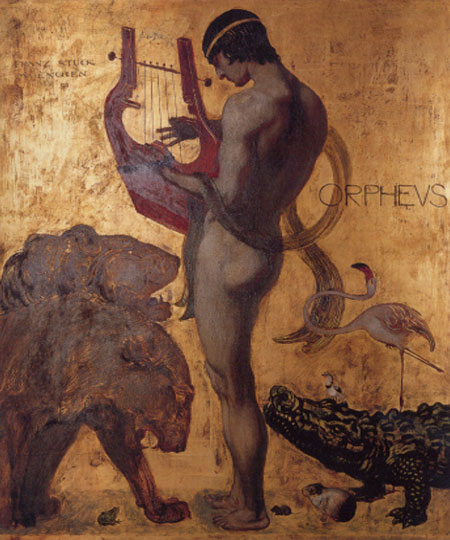
http://moooonriver.spaces.live.com/Blog/cns!F50083AB13224D70!1511.entry, Orpheus:
http://www.ancientsculpturegallery.com/231.html, Ancient Sculpture Gallery, “Orpheus and Muses plaque”:
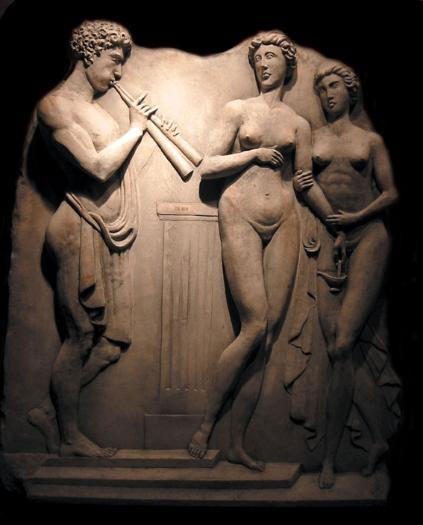
In mythology Orpheus was the chief representative of the arts of song and the lyre. The mythical figure of Orpheus was borrowed by the Greeks from their Thracian neighbours; the Thracian "Orphic Mysteries", rituals of unknown content, were named after him.
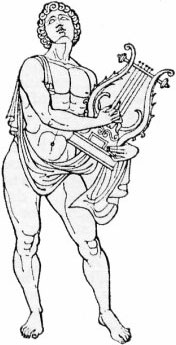
http://www.ancient-bulgaria.com/2006/08/30/orpheus-the-poet-of-rhodope-mountains/ (Discover Ancient Bulgaria), Orpheus The Poet of Rhodope Mountains:
http://www.perseus.tufts.edu/cgi-bin/image?lookup=1992.11.0101, “Main panel: death of Orpheus | Museum of Fine Arts, Boston”:
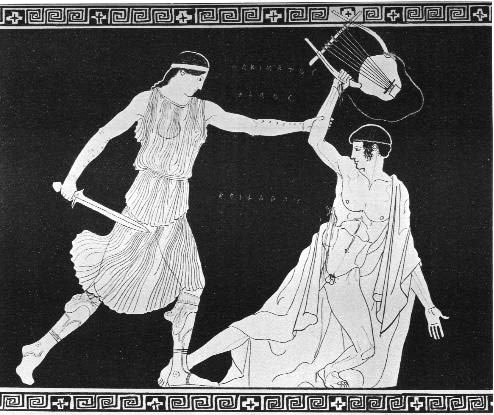
See-through attire on Orpheus:
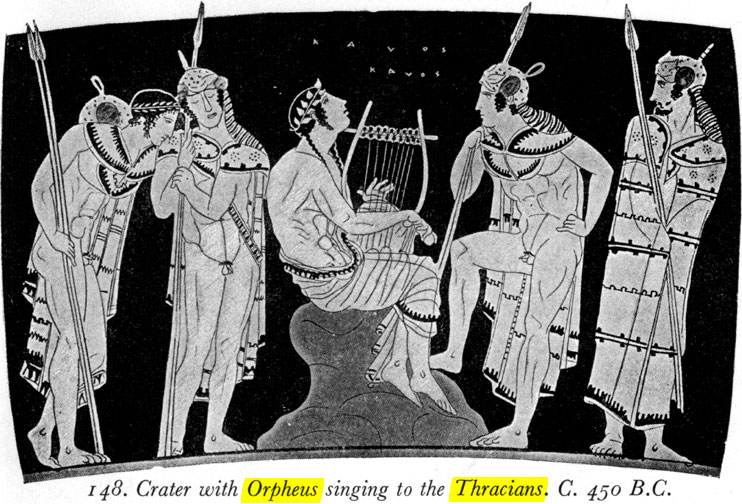
Art and Architecture in Europe, Matějček, 1960, p. 89, illustration 148, “Greek Art | Crater with Orpheus singing to the Thracians. C. 450 B.C.”:
http://www.personal.psu.edu/users/w/x/wxk116/eros/sexart/sex32.html, Erotic Art of Ancient Rome -- The Museum:
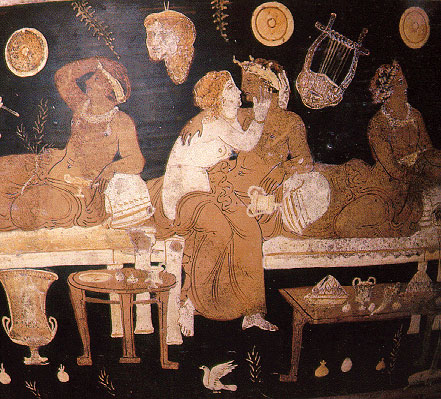
There’s Orpheus’ lyre, and Aphrodite’s dove.
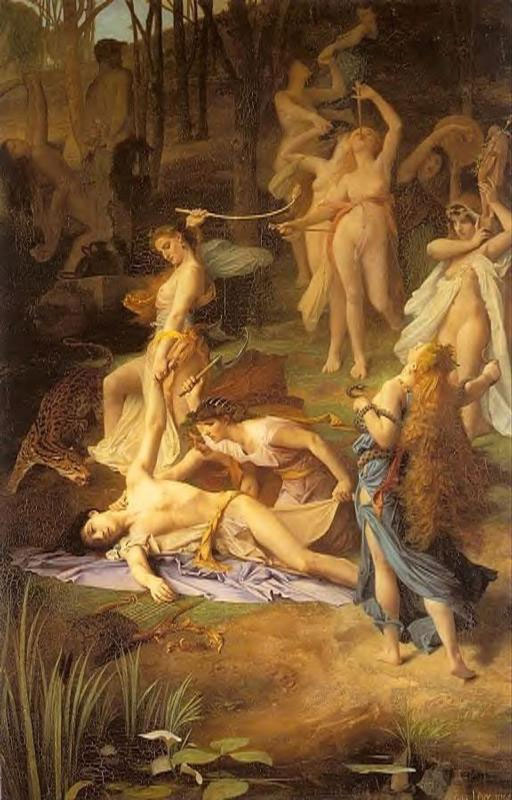
http://community.webshots.com/photo/10920683/10921564gVMFFhbzJl, The Death of Orpheus, by Emile Levy (1826-1980):
http://gallery.euroweb.hu/html/a/abbate/, Orpheus and Eurydice:
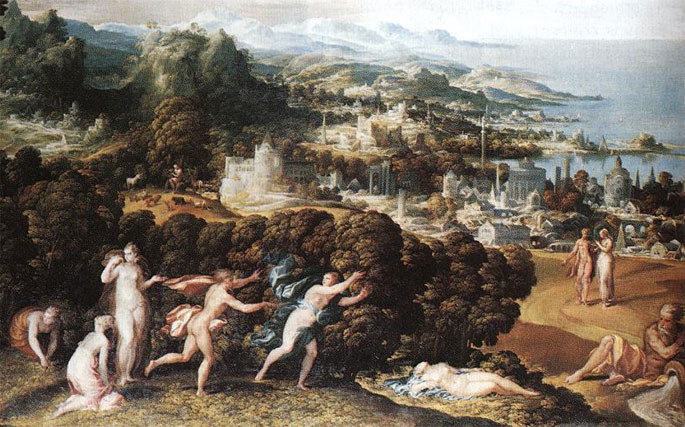
(See-through attire can even be more sexually voluptuous than complete nudity.)
http://www.darvillsrareprints.com/Cipriani.htm, The Death of Orpheus:
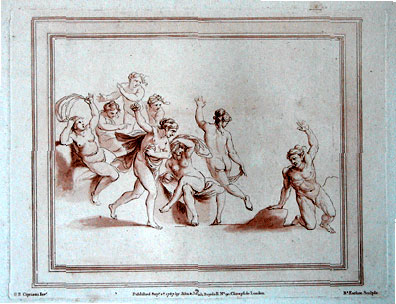
http://creative.gettyimages.com/source/classes/FrameSet.aspx?s=ImagesSearchState|3|5|0|0|15|2|1||0|0|0|1|60|2ed3.d5c5.03fb.e000.002f.76b0.7ce0.e038.770b.000f|1|0|0|orpheus+the+palma||1|0|0&pk=4, Caption: Orpheus:
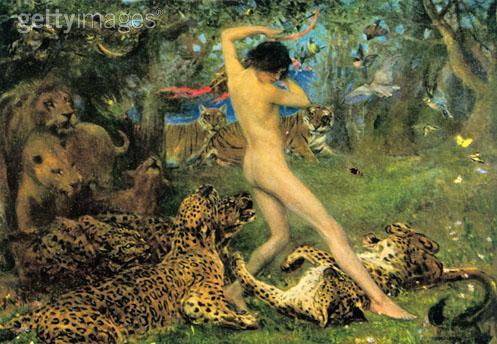
http://creative.gettyimages.com/source/classes/FrameSet.aspx?s=ImagesSearchState|3|5|0|0|15|2|1||0|0|0|1|60|2ed3.d5c5.03fb.e000.002f.76b0.7ce0.e038.770b.000f|1|0|0|rl000858||1|0|0&pk=4, Caption: Orpheus and Eurydice:
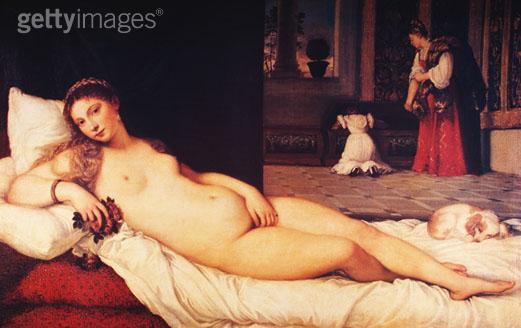
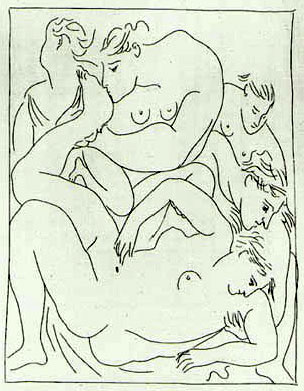
http://www.franklinbowlesgallery.com/SF/Artists/Picasso/Pages/Etchings/Ovid/PICA0801P.htm, Mort d'Orphee, by Pablo Picasso (1881-1973):
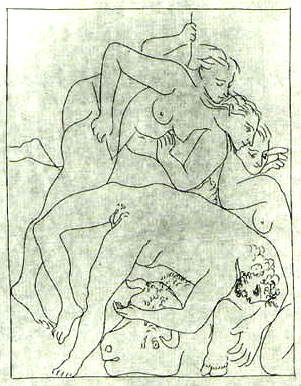
http://www.franklinbowlesgallery.com/SF/Artists/Picasso/Pages/Etchings/Ovid/PICA0799P.htm, Eurydice Piquee par un Serpent, by Pablo Picasso (1881-1973):
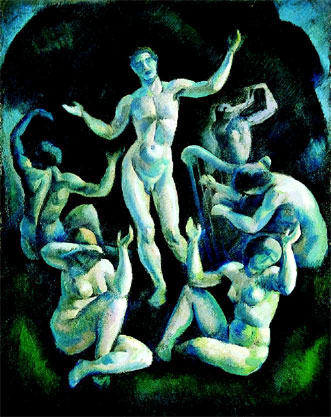
http://www.hung-art.hu/frames.html?/magyar/g/gabor_j/muvek/, “Orpheus 1920”:
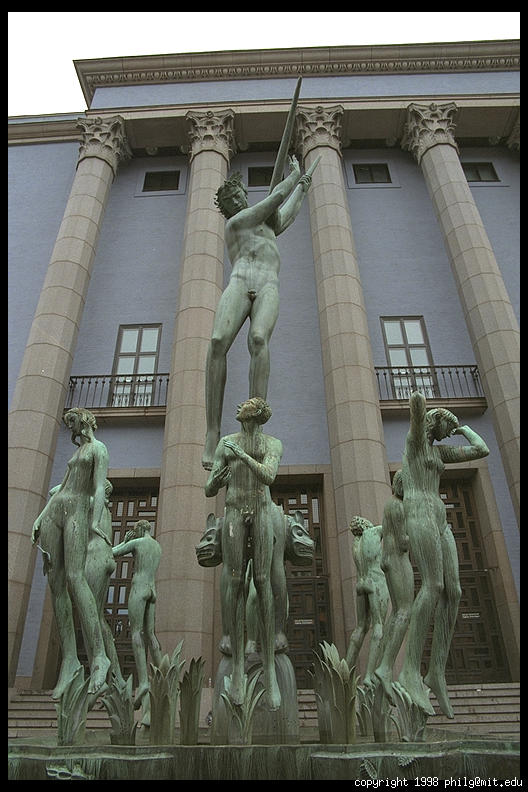
http://photo.net/photo/pcd0511/stockholm-milles-statue-33.tcl (via http://photo.net/photo/pcd0511/index-fpx.html), A statue, Orphaeus by Carl Milles, in central Stockholm:
http://www.stradanove.net/news/images/teatro/o/orpheus.jpg
(There’re more that I didn’t use because of the frontal nudity.)