SMYRNA
The Church in Smyrna (c. 93 AD), Revelation 2:8-11
Revelation 2:8-11, “The Persecuted Church”:
8“And to the angel of the church in Smyrna write, ‘These things says the First
and the Last, who was dead, and came to life: 9“I know your works, tribulation, and poverty (but you are
rich); and I know the blasphemy of those who say they are Jews and are not, but
are a synagogue of Satan. 10Do
not fear any of those things which you are
about to suffer. Indeed, the devil is about to throw some of you into prison,
that you may be tested, and you will have tribulation ten days. Be faithful
until death, and I will give you the crown of life. 11“He who has an ear, let him hear what the Spirit says to
the churches. He who overcomes shall not be hurt by the second death.”’
http://jmm.aaa.net.au/articles/2265.htm (John Mark Ministries), UNDERSTANDING THE BOOK OF REVELATION, “(2) SMYRNA - THE RICH CHURCH (Rev. 2:8-11)”:
The Christians at Smyrna were desperately poor - the Greek word says they were destitute. They'd lost their jobs and their livelihood, many of them, and were forced to borrow or beg to stay alive. There were no social services then! (How would we survive if Sunday after Sunday nothing appeared in the offering plate?).
Secondly they suffered slander - verbal persecution. They, like many other Christians, were accused of cannibalism because they talked of eating the body and drinking the blood of Jesus Christ at Communion. They had `love feasts' - and so were accused of having sexual orgies.
http://www.cogwriter.com/smyrnachurch.htm, The Smyrna Church Era:
Smyrna is the second of the seven churches listed in the Book of Revelation. It was one of only two churches (the Philadelphia Church Era being the other) that received only praise and no correction from Jesus. The Smyrna Church became predominant by about 135 A.D. (the time of the second fall of Jerusalem), though its leadership began to develop a bit prior to this.
…
Smyrna...Christianity was preached to the inhabitants at an early date. As early as the year 93, there existed a Christian community directed by a bishop for whom St. John in the Apocalypse (i, II; ii, 8-11) has only words of praise
http://www.raystedman.org/revelation/4191.html, SMYRNA AND PERGAMUM: THE PRESSURED CHURCH AND THE COMPROMISING CHURCH:
Thirdly, Jesus says, "I know the slander of those who say they are Jews and are not, but are a synagogue of Satan." There was a smear campaign going on against these Christians. Lies were being told about them. We know from early literature that, because the Christians talked about eating and drinking the body and blood of Christ, they were accused of being cannibals. People thought of them with horror as cannibals, eating one another. You can imagine the reaction that brought upon them. Also, because they refused to visit the pagan temples, or to acknowledge the gods of the pagans, they were called atheists. Consequently they were treated with scorn in this world given over to idolatry. Christians talked often about being members one of another and of loving one another, and so they were accused of sexual orgies. Lies were spread about them that when they met together it was to indulge in licentious and lascivious practices. This slander is what produced much of the persecution of the early Christians. It came, we are told here, from false Jews. These were physical descendants of Abraham and they had a synagogue there in Smyrna, but, like the Pharisees who harassed and hounded Jesus, they persecuted these believers, proving they did not have the spiritual insights of Abraham.
http://www.mazzaroth.com/ChapterSix/RevelationTwoSecondAge.htm, Revelation Two - Second Age, “Second Age 100-312 A.D. -- Fourth Persecution -- 109-163 A.D.”:
Saint Polycarp (69?-155? A.D.), a Bishop of Smyrna and a Christian martyr reputed to have been taught by John the Apostle and at the age of eighty-six was killed in Smyrna.
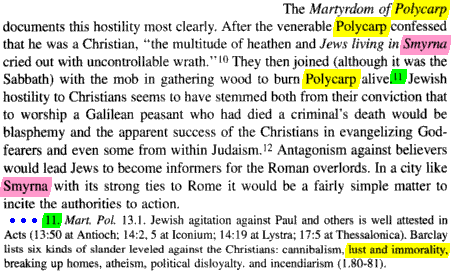
http://books.google.com/books?hl=en&id=06VR1JzzLNsC&dq=%22the+book+of+revelation%22+%22robert+h+mounce%22&printsec=frontcover&source=web&ots=ukSLr5NlL5&sig=AX1_LBh40EGJLe5FQo2uD4kB5F4#PPA75,M1, The New International Commentary on the New Testament: The Book of Revelation Revisted –Google Books Result, by Robert H. Mounce, 1997, p. 75, “Letters to the Seven Churches (2:1-3:22)”:
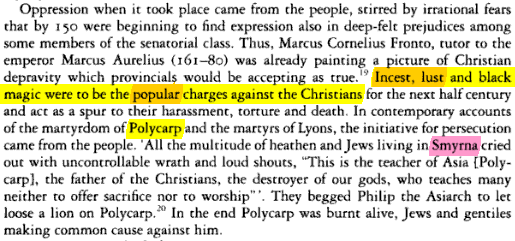
http://books.google.com/books?id=H0ro6OGoZS0C&pg=PA824&lpg=PA824&dq=%22early+christian+world%22+%22senior+provincial+administrators%22&source=web&ots=w5WuKzZTVu&sig=YpT8TzD-gaLTbwMy3LZAtjiG8J0, The Early Christian World –Google Books Result, by Philip Francis Esler, 2000, p. 824, “Martydom and political oppression”:
http://www.earlychristianwritings.com/text/polycarp-lightfoot.html (Early Christian Writings), The Epistle of Polycarp (direct pupil of the apostle John, 70-155 AD):
Polycarp 1:1I rejoiced with you greatly in our Lord Jesus Christ, for that ye
received the followers of the true Love and escorted them on theirway, as befitted you--those men encircled in saintly bonds which are
the diadems of them that be truly chosen of God and our Lord;
Sounds pretty tangible to me.
http://meta-religion.com/World_Religions/Christianity/Church_Fathers/epistle_of_ingatius_to_the_trallians.htm, The Epistle of Ignatius to the Trallians, “Chapter XII.-Continue in Unity and Love”:
I salute you from Smyrna, together with the Churches of God which are with me, who have refreshed me in all things, both in the flesh and in the spirit. My bonds, which I carry about with me for the sake of Jesus Christ (praying that I may attain to God), exhort you. Continue in harmony among yourselves
http://eis.net.au/~paulh/rn5_7lsm.htm, II - SMYRNA : Revelation 2:8-11; Isaiah 44:1-8:
3. I know the slander you endure
In the catacombs outside Rome to this day there is a drawing of the Cross
beneath which a Christian is shown bowing; but the figure on the Cross, like
Bottom in Midsummer Night's Dream, has the head of a long-eared, grinning ass.
And underneath, the inscription reads: "Alex worships his god."
Because in those days the unbaptised withdrew from the worship service before the Lord's Supper was eaten so that the Communion Service was private, and because the Supper was known to refer to the shedding of blood, Christians were charged with indulging licentious and cruel orgies in which human sacrifice took place. We have simply no idea how Christians were reviled in those times.
http://www.greenviewchurch.co.uk/resources/JT%20Docs/Sermons/Rev%202%20Smyrna.pdf, Smyrna: Rev 2:8-11:
What seems to have happened at Smyrna is that Jews who should have perhaps been sympathetic to the Christian dilemma instead took great delight in reporting Christians to the authorities accusing them of all kinds of illicit activities. Perhaps accusing them of being subversive to Rome. Saying as they did in Acts that the Christians were - acting against the decrees of Caesar saying there is another king Jesus. Certainly we know Christians were often accused of immorality and cannibalism. Their love feasts were construed to be orgies, their Christian Communion an ‘eating of human flesh’. Their reference to each other as brothers and sisters brought the charge of incest.
http://www.theologian.org.uk/churchhistory/persecution.html (The Theologian: The Internet journal for integrated theology), Church History: Why were the Early Christians Persecuted?:
The charges of atheism and immorality help explain the hatred of the mob for Christians, evidenced in the pogroms in places such as Smyrna and Lyons.
http://www.thelivingwordtbc.com/rev7.htm, The Church at Smyrna: Revelation 2:8-11, “A. The Fierce Persecution Of The Church”:
This was a Church that was under attack. They were daily persecuted. … Because the Christians had a meal called the “Love Feast,” it was said that their gatherings were orgies of lust.
http://www.cogwriter.com/smyrnachurch.htm, The Smyrna Church Era:
Smyrna is the second of the seven churches listed in the Book of Revelation. It was one of only two churches (the Philadelphia Church Era being the other) that received only praise and no correction from Jesus. The Smyrna Church became predominant by about 135 A.D. (the time of the second fall of Jerusalem), though its leadership began to develop a bit prior to this.
The Apostle John was the last of the original apostles to die, and his successor is acknowledged to have been Polycarp of Smyrna.
“They Kept the Holy Days”:
Much of what we know about those in the Smyrna Church era was written by those who were opposed to them. And we know that the other Holy Days were kept by them, because this was specifically preached against during the time of Smyrna's predominance.
The Roman Catholic saint John Chrysostom preached the following in 387 A.D.:
…
The wicked and unclean fast of the Jews is now at our doors. Thought it is a fast, do not wonder that I have called it unclean...But now that the devil summons your wives to the feast of the Trumpets and they turn a ready ear to this call, you do not restrain them. You let them entangle themselves in accusations of ungodliness, you let them be dragged off into licentious ways. (John Chrysostom. Homily II Against the Jews I:1; III:4. Preached at Antioch, Syria on Sunday, September 5, 387 A.D.).
“Doctrines Held”:
Here are summaries some of the doctrines held during the time of the Smyrna Church:
…
Military Service was not allowed for true early Christians.
“Nazarenes and Paulicians”:
In the latter portion of the third century and even into the fourth century, many Smyrnaeans (especially those with a Jewish heritage) in the Asia Minor area were known as Nazarenes and some were known as Paulicians.
…
The fourth century Catholic historian Epiphanius wrote of this group from the time of 69/70 A.D. until his day, and he starts out with an interesting admission:
All Christians were called Nazarenes once…They were so-called followers of the apostles…they dedicate themselves to the law
…
Hence, here is a historical admission that the original church did keep the Sabbath and that for several centuries were often referred to as Nazarenes. But instead of embracing original Christianity, Epiphanius calls it an early “heresy”.
…
as the Roman Catholic/Eastern Orthodox became less like original Christianity, they also adopted a different (a trinitarian) view of the Godhead. "Nazarene" Christianity completely separated from Roman Catholic/Eastern Orthodox "Christianity" by the end of the third century, with most of the separation occurring in the second century.
…
“Not Only In Asia Minor”:
"The type of Christianity which first was favored, then raised to leadership by Constantine was that of the Roman Papacy. But this was not the type of Christianity that first penetrated Syria, northern Italy, southern France, and Great Britain.
“Early Smyrna Persecutions”:
Those in Smyrna underwent various persecutions.
“Later Smyrna Era Persecutions”:
By the early fourth century, Christianity had almost completely separated from Judaism, the religion of Jesus and his apostles...By early fourth century, non-Jewish Christianity had become a major world religion
“Conclusions”:
The Smyrna Church Era predominant circa 135 A.D. to circa 450 A.D.
http://www.todayscatholicworld.com/homily-ii.htm, Homily II: Against the Jews, by St. John Chrysostom, “III.”
(4) This is why he made you to be head of the wife. This is why Paul gave the order: "If wives wish to learn anything, let them ask their own husbands at home", so that you, like a teacher, a guardian, a patron, might urge her to godliness. Yet when the hour set for the services summons you to the church, you fail to rouse your wife from their sluggish indifference. But now that the devil summons your wives to the feast of the Trumpets and they turn a ready ear to this call, you do not restrain them. You let them entangle themselves in accusations of ungodliness, you let them be dragged off into licentious ways. For, as a rule, it is the harlots, the effeminates, and the whole chorus from the theater who rush to that festival.
(5) And why do I speak of the immorality that goes on there? Are you not afraid that your wife may not come back from there after a demon has possessed her soul? Did you not hear in my previous discourse the argument which clearly proved to us that demons dwell in the very souls of the Jews and in places in which they gather? Tell me, then. How do you Judaizers have the boldness, after dancing with demons, to come back to the assembly of the apostles?
Judaizers where Christians who followed more Jewish practices than the others.
http://www.todayscatholicworld.com/homily-i.htm, Homily I: Against the Jews, by St. John Chrysostom, “VI.”
(8) Wild beasts oftentimes lay down their lives and scorn their own safety to protect their young. No necessity forced the Jews when they slew their own children with their own hands to pay honor to the avenging demons, the foes of our life. What deed of theirs should strike us with greater astonishment? Their ungodliness or their cruelty or their inhumanity? That they sacrificed their children or that they sacrificed them to demons? Because of their licentiousness, did they not show a lust beyond that of irrational animals? Hear what the prophet says of their excesses. "They are become as amorous stallions. Every one neighed after his neighbor's wife".
http://books.google.com/books?id=qBZcWLrNuUIC&pg=PA81&lpg=PA81&dq=%22The+Revelation+of+John%22+By+William+Barclay+%22smyrna%22&source=web&ots=ROWyMPM6mB&sig=8JppVaD6qW3_ELFNXUmNfGZaSW8#PPA89,M1, The New Daily Study Bible: The Revelation of John –Google Books Result, by William Barclay, 2004, pp. 89-90, “Smyrna”: The Cause of the Trouble | Revelation 2:8-11 (contd)”:
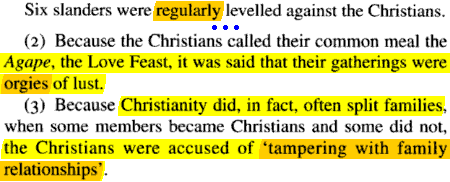
http://www.woodbrook.org/sermons/1998/980927.htm, The Crown of Life (Smyrna): Revelation 2: 8-11, “COMMENDATION TO CHURCH | (1) Slander”:
2. The great emphasis on
love was turned into the slander that the
Christians were given over to lust and
immorality.
3. When a person became a Christian and had to make
hard choices about existing family relationships where paganism held sway, Christians
were vulnerable to the slanderous accusation that they were breaking up homes.
http://ffgreenville.org/notes/books/rev_2007/2007-12-02-Rev-002-008.htm, Revelation 2:8-11:
b. And the blasphemy by those who say they are Jews and are not, but are a synagogue of Satan--
1) The second aspect of the persecution at Smyrna was slander.
…
b) There were at least seven common slanders against Christians:
…
v) Christians were accused of incest because they called each other brother and sister.
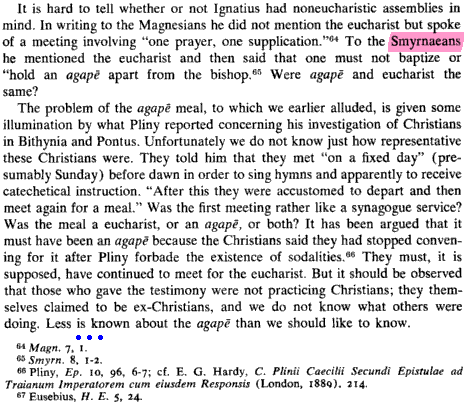
http://books.google.com/books?hl=en&id=d_vxEB7nT_QC&dq=%22augustus+to+constantine%22+%22the+rise+and+triumph+of+christianity+in+the+roman%22&printsec=frontcover&source=web&ots=Bl0zocB15Z&sig=CeJBGr9ACZb3fGmslyQfMvVy26Y#PPT309,M1, Augustus to Constantine: The Rise and Triumph of Christianity in the Roman –Google Books Result, by Robert McQueen Grant, 2004, p. 295, “Christian Worship | II-Eucharist”:
http://www.mabenterprises.com/gaychristians/religious_text/thebible_b.htm, An Investigation into the Bible and Homosexuality, "Malokoi and Arsenokoitai":
The cultural environment of the Greek world of the 1st Century, as far as homosexual behavior was concerned dealt with two major areas. First, there was the refined temple prostitution activity. Only now, it had taken on a significant self-mutilation aspect that made it particular detestable. In the course of ritual worship, temple prostitutes, male and female, would have sexual intercourse with worshipers during drunken orgiastic excesses, often including self-emasculation. The Temple of Diana (Artemis) at Ephesus was notorious for such practices, and Paul, first as a Pharisee of the Pharisees and then as the Apostle of the Lord Jesus Christ to the gentile world, would have been utterly appalled at such spectacles.
http://meta-religion.com/World_Religions/Christianity/Other_Books/New_Testament_Apocrypha/acts_of_john.htm, The Acts of John: The Apocryphal New Testament, “37”:
37 (continued.) Now the brethren from Miletus said unto John: We have continued a long time at Ephesus; if it seem good to thee, let us go also to Smyrna; for we hear already that the mighty works of God have reached it also. And Andronicus said to them: Whensoever the teacher willeth, then let us go. But John said: Let us first go unto the temple of Artemis, for perchance there also, if we show ourselves, the servants of the Lord will be found.
John’s not praising the pagan temple, but is saying the ones who worship Artemis likely will worship God.
http://userwww.service.emory.edu/~arashid/niel.html, Christianity - Persecution of the Early Church in the Roman Empire:
Christians were persecuted from around 64 AD to around 313 AD that began with Nero and ended with the Council of Nicea under Constantine. In the Roman Empire, religion was considered to be intertwined with the government. So this faction of Christianity was opposed to sustain social and political order. By being pious to the Empire, citizens show their loyalty to the empire, which in turn keeps the empire unified. Christianity was also not even considered a religion but a “superstition” by the Romans. The practices of Christianity were also misunderstood and some believed that Christians were committing immoral acts such as incest and cannibalism. There is believed to be ten major persecutions which are often compared to the ten plagues in Egypt. These ten were under Nero, Domitian, Trajan, Marcus Aurelius, Septimius Severus, Maximinus, Decius, Valerian, and Diocletian which spanned almost 250 years until they were free from persecution with the deterioration of the Roman Empire.
…
After Nero died, Christians went through a period where there was little persecution. However this changed when the tyrant, Domitian (Roman emperor, 81-96 AD) came to power. He liked Nero killed many Christians as he thought Christianity was blasphemous and immoral.
http://www.british-israel.ca/Church%20of%20God3.htm, Struggle for Truth, “John and Domitian”:
Without a doubt, Domitian had heard of John (Jesus’ Disciple). Perhaps his greatest concern was the Christian doctrine that Jesus would become king. The Roman emperor could not tolerate another king, so Domitian brought John to Rome.